17
win and sin: Predicate
Transformers for Currency
Leslie Lamport
Systems Research Center
DEC’s business and technology objectives require a strong research program. The Systems Research Center (SRC) and three other research laboratories are committed to filling that need.
SRC began recruiting its first research scientists in l984—their charter, to advance
the state of knowledge in all aspects of computer systems research. Our current
work includes exploring high-performance personal computing, distributed computing, programming environments, system modelling techniques, specification technology, and tightly-coupled multiprocessors.
Our approach to both hardware and software research is to create and use real systems so that we can investigate their properties fully. Complex systems cannot be evaluated solely in the abstract. Based on this belief, our strategy is to demonstrate the technical and practical feasibility of our ideas by building prototypes and using them as daily tools. The experience we gain is useful in the short term in enabling us to refine our designs, and invaluable in the long term in helping us to advance the state of knowledge about those systems. Most of the major advances in information systems have come through this strategy, including time-sharing, the ArpaNet, and distributed personal computing.
SRC also performs work of a more mathematical flavor which complements our systems research. Some of this work is in established fields of theoretical computer science, such as the analysis of algorithms, computational geometry, and logics of programming. The rest of this work explores new ground motivated by problems that arise in our systems research.
DEC has a strong commitment to communicating the results and experience gained through pursuing these activities. The Company values the improved understanding that comes with exposing and testing our ideas within the research community. SRC will therefore report results in conferences, in professional journals, and in our research report series. We will seek users for our prototype systems among those with whom we have common research interests, and we will encourage collaboration with university researchers.
win and sin:
Predicate Transformers for Concurrency
Leslie Lamport
1 May 1987
c
Digital Equipment Corporation 1988
Author’s Abstract
The weakest liberal precondition and strongest postcondition predicate transformers are generalized to the weakest invariant and strongest invariant. These new predicate transformers are useful for reasoning about concurrent programs containing operations in which the grain of atomicity is unspecified. They can also be used to replace behavioral arguments with more rigorous assertional ones.
Capsule Review
It is widely recognized that reasoning, either formally or informally, about concurrent programs is harder than reasoning about ordinary sequential programs. At any point in the execution of any thread of control it is potentially possible for shared variables to be written by another thread, invalidating conditions that have just been established by the first thread.
The standard approach to verifying concurrent programs is to divide the execution of each thread into a series of atomic actions, and to show that all possible interleavings of the atomic actions of the various threads are guaranteed to produce correct results. This report introduces a new method for verifying concurrent programs without specifying the grain of atomicity of operations. It requires instead only that certain invariants of
the operations be known. For example, a statement like a :DbCc typically consists
of several atomic actions (particularly if a, b, and c are long integers and cannot be read or written atomically by the hardware), but it may be assumed that execution of the entire statement or any part of it leaves invariant the value of any variable d distinct from a, b, and c.
From a theoretical standpoint, the verification method introduced in this report is interesting in that it makes it possible to verify concurrent programs without precisely specifying the decomposition of statements into atomic operations. From a practical standpoint, this means that programs can be analyzed at a coarser grain than that of atomic operations.
The tools developed here are by no means a panacea. Verification of concurrent
algorithms is still a tricky business, requiring careful attention to detail, as study of the examples in the text will indicate. However, by allowing the analysis to be done at a coarser grain, these tools can reduce the number of steps (and consequently the temptation to skip some steps) needed for verification, making the process somewhat less arduous (and error-prone) than it has been in the past.
Contents
1 Introduction 1
2 Assertional Reasoning 2
2.1 States and Predicates : : : : : : : : : : : : : : : : : : : : : : : : : : 3
States : : : : : : : : : : : : : : : : : : : : : : : : : : : : : : : 3
Definition of sx1
v1
ÐÐÐ ÐÐÐ
xm
vm : : : : : : : : : : : : : : : : : : : : : : : : 4
State Functions and Predicates : : : : : : : : : : : : : : : : : : 4
State Function Not Accessing a Set of Variables : : : : : : : : : 4
2.2 Actions and Atomic Operations : : : : : : : : : : : : : : : : : : : : 5
Actions : : : : : : : : : : : : : : : : : : : : : : : : : : : : : : 5
Action Modifying or Not Accessing Variables : : : : : : : : : : 5
Atomic Operations : : : : : : : : : : : : : : : : : : : : : : : : 6
2.3 The Hoare Logic of Actions : : : : : : : : : : : : : : : : : : : : : : 6
Definition of Hoare Triples : : : : : : : : : : : : : : : : : : : : 6
Proving Hoare Triples: : : : : : : : : : : : : : : : : : : : : : : 7
Action Leaving a Predicate Invariant or Unchanged : : : : : : : 7
Properties of Invariance: : : : : : : : : : : : : : : : : : : : : : 7
2.4 Properties of a Program : : : : : : : : : : : : : : : : : : : : : : : : 8
Executions : : : : : : : : : : : : : : : : : : : : : : : : : : : : 8
Properties : : : : : : : : : : : : : : : : : : : : : : : : : : : : : 8
Program Invariants : : : : : : : : : : : : : : : : : : : : : : : : 9
2.5 Simple cobegin Programs : : : : : : : : : : : : : : : : : : : : : : : 9
The Programs and Their Control Predicates: : : : : : : : : : : : 9
Atomic Operations Belonging to Different Processes : : : : : : : 9
Predecessors : : : : : : : : : : : : : : : : : : : : : : : : : : : 9
2.6 The Owicki-Gries Method : : : : : : : : : : : : : : : : : : : : : : : 10
Decomposing the Invariant : : : : : : : : : : : : : : : : : : : : 10
The Owicki-Gries Conditions: : : : : : : : : : : : : : : : : : : 11
3 The Weakest and Strongest Invariants 11
The Composition of Actions : : : : : : : : : : : : : : : : : : : 11
Commutativity of Actions : : : : : : : : : : : : : : : : : : : : 11
3.2 The Weakest Liberal Precondition : : : : : : : : : : : : : : : : : : : 12
3.3 The Strongest Postcondition : : : : : : : : : : : : : : : : : : : : : : 13
3.4 Nonatomic Operations : : : : : : : : : : : : : : : : : : : : : : : : : 13
Operations and Their Control Predicates : : : : : : : : : : : : : 13
The Actionh¦i : : : : : : : : : : : : : : : : : : : : : : : : : : 14
Hoare Triples, wlp, and sp for Operations: : : : : : : : : : : : : 14
Some Definitions for Sets of Actions : : : : : : : : : : : : : : : 14
Properties of Operations : : : : : : : : : : : : : : : : : : : : : 14
3.5 The Weakest Invariant : : : : : : : : : : : : : : : : : : : : : : : : : 15
Definition of win : : : : : : : : : : : : : : : : : : : : : : : : : 15
Expressing win in Terms of wlp: : : : : : : : : : : : : : : : : : 15
Properties of win : : : : : : : : : : : : : : : : : : : : : : : : : 16
The Predicate Transformer winp : : : : : : : : : : : : : : : : : 16
3.6 The Strongest Invariant : : : : : : : : : : : : : : : : : : : : : : : : 17
3.7 Simple cobegin Programs with Unspecified Atomicity : : : : : : : : 18
The Programs and Their Control Predicates: : : : : : : : : : : : 18
Operations Belonging to Different Processes : : : : : : : : : : : 19
Predecessors : : : : : : : : : : : : : : : : : : : : : : : : : : : 19
The Semantics of Nonatomic Operations : : : : : : : : : : : : : 19
3.8 The Owicki-Gries Method with Unspecified Atomicity : : : : : : : : 20
Decomposing the Invariant : : : : : : : : : : : : : : : : : : : : 20
The Owicki-Gries Conditions: : : : : : : : : : : : : : : : : : : 21
4 Applications 21
4.1 The Single-Access Rule : : : : : : : : : : : : : : : : : : : : : : : : 21
Proof of Sequential Correctness—(a) : : : : : : : : : : : : : : : 23
Proof of Sequential Correctness—(b) : : : : : : : : : : : : : : : 23
Proof of Interference Freedom : : : : : : : : : : : : : : : : : : 23
4.2 The Bakery Algorithm : : : : : : : : : : : : : : : : : : : : : : : : : 24
Proof of Sequential Correctness—(a) : : : : : : : : : : : : : : : 26
Proof of Sequential Correctness—(b) : : : : : : : : : : : : : : : 27
Proof of Interference Freedom : : : : : : : : : : : : : : : : : : 28
4.2.2 Correcting the Proof : : : : : : : : : : : : : : : : : : : : : : 34
4.3 Another Example : : : : : : : : : : : : : : : : : : : : : : : : : : : 36
5 Discussion 39
Acknowledgments 40
References 41
List of Figures
1 A simplified version of the bakery algorithm. : : : : : : : : : : : : : 3
2 An annotation of the simplified bakery algorithm. : : : : : : : : : : : 10
3 The bakery algorithm. : : : : : : : : : : : : : : : : : : : : : : : : : 18
4 Annotation of a program obtained with the single-action rule. : : : : : 22
1
Introduction
Partial correctness is a relation between the program states before and after execution of an entire program. For reasoning about concurrent programs, the appropriate gener-alization of partial correctness is invariance, which is a relation between the program states before and after the execution of each atomic operation of a program. The
ap-propriate generalization of the Hoare triplefPgSfQgis the assertion that S leaves a
predicate I invariant [13]. Because the invariant I describes the program state during execution, it must depend upon the control state as well as on the values of ordinary program variables.
The predicate transformers wlp (the weakest liberal precondition) and sp (the strongest postcondition) for proving partial correctness properties of sequential programs were developed in the early 1970’s by de Bakker and others [3, 4] and popularized by Dijkstra [5]. Here, we generalize them to the predicate transformers win (the weakest invariant) and sin (the strongest invariant) for proving safety properties of concurrent programs. Some of the ideas presented here originally appeared in [12], but with a different notation.
The wlp and sp operators are useful because they allow one to encode partial correctness information in a predicate. A predicate containing the wlp or sp operator can be used in a program annotation to prove a partial correctness property. While it is well known that the ability to express such predicates is necessary for a logic of Hoare triples to be complete [1], the practical utility of these predicates in proving partial correctness properties is not widely appreciated.
In an analogous fashion, the predicate transformers win and sin are useful for proving invariance properties of concurrent programs because predicates they can appear in an invariant. We have discovered two applications of these predicate transformers: reasoning about programs that are not decomposed into their atomic operations, and transforming certain behavioral reasoning into more rigorous assertional reasoning.
presented here.
Our final example illustrates a different use of the predicate transformers. Assertional reasoning, based upon invariance, has proved to be more reliable than behavioral reasoning, which argues directly about the sequence of operations executed by the program. However, there have been examples in which a purely assertional proof was more complicated than a hybrid proof—one using a behavioral argument to show that the given algorithm is equivalent to a simpler one whose correctness is proved assertionally. It appears that the win and sin operators can be used in these examples to replace the hybrid proof with a simple, assertional one. This is illustrated by a distributed algorithm abstracted from part of a well-known algorithm for computing a minimum spanning tree [6].
This paper is primarily concerned with applications of win and sin rather than with their formal properties. The treatment of the formalism is brief, and no attempt is made to develop a complete proof system. We hope to present completeness results in a future paper.
Our approach is semantic rather than syntactic, meaning that we deal not with pieces of program text but with the mathematical objects represented by those pieces of text. For
example, we view the expression x >0 as a boolean-valued function on the program
state (a function that depends only on the value of the variable x) rather than as a string of characters generated by some grammar. By eschewing syntax, we hope to focus attention on the underlying concepts.
The definitions and properties of the predicate transformers win and sin are independent of a programming language. They can be applied to concurrent programs written in any imperative language, regardless of whether processes communicate through shared memory, synchronous or asynchronous message passing, or remote procedure
call. However, our major examples involve a generalization of the Owicki-Gries
method [10, 14], and we describe this method only for programs that can be written in a very simple language.
2
Assertional Reasoning
We begin with a review of the traditional approach to concurrent program verification that will serve to introduce some notation and describe our view of concurrent programs. We take as an example the program of Figure 1. In this program, the body of the outer cobegin is executed concurrently as n separate processes, each with a different value
substituted for i, and the body of the inner cobegin similarly “forks” n 1 subprocesses.
(Here and throughout this paper, the range of values of the variables i and j is assumed
to be the setf1; : : : ;ng. To avoid having to define the meaning of an empty cobegin
statement, we assume that n >1 for this program and its variants that appear later.)
var num: array 1: : :n of nonnegative integer; cobegin iD1:::n
loop ncsi: hnoncritical sectioni;
þi: hnum[i] := 1Cmaxfnum[ j ] : j 6Digi;
Ži: cobegin j6Di
i j: hawait i −ji
coend;
csi: hcritical sectioni;
²i: hnum[i] := 0i
[image:12.612.199.415.142.270.2]endloop coend
Figure 1: A simplified version of the bakery algorithm.
i − j is defined to equal
.num[ j ]D0/_ .num[i]<num[ j ]/_.num[i]Dnum[ j ]^ i< j/ (1)
Since we are concerned only with safety properties [10], it does not matter what fairness assumptions are made about when an operation must be executed. Thus, the inner cobegin could be implemented by a for loop, with the subprocesses executed one after the other.
This program is a simplified version of the bakery algorithm—a mutual exclusion algorithm described in [9]. The critical and noncritical sections are represented by atomic operations, which are assumed not to modify the variables num[i], and the
original bakery algorithm is trivialized by making the operationsþi andi j atomic.
2.1
States and Predicates
In our semantic approach, a program consists of a set S of states and a set5of atomic
operations.1 Here, we describe the set of states; atomic operations are defined in
Section 2.2.
States
A state of a program is a mapping from the set of program variables to some set of values—in other words, a state consists of an assignment of values to the program’s variables. In addition to ordinary program variables, we also introduce control variables that describe the control state of the program.
For simple cobegin programs, such as the simplified bakery algorithm of Figure 1,
the control variables consist of variables at(¾), for every atomic operation¾ in 5.
1If we were considering liveness properties as well as safety properties, a program would also have to
The variable at(¾) is a boolean-valued variable whose value is true iff (if and only if)
control is at operation¾. For the simplified bakery algorithm, the variables are num[i],
at(ncsi), at(þi), at(i j), at(csi), and at(²i), for all i;j D1; : : : ;n with i 6D j . A state
of this program is an assignment of nonnegative integers to the variables num[i] and booleans to the at variables.
We restrict the set S of states to allow only valid assignments of values to the control variables. For simple cobegin programs, we require that the values of the at variables do not declare control to be at two places in the same process—except where a nested cobegin splits the process into subprocesses. For example, in the simplified bakery
algorithm, at(i j) and at(csi) are not both assigned the value true in any state.
The set S of program states may include ones we don’t expect to occur during an
execution. For example, the simplified bakery algorithm contains states with at(i j)
true and num[i]D0, even thoughþi sets num[i] to a nonzero value. Similarly, there
are states in which at(cs1) and at(cs2) both have the value true, even though this is
a correct mutual exclusion algorithm, and control will never be simultaneously at the critical sections of two different processes while executing the program.
Definition of sx1 v1
ÐÐÐ ÐÐÐ
xm
vm
Let x1,: : :, xmbe distinct variables, and letv1,: : :,vmbe values. For any state s, we
define sx1
v1
ÐÐÐ
ÐÐÐvxmm to be the assignment of values to variables that is the same as s except
that each xp is assigned the valuevp. Note that svx11ÐÐÐÐÐÐxvmm need not be a state if one or
more of the xi are control variables.
State Functions and Predicates
A state function is a function whose domain is the set of states, and a predicate is a
boolean-valued state function. If P is a predicate, we write sjD P instead of P.s/and
definejDP to equal8s2 S: sjD P. Thus,jDP asserts that P is true for all program
states.
A variable is a state function whose value on a state is the value of the variable in that state. In particular, a boolean-valued variable is a predicate.
State Function Not Accessing a Set of Variables
We say that a state function f does not access a set fx1, : : :, xmg of variables iff
f.s/D f.sx1
v1
ÐÐÐ
ÐÐÐvxmm/for every state s and all valuesv1,: : :,vmsuch that s
x1 v1
ÐÐÐ
ÐÐÐxvmm is a state.
Intuitively, f does not access a set of variables iff the value of f can be computed
without knowing the values of those variables.2
2One might expect that a state function does not access a setfx
1; : : : ;xmgof variables iff it does not
access each singleton setfxig. However, this is not true. For example, in the simplified bakery algorithm,
taking any state and changing the value of either at(csi) or at(²i) by itself cannot yield a valid control state.
Hence, every state function does not access the setfat(csi)gand does not access the setfat(²i)g. However,
A control predicate is a predicate that does not access the set of all variables other than control variables.
2.2
Actions and Atomic Operations
Actions
An action is a relation on the set of states—that is, a set of pairs of states. The possible
executions of an atomic operation are represented by an action ¾, where.s;t/ 2 ¾
means that executing the atomic operation starting in state s can produce state t .
An action¾is deterministic iff for each state s there is at most one t such that.s;t/2¾.
Any deterministic action can be written in the following form, where the xpare distinct
program variables, b is a predicate, and the epare state functions:
b 0 B @ x1 ::: xm 1 C A:D
0 B @ e1 ::: em 1 C A (2)
This describes the set of all pairs.s;sx1
e1.s/
ÐÐÐ ÐÐÐ
xm
em.s//such that sjDb equals true. In other
words, it is an action that can be executed only if b is true, and it has the effect of first
evaluating the expressions ep and then setting the xp, all in one step. Although we
do not assume that actions are deterministic, we will not discuss the representation of nondeterministic actions.
For the simplified bakery algorithm of Figure 1, statementþidescribes the action
at(þi)
0 @num[i]at(þi)
at(i j)
1 A:D
0 @1
Cmaxfnum[ j ] : j 6Dig
f alse
t rue; f or all j 6Di
1 A
and statementi j describes the action
at(i j) ^i − j
at(i j)
at(csi)
:D
f alse
V
k6Di;j:at(ik)
Action Modifying or Not Accessing Variables
We say that an action¾modifies a variable x iff there exists a pair.s;t/in¾such that x
has different values in states s and t . We say that¾ does not access the setfx1,: : :, xmg
of variables iff¾does not modify any of the xpand for any.s;t/2¾and any valuesv1,
: : :,vm, if svx11ÐÐÐÐÐÐ
xm
vm is a state then.s
x1 v1
ÐÐÐ ÐÐÐ
xm
vm;t
x1 v1
ÐÐÐ ÐÐÐ
xm
vm/2¾. Intuitively, x does not access a
set of variables iff¾ can be executed without reading or writing any of those variables.
The action (2) does not modify any variables other than the xp; it does not access any
set of variables that does not contain the xp and is not accessed by any of the ep. In
the simplified bakery algorithm, the action described byþ2modifies only the variables
num[2], at(þ2), and at(2 j) for all j6D2; it does not access the setfat(þ1);at(12)g(as
well as many other sets of variables).
Atomic Operations
An atomic operation¾of a program consists of an action together with control predicates
at(¾) and after(¾). Intuitively, at(¾) asserts that control is at a point where¾ can be
executed, and after(¾) asserts that control is at a point that can be reached by executing
¾. In the simplified bakery algorithm,
after(ncsi) at(þi)
after(þi)
^
j6Di
at(i j)
after(i j) at(csi)_ :at(i j)^
_
k6Di;j
at(ik)
!
after(²i) at(ncsi)
The at predicates are program variables and are not defined in terms of anything else.
We will identify an atomic operation with its action. Thus, if¾is an atomic operation,
.s;t/2¾ means that the pair of states.s;t/is an element of the action of¾. Similarly,
we say that an atomic operation does not modify a variable iff its action does not modify the variable.
Our informal statement, that at(¾) holds iff control is at¾and after(¾) holds iff control is
immediately after¾, is formalized as the following assumption about atomic operations.
CTL1. For any atomic operation ¾: if .s;t/ 2 ¾ then s jD at(¾) and
t jDafter(¾).
For simple cobegin programs like the simplified bakery algorithm, there is a variable
at(¾) for each atomic operation¾in the set5of the program’s atomic operations. For
programs written in a different language, the at predicates might be defined in terms of other control variables.
2.3
The Hoare Logic of Actions
Definition of Hoare Triples
Let¾ be an action and let P and Q be predicates. We define the Hoare triplefPg¾fQg
to mean 8.s;t/ 2 ¾:.s jD P/ ) .t jD Q/. In other words,fPg¾fQgasserts that
state t . While this definition is superficially the same as the usual one for ordinary
Hoare triples, it is different in two respects: (i)¾is an action (a set of pairs of states),
not a program statement, and (ii) the state includes control variables, not just ordinary program variables.
Proving Hoare Triples
The language-independent rules for reasoning about ordinary Hoare triples [8] apply to our Hoare triples as well. Because our states include control variables, we do not need a separate axiom or proof rule for every language construct. Instead, we can use the simple
rule that, if¾ is the action (2), thenfPg¾fQgis equivalent tojD.P^b/) Qx1
e1
ÐÐÐ ÐÐÐ
xm
em,
where Qx1
e1
ÐÐÐ ÐÐÐ
xm
em is the predicate defined by letting s jD Q
x1
e1
ÐÐÐ ÐÐÐ
xm
em equal s
x1
e1.s/
ÐÐÐ ÐÐÐ
xm
em.s/jD Q,
for any state s.3 This rule follows from the definitions offPg¾fQgand of action (2).
As an example, the reader can derivef.num[i]>0/_ :at(i j)gi jfi− jgfrom this
rule and the definition of i − j .
Action Leaving a Predicate Invariant or Unchanged
We say that a predicate P is an invariant of an action¾, or that¾ leaves P invariant,
ifffPg¾fPgholds. In other words, P is an invariant of¾iff any execution of¾ from a
state in which P is true yields a state in which P is true.
We say that¾ leaves P unchanged iff it leaves both P and:P invariant, which is true
iff.sjD P/.t jDP/for all.s;t/2¾.
Properties of Invariance
We now list some simple properties that are useful for reasoning about invariance,
where¾ is an arbitrary atomic operation and P and the Phare predicates.
AC1. If P does not access the set of variables modified by¾, then¾leaves P unchanged.
AC2. If¾ leaves each Ph invariant, then it leaves
V
h Phand
W
h Phinvariant.
AC3. IfjDP ) :at(¾) then¾ leaves P invariant.
AC4. ¾leaves P invariant iff it leaves.at(¾)_after(¾)/^P invariant.
Properties AC1 and AC2 follow from the definitions of what it means for an action to leave a predicate invariant or unchanged. Properties AC3 and AC4 follow from the definition of invariance and assumption CTL1.
Remember that an atomic operation¾ consists of an action together with the control
predicates at(¾) and after(¾). Properties of atomic operations that do not mention
control predicates, such as properties AC1 and AC2, hold for any action.
3In a syntactic approach, one would define Qx1 e1
ÐÐÐ ÐÐÐ
xm
em when Q and the epare formulas rather than state
functions. Given formulas for Q and the ep, the formula for Qxe11ÐÐÐÐÐÐ
xm
em is obtained by simultaneously
2.4
Properties of a Program
Executions
An execution of the program consists of a finite or infinite sequence s0;s1; : : :of states
such that each pair.sm;smC1/is in some action of5.4 In other words, an execution
is any sequence of states obtained by starting in an arbitrary state and executing pro-gram actions. Properties of the propro-gram are expressed as assertions about the set of executions.
We do not assume any particular starting state for the execution, so the simplified bakery algorithm has executions beginning in a state with all processes at their critical sections. In our formalism, the usual assumption that the program starts in a proper initial state appears as a hypothesis in the property to be proved.
We can consider two programs to be equivalent if they have the same set of executions.
A pair of states is in an action of5iff it is in the union of all the actions of5. (Since
actions are sets of pairs, the union of actions is just ordinary set union.) The set of executions of a program depends only on the set S of states and the union of the actions
in5. Thus, two programs may be considered equivalent if they have the same set of
states and the unions of their atomic operations are the same.
There can be many different sets5that have the same union and thus define equivalent
programs. For example, suppose a program has an atomic operation ¾ that sends a
message to some process p and an atomic operation¼that sends a message to some
other process q. Replacing these two atomic operations by the single atomic operation
¾ [¼that sends a message to either p or q results in a new set 5 that defines an
equivalent program. (We define at(¾[¼) to be at(¾)_at(¼) and after(¾[¼) to be
after(¾)_after(¼).) The action¾[¼will be nondeterministic if there exists a state in
which the program can send a message to either p or q.
Properties
A property is a boolean-valued function on the set of sequences of states. The program
is said to satisfy a propertyP, writtenjDP, iffPis true for every program execution.
If P and Q are predicates, we define P ) 2Q to be the property that is true of a
sequence s0;s1; : : : iff:.s0 jDP/_.8m: smjDQ/. Thus,jDP )2Q asserts that Q
is true for every state of every program execution that starts in a state with P true.
We consider only properties of the form P )2Q. Partial correctness is expressed
in this form by letting P be the initial condition and Q the predicate asserting that the termination condition (which is a control predicate) implies that the answer is correct. The mutual exclusion property of the simplified bakery algorithm is expressed
as P )2Q where P is
V
iat(ncsi) and Q is
V
i6Dj:.at(csi)^at(csj)/.
4Since we are concerned only with safety properties, we need not disallow finite sequences that end in
Program Invariants
A predicate is said to be a program invariant iff it is an invariant of every action of
5, or, equivalently, iff it is an invariant of the union of all actions of5. A predicate
I is a program invariant iffjD I )2I . It is clear thatjD P )I ,jD I )2I , and
jD I ) Q together imply jD P ) 2Q. Hence, to provejD P ) 2Q, it suffices
to find a program invariant I such thatjD P ) I andjD I ) Q. This reduces the
proof of a safety property, which is an assertion about executions, to reasoning about predicates and individual actions.
2.5
Simple cobegin Programs
We will describe the Owicki-Gries method only for programs that can be written in a simple language of nested cobegins. We now describe these programs and make some definitions that pertain only to them and not to arbitrary programs.
The Programs and Their Control Predicates
A simple cobegin program is one that can be written in a language consisting of el-ementary statements (such as assignment and await statements), concatenation (“;”), nonterminating loop—endloop statements, and cobegin—coend statements. We re-quire that any “loop” keywords must precede every “;”. Each elementary statement is enclosed in angle brackets, indicating that it represents an atomic operation.
The control variables of a simple cobegin program consist of the variables at(¾) for all
its atomic operations¾. The after predicates can be defined in terms of the at variables
by a simple recursion on the program structure; we will not bother giving the general definition.
Atomic Operations Belonging to Different Processes
We say that two atomic operations belong to different processes iff they occur in different clauses of the same cobegin statement. For example, in the simplified bakery
algorithm of Figure 1,i j andik belong to different processes if j 6Dk, whileþi and
i j do not belong to different processes. The Owicki-Gries method is based upon the
following property of simple cobegin programs.
CTL2. If atomic operations¾ and¼in5belong to different processes, then¾leaves
at(¼) and after(¼) unchanged.
Predecessors
We say that an atomic operation ¼ is a predecessor of an atomic operation ¾ iff
control can reach¾ by executing¼. In the simplified bakery algorithm,þi is the only
var num: array 1: : :n of nonnegative integer; cobegin iD1:::n
loop ncsi: hnoncritical sectioni;
þi: hnum[i] := 1Cmaxfnum[ j ] : j 6Digi fnum[i]>0g;
Ži: cobegin j6Di
fnum[i]>0g i j: hawait i − ji f.num[i]>0/^.i − j/g
coend;
f.num[i]>0/^Vj6Di.i − j/g
csi: hcritical sectioni;
²i: hnum[i] := 0i
endloop coend
Figure 2: An annotation of the simplified bakery algorithm.
that a “loop” cannot follow a “;” implies that an atomic operation has more than one predecessor only if it immediately follows a “coend”. If the body of a loop statement
consists of a single atomic operation¾, then¾ is its own predecessor.
2.6
The Owicki-Gries Method
Decomposing the Invariant
One can prove directly that a predicate I is a program invariant by provingfIg¾fIg
for every atomic operation¾, as proposed by Ashcroft [2]. However, in the
Owicki-Gries method [10, 14], the proof is decomposed into smaller steps by writing I as a conjunction of simpler predicates. For our cobegin programs, I is written in the form
^
¾25
.at(¾))I¾/^.after(¾))I¾0/ (3)
for predicates I¾ and I0
¾. Intuitively, I is the predicate asserting that, for every atomic
operation¾, if control is at¾ then I¾ is true, and if control is immediately after¾ then
I0
¾ is true. We represent I as a program annotation, wherefI¾gis written immediately
before andfI0
¾gimmediately after¾, omitting predicates that are identically true. We
say that the annotation is invariant iff the predicate I represented by the annotation is a program invariant.
Figure 2 shows such an annotation for the simplified bakery algorithm. For the predicate
I defined by this annotation, it is easy to see that
jD Viat(ncsi) ) I , and some predicate calculus reasoning shows that the
defini-tion of i − j impliesjDI )Vi6Dj:.at(csi)^at(csj)/. Hence, to prove the mutual
The Owicki-Gries Conditions
One proves the invariance of an annotation by proving the following two Owicki-Gries
conditions.
Sequential Correctness:
(a) For every action¾ 25: fI¾g¾fI¾0g.
(b) For every action¾ 2 5: if¼1; : : : ; ¼m are the predecessors of¾, then
jD.at(¾)^VpI0
¼p/)I¾.
Interference Freedom: For every pair of distinct atomic operations
¾; ¼ in 5 that belong to different processes: fI¼^I¾g¼fI¾g and
fI¼^I0 ¾g¼fI¾0g.
The proof that these conditions imply the invariance of (3) uses properties CTL1, CTL2, and AC2, the definition of a Hoare triple, and properties of the control structure of simple cobegin programs.
We urge the reader who is not familiar with the Owicki-Gries method to use it to prove the invariance of the annotation of Figure 2.
3
The Weakest and Strongest Invariants
3.1
More About Actions
The Composition of Actions
Let¾¼denote the composition of the actions¾and¼, which is defined to be the action
f.s;u/:9t :..s;t/2¾/^..t;u/2¼/g. Thus,¾¼is executed by first executing¾ then
executing¼, all as a single action. The composition of two actions in5, the set of
atomic operations of the program, is usually not an element of5.
The composition¾1РРоmof any finite, nonempty sequence of actions is defined in the
obvious way, and the composition of the null sequence of actions is defined to be the
identity actionf.s;s/: s2 Sg. Thus, any element in5Ł, the set of finite sequences of
atomic operations in5, is defined to be an action.
Commutativity of Actions
We say that¾ right commutes with¼(or that¼left commutes with¾) iff¾¼¼¾.
Hence,¾ right commutes with¼iff.s;t/2 ¾and.t;u/2¼imply that there exists a
state t0with.s;t0/ 2¼and.t0;u/2 ¾. Intuitively,¾ right commutes with¼iff any
state reachable from state s by first executing¾ and then executing¼is also reachable
Two actions are said to commute iff each of them right commutes with the other—in other words, iff executing them in either order has the same effect. A semaphore action
P.s/right commutes with a semaphore action V.s/in a different process, but these
two actions do not commute.
The following property is a consequence of the definitions of commutativity and of what it means for an action not to access a set of variables.
AC5. Two actions commute if each of them does not access the set of variables modified by the other.
3.2
The Weakest Liberal Precondition
For any action ¾ and predicate Q, we define the predicate wlp.¾;Q/ by letting
s jD wlp.¾;Q/ equal 8t 2 S:..s;t/ 2 ¾/ ) .t jD Q/. The operator wlp is the
weakest liberal precondition operator [5]. The predicatewlp.¾;Q/is the weakest one
satisfyingfwlp.¾;Q/g¾fQg. Thus,fPg¾fQgis equivalent tojD P ) wlp.¾;Q/,
so¾ leaves I invariant iffjD I ) wlp.¾;I/. If¾ is the action defined by (2), then
wlp.¾;Q/Qx1
e1
ÐÐÐ
ÐÐÐxemm _ :b.
Our definition ofwlp.¾;Q/differs from the usual definition in that (i)¾ is an action
rather than a program statement, and (ii) our predicates may be functions of control variables, rather than just of ordinary variables. For example, CTL1 and the definition
of wlp implyjD.:at(¾)/)wlp.¾;Q/for any atomic operation¾ and predicate Q.
This result has no counterpart for the usual definition of wlp.
We will use the following properties of wlp, where P, Q, and the Qhare any predicates,
and¾and¼are any actions.
WLP0. jDwlp.¾¼;Q/wlp.¾; wlp.¼;Q//
WLP1. jDVhwlp.¾;Qh/wlp.¾;
V
h Qh/
WLP2. IfjD P )Q thenjDwlp.¾;P/)wlp.¾;Q/.
WLP3. If¾ leaves I invariant and¾ right commutes with¼, then¾ leaveswlp.¼;I/
invariant.
WLP4. If¾ leaves P unchanged, thenjDwlp.¾;P_Q/P_wlp.¾;Q/.
WLP5. If a set of variables is not accessed by¾ and not accessed by Q, then it is not
accessed bywlp.¾;Q/.
Properties WLP0–WLP2 follow easily from the definition of wlp and are well known. Note that in WLP1, h can range over an infinite set of indices. Property WLP3 follows
from WLP0 and the easily derived property thatÞ þ impliesjD wlp.þ;Q/ )
easier to prove it directly from the definition of wlp. Property WLP5 follows from the definitions of wlp and of what it means for a predicate or an action not to access a set of variables.
3.3
The Strongest Postcondition
The strongest postcondition operator, sp, is defined by letting t jD s p.¾;P/equal
9s 2 S:..s;t/ 2 ¾/ ^ .s jD P/. It follows from this definition that fPg¾ fQg is
equivalent tojDs p.¾;P/)Q.
As observed by de Bakker and Meertens [4], the operator sp is a dual of wlp; for every property of wlp there is a corresponding dual property of sp. For example, the following are the duals of WLP2 and WLP3.
SP2. IfjDP) Q thenjDs p.¾;P/)s p.¾;Q/.
SP3. If ¾ leaves I invariant and ¾ left commutes with ¼, then ¾ leaves s p.¼;I/
invariant.
The interested reader can derive these and the duals of the other properties of wlp.
3.4
Nonatomic Operations
Operations and Their Control Predicates
An operation¦ consists of a set of atomic operations and two control predicates, at(¦)
and after(¦). The set of operations of¦contains all the atomic operations that constitute
¦, and the predicates at(¦) and after(¦) assert that control is at the entry and exit point
of¦, respectively. For example, in the simplified bakery algorithm, the operationŽi
hasfi j : j 6Digas its set of operations, at(Ži)Vjat(i j), and after(Ži)at(csi).
We identify an operation¦ with its set of atomic operations, writing¾ 2 ¦ to denote
that¾ is an element of¦’s set of atomic operations. We can view an operation as a set
of actions plus certain control information, so any concept defined for sets of actions is also defined for operations. Any property of operations that does not mention control predicates holds for an arbitrary set of actions.
If¦is an operation, we define the control predicate in(¦) to equalW¾2¦at(¾), so in(¦)
asserts that control is inside¦or at its entry point. We make the following assumption
about the relation between in(¦), after(¦), and the control predicates for the atomic
operations in¦.
CTL3. jD.in(¦)_after(¦)/W¾2¦.at(¾)_after(¾)/
We identify an atomic operation¾ with the singleton setf¾g, so an atomic operation
is equivalent to at(¾). Therefore, any rules for reasoning about nonatomic operations
should reduce to rules for atomic operations when in is replaced by at.
The Actionh¦i
For an operation¦, we leth¦idenote the action consisting of all pairs.s;t/such that
an execution of¦ starting from state s can terminate in state t . In other words,h¦iis
the action obtained by considering¦ to be an atomic operation, where nonterminating
executions are disallowed. IfjDafter(¦)) :in(¦) holds, so¦is not a “self-looping”
operation, then we can define the actionh¦iin terms of¦, at(¦), and after(¦) by
h¦i D [
½2¦Ł
f.s;t/2½:.sjDat(¦)/^.t jDafter(¦)/g (4)
When self-looping operations are allowed, the definition ofh¦iis more complicated
and is omitted.
Hoare Triples, wlp, and sp for Operations
We have defined Hoare triples, wlp, and sp for actions. We extend these definitions
to operations by definingfPg¦fQgto equalfPg h¦i fQg, definingwlp.¦;Q/to equal
wlp.h¦i;Q/, etc.
These concepts are traditionally defined for program statements. If we view a pro-gram statement as an operation, then our definitions are essentially the same as the conventional ones—except that our program state includes control information. More
precisely, if operation¦represents a program statement S, and the predicate Q does not
access the set of control variables, thenwlp.¦;Q/equalswlp.S;Q/_ :at(¦), where
wlp.S; /denotes the traditional weakest liberal precondition operator for statement
S.
Some Definitions for Sets of Actions
We now extend the definitions of some properties of individual actions to properties of sets of actions (and hence of operations) by defining them to hold for a set of actions
iff they hold for each action in the set. A set¦ of actions is said to leave a predicate
P invariant iff each action in¦ leaves P invariant, and to leave P unchanged iff each
action in¦leaves P unchanged. We say that¦ modifies a variable iff some action in¦
modifies the variable, and that it does not access a set of variables iff each of its actions
does not access the set of variables. We say that¦ right commutes with a set of actions
− iff every action of¦ right commutes with every action of−; the definitions of left
commutes and commutes are analogous.
Properties of Operations
We will use the following general properties of operations, where ¦ and− are any
for arbitrary sets of actions, not just for operations.
OP1. If P does not access the set of variables modified by¦, then¦ leaves P
un-changed.
OP2. If¦ leaves each Phinvariant, then it leavesVhPhandWhPhinvariant.
OP3. ¦leaves P^ :in(¦) invariant.
OP4. ¦leaves P invariant iff it leaves.in(¦)_after(¦)/^P invariant.
OP5. Operations¦and− commute if each of them does not access the set of variables
modified by the other.
Properties OP1, OP2, and OP5 are immediate consequences of the correspondingly-numbered properties of actions. Property OP3 follows from AC3 and the definition of
in(¦). Property OP4 follows from AC3, AC4, the definition of in(¦), and assumption
CTL3.
3.5
The Weakest Invariant
Definition of win
Let¦be a set of actions and let Q be a predicate. The predicatewin.¦;Q/is defined to
equal the disjunction of all predicates I such thatjDI ) Q and¦ leaves I invariant.
The operator win is called the weakest invariant operator. By OP2, win.¦;Q/is an
invariant of¦; it is the weakest invariant of¦ that implies Q. The set of actions¦
leaves Q invariant iffjD Qwin.¦;Q/. (SincejDwin.¦;Q/) Q always holds,¦
leaves Q invariant iffjD Q)win.¦;Q/.)
Expressing win in Terms of wlp
The win operator can be expressed in terms of wlp as follows.
win.¦;Q/ ^
½2¦Ł
wlp.½;Q/ (5)
Let R denote the right-hand side of (5). To verify (5), we must prove that (i)jDR) Q,
(ii) R is an invariant of¦, and (iii) R is implied by every invariant of¦. Property
(i) holds because the empty sequence, which is in ¦Ł, is the identity action , and
wlp.;Q/D Q. To prove (ii), observe that for any action¾ of¦, WLP0 and WLP1
implyjD wlp.¾;R/ V½wlp.¾½;Q/. HencejD R ) wlp.¾;R/, so ¾ leaves R
invariant. Finally, it follows from WLP0 and WLP2 that jD I ) wlp.¾;I/and
jD I )wlp.½;Q/implyjD I )wlp.¾½;Q/. A simple induction argument then
shows that if¦ leaves I invariant and jD I ) Q, thenjD I ) wlp.½;Q/for all
Leth¦ŁibeS½2¦Ł½, the action consisting of all.s;t/such that executing some finite
number of actions of¦ starting in s yields t . It is easy to show thatjDwin.¦;Q/
wlp.h¦Łi;Q/. If¦ is an operation, soh¦iis defined, thenh¦Łiis a superset ofh¦i.
Whileh¦icontains pairs of states obtained only from complete executions of¦, the
actionh¦Łiincludes pairs obtained from incomplete executions as well.
Properties of win
We will use the following properties of the win operator, where P, Q, and the Qh are
any predicates and¦ and− are any sets of actions. They follow easily from equation
(5) and the corresponding properties of wlp.
WIN1. jDVhwin.¦;Qh/win.¦;
V
h Qh/
WIN2. IfjDP )Q thenjDwin.¦;P/)win.¦;Q/.
WIN3. If¦ leaves I invariant and¦ right commutes with−, then¦ leaveswin.−;I/
invariant.
WIN4. If¦ leaves P unchanged, thenjDwin.¦;P_Q/P_win.¦;Q/.
WIN5. If a set of variables is not accessed by¦ and not accessed by Q, then it is not
accessed bywin.¦;Q/.
The Predicate Transformer winp
Of particular importance in verifying programs are formulas of the formwin.¦;after(¦))Q/,
where¦ is an operation. We denote this formula bywinp.¦;Q/, where winp stands
for weakest invariant of a postcondition. The predicatewinp.¦;Q/asserts of a state
s that if control is anywhere in¦, then any terminating execution of¦ starting in state
s terminates with Q true. Contrastwinp.¦;Q/with wlp.¦;Q/, which makes this
assertion only for a state s with control at the beginning of¦. We will use the following
properties of winp.
WINP1. jDat(¦)^winp.¦;Q/at(¦)^wlp.¦;Q/
WINP2. If jD after(¦) ) :in(¦) then jD after(¦) ^ winp.¦;Q/
after(¦)^Q.
WINP3. If¦leaves P invariant, thenjDP^winp.¦;Q/P^winp.¦;P^Q/.
WINP4. IfjDafter(¦) ) :in(¦) and¦ leaves P invariant, then¦ leaves.in(¦)^
P^winp.¦;Q//_.after(¦)^P^Q/invariant.
The validity of WINP1 should be obvious from our discussion of the relation
be-tween winp and wlp. It can be derived from (4), (5), and the observation that
jDwlp.Sh¾h;Q/
V
hwlp.¾h;Q/. Property WINP2 is proved as follows.5
5Complicated proofs are broken down into numbered steps. Boxed numbers indicate the statement or
1. jDafter(¦)win.¦;after(¦)/
PROOF: OP3 and the hypothesis imply that¦ leaves after(¦) invariant.
2. jDafter(¦)^winp.¦;Q/win.¦;after(¦)^Q/
PROOF: By 1, WIN1, and the definition of winp, sincejD.after(¦)^.after(¦))
Q// after(¦)^Q.
3 jDafter(¦)^winp.¦;Q/after(¦)^Q.
PROOF: By 2 and the definition of win, since OP3 and the hypothesis imply that¦
leaves after(¦)^Q invariant, sowin.¦;after(¦)^Q/equals after(¦)^Q.
Property WINP3 is proved as follows.
1. jDwinp.¦;P^Q/winp.¦;P/^winp.¦;Q/
PROOF: By the definition of winp and WIN1, since.after(¦))P/^.after(¦))Q/
equals after(¦)).P^Q/.
2. jD P)winp.¦;P/
PROOF: SincejDP).after(¦))P/, WIN2 impliesjDwin.¦;P/)winp.¦;P/.
But¦ leaves P invariant, sojDwin.¦;P/ P.
3 jD.P^winp.¦;Q//).P^winp.¦;P^Q//
PROOF: By 1 and 2.
4 jD.P^winp.¦;P^Q//).P^winp.¦;Q//
PROOF: By WIN2,jDwinp.¦;P^Q/)winp.¦;Q/.
To prove WINP4, we apply WINP2 to rewrite.in(¦)^P^winp.¦;Q//_.after(¦)^
P^Q/as.in(¦)_after(¦)/^P^winp.¦;Q/and then apply OP2.
3.6
The Strongest Invariant
Just as sp is the dual of wlp, we can define an operator sin, the strongest invariant, that
is dual to win. For any set of actions¦and predicate P, sin.¦;P/is defined to be the
conjunction of all invariants I of¦ that are implied by P. Corresponding to (5), we
have
sin.¦;P/ ^
½2¦Ł
s p.½;P/ (6)
The dual of winp is sinp.¦;P/, defined to be sin.¦;at(¦)^P/, where¦is an operation.
We will use the following properties, dual to WIN2 and WIN3, which can be derived from (6), SP2, and SP3.
array num[1: : :n] of nonnegative integer
array c[1: : :n] of boolean cobegin iD1:::n
loop ncsi: noncritical section;
Þi: c[i] := true;
þi: num[i] := 1Cmaxfnum[ j ] : j 6Dig;
i: c[i] := false;
Ži: cobegin j6Di
ži j: await:c[ j ] ;
i j: await i −j
coend;
csi: critical section;
²i: num[i] := 0
[image:27.612.202.408.136.323.2]endloop coend
Figure 3: The bakery algorithm.
SIN3. If¦ leaves I invariant and ¦ left commutes with −, then¦ leaves sin.−;I/
invariant.
3.7
Simple cobegin Programs with Unspecified Atomicity
The Programs and Their Control Predicates
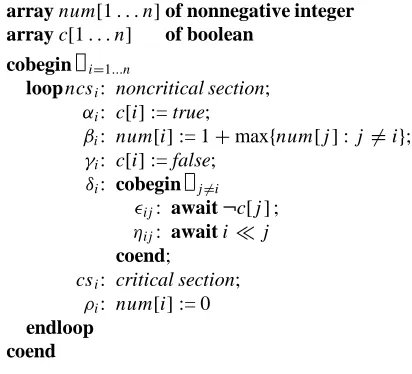
We now consider simple cobegin programs containing elementary statements that are not atomic operations. These are programs that can be written in the same simple language considered above, except without the requirement that every elementary statement be enclosed in angle brackets. An example of such a program is the bakery algorithm, given in Figure 3. This is essentially the same as the original version in [9], though with different notation. It is an extreme example because no atomic operations are specified.
Figure 3 says nothing about the grain of atomicity of the program’s operations.
State-mentþicould be executed by reading each num[ j ] one bit at a time, and writing num[i]
one bit at a time. The individual bits could even be read and written several times. Thus, Figure 3 does not describe a single program; it is a specification of a class of programs that are valid implementations of the bakery algorithm. Proving a property of the bakery algorithm means proving that property for any valid implementation.
In addition to the ordinary variables num[i] and c[i], an implementation of the bakery algorithm will contain hidden variables—variables not explicitly mentioned in Fig-ure 3. For example, hidden variables are needed to hold the values of intermediate
hidden variables. We can’t write an explicit expression for the predicate in(þi) in
terms of variables at(¾) for atomic operations¾ because Figure 3 does not specify what
those atomic operations are. Such an expression can be written only for a particular implementation, in which the atomic operations are given.
We letdenote the set of operations that correspond to the elementary statements and
tests of the program. For the bakery algorithm,D fncsi; Þi; þi; i; ži j; i j;csi; ²i :
i 6D jg. The setis a partition of the set5of atomic operations, since each atomic
operation of the program belongs to exactly one operation in. Of course, the actual
atomic operations that constitute an element ofdepend upon the implementation.
We can deduce certain relations between the at and after predicates from the
pro-gram control structure. For example, in the bakery algorithm, we have jDat(csi)
V
j6Diafter(i j) andjD.after(i j)^in(csi)/)at(csi). We will assume these obvious
relations without giving a formal method for deriving them.
Operations Belonging to Different Processes
The definition of what it means for two arbitrary operations to belong to different
processes is the same as the definition for atomic operations—namely, that ¦ and−
belong to different processes iff they occur in different clauses of the same cobegin statement. We make the following assumption, which is the generalization of CTL2 to arbitrary operations.
CTL4. If operations¦ and− inbelong to different processes, then− leaves at(¦),
in(¦), and after(¦) unchanged.
Predecessors
The definition of one operation being a predecessor of another is essentially the same
as the definition for atomic operations—namely, an operation²inis a predecessor
of an operation¦iniff control can reach¦ by completing the execution of². In the
bakery algorithm,²i is the only predecessor of ncsi, and each i j is a predecessor of
csi.
The Semantics of Nonatomic Operations
To reason formally about programs with nonatomic operations, we must make some assumptions about those operations. Our first assumption is that, in the absence of con-current execution of other operations, a nonatomic operation has the expected meaning.
For example, executing a nonatomic assignment x :D2Ły when y equals 1 sets x to
2. Formally, this means that we assume the validity of ordinary rules for manipulating
wlp formulas involving nonatomic operations. Thus, if¦ is a nonatomic assignment
x :D2Ły, thenwlp.¦;xD2/equals.yD1/_ :at(¦).
What it means to execute a nonatomic operation in the presence of concurrent activity
concurrently modified by another operation, must execution of this assignment set x to an even value? One can argue that the answer is “yes”, since regardless of what value is obtained when reading y, multiplying it by 2 yields an even number. On the
other hand, one can argue that the answer is “no”, since hx :Dyi;hx :DxCyiis a
valid implementation of x :D2Ły whose execution could set x to an odd value—for
example, if another process increments y by 1 in the middle of the execution.
Deciding what the semantics of x :D2Ły should be is a problem in language design—a
topic we wish to avoid. Instead, we just assume that this operation does not modify or access any variables we don’t expect it to. We can make the obvious assumption that
x is the only nonhidden variable modified by this operation, and the operation does
not access any set of nonhidden variables that does not contain x or y. However, we also need some assumption about the hidden variables that the operation may modify or access.
Intuitively, we assume that each process has its own local variables that are not accessed
or modified by any other process. More precisely, we assume that, for each operation¦
in, there is a set of variables that are local to¦. If¦and−are operations in different
processes, we assume that they have disjoint sets of local variables. We then assume the following rules for reasoning about nonatomic assignment and await statements.
Assignment Rule A nonatomic operation x :Dex p.y1; : : : ;ym/modifies only x and
variables local to the operation. The operation does not access any set of variables that
contains neither x, nor any yp, nor any variable local to the operation.
Await Rule A nonatomic operation await ex p.y1; : : : ;ym/modifies only variables
local to it. The operation does not access any set of variables that contains neither any
ypnor any variable local to the operation.
3.8
The Owicki-Gries Method with Unspecified Atomicity
Decomposing the Invariant
We now extend the Owicki-Gries method to permit reasoning about simple cobegin programs like the bakery algorithm with nonatomic elementary statements. A safety property is still proved by finding the appropriate invariant I , where I is written as an annotation. However, the annotation now denotes the predicate
^
¦2
.in(¦))I¦/^.after(¦))I¦0/ (7)
Intuitively, this predicate asserts that, for each operation¦, if control is in¦ then I¦is
true, and if control is immediately after¦ then I0
¦is true. Since in(¦) is equivalent to
The Owicki-Gries Conditions
To prove the invariance of an annotation, one proves the following nonatomic
Owicki-Gries conditions, where J¦is defined to be.in(¦)^I¦/_.after(¦)^I0
¦/.
Sequential Correctness:
(a) Every operation¦ 2leaves J¦invariant.
(b) For every operation ¦ 2 and every predecessor set²1; : : : ; ²m of ¦:
jD.at(¦)^VpI0
²p/) I¦.
Interference Freedom: For every pair of distinct operations¦; −inthat belong
to different processes: − leaves in(¦)^I¦^J−and after(¦)^I0
¦^J−invariant.
The proof that these conditions imply the invariance of I is similar to the proof for the atomic Owicki-Gries conditions.
By part (a) of the sequential correctness condition, each operation− inleaves J−
invariant. Therefore, OP2 implies that to prove the interference-freedom condition for
the pair¦,−, it suffices to prove that− leaves in(¦)^I¦ and after(¦)^I0
¦ invariant.
Since ¦ and− are in different processes, − leaves in(¦) and after(¦) invariant (by
CTL4). Hence by OP2, to prove this interference-freedom condition, it also suffices to
prove that− leaves I¦and I0
¦invariant.
For an atomic operation¾, the formula fI¾g¾fI¾0gis equivalent to the assertion that
¾ leaves J¾ invariant. Hence, if all operations are atomic, the nonatomic
sequential-correctness condition is equivalent to the atomic Owicki-Gries condition. If ¦ and
− are atomic operations, the presence of the in(¦) and after(¦) conjuncts makes this
nonatomic interference-freedom condition somewhat weaker than the atomic Owicki-Gries condition.
4
Applications
4.1
The Single-Access Rule
var x, y: array 1: : :n of integer;
m: integer;
cobegin iD1:::nÞi:hm := max.m;x[i]/;
y[i] := x[i] i fm½ y[i]g
coend
Figure 4: Annotation of a program obtained with the single-action rule.
var x, y: array 1: : :n of integer;
m: integer;
cobegin iD1:::n¾i: hm := max.m;x[i]/i fm½x[i]g;
fwinp. i;m½y[i]/g i: y[i] := x[i] fm½y[i]g
coend
Figure 5: Annotation of the original program.
The single-access rule is based upon the assumption that any access to a shared variable is atomic, which may not always be the case. (For example, the variable may be implemented as two words of memory, with access to each word being a separate
action.) A more precise formulation of the single-access rule is that ifI¾I appears
in a program, ¾ is atomic, and and are operations that do not access any set
of variables that are not local to the process containing them, then I¾I may be
considered a single atomic operation.
Any Owicki-Gries method proof of a program transformed with the single-access rule can be turned into a proof of the original program. However, proving this result in general is rather tedious and requires properties of win and sin that we have not introduced. Instead, we illustrate the result with an example—namely, the annotated program of Figure 4, which is obtained by applying the single-action rule to combine
¾i: hm :Dmax.m;x[i]/i
i: y[i] :Dx[i]
into the one atomic operationÞi. (In this program, m is the only nonlocal variable.)
It is easy to prove the invariance of this annotation, from which one can deduce that
m½max.y[1]; : : : ;y[n]/holds upon termination.