A P R I L 1 9 9 5
WRL
Technical Note TN-47
I/O Component
Characterization
for I/O Cache Designs
The Western Research Laboratory (WRL) is a computer systems research group that was founded by Digital Equipment Corporation in 1982. Our focus is computer science research relevant to the design and application of high performance scientific computers. We test our ideas by designing, building, and using real systems. The systems we build are research prototypes; they are not intended to become products.
There are two other research laboratories located in Palo Alto, the Network Systems Lab (NSL) and the Systems Research Center (SRC). Another Digital research group is located in Cambridge, Massachusetts (CRL).
Our research is directed towards mainstream high-performance computer systems. Our prototypes are intended to foreshadow the future computing environments used by many Digital customers. The long-term goal of WRL is to aid and accelerate the development of high-performance uni- and multi-processors. The research projects within WRL will address various aspects of high-performance computing.
We believe that significant advances in computer systems do not come from any single technological advance. Technologies, both hardware and software, do not all advance at the same pace. System design is the art of composing systems which use each level of technology in an appropriate balance. A major advance in overall system performance will require reexamination of all aspects of the system.
We do work in the design, fabrication and packaging of hardware; language processing and scaling issues in system software design; and the exploration of new applications areas that are opening up with the advent of higher performance systems. Researchers at WRL cooperate closely and move freely among the various levels of system design. This allows us to explore a wide range of tradeoffs to meet system goals.
We publish the results of our work in a variety of journals, conferences, research reports, and technical notes. This document is a technical note. We use this form for rapid distribution of technical material. Usually this represents research in progress. Research reports are normally accounts of completed research and may include material from earlier technical notes.
Research reports and technical notes may be ordered from us. You may mail your order to:
Technical Report Distribution
DEC Western Research Laboratory, WRL-2 250 University Avenue
Palo Alto, California 94301 USA
Reports and technical notes may also be ordered by electronic mail. Use one of the fol-lowing addresses:
Digital E-net: JOVE::WRL-TECHREPORTS
Internet: [email protected]
UUCP: decpa!wrl-techreports
To obtain more details on ordering by electronic mail, send a message to one of these addresses with the word ‘‘help’’ in the Subject line; you will receive detailed instruc-tions.
I/O Component Characterization
for I/O Cache Designs
Kathy J. Richardson
Copyright
1995 Digital Equipment Corporation
Abstract
When investigating I/O behavior, the tracing environment, simulation systems, and simulation model determine what can be measured and simulated. Workloads generate a variety of disk I/O requests to access file information, execute programs, and perform computation. The system presented here includes information about I/O requests, allowing workload components to be characterized individually.
The component characterization shows that I/O requests for data have vastly different reuse rates and access patterns. Disk files can be classified as accesses to inodes, directories, datafiles or executables. Inodes and directories are small, highly reused files. Datafiles and executables have more diverse characteristics. The smaller ones exhibit moderate reuse and have little se-quential access, while the larger files tend to be accessed sese-quentially and not reused. Properly used, file type and file size information can improve cache performance.
1
Introduction
Workloads generate a variety of disk I/O requests to access file information, execute programs, and perform
computation. The characteristics of the set of applications comprising each workload determine the I/O
load and final system performance. A characterization shows that I/O requests for data have vastly different
reuse rates and access patterns. File information can help split the workload into components with unique
properties.
Knowledge of the statistical distribution of I/O requests can help design systems that achieve the best
price/performance ratio. Some techniques for improving performance rely heavily on the statistical nature
of requests. Caches work because, statistically, programs and work environments exhibit locality. A better
understanding of the statistical properties of the workloads allows cache designers to exploit the most
prominent statistical properties of the workloads. characterizing the workload shows what type of requests
are the most important to performance, and focuses attention on the most important part of the problem to
be solved.
This paper includes a description of the tracing system and workloads which are characterized by type,
static, and dynamic resource requirements. An evaluation of the cache behavior of each component shows
that each requires a very different cache configuration to best capture its locality. Lastly, an attribute
cache scheme, using file information to significantly improve cache performance, shows the usefulness of
workload characterization.
2
I/O Workload Traces
Direct comparisons between various I/O configurations requires delivering an identical I/O stream to
each configuration. Using an I/O trace guarantees repeatable use of identical I/O streams. The tracing
environment, simulation systems and simulation model determine the kind of I/O behavior that can be
measured and simulated. Since the tracing environment monitors and records only part of the existing
system behavior, the trace constrains the measurements that can be made and thus constrains the resulting
conclusions.
2.1 Tracing
An I/O workload trace should contain block access patterns as well as file and application information. File
access patterns suffice to model broad I/O cache performance, but cannot provide the link between workload
activities and cache behavior. Additional information is required to understand the nature of application I/O
requests, and improve I/O cache performance in non-ad-hoc ways.
Relating cache performance to application behavior requires file system information along with
Application
Application
Application
Trace Reader
Generate Trace
Unix OS
I/O Requests
Analysis Program
System Call Interface
[image:6.612.210.412.72.255.2]System Trace Buffer Trace Entries
Figure 1: Logical diagram of trace, and simulation configuration.
improvements or application I/O optimizations. This requires tracing application I/O requests and including
information about each request.
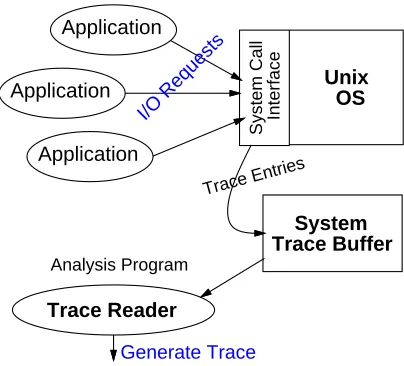
A new version of the WRL tracing facilities collected the traces on DECstation 5000’s running
UL-TRIX [3, 4]. Its kernel-based approach traces all processes. Figure 1 shows the system configuration.
The original system was designed primarily to study processor memory issues in a multi-programming
environment. The modified system logs system call information, rather than instruction and data addresses,
in the trace buffer. On an I/O system call, the call type, process ID, and call parameters are entered in the
buffer. On return from the system call, the return value, error status and call information are entered in the
buffer. When the buffer becomes sufficiently full, the kernel schedules a special process called the analysis
program to read and process the buffer contents. To generate an I/O system call trace, the analysis program
matches call and return values, produces a file system event trace, compresses the trace and writes it to a
file.
The set of I/O system calls traced includes all file related activity – read, write, open, close, create,
reposition, delete, move, and executable execution. The I/O system call traces cannot be directly used for
I/O cache simulations since individual I/O requests refer to state information stored in the operating system.
A post pass simulates the operating system file management and produces a stateless trace. To generate a
stateless trace of file block read and write requests requires keeping track of the current working directories,
and simulating the operating system file table information and file descriptors [1, 6].
Unique identification numbers are assigned to each file. The stateless trace includes the filename of
each I/O request in the form of a unique ID. It also includes the file type, which is implied by the system call
and the explicit range of data bytes requested from the file. For executables the number of bytes accessed
2.2 File Types
In a UNIX system, I/O requests resulting directly from program execution can be grouped into four
categories: datafiles, executables, inodes, and directories. Datafiles are explicitly read or written by
active processes. Executables are run by processes, and initiated via one of the exec systems calls. Inodes
and directories contain meta-data. Inodes contain information used by the operating system to locate the
actual data on the disk. Directories facilitate the user organization of data and point to inodes. References
to inodes and directories occur when opening files or evaluating access permissions.
2.3 Workloads
Figure 2 describes the eleven workloads evaluated in this paper. Most of the traces monitor several days of
user activity. Such long traces are necessary to capture significant I/O activity and to show the interaction
of the many large and small files that comprise a workload.
The traces cover a wide range of user applications and types of work. All traces were collected in a
research laboratory with a broad range of activities. Although not necessarily typical of heavy commercial
use, such as large database systems, the traces should represent many engineering development and office
environments. More detailed descriptions of the workloads are included in [9].
3
Experimental Characterization of I/O Behavior
3.1 Static and Dynamic I/O Requirements by Type
Static measures of I/O behavior count unique objects and ignore the frequency with which the objects are
used. The static I/O requirements of a workload measure the unique I/O data and meta-data that is either
read or written. Assuming no data buffering between workloads, this is the minimum amount of I/O that
the stream must perform for the workload.
Dynamic measures count the total references made by a workload. The dynamic I/O requirements
represent the total I/O performed to support the workload applications. Assuming no data buffering other
than that explicitly performed within the applications, this is the amount of I/O performed by the workload.
Static objects are the number of unique files touched by the workload. Figure 3a breaks down, by
type, the unique files referenced by each workload. A file is categorized as a datafile, an executable, an
inode or a directory. Most of the unique files are either inodes or directories (greater than 75%). Inodes
make up more than half the unique files accessed in all workloads, ranging from 51.3% to 86.7%. The file
system associates an inode with each directory, datafile, and executable file, and the inode must be accessed
to access the other files. Thus, at least half the static files must be inodes. Datafiles make up most of the
remaining files, ranging from 6.9% to 41.7% for the workloads. The combination of inodes and datafiles
a. Static Objects b. Dynamic References
a. Static Size b. Dynamic Bytes Transferred
Figure 4: Static and dynamic size broken down by type, averaged over all workloads.
Dynamic references are the number of requests made for files, either whole or partial. Figure 3b breaks
down the references according to type. The breakdown of reference types shows the relative frequency with
which a workload requests each type. For datafiles, references are the application’s actual I/O calls. They
incorporate the data needs of the application and the buffering properties of any I/O libraries used.
In the dynamic stream, executable references make an insignificant contribution to the total requests
(less that half a percent). Each reference brings in an entire executable. If executables were referenced
in pieces, their contribution to the whole would be greater. Directory references contribute 10% to 20%
of the total requests, a much higher percentage than their static file count. Inodes are the most frequently
referenced type in all but one workload, contributing between 41% and 73% of the total references. On
average, datafiles make up 20% of the total references, about the same as their static file contribution. For
individual workloads, the datafile reference contribution does not correspond to its static contribution. The
relationship varies considerably with workload.
Static size is the total amount of space required to store all the files touched by a workload. Figure 4a
shows the relative physical space requirements for each of the data types. Each type has a different average
size, and therefore requires a different amount of storage space. The total static size of all files forms an
upper bound on the amount of storage space required to capture all re-references to the files. Since the
working set changes over time and some parts of datafiles never get referenced, the actual space requirements
for full capture may be less.
For all the workloads, the inodes and directories occupy only a small portion of the total space
require-ments. For half of the workloads they are less than one percent of the total; in all workloads they are less
than 5%. Executables contribute much more; their relative static size contribution varies from 1.7% to
41.6%. Datafiles require the majority of the total space requirements.
average breakdown of bytes transferred dynamically by type. The number of bytes transferred dynamically,
also known as the dynamic size, is the amount of data that the operating system must deliver to or from the
applications by the operating system. With no I/O cache, this is the number of bytes transferred to/from
disk.
Although inodes and directories comprise only a small portion of the static size requirements, they make
up a significant portion of the dynamic size. Together, they account for 5% to 49% of the traffic bytes.
The byte traffic component from inodes and directories is almost equal. The directory entries are about
four times the size of the inodes, but have about a fourth the number of dynamic references, resulting in
comparable dynamic byte requirements. The executable component of bytes transferred is larger than would
be expected from the other measures. The average executable is large and each request retrieves the entire
file. A small number of requests transfer a large amount of data. Only about 45% of the bytes requested
from the operating system are datafiles used as actual computation data.
Conclusions from Static and Dynamic Type Characteristics
Each I/O type differs in importance. Inodes and directories comprise a significant percentage of the files,
but they are small and require little space. They also have the greatest average reuse, so they are the most
important files to keep in the cache. As Figure 4 showed, executables require considerably more space than
do directories and inodes, and datafile files require still more.
To provide the greatest benefit, a cache should capture the most references with the smallest amount of
space. I/O accesses have two components: an overhead to access the data, and a per-byte time to transfer
the data. Thus, a good cache policy should minimize the number of requests as well as the actual amount of
data retrieved. Reducing the number of misses decreases overhead, even if the amount of data transferred is
not decreased. Because of the large differences in the file size and reuse between the various types, a cache
scheme that relies on the statistical properties of the whole group will not match the properties of any one
group.
3.1.1 Dynamic Run Length and Request Length
A run is a sequential access of a file or a portion of a file. The run length is the number of sequentially
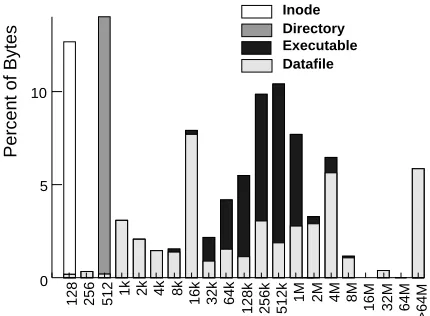
accessed bytes. Figure 5 shows the distribution of run lengths by type and the distribution of bytes transferred
for these runs. The x-axis is divided into run lengths; the maximum run size is shown for each category. For
example, the label 32k includes all runs greater than 16k and less than or equal 32k bytes. The distribution of
run lengths tails off quickly. Fewer than 1% of the runs exceed 16 Kbytes. The number of bytes transferred
by large runs does not tail off. In fact, half of the bytes transferred occur in sequential runs of greater than
64 Kbytes and a quarter of all bytes transferred are in runs of more than 256 Kbytes. Thus, even though
128 256 512 1k 2k 4k 8k 16k 32k 64k
128k 256k 512k 1M 2M 4M 8M 16M 32M 64M
>64M
0 5 10 15 20 25 30 35 40 45 50 55 60 65 70
Run Length Distribution (bytes) Inode Directory
Datafile
Percent of Runs
Executable
0 5 10
128 256 512 1k 2k 4k 8k 16k 32k 64k
128k 256k 512k 1M 2M 4M 8M 16M 32M 64M
>64M
Percent of Bytes
Run Length Distribution (bytes) Inode Directory
[image:11.612.341.556.132.290.2]Datafile Executable
Figure 5: Run length distributions.
256 512 1k 2k 4k 8k 16k 32k 64k
128k 256k 512k 1M 2M 4M 8M 16M 32M 64M
>64M
0 5 10 15 20 25
Datafile
Request Size Distribution (bytes)
Percent of Requests
Executable
128
[image:11.612.204.416.464.631.2]most of the bytes transferred by the workload occur in these large sequential runs. This type of behavior
has been measured previously [7, 2].
Figure 6 shows the distribution of requests for datafiles and executables. Since executables are modeled
as a single request for the entire executable, they generate large requests. Most of the datafile requests are
for at most 8 Kbyte blocks regardless of the file size or run length. Large sequential runs thus generate many
requests.
Since many smaller requests produce large runs, these runs have a considerable sequential locality that
can be exploited with an appropriate cache policy. Transferring the runs in a few larger blocks can reduce
I/O cache misses, disk overhead and the time the disk spends servicing requests. However, applications
re-use large sequential runs infrequently, so trying to keep them around can pollute the cache with data
unlikely to be re-referenced, and can evict many smaller files that will be re-referenced. Medium to large
caches that hold much, if not all, of the working set show the greatest effects of both cache pollution and
sequential locality.
4
Performance Modeling and Simulation
4.1 I/O Cache Simulation Model
A single cache simulator, applied and configured in many different ways, was used to study the workload
behavior in I/O caches. The I/O cache simulator models fully associative I/O caches using an LRU
replacement policy. Fully associative caches efficiently simulate multiple caches simultaneously [11].
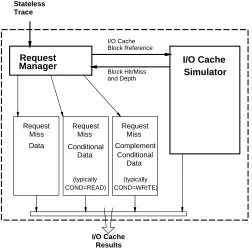
To reproduce the I/O request stream behavior, a simulator must track I/O requests along with cache
block behavior. An individual I/O request may encompass several cache blocks, each of which may hit
or miss in the cache. Figure 7 shows how the request manager generates I/O cache block references
and then uses the LRU stack hit depth or cache miss information to determine the appropriate number of
request misses for each given cache size. The request manager also records the request misses based on
a supplied condition (COND) and its complement. The condition typically breaks down read and write
requests separately (READ and not-READ). A single simulation produces a full range of I/O cache block
behavior, request miss behavior, and request component behavior based on the condition.
4.2 Request Model
The request model evaluates I/O requests from the application viewpoint and describes how the requests
break down into cache block requests. An application requests file I/O. Each request generates one or more
cache block requests. The number of cache block requests generated by an I/O request depends on the
original request size, the cache block size, and the offset of the request from the beginning of the file. The
Stateless Trace
Request Manager
I/O Cache Block Reference
Block Hit/Miss and Depth
(typically COND=READ)
Request Miss
Data Conditional Request
Miss Data
Request Miss
Data Conditional Complement
I/O Cache Results
I/O Cache Simulator
[image:13.612.186.438.76.327.2](typically COND=WRITE)
Figure 7: Cache simulator layout.
Each file has a unique file ID. This ID, along with an offset into the file, forms the address for a data
request. The file offset is converted to a cache block offset that is then used to access the I/O cache. The
cache matches two tag fields: one for file ID and one for block offset. Full associativity eliminates the
problem of generating a single uniform index. A cache block holds data from only one file at a time. Caches
that store actual disk blocks, rather than file blocks, could have pieces of several files in a single block.
Simulating disk blocks requires knowledge of the disk layout; the traces did not contain actual disk block
addresses, so this was not modeled.
If the request size exceeds the cache size, the request is modeled as multiple requests. This is necessary
because all requests go through the I/O cache before being delivered to the application. A request size
greater than the cache size incurs multiple request misses. A small cache might therefore have more request
misses than actual requests.
The I/O cache simulates block requests. Each block can produce a cache miss. An I/O request that
generates multiple block requests can produce multiple cache misses. All the block misses for a request are
coalesced into a single request miss.
A request misses in the cache if any of the cache blocks it accesses miss. Request misses reflect the disk
activity caused by I/O cache misses. The size of the request miss depends on how many blocks miss in the
cache. Read request misses reflect the number and size of read disk accesses for a workload. The number
of write accesses depends on the write policy and the cache activity. In a non-volatile cache, disk writes
Unified Cache: Application Workload
64k 1M 64M
4k
I/O Cache Size (Bytes)
Block Size − bytes 4k 8k 16k 32k
8M
Miss Ratio
100%
[image:14.612.194.427.72.308.2]25% 50% 75%
Figure 8: Typical workload behavior in a unified cache.
These are termed write expulsions. Each disk write is a cache block in size. More advanced write expulsion
techniques exist [8], and their impact should be similar to other reported results.
5
Workload Component Behavior in I/O Caches
This section examines the cache behavior properties of the various I/O workload components. The behavior
differs for each component. Different components require different block and cache sizes to capture locality
effectively. Understanding the sources of locality and the cache properties that best capture locality can
help to improve I/O cache efficiency. For a more thorough study of I/O cache behavior see [10, 9].
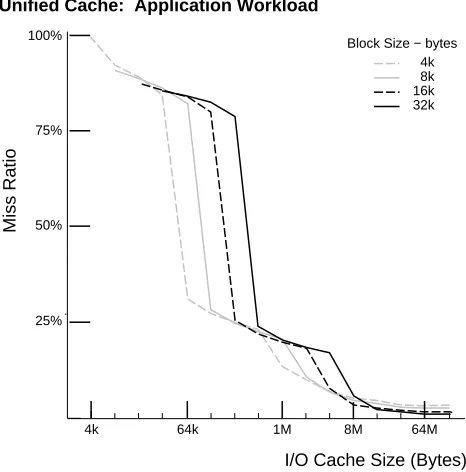
If all I/O requests are cached without regard to file type, few options exist for reducing the cache misses
and improving cache performance. Figure 8 shows the cache miss behavior of the Application workload
in a unified cache that uses no information about request types. The miss ratio is the percent of requests
not serviced by the cache. Due to the overwhelming number of small requests from inodes and directories,
smaller block size choices always win. This behavior is typical of all the workloads. Other work has
focused on ad-hoc techniques for separating the temporal and sequential components with cleaver cache
configurations [8, 5]. Directly improving the I/O cache performance requires more information about the
statistical properties of the workload and the type of locality that can be captured.
Individually measuring the cache behavior of each of the four different file types—inode, directory,
executable, and datafile—helps evaluate the usefulness of type information for an I/O cache. Differences
0 10 20 30 40 50 60 70 80 90 100 4K
1 2 4 8 16 32 64 256 1K 16K 64K 256K
I/O Cache Size (128 byte entries)
Hit Ratio: Inode and Directory Read (percent)s
0 10 20 30 40 50 60 70 80 90 100 Kernel Build Ingres Transactions Application Data Analysis Document Preparation Software Development 2 MECCA Server MECCA Development CAD: Chip Build Network Update Software Development 1 Compute Server
4K
1 2 4 8 16 32 64 256 1K 16K 64K 256K
I/O Cache Size (128 byte entries)
[image:15.612.116.510.82.323.2]Hit Ratio: Inode and Directory Reads and Writes (percent)
Figure 9: Inode and Directory references in a fully associative I/O cache.
each type, along with the system utilization of each type, determine system I/O performance.
The hit ratio is a simple means to compare and understand the way individual file types use the cache.
The hit ratio for a given cache is defined as the number of references that hit in the cache divided by
the total number of references. The hit ratio can adequately compare schemes when the total number of
references remains constant for each scheme. The hit ratio increases dramatically when the cache captures
the workload’s set of highly reused files. This is referred to working set capture. High hit ratios, low miss
ratios, and smaller working sets all mean better cache performance. All the caches presented use a fully
associative LRU replacement policy, and use a copy-back write policy.
5.1 Inodes and Directories
Inodes and directories have similar cache behavior. Including both in the same subcache produces uniform
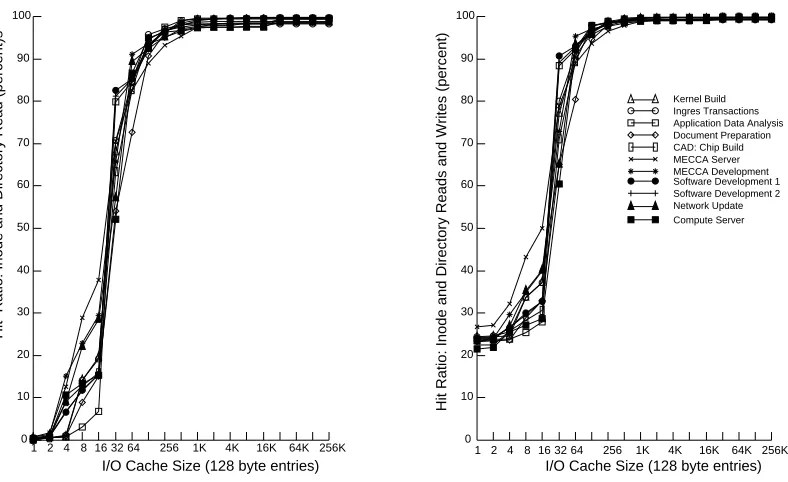
behavior across all workloads. Figure 9 shows the read hit ratio and the total hit ratio for inodes and
directories together in a cache with 128-byte blocks. The cache size is measured in 128 byte inode entries.
In this cache, a single 512-byte directory entry occupies four blocks. Ideally, the inode and directory working
sets would not conflict in the cache, and the combination would yield the same hit ratio with less space than
if each had a separate cache. For cache sizes greater than the directory working set size of sixteen directory
entries, or sixty-four 128-byte blocks, the combined subcache gets a higher hit ratio than two individual
subcaches. Because of the relationship between inodes and directories, workloads often require many inodes
inode entries or sixteen directory entries, the two conflict, competing for cache space. The resulting read
hit ratio is lower for the combined subcache than it would be for two separate half-sized subcaches. 256
entries suffice to capture the inode and directory working set completely and eliminate competition. This
requires only 32 Kbytes of cache.
5.2 Datafile and Executable Cache Behavior
Block Size Effect on Datafile and Executable Locality Capture
The block size determines the amount of sequential locality a cache can capture. Large cache blocks capture
more sequential locality, eliminating extra disk requests for long runs of adjacent data, and reducing the
transfer overhead per byte. This improves the cache performance if the workload contains a high proportion
of large sequentially-accessed files. If the workload accesses many small files, or short runs, large blocks
reduce the cache performance by inefficiently using cache space. If blocks are much larger than the file
size, much of the block remains empty or holds excess data that never gets used. This effectively reduces
the amount of data the cache can hold. Transferring larger blocks does not reduce the overhead per byte if
the workload never uses the extra data. In fact, transferring unnecessary data increases the transfer time.
Executable and datafiles have a broad distribution of file sizes, reuse rates and access patterns. The
average request patterns of a workload determine the best block size choice. The request pattern varies
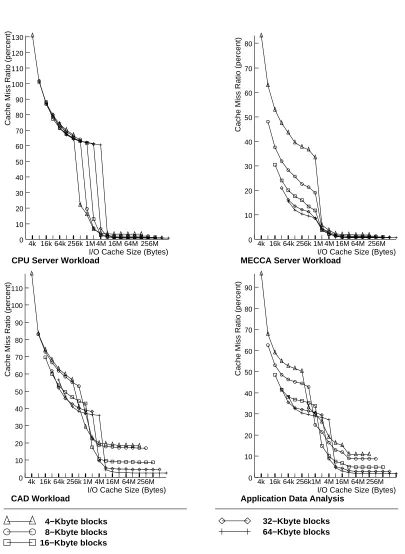
considerably among workloads. Figure 10 shows the block size effect on cache behavior for datafiles and
executable files. The four workloads shown represent the different kinds of behavior found in the workloads.
Since block size does not affect the executable cache behavior, the variation comes only from references to
datafiles. Caching executables with datafiles eliminates consistency problems, since many executables start
out as datafiles generated by compilers, loaders or editors. Executables and datafiles also have similar size
distributions.
The locality in the individual workloads varies, ranging from the primarily temporal locality found in
the CPU Server workload, to the primarily spatial locality found in MECCA Server, to both spatial and
temporal in Application and CAD. In a workload having primarily temporal locality, increasing the block
size provides little reduction in the number of request misses and it increases the size of the cache required to
capture the working set. However, in a workload having primarily spatial locality, increasing the block size
significantly reduces the number of request misses, and does not increase the cache required to capture the
working set. In a workload exhibiting both spatial and temporal locality, increasing the block size reduces
the request misses, but increases the cache size required to capture the working set. The best block size
choice depends on the I/O cache size, the workload working set size, and the type of workload locality.
For caches smaller than the working set, larger blocks capture the workload’s sequential locality. In a
cache considerably larger than the working set, large blocks capture sequential as well as temporal locality.
4k 16k 64k 256k 1M 4M 16M 64M 256M 0 10 20 30 40 50 60 70 80 90 100 110 120 130
CPU Server Workload
Cache Miss Ratio (percent)
I/O Cache Size (Bytes)
4k 16k 64k 256k 1M 4M 16M 64M 256M 0 10 20 30 40 50 60 70 80
MECCA Server Workload
Cache Miss Ratio (percent)
I/O Cache Size (Bytes)
4k 16k 64k 256k 1M 4M 16M 64M 256M 0 10 20 30 40 50 60 70 80 90 100 110 CAD Workload
Cache Miss Ratio (percent)
I/O Cache Size (Bytes)
4k 16k 64k 256k1M 4M 16M 64M 256M 0 10 20 30 40 50 60 70 80 90
Application Data Analysis
Cache Miss Ratio (percent)
I/O Cache Size (Bytes)
8−Kbyte blocks 16−Kbyte blocks
[image:17.612.110.515.86.640.2]32−Kbyte blocks 64−Kbyte blocks 4−Kbyte blocks
Figure 10: Miss request ratios of datafiles and executables, showing temporal locality (top left), spatial
Increasing the number of blocks beyond that needed to store all the independent files in the working set does
little to improve the temporal locality capture, and nothing to improve sequential locality capture. Beyond
this point, increasing the block size increases the sequential locality capture. For the measured workloads,
an 8-Mbyte cache using 4-Kbyte blocks always captured the working set.
Separating Sequential and Temporal Locality
The statistical breakdown of I/O accesses provides information about workload locality. Most of the
I/O bytes transfer sequentially to or from large files of more than half a megabyte. Most of the I/O
requests, however, access the many small files in a workload. Thus, most of the spatial locality comes
from sequentially accessing large files. The small files exhibit temporal locality. Assigning different block
sizes to the appropriate file sizes could capture both temporal and sequential locality, and improve cache
performance.
A Sequential Cache tries to capture the workload’s sequential locality by using large blocks and allocating
only large files. Requests to sequentially accessed large files constitute a significant fraction of the
sequential cache requests. Capturing the reuse of these large files would require considerable cache
space, but the cache needs only a small amount of space to capture the sequential access behavior.
A Temporal Cache tries to capture the workload’s temporal locality by using small cache blocks for
small-and medium-sized, or moderate files. Because of the high reuse rate typical of moderate files it is
crucial to capture their working set.
Sequential Cache Properties
Figure 11 shows the sequential cache request miss ratio of the large files in each of four workloads. The
Figure shows 512KB cut-off caches, holding only files of at least 512 Kbytes. The request miss ratio is the
fraction of datafile and executable request misses contributed by the large files, not the fraction of large file
requests that miss.
The Application workload and the CAD Chip Build workloads exhibit almost ideal sequential locality
capture. The workloads sequentially access the large files and do not reuse individual blocks, so increasing
the cache size does not capture more locality. The cache cannot capture file reuse until the entire set of files
fit in the cache. Doubling the block size from 4 Kbytes to 8 Kbytes produces a much smaller reduction
in the number of misses than subsequent doublings because many requests access 8 Kbytes regardless of
whether the cache has 4-Kbyte or 8-Kbyte blocks.
A single large block suffices to capture the sequential locality of one active file. The number of blocks
needed to capture sequential locality of more than one file equals the maximum number of active files that
4k 16k 64k 256k 1M 4M 16M 64M 256M 0
10 20 30 40
Application Data Analysis
I/O Cache Size (bytes)
Request Miss Ratio (percent)
4k 16k 64k 256k 1M 4M 16M 64M 256M 0
10
MECCA Server Workload
I/O Cache Size (bytes)
Request Miss Ratio (percent)
4k 16k 64k 256k 1M 4M 16M 64M 256M 0
10 20 30 40
CAD Workload
I/O Cache Size (bytes)
Request Miss Ratio (percent)
4k 16k 64k 256k 1M 4M 16M 64M 256M 0
10
CPU Server Workload
I/O Cache Size (bytes)
Request Miss Ratio (percent)
4K block Sequential 8K block Sequential 16K block Sequential
[image:19.612.113.516.103.643.2]32K block Sequential 64K block Sequential 128K block Sequential
long the file block remains active in the cache. Larger blocks stay active for a longer period of time because
the workload takes longer to consume the data. If the cache cannot hold all the active files, contention forces
out actively-used blocks. Contention for cache space becomes more pronounced for larger cache blocks.
Thus, two half-size blocks perform better than a single large block.
The large files in the MECCA Server and the CPU Server workloads exhibit almost no sequential locality
capture even among very large files. This arises when the workload accesses files with very large requests.
Most of the large files are executables, which get accessed all at once, rather than datafiles, which tend to
be accessed in 8-Kbyte pieces.
Temporal Cache Properties
Figures 12 shows the temporal cache request miss ratio for moderate size files in the four representative
workloads. The figure shows the temporal cache behavior for files smaller than 512 Kbytes. As with the
sequential cache results, the temporal request miss ratio is the fraction of request misses contributed by the
moderate size files, not the fraction of moderate file request misses.
The temporal cache attempts to capture the greatest temporal locality in the least space. The amount of
temporal locality captured depends on the reuse rates and on the amount of data that fits in the cache.
Smaller cache blocks increase the usable cache space by reducing the amount of unused space per block,
and by increasing the number of independent files that can reside in the cache at one time. Excluding large
files eliminates the low-reuse sequential data from the cache, which increases the density of actively used
data and allows the cache area to capture highly reused data more effectively.
As evidenced by their cache behavior, most of the workloads contain primarily temporal locality once
the large files have been excluded. The Application Data Analysis, CAD Chip Build, and CPU Server
workloads of Figure 12 show only temporal locality behavior. Eliminating all large files from the cache
effectively eliminates all the sequential behavior from the temporal caches for most workloads. Then larger
blocks do little to reduce the miss ratio for any cache size.
A few workloads, such as the MECCA Server, exhibit both temporal and sequential locality among the
moderate sized executables and datafiles. The two may not be easily separable. MECCA accesses a large
set of medium-sized files sequentially. It reuses these files frequently, producing a large working set.
Trading Off Spatial and Temporal Locality
File size provides a simple mechanism for separating the temporal and spatial locality of executables and
datafiles. This makes it feasible to tailor the cache management to the expected locality of each request,
rather than to the average locality of the entire workload. Sequential data can be cached in large blocks,
while small highly reused files can be cached in small blocks.
4k 16k 64k 256k 1M 4M 16M 64M 256M 0
10 20 30 40 50
Application Data Analysis
I/O Cache Size (bytes)
Request Miss Ratio (percent)
4k 16k 64k 256k 1M 4M 16M 64M 256M 0
10 20 30 40 50 60
MECCA Server Workload
I/O Cache Size (bytes)
Request Miss Ratio (percent)
4k 16k 64k 256k 1M 4M 16M 64M 256M 0
10 20 30 40 50 60 70
CAD Workload
I/O Cache Size (bytes)
Request Miss Ratio (percent)
4k 16k 64k 256k 1M 4M 16M 64M 256M 0
10 20 30 40 50 60 70 80 90 100 110
CPU Server Workload
I/O Cache Size (bytes)
Request Miss Ratio (percent)
4K block Temporal 8K block Temporal
[image:21.612.111.515.104.636.2]16K block Temporal 32K block Temporal
management can directly increase locality capture and reduce cache pollution. The temporal cache uses
small blocks to reduce wasted space and capture its working set in a minimal area. The sequential cache uses
a few large blocks to capture the majority of the sequential behavior in a small area. Limiting the amount
of space sequential data can occupy in the cache reduces cache pollution. A separate sequential subcache
holding only large files can also prevent large files with little sequential locality, such as executables, from
polluting the other subcache.
5.3 Choosing a Cache Size
There are three major cache size regions: The small I/O cache region, the working set capture region, and
the large I/O cache region. Caches in the small region cannot capture the expected working set of the entire
workload. Caches in the large cache region are big enough to capture the working set of most workloads.
The working set capture region covers the intermediate sizes.
Each of the three cache size regions needs to capture a different sort of locality: (1) small caches have
very limited space and should be designed to capture locality that requires little space. A small cache can
potentially capture inode and directory requests, some small amount of datafile and executable temporal
locality and some sequential behavior. (2) Caches in the working set capture region are large enough that
they should easily capture the inode and directory working sets. The cache should be tailored to hold
the datafile and executable temporal working set, and then providing adequate support for capturing some
sequential locality. (3) Large caches have sufficient space to capture the temporal locality of inodes and
directories and of the datafiles and executables. The cache needs to capture the remaining sequential locality
and reuse of large sequential files, which have a reasonably long time period between reuse.
6
Variable Attribute Cache Scheme
The variable attribute cache scheme uses attributes to substantially reduce read request misses. No single
cache configuration produces low miss ratios over a broad range of caches, hence the scheme varies with
cache size. The design exploits common workload behavior and systematically varies the attribute cache
configuration with cache size to capture the appropriate behavior. The resulting design is not optimal, but
it shows the type of benefits that could be expected from a real attribute cache scheme.
Figure 13 shows the attribute cache configurations and the general policy governing subcache space
allocation for each of three cache size regions. In the small cache region, the scheme uses a two-category
attribute cache, allocating half the cache to inodes and directories, and partitioning the other half into a
general subcache having four equal blocks. The general subcache is designed to capture both temporal
and sequential locality. In the medium cache size region, the scheme allocates the bulk of the area to the
temporal subcache, which uses 4-Kbyte blocks to capture the temporal working set. It allocates from 64 to
33% 50% 50% 25% Limited 25%
Temporal I/O Cache
Sequential I/O Cache
Inode and Directory Inode and Directory
Temporal I/O Cache
Sequential I/O Cache
Large Region
Medium Region
Inode and Directory
Small Region
I/O Cache General
50%
50% min. Fixed/Limited
Fixed/Limited I/O Cache
General
Unix Baseline
Inode Cache 32K bytes 128 byte Blocks
4 Blocks 4k byte
[image:23.612.123.498.71.273.2]Blocks
Figure 13: Variable attribute cache configurations for each size region.
requests and sequential requests. In the large cache region, the scheme increases the sequential subcache so
that it occupies a large part of the cache, starting at about one-third and increasing to one-half at the high end
of the cache region. The ID subcache remains fixed at 128 Kbytes until the cache becomes large enough to
support a multi-megabyte ID subcache, at which point it expands to 25% of the cache area.
6.1 Read Request Behavior
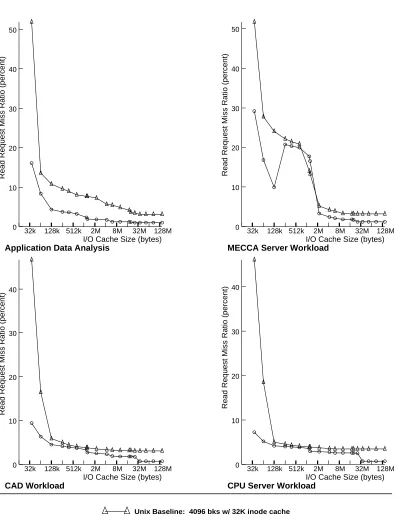
Figure 14 compares the variable attribute cache scheme with the Unix baseline scheme for the four
representative workloads. The variable scheme lowers the read request miss ratio (RRMR) across the full
cache range. The resulting miss ratio usually corresponds with that of caches eight times the size. For many
medium and large caches, however, the variable scheme produces RRMR’s below that of the maximum
Unix baseline cache.
The MECCA Server workload exhibits anomalous variable-scheme cache behavior. As previously
noted, the workload locality is only captured by large cache blocks. In the small cache region, the variable
scheme uses larger blocks which are ideal for this workload. In the medium cache region, the variable
scheme changes to 4K blocks in the temporal cache and partitions space for a sequential cache. The 4-Kbyte
blocks produce miss ratios comparable to the baseline, but the MECCA Server workload benefits little
from the sequential subcache. This subcache sits unused, increasing the total space required to capture the
working set.
Figure 15 compares changes in the read requests for the four sample workloads, relative to the Unix
baseline cache. It also includes a graph showing results for all eleven workloads. The workloads see dramatic
reductions in their read request misses for both small and very large caches, and moderate reductions over
32k 128k 512k 2M 8M 32M 128M 0
10 20 30 40 50
Application Data Analysis
I/O Cache Size (bytes)
Read Request Miss Ratio (percent)
32k 128k 512k 2M 8M 32M 128M 0
10 20 30 40 50
MECCA Server Workload
I/O Cache Size (bytes)
Read Request Miss Ratio (percent)
32k 128k 512k 2M 8M 32M 128M 0
10 20 30 40
CAD Workload
I/O Cache Size (bytes)
Read Request Miss Ratio (percent)
32k 128k 512k 2M 8M 32M 128M 0
10 20 30 40
CPU Server Workload
I/O Cache Size (bytes)
Read Request Miss Ratio (percent)
New Variable Attribute Cache
[image:24.612.116.515.106.627.2]Unix Baseline: 4096 bks w/ 32K inode cache
32k 128k 512k 2M 8M 32M 128M
I/O Cache Size (bytes)
0.00 0.10 0.20 0.30 0.40 0.50 0.60 0.70 0.80 0.90 1.00 1.10 1.20 1.30
Relative Read Misses
Unix baseline
Application Data Analysis MECCA Server CAD Chip Build CPU Server
Variable Attribute Cache
32k 128k 512k 2M 8M 32M 128M
Unix baseline
Average
I/O Cache Size (bytes)
0.00 0.10 0.20 0.30 0.40 0.50 0.60 0.70 0.80 0.90 1.00 1.10 1.20 1.30
Relative Disk Requests
[image:25.612.350.530.84.324.2]Selected Workloads All Eleven Workloads
Figure 15: Relative Read Disk Requests.
when applications must wait for I/O requests to complete.
Read request misses generate disk accesses, determining the number of times applications wait for I/O
to complete, and the minimum number of context switches required to overlap computation with the I/O.
The variable attribute cache scheme reduces the number of read disk accesses for almost all workloads over
a full range of I/O cache sizes. Averaging over the workloads, it reduces the read accesses by at least 18%
and as much as 66% depending on the cache size. The overall reduction averaged 48% in the small cache
region, 28% in the middle cache region, and 58% in the large cache region.
7
Conclusions
Distinct components make up the I/O workload. By including file system information with I/O requests,
these components can be separated. For a set of 11 workloads, file type and size information sufficed
to distinguish different cache behaviors. Inodes and directories turn out to be small, highly reused files.
Datafiles and executable files have more diverse characteristics. The smaller ones exhibit moderate reuse
and have little sequential access, while the larger files tend to be accessed sequentially and not reused.
I/O caches should make use of file types to improve their efficiency. Attribute caches capitalize on the
distinct access patterns of different file types and sizes. Each subcache uses a different block size to capture
files stored in the cache. Allocating medium files to mid-sized blocks captures temporal locality with a
smaller cache. And allocating large files to large blocks captures sequential locality. Matching the block
size to the file size reduces unused cache space, increases cache utilization, and reduces the number of
request misses.
Partitioning the cache prevents large files from filling up the entire cache and forcing out small files.
This allows the cache to capture the working set of individual components even if the workload working set
exceeds the cache size. Capturing the working set of individual components significantly reduces the total
request misses.
Acknowledgments
This research was supported by NASA through the Graduate Researcher Fellowship program and under
contract NAG2-248, and by the Digital Western Research Laboratory.
References
[1] Maurice J. Bach. The Design of the UNIX Operating System. Prentice-Hall, Inc., Englewood Cliffs,
New Jersey, 1986.
[2] Mary G. Baker, John H. Hartman, Michael D. Kupfer, Ken W. Shirriff, and John K. Ousterhout.
Measurements of a distributed file system. In Proceedings of the Thirteenth ACM symposium on
Operating Systems Principles, SIGOPS, Special Interest Group on Operating Systems, pages 198–
212, Pacific Grove, CA, October 1991. SIGOPS, ACM.
[3] Anita Borg, R. E. Kessler, Georgia Lazana, and David Wall. Long address traces from RISC machines:
Generation and analysis. In The 17th Annual International Symposium on Computer Architecture, pages
270–279. IEEE Computer Society Press, May 1990.
[4] J. B. Chen, A. Borg, and N. P. Jouppi. A simulation based study of TLB performance. In The 19th
Annual International Symposium on Computer Architecture, pages 114–123. IEEE Computer Society
Press, May 1992.
[5] Ramakrishna Karedla, J. Spencer Love, and Bradley G. Wherry. Caching strategies to improve disk
system performance. Computer, 27(3):38–46, March 1994.
[6] Samuel J. Leffler, Marshall Kirk McKusick, Michael J. Karels, and John S. Quarterman. The design
and implementation of the 4.3BSD UNIX operating system. Addison-Wesley Publishing Company,
[7] John Ousterhout, Herve Da Costa, David Harrison, JohnA. Kunze, Mike Kupfer, and James G.
Thompson. A trace-driven analysis of the UNIX 4.2 BSD file system. Technical Report UCB/CSD
85/230, University of California, Berkeley, April 1985.
[8] A. L. Narasimha Reddy. A study of I/O system organizations. In The 19th Annual International
Symposium on Computer Architecture, pages 308–317. IEEE Computer Society Press, May 1992.
[9] Kathy J. Richardson. I/O Characterization and Attribute Caches for Improved I/O Performance. PhD
thesis, Stanford University, Dec 1994. Also available as Technical Report CSL-TR-94-655.
[10] Alan Jay Smith. Disk cache - miss ratio analysis and design considerations. ACM Transactions on
Computer Systems, 3(3):161–203, August 1985.
[11] James Gordon Thompson. Efficient Analysis of Caching Systems. PhD thesis, University of California,
WRL Research Reports
‘‘Titan System Manual.’’ Michael J. K. Nielsen.
WRL Research Report 86/1, September 1986. ‘‘Global Register Allocation at Link Time.’’ David W. Wall.
WRL Research Report 86/3, October 1986. ‘‘Optimal Finned Heat Sinks.’’
William R. Hamburgen.
WRL Research Report 86/4, October 1986.
‘‘The Mahler Experience: Using an Intermediate Language as the Machine Description.’’
David W. Wall and Michael L. Powell. WRL Research Report 87/1, August 1987.
‘‘The Packet Filter: An Efficient Mechanism for User-level Network Code.’’
Jeffrey C. Mogul, Richard F. Rashid, Michael J. Accetta.
WRL Research Report 87/2, November 1987. ‘‘Fragmentation Considered Harmful.’’ Christopher A. Kent, Jeffrey C. Mogul. WRL Research Report 87/3, December 1987. ‘‘Cache Coherence in Distributed Systems.’’ Christopher A. Kent.
WRL Research Report 87/4, December 1987. ‘‘Register Windows vs. Register Allocation.’’ David W. Wall.
WRL Research Report 87/5, December 1987. ‘‘Editing Graphical Objects Using Procedural
Representations.’’ Paul J. Asente.
WRL Research Report 87/6, November 1987. ‘‘The USENET Cookbook: an Experiment in
Electronic Publication.’’ Brian K. Reid.
WRL Research Report 87/7, December 1987.
‘‘MultiTitan: Four Architecture Papers.’’
Norman P. Jouppi, Jeremy Dion, David Boggs, Mich-ael J. K. Nielsen.
WRL Research Report 87/8, April 1988. ‘‘Fast Printed Circuit Board Routing.’’ Jeremy Dion.
WRL Research Report 88/1, March 1988.
‘‘Compacting Garbage Collection with Ambiguous Roots.’’
Joel F. Bartlett.
WRL Research Report 88/2, February 1988.
‘‘The Experimental Literature of The Internet: An Annotated Bibliography.’’
Jeffrey C. Mogul.
WRL Research Report 88/3, August 1988.
‘‘Measured Capacity of an Ethernet: Myths and Reality.’’
David R. Boggs, Jeffrey C. Mogul, Christopher A. Kent.
WRL Research Report 88/4, September 1988. ‘‘Visa Protocols for Controlling Inter-Organizational
Datagram Flow: Extended Description.’’
Deborah Estrin, Jeffrey C. Mogul, Gene Tsudik, Kamaljit Anand.
WRL Research Report 88/5, December 1988. ‘‘SCHEME->C A Portable Scheme-to-C Compiler.’’ Joel F. Bartlett.
WRL Research Report 89/1, January 1989.
‘‘Optimal Group Distribution in Carry-Skip Ad-ders.’’
Silvio Turrini.
WRL Research Report 89/2, February 1989. ‘‘Precise Robotic Paste Dot Dispensing.’’ William R. Hamburgen.
‘‘Simple and Flexible Datagram Access Controls for Unix-based Gateways.’’
Jeffrey C. Mogul.
WRL Research Report 89/4, March 1989.
‘‘Spritely NFS: Implementation and Performance of Cache-Consistency Protocols.’’
V. Srinivasan and Jeffrey C. Mogul. WRL Research Report 89/5, May 1989.
‘‘Available Instruction-Level Parallelism for Super-scalar and Superpipelined Machines.’’
Norman P. Jouppi and David W. Wall. WRL Research Report 89/7, July 1989.
‘‘A Unified Vector/Scalar Floating-Point Architec-ture.’’
Norman P. Jouppi, Jonathan Bertoni, and David W. Wall.
WRL Research Report 89/8, July 1989.
‘‘Architectural and Organizational Tradeoffs in the Design of the MultiTitan CPU.’’
Norman P. Jouppi.
WRL Research Report 89/9, July 1989.
‘‘Integration and Packaging Plateaus of Processor Performance.’’
Norman P. Jouppi.
WRL Research Report 89/10, July 1989.
‘‘A 20-MIPS Sustained 32-bit CMOS Microproces-sor with High Ratio of Sustained to Peak Perfor-mance.’’
Norman P. Jouppi and Jeffrey Y. F. Tang. WRL Research Report 89/11, July 1989.
‘‘The Distribution of Instruction-Level and Machine Parallelism and Its Effect on Performance.’’ Norman P. Jouppi.
WRL Research Report 89/13, July 1989.
‘‘Long Address Traces from RISC Machines: Generation and Analysis.’’
Anita Borg, R.E.Kessler, Georgia Lazana, and David W. Wall.
WRL Research Report 89/14, September 1989. ‘‘Link-Time Code Modification.’’
David W. Wall.
WRL Research Report 89/17, September 1989. ‘‘Noise Issues in the ECL Circuit Family.’’ Jeffrey Y.F. Tang and J. Leon Yang. WRL Research Report 90/1, January 1990.
‘‘Efficient Generation of Test Patterns Using Boolean Satisfiablilty.’’
Tracy Larrabee.
WRL Research Report 90/2, February 1990. ‘‘Two Papers on Test Pattern Generation.’’ Tracy Larrabee.
WRL Research Report 90/3, March 1990. ‘‘Virtual Memory vs. The File System.’’ Michael N. Nelson.
WRL Research Report 90/4, March 1990.
‘‘Efficient Use of Workstations for Passive Monitor-ing of Local Area Networks.’’
Jeffrey C. Mogul.
WRL Research Report 90/5, July 1990.
‘‘A One-Dimensional Thermal Model for the VAX 9000 Multi Chip Units.’’
John S. Fitch.
WRL Research Report 90/6, July 1990. ‘‘1990 DECWRL/Livermore Magic Release.’’ Robert N. Mayo, Michael H. Arnold, Walter S. Scott,
Don Stark, Gordon T. Hamachi.
‘‘Pool Boiling Enhancement Techniques for Water at Low Pressure.’’
Wade R. McGillis, John S. Fitch, William R. Hamburgen, Van P. Carey.
WRL Research Report 90/9, December 1990. ‘‘Writing Fast X Servers for Dumb Color Frame
Buf-fers.’’ Joel McCormack.
WRL Research Report 91/1, February 1991. ‘‘A Simulation Based Study of TLB Performance.’’ J. Bradley Chen, Anita Borg, Norman P. Jouppi. WRL Research Report 91/2, November 1991. ‘‘Analysis of Power Supply Networks in VLSI
Cir-cuits.’’ Don Stark.
WRL Research Report 91/3, April 1991. ‘‘TurboChannel T1 Adapter.’’
David Boggs.
WRL Research Report 91/4, April 1991. ‘‘Procedure Merging with Instruction Caches.’’ Scott McFarling.
WRL Research Report 91/5, March 1991. ‘‘Don’t Fidget with Widgets, Draw!.’’ Joel Bartlett.
WRL Research Report 91/6, May 1991.
‘‘Pool Boiling on Small Heat Dissipating Elements in Water at Subatmospheric Pressure.’’
Wade R. McGillis, John S. Fitch, William R. Hamburgen, Van P. Carey.
WRL Research Report 91/7, June 1991.
‘‘Incremental, Generational Mostly-Copying Gar-bage Collection in Uncooperative Environ-ments.’’
G. May Yip.
WRL Research Report 91/8, June 1991.
‘‘Interleaved Fin Thermal Connectors for Multichip Modules.’’
William R. Hamburgen.
WRL Research Report 91/9, August 1991.
‘‘Experience with a Software-defined Machine Ar-chitecture.’’
David W. Wall.
WRL Research Report 91/10, August 1991. ‘‘Network Locality at the Scale of Processes.’’ Jeffrey C. Mogul.
WRL Research Report 91/11, November 1991. ‘‘Cache Write Policies and Performance.’’ Norman P. Jouppi.
WRL Research Report 91/12, December 1991. ‘‘Packaging a 150 W Bipolar ECL Microprocessor.’’ William R. Hamburgen, John S. Fitch.
WRL Research Report 92/1, March 1992. ‘‘Observing TCP Dynamics in Real Networks.’’ Jeffrey C. Mogul.
WRL Research Report 92/2, April 1992. ‘‘Systems for Late Code Modification.’’ David W. Wall.
WRL Research Report 92/3, May 1992.
‘‘Piecewise Linear Models for Switch-Level Simula-tion.’’
Russell Kao.
WRL Research Report 92/5, September 1992. ‘‘A Practical System for Intermodule Code
Optimiza-tion at Link-Time.’’
Amitabh Srivastava and David W. Wall. WRL Research Report 92/6, December 1992. ‘‘A Smart Frame Buffer.’’
‘‘Recovery in Spritely NFS.’’ Jeffrey C. Mogul.
WRL Research Report 93/2, June 1993. ‘‘Tradeoffs in Two-Level On-Chip Caching.’’ Norman P. Jouppi & Steven J.E. Wilton. WRL Research Report 93/3, October 1993.
‘‘Unreachable Procedures in Object-oriented Programing.’’
Amitabh Srivastava.
WRL Research Report 93/4, August 1993.
‘‘An Enhanced Access and Cycle Time Model for On-Chip Caches.’’
Steven J.E. Wilton and Norman P. Jouppi. WRL Research Report 93/5, July 1994. ‘‘Limits of Instruction-Level Parallelism.’’ David W. Wall.
WRL Research Report 93/6, November 1993. ‘‘Fluoroelastomer Pressure Pad Design for
Microelectronic Applications.’’
Alberto Makino, William R. Hamburgen, John S. Fitch.
WRL Research Report 93/7, November 1993. ‘‘A 300MHz 115W 32b Bipolar ECL
Microproces-sor.’’
Norman P. Jouppi, Patrick Boyle, Jeremy Dion, Mary Jo Doherty, Alan Eustace, Ramsey Haddad, Robert Mayo, Suresh Menon, Louis Monier, Don Stark, Silvio Turrini, Leon Yang, John Fitch, Wil-liam Hamburgen, Russell Kao, and Richard Swan. WRL Research Report 93/8, December 1993. ‘‘Link-Time Optimization of Address Calculation on
a 64-bit Architecture.’’
Amitabh Srivastava, David W. Wall. WRL Research Report 94/1, February 1994.
‘‘ATOM: A System for Building Customized Program Analysis Tools.’’
Amitabh Srivastava, Alan Eustace. WRL Research Report 94/2, March 1994.
‘‘Complexity/Performance Tradeoffs with Non-Blocking Loads.’’
Keith I. Farkas, Norman P. Jouppi. WRL Research Report 94/3, March 1994. ‘‘A Better Update Policy.’’
Jeffrey C. Mogul.
WRL Research Report 94/4, April 1994.
‘‘Boolean Matching for Full-Custom ECL Gates.’’ Robert N. Mayo, Herve Touati.
WRL Research Report 94/5, April 1994.
‘‘Software Methods for System Address Tracing: Implementation and Validation.’’
J. Bradley Chen, David W. Wall, and Anita Borg. WRL Research Report 94/6, September 1994. ‘‘Performance Implications of Multiple Pointer
Sizes.’’
Jeffrey C. Mogul, Joel F. Bartlett, Robert N. Mayo, and Amitabh Srivastava.
WRL Research Report 94/7, December 1994. ‘‘How Useful Are Non-blocking Loads, Stream
Buf-fers, and Speculative Execution in Multiple Issue Processors?.’’
Keith I. Farkas, Norman P. Jouppi, and Paul Chow. WRL Research Report 94/8, December 1994. ‘‘Recursive Layout Generation.’’
Louis M. Monier, Jeremy Dion.
WRL Research Report 95/2, March 1995. ‘‘Contour: A Tile-based Gridless Router.’’ Jeremy Dion, Louis M. Monier.
WRL Research Report 95/3, March 1995. ‘‘The Case for Persistent-Connection HTTP.’’ Jeffrey C. Mogul.
WRL Research Report 95/4, May 1995.
‘‘Network Behavior of a Busy Web Server and its Clients.’’
Jeffrey C. Mogul.
WRL Technical Notes
‘‘TCP/IP PrintServer: Print Server Protocol.’’ Brian K. Reid and Christopher A. Kent. WRL Technical Note TN-4, September 1988. ‘‘TCP/IP PrintServer: Server Architecture and
Im-plementation.’’ Christopher A. Kent.
WRL Technical Note TN-7, November 1988. ‘‘Smart Code, Stupid Memory: A Fast X Server for a
Dumb Color Frame Buffer.’’ Joel McCormack.
WRL Technical Note TN-9, September 1989. ‘‘Why Aren’t Operating Systems Getting Faster As
Fast As Hardware?’’ John Ousterhout.
WRL Technical Note TN-11, October 1989.
‘‘Mostly-Copying Garbage Collection Picks Up Generations and C++.’’
Joel F. Bartlett.
WRL Technical Note TN-12, October 1989.
‘‘The Effect of Context Switches on Cache Perfor-mance.’’
Jeffrey C. Mogul and Anita Borg.
WRL Technical Note TN-16, December 1990. ‘‘MTOOL: A Method For Detecting Memory
Bot-tlenecks.’’
Aaron Goldberg and John Hennessy.
WRL Technical Note TN-17, December 1990. ‘‘Predicting Program Behavior Using Real or
Es-timated Profiles.’’ David W. Wall.
WRL Technical Note TN-18, December 1990. ‘‘Cache Replacement with Dynamic Exclusion’’ Scott McFarling.
WRL Technical Note TN-22, November 1991.
‘‘Boiling Binary Mixtures at Subatmospheric Pres-sures’’
Wade R. McGillis, John S. Fitch, William R. Hamburgen, Van P. Carey.
WRL Technical Note TN-23, January 1992.
‘‘A Comparison of Acoustic and Infrared Inspection Techniques for Die Attach’’
John S. Fitch.
WRL Technical Note TN-24, January 1992. ‘‘TurboChannel Versatec Adapter’’ David Boggs.
WRL Technical Note TN-26, January 1992. ‘‘A Recovery Protocol For Spritely NFS’’ Jeffrey C. Mogul.
WRL Technical Note TN-27, April 1992. ‘‘Electrical Evaluation Of The BIPS-0 Package’’ Patrick D. Boyle.
WRL Technical Note TN-29, July 1992.
‘‘Transparent Controls for Interactive Graphics’’ Joel F. Bartlett.
WRL Technical Note TN-30, July 1992. ‘‘Design Tools for BIPS-0’’
Jeremy Dion & Louis Monier.
WRL Technical Note TN-32, December 1992. ‘‘Link-Time Optimization of Address Calculation on
a 64-Bit Architecture’’
Amitabh Srivastava and David W. Wall. WRL Technical Note TN-35, June 1993. ‘‘Combining Branch Predictors’’ Scott McFarling.
WRL Technical Note TN-36, June 1993.
‘‘Boolean Matching for Full-Custom ECL Gates’’ Robert N. Mayo and Herve Touati.
‘‘Ramonamap - An Example of Graphical Group-ware’’
Joel F. Bartlett.
WRL Technical Note TN-43, December 1994. ‘‘Circuit and Process Directions for Low-Voltage
Swing Submicron BiCMOS’’
Norman P. Jouppi, Suresh Menon, and Stefanos Sidiropoulos.
WRL Technical Note TN-45, March 1994.
‘‘Experience with a Wireless World Wide Web Client’’
Joel F. Bartlett.
WRL Technical Note TN-46, March 1995.
‘‘I/O Component Characterization for I/O Cache Designs’’
Kathy J. Richardson.
WRL Technical Note TN-47, April 1995. ‘‘Attribute caches’’
Kathy J. Richardson, Michael J. Flynn. WRL Technical Note TN-48, April 1995.
‘‘Operating Systems Support for Busy Internet Ser-vers’’
Jeffrey C. Mogul.