S T U D Y P R O T O C O L
Open Access
Can integrating the Memory Support
Intervention into cognitive therapy improve
depression outcome? Study protocol for a
randomized controlled trial
Allison G. Harvey
1*, Lu Dong
1, Jason Y. Lee
1, Nicole B. Gumport
1, Steven D. Hollon
2, Sophia Rabe-Hesketh
1,
Kerrie Hein
1, Kirsten Haman
2, Mary E. McNamara
1, Claire Weaver
1, Armando Martinez
1, Haruka Notsu
1,
Garret Zieve
1and Courtney C. Armstrong
1Abstract
Background:
The Memory Support Intervention was developed in response to evidence showing that: (1) patient
memory for treatment is poor, (2) poor memory for treatment is associated with poorer adherence and poorer
outcome, (3) the impact of memory impairment can be minimized by the use of memory support strategies and
(4) improved memory for treatment improves outcome. The aim of this study protocol is to conduct a confirmatory
efficacy trial to test whether the Memory Support Intervention improves illness course and functional outcomes. As
a
“
platform
”
for the next step in investigating this approach, we focus on major depressive disorder (MDD) and cognitive
therapy (CT).
Method/design:
Adults with MDD (
n
= 178, including 20% for potential attrition) will be randomly allocated to CT +
Memory Support or CT-as-usual and will be assessed at baseline, post treatment and at 6 and 12 months
’
follow-up
(6FU and 12FU). We will compare the effects of CT + Memory Support vs. CT-as-usual to determine if the new
intervention improves the course of illness and reduces functional impairment (aim 1). We will determine if patient
memory for treatment mediates the relationship between treatment condition and outcome (aim 2). We will evaluate
if previously reported poor treatment response subgroups moderate target engagement (aim 3).
Discussion:
The Memory Support Intervention has been developed to be
“
transdiagnostic
”
(relevant to a broad range
of mental disorders) and
“
pantreatment
”
(relevant to a broad range of types of treatment). This study protocol
describes a
“
next step
”
in the treatment development process by testing the Memory Support Intervention for
major depressive disorder (MDD) and cognitive therapy (CT). If the results are promising, future directions will
test the applicability to other kinds of interventions and disorders and in other settings.
Trial registration:
ClinicalTrials.gov, ID: NCT01790919. Registered on 6 October 2016.
Keywords:
Memory support, Depression, Cognitive therapy, Transdiagnostic, Experimental therapeutics
* Correspondence:[email protected]
1Department of Psychology, University of California, Berkeley, 3210 Tolman
Hall #1650, Berkeley, CA 94720-1650, USA
Full list of author information is available at the end of the article
Background
Patients accurately recall only about one third of the
recommendations made during a physician visit [1
–
8]
and
during
a
cognitive
behavior
therapy
(CBT)
session [9, 10]. In one study, 25% of patients
remem-bered recommendations that were
not
made [1].
Recall is particularly poor for advice for
health-behavior change [11]. Perhaps not surprisingly, poor
memory for the content of treatment is associated
with
poor
adherence
to
medical
treatments
for
chronic conditions [12
–
16], which is known to be
associated with worse outcome [17]. Also, poor
mem-ory for CBT is associated with poorer outcome [10].
We have offered various explanations for these findings
[18]. First, even when memory is functioning optimally,
fallibility is possible at initial encoding, storage or retrieval
[19]. Second, a CBT treatment session is typically 50 min
long, covers complex information, and can elicit negative
emotion. Negative emotion is associated with attentional
biasing and narrowing, which impacts encoding [20].
Third, the odds are stacked
against
people learning,
gener-alizing and transferring knowledge to new situations; this
is known as the transfer of learning problem [21, 22].
Fourth, memory deficits and biases are common across
mental disorders [23
–
27] and memory deficits are
associated with poorer memory for treatment [28, 29].
The good news is that the impact of memory
impair-ment can be minimized. Memory encoding and
reten-tion can be markedly improved by the use of memory
support techniques. This has been demonstrated in
medical visits [13, 30], and among older adults [31] as
well as for people with memory impairments associated
with Alzheimer
’
s disease, vascular dementia [32] and
frontal lobe dysfunction [33].
We developed and tested the Memory Support
Inter-vention, which is designed to improve patient memory
for treatment
. This approach is
not
intended to have a
direct effect on improving memory functioning per se.
The Memory Support Intervention was distilled from
the cognitive science and education literature based on
carefully honed criteria [18]. A small underpowered trial
has provided preliminary evidence that the intervention
exerts a measurable effect on patient memory for
treatment and demonstrates a clinical effect [34].
The Memory Support Intervention has been developed
to be
“
transdiagnostic
”
(relevant to a broad range of mental
disorders) and
“
pantreatment
”
(relevant to a broad range of
types of treatment). However, investigating these possible
broader applications seems premature without first
estab-lishing efficacy, which is the aim of the study described in
this paper. To create a platform for the
“
next step
”
in
inves-tigating the approach, we will recruit patients who meet
diagnostic criteria for major depressive disorder (MDD)
and focus on one biopsychosocial intervention
—
cognitive
therapy (CT). If the results are promising, future directions
will test the applicability to other kinds of interventions and
disorders and in other settings.
Why focus on MDD? First, MDD is prevalent and
causes impairment [35, 36]; second, there is a need to
improve treatments for MDD because a proportion of
patients do not recover and of those who do recover, the
majority relapse [37]; third, memory is poor in MDD
and is modifiable [38, 39]; fourth, preliminary data
sug-gest that improving memory for treatment in MDD
improves outcome [34, 40, 41].
Why focus on CT for MDD? CT for MDD is well
articu-lated and has been widely studied. Meta-analyses confirm
CT as a frontline treatment [42, 43]. Despite these
impres-sive outcomes, there is room for improvement [44, 45].
This study protocol addresses two additional
consider-ations. First, older age, lower intelligence and chronic
depression each predict poorer response to treatment
for depression, including CT [46]. Impairment in
de-clarative memory is also associated with poorer outcome
[47
–
50]. Moreover, fewer years of education has been
associated with a positive response to CT + Memory
Support relative to more years of education [34]. We
hypothesize that all of these poorer response groups
may derive special benefit from the Memory Support
Intervention. Hence, while we expect all patients to
benefit from the Memory Support Intervention, we
have planned analyses to determine if these subgroups
stand to gain the greatest advantage from
experimen-tal facilitation of memory for treatment. Second, there
is evidence that improved mood in MDD is associated
with improved declarative memory [51], although
re-mitted MDD patients still exhibit significant memory
deficits [23]. We have planned analyses to address
this potential confound.
Task. The third aim is to evaluate if previously reported
poor treatment response subgroups moderate target
en-gagement. We expect that the relationship between
mem-ory support dose and outcome will be positive and
stronger among those who are older, have lower IQ, have
more chronic depression, have poorer baseline declarative
memory performance and have fewer years of education.
Method/design
Study design and setting
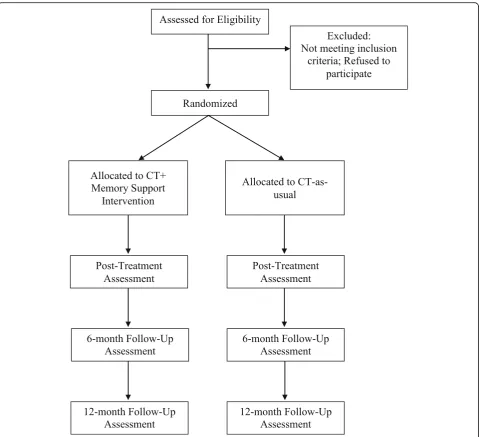
This is a prospective randomized controlled study.
Adults (
n
= 178) who meet criteria for MDD will be
randomly assigned, in a 1:1 parallel group design, to CT
+ Memory Support or CT-as-usual (see Fig. 1 for a flow
chart of the study design). Randomization is stratified by
age (
≤
49, 50 + years) and depression chronicity (< 2 years,
≥
2 years) [46]. Participants receive a battery of outcome
measures pre-treatment and post-treatment (i.e., within
2 weeks after the final treatment session) and at 6 and
12 months
’
follow-up. Additional assessments of patient
and therapist memory for treatment take place in weeks
4, 8, 12 and 16 of treatment for the mediation analysis.
The assessment team is blind to treatment allocation.
Randomization will be conducted using a computerized,
random-number generator where the planned stratified
randomization is a part of the generation of the
alloca-tion sequence. Only the project coordinators in charge
of randomization and of the Memory Support Rating
Scale (MSRS) scoring know the treatment allocation of
each participant. A Data Safety and Monitoring Board
(DSMB) will review the study every 6 months during the
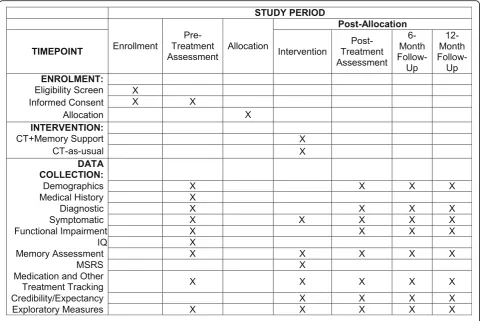
active treatment phase. The Standard Protocol Items:
Recommendations for Interventional Trials (SPIRIT
2013) Checklist (see Additional file 1) and Figure (see
Fig. 2 Standard Protocol Item: Recommendation for
Interventional Trials diagram) are provided [52].
For participants who discontinue, the assessment team
will endeavor to collect all assessment data, prioritizing
the primary outcomes.
Participants
A total of 178 adults who meet the criteria will be
re-cruited. Recruitment will be conducted in the Bay Area,
CA, United States by clinician referral and advertisements.
Eligibility is assessed first by a phone interview and then,
if the individual is eligible after the phone interview, a
more detailed, in-person interview. To enhance
represen-tativeness and generalizability, the inclusion and exclusion
criteria are kept to a minimum.
Inclusion criteria
The inclusion criteria are:
Age 18 + years
Willing and able to give consent. Participants must
consent to being video-recorded (necessary for
MSRS scoring) and to NIMH data sharing
1English language fluency
Diagnosis of major depressive disorder (MDD), first
episode, recurrent or chronic according to the
Diagnostic and Statistical Manual of Mental
Disorders, Fifth Edition
(DSM-5)
Minimum score 26 or above on the Inventory of
Depressive Symptomatology, Self-Report (IDS-SR).
This cutoff denotes at least
“
moderate
”
depression
If taking medications for mood, medications must be
stable for the past 4 weeks
Exclusion criteria
The exclusion criteria are:
History of bipolar disorder
History of psychosis or psychotic features
Lifetime history of failure to respond to four or
more sessions of CBT/CT for depression
Current non-psychotic disorder if it constitutes the
principal diagnosis and if it requires treatment other
than that offered in the project.
“
Principal
”
is defined
as the disorder currently most distressing and
disabling, using a widely accepted severity rating
scale capturing distress and interference (0
–
8, 4 +
indicates clinical severity)
Moderate or severe substance use in the past
6 months where
“
moderate
”
is defined as 4
–
5
symptoms and
“
severe
”
is defined as 6 + symptoms
of those listed in DSM-5 for each of the
substance-related disorders
Evidence of any medical disorder or condition that
could cause depression, preclude participation in
CT, or is associated with memory problems, that is
not currently stabilized and/or managed under the
care of a physician or the presence of an active and
progressive physical illness or neurological
degenerative disease
Current suicide risk sufficient to preclude treatment
on an outpatient basis (assessed by the
Columbia-Suicide Severity Rating Scale) or current homicide
risk (assessed by our staff or referring treatment
provider)
Pregnancy or breastfeeding
Not able/willing to participate in and/or complete
the pre-treatment assessments
stable doses for 4 weeks prior to randomization and
(2) medication use and changes, along with
participa-tion in other treatments/therapy, will be recorded. All
medication decisions will ultimately rest with the
treating physician and participant.
Following the precedent set in prior research [54],
participants with a lifetime history of failure to
re-spond to four or more sessions of CBT for depression
will be excluded. Participants who have engaged in
moderate or severe substance use in the past 6 months
will also be excluded.
“
Moderate
”
substance use is
defined as four to five symptoms and
“
severe
”
substance use is defined as six or more of the
symptoms listed in the DSM-5 for each of the
substance-related disorders.
Measures
The primary and secondary outcomes are presented in
Additional file 2. Additional file 3 lists all of the
mea-sures as well as the timing for administration. Except
where specified in Additional file 3, the measures
de-scribed below will be delivered at each assessment point.
In addition to demographics (age, contact information,
gender, race/ethnicity, family, education, employment,
living arrangements, government assistance, housing)
and assessment of medical history the following
measures will be administered:
Diagnostic
To evaluate current and past psychiatric disorders the
[image:4.595.59.539.86.523.2]will be administered along with the
Longitudinal
Interval Follow-up Evaluation (LIFE)
[57] to further
ascertain presence/absence of MDD, number and length
of mood episodes and remission, response, relapse,
recovery, recurrence and time to relapse or recurrence
(see Additional file 1 for definitions which are drawn
from the ACNP criteria [58]).
Symptomatic
The
IDS-SR
[59], a widely used self-report measure of
depression severity, as well as two subscales (ideation
and behavior) from the lifetime and current version of
the Columbia-Suicide Severity Rating Scale (C-SSRS)
[60
–
62], will be administered. The
Quick Inventory for
Depression Symptomatology
(QIDS) is administered
every treatment session [38] for clinical purposes
(moni-toring of suicide and depression symptoms).
Functional impairment
The
World Health Organization Disability Assessment
Schedule 2.0 (WHODAS 2.0)
[39] as well as the
four-question
“
Healthy Days
”
(CDC HRQOL-4) core module
developed by the CDC [63] will be administered.
IQ
The
National Adult Reading Test (NART)
[64] estimates
premorbid intelligence. The total number of errors are
calculated and used to derive an estimate of full-scale IQ
and verbal IQ.
Memory
The
Patient Treatment Recall Task
[10] and the
Generalization Task
[65] are included as early indicators
of target engagement and the trajectory of recall and
learning over time.
Classical tests of memory
include a test
of declarative memory
—
the
Episodic Face-Name Learning
Task
[66
–
68]
—
which is the domain in which the most
profound declines in MDD are observed [69
–
74].
Working memory will be assessed via the
N-Back
[75]
because working memory aids the formation and
reten-tion of long-term declarative memories via attentive and
elaborative-rehearsal processes [76, 77].
Memory Support Rating Scale (MSRS) [78]
Selected treatment session video-recordings will be
coded using the
MSRS
to establish the dose of memory
support delivered.
[image:5.595.58.541.88.409.2]receiving and any changes in those treatments
through-out the duration of the study.
Treatment credibility/expectancy
is administered at
session 2, post-treatment, 6FU and 12FU via the
Credibility/Expectancy Questionnaire
[79, 80].
Exploratory measures
As this is a relatively new program of research and we
wish to learn as much as possible, we have included the
following measures on a pilot/exploratory basis:
Patient
Usefulness and Utilization of Cognitive Therapy Skills
Scale
(delivered post treatment, 6FU and 12FU), the
Competencies in Cognitive Therapy Scale
[81] (delivered at
post treatment, 6FU and 12FU),
Patient Conceptualization
of Depression Task
(delivered at the pre-treatment
assess-ment, post treatment and 6FU) and a
Memory Support
Treatment Provider Checklist
to be completed by the
ther-apists delivering CT + Memory Support (delivered during
weeks 4, 8, 12 and 16 of the treatment).
Treatments
Both treatments are comprised of 20
–
26 × 50-min
sessions conducted over 16 weeks.
CT-as-usual
CT was developed by Beck et al. [82] and has
incor-porated a number of innovations [83, 84]. Treatment
maneuvers are designed to identify, reality test, and
correct distorted beliefs and information processing
[82]. CT for MDD will be conducted according to the
standard manuals [82, 85, 86].
CT + Memory Support
The Memory Support Intervention is a manualized
ad-junctive treatment that will be delivered alongside
CT-as-usual. The Memory Support Intervention is designed
to improve patient memory for treatment. Distilled from
the cognitive science and education literature based on
carefully honed criteria [18], the Memory Support
Inter-vention is comprised of eight memory-promoting
strat-egies: attention recruitment, categorization, evaluation,
application, repetition, practice remembering, cue-based
reminder and praise recall. These strategies are
pro-actively, strategically and intensively integrated into
treatment-as-usual to support encoding. Memory
sup-port is delivered alongside each
“
treatment point,
”
defined as a main idea, principle, or experience that the
treatment provider wants the patient to remember or
implement as part of the treatment [10]. We
acknow-ledge that some memory support is a standard part of
certain treatments, including CBT [84, 87]. In the
present study, the two treatment arms will differ in the
“
dose
”
of memory support. An underpowered pilot study
indicated
that
the
Memory
Support
Intervention
effectively increases the amount of memory support
de-livered and improves depression outcome on certain
measures [34].
Intervention fidelity
Treatment session video-recordings that occur at session
2 and at weeks 4, 8, 12 and 16 are coded using the
MSRS [78] to establish the dose of memory support
de-livered. CT + Memory Support therapists are blind to
which sessions are coded. CT-as-usual therapists are
blind to the memory support portion of the research.
To reduce expectations impacting the delivery of each
arm and to ensure purity of delivery [88], each treatment
provider will be allocated to deliver only one of the two
treatments. The rationale is that therapists report that
once they have mastered memory support it is difficult
to deliver CT-as-usual.
Clinicians use a treatment manual and receive weekly
supervision to standardize treatment administration.
Treatment sessions are video- and audio-taped and a
random selection are rated using the
Cognitive Therapy
Rating Scale
[89] which is a measure of general
interven-tion skills and CBT-specific skills. The goal of this
inter-vention is to maintain consistency and ensure adherence
to the protocols [89].
Data analysis
Preliminary data evaluation
Missing or aberrant data will be verified. Data will be
audited for quality and completeness. Evaluation of
dis-tributions detects outliers and ensures that assumptions
of planned analyses are met. Baseline differences
be-tween groups will be examined (e.g., IQ, demographics,
psychiatric and medical comorbidity, medications).
Stat-istical tests will not be used to select covariates in the
primary intent-to-treat analysis [90
–
92]. Instead, the
potential influences of baseline differences will be
evalu-ated as moderators. If remedial training is given to a
therapist whose adherence to the treatment protocol is
not satisfactory, this will be included as a dummy-coded
covariate in all analyses.
Multiple testing
We will use alpha = .05 for each primary hypothesis. For
multiple testing conducted within each main hypothesis,
we will adopt a stepwise multiple comparison procedure
that is considered more powerful than the widely used
Bonferroni correction [93, 94].
Missing data
will be added as predictors to reduce bias due to data
missing not at random.
Hypothesis 1
CT + Memory Support will be superior to CT-as-usual
for improving course of illness and reducing functional
impairment at post-treatment, 6FU and 12FU on
primary outcomes
listed in Additional file 1. Treatment
groups will be compared on categorical outcomes (e.g.,
remission, relapse) using logistic regression to evaluate
the odds of remission at post-treatment, and the odds of
relapse at 6FU and 12FU. For the continuous variables
(e.g., IDS-SR), we will test for differences in the mean
trajectories across time between CT + Memory Support
and CT-as-usual using Hierarchical Linear Modeling
(HLM) [96
–
98]. The 1st level will represent
within-person variation, and will include time indicators (or
dummy variables) as predictors (post-treatment, 6FU
and 12FU, with baseline as reference). The 2nd level
rep-resents between-person variation in the intercept and
coefficients of the time indicators, and will include a
dummy variable for arm (CT + Memory Support vs.
CT-as-usual) as the predictor variable. Interactions between
arm and the time indicators will be retained only if
found to be significant at the 5% level using
likelihood-ratio tests. Significant interaction terms between arm
and time indicator suggest that there are different
trajec-tories across time and between arms, and will be
graphed to interpret the interaction.
Hypothesis 2
Relative to CT-as-usual, the relationship between CT
+ Memory Support and better treatment outcome will
be
mediated
by
patient
memory
for
treatment
.
Outcome will be measured by IDS-SR at post-treatment,
6FU and 12FU. Patient memory will be measured by the
Patient Treatment Recall Task and the Generalization
Task at weeks 4, 8, 12 and 16 of treatment. A mediation
model will be specified using Structural Equation
Modeling [99]. Indirect effects from CT + Memory
Support to better treatment outcome via patient
memory will be assessed.
Hypothesis 3
The relationship between treatment condition and
out-come will be moderated by poorer response subgroups;
namely, older age, lower IQ, more chronic depression,
poorer baseline declarative memory performance and
fewer years of education. IQ will be estimated with the
NART. Chronicity will be defined as current episode
greater than or equal to 2 years [46]. Declarative
mem-ory will be quantified as described in Additional file 1.
To assess whether Memory Support is more beneficial
for any of the patient subgroups, moderation will be
tested as an interaction between potential moderator
and treatment arm; in the HLMs, the interaction
be-tween any of these variables, time, and treatment group
will be tested.
Intervention fidelity check
MSRS scores will be compared for CT + Memory
Sup-port vs. CT-as-usual via independent samples
t
tests. To
test the assumption that memory for CT session content
improves as a result of CT + Memory Support we will
use HLMs to analyze differences in linear rates of
change between the two groups on the Patient
Treat-ment Recall Task and Generalization Task delivered
during weeks 4, 8, 12 and 16 of the treatment phase and
at 6FU and 12FU.
Additional planned analyses
1.
Is CT + Memory Support associated with longer
time-to-relapse relative to CT-as-usual?
Survival analyses
[
100
] will be conducted. The Kaplan-Meier product
limit method will be used to generate survival curves
for the two treatment conditions [
101
]. Cox
regression will be applied to test for group
differences.
2.
Are demographics, psychiatric and medical
comorbidity, medications and symptom severity
moderators?
This will be tested by adding the
product of arm and the moderator variable to
regression models or HLMs [
102
,
103
]. A significant
coefficient for the interaction term would indicate a
moderating effect, and will be followed up with
graphs to determine the nature of the effect
modification [
102
].
3.
Does memory for treatment improve simply because
memory deficits resolve with successful treatment?
Linear regressions will evaluate whether change in
pre-post IDS and pre-post declarative and working
memory each independently predict week 4 to
post-treatment differences in Patient Recall Task
per-formance. If significant, we will conduct a
hierarchical linear regression to evaluate whether
pre-post change in IDS scores predicts pre-post
change in Patient Treatment Recall Task
performance beyond pre-post improvement in
memory.
5.
Number of sessions received
(range 20
–
26 sessions)
will be added as a covariate to control for differences
in this across participants.
Power analysis
Based on the pilot study [34], using Glimmpse [104,
105] for repeated measures design, we took into account
the four repeated measurements (pre-treatment,
post-treatment, 6FU, 12FU). At an alpha level of 0.05 with
80% power, the sample size is estimated to be 80 for the
IDS-SR. We also used G*Power and the Demidenko
[106] method to calculate estimated sample size for
bin-ary mood outcomes (i.e., remission, relapse). The sample
sizes are estimated to be 103 (remission) and 118
(re-lapse). Finally, Fritz and MacKinnon [107] provide
rec-ommendations for mediation sample size, and estimates
from pilot data indicate that the recommended sample
size is 148. Adding an additional 20% for possible
attri-tion, we propose a sample of 178.
Discussion
This study protocol addresses several research priorities.
First, following the experimental therapeutics approach
[108], this study protocol describes a confirmatory
effi-cacy trial to provide a definitive test of the hypothesis
that a novel target
—
patient memory for the contents of
treatment
—
probed with a novel intervention
—
the
Mem-ory Support Intervention
—
will improve clinical
out-come. Second, a novel intervention derived from basic,
non-patient research in cognitive science and education,
will be tested in the service of improving outcomes for
patients with severe mental disorders. Third, the
Mem-ory Support Intervention has been derived to be
“
transdiagnostic
”
(relevant to a broad range of mental
disorders) and
“
pantreatment
”
(relevant to a broad range
of types of treatment). However, investigating these
pos-sible broader applications seems premature without first
establishing efficacy, which is the aim of the study
de-scribed in this protocol. If the results are promising,
fu-ture directions will test the applicability to a broad range
of biopsychosocial interventions for a wide range of
pa-tient populations being treated at various medical and
mental health settings.
Trial status
The trial is funded for 4 years (Project ID Number:
R01MH108657). The research staff team started setting
up the study in September, 2016. Patients were first
ran-domized in December, 2016. The treatment phase will
be completed by August of 2019. Final outcome
assess-ments will be complete by August of 2020.
Endnotes
1This was added in July, 2017. NIH/NIMH
data-sharing
requirements
necessitated
reconsent
of
participants already randomized. If a patient does not
agree to data sharing we have been instructed to exclude
them from the analysis.
Additional files
Additional file 1:SPIRIT 2013 Checklist. (DOC 122 kb)
Additional file 2:Summary of primary and secondary outcome(s). (DOCX 13 kb)
Additional file 3:Timeframe for Assessments. Table indicating time points where assessments are conducted. (DOCX 46 kb)
Abbreviations
12FU:12-months’follow-up assessment; 6FU: 6-months’follow-up assess-ment; ACNP: American College of Neuropsychopharmacology;
CBT: Cognitive behavior therapy; CEQ: Credibility/Expectancy Questionnaire; C-SSRS: Columbia-Suicide Severity Rating Scale; CT: Cognitive therapy; CTRS: Cognitive Therapy Rating Scale; DSM-5:Diagnostic and Statistical Manual of Mental Disorders, Fifth Edition; DSMB: Data and Safety Monitoring Board; HLM: Hierarchical Linear Modeling; IDS-SR: Inventory of Depressive Symptoms, Self-Report; LIFE: Longitudinal Interval Follow-up Evaluation; MDD: Major depressive disorder; MSRS: Memory Support Rating Scale; NART: National Adult Reading Test; NIMH: National Institutes of Mental Health; QIDS: Quick Inventory of Depressive Symptoms; SEM: Structural Equation Modeling; SPIRIT 2013: Standard Protocol Items: Recommendations for Interventional Trials; WHODAS 2.0: The World Health Organization Disability Assessment Schedule 2.0
Acknowledgements
This study is funded by the National Institute of Mental Health (R01MH108657). The DSMB is composed of three members: Dr. John McQuaid, PhD, Dr. Jutta Joormann, PhD and Dr. Hao Wu.
The DSMB reviews progress and safety of study procedures twice per year and are responsible for safe guarding the interests of study participants. This committee is independent of the sponsor.
Funding
This study is funded by the National Institute of Mental Health (R01MH108657). The funding agency has/had no role in the design, collection, management, analysis, or interpretation of data; the writing of the manuscript; or the decision to submit the study protocol for publication. The funding agency has no ultimate authority over any of these activities.
Availability of data and materials
Not applicable
Authors’contributions
AGH developed the study concept. AGH, LD, JL, SH and S R-H contributed to the acquisition of the funding. AGH and JL contributed to developing the Memory Support Intervention. SDH, KHa and AGH trained the therapists. AGH, NBG, KHe, MM, CW, HN, AM, GZ and CA are responsible for the acquisition of data and the measurement of memory. LD, AM and S R-H are responsible for the analysis and interpretation of data. AGH drafted the manuscript. All authors have been involved in revising the manuscript. All authors read and approved the final manuscript. Other than the authors and compliance with data-sharing agreements stipulated by NIH, no other entities have contractual agreements with regard to access to the final dataset.
Ethics approval and consent to participate
followed by a written informed consent which is obtained at the beginning of the pre-assessment, which confirms eligibility, by a member of the assessment team. Adverse events and other unintended effects will be report to CPHS and NIH, following the rules stipulated by these two oversight bodies. If important protocol modifications are made these will be reviewed by CPHS and reported on ClinicalTrials.gov.
Consent for publication
Not applicable
Competing interests
The authors declare that they have no competing interests.
Publisher
’
s Note
Springer Nature remains neutral with regard to jurisdictional claims in published maps and institutional affiliations.
Author details
1Department of Psychology, University of California, Berkeley, 3210 Tolman
Hall #1650, Berkeley, CA 94720-1650, USA.2Vanderbilt University, Nashville, TN, USA.
Received: 25 August 2017 Accepted: 23 October 2017
References
1. Bober SL, Hoke LA, Duda RB, Tung NM. Recommendation recall and satisfaction after attending breast/ovarian cancer risk counseling. J Genet Couns. 2007;16:755–62.
2. Jansen J, Butow PN, van Weert JC, van Dulmen S, Devine RJ, Heeren TJ, et al. Does age really matter? Recall of information presented to newly referred patients with cancer. J Clin Oncol. 2008;26:5450–7.
3. Pickney CS, Arnason JA. Correlation between patient recall of bone densitometry results and subsequent treatment adherence. Osteoporos Int. 2005;16:1156–60.
4. Lewkovich GN, Haneline MT. Patient recall of the mechanics of cervical spine manipulation. J Manipulative Physiol Ther. 2005;28:708–12. 5. Croyle RT, Loftus EF, Barger SD, Sun YC, Hart M, Gettig J. How well do
people recall risk factor test results? Accuracy and bias among cholesterol screening participants. Health Psychol. 2006;25:425–32.
6. Mcguire LC. Remembering what the doctor said: organization and adults’ memory for medical information. Exp Aging Res. 1996;22(4):403–28. 7. Ley P. Memory for medical information. Br J Soc Clin Psychol. 1979;18:
245–55.
8. Jansen J, van Weert J, van der Meulen N, van Dulmen S, Heeren T, Bensing J. Recall in older cancer patients: measuring memory for medical information. Gerontologist. 2008;48(2):149–57.
9. Chambers MJ. Patient recall of recommendations in the behavioural treatment of insomnia. Sleep Res. 1991;20:222.
10. Lee J, Harvey AG. Memory for therapy in bipolar disorder and comorbid insomnia. J Consult Clin Psychol. 2015;83:92–102. PubMed Central PMCID: PMCPMC4323885.
11. Flocke SA, Stange KC. Direct observation and patient recall of health behavior advice. Prev Med. 2004;38:343–9.
12. Tosteson AN, Grove MR, Hammond CS, Moncur MM, Ray GT, Hebert GM, et al. Early discontinuation of treatment for osteoporosis. Am J Med. 2003; 115:209–16.
13. Cox DJ, Tisdelle DA, Culbert JP. Increasing adherence to behavioral homework assignments. J Behav Med. 1988;11(5):519–22.
14. Linn AJ, van Dijk L, Smit EG, Jansen J, van Weert JC. May you never forget what is worth remembering: the relation between recall of medical information and medication adherence in patients with inflammatory bowel disease. J Crohn’s Colitis. 2013;7(11):e543–50.
15. Ley P, Jain V, Skilbeck C. A method for decreasing patients’medication errors. Psychol Med. 1977;6(04):599–601.
16. Kravitz RL, Hays RD, Sherbourne CD, DiMatteo MR, Rogers WH, Ordway L, et al. Recall of recommendations and adherence to advice among patients with chronic medical conditions. Arch Intern Med. 1993;153:1869–78. 17. Simpson HB, Maher MJ, Wang Y, Bao Y, Foa EB, Franklin M. Patient
adherence predicts outcome from cognitive behavioral therapy in obsessive-compulsive disorder. J Consult Clin Psychol. 2011;79(2):247.
18. Harvey AG, Lee J, Williams J, Hollon SD, Walker MP, Thompson MA, et al. Improving outcome of psychosocial treatments by enhancing memory and learning. Perspect Psychol Sci. 2014;9:161–79. PubMed Central PMCID: PMCPMC4276345.
19. Schacter D. The seven sins of memory: how the mind forgets and remembers. New York City: Houghton Mifflin; 2001.
20. Easterbrook JA. The effect of emotion on cue utilization and the organization of behavior. Psychol Rev. 1959;66:183–201. PubMed PMID: 1961-03074-001. 21. Thorndike EL. The fundamentals of learning. New York: Teacher’s College
Bureau of Publications; 1932.
22. Barnett SM, Ceci SJ. When and where do we apply what we learn? A taxonomy for far transfer. Psychol Bull. 2002;128:612.
23. Behnken A, Schöning S, Gerss J, Konrad C, de Jong-Meyer R, Zwanzger P, et al. Persistent non-verbal memory impairment in remitted major
depression—caused by encoding deficits? J Affect Disord. 2010;122:144–8. 24. Robinson LJ, Thompson JM, Gallagher P, Goswami U, Young AH, Ferrier IN, et al. A meta-analysis of cognitive deficits in euthymic patients with bipolar disorder. J Affect Disord. 2006;93:105–15.
25. Varga M, Magnusson A, Flekkoy K, David AS, Opjordsmoen S. Clinical and neuropsychological correlates of insight in schizophrenia and bipolar I disorder: does diagnosis matter? Compr Psychiatry. 2007;48:583–91. 26. Jelinek L, Jacobsen D, Kellner M, Larbig F, Biesold K-H, Barre K, et al. Verbal
and nonverbal memory functioning in posttraumatic stress disorder (PTSD). J Clin Exp Neuropsychol. 2006;28:940–8.
27. Airaksinen E, Larsson M, Forsell Y. Neuropsychological functions in anxiety disorders in population-based samples: evidence of episodic memory dysfunction. J Psychiatr Res. 2005;39:207–14.
28. Bruce JM, Hancock LM, Arnett P, Lynch S. Treatment adherence in multiple sclerosis: association with emotional status, personality, and cognition. J Behav Med. 2010;33(3):219–27.
29. Insel K, Morrow D, Brewer B, Figueredo A. Executive function, working memory, and medication adherence among older adults. J Gerontol B Psychol Sci Soc Sci. 2006;61(2):102–7.
30. Ley P, Bradshaw P, Eaves D, Walker C. A method for increasing patients’ recall of information presented by doctors. Psychol Med. 1973;3:217–20. 31. Bamidis PD, Vivas AB, Styliadis C, Frantzidis C, Klados M, Schlee W, Siountas
A, Papageorgiou SG. A review of physical and cognitive interventions in aging. Neurosci Biobehav Rev. 2014;44:206–20.
32. Almkvist O, Fratiglioni L, Agüero-Torres H, Viitanen M, Bäckman L. Cognitive support at episodic encoding and retrieval: similar patterns of utilization in community-based samples of Alzheimer’s disease and vascular dementia patients. J Clin Exp Neuropsychol. 2010;21:816–30.
33. Bunce D. Cognitive support at encoding attenuates age differences in recollective experience among adults of lower frontal lobe function. Neuropsychology. 2003;17:353–61.
34. Harvey AG, Lee J, Smith RL, Gumport NB, Hollon SD, Rabe-Hesketh S, et al. Improving outcome for mental disorders by enhancing memory for treatment. Behav Res Ther. 2016;81:35–46.
35. Lopez AD, Mathers CD. Measuring the global burden of disease and epidemiological transitions: 2002–2030. Ann Trop Med Parasitol. 2006; 100(5-6):481–99.
36. Mathers CD, Loncar D. Projections of global mortality and burden of disease from 2002 to 2030. PLoS Med. 2006;3(11):e442.
37. Eaton WW, Shao H, Nestadt G, Lee BH, Bienvenu OJ, Zandi P. Population-based study of first onset and chronicity in major depressive disorder. Arch Gen Psychiatry. 2008;65(5):513–20.
38. Rush A, Trivedi M, Ibrahim H, Carmody T, Arnow B, Klein D, et al. The 16-item Quick Inventory of Depressive Symptomatology (QIDS) Clinician Rating (QIDS-C) and Self-Report (QIDS-SR): a psychometric evaluation in patients with chronic major depression. Biol Psychiatry. 2003;54:573–83. 39. World Health Organization. 2.0: WHODAS 2.0. 2011.
40. Dong L, Lee JY, Harvey AG. Memory support strategies and bundles: a pathway to improving cognitive therapy for depression? J Consult Clin Psychol. 2017;85(3):187.
41. Dong L, Zhao X, Ong SL, Harvey AG. Patient recall of specific cognitive therapy contents predicts adherence and outcome. Behav Res Ther. 2017; 97:189–99.
43. Cuijpers P, Berking M, Andersson G, Quigley L, Kleiboer A, Dobson KS. A meta-analysis of cognitive-behavioural therapy for adult depression, alone and in comparison with other treatments. Can J Psychiatry. 2013;58:7. 44. Bockting CL, Hollon SD, Jarrett RB, Kuyken W, Dobson K. A lifetime
approach to major depressive disorder: the contributions of psychological interventions in preventing relapse and recurrence. Clin Psychol Rev. 2015; 41:16–26.
45. Jarrett RB, Minhajuddin A, Kangas JL, Friedman ES, Callan JA, Thase ME. Acute phase cognitive therapy for recurrent major depressive disorder: who drops out and how much do patient skills influence response? Behav Res Ther. 2013;51(4):221–30.
46. Fournier JC, DeRubeis RJ, Shelton RC, Hollon SD, Amsterdam JD, Gallop R. Prediction of response to medication and cognitive therapy in the treatment of moderate to severe depression. J Consult Clin Psychol. 2009;77(4):775.
47. Majer M, Ising M, Künzel H, Binder EB, Holsboer F, Modell S, et al. Impaired divided attention predicts delayed response and risk to relapse in subjects with depressive disorders. Psychol Med. 2004;34:1453–63.
48. Bearden CE, Glahn DC, Monkul ES, Barrett J, Najt P, Villarreal V, et al. Patterns of memory impairment in bipolar disorder and unipolar major depression. Psychiatry Res. 2006;142(2):139–50.
49. Deuschle M, Kniest A, Niemann H, Erb-Bies N, Colla M, Hamann B, et al. Impaired declarative memory in depressed patients is slow to recover: clinical experience. Pharmacopsychiatry. 2004;37(04):147–51. 50. Bremner JD, Vythilingam M, Vermetten E, Vaccarino V, Charney DS.
Deficits in hippocampal and anterior cingulate functioning during verbal declarative memory encoding in midlife major depression. Am J Psychiatry. 2004;161(4):637–45.
51. Douglas KM, Porter RJ. Longitudinal assessment of neuropsychological function in major depression. Aust N Z J Psychiatry. 2009;43(12):1105–17. 52. Chan A-W, Tetzlaff JM, Gøtzsche PC, Altman DG, Mann H, Berlin JA, et al. SPIRIT 2013 explanation and elaboration: guidance for protocols of clinical trials. BMJ. 2013;346:e7586.
53. Daumit GL, Dickerson FB, Wang N-Y, Dalcin A, Jerome GJ, Anderson CA, et al. A behavioral weight-loss intervention in persons with serious mental illness. N Engl J Med. 2013;368(17):1594–602.
54. McGrath CL, Kelley ME, Dunlop BW, Holtzheimer III PE, Craighead WE, Mayberg HS. Pretreatment brain states identify likely nonresponse to standard treatments for depression. Biol Psychiatry. 2014;76(7):527–35. 55. First MB, Spitzer RL, Gibbon M, Williams JBW. Structured clinical interview
for DSM-V Axis 1 disorders administration booklet. New York: American Psychiatric Press; 2013.
56. First MB, Williams JBW, Karg RS, Spitzer RL. Structured Clinical Interview for DSM-5 Disorders (SCID-5-RV, FEB 2014 revision). New York: Biometrics Research Department, Columbia University; 2014.
57. Keller MB, Lavori PW, Friedman B, Nielsen E, Endicott J, McDonald S, et al. The longitudinal interval follow-up evaluation: a comprehensive method for assessing outcome in prospective longitudinal studies. Arch Gen Psychiatry. 1987;44:540–8. PubMed PMID: 1988-01549-001.
58. Rush AJ, Kraemer HC, Sackeim HA, Fava M, Trivedi MH, Frank E, et al. Report by the ACNP Task Force on response and remission in major depressive disorder. Neuropsychopharmacology. 2006;31(9):1841–53.
59. Trivedi MH, Rush AJ, Ibrahim HM, Carmody TJ, Biggs MM, Suppes T, et al. The Inventory of Depressive Symptomatology, Clinician Rating (IDS-C) and Self-Report (IDS-SR), and the Quick Inventory of Depressive
Symptomatology, Clinician Rating (QIDS-C) and Self-Report (QIDS-SR) in public sector patients with mood disorders: a psychometric evaluation. Psychol Med. 2004;34:73–82.
60. Center for Drug Evaluation and Research. Guidance for industry: suicidal ideation and behavior: prospective assessment of occurrence in clinical trials. Rockville: U.S. Department of Health and Human Services, U.S. Food and Drug Administration; 2012.
61. Mundt JC, Greist JH, Jefferson JW, Federico M, Mann JJ, Posner K. Prediction of suicidal behavior in clinical research by lifetime suicidal ideation and behavior ascertained by the electronic Columbia-Suicide Severity Rating Scale. J Clin Psychiatry. 2013;74(9):887–93.
62. Posner K, Brown GK, Stanley B, Brent DA, Yershova KV, Oquendo MA, Currier GW, Melvin GA, Greenhill L, Shen S, Mann JJ. The Columbia–Suicide Severity Rating Scale: initial validity and internal consistency findings from three multisite studies with adolescents and adults. Am J Psychiatry. 2011;168(12): 1266–77.
63. Moriarty D, Zack M, Kobau R. The Centers for Disease Control and Prevention’s Healthy Days Measures: population tracking of perceived physical and mental health over time. Health Qual Life Outcomes. 2003;1(1):37.
64. Nelson HE, Willison J. National Adult Reading Test (NART). Windsor: NFER-Nelson; 1991.
65. Gumport NB, Williams JJ, Harvey AG. Learning cognitive behavior therapy. J Behav Ther Exp Psychiatry. 2015;48:164–9. PubMed Central PMCID: PMCPMC4426215.
66. Mander BA, Santhanam S, Saletin JM, Walker MP. Wake deterioration and sleep restoration of human learning. Curr Biol. 2011;21:R183–4.
67. Miller SL, Celone K, DePeau K, Diamond E, Dickerson BC, Rentz D, et al. Age-related memory impairment associated with loss of parietal deactivation but preserved hippocampal activation. Proc Natl Acad Sci. 2008;105(6):2181–6.
68. Sperling R, Bates J, Chua E, Cocchiarella A, Rentz D, Rosen B, et al. fMRI studies of associative encoding in young and elderly controls and mild Alzheimer’s disease. J Neurol Neurosurg Psychiatry. 2003;74(1):44–50. 69. Taconnat L, Baudouin A, Fay S, Raz N, Bouazzaoui B, El-Hage W, et al.
Episodic memory and organizational strategy in free recall in unipolar depression: the role of cognitive support and executive functions. J Clin Exp Neuropsychol. 2010;32:719–27.
70. Danion JM, Willard-Schroeder D, Zimmermann MA, Grangé D, Schlienger JL, Singer L. Explicit memory and repetition priming in depression. Preliminary findings Arch Gen Psychiatry. 1991;48:707–11.
71. Jermann F, Van der Linden M, Adam S, Ceschi G, Perroud A. Controlled and automatic uses of memory in depressed patients: effect of retention interval lengths. Behav Res Ther. 2005;43:681–90.
72. Calev A, Erwin PG. Recall and recognition in depressives: use of matched tasks. Br J Clin Psychol. 1985;24:127–8.
73. Ellwart T, Rinck M, Becker ES. Selective memory and memory deficits in depressed inpatients. Depress Anxiety. 2003;17:197–206.
74. Hertel PT, Milan S. Depressive deficits in recognition: dissociation of recollection and familiarity. J Abnorm Psychol. 1994;103:736–42. 75. Kirchner WK. Age differences in short-term retention of rapidly changing
information. J Exp Psychol. 1956;55:352–8.
76. Cowan N. What are the differences between long-term, short-term, and working memory? Prog Brain Res. 2008;169:323–38.
77. Ericsson KA, Kintsch W. Long-term working memory. Psychol Rev. 1995;102(2):211.
78. Lee JY, Worrell FC, Harvey AG. The Development and Validation of the Memory Support Rating Scale (MSRS). Psychol Assess. 2016;28(6):715–25. 79. Devilly GJ, Borkovec TD. Psychometric properties of the credibility/
expectancy questionnaire. J Behav Ther Exp Psychiatry. 2000;31:73–86. PubMed PMID: 2000-12660-001.
80. Devilly GJ, Spence SH. The relative efficacy and treatment distress of EMDR and a cognitive-behavior trauma treatment protocol in the amelioration of posttraumatic stress disorder. J Anxiety Disord. 1999;13:131–57. PubMed PMID: 1999-13238-007.
81. Strunk DR, Hollars SN, Adler AD, Goldstein LA, Braun JD. Assessing patients’ cognitive therapy skills: initial evaluation of the competencies of Cognitive Therapy Scale. Cogn Ther Res. 2014;38(5):559.
82. Beck AT. Cognitive therapy of depression. New York: Guilford Press; 1979. p. 425.
83. Bennett-Levy J, Butler G, Fennell MJV, Hackmann A, Mueller M, Westbrook D. The Oxford handbook of behavioural experiments. Oxford: Oxford University Press; 2004.
84. Beck JS. Cognitive therapy: basics and beyond. New York: Guilford Press; 1995.
85. Beck JS. Cognitive therapy: basics and beyond. 2nd ed. New York: Guilford Press; 2011.
86. Greenberger D, Padesky CA. Mind over mood: change how you feel by changing the way you think. New York: Guilford Press; 2015.
87. Beck JS. Cognitive therapy for challenging problems: what to do when the basics don’t work. New York: Guilford Press; 2005. p. 324.
88. Manber R, Edinger JD, Gress JL, San Pedro-Salcedo MG, Kuo TF, Kalista T. Cognitive behavioral therapy for insomnia enhances depression outcome in patients with comorbid major depressive disorder and insomnia. Sleep. 2008;31:489–95.
89. Young J, Beck AT. The development of the Cognitive Therapy Scale. 1980. 90. Beach ML, Meier P. Choosing covariates in the analysis of clinical trials.
91. Canner PL. Covariate adjustment of treatment effects in clinical trials. Control Clin Trials. 1991;12:359–66.
92. Senn SJ. Covariate imbalance and random allocation in clinical trials. Stat Med. 1989;8:467–75.
93. Nakagawa S. A farewell to Bonferroni: the problems of low statistical power and publication bias. Behav Ecol. 2004;15:1044–5. PubMed PMID: 2004-19626-022.
94. Shaffer JP. Multiple hypothesis testing. Annu Rev Psychol. 1995;46(1):561–84. 95. Little RJ, Rubin DB. Statistical analysis with missing data. 2nd ed. New York:
Wiley; 2002.
96. Raudenbush S, Bryk A. Hierarchical linear models. Thousand Oaks: Sage; 2002.
97. Goldstein H. Multilevel statistical models. 4th ed. Chichester: Wiley; 2010. 98. Hox J. Multilevel analysis: techniques and applications. NY: Routledge; 2010. 99. Hayes AF. Introduction to mediation, moderation, and conditional process
analysis: a regression-based approach. New York: Guilford Press; 2013. 100. Greenhouse JB, Stangl D, Bromberg J. An introduction to survival analysis:
statistical methods for analysis of clinical trial data. J Consult Clin Psychol. 1989;57:536–44.
101. Kaplan E, Meier P. Nonparametric estimation from incomplete observations. J Am Stat Assoc. 1958;53:457–81.
102. Cohen J, Cohen P, West S, Aiken L. Applied multiple regression/correlation analysis for the behavioral sciences. 3rd ed. New Jersey: Lawrence Erlbaum Associates; 2003.
103. Jaccard J, Wan CK, Turrisi R. The detection and interpretation of interaction effects between continuous variables in multiple regression. Multivar Behav Res. 1990;25(4):467–78.
104. Guo Y, Logan HL, Glueck DH, Muller KE. Selecting a sample size for studies with repeated measures. BMC Med Res Methodol. 2013;13(1):100. 105. Kreidler SM, Muller KE, Grunwald GK, Ringham BM, Coker-Dukowitz ZT,
Sakhadeo UR, et al. GLIMMPSE: online power computation for linear models with and without a baseline covariate. J Stat Softw. 2013;54:10.
106. Demidenko E. Sample size determination for logistic regression revisited. Stat Med. 2007;26(18):3385–97.
107. Fritz MS, MacKinnon DP. Required sample size to detect the mediated effect. Psychol Sci. 2007;18(3):233–9.
108. Insel TR, Gogtay N. National Institute of Mental Health clinical trials: new opportunities, new expectations. JAMA Psychiat. 2014;71(7):745–6.
• We accept pre-submission inquiries
• Our selector tool helps you to find the most relevant journal • We provide round the clock customer support
• Convenient online submission • Thorough peer review
• Inclusion in PubMed and all major indexing services • Maximum visibility for your research
Submit your manuscript at www.biomedcentral.com/submit