A New Genetic Algorithm Applied to Multi-Objectives
Optimal of Upgrading Infrastructure in NGWN
Dac-Nhuong Le1, Nhu Gia Nguyen2, Dac Binh Ha2, Vinh Trong Le3 1
Faculty of Information Technology, Haiphong University, Haiphong, Vietnam 2
Duytan University, Danang, Vietnam 3
Hanoi University of Science, Vietnam National University, Hanoi, Vietnam
Email: [email protected], [email protected], [email protected], [email protected]
Received June, 2013
ABSTRACT
A problem of upgrading to the Next Generation Wireless Network (NGWN) is backward compatibility with pre-existing networks, the cost and operational benefit of gradually enhancing networks, by replacing, upgrading and installing new wireless network infrastructure elements that can accommodate both voice and data demand. In this pa-per, we propose a new genetic algorithm has double population to solve Multi-Objectives Optimal of Upgrading Infra-structure (MOOUI) problem in NGWN. We modeling network topology for MOOUI problem has two levels in which mobile users are sources and both base stations and base station controllers are concentrators. Our objective function is the sources to concentrators connectivity cost as well as the cost of the installation, connection, replacement, and capac-ity upgrade of infrastructure equipment. We generate two populations satisfy constraints and combine them to build solutions and evaluate the performance of my algorithm with data randomly generated. Numerical results show that our algorithm is a promising approach to solve this problem.
Keywords: Multi-Objectives Optimal; Next Generation Wireless Network; Network Design; Capacity Planning; Genetic Algorithm; Two-populations
1. Introduction
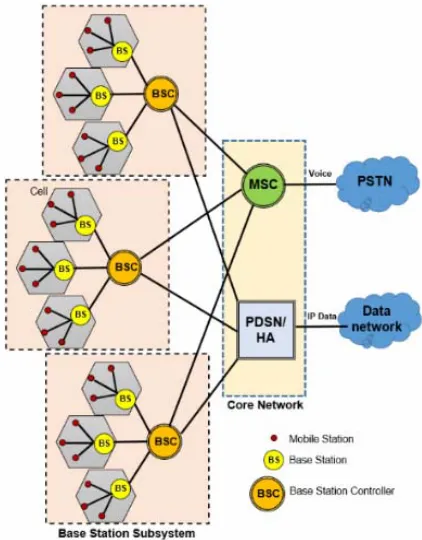
The Next Generation Wireless Networks (NGWNs) are expected to provide high data rate and optimized quality of service to multimedia and real-time applications over the Internet Protocol networks to anybody, anywhere, and anytime. The wireless network infrastructure consists of equipment required by mobile network operators to enable mobile telephony calls or to connect fix subscribers by radio technology. The interacting layers architecture of next generation wireless network is shown in Figure 1.
The PSTN-cloud covers all network elements to make a standard telephone call, while the data network cloud includes the Internet, Intranets, and other IP based net- works [1]. The architectural building blocks enabling mobile telephony are:
The core network: comprised of the mobile switching centers (MSC), the packet data serving nodes (PDSN), and home agents (HA), and
The base station subsystem (BSS) also known as the radio access network, consisting of base sta- tion controllers (BSC), base transceiver stations
[image:1.595.316.527.442.712.2]Corresponding to the architectural building blocks of a wireless network, are three types of interconnects [2]. These are (1) mobile device to BS interconnect, which includes both forward and reverse radio links, (2) the BS to BSC interconnect, which is called the backhaul, and (3) BSC to MSC interconnect. The known hierarchical ca-pacitated concentrator location problem, which is an ex- tension of the concentrator location problem to multiple levels and a classical research issue in the telecommuni-cations literature [3-6]. In [7], the authors studied the base station location and service assignment problem in a W-CDMA. A greedy strategy to optimal positioning of BSs for cellular radio networks and capacity planning of UMTS networks studied in [8-9]. A Tabu search and Genetic algorithm approach to cellular capacity expan- sion to maximizing the coverage area and minimizing the number of transmitters is presented in [10,11]. Yu et al in [12] proposed a set covering algorithm for given traffic and finding optimal solution configuration in a CDMA network. An alternate approach to capacity planning and expansion is introduced for 3G network system capacity without an increase in BSs using a cell splitting approach [13].
In latest papers [14-18], we have proposed a novel Particle Swarm Optimization (PSO), Ant Colony Opti- mization (ACO) and Genetic algorithms (GA) to optimal location of controllers in wireless networks and cen- tralized wireless access network. In this paper, we focus on the Multi-Objectives Optimal of Upgrading Infra- structure (MOOUI) in NGWN and propose a new Ge- netic algorithm to solve it. The rest of this paper is or- ganized as follows: Section 2 presents the MOOUI prob- lem formulation. Section 3 presents our new algorithm to solve it based on GA algorithm. Section 4 is our simula- tion and analysis results, and finally, section 5 concludes the paper.
2. Problemformulation
In this section, we assume that network topology has m
mobile users, n base stations, and p base station controllers.
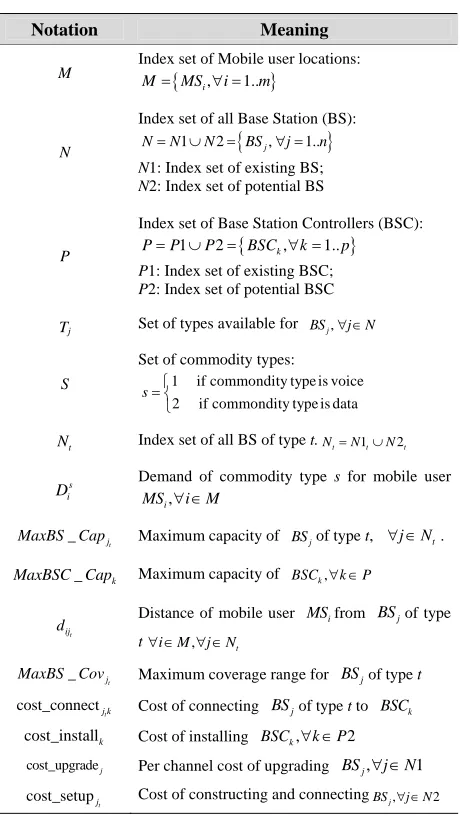
we introduce the following notation in Table 1 below.
The MOOUI problem in NGWN has two steps the ini- tial assignment of MSs to BS and the connection of BS to BSC and capacity expansion and traffic increase with constraint specifies that:
Each mobile user MSi will be assigned to exactly
one base station BSj of type t
Mobile usersare within that base stations’ maxi-
mum range MaxBS_Cov
At most one base station of type t can exist at lo-
cation j
if a base station BSj is operated, it has to be con-
[image:2.595.309.539.95.504.2]nected to a BSCk and the BSC has to be active.
Table 1. Notation defininition.
Notation Meaning
M Index set of Mobile user locations: , 1..
i M MS i m
N
Index set of all Base Station (BS):
1 2 j, 1..
NN N BS j n
N1: Index set of existing BS; N2: Index set of potential BS
P
Index set of Base Station Controllers (BSC):
1 2 k, 1.. PP P BSC k p
P1: Index set of existing BSC; P2: Index set of potential BSC
Tj Set of types available for BSj, j N
S
Set of commodity types: 1 if commondity type is voice 2 if commondity type is data s
t
N Index set of all BS of type t.NtN1tN2t
s i
D Demand of commodity type s for mobile user
, i MS i M
_ jt
MaxBS Cap Maximum capacity of BSjof type t, j Nt.
_ k
MaxBSC Cap Maximum capacity of BSCk, k P
t
ij
d Distance of mobile user MSifrom BSjof type t i M, j Nt
_
t
j
MaxBS Cov Maximum coverage range for BSjof type t
cost_connectj kt Cost of connecting BSjof type t to BSCk
cost_installk Cost of installing BSCk, k P2
cost_upgradej Per channel cost of upgrading BSj, j N1
cost_setupjt Cost of constructing and connectingBSj, j N2
The capacity constraints of the model, in which we argue that BSs must have the necessary capacity to ac-commodate traffic demand of all demand types s for all MSs assigned to it and the BSC must have the necessary capacity to accommodate all BSs assigned to it.
In the first step, we use the indicator variables are:
1 if of type is operated 0 otherwise
t
j j
BS t
(1)
1 if of type is connected to 0 otherwise
t
j k
j k
BS t BSC
(2)
1 if is operated in initialassigment 0 otherwise
k k
BSC
(3)
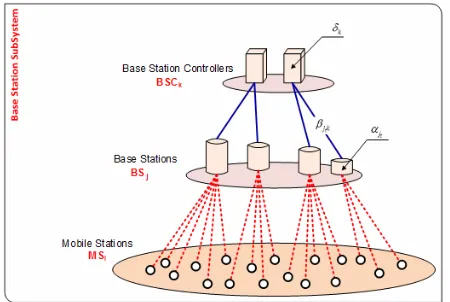
[image:2.595.349.537.591.682.2]Figure 2. The indicator variables in Initial Assignment step.
In the second step, we use the decision variables are:
1 if mobile user is connected to 0 otherwise t i ij j MS B
X
S
(4)
1 if of type is connected to 0 otherwise
t
j k
j k
BS t BSC
Y
(5)
1 if of type is operated 0 otherwise
t
j j
BS t
Z
(6)
1 if is operated 0 otherwise
k k
BSC W
[image:3.595.86.287.284.408.2] [image:3.595.307.541.546.701.2] (7)
Figure 3 illustrates an assignment after capacity ex- pansion and traffic increase, and indicates the respective decision variables. New wireless BSS infrastructure equipped with BS and BSC in red shades.
The objective of MOOUI is to minimize the total cost of expanding an initial wireless BSS to accommodate increased traffic demand.
The MOOUI problem can be defined as follows:
2 1 2 1 1 ( cost_connect cost_install cost_upgrade _ cost_setup )t t t
j t t j t t j p n
j k j k j k j k t T
k k k
k P
j j j
j N t T
j j j N t T
Min Y
W
MaxBS cap Z
Z
jt (8) Subject to: 1 1, 1.. t j n ij j t TX i m
(9), 1.. , 1.. ,
t t t
ij ij j j j
d X MaxCov Z i m j n tT (10)
1, 1.. t j j t T Z j
1, 1.. ,
t t
p
j j k j
k
Z Y j n t
T
(12), 1.. , 1.. ,
t
j k k j
Y W k p j n tT
(13)
2
1 1
_ , 1.. ,
t t t
m s
i ij j j j
i s
D X MaxBS Cap Z j n t T
(14)1
_ , 1.
t j
n
j k k k
j t T
Y MaxBSC Cap W k p
. (15)
0,1 ,
0,1 ,
0,1 ,
0,1 1.. , 1.. , 1.. ,t t t
ij j k j k
j
X Y Z W
i m j n k p t T
(16)
3. A New Genetic Algorithm for the MOOUI
3.1. Represent and Decode an IndividualIn this section, we present a new genetic algorithm for
the MOOUI problem with two populations X and
Y. The encoding of the configuration is by
means of matrix
POP
POP POPX
m
( ij n)
X x , where
xij = 1means that mobile user MSi has been connected to
base station BSj, and other wise, xij=0. The encoding of
the POPY configuration is by means of matrix
(i1.. ,n j1.. )m
( jk) , (mp 1.. , 1.. )
Y y j m k p ,
where yjk = 1means that base station BSj has been con-
nected to base station controller BSCk, and other wise, yjk
= 0.
3.2. Initialization
We use fully random initialization in order to initialize
the individuals X ensure that the individual x satis-
fies constraints in (9)(10)(14) and (16). Each individual x,
we fully random initialization in order to initialize the
individuals Y ensure that the individual y satisfies
constraints in (12)(13)(15) and (16).
POP
POP
Figure 3. The assignment after capacity expansion and traffic increase with decision variables.
3.3. Crossover Operator
This operator minics the mating process in the nature. To
do crossover in X, two individuals are picked first
and two integer numbers(i,j)(crossover point is xij) are
generated randomly between [1,n] and [1,m] (where nis
number of MSs and m is number of BSs).
POP
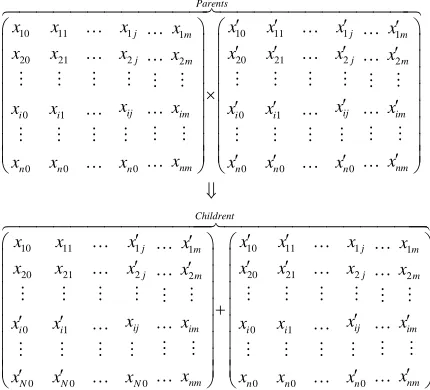
Then the offspring is generated by interchanging the
second halves of its parent, as illustrated in Figure 4.
In the crossover stage, the algorithm examines all pairs of individuals. It begins with the pairs that include the individual with a higher fitness value until the population size becomes twice of the original size. Similar, we apply
crossover operator to POPY.
3.4. Mutation Operator
The mutation operation is one kind of random change in
the individual of X. In our algorithm, point wise
mutation is adopted, in which one gene in the individual is changed with a certain probability, referred to as the mutation probability. This operator allows the algorithm to search for new and more feasible individuals in new corners of the solution spaces.
POP
To do mutation, an individual is randomly selected from the BS and the selected BS is called the mutation point, as illustrated in Figure 5.
10 11 1 1 10 11 1
20 21 2 2 20 21 2
0 1 0 1
0 0 0 0 0 0
Parent
j m
j m
ij im ij im
i i i i
nm nm
n n n n n n
x x x x x x x
x x x x x x x
x x x x
x x x x
x x
x x x x x x
10 11 1 1 10 11 1
20 21 2 2 20 21 2 2
0 1 0 1
0 0 0 0 0 0
s
j m
j m j m
ij im ij im
i i i i
nm nm
N N N n n n
x x x x x x
1 2 j m j m x x 1 j m x x
x x x x x x x x
x x x x
x x x x
x x
x x x x x x
Childrent 2
j xm
[image:4.595.64.279.412.607.2]x x
Figure 4. The crossover operator for population POPx.
10 11 1 1 10 11 1 1
20 21 2 2 20 21 2
0 1 0 1
0 0 0 0 0 0
Parents
j m j m
j m
ij im ij im
i i i i
nm nm
n n n n n n
x x x x x x x x
x x x x x x x
x r x x r
x x x x
x
x x x x x x
[image:4.595.62.282.637.720.2] Childrent
Figure 5. The mutation operator for population POPx.
The mutation stage is implemented until either popula- tion size becomes twice of the original size or all indi- viduals in the current generation are examined. Similar,
we apply mutation operator to POPY.
3.5. Evaluation Function
After the mutation, each solution
, | X, Y
s x y xPOP yPOP
is satisfies constraints in (9)-(16). The cost function of
solution s computed by formula (8).
3.6. Our GA Algorithm Proposed
The pseudo-code of our algorithm as follows:
A NEW GENETIC ALGORITHM FOR THE MOOUI
BEGIN
INITIALISE populationPOPXwithrandomcandidatesolutions; REPEAT
1. SELECT parents in POPX;
2. RECOMBINE pairsofparents in POPX;
X POP 3. CROSSOVER the resultingoffspring in ;
4. MUTATION the resultingoffspring in POPX;
X xPOP 5. FOR each eachcandidate DO
5.1 INITIALISE populationPOPYwithrandomcandidate
solutionsyPOPY follows candidatexPOPX;
5.2. SELECT parents inPOPY ;
Y POP 5.3. RECOMBINE pairsofparents in ;
5.4. CROSSOVER the resultingoffspring in POPY;
Y POP 5.5. MUTATION the resultingoffspring in ; 5.6. COMBINE Solution
, | X, Y
s x y xPOP yPOP
6. EVALUATE FUNCTION newsolutions s by formula (8); 7. SELECT individualsxfor the nextgeneration;
UNTIL (TERMINATION CONDICTION issatisfied) END
4. Experiments and Results
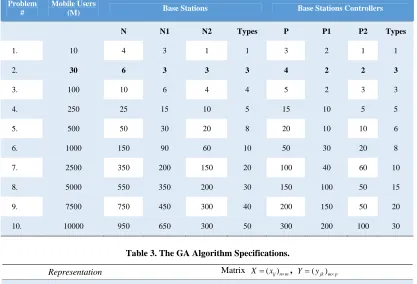
4.1. The Problems TackledIn our experiments, we have tackled several MOOUI instances of different difficulty levels. There are 10 MOOUI instances with values for M, N and P is shown in Table 2.
4.2. Parametersfor the GA Algorithm
In our experiments, we have already defined our cross- over probability as 0.7, we will work with a population
size of 500 and a mutation rate of pm1m.
Our GA algorithm to tackle these problems can be
Table 2. Main characteristic of the problems tackled.
Problem #
Mobile Users
(M) Base Stations Base Stations Controllers
N N1 N2 Types P P1 P2 Types
1. 10 4 3 1 1 3 2 1 1
2. 30 6 3 3 3 4 2 2 3
3. 100 10 6 4 4 5 2 3 3
4. 250 25 15 10 5 15 10 5 5
5. 500 50 30 20 8 20 10 10 6
6. 1000 150 90 60 10 50 30 20 8
7. 2500 350 200 150 20 100 40 60 10
8. 5000 550 350 200 30 150 100 50 15
9. 7500 750 450 300 40 200 150 50 20
[image:5.595.95.501.360.571.2]10. 10000 950 650 300 50 300 200 100 30
Table 3. The GA Algorithm Specifications.
Representation Matrix X(xij n m) , Y(yjk)m p Recombination One point crossover
Recombination probability 70%
Mutation Each value inverted with independent probability pm per position
Mutation probability pm1m
Parent selection Best out of random two Survival selection Generational
Population size POPX POPY 500 Number of offspring 500
Initialization Random
Termination condition No improvement in last 100 generations
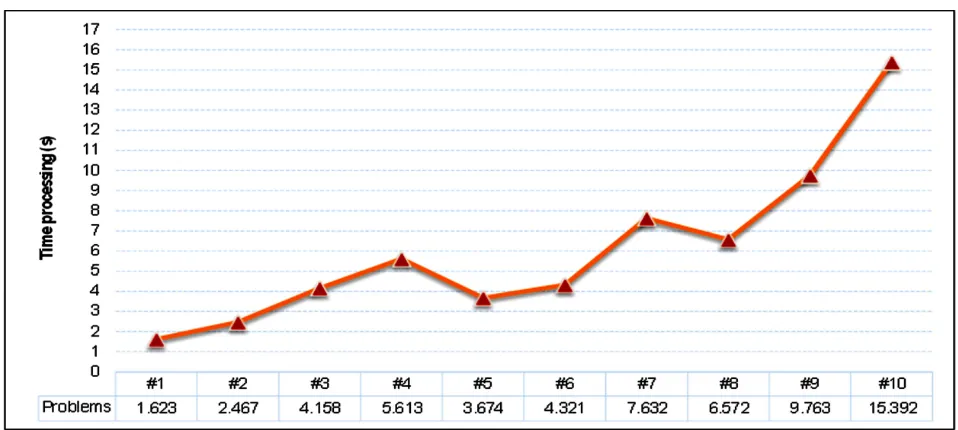
4.3. Numerical Analysis problem #1, #2, #3, #4 and #5, algorithm has approxi-
mate optimal results fast with small interactions. How-ever, when the problem size is large, the optimal results may be slower such as problem #6, #7, #8, #9 and #10. Convergence speed is not the same and depends on the distribution of parameters data.
We evaluate the performance of our algorithms to opti- mize of capacity expansion with multi-objectives. The experiment was conducted on Genuine Intel® CPU Duo Core 3.0 GHz, 2 GB of RAM machine. We ran experi- ment GA algorithm implemented using C language.
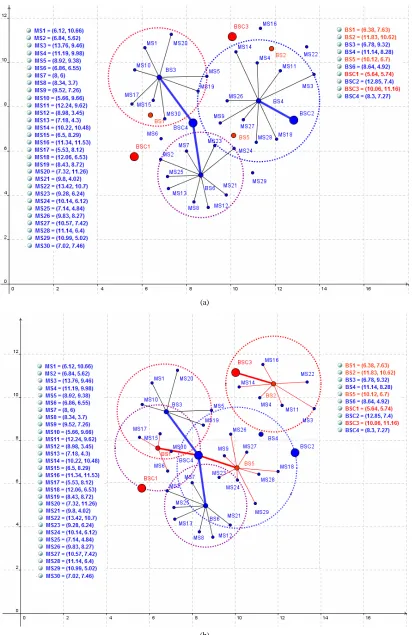
Figure 8(a) shows an existing initial assignment of problem #2. In which, three types of base station are (BS1, BS6), (BS2, BS3), (BS4, BS5); BS2, BS3 BSC2, BSC4 are existing BSCs; BSC1, BSC3 are potential BSCs; BS3, BS4, BS6 areexisting BSs; BS1, BS2, BS5 arepotential BSs. MS6, MS16, MS22, MS29 are not Comparing values of objective function between initial
solution and optimal solution shown in Figure 6 with
Population size and termination
condition is 100 generations. Figure 7 shown time proc-
essing of MOOUI instances tackle. The results show that
problems with the small number of M, N, P such as
500
X Y
[image:5.595.91.505.374.575.2]connected. Figure 8(b) shows an optimal solution with BSC2 is replaced by BSC3, BS4 is replaced by BS2 and BS5. BS1 is added and connect to BSC4. Red edges are replace connections and black edges are existing connec- tions.
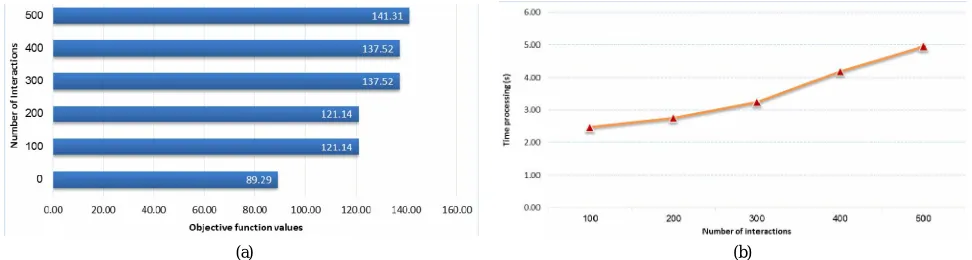
To evaluation the effect of population size and number of iterations to the value of the objective function. We consider the problem #2 with the iterations can vary from 100 to 500 and fixed population size is 500, comparing
results are shown in Figures 9(a) and (b). To comparing
the problem #2 with the population size can vary from 500 to 1000 and fixed iterations size is 100, comparing
results are shown in Figures 10(a) and (b). The
[image:6.595.59.537.208.451.2]experi-mental results show that the algorithm can be imple-mented with the big number of interactions and large population size in polynomial time. From this result, we confirmed that this is a promising approach to solve this problem.
Figure 6. Comparing value of capacity expansion in the MOOUI instances tackle.
[image:6.595.58.537.475.690.2](a)
(b)
[image:7.595.93.505.80.715.2]
(a) (b)
Figure 9. (a) Comparing objective function values of problem#2 with different number of interactions; (b) Comparing time processing of problem#2 with different number of interactions.
(a) (b)
Figure 10. (a) Comparing objective function values of problem#2 with different population size; (b) Comparing time proc-essing of problem #3 with different population size.
5. Conclusions
In this paper, we propose a new genetic algorithm has double population to solve Multi-Objectives Optimal of Upgrading Infrastructure problem in NGWN. Our net- work topology model has two levels in which mobile users are sources and both base stations and base station controllers are concentrators. The objective function is the sources to concentrators connectivity cost as well as the cost of the installation, connection, replacement, and capacity upgrade of infrastructure equipment. We gener- ate two populations satisfies constraints and combine to build solutions and evaluate the performance of our algo- rithm with data randomly generated. Numerical results show that our algorithms is a promising approach to solve this problem.
6. Acknowledgements
This research is partly supported by the QG.12.21 project of Vietnam National University, Hanoi.
REFERENCES
[1] Commworks, Wireless Data for Everyone.http://www.commworks.com. Technical Paper, 3Com
Corporation, 2001.
[2] Siemens Mobile. UMTS. http://www.siemens.de. White Paper, 2001.
[3] Mirzaian, A. and K. Steiglitz. A Note on the Complexity of the Star-Star Concentrator Problem. IEEE Transac-tions On CommunicaTransac-tions. No. 29, 1981, pp. 1549-1552. doi:10.1109/TCOM.1981.1094884
[4] B. Gavish, A System for Routing and Capacity Assign-ment in Computer Communication Networks. IEEE Transactions of Communications, No. 37, 1989, pp. 360-366. doi:10.1109/26.20116
[5] S. Narasimhan and H. Pirkul, “The Hierarchical Concen-trator Location Problem,” Computer Communications, Vol. 15, No. 3, 1992, pp. 185-191.
doi:10.1016/0140-3664(92)90079-T
[6] R. Gupta and J. Kalvenes, “Hierarchical Cellular Network Design with Channel Allocation,” In Proceedings of the Ninth Annual Workshop on Information Technologies & Systems, 1999, pp. 155-160.
[7] Kalvenes, J., J. Kennington and E. Olinick. Base Station Location and Service Assignment in W-CDMA Networks. Technical Report 02-EMS-03. SMU, 2002.
[8] Mathar R. and T. Niessen. Optimum positioning of base stations for cellular radio networks. Wireless Networks. Vol. 6, No. 6. 2000, pp. 421-428.
doi:10.1023/A:1019263308849
[image:8.595.55.541.85.215.2]Networks. In Proceedings of Sixth INFORMS Telecom-munications Conference, Boca Raton, Florida 2002. [10] C. Y. Lee and H. Kang, “Cell Planning with Capacity
Expansion in Mobile Communications: A Tabu Search Approach,” IEEE Transactions on Vehicular Technology, Vol. 49, No. 5. 2000, pp. 1678-1691.
doi:10.1109/25.892573/
[11] P. Calegari, F. Guidee, P. Kuonen and D. Wagner, “Ge-netic Approach to Radio Network Optimization for Mo-bile Systems,” IEEE VTC, pp. 755-759, 1997.
[12] C. Yu, S. Subramanian and N. Jain, “CDMA cell site optimization using a set covering algorithm,” In Pro-ceedings of Eight Int. Network Planning Symposium, 1998, pp. 75-78.
[13] R. Giuliano, F. Mazzenga and F. Vatalaro, “Smart cell sectorization for third generation CDMA systems,” Wire-less Communications and Mobile Computing, Vol. 2, No. 3, 2002, pp. 253-267.
[14] Dac-Nhuong Le, “Genetic Algorithm Applied to the Op-timal Centralized Wireless Access Network,” Interna-tional Journal of Information & Network Security (IJINS), Vol. 2, No. 2, 2013, pp. 129-137.
[15] Dac-Nhuong Le and Nhu Gia Nguyen, “A New Evolu-tionary Approach for Gateway Placement in Wireless Mesh Networks,” International Journal of Computer Networks and Wireless Communications (IJCNWC), Vol. 2, No. 5, 2012, pp. 550-555.
[16] Dac-Nhuong Le, “PSO and ACO Algorithms Applied to optimal Resource Allocation to Support QoS Require-ments in Next Generation Networks,” International Jour-nal of Information & Network Security (IJINS), Vol. 2, No. 3, 2013, pp. 216-228.
[17] Dac-Nhuong Le, “PSO and ACO Algorithms Applied to Optimizing Location of Controllers in Wireless Net-works,” International Journal of Computer Science and Telecommunications (IJCST), Vol. 3, No. 10, 2012, pp. 1-7.
[18] Dac-Nhuong Le, “Optimizing the cMTS to Improve Quality of Service in Next Generation Networks based on ACO Algorithm,” International Journal of Computer Network and Information Security (IJCNIS), Vol. 5, No. 4, 2013, pp. 25-30.doi:10.5815/ijcnis.2013.04.04
[19] Dac-Nhuong Le, “EA and ACO Algorithms Applied to Optimizing Location of Controllers in Wireless Net-works,” International Journal of Network Communica-tion and Networking (IJNCN), Vol. 3, No. 2, 2013, pp. 17-27.