An Integrated EMG Data Acquisition System by
Using Android app
Dr. R. Harini1 1
Teaching facultyt, Dept. of electronics, S.K. University, Anantapur, A.P, INDIA
Abstract: This paper presents the design and development of android based integrated electromyogram (EMG) data acquisition system for the measurement of electrical activity of muscles. The proposed system objective is to develop a EMG monitoring device controlled by Arduino microcontroller. The software implementation is in a form of android app application. The present system research work attempts to design and implementation of patient monitoring in real time with wireless transmission via Wi-Fi.
Keywords: Electromyography (EMG), Arduino MCU, Android OS, Wireless health monitoring.
I. INTRODUCTION
Electromyography (EMG) is an electro diagnostic medicine technique for evaluating and recording the electrical activity produced by skeletal muscles[1]. EMG is performed using an instrument called an electromyography to produce a record called an electromyogram. Electromyography signals show the amount of electric potential generated by the cells of the muscle when any muscular activity involving motion is performed or when the muscles are at rest. The central nervous system (CNS) activates muscles which causes muscle fiber contraction, followed by the depolarization of the outer muscle fiber membrane. The depolarization regions will arise at the regions of innervations and will move towards the outer tendons.
A motor unit(MU) is made up of a motor neuron and the skeletal muscle fibers innervated by that motor neuron's axonal terminals. Groups of motor units often work together to coordinate the contractions of a single muscle, all of the motor units within a muscle are considered a motor pool. Each motor unit will have these depolarization regions and each of these will give rise to an electric field and generate voltage These voltages are added up on the skin forming a voltage distribution. This sum depends on the distance of each source from the skin and hence the contribution to skin potential of superficial MUs is higher than the deep MUs.
EMG signals are used in many clinical and biomedical applications. EMG is used as a diagnostics tool for identifying neuromuscular diseases, assessing low-back pain, kinesiology, and disorders of motor control. EMG signals are also used as a control signal for prosthetic devices such as prosthetic hands, arms, and lower limbs. This sensor will measure the filtered and rectified electrical activity of a muscle, depending the amount of activity in the selected muscle.
II. HARDARE DEVELOPMENT OF EMG SYSTEM
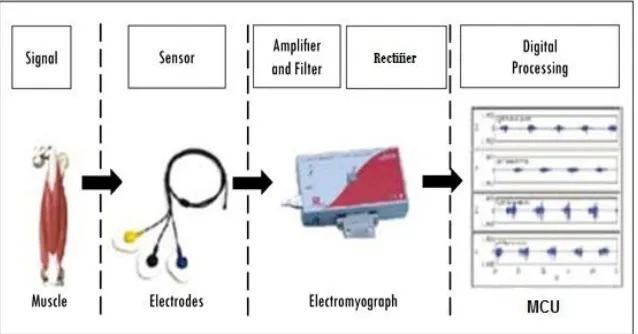
[image:2.612.167.486.548.715.2]The present design is a non-invasive method. The implementation of EMG acquisition system is cascading by several stages as shown in fig1 which depicts the system block diagram of EMG acquisition system. The block diagram consisting following blocks.
A. Signal Acquisition
EMG signal acquisition and processing is one of the active research areas. Apart from prosthesis, EMG signal finds application in clinical diagnosis, rehabilitation, robotics, etc. [2] EMG signal is acquired from the amputee arm and processed to generate respective control signals, which can be used to drive the prosthetic devices here 3 electrode are used. After determining which muscle group we want to target (for example I will be using my right bicep) and cleaning the skin thoroughly, place one electrode on skin above the middle of the length of the desired muscle, call this the mid muscle electrode.
Next place a second electrode at one end of the muscle, call this the end muscle electrode.
Last place the third electrode on a bony part of your body nearby the muscle group, call this the reference electrode. The amplitude of the EMG signal is in the range of micro volts. Hence an analog front end is used to amplify and filter the signal before processing it.
B. Signal Conditioning Unit
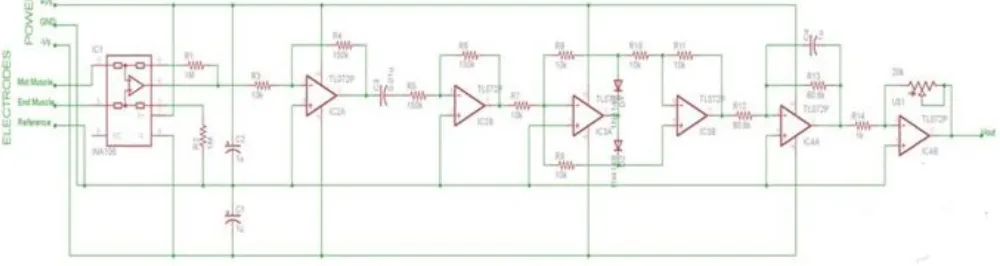
[image:3.612.59.559.338.471.2]The EMG circuit contains the instrumentation amplifier, dc offset filter, high pass filter and also the rectification. Since this work is using two channels hence the same circuit but with different gain will be fabricated out for both the channels. An analog front end is designed as shown in the Fig 2. Here three electrodes are used, two electrodes are connected to the differential amplifier and the third is connected to the ground. The differential amplifier is used to suppress the signals common to both the electrodes. Noises generated from the power sources, the electromagnetic devices and the signals from distant muscles must be eliminated. In this work AD8211 from Texas instrument is used as an instrumentation amplifier since it has high CMRR and high input impedance with gain 1 to1000 [3].
Fig 2. Schematic diagram of EMG acquisition system
C. ATMEGA328 Controller
In present system Atmega328 microcontroller is used to read the data which is read by the EMG sensor and process further. Atmega328 is high performance Microchip 8-bit AVR RISC-based microcontroller combines 32KB ISP flash memory with read-while-write capabilities, 1KB EEPROM, 2KB SRAM, 23 general purpose I/O lines, 32 general purpose working registers, three flexible timer/counters with compare modes, internal and external interrupts, serial programmable USART, a byte-oriented 2-wire serial interface, SPI serial port, 6-channel 10-bit A/D converter [4].The atmega328 any digital line is used for serial port read and write by software serial command. The serial lines are further connected to the Personal Computer through USB.
D. Wi-Fi Module
ESP8266 can be used as a wireless network interface card (NIC) in embedded systems that require internet connectivity or device-to-device communication. ESP8266 is a WLAN module supporting IEEE 802. 11 b/g/n standards and operates in 2.4 GHz ISM frequency band. It contains Wi-Fi networking solution, allowing it to either host the application or to offload all Wi-Fi networking functions from another application processor. This Wi-Fi module is suitable for adding Wi-Fi functionality to an existing microcontroller unit via a UART serial connection.
III. SOFTWARE IMPLEMENTATION
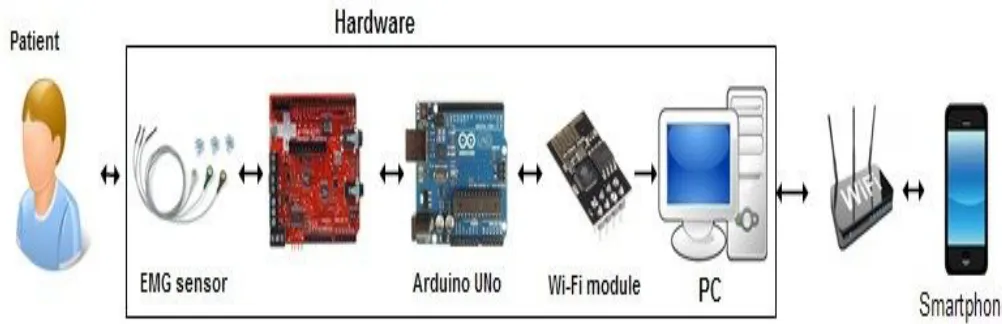
executing on a PC by using Arduino IDE. The Android App and GUI development for EMG acquisition system is implemented in Android studio. Fig3 shows the block diagram of implementation of present system.
Fig. 3 Block diagram of implementation of EMG acquisition system
A. Arduino IDE
In present work The Arduino integrated development environment (IDE) is used to interface biomedical parameter EMG sensor. It is a cross-platform application written in C, and derives from the IDE for the Processing programming language [5] and the Wiring projects. It is designed to introduce programming to artists and other newcomers unfamiliar with software development. It includes a code editor with features such as syntax highlighting, brace matching, and automatic indentation, and is also capable of compiling and uploading programs to the board with a single click. Arduino programs are written in C or C++.
B. Android Studio
Android Studio is an integrated development environment (IDE) for developing on the Android platform with Android SDK tools. It is freely available and downloaded easily from internet. It is based on Jet Brains' IntelliJ IDEA software, the Studio is designed specifically for Android development[6]. It is available for download on Windows, Mac OS X and Linux. Hardware’s that support Android is mainly based on AVR architecture platform. The interface software program is written in Arduino IDE environment. The entire APP is developed using Android JAVA backend and front end is developed using XML on Android KitKat 4.4.2 Operating System.
C. XAMPP
XAMPP is used in present work for development of Database storage and maintenance of server. XAMPP stands for Cross-Platform (X), Apache (A), MySQL (M), PHP (P) and Perl (P). It is a simple, lightweight Apache distribution that makes it extremely easy for developers to create a local web server for testing purposes. Everything you need to set up a web server application (Apache), database (MySQL), and scripting language (PHP) – is included in a simple extractable file [7]. XAMPP is also cross-platform, which means it works equally well on Linux, Mac and Windows.
D. Algorithm of EMG Measurement Development 1) Initialize Ports, Operational Amplifiers
2) Initialize ADC sampling rate using time
3) Initialize USAR
4) Enable interrupt
5) Read the signals from the sensor and transmit signals to the amplifie 6) Convert analog signal to digital signal using inbuilt A
7) Display the EMG values on serial monit
8) Store EMG values in database
E. Flow chart of EMG measurement development
Fig.4EMG acquisition system flowchart
IV. RESULTS AND DISCUSSION
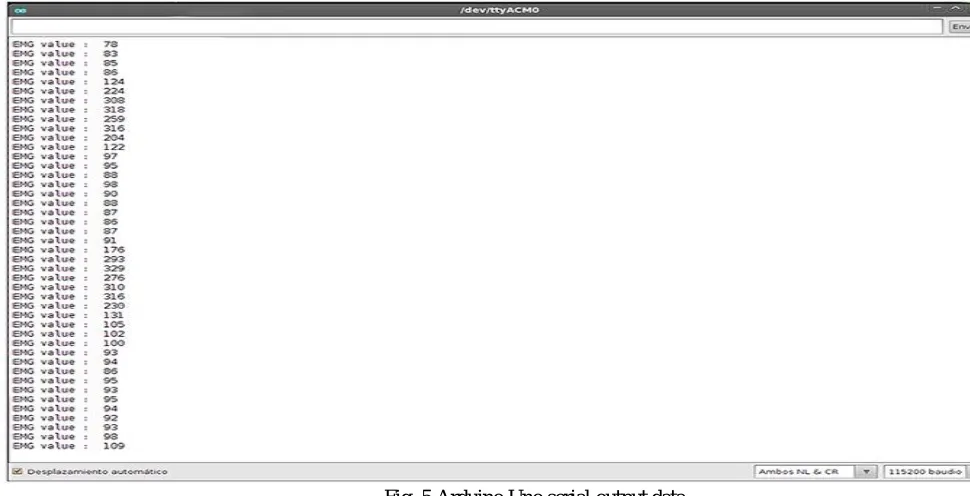
[image:5.612.57.542.406.654.2]The results are obtained using Arduino Uno, Android studio and a smartphone. The output of the EMG sensor is processed in Arduino Atmega328 controller and send to Arduino serial output in PC as shown in Figure5.
Fig. 5 Arduino Uno serial output data
Fig. 6EMG plot on smartphone
V. CONCLUSION
In present work the integrated system includes EMG sensor, microcontroller & Android technology to transmit data wirelessly in Smartphone. The present paper presents remote patient monitoring system by using android Smartphone, which allows doctors to view his patient’s vital parameter remotely and dynamically at real time. The future work is to expand EMG signal acquisition for some more necessary movements like holding cup, hand shake, opening door and to classify them. And also to find and extract some more features from the EMG signal to improve the classification accuracy.
REFERENCES
[1] Kamen, Gary. Electromyographic Kinesiology. In Robertson, DGE et al. Research Methods in Biomechanics. Champaign, IL: Human Kinetics Publ., 2004.
[2] V.Rajesh and P.Rajesh Kumar, “Myoelectric Signal BasedFinger Motion Discrimination by using Wavelet’s and PatternRecognisition”, 2009, Indian Journal of
Biomechanics.
[3] AD8211 from Texas instrument dataheet.pdf
[4] ATMEGA328P datasheet http://pdf1.alldatasheet.com/datasheet-pdf/view/241077/ATMEL/ATMEGA328P.html
[5] http://arduino.cc/en/Main/arduinoBoard
[6] "Download Android Studio". Android Developers. Retrieved June 13, 2016.