Sequence Typing Tool That Accurately Identifies
Yersinia
Isolates to
the Species and Subspecies Levels
Miquette Hall,aMarie A. Chattaway,bSandra Reuter,cCyril Savin,dEckhard Strauch,eElisabeth Carniel,dThomas Connor,f Inge Van Damme,gLakshani Rajakaruna,bDunstan Rajendram,hClaire Jenkins,bNicholas R. Thomson,cAlan McNallya
Pathogen Research Group, Nottingham Trent University, Nottingham, United Kingdoma; Gastrointestinal Bacteria Reference Unit, Public Health England, Colindale, London, United Kingdomb; Pathogen Genomics, Wellcome Trust Sanger Institute, Hinxton, Cambridge, United Kingdomc; FrenchYersiniaReference Laboratory and WHO Collaborating Centre, Institut Pasteur, Paris, Franced; Bundesinstitut für Risikobewertung, Berlin, Germanye; Cardiff School of Biosciences, Cardiff University, Cardiff, United Kingdomf; Department of Veterinary Public Health and Food Safety, University Ghent, Ghent, Belgiumg; Genomic Service Unit, Public Health England, London, United Kingdomh
The genusYersiniais a large and diverse bacterial genus consisting of human-pathogenic species, a fish-pathogenic species, and a large number of environmental species. Recently, the phylogenetic and population structure of the entire genus was elucidated through the genome sequence data of 241 strains encompassing every known species in the genus. Here we report the mining of this enormous data set to create a multilocus sequence typing-based scheme that can identifyYersiniastrains to the species level to a level of resolution equal to that for whole-genome sequencing. Our assay is designed to be able to accurately subtype the im-portant human-pathogenic speciesYersinia enterocoliticato whole-genome resolution levels. We also report the validation of the scheme on 386 strains from reference laboratory collections across Europe. We propose that the scheme is an important mo-lecular typing system to allow accurate and reproducible identification ofYersiniaisolates to the species level, a process often inconsistent in nonspecialist laboratories. Additionally, our assay is the most phylogenetically informative typing scheme avail-able forY. enterocolitica.
T
he Gram-negativeYersiniais one of the most important andwell-studied bacterial genera, consisting of three human
pathogens.Y. pestisis the causative agent of bubonic and
pneu-monic plague and is a recently diverged clone ofYersinia
pseudo-tuberculosis (1), which alongsideY. enterocolitica is a zoonotic
gastrointestinal pathogen (2). The remaining species are not
asso-ciated with human disease and are considered to be
environmen-tal organisms, with the exception of the common fish pathogenY.
ruckeri (2) and the insecticidal speciesY. entomophaga. Of the
human-pathogenic species,Y. enterocoliticais the most common
etiological agent of human disease, and in Germany and Scandi-navia, the numbers of cases of human intestinal yersiniosis caused byY. enterocoliticarival those caused bySalmonella(3).Y. entero-coliticais in itself a very diverse species that is classically subdi-vided into nonpathogenic, low-pathogenic, and high-pathogenic
biotypes based on virulence in a mouse infection model (4).
Bio-type 1A isolates are considered nonpathogenic, which is
concor-dant with a lack of the majorY. enterocoliticavirulence factors
such as pYV, invasin, YadA, and Ail (5), although there are
nu-merous reports of biotype 1A human carriage (6,7). Biotype 1B
isolates are high pathogenic, which is concordant with carriage of the high-pathogenicity island, but isolation from human disease cases is very rare with the exception of notable outbreaks such as
the recent emergence in Poland (8). Biotype 2 to 4 isolates are low
pathogenic and are globally the most common causes of human
gastrointestinal yersiniosis (4). Biotype 5 isolates are also
consid-ered low pathogenic but have only been isolated from wild hare
populations and are very rare in nature (5).
From a clinical perspective, the isolation and subsequent
iden-tification ofYersiniaand in particularY. enterocoliticato the
spe-cies and subspespe-cies levels can be challenging, with recent publica-tions striving to improve the efficacy of selective culturing of
Yersiniafrom clinical and environmental samples (9). Once iso-lated, strains are most commonly identified to the species level by comparing the differential utilization of a panel of 17 biochemical
substrates (4,10). Further subdivision ofY. enterocoliticainto
bio-types is also performed based on utilization of a further 12 sub-strates. In both cases, the interpretation of such biochemical typ-ing may often be subjective and affected by environmental factors
such as temperature of incubation (4,10). There is also further
subdivision based on classical serotyping. As such, the
identifica-tion ofYersiniato the species and subspecies levels can be very
problematic for nonspecialist laboratories with misidentification at the species level and subtyping level not an uncommon occur-rence, as exemplified by recent assignment of new species by mo-lecular methods following inconclusive species determination by
biochemical methods (11,12).
Recent work by our group definitively characterized the
phy-Received20 August 2014 Returned for modification30 September 2014
Accepted13 October 2014
Accepted manuscript posted online22 October 2014
CitationHall M, Chattaway MA, Reuter S, Savin C, Strauch E, Carniel E, Connor T, Van Damme I, Rajakaruna L, Rajendram D, Jenkins C, Thomson NR, McNally A. 2015. Use of whole-genus genome sequence data to develop a multilocus
sequence typing tool that accurately identifiesYersiniaisolates to the species and
subspecies levels. J Clin Microbiol 53:35– 42.doi:10.1128/JCM.02395-14.
Editor:N. A. Ledeboer
Address correspondence to Alan McNally, [email protected].
Supplemental material for this article may be found athttp://dx.doi.org/10.1128
/JCM.02395-14.
Copyright © 2015, American Society for Microbiology. All Rights Reserved.
doi:10.1128/JCM.02395-14
on May 16, 2020 by guest
http://jcm.asm.org/
logeny of the entireYersiniagenus using genome sequences of 241
strains encompassing the full diversity within the genus (13).
Par-ticular attention was given toY. enterocolitica, of which 94 strains
encompassing all biotypes and serotypes were sequenced. The whole-genus phylogeny was constructed using 84 housekeeping genes that are located on 23 syntenic blocks, regions of DNA-containing genes conserved across the genus, and showed the presence of 14 species clusters as determined by Bayesian analysis
of population structure (BAPS) software (13). The resulting
phy-logeny also accurately distinguishedY. pestisas a distinct clone of
Y. pseudotuberculosisand phylogenetically splitY. enterocoliticaon the basis of high-pathogenic, low-pathogenic, and nonpathogenic
biotypes (13). A core genome single nucleotide polymorphism
(SNP)-based phylogeny provided greater resolution forY.
entero-coliticaand showed that the phylogenetic separation within the low-pathogenic strains is concordant with serotype and not bio-type, which is almost certainly due to difficulties in interpreting
variable reactions discriminating biotypes 2 and 3 (13).
Given our significant findings on the true phylogenetic
struc-ture of the entireYersiniagenus and the fact that this phylogeny
can be determined from housekeeping genes present on conserved syntenic blocks, we sought to determine if a standard, seven-gene multilocus sequence typing (MLST) scheme could be developed from a subset of those genes. Such a scheme would then be able to rapidly and with complete accuracy identify any member of the
Yersiniagenus to the species and subspecies levels upon the initial
isolation. There is a well-established MLST scheme available forY.
pseudotuberculosis(14) that has been used to delineate the
popu-lation structure of the species complex (15); however, this scheme
has not been designed to be robust across the genus. Similarly,
there have been attempts to create MLST schemes forY.
enteroco-litica(16–18); however, these have not been informed by genomic data and their suitability for identification to the species and sub-species levels is questionable compared to that of our previous
whole-genome phylogeny study (13). Here, we present the design
and validation of a new pan-YersiniaMLST scheme that provides
identification to the species level that is completely concordant
with our previous whole-genome phylogeny (13). Furthermore, it
accurately differentiatesY. pestisandY. similisfromY.
pseudotu-berculosis and, more significantly, the scheme subtypes
low-pathogenicY. enterocoliticaon the basis of serotype in complete
concordance with whole-genome phylogeny of the species. We
propose that the pan-YersiniaMLST scheme is an invaluable tool
in the identification ofYersiniato the species and subspecies levels
from clinical samples and that the classification of low-pathogenic
Y. enterocoliticaon the basis of phylogenetically distinct serotypes be adopted.
MATERIALS AND METHODS
Strains.The initial design and development of the MLST scheme utilized de novoassembled genome sequences of 171Yersiniastrains that were part of our previously published work (13). This strain collection was made up of theYersiniaspecies as follows: 1Y. aldovae, 2Y. aleksiciae, 3Y. bercovieri, 58Y. enterocolitica, 22Y. frederiksenii, 16Y. intermedia, 9Y. kristensenii, 1 Y. massiliensis, 10Y. mollaretii, 1Y. pekkanenii, 3Y. pestis, 33Y. pseudotu-berculosis, 5Y. rohdei, 3Y. ruckeri, and 4Y. similis. The 171 strains are a subset of the 241 sequenced in our previous study and were chosen be-cause their assembled genomes contained no ambiguous base calls or contig breaks in the syntenic blocks our study design focused on.
Selection of phylogenetically informative genes within conserved syntenic blocks.To establish the level of genetic diversity of each of the common housekeeping genes, GenBank files of each of the 23 syntenic blocks fromY. enterocolitica8081,Y. pseudotuberculosisIP32953, andY. pestisD106004 were created using Artemis (19). The sequences of each of the conserved housekeeping genes were then extracted and aligned in MEGA 5.0 (20), as these represent the three human-pathogenic species that are located at diametrically opposite ends of the genus phylogeny. The genes that had a level of SNPs between 10 and 25% were retained for further analysis. The sequences of the remaining genes were used to create individual gene maximum likelihood trees using MEGA 5.0 and com-pared to theYersiniaphylogeny (13). Seven genes that were able to closely match the branching order and clearly discriminate between the species clusters, with ⬍2% strain displacement, and that were disseminated across the syntenic blocks were chosen. Pan-Yersiniagene primers for the seven selected genes were designed based on the multiple alignments.
PCR and sequence analysis.The culture was grown overnight in 1.5 ml LB broth at 25°C with shaking, and genomic DNA was extracted using the GenElute bacterial genomic DNA kit (Sigma-Aldrich), following the manufacturer’s instructions. A temperature gradient PCR was used to establish the optimum annealing temperatures for the primers. The result was optimized by carrying out the PCR on representative strains of all the species for each primer pair as follows: initial denaturation at 94°C for 5 min; 30 cycles of denaturation at 94°C for 30 s, annealing temperature dependent upon the primer set for 30 s; elongation at 72°C for 30 s; and final elongation at 72°C for 5 min. PCRs were carried out using the GoTaq Flexi DNA polymerase kit (Promega) and deoxynucleoside triphosphates (dNTPs) (Promega) as follows: 5l 1.5 mM MgCl2, 5l 10⫻PCR buffer, 2l 10M dNTPs, 0.3l 5 U/MTaqDNA polymerase, 40l sterilized distilled water, 0.5l 10 pmol forward and reverse primers, 1l⬃10 ng/l DNA. The amplification product was then cleaned using Exo-SAP-IT (Affymetrix) and Sanger sequenced in duplicate to obtain inde-pendent forward and reverse reactions.
The sequence data obtained for each gene were aligned and trimmed to a uniform length, using MEGA 5.0. Each unique sequence was identi-fied using the Web tool Non-redundant databases (http://pubmlst.org /analysis/) and allocated a specific allele number. All of the sequence and isolate data were uploaded to the publically available MLST database (http://pubmlst.org/yersinia) using the BIGSdb genomics platform (21). Phylogenetic and population analysis of MLST data.The freely avail-able software START (22) was used to calculate the ratio of nonsynony-mous (dN) to synonymous (dS) nucleotide substitutions to determine the level of selective pressure acting upon each MLST gene. START was also used to determine that the GC content in the MLST genes was comparable to that of the whole-genome GC content. To detect recombination within theY. enterocoliticaMLST data, SplitsTree 4.2 (23) was used to compute the pairwise homoplasy index (PHI). An MLST database and Web inter-face were created for the scheme (http://pubmlst.org/yersinia/), and the sequence data for all seven loci from all 171 individual strains were input to assign allele numbers. From these sequences, types were ascribed to each unique allele combination occurring in the data set. The designated allele numbers were visualized by creating minimum spanning trees using the goeBURST Full MLST algorithm in PHYLOViZ (24). Maximum like-lihood phylogenies were created by concatenation of the sequence of the seven loci and alignment with ClustalW in MEGA 5.0, before the phylog-eny was determined with the GTR gamma model in RAxML 7.2.8 –2 (25).
RESULTS
Selection of genes and validation of a pan-Yersinia MLST scheme onin silicogenome sequence data.The sequences of 73
genes conserved across the genus (Table 1) from 171de novo
as-sembled genomes were used to create individual gene phylogenies. Additionally, the alignments were used to identify regions of high similarity in each gene that would permit the design of universal primers capable of amplifying the gene across the genus. From this
on May 16, 2020 by guest
http://jcm.asm.org/
analysis, seven optimal gene loci were selected based on their abil-ity to mirror the genome-informed phylogeny and the abilabil-ity to
design primers that would work across the genus (Table 2), as well
as their separation across the syntenic blocks (Fig. 1).
There was a high level of diversity shown across the seven se-lected MLST regions, averaging around 60 alleles and 40%
poly-morphic sites for each (Table 3). ThedN/dSratios were far below
1 for each MLST region, suggesting that the nucleotide substitu-tions are not a result of selective pressure. The average GC content
found in the MLST gene regions corresponds to that of the
Yer-siniachromosomes, which ranges from 46.9% inY. frederikseniito
49.0% inY. mollaretii(data accessible at the xBASE websitehttp:
//www.xbase.ac.uk/taxon/Yersinia). The PHI test also failed to
de-tect any recombination within the MLST amplicons from theY.
enterocoliticadata set.
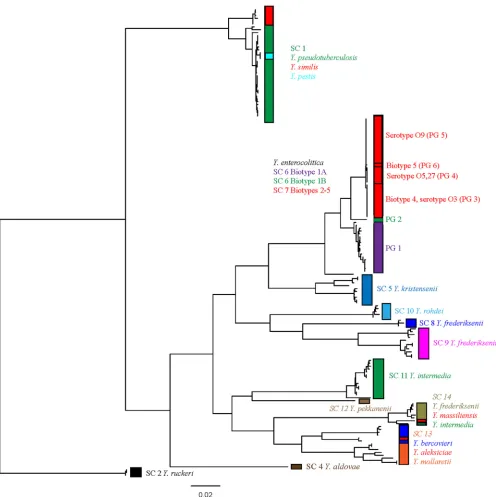
Pan-YersiniaMLST scheme is phylogenetically informative to genome sequence level.A maximum likelihood phylogeny of the concatenated MLST data obtained from the 171 genome-se-quenced strains was constructed. The resulting tree showed accu-rate phylogenetic separation of all of the species identified by the
84-gene tree approach taken in our previous work (Fig. 2) with
[image:3.585.40.547.75.438.2]100% concordance between the two phylogenies and identical
TABLE 1The 73 housekeeping genes selected for investigation for use in the genus MLST scheme
Syntenic block
Relative location on each syntenic block in relation to theY. enterocolitica8081 reference genome:
Size (bp) Housekeeping gene(s) in each block
Beginning End
1 0 107030 107,030 asnA,dfp,tpiA,glnA
2 108300 191330 83,030 sthA
3 191500 202555 11,055 rhlB,rho
4 282830 313630 30,800 udp,aarF,hemB
5 879520 980830 101,310 pcm,recA
6 1039400 1251800 212,400 gloB,nadB,guaA,nrdF,nrdE
7 1802900 1991400 188,500 purB,ptsG,phoQ,phoP,purT,pip,tmk,icdA
8 2027865 2087750 59,885 kduD1
9 2108500 2142600 34,100 NDa
10 2154500 2325300 170,800 tyrR
11 2447240 2499700 52,460 topB,ansA,dadA,nhaB,fadR,xthA
12 2554700 2591553 36,853 minD,zwf,aspS,znuC,znuA,znuB,minC,rnd,msbB
13 2602500 2630230 27,730 kdsA,prfA,hemA
14 2640950 2668185 27,235 chaA
15 2668285 2709585 41,300 ND
16 2709700 2800900 91,200 ND
17 2854263 3294700 440,437 folE,nadA,udk,sfcA,glnS
18 3313400 3544778 231,378 proB,rosA,hemH,adk
19 3610900 3712864 101,964 thyA,tas,lgt,galR,lysS,prfB
20 3726200 3761260 35,060 tktA,speA,gshB,endA
21 3960000 4238800 278,800 rfaE,pyrB,parC,gcp,uxaC
22 4245400 4464400 219,000 ND
23 4504400 4561500 57,100 fdoI,fdhE,glnQ
Total size of syntenic blocks 2,639,427
Total size ofY. enterocolitica 8081 genome
4,615,899
aND, no housekeeping genes present in the syntenic block.
TABLE 2Primer sequences, the sizes of the amplified regions, and the annealing temperature for the final seven selected MLST genes
MLST gene
Primer
PCR product length (bp)
MLST region length (bp)
Annealing temperature (°C)
Forward Reverse
aarF 5=-TTCCATGCAGATATGCACC-3= 3=-CCACTCACTAATAGTGTAGC-5= 650 500 52 dfp 5=-GATCCGGTACGCTTTATCAG-3= 3=-CATAACGGCTGACAATCTCG-5= 547 455 59 galR 5=-ATTGGTAACGGTTACCATG-3= 3=-GTTGGGCTGAACATATTGGT-5= 648 500 59 glnS 5=-GAATCATGTATCCGTGATG-3= 3=-GCACAGAAATAACCTTCAC-5= 557 442 56.5 hemA 5=-ATGACTCTGCTCGCATTAGG-3= 3=-CGGTTGGCAATAATCATATG-5= 602 490 54 speA 5=-ATGTCTGATGATAACTTGATT-3= 3=-CAGATAAACTTTATGGCCC-5= 550 452 55.5 rfaE 5=-ATGAAAGTCACTCTGCCTGA-3= 3=-ATCACTGCCTTTAGGATC-5= 509 429 55.5
on May 16, 2020 by guest
http://jcm.asm.org/
[image:3.585.40.544.621.723.2]separation into 14 distinct species clusters as determined by BAPS. TheY. pseudotuberculosiscomplex was accurately split with
dis-tinct clades containingY. pestisandY. similiswithin the largerY.
pseudotuberculosiscomplex, showing that the scheme is capable of differentiating accurately within this lineage. Closer investigation
of theY. enterocoliticacomplex showed that the MLST scheme also
differentiates on the basis of high-pathogenic, low-pathogenic, and nonpathogenic groups, and within the low-pathogenic group differentiates on the basis of serotype into defined phylogroups as observed when the whole-genome phylogeny is used. As such, the pan-YersiniaMLST scheme provides a completely robust
mecha-nism by which to accurately assign anyYersiniaisolate to a defined
species cluster and further subtype without any additional growth requirements beyond initial isolation.
Validation of the pan-YersiniaMLST scheme on reference laboratory isolate collections.To validate thein silicoresults for our genus-wide typing scheme, we performed MLST on a further 214Yersiniastrains archived in the nationalYersiniareference laboratories of Belgium, Germany, United Kingdom, and France
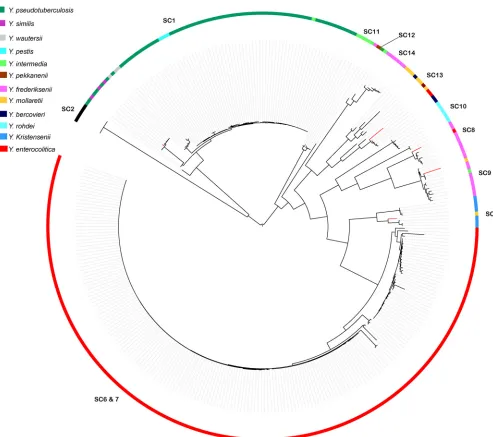
(see Table S1 in the supplemental material). The concatenated MLST sequence data for all 385 strains were then used to construct a maximum likelihood phylogeny and compare the results of the classical biochemical typing and subtyping with those for our
phy-logenetic approach (Fig. 3). The phylogeny once again shows
un-ambiguous separation of strains into the previously designated species clusters, with 97.83% of strains tested being assigned to the corresponding species cluster based on their biochemical typing.
Included here are strains ofY. wautersii, a newly proposed species
which is a sublineage ofY. pseudotuberculosis. Two strains
bio-chemically defined asY. pseudotuberculosisby the reference
labo-ratories with theY. similissubgroup and a further 6 isolates were
assigned to species clusters in disagreement with their classical biochemical typing designation by the reference laboratories.
To validate thein silicoresults showing that our MLST scheme
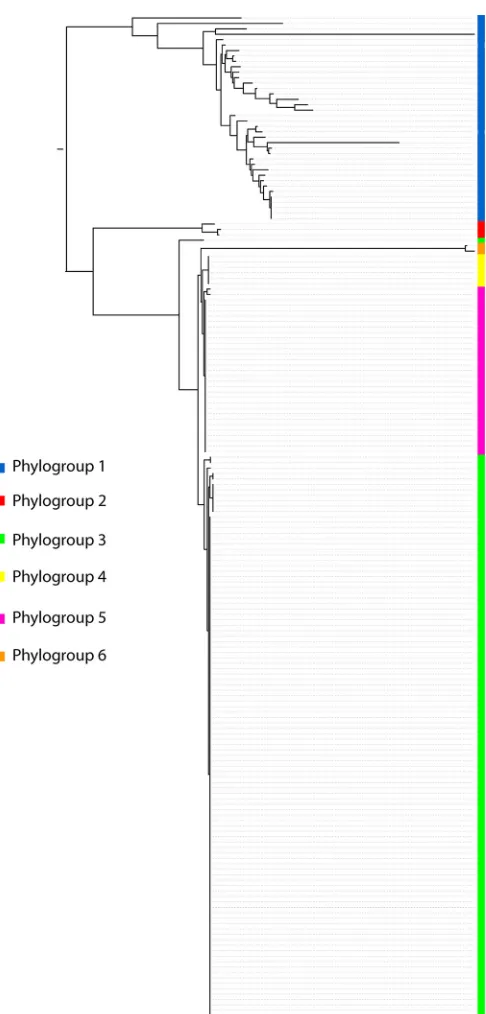
was able to successfully subtypeY. enterocolitica, we separately
analyzed the MLST data for the 188Y. enterocoliticaisolates
con-tained within the entire data set generated here (Fig. 4). Our
phy-logeny perfectly assigns every strain to a defined phylogroup on the basis of serotype as previously reported with whole-genome SNP-based phylogeny. There are no ambiguous phylogroup assig-nations on the basis of serotype, although, as with the whole-genome study, biotype is not phylogenetically robust. To allow an easy comparator for use of the scheme, we assigned which species
cluster and/orY. enterocoliticaphylogroup each sequence type
be-longs to (see Table S2 in the supplemental material).
DISCUSSION
The enteropathogenicYersiniaspp. are the third most common
cause of bacterial infectious intestinal disease in the developed
world (5). Despite this, the isolation and identification of
infec-tions withY. enterocoliticaandY. pseudotuberculosisare still
heav-ily reliant on classical biochemical techniques that may be open to
[image:4.585.49.542.67.312.2]FIG 1Diagram showing the positioning of the seven selected loci and their native syntenic block on reference genomes across the genus. Ye8081,Y. enterocolitica bioserotype 1B/O:8; KIM5,Y. pestisMedievalis; CO92,Y. pestisOrientalis; Ye5603,Y. enterocoliticabioserotype 4/O:3; YPSTB,Y. pseudotuberculosisYPIII serotype III.
TABLE 3Level diversity across all 171 genome-sequenced strains for each of the MLST regions as determined by START
Gene
Size of fragment (bp)
% GC content
% polymorphic
sites dN/dSratio No. of alleles
aarF 500 44 37.4 0.0049 58
dfp 500 47.8 40.8 0.0599 61
galR 500 49.7 44.8 0.028 70
glnS 500 48.5 38.4 0.0221 68
hemA 500 51.3 39.8 0.0222 65
rfaE 429 54.1 40.3 0.019 60
speA 490 48.9 34.7 0.0232 50
Mean 488.4 49.2 39.5 0.0256 61.7
on May 16, 2020 by guest
http://jcm.asm.org/
[image:4.585.40.287.616.723.2]subjective interpretation to provide a definitive identification (4,
10). This subjective biochemical typing is even more problematic
when applied to subtyping of isolates, which is of importance in
epidemiological tracking, and in the case ofY. enterocoliticamay
be of clinical importance in distinguishing between the carriage of a nonpathogenic organism, a self-limiting infection with a low-pathogenic strain, or an infection with a more aggressive high-pathogenic strain type. Similarly, nonhigh-pathogenic species within
the genus may be biochemically typed as atypicalY. enterocolitica,
leading to misidentification of clinical episodes, administration of
unnecessary treatments, and skewed data in environmental and
livestock surveys of enteropathogenicYersiniaprevalence (26,27).
Despite the proven levels of resolution offered by molecular typing techniques for bacterial pathogens to overcome such prob-lems, there is no such approved and standardized methodology in
place forY. enterocolitica, the most common cause of human
gas-trointestinal yersiniosis. An MLST scheme does exist forY.
pseu-dotuberculosisbut is designed and validated to be used as an epi-demiological and population genetics tool solely for that species
(15). In this study, we have utilized the comprehensive genus
ge-FIG 2Maximum likelihood phylogeny of concatenated alleles derived from every unique sequence type obtained from 171 genomes from across the genus. The species contained within each sequence type are indicated, and species clusters are labeled as defined in our previous genome study (13), with the MLST tree showing complete concordance with our previous phylogeny.
on May 16, 2020 by guest
http://jcm.asm.org/
[image:5.585.46.542.63.560.2]nome sequence data set previously produced by our group (13) to inform the design of an MLST-based scheme that can rapidly and reproducibly assign any strain to a defined species cluster and any
Y. enterocoliticato a defined phylogroup.
Previous attempts have been made to create MLST typing tools forY. enterocolitica. The first scheme (16) was a 5-locus scheme incorporating 16S that was developed to allow phylogenetic
infer-ences within the genusYersinia. However, when the phylogeny
published in that pregenomics era study is compared to our
de-finitive phylogeny recently published (13), it is clear that the
5-lo-cus phylogeny is inaccurate withY. enterocoliticadeeply
embed-ded within environmental species (16). As such, determining the
species using this scheme on an unknown isolate would not offer sufficiently robust resolution for reference laboratory adoption. A
conventional 7-locus scheme was developed from a semiran-dom selection of housekeeping genes to investigate
subgroup-ing within the nonpathogenic biotype 1AY. enterocolitica
iso-lates (17). While the loci in this scheme are among the 84 genes
conserved across the genus, in silico analysis suggests that the
primers designed may not be optimal across the genus due to base mismatches at the primer sites and as such would not be suitable
for the purposes of identifyingYersiniaisolates to the species level.
Most recently, a scheme was developed to differentiate the three
human-pathogenic species of theYersiniagenus using a 7-locus
MLST scheme (18). This scheme accurately subtypedY.
enteroco-litica into distinct subtypes, including serotype-specific clades within the low-pathogenic strains, as observed both in our scheme
and in our genomic phylogeny (13). However, this scheme also
FIG 3Maximum likelihood phylogeny of concatenated alleles derived from 385 reference laboratory strains ofYersinia. The species clusters are designated on each clade as SC, with the biochemically determined species of each strain denoted by the described color coding. Strains whose species cluster differed from biochemical typing results are denoted by red branches on the phylogeny.
on May 16, 2020 by guest
http://jcm.asm.org/
[image:6.585.45.538.77.514.2]uses primers thatin silicoanalysis suggests would not anneal to sequences from some species. Additionally, neither of the latter two schemes has been set up with a database and protocols to allow its wide-scale adoption for reference typing.
In conclusion, we present a model and novel design strategy for molecular typing tools based on genome sequence data across an entire genus containing human-pathogenic species. By using these data, we can design a simple MLST-based scheme that
pro-vides the power of resolution of whole-genome sequencing to quickly and accurately identify isolates to the species level and also
subtype strains of Y. enterocolitica. While next-generation
se-quencing is becoming commonplace in a small number of public health laboratories, there are still many front-line clinical micro-biology laboratories that are not yet in a position to employ benchtop sequencing due to the cost or bioinformatics resources. Our scheme provides a blueprint for the efficient design of simple molecular-based tools that provide an equal level of resolution for typing, although obviously not for SNP-based molecular epidemi-ological investigations. We encourage the public health microbi-ology community to adopt our scheme and further validate it as a
universal typing tool for the entireYersiniagenus and as a
subtyp-ing and population genetics tool for the important human patho-genY. enterocolitica.
ACKNOWLEDGMENTS
This work was funded by NTU VC studentships awarded to M.H. and S.R. The French Yersinia Reference Laboratory was funded in part by the In-stitute for Health Surveillance (InVS).
We thank the National Collection of Type Cultures for provision of strains from across the genus for our validation work.
REFERENCES
1.Achtman M, Morelli G, Zhu P, Wirth T, Diehl I, Kusecek B, Vogler AJ, Wagner DM, Allender CJ, Easterday WR, Chenal-Francisque V, Wor-sham P, Thomson NR, Parkhill J, Lindler LE, Carniel E, Keim P.2004. Microevolution and history of the plague bacillus,Yersinia pestis. Proc Natl Acad Sci U S A101:17837–17842.http://dx.doi.org/10.1073/pnas .0408026101.
2.Wren BW.2003. TheYersiniae—a model genus to study the rapid evolu-tion of bacterial pathogens. Nat Rev Microbiol1:55– 64.http://dx.doi.org /10.1038/nrmicro730.
3.Rosner BM, Stark K, Werber D.2010. Epidemiology of reportedYersinia enterocoliticainfections in Germany, 2001–2008. BMC Public Health10:
337.http://dx.doi.org/10.1186/1471-2458-10-337.
4.Bottone EJ.1999.Yersinia enterocolitica: overview and epidemiologic correlates. Microbes Infect 1:323–333. http://dx.doi.org/10.1016 /S1286-4579(99)80028-8.
5.Bottone EJ.1997.Yersinia enterocolitica: the charisma continues. Clin Microbiol Rev10:257–276.
6.Tennant SM, Grant TH, Robins-Browne RM.2003. Pathogenicity of Yersinia enterocoliticabiotype 1A. FEMS Immunol Med Microbiol38:
127–137.http://dx.doi.org/10.1016/S0928-8244(03)00180-9.
7.Singh I, Virdi JS.2004. Production ofYersiniastable toxin (YST) and distribution ofystgenes in biotype 1A strains ofYersinia enterocolitica. J Med Microbiol53:1065–1068.http://dx.doi.org/10.1099/jmm.0.45527-0. 8.Gierczyñski R, Szych J, Rastawicki W, Wardak S, Jagielski M. 2009. Molecular characterization of human clinical isolates ofYersinia enteroco-liticabioserotype 1B/O8 in Poland: emergence and dissemination of three highly related clones. J Clin Microbiol47:1225–1228.http://dx.doi.org/10 .1128/JCM.01321-08.
9.Savin C, Leclercq A, Carniel E.2012. Evaluation of a single procedure allowing the isolation of enteropathogenicYersiniaalong with other bac-terial enteropathogens from human stools. PLoS One7:e41176.http://dx .doi.org/10.1371/journal.pone.0041176.
10. Wauters G, Kandolo K, Janssens M.1987. Revised biogrouping scheme ofYersinia enterocolitica. Contrib Microbiol Immunol9:14 –21. 11. Murros-Kontiainen A, Fredriksson-Ahomaa M, Korkeala H, Johansson
P, Rahkila R, Björkroth J.2011.Yersinia nurmiisp. nov. Int J Syst Evol Microbiol61:2368⫺2372.http://dx.doi.org/10.1099/ijs.0.024836-0. 12. Murros-Kontiainen A, Johansson P, Niskanen T, Fredriksson-Ahomaa
M, Korkeala H, Björkroth J.2011.Yersinia pekkaneniisp. nov. Int J Syst Evol Microbiol61:2363⫺2367.http://dx.doi.org/10.1099/ijs.0.019984-0. 13. Reuter S, Connor T, Barquist L, Walker D, Feltwell T, Harris S, Fookes M, Hall M, Petty N, Fuchs T, Corander J, Dufour M, Ringwood T, Savin C, Bouchier C, Martin L, Miettinen M, Shubin M, Riehm J, Laukkanen-Ninios R, Sihvonen L, Siitonen A, Skurnik M, Falcão J, FIG 4Maximum likelihood phylogeny of concatenated alleles derived from
188Y. enterocoliticastrains. The phylogroups are indicated by the described color coding.
on May 16, 2020 by guest
http://jcm.asm.org/
[image:7.585.43.286.61.568.2]Fukushima H, Scholz H, Prentice M, Wren B, Parkhill J, Carniel E, Achtman M, McNally A, Thomson N.2014. Parallel independent evo-lution of pathogenicity within the genusYersinia. Proc Natl Acad Sci U S A
111:6768 – 6773.http://dx.doi.org/10.1073/pnas.1317161111.
14. Achtman M, Zurth K, Morelli G, Torrea G, Guiyoule A, Carniel E.
1999.Yersinia pestis, the cause of plague, is a recently emerged clone of Yersinia pseudotuberculosis. Proc Natl Acad Sci U S A96:14043–14048. http://dx.doi.org/10.1073/pnas.96.24.14043.
15. Laukkanen-Ninios R, Didelot X, Jolley K, Morelli G, Sangal V, Kristo P, Brehony C, Imori P, Fukushima H, Siitonen A, Tseneva G, Voskressenskaya E, Falcao J, Korkeala H, Maiden M, Mazzoni C, Carniel E, Skurnik M, Achtman M.2011. Population structure of the Yersinia pseudotuberculosiscomplex according to multilocus sequence typing. Environ Microbiol 13:3114 –3127. http://dx.doi.org/10.1111/j .1462-2920.2011.02588.x.
16. Kotetishvili M, Kreger A, Wauters G, Morris JG, Jr, Sulakvelidze A, Stine OC.2005. Multilocus sequence typing for studying genetic relation-ships amongYersiniaspecies. J Clin Microbiol43:2674 –2684.http://dx .doi.org/10.1128/JCM.43.6.2674-2684.2005.
17. Sihvonen L, Jalkanen K, Huovinen E, Toivonen S, Corander J, Kuusi M, Skurnik M, Siitonen A, Haukka K.2012. Clinical isolates ofYersinia enterocoliticabiotype 1A represent two phylogenetic lineages with differ-ing pathogenicity-related properties. BMC Microbiol12:208.http://dx .doi.org/10.1186/1471-2180-12-208.
18. Duan R, Liang J, Shi G, Cui Z, Hai R, Wang P, Xiao Y, Li K, Qiu H, Gu W, Du X, Jing H, Wang X.2014. Homology analysis of pathogenic YersiniaspeciesYersinia enterocolitica,Yersinia pseudotuberculosis, and Yersinia pestisbased on multilocus sequence typing. J Clin Microbiol52:
20 –29.http://dx.doi.org/10.1128/JCM.02185-13.
19. Rutherford K, Parkhill J, Crook J, Horsnell T, Rice P, Rajandream MA, Barrell B.2000. Artemis: sequence visualization and annotation. Bioinformatics16:944 –945.http://dx.doi.org/10.1093/bioinformatics /16.10.944.
20. Tamura K, Peterson D, Peterson N, Stecher G, Nei M, Kumar S.2011. MEGA5: molecular evolutionary genetics analysis using maximum likeli-hood, evolutionary distance, and maximum parsimony methods. Mol Biol Evol28:2731⫺2739.http://dx.doi.org/10.1093/molbev/msr121. 21. Jolley KS, Maiden MC.2010. BIGSdb: scalable analysis of bacterial
ge-nome variation at the population level. BMC Bioinformatics11:595.http: //dx.doi.org/10.1186/1471-2105-11-595.
22. Jolley KA, Feil EJ, Chan MS, Maiden MC.2001. Sequence type analysis and recombinational tests (START). Bioinformatics17:1230 –1231.http: //dx.doi.org/10.1093/bioinformatics/17.12.1230.
23. Huson DH, Bryant D.2006. Application of phylogenetic networks in evolutionary studies. Mol Biol Evol 23:254 –267. http://dx.doi.org/10 .1093/molbev/msj030.
24. Francisco AP, Bugalho M, Ramirez M, Carrico JA.2009. Global optimal eBURST analysis of multilocus typing data using a graphic matroid ap-proach. BMC Bioinformatics 10:152. http://dx.doi.org/10.1186/1471 -2105-10-152.
25. Stamatakis A, Ludwig T, Meier H.2005. RAxML-III: a fast program for maximum likelihood-based inference of large phylogenetic trees. Bioin-formatics21:456.http://dx.doi.org/10.1093/bioinformatics/bti191. 26. Milnes A, Stewart I, Clifton-Hadley F, Davies R, Newell D, Sayers A,
Cheasty T, Cassar C, Ridley A, Cook A, Evans S, Teale C, Smith R, McNally A, Toszeghy M, Futter R, Kay A, Paiba G. 2008. Intestinal carriage of verocytotoxigenicEscherichia coliO157,Salmonella, thermo-philicCampylobacterandYersinia enterocolitica, in cattle, sheep and pigs at slaughter in Great Britain during 2003. Epidemiol Infect136:739 –751. http://dx.doi.org/10.1017/S0950268807009223.
27. McNally A, Cheasty T, Fearnley C, Dalziel RW, Paiba GA, Manning G, Newell DG.2004. Comparison of the biotypes ofYersinia enterocolitica isolated from pigs, cattle and sheep at slaughter and from humans with yersiniosis in Great Britain during 1999 –2000. Lett Appl Microbiol39:
103–108.http://dx.doi.org/10.1111/j.1472-765X.2004.01548.x.