
k-
coverage Problems and Solutions in Wireless Sensor
Networks: A Survey
Nilufa Yeasmin
Stamford University BangladeshABSTRACT
Wireless Sensor Networks (WSNs) consist of sensor nodes those are capable of sensing environmental data such as temperature, hu-midity, pressure, sound etc. and transmit those data to a basestation through the network. Achieving sufficient coverage in the sensing area is a challenging feature in WSNs. Coverage indicates that how well an area is monitored i.e., whether each location of an area is within the sensing range of sensors. Some WSNs applications re-quire multilevel coverage where each location in an area is covered by more than one sensor node. Moreover, sensor nodes must have to maintain a communication range among themselves. In this paper, a survey has been presented onk-coverage problems in WSNs where each location of an area should be covered by at leastksensors. Here, two categories ofk-coverage problems have been identified and their different solution approaches have been discussed.
General Terms:
Wireless Sensor Network Coverage, Geometric Coverage Solution
Keywords:
Sensor nodes, coverage,k-coverage, verification,
1. INTRODUCTION
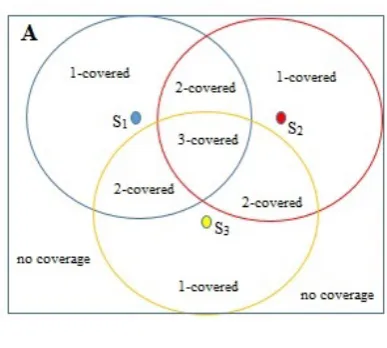
[image:1.595.338.532.233.407.2]In recent years, Wireless Sensor Networks (WSNs) have been widely applied in different real-time applications such as e-health monitoring, home automation, forest fire detection, object tracking etc. The applications use sensor nodes to be deployed in different indoor and outdoor locations. The deployed nodes cover a region individually or collectively to provide network services or sensing capabilities. Coverage is one of the most important performance parameter for WSNs which reflect how well a target area is moni-tored or covered by the deployed sensors. A number of researches have been performed to solve the coverage-related problems. Cov-erage problems in WSNs can broadly be classified into three ma-jor categories: area coverage, point coverage and barrier coverage [10]. In the area coverage problem, the main objective is to moni-tor or cover all locations of a given area, sometimes referred to as region. However, point coverage problem focuses on covering a set of points (i.e., targets) from all locations of a given area. On the other hand, barrier coverage problem deals with constructing a bar-rier for intrusion detection in the deployed WSNs region. The goal is to minimize the probability of undetected penetration through
Fig. 1. Coverage Level
the barrier of the WSNs region. In this survey, the focus is on the k-coverage problems in WSNs those falls in the category of area coverage problem.
k-coverage problem concerns with covering a region byksensors wherek >= 1. For example, if sensing range of2(two) sensors overlap, i.e., a region is within the sensing range of2sensors, the overlapped region is called 2-covered. Fig. 1 shows no-coverage re-gions, 1-covered, 2-covered and 3-covered regions by 3 (three) disc sensing range sensors,S1, S2 andS3for a given rectangular area
A. Similarly, a region is calledk-covered if it is within the sens-ing range of at leastkdifferent sensors wherek >= 1. Different applications of WSNs like fire detection, radiation detection, and intrusion detection may require k-coverage in real-time. It helps to design a fault-tolerance robust network. Moreover, redundantk
sensors can ensure more reliable sensor data received from the envi-ronment. Some WSNs applications used for location determination also needk-coverage for improved accuracy.
of these problems are not directly applicable to WSNs applications due to the nature of sensor nodes. For example, sensor nodes have limited sensing range and battery life whereas the observers of the Art Gallery problem have infinite visibility unless any obstacle ap-pears. Unlike the observers, all the sensor nodes need to commu-nicate with each other within its limited communication range in WSNs. Sometime, the distributed nature of WSNs also restricts to adapt all solutions those are solved in centralized manner.
This survey focuses on two categories ofk-coverage problems and their solutions for WSNs. There are some surveys [10][14][7] based on the different coverage problems in WSNs. However, in this ar-ticle, specifically thek-coverage problems and solutions for WSNs have been presented, which is first to the best of my knowledge. Two following categories ofk-coverage problems have been iden-tified:
(1) k-coverage Verification:In this category,k-coverage problem is formulated as a decision problem where a given area needs to be verified whether it isk-covered or not.
(2) Selecting Subset from Deployed Nodes fork-coverage: The problem selects minimum subset from already deployed sensor nodes to activate from sleeping mode in order to maintaink -coverage in the given area.
Different solution approaches for each category have been dis-cussed in the rest of the article.
2. K-COVERAGE VERIFICATION
Problem Definition:Given an area deployed withnsensors, deter-mine whether the area isk-covered, i.e., every location in the area is within the sensing range of at leastk sensors wherek >= 1. This is a decision problem [6].
Wanget al.[15] have proposed Coverage Configuration Protocol (CCP) to provide different degrees of coverage in the area required by applications. It has been proved that a set of sensors covering a convex region are connected as long as their communication range is no less than twice of the sensing range. This property is used to derive the relationship between the coverage degree and connectiv-ity among sensor nodes. Wanget al.have claimed thatk-coverage could be ensured for a convex regionA, if 1) there are intersection points between sensors or between sensors andA’s boundary; 2) all the intersection points between sensors are at leastk-covered; and 3) all intersection points between any sensor andA’s boundary are at leastk-covered. The CCP allows to verify thek-coverage by only checking the intersection points. The protocol further extends the verification problem to activate a sensor from sleeping mode based onk-coverage eligibility criteria. The criteria states that a sensor is eligible to be active if all the intersection points inside its sensing circle are at leastk-covered. The complexity of the eligibil-ity algorithm isO(n3)wherenis the number of neighboring nodes within a sensor’s sensing radius.
In [6], Huang and Tseng have provided a polynomial time algo-rithm in terms of the number of sensors to solve thek-coverage verification problem. Instead of checking every location in the area, the authors have proposed to check only the perimeter of each sen-sor to determine its coverage. Each sensen-sor first determines its seg-ments in the perimeter that are covered by neighboring node. This is done by calculating the angle,α= arccos (d(si,sj)
2r ), wheresj
is the neighboring sensor ofsiand ris the sensing range ofsi.
The arch ofsifalling in the angle[π−α, π+α]is represented as
[image:2.595.327.543.68.367.2]segments perimeter-covered bysj. The start (left) and end (right)
Fig. 2. Determining: (a) the segment ofs0isperimeter covered bysj, and (b) the perimeter-coverage ofs0isperimeter. [6]
[image:2.595.334.534.420.651.2]Fig. 4. Intersection Coverage Checking [19]
points of each segment, denoted by[αj,L, αj,R], are placed on a
line segment[0,2π]. Then all the points are sorted in an ascending order into a listL. Finally, the perimeter coverage ofsi is
deter-mined by traversing the line segment[0,2π]while visiting each element in the sorted list L from left to right. The perimeter cover-age scenario is illustrated in Fig. 2. It has been proved that as long as the perimeters of sensors arek-covered, the whole region is also k-covered. The authors have considered both the Unit-disc Cover-age (k-UC) model and Non-unit-disc Coverage (k-NC) model. The cost of the algorithm fork-UC problem isO(ndlogd)wheredis the maximum number of neighbor sensors of a given sensor node. Thek-NC problem can also be solved with same complexity as k-UC problem except that the neighbors of a sensor need to be re-defined. This complexity is lower than the approach presented in [15] where the coverage level has been determined by checking the coverage of every intersection points in the sensor’s sensing range that results inO(n3)complexity [6].
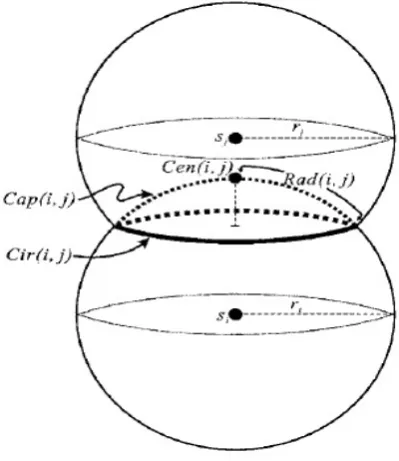
The solution presented fork-coverage verification in [6] is appli-cable for 2-Dimensional area. However, based on the similar con-cept of perimeter coverage as [6], Huanget al.have also proposed a polynomial-time algorithm for solving thek-coverage decision problem in 3-Dimensional area [8]. The authors have formulated the problem asα-Ball-Coverage, whereαis any natural number and sensor’s sensing region is modeled as ball. Initially, each sensor
Sicalculates its spherical cap,Cap(i, j)and circle,Cir(i, j)for
each neighboring sensorSj.Cap(i, j)represents the intersection
of sphereSiand ballBjwhereasCir(i, j)denotes the intersection
of spheresSiandSj. These terminologies have been illustrated in
Fig. 3. Then, for each neighborsk 6= sj, the angle ofCir(i, j)
that is circle-covered byCap(i, k)is calculated which is denoted by[θjk,L, θk,Rj ]. For all the angles,θjk,Landθk,Rj points are placed on a line segment[0,2π]which is then sorted in ascending order into a listLj. Then, the line segment[0,2π]is traversed by
se-quentially visiting each point in the listLjin order to determine
the circle coverage ofCir(i, j), denoted byccj. Finally, the
min-imum circle coverage for all neighboring circles onSiis returned
as the sphere coverage ofsi. The complexity of the algorithm is
O(d2logd)wheredis the maximum neighboring sensor of a sen-sor. Similar to [6], it has been proved that as long as the spheres of sensors arek-covered, the whole region is alsok-covered [8]. Both the approaches presented in [6] and [8] consider that all the sensors have same sensing radius and know their locations along with their neighbor sensor’s location
[image:3.595.317.550.71.191.2]The approach presented in [15], [6], and [8] requires that exact locations of all deployed sensors are known. In contrast, Zhang
Fig. 5. Sensing Border Concept [3]
and Wang have proposed a distributed algorithm where each sen-sor node determines whether they are on the coverage boundary by using localized distance [19]. Fork-coverage verification of an area, at first, it is determined whether the intersection points in the sensing border of each node isk-covered. Based on intersection coverage, the algorithm detects boundary node of a coverage hole for the verification of 1-coverage. Boundary node is the node for which there exists at least one intersection point on its sensing bor-der which is not covered by any other node’s sensing range. For example, in Fig. 4(a), nodeuis a boundary node of 1-coverage-hole whereasuis not a boundary node of 1-coverage-hole in Fig. 4(b). Finally, the 1-coverage verification is extended tok-coverage verification that detects the boundary node of ak-coverage hole. The total running time of the algorithm isO(n3).
Bejerano has proposed ak-coverage scheme that also uses the dis-tance of a node from its neighbor instead of using exact location [3] [4]. However, the assumption is similar to [15], [6] and [8], that is thek-coverage of every internal node can be verified by check-ing its senscheck-ing range border. Moreover, the Transmission Radius (TR) should be twice greater than the Sensing Radius (SR) to en-sure connectivity. At first, a node,u, runs a segment sequence al-gorithm to detect 1-coverage-hole as in [19]. A cyclic segment se-quence of nodeu, denoted asQu, is a sequence of segments with
the property that every first and last segments overlap with exactly two other segments inQu. For example, in Fig. 5, the cyclic
seg-ment sequence of nodeuisQu = {Su,a, Su,c, Su,e, Su,f}.
Af-ter the calculation ofQu, the scheme computesr-map coordinates
that represents the location of neighbors of nodeulocated in its r-vicinity(Nu(r)).r-map coordinate of nodevis represented as
< du,v, θu,v >wheredu,vis the Euclidean distance of node v
from originating nodeuandθu,v is the angle of nodevrelative
to an arbitrary polar-axis. Then, from ther-map coordinate, the scheme calculates the angle between the start and end point of each segment in the cyclic segment relative to nodeuand sort them in increasing order of angle. Finally, the algorithm traverse the sens-ing border of nodeuand verifies whether every point is at least k-covered. The overall running time of thek-coverage verification scheme isO(n3), wherenis the number of nodes inN
u(r)[3].
Fig. 6. An illustration of 2-coverage of a line segmentl=qsqe[9]
find a small set of points in the areaS, so that thek-coverage de-cision problem could be answered by only examining those points efficiently. The sensing range is considered as ballB(a, r)where
ais the center andris radius. At first,k-th order Voronoi diagram,
Vk(l)is drawn based on the given center of the balls. Then, only
three set of points are checked to determine whether they arek -covered. The point sets are 1) the vertices ofVk(l) for givenS,
2) the intersections between the sides ofS andVk(l), and 3) the
corners ofS. Moreover, the framework can also determine the 1-coverage inR2andR3respectively inO(nlogn)andO(n3)time for different sensing range. In addition to the decision problem of k-coverage, the proposed framework can also determine the maxi-mum value ofksuch that every point inSisk-covered. The com-plexity of determiningkisO(n3)andO(n4)respectively forR2 andR3.
Juanget al.have addressed thek-coverage verification problem in different way [9]. Here, instead of verifying the total given area, a query line segment is checked to determine whether all sub-segments of the line segment arek-covered i.e., each point loca-tions in the sub-segment is within the sensing range ofksensors. According to Fig. 6, the sub-segmentsq2sq1e, q3sq2e, q4sq3e are
2-covered whereas the sub-segmentsq1sq2s, q1eq3s, q2eq4s, q3eq4e
are 1-covered. The intersecting points are called CE-points. For all segmentss,qsandqeare denoted as in-CE points and out-CE
points respectively. Three methods based on R-tree index [5] have been proposed as the solutions where R-tree index of the areaSis constructed in advance. The first method called the Basic method, initially stores all the CE points sequentially by traversing meta-R-tree and then the coverage number of the first sub-segment is computed. While traversing the CE points sequentially, if an in-CE-point is encountered, the coverage number is increased by 1; oth-erwise, the coverage number is decreased by 1 if an out-CE-point of a sensor is encountered. To improve the calculation of finding CE points in Basic method, the second approach, the Projection method uses vertical inscribed squares (VI-square) kept in the leaf nodes of the R-tree. For a sensor,s(x, y)with sensing radiusr, the VI-square is an internal square of r(s), where the coordinates of its lower-left and the upper-right points are(x−√r
2, y−
r
√ 2)and
(x+√r
2, y+
r
√
2)respectively [9]. As a sub-segment of a line seg-ment is covered by a VI-square, it can be used to provide the lower bound of the coverage numbers of sub-segments. Instead of find-ing CE points, this method computes square coverfind-ing end points (SCE-points) which is more lightweight. The remaining parts of finding coverage number is same as the Basic method. Though the Projection method provides a lower bound, it can not ensure the actual coverage of some sub-segments [9]. Computation for both the Basic and Projection method depends on the number of
sensors around the given line segment. However, the third method called the tessellation method partitions the given line segment into same length equal tor2instead of generating the intersection points. Then, for each sub-segment, its corresponding Regular Pruning Window (RPW) [9] is generated and the meta-R-tree is traced to find the number of sensors. If the number of sensors in RPW are larger than or equal to k, the sub-segment is verified ask-covered; otherwise the basic method is applied to the sub-segment. From the experiment, it has been found that the tessellation method provides better performance in terms of running time, compared to the other two methods [9].
3. SELECTING SUBSET FROM DEPLOYED
NODES FORK-COVERAGE
Problem Description:For a desired coverage degree,k >= 1, select a minimal subset of sensors from already deployedn sen-sors so that every location of the area is within the sensing range of at leastk different sensors. Thisk-coverage problem has been proved to be NP-hard by reduction to the minimum dominating set problem [17].
In [15], the proposed CCP protocol allows each sensor node to run the Ks− eligibility algorithm in order to determine whether the
node should be active from sleep mode to maintaink-coverage in the area. However, the algorithm does not return a total size of the subset for activated nodes. Zhouet al.[20] have proposed a cen-tralized and a decencen-tralized greedy algorithm to find the minimum size subset ofk-covered sensors which delivers a solution of near-optimal factor ofO(lgn). This algorithm takes a set of sensors and a query region as its input and provides the required subset as an output to maintaink-coverage.
Yanget al.[18] have represented the sensor subset selection prob-lem ask-(Connected) Coverage Set (k-CCS/k-CS) problem. The problem has been defined in terms of linear programming (LP) and an approximation algorithm has been proposed as a solution. Fur-thermore, two more non-global solutions for (k-CCS/k-CS) prob-lem have also been designed. The first solution uses a regular clus-tering approach to select backbone nodes to form the subsets. The second solution uses a pruning algorithm based on 2-hop neigh-borhood information. In this algorithm, a nodeuisk-covered by a subsetCof its neighbors if and only if three conditions are satis-fied:1)The subsetCis connected by nodes with higher priorities thanu,2)Any neighbor ofuis a neighbor of at leastknodes from
C,3)Each node inChas higher priority thanu.
In addition to select a subset fork-coverage, Sheuet al.[12] have proposed ak-coverage preserving protocol to achieve energy effi-ciency while maintaining the required area isk-covered. The au-thors have modeled this problem as a minimum set k-coverage problem and solved it by using a heuristic greedy algorithm. Thek-coverage preserving protocol deals with the probabilistick -coverage requirement model. In the probabilistick-coverage pro-tocol, any point within a region can be detected by more thank
sensors with no lower than a confidence probability. Given a confi-dence probabilityPc, the purpose is to find the lower bound of the
cumulative detection probability at any point inR, and it should not be lower than the thresholdPc. Thus the lower-bound of detection
probabilityPd(si)for probabilistic coverage degreek
0
is given by:
Pc≤1−(1−Pd(si)) k0
Fig. 7. (a) First and (b) Second three-lens flowers ofsi[2]
While previous researchers studied the problems in homogeneous sensor networks, Ammari et al.[2] have focused on the problem of connectedk-coverage in heterogeneous sensor networks. Specif-ically, random sensor set deployment and pseudo-randomly dis-tributed sensor set deployment has been used for the approach. The authors have shown that it is possible to design distributed proto-cols for heterogeneous sensor networks. In the protocol, a sensor,
sirandomly picks one of the three-lens flowers as shown in Fig.
7 and checks whether its sensing range isk-covered. However, it has been proved impossible to design efficient centralized proto-cols due to random deployment and sensor heterogeneity. Thus, a pseudo-random deployment method have been proposed. In this method, sensors are deployed in different layers in a circular field with respect to the sink according to their strengths.
Ammariet al.have further studied the connected k-coverage proto-cols and have proposed four configuration protoproto-cols in [1]. The first protocol, called the centralized randomized connectedk-coverage, selects a minimum sensor set from a field through the sink node to achievek-coverage and connectivity. Initially, sensors located in the three lenses of a given slice are selected as the previous work in [2]. At each selection, it is checked whetherksensors have been selected tok-cover the slice, then the degree of coverage for the other adjacent slice is updated. The second and third protocols are called T-clustered randomized connectedk-coverage (T-CRACCk) and D-clustered randomized connectedk-coverage (D-CRACCk). For the third approach, in each round, the sink node selects a subset of sensors, called cluster-heads, which are responsible for select-ing a subset of neighborselect-ing sensors tok-cover its underlying clus-ter and maintain connection to each other. Precisely, each clusclus-ter- cluster-head exploits the overlap between the slices of its cluster as well as the overlap between its slices and the adjacent cluster-heads to se-lect a minimum number of its sensing neighbors. Both T-CRACCk and D-CRACCk consider different degree of network clustering. In the fourth protocol, called distributed randomized connectedk -coverage (DIRACCk), all sensors are required to coordinate among themselves tok-cover a field in each round.
4. CONCLUSION
In this survey, different solutions and their assumptions for two types ofk-coverage problem in WSNs have been presented. There exist both centralized and decentralized coverage solutions for the problems. From the survey, it has been found that researches have focused more on solving thek-coverage problem in 2D WSNs than in 3D WSNs. Moreover, homogeneous sensor nodes and disk sens-ing model have mostly been used in different solutions. A few
solu-tion approaches consider the probabilistic sensing model of WSNs. However, no approaches have been found which consider different obstacles and interference in the given area while maintainingk -coverage. This is a short survey that provides the broad picture of different solution approaches fork-coverage problems. In future, this survey could be more detailed and extended by involving dif-ferent sensor scheduling scheme and routing protocols those ensure k-coverage in WSNs.
5. REFERENCES
[1] H.M. Ammari and S.K. Das. Centralized and clustered k-coverage protocols for wireless sensor networks.Computers, IEEE Transactions on, 61(1):118–133, Jan 2012.
[2] H.M. Ammari and J. Giudici. On the connected k-coverage problem in heterogeneous sensor nets: The curse of random-ness and heterogeneity. In Distributed Computing Systems, 2009. ICDCS ’09. 29th IEEE International Conference on, pages 265–272, June 2009.
[3] Yigal Bejerano. Simple and efficient k-coverage verifica-tion without locaverifica-tion informaverifica-tion. InINFOCOM 2008. The 27th Conference on Computer Communications. IEEE. IEEE, 2008.
[4] Yigal Bejerano. Coverage verification without location information. Mobile Computing, IEEE Transactions on, 11(4):631–643, 2012.
[5] Antonin Guttman.R-trees: A dynamic index structure for spa-tial searching, volume 14. ACM, 1984.
[6] Chi-Fu Huang and Yu-Chee Tseng. The coverage problem in a wireless sensor network.Mob. Netw. Appl., 10(4):519–528, August 2005.
[7] Chi-Fu Huang and Yu-Chee Tseng. A survey of solutions to the coverage problems in wireless sensor networks.Journal of Internet Technology, 6(1):1–8, 2005.
[8] Chi-Fu Huang, Yu-Chee Tseng, and Li-Chu Lo. The cover-age problem in three-dimensional wireless sensor networks. Journal of Interconnection Networks, 8(03):209–227, 2007. [9] Kun-Han Juang, En Tzu Wang, Chieh-Feng Chiang, and
Ar-bee LP Chen. Verification of k-coverage on query line seg-ments. InProceedings of the 17th International Database En-gineering & Applications Symposium, pages 114–121. ACM, 2013.
[10] Junbin LIANG, LIU Ming, and KUI Xiaoyan. A survey of coverage problems in wireless sensor networks. Sensors & Transducers (1726-5479), 163(1), 2014.
[11] Joseph O’rourke.Art gallery theorems and algorithms, vol-ume 1092. Oxford University Press Oxford, 1987.
[12] Jang-Ping Sheu and Huang-Fu Lin. Probabilistic coverage preserving protocol with energy efficiency in wireless sensor networks. InWireless Communications and Networking Con-ference, 2007.WCNC 2007. IEEE, pages 2631–2636, March 2007.
[13] Anthony Man-Cho So and Yinyu Ye. On solving coverage problems in a wireless sensor network using voronoi dia-grams. InInternet and Network Economics, pages 584–593. Springer, 2005.
[14] Bang Wang. Coverage problems in sensor networks: A sur-vey.ACM Computing Surveys (CSUR), 43(4):32, 2011. [15] Xiaorui Wang, Guoliang Xing, Yuanfang Zhang, Chenyang
and connectivity configuration in wireless sensor networks. In Proceedings of the 1st international conference on Embedded networked sensor systems, pages 28–39. ACM, 2003. [16] Robert Williams. The geometrical foundation of natural
structure. Dover Publications, 1979.
[17] Shuhui Yang, Fei Dai, Mihaela Cardei, Jie Wu, and Floyd Pat-terson. On connected multiple point coverage in wireless sen-sor networks.International Journal of Wireless Information Networks, 13(4):289–301, 2006.
[18] Shuhui Yang, Fei Dai, Mihaela Cardei, Jie Wu, and Floyd Patterson. On connected multiple point coverage in wireless sensor networks.Journal of Wireless Information Networks, 2006, 2006.
[19] Xia Zhang and Cheng Wang. Distributed k-coverage verifi-cation algorithm based on localized distance information in wsns. InNetworking, Architecture, and Storage, 2009. NAS 2009. IEEE International Conference on, pages 196–199. IEEE, 2009.
![Fig. 4.Intersection Coverage Checking [19]](https://thumb-us.123doks.com/thumbv2/123dok_us/8035728.770124/3.595.57.298.67.198/fig-intersection-coverage-checking.webp)
![Fig. 6.An illustration of 2-coverage of a line segment l = qsqe[9]](https://thumb-us.123doks.com/thumbv2/123dok_us/8035728.770124/4.595.75.270.70.183/fig-illustration-coverage-line-segment-l-qsqe.webp)
![Fig. 7.(a) First and (b) Second three-lens flowers of si [2]](https://thumb-us.123doks.com/thumbv2/123dok_us/8035728.770124/5.595.62.288.72.203/fig-b-second-lens-owers-si.webp)
