Repeat Typing in Relation to the Population Structure of
Mycobacterium tuberculosis
in the Netherlands
Rosa Sloot,aMartien W. Borgdorff,bJessica L. de Beer,cJakko van Ingen,dPhilip Supply,e,f,g,h,iDick van Soolingenc,d,j Department of Clinical Epidemiology, Biostatistics and Bioinformatics, Academic Medical Center, University of Amsterdam, Amsterdam, the Netherlandsa
; Department of Infectious Diseases, Public Health Service, Amsterdam, the Netherlandsb
; National Tuberculosis Reference Laboratory, National Institute for Public Health and the Environment, Bilthoven, the Netherlandsc
; Department of Medical Microbiology, Radboud University Nijmegen Medical Centre, Nijmegen, the Netherlandsd ; Institut National de la Santé et de la Recherche Médicale U1019, Center for Infection and Immunity of Lille, Lille, Francee
; Centre National de la Recherche Scientifique, Unité Mixte de Recherche 8204, Center for Infection and Immunity of Lille, Lille, Francef
; Université Lille Nord de France, Center for Infection and Immunity of Lille, Lille, Franceg ; Institut Pasteur de Lille, Center for Infection and Immunity of Lille, Lille, Franceh
; GenoScreen, Lille, Francei
; Department of Pulmonary Diseases, Radboud University Nijmegen Medical Centre, Nijmegen, the Netherlandsj
The population structure of 3,776Mycobacterium tuberculosisisolates was determined using variable-number tandem-repeat (VNTR) typing. The degree of clonality was so high that a more relaxed definition of clustering cannot be applied. Among recent immigrants with non-Euro-American isolates, transmission is overestimated if based on identical VNTR patterns.
D
NA typing is a powerful tool to trace tuberculosis (TB)trans-mission and outbreaks. Clustering ofMycobacterium
tuber-culosisisolates based on identical DNA fingerprints is commonly
used as a proxy for recent transmission (1). However, this
as-sumption is not always correct and depends on many factors, such
as circulation of genetically similar strains, evolution ofM.
tuber-culosisover time, transmission rate, DNA typing methods applied, duration of the study period, sampling, and effectiveness of TB
control (2, 3). Various studies have shown that not all cases in
DNA fingerprint clusters have epidemiological links with other
cases in the cluster (4,5). Moreover, epidemiological links have
been found between cases caused by bacteria with slightly
differ-ent DNA fingerprints (6). Clustering results among cases in the
immigrant population especially should be interpreted with
cau-tion (7,8), as isolates from these patients often belong to
geneti-cally compact strain lineages predominating in the countries of
origin (9,10,11,12).
In the Netherlands, more than 70% of all TB cases are found among foreign-born persons, and extensive information on each patient is stored in a national registry. We aimed to investigate the
population structure ofM. tuberculosisisolates among native and
immigrant cases and to determine the consequences for the inter-pretation of recent transmission based on variable-number tan-dem-repeat (VNTR) typing results.
Culture-confirmed TB cases from October 2003 to December 2008 were included in this study. Patient information was ob-tained from the Netherlands Tuberculosis Register (NTR), held by
the KNCV Tuberculosis Foundation. In total, 3,975M.
tuberculo-sisisolates were typed by IS6110/PGRS restriction fragment length
polymorphism (RFLP) and standard 24-locus VNTR typing (13,
14) at the RIVM or by Genoscreen (Lille). Molecular data were
matched with demographic data using the date of birth, sex, postal area code, and year of diagnosis, resulting in 3,793 (95%) match-ing cases. After exclusion of 17 foreign-born individuals because of incomplete data for several variables, 3,776 (95%) cases re-mained eligible.
Genotype information was uploaded to the MIRU-VNTRplus
web-application (http://www.miru-vntrplus.org) (15) for
phylo-genetic lineage prediction, which was performed stepwise as
de-scribed by Allix-Beguec et al. (16). Isolates that were part of the
CAS, Beijing, EAI,Mycobacterium bovis, andMycobacterium
afri-canumlineages were categorized as non-Euro-American and the
remaining as a Euro-American superlineage (16).
Clonal complexes, defined as groups of at least two isolates differing in not more than 3/24 loci, were identified on a mini-mum-spanning tree with BioNumerics software (Applied Maths, Kortrijk, Belgium), using MIRU-VNTR data and the categorical distance, which scores the number of alleles shared or different over the 24 markers used.
Multiple imputation was used to account for 184 (5%) and 37 (1%) of 3,776 cases with missing data for the variables “time since immigration at TB diagnosis” and “gender,” respectively. All re-maining variables were used to create five imputed data sets, and results are based on pooled statistics. Two different cluster defini-tions were used to investigate the interpretation of recent trans-mission; identical VNTR patterns and single-locus variants (SLVs). The theory behind this was that allowing SLVs to be clus-tered might involve genetically closely related strains that in fact share the same transmission chain. The analyses were performed separately for the Euro-American and non-Euro-American lin-eages and completed with SPSS 18.0 (SPSS, Chicago, IL) and sta-tistical program R version 2.11.0.
A minimum-spanning tree was produced for all 3,776 isolates included in the analysis. In total 3,377 (89%) isolates were
distrib-uted over 83 clonal complexes (Fig. 1), whereas the remaining 399
(11%) isolates did not belong to any clonal complex. Within each complex, all the VNTR patterns represented the same lineage type,
Received21 February 2013 Returned for modification4 April 2013
Accepted1 May 2013
Published ahead of print8 May 2013
Address correspondence to Dick van Soolingen, [email protected]. Copyright © 2013, American Society for Microbiology. All Rights Reserved. doi:10.1128/JCM.00489-13
on May 16, 2020 by guest
http://jcm.asm.org/
except the two largest complexes comprising 84% Haarlem strains and 67% T-specific strains.
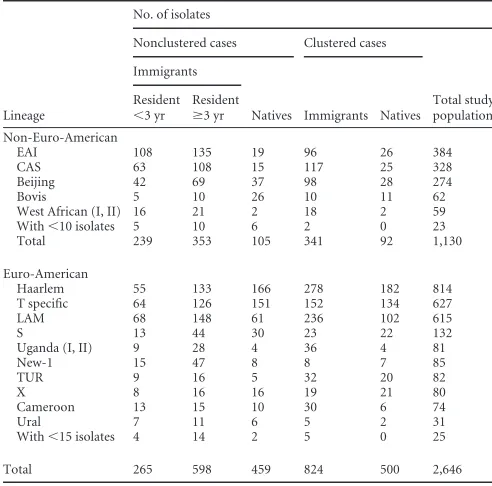
Of the 3,776 isolates, 1,130 (30%) represented the
non-Euro-American lineages (Table 1). We reasoned that recently arrived
immigrant cases having nonclusteredM. tuberculosisisolates most
likely represent importation of foreign genotypes. Among the 504 nonclustered recent-immigrant cases, 239 (47%) were caused by isolates of the non-Euro-American lineages, of which EAI (45%),
CAS (26%), and Beijing (18%) constituted the majority (Table 1).
Cases caused by these non-Euro-American lineages originated from Asia (41%) and Africa (56%). In contrast, recent-immigrant nonclustered cases with Euro-American lineages had a higher di-versity in geographical origin. Furthermore, 40 (8%) of the 504 recent-immigrant nonclustered cases originated from European countries, of which the majority (93%) were caused by the Euro-American lineages. Among the 564 native Dutch cases with
non-clusteredM. tuberculosisisolates, 459 (81%) had isolates of the
Euro-American lineages, of which the majority were of the
Haar-lem (36%), T-specific (33%), and LAM (13%) lineages (Table 1).
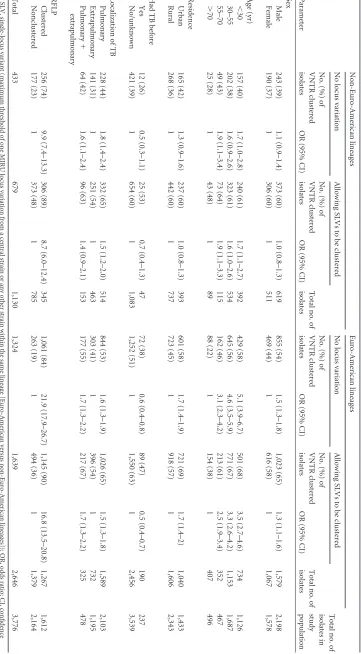
Patient factors significantly associated with VNTR clustering in the whole study population, using identical profiles as a cluster
definition, were analyzed. As observed in previous studies (17,
18), we found male sex, young age, urban residence, having
pul-monary tuberculosis, and no previous treatment for tuberculosis as significant risk factors for clustering. All risk factors became less
[image:2.585.109.474.66.414.2]FIG 1Identification of clonal complexes in the total study population in a minimum-spanning tree.
TABLE 1Distribution of non-Euro-American and Euro-American lineages over clustered and nonclustered immigrant and native Dutch tuberculosis cases
Lineage
No. of isolates
Nonclustered cases Clustered cases
Total study population Immigrants
Natives Immigrants Natives Resident
⬍3 yr
Resident
ⱖ3 yr Non-Euro-American
EAI 108 135 19 96 26 384
CAS 63 108 15 117 25 328
Beijing 42 69 37 98 28 274
Bovis 5 10 26 10 11 62
West African (I, II) 16 21 2 18 2 59
With⬍10 isolates 5 10 6 2 0 23
Total 239 353 105 341 92 1,130
Euro-American
Haarlem 55 133 166 278 182 814
T specific 64 126 151 152 134 627
LAM 68 148 61 236 102 615
S 13 44 30 23 22 132
Uganda (I, II) 9 28 4 36 4 81
New-1 15 47 8 8 7 85
TUR 9 16 5 32 20 82
X 8 16 16 19 21 80
Cameroon 13 15 10 30 6 74
Ural 7 11 6 5 2 31
With⬍15 isolates 4 14 2 5 0 25
Total 265 598 459 824 500 2,646
on May 16, 2020 by guest
http://jcm.asm.org/
[image:2.585.297.543.481.724.2]TABLE 2 Risk factors for clustering, with and without allowing single-locus variants to be clustered, according to lineage a Parameter Non-Euro-American lineages Euro-American lineages Total no. of isolates in study population No locus variation Allowing SLVs to be clustered Total no. of isolates No locus variation Allowing SLVs to be clustered Total no. of isolates No. (%) of VNTR clustered isolates OR (95% CI) No. (%) of VNTR clustered isolates OR (95% CI) No. (%) of VNTR clustered isolates OR (95% CI) No. (%) of VNTR clustered isolates OR (95% CI) Sex Male 243 (39) 1.1 (0.9–1.4) 373 (60) 1.0 (0.8–1.3) 619 855 (54) 1.5 (1.3–1.8) 1,023 (65) 1.3 (1.1–1.6) 1,579 2,198 Female 190 (37) 1 306 (60) 1 511 469 (44) 1 616 (58) 1 1,067 1,578 Age (yr) ⬍ 30 157 (40) 1.7 (1.0–2.8) 240 (61) 1.7 (1.1–2.7) 392 429 (58) 5.1 (3.9–6.7) 501 (68) 3.5 (2.7–4.6) 734 1,126 30–55 202 (38) 1.6 (0.9–2.6) 323 (61) 1.6 (1.0–2.6) 534 645 (56) 4.6 (3.5–5.9) 771 (67) 3.3 (2.6–4.2) 1,153 1,687 55–70 49 (43) 1.9 (1.1–3.4) 73 (64) 1.9 (1.1–3.3) 115 162 (46) 3.1 (2.3–4.2) 213 (61) 2.5 (1.9–3.4) 352 467 ⬎ 70 25 (28) 1 43 (48) 1 89 88 (22) 1 154 (38) 1 407 496 Residence Urban 165 (42) 1.3 (0.9–1.6) 237 (60) 1.0 (0.8–1.3) 393 601 (58) 1.7 (1.4–1.9) 721 (69) 1.7 (1.4–2) 1,040 1,433 Rural 268 (36) 1 442 (60) 1 737 723 (45) 1 918 (57) 1 1,606 2,343 Had TB before Yes 12 (26) 0.5 (0.3–1.1) 25 (53) 0.7 (0.4–1.3) 47 72 (38) 0.6 (0.4–0.8) 89 (47) 0.5 (0.4–0.7) 190 237 No/unknown 421 (39) 1 654 (60) 1 1,083 1,252 (51) 1 1,550 (63) 1 2,456 3,539 Localization of TB Pulmonary 228 (44) 1.8 (1.4–2.4) 332 (65) 1.5 (1.2–2.0) 514 844 (53) 1.6 (1.3–1.9) 1,026 (65) 1.5 (1.3–1.8) 1,589 2,103 Extrapulmonary 141 (31) 1 251 (54) 1 463 303 (41) 1 396 (54) 1 732 1,195 Pulmonary ⫹ extrapulmonary 64 (42) 1.6 (1.1–2.4) 96 (63) 1.4 (0.9–2.1) 153 177 (55) 1.7 (1.3–2.2) 217 (67) 1.7 (1.3–2.2) 325 478 RFLP Clustered 256 (74) 9.9 (7.4–13.3) 306 (89) 8.7 (6.0–12.4) 345 1,061 (84) 21.9 (17.9–26.7) 1,145 (90) 16.8 (13.5–20.8) 1,267 1,612 Nonclustered 177 (23) 1 373 (48) 1 785 263 (19) 1 494 (36) 1 1,379 2,164 Total 433 679 1,130 1,324 1,639 2,646 3,776 a SLV, single-locus variant (maximum threshold of one MIRU locus variation from a central strain or any other strain within the same lineage [Euro-Amer ican versus non-Euro-American lineages]); OR, odds ratio; CI, confidence interval.
on May 16, 2020 by guest
http://jcm.asm.org/
[image:3.585.112.473.70.724.2]strongly associated when analyses was restricted to cases caused by
non-Euro-American lineages (Table 2). Only age (⬍30 and 55 to
70 years) and having pulmonary tuberculosis remained signifi-cantly associated with clustering.
Allowing SLVs to be clustered increased the clustering propor-tion by 24% and 57% among cases with Euro-American isolates
and non-Euro-American isolates, respectively (Table 2). This
re-sulted in a decreased magnitude of association between the risk factors and clustering, in particular for the cases caused by
non-Euro-American lineages (Table 2).
Similarly, the association between RFLP and VNTR clustering in cases caused by non-Euro-American lineages was reduced com-pared to that in cases caused by Euro-American lineages. Discrep-ancy between VNTR and RFLP typing (i.e., clustered by either VNTR or RFLP) was in most cases caused by VNTR clustered and
RFLP nonclustered isolates (Table 2). Among 1,130
Euro-American isolates, 177 (16%) were clustered by VNTR and non-clustered by RFLP. In contrast, among 2,646 Euro-American iso-lates, 263 (10%) were clustered by VNTR and nonclustered by
RFLP (Table 2).
This study shows the lineage-dependent degree of reliability of the inference on transmission. Classification of lineage type was based on the geographical association between patient origin and strain lineage, defined as Euro-American and non-Euro-Ameri-can. Among nonclustered native Dutch TB cases, Euro-American lineages were most frequently isolated. Domination of these lin-eages among native TB cases has also been shown in other
Euro-pean populations (19, 20), suggesting that these lineages have
been circulating in Europe for centuries (21). In contrast,
recent-immigrant cases caused by nonclustered non-Euro-American strains originated from distant geographical areas.
Risk factors for recent transmission, as determined by VNTR clustering, were reduced in the non-Euro-American lineages compared to the Euro-American lineages, indicating the lineage dependence. This was further visible when testing the effect of tolerating single-locus variants in the cluster definition, as the in-crease in clustered non-Euro-American strains was twice as high as that among Euro-American strains, reflecting the clonality of the former strains in the study population. Furthermore, the mag-nitude of association between risk factors and clustering decreased after allowing single-locus variants, especially among cases with non-Euro-American isolates, thus increasing overestimation of recent transmission for cases caused by non-Euro-American lin-eages.
In conclusion, to remain useful in TB control practice, the definition of a cluster on the basis of VNTR typing should be a fully identical 24-locus VNTR typing result. This study further indicated limits in the interpretation of recent transmission based on clustering by VNTR typing in the recent-immigrant popula-tion. Our findings are in particular relevant for other European low-incidence countries having similar forms of immigration.
ACKNOWLEDGMENTS
We thank all the Municipal Health Services that reported their cluster investigations to the national surveillance unit and the microbiological laboratories in the Netherlands for their efforts to sendMycobacterium tuberculosisisolates to the RIVM.
P.S. is a consultant for GenoScreen, Lille, France. All other authors have declared that no competing interests exist.
REFERENCES
1.Small PM, Hopewell PC, Singh SP, Paz A, Parsonnet J, Ruston DC, Schecter GF, Daley CL, Schoolnik GK.1994. The epidemiology of tu-berculosis in San Francisco. A population-based study using conventional and molecular methods. N. Engl. J. Med.330:1703–1709.
2.Jasmer RM, Hahn JA, Small PM, Daley CL, Behr MA, Moss AR, Creasman JM, Schecter GF, Paz EA, Hopewell PC.1999. A molecular epidemiologic analysis of tuberculosis trends in San Francisco, 1991-1997. Ann. Intern. Med.130:971–978.
3.Glynn JR, Bauer J, de Boer AS, Borgdorff MW, Fine PE, Godfrey-Faussett P, Vynnycky E.1999. Interpreting DNA fingerprint clusters of
Mycobacterium tuberculosis. Int. J. Tuberc. Lung Dis.3:1055–1060. 4.Ellis BA, Crawford JT, Braden CR, McNabb SJ, Moore M, Kammerer S.
2002. Molecular epidemiology of tuberculosis in a sentinel surveillance population. Emerg. Infect. Dis.8:1197–1209.
5.Braden CR, Templeton GL, Cave MD, Valway S, Onorato IM, Castro KG, Moers D, Yang Z, Stead WW, Bates JH.1997. Interpretation of restriction fragment length polymorphism analysis of Mycobacterium tu-berculosis isolates from a state with a large rural population. J. Infect. Dis.
175:1446 –1452.
6.Schürch AC, Kremer K, Daviena O, Kiers A, Boeree MJ, Siezen RJ, van Soolingen D.2010. High-resolution typing by integration of genome sequencing data in a large tuberculosis cluster. J. Clin. Microbiol.48: 3403–3406.
7.Diel R, Rüsch-Gerdes S, Niemann S.2004. Molecular epidemiology of tuberculosis among immigrants in Hamburg, Germany. J. Clin. Micro-biol.42:2952–2960.
8.Iñigo J, García de Viedma D, Arce A, Palenque E, Alonso Rodríguez N, Rodríguez E, Ruiz Serrano MJ, Andrés S, Bouza E, Chaves F. 2007. Analysis of changes in recent tuberculosis transmission patterns after a sharp increase in immigration. J. Clin. Microbiol.45:63– 69.
9.van Soolingen D, Qian L, de Haas PE, Douglas JT, Traore H, Portaels F, Qing HZ, Enkhsaikan D, Nymadawa P, van Embden JD. 1995. Predominance of a single genotype of Mycobacterium tuberculosis in countries of east Asia. J. Clin. Microbiol.33:3234 –3238.
10. Hirsh AE, Tsolaki AG, DeRiemer K, Feldman MW, Small PM.2004. Stable association between strains of Mycobacterium tuberculosis and their human host populations. Proc. Natl. Acad. Sci. U. S. A.101:4871– 4876.
11. Cardoso Oelemann M, Gomes HM, Willery E, Possuelo L, Batista Lima KV, Allix-Béguec C, Locht C, Goguet de la Salmonière YO, Gutierrez MC, Suffys P, Supply P.2011. The forest behind the tree: phylogenetic exploration of a dominant Mycobacterium tuberculosisstrain lineage from a high tuberculosis burden country. PLoS One6:e18256. doi:10.1371 /journal.pone.0018256.
12. Lillebaek T, Andersen AB, Bauer J, Dirksen A, Glismann S, de Haas P, Kok-Jensen A.2001. Risk of Mycobacterium tuberculosis transmission in a low-incidence country due to immigration from high-incidence areas. J. Clin. Microbiol.39:855– 861.
13. Supply P, Allix C, Lesjean S, Cardoso-Oelemann M, Rüsch-Gerdes S, Willery E, Savine E, de Haas P, van Deutekom H, Roring S, Bifani P, Kurepina N, Kreiswirth B, Sola C, Rastogi N, Vatin V, Gutierrez MC, Fauville M, Niemann S, Skuce R, Kremer K, Locht C, van Soolingen D.
2006. Proposal for standardization of optimized mycobacterial inter-spersed repetitive unit-variable-number tandem repeat typing of Myco-bacterium tuberculosis. J. Clin. Microbiol.44:4498 – 4510.
14. van Embden JD, Cave MD, Crawford JT, Dale JW, Eisenach KD, Gicquel B, Hermans P, Martin C, McAdam R, Shinnick TM, Small PM.
1993. Strain identification of Mycobacterium tuberculosis by DNA finger-printing: recommendations for a standardized methodology. J. Clin. Mi-crobiol.31:406 – 409.
15. Weniger T, Krawczyk J, Supply P, Niemann S, Harmsen D. 2010. MIRU-VNTRplus: a web tool for polyphasic genotyping of Mycobacte-rium tuberculosis complex bacteria. Nucleic Acids Res.38:W326 –W331. 16. Allix-Béguec C, Fauville-Dufaux M, Supply P.2008. Three-year popu-lation-based evaluation of standardized mycobacterial interspersed repet-itive-unit-variable-number tandem-repeat typing of Mycobacterium tu-berculosis. J. Clin. Microbiol.46:1398 –1406.
17. Bauer J, Yang Z, Poulsen S, Andersen AB.1998. Results from 5 years of nationwide DNA fingerprinting ofMycobacterium tuberculosiscomplex isolates in a country with a low incidence ofM. tuberculosisinfection. J. Clin. Microbiol.36:305–308.
on May 16, 2020 by guest
http://jcm.asm.org/
18. van Soolingen D, Borgdorff MW, de Haas PE, Sebek MM, Veen J, Dessens M, Kremer K, van Embden JD.1999. Molecular epidemiology of tuberculosis in the Netherlands: a nationwide study from 1993 through 1997. J. Infect. Dis.180:726 –736.
19. Garzelli C, Lari N, Cuccu B, Tortoli E, Rindi L. 2010. Impact of immigration on tuberculosis in a low-incidence area of Italy: a molecular epidemiological approach. Clin. Microbiol. Infect.16:1691–1697.
20. Kinander W, Bruvik T, Dahle UR.2009. Dominant Mycobacterium tuberculosis lineages in elderly patients born in Norway. PLoS One
4:e8373. doi:10.1371/journal.pone.0008373.
21. Lillebaek T, Dirksen A, Vynnycky E, Baess I, Thomsen VØ, Andersen AB.2003. Stability of DNA patterns and evidence of Mycobacterium tu-berculosis reactivation occurring decades after the initial infection. J. In-fect. Dis.188:1032–1039.