Munich Personal RePEc Archive
Temporary controls on capital inflows
Reinhart, Carmen and Smith, R Todd
University of Maryland, College Park, Department of Economics
August 2002
Temporary Controls on Capital Inflows* Carmen M. Reinhart
University of Maryland and NBER
R. Todd Smith
University of Alberta
This draft: November 2000
A revised version was published in:
Journal of International Economics, Vol. 57. No. 2, August 2002, 327-351.
During the past decade a number of countries imposed capital controls that had two distinguishing features: they were asymmetric, in that they were designed principally to discourage capital inflows, and they were temporary. This paper studies formally the consequences of these policies, calibrates their potential effectiveness, and assesses their welfare implications in an environment in which the level of capital inflows can be sub-optimal. In addition, motivated by the fact that these types of controls have often been left in place after the dissipation of the shock that lead to the controls being implemented, the paper evaluates the welfare cost of procrastination in removing these types of controls.
*We received helpful comments from two referees, Andres Velasco (the editor),
Guillermo Calvo, Mike Dooley, Vincent Reinhart, and seminar participants at the Harvard Institute for International Development, MIT, Instituto Torcuato DiTella
1. Introduction
There have been various episodes in the past decade when capital inflows to countries were
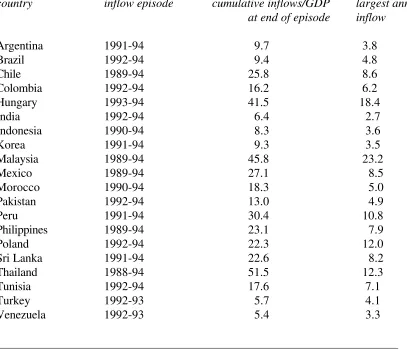
very large relative to the size of the economies (see Table 1). This can be a serious problem if the
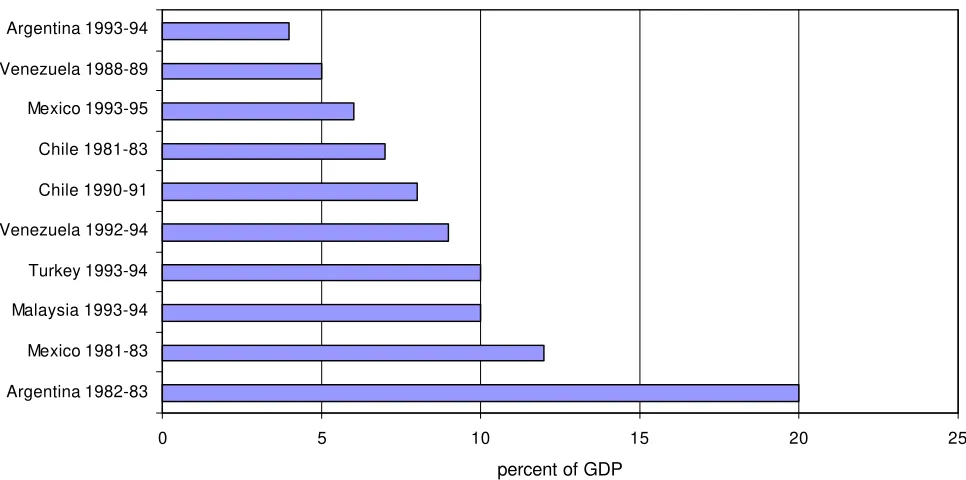
inflows are temporary. There are many historical examples of substantial reversals of capital inflows
(see Figure 1). This paper studies a form of capital control that a group of countries used in the 1990s
to manage this potential problem. These capital controls had two distinguishing characteristics: they
were asymmetric and they were intended to be purely temporary.
The asymmetry of the capital controls stemmed from the fact that they were targeted at
discouraging capital inflows but posed little barrier to capital outflows. In fact, in several
countries--notably Brazil, Chile, and Colombia--the asymmetry of the controls was reinforced by simultaneously
lifting some long-standing controls on capital outflows. The types of controls that were imposed on
capital inflows varied across countries; they included both outright quantitative restrictions and
various forms of taxes.1 The Czech Republic (1995) utilized quantitative limits on short-term foreign
borrowing. Brazil (1993-97) used an explicit tax in tandem with outright prohibition or minimum stay
restrictions for certain types of inflows. Both types of controls in Brazil varied considerably over time
in terms of which types of inflows they applied to and, for the explicit taxes on inflows, the tax rates
also varied across time. Malaysia (1994) used outright prohibitions on certain types of inflows and,
as in Thailand (1995-97), placed restrictions on domestic banks’ offshore borrowing. Chile (1991-98)
and Colombia (1993-98) relied mainly on a specific type of indirect tax—a non-remunerated deposit
requirement at the central bank—that applied to various types of inflows, but mostly shorter-term
inflows. Chile also utilized minimum stay requirements to mitigate reversals of inflows.
The reason for the temporariness of the capital controls varies across countries, although a
common thread was the aim of stopping or slowing what was perceived as temporary inflows of
capital—“short-term inflows”. At one extreme, the Malaysian authorities explicitly stated in January
1994 that restrictions on capital inflows were to be implemented and that they would be temporary.
2
In most other cases the authorities were not as explicit about the duration of the policy, but it was
apparent that the measures were a response to a temporary shock. This shock was reflected in a surge
1
For further details on country experiences see Reinhart and Smith (1998) and Ariyoshi et. al (2000).
2
in capital inflows, a significant increase in the current account deficit, and a surge in economic
activity, particularly personal consumption expenditures (see Ariyoshi et. al (2000), Reinhart and
Smith (1998)). Their temporariness was also reflected in the fact that the tax rates or quantitative
restrictions were varied (or simply removed) in synch with cyclical developments—when inflows
slowed the restrictions were eased. 34
Another noteworthy characteristic of these recent experiences with capital controls is that the
controls were implemented in a very different economic environment than is usually the case when
capital controls are implemented. This is potentially important because while empirical work often
concludes that capital controls lose their effectiveness relatively quickly this literature does not usually
differentiate between controls on inflows and controls on outflows. 5
There is reason to believe that
the effectiveness of capital controls is not symmetric and, in particular, that controls on inflows may
be more effective than controls on outflows. One reason is that controls on outflows are usually
resorted to during balance-of-payments crises. In these circumstances, the imposition of controls, in
and of itself, may send a signal that worse times are to come.6
In contrast, the countries mentioned
above that imposed controls on capital inflows did so under more normal economic circumstances.
While rate-of-return differentials were often still an incentive to evade the controls, these differentials
were generally much smaller than during crises. Finally, some recent empirical studies that focus
specifically on controls on inflows find that they may have been effective in terms of altering the
composition and/or the level of inflows (Ariyoshi et. al (2000), Reinhart and Smith (1998), Montiel
and Reinhart (1999), De Gregorio et al. (2000)).
3
One might argue that controls that are intended as permanent can be categorized as temporary if they lose their effectiveness over time. Controls of this type are the focus of the literature on “leaky controls” (e.g. Gros (1987)). These types of controls probably create different incentives and thus may not fit well into the class of capital controls considered in this paper.
4
There are earlier instances where countries have sought to restrict capital inflows temporarily, but these instances are considerably more isolated than the experience in the 1990s. One of the better known instances involved Switzerland in the late 1970s in which substantial capital inflows--partly because of German residents’ desire to escape a new withholding tax in Germany--prompted the Swiss National Bank to impose a 100 percent reserve requirement on non-residents' bank deposits in Switzerland. The consequence was a negative nominal interest rate on foreign deposits in Swiss banks because these banks demanded a fee to accept foreign deposits.
5
Dooley (1996) surveys the literature on capital controls. Mathieson and Rojas-Suarez (1993) review the empirical evidence on the effectiveness of capital controls (see also Ariyoshi et. al (2000)).
6
There are several possible reasons why policymakers might want to impose controls on capital
inflows (e.g., Dooley (1996)). The reason considered in this paper underlies many of the country
experiences discussed above. Namely, taxing capital inflows can be helpful in curbing an excessive
temporary increase in economic activity, and particularly private consumption, that is being financed
to a large extent by capital inflows. This possibility has been widely discussed in the context of
exchange rate crises. For instance, Feldstein (p.6,1999) notes that “[w]hile access to more foreign
debt could raise domestic investment, experience shows that countries that seek substantially more
foreign debt frequently invest those funds in relatively unproductive ways….” The approach taken
in the paper is to study capital inflow restrictions in a dynamic general equilibrium model in which
certain shocks can result in temporarily excessive domestic consumption financed by capital inflows.
By “excessive” it is meant that private consumption and foreign debt are, at least temporarily, higher
than the Pareto efficient allocation. Capital inflow restrictions in the model are therefore a natural
application of the Theory of Second Best.
The shocks that can lead to excessive capital inflows in the model are temporary changes in
the foreign interest rate and, secondly, temporary changes in domestic monetary policy. These shocks
have previously been identified as being important for explaining surges in capital inflows to
developing countries (e.g., Calvo et al. (1993), Eichengreen and Rose (1998), and Frankel and Rose
(1996)). The paper considers two underlying “distortions” that are responsible for why these shocks
can have these consequences. First, the paper considers a monetary distortion as in the literature on
“temporary stabilizations” (Calvo (1986), Calvo and Vegh (1993), Calvo et al. (1995), and Rebelo
and Vegh (1995)). Second, the paper considers an environment in which the social cost of foreign
debt exceeds the private cost. Several authors have discussed this type of externality. For instance,
Harberger (1986) argues that the risk premium on foreign debt is increasing in the level of foreign
debt, Chang and Velasco (1999) emphasize that the social and private costs of short-term foreign
debt might be different, and Furman and Stiglitz (1998) discuss various reasons why private
accumulation of foreign debt might have negative external effects on others in the economy.
There is a large literature on capital controls. Nonetheless, as Dooley (1996) emphasizes,
while there is a well-developed literature dealing with the economic effects of capital controls, there
motives for capital controls. This paper studies such an environment that is motivated by recent
experiences in developing countries. There is also an existing literature (beginning with Calvo (1986))
that is concerned with the economic effects of temporary reductions in inflation rates. This type of
policy change is one of the “shocks” considered in the paper, but the focus below is very different
from these other studies. Most importantly, the focus below is on the positive and normative
consequences of taxing capital inflows in an environment in which some domestic and foreign shocks
can produce an inefficient level of capital inflows. In contrast, the literature on temporary policy
changes is an inherently positive analysis--the aim is to explain the behavior of macroeconomic
aggregates during actual domestic stabilization policies.7
A main finding of the paper is that the tax rate on capital inflows must be very high in order
to have much effect on the capital account balance. For instance, a reduction in the capital account
balance by five percent of GDP would require a tax rate on net interest payments on foreign-held debt
on the order of 85 percent for one year or 60 percent for two years.8
These tax rates are high, but so
are the tax rates that have been imposed in countries that have been successful in curbing capital
inflows.
A second main finding is that for reasonable parameterizations the welfare benefits of taxing
capital inflows are usually small. In particular, when “overborrowing” is due to just the monetary
distortion discussed above, the welfare benefits (expressed in terms of a discounted stream of private
consumption) of even very large shocks are typically within one percent of GDP. When there is an
externality associated with foreign borrowing, the welfare benefits of taxing capital inflows are
substantially larger, but they are generally still within two percent or so of GDP for even very large
shocks. It is shown that these modest potential benefits of taxing capital inflows can easily be lost,
or even reversed (i.e., welfare losses), if the tax rate is not sufficiently close to the optimal tax rate.
A third component of the analysis builds on the fact that many of the countries implementing
the types of capital controls that are considered in the paper leave them in place longer than the
7
In the context of domestic stabilizations, Calvo (1986) notes that capital controls could raise welfare because they restrict access to foreign capital and thus limit the response of consumption to the shock. Related, Calvo et al. (1995) compares the behavior of some macroeconomic variables with perfect capital mobility and no capital mobility.
8
period of time that the offending shock lasts. This procrastination in the removal of controls may be
due to a concern that capital inflows will surge if controls are removed too soon. It may also be
because “…a control system, once established, is likely to take on a life of its own…Thus, controls
designed to mitigate a temporary distortion might outlive the economic rationale on which they were
established” (Dooley (p.642, 1996)). Whatever the reason, the calculations in the paper suggest that
the welfare benefits of capital inflow taxes generally vanish after roughly twice the length of time that
the initial shock lasts. This finding may therefore be helpful in gauging the costs associated with
delaying the removal of capital inflow restrictions.
The format of the paper is as follows. Section 2 describes the model and illustrates the
qualitative consequences of taxing capital inflows. Section 3 measures the magnitudes of tax rates
that are required to engineer significant reductions in capital inflows and measures the welfare
consequences of capital inflow taxes. Section 4 studies externalities from foreign borrowing. Finally,
section 5 contains concluding comments.
2. A Model with Taxes on Capital Inflows
2.1. Model
The home country is a small open economy facing a foreign instantaneous real interest rate
of r* > 0. The representative agent in the home country has preferences:
, dt ) C , C U( e
t *t t
-0
β
∫∞ (1)
where Ct and C
*
t denote consumption of the non-traded and traded goods respectively, β > 0 is
the subjective discount rate, and U(C ,C*)
t
t is twice differentiable, strictly concave, and increasing
in each of its arguments. As usual, it is assumed that *
r =
β which implies that steady-state
consumption (in the absence of capital controls) is constant.
There is free trade in goods, and the world price of the traded good in units of foreign
currency is Pt*. The foreign rate of inflation is π*, and thus the foreign nominal interest rate is
* * * = +π
r
home-country currency price of a unit of foreign currency is denoted Et. The real exchange rate is therefore P / P E =
et t t t
*
. The nominal exchange rate depreciates at rate ε and we assume ε + π* ≥0
.
The representative agent’s consumption purchases must satisfy a cash-in-advance constraint:
, ) e / C + C (
m t t
* t
t≥α (2)
where mt is real cash balances and α is a positive constant. This constraint binds if the nominal
interest rate on domestic bonds, it, is positive; the assumptions 0
* ≥
+ π
ε and r*>0 will ensure
this is the case.
There are three assets available to home-country residents: the domestic currency (which is
not held by foreigners); foreign bonds that yield r* (in units of the traded good); and one-period
domestic bonds that yield rt (in units of the traded good). The real and nominal interest rates on
home-country bonds will depend on whether there are restrictions on capital inflows.
Each period the representative agent in the home country receives an endowment of yunits
of the non-traded good andy* units of the traded good. The agent’s real net wealth at time tis
b -m
at≡ t t, where bt is net foreign debt. Thus, the budget constraint is:
, + m b r C e C y + e y =
a t t t t
* t t t * t
t (π ε) τ
*+
& (3)
where τt is lump-sum transfers from the government. The appropriate interest rate in formulating (3)
is the domestic rate because the paper only considers restrictions on capital inflows, and thus rt ≥r*.
Define the domestic market discount factor, Dt, as:
(
- r ds)
. =D s
t 0
t exp ∫ (4)
Multiply (3) by Dt, integrate, and impose the transversality condition to yield:
, a + dt + y + e y D = dt m i + C + e C D t 0 * t t 0 t t * t t t t 0 ∫
∫∞ ∞ τ (5)
where i=r+π +* ε. To motivate taxes on capital inflows, assume that the representative agent has
an initial stock of debt: b0>0. Without loss of generality, let b0=m0 so that a0=0. Using this and
. dt + y + e y D = dt ) i + (1 C + e C D t * t t 0 t * t t t t 0 ∫
∫∞ α ∞ τ (6)
The representative agent maximizes (1) subject to (6).
The consolidated budget constraint of the government/central bank in the home country is:
. b r + m + m + f r =
f&t t (π ε) t &t τt γt t t
*
* +
(7)
Here, ft is foreign exchange reserves (foreign bonds), and the final term on the right side is revenue
from taxing capital inflows. This tax, at rate γt∈[0,1), applies to net interest payments on foreign
debt. Alternatively, if the tax applied to a broader base (e.g., the stock of foreign debt) the main
consequence would be that the tax rate that is necessary to generate a real interest rate of a given
magnitude is lower. Note also that the paper is concerned with temporary controls on capital inflows
so γt >0only for an interval of time t∈[0,T), where T <∞. It is assumed that ft=0∀ t, and thus
net revenue from seigniorage and from taxing capital inflows is rebated (lump-sum) to home-country
residents.
Equilibrium in the non-traded goods market and the money market require:
y , =
Ct (8)
. m =
mt ts (9)
To derive the equilibrium condition for the traded-goods sector, substitute (7) into (3), impose
(8)-(9), integrate the resulting equation forward, and impose the transversality condition. This yields:
. b r y = dt C e 0 * * t t r -0 * *
∫∞ (10)
2.2. Qualitative Effects of Taxing Capital Inflows
The obvious benchmark for comparing the effects of restrictions on capital inflows is the case
in which there are no restrictions. When there are no taxes on inflows, arbitrage ensures rt=r*, for
all t. Letting ϕ denote the Lagrange multiplier on (6), the first-order conditions are:
, ) i + (1 = ) C , C ( U t * t t
C*t ϕ α (11)
Equilibrium consumption is therefore Ct=y and C = y -r b0 * * t
*
, and the (constant) equilibrium real
exchange rate is ( , )/ ( , * * 0)
0 * *
* y y r b U y y r b U
e= C − C − .
When there are taxes on capital inflows, the first-order conditions are:
(
- (r - )ds)
(1+ i ) , =) C , C (
U s t
t 0 *
t t
C*t exp ∫ β ϕ α (13)
(
)
.exp- (r - )ds (1+ i )/e
= ) C , C (
U s t t
t 0 *
t t
Ct ∫ β ϕ α (14)
For illustration purposes suppose that γt=γ for all t∈[0,T), and let tˆ<T denote a future date for
which foreign debt is strictly positive for all t< tˆ . Then, for all t∈[0,tˆ), one can write:
(
1+ i)
e */(1 ).= ) C (y ,
U t rt
* t C*t
γ γ
α
ϕ − −
(15)
There are two main consequences of the capital inflow tax. First, the tax causes the
home-country real and nominal interest rates to immediately jump upward. The reason is that arbitrage
results in rt = r* /(1-γt), because only then do both foreign and home-country bonds offer the
same net-of-tax real return to foreign investors. As a result, the level of consumption jumps down
because of a higher effective price of consumption today (i.e., 1+αit) relative to after the tax is
removed. Second, so long as foreign debt is positive, the home-country real and nominal interest rates
remain higher than foreign rates because the home country must still attract foreign capital. This
encourages the representative agent in the home country to substitute consumption intertemporally,
which is reflected in increased saving and an upward-sloping consumption path. If at some date tˆ
domestic savings are high enough that foreign debt has been reduced to zero, then since foreign
capital is no longer required the real interest rate falls tort=r*.9
Similarly, if the tax on inflows is
removed when there exists positive foreign debt then the real interest rate falls to r* at the moment
the tax is lifted. In this case, foreign capital will finance the remaining foreign debt, bT>0, at an
interest rate of r*. In both cases the level of consumption after tˆ or T, whichever comes first, is
9
One can rule out the possibility that the increase in savings is so large that the home country becomes a net creditor to the rest of the world (i.e., one can rule out bt<0 for any t<T). The reason is that this circumstance would imply
permanently higher than before the capital controls were imposed because debt servicing costs are
permanently lower. Consequently, the imposition of a tax on capital inflows initially causes a real
exchange rate depreciation, and then subsequently a real exchange rate appreciation beyond the level
that would have prevailed had capital inflow taxes never been imposed.
3. Effectiveness of capital controls and their welfare consequences
3.1. Why are temporary taxes on inflows so high?
In practice, taxes on inflows are often levied at very high rates.10
For instance, consider a
three-month investment in Chile during 1995 earning 20 percent per annum. The unremunerated
deposit requirement in that year was equivalent to a 50 percent tax rate on net interest payments (see
Ariyoshi et. al (2000)).
To provide insight into why tax rates tend to be high, we parameterize the model and consider
some numerical exercises. Specifically, let preferences be:
1. q 0 0, > , 1/ -1 ) C ( ) C ( = ) C , C U( * t ) 1/ -q(1 ) 1/ -q)(1 -(1 t * t
t η ≤ ≤
η
η η
(16)
The parameter η measures the elasticity of intertemporal substitution, and q measures the share of
traded goods in total consumption. For these preferences, optimal consumption satisfies:
, T < t , )] + (r + [1 y q e = C q ) 1/ -q)(1 -(1 )t -(r * t ) / 1 1 ( 1 1 * η η β ε π α ϕ − − + (17) , T t , )] + (r + [1 y q e = C q ) 1/ -q)(1 -(1 )T -(r *
t ≥
+ − − (11/ ) 1 1 * * η η β ε π α ϕ (18)
where we define r =r* /(1-γ ). In writing these expressions it has been assumed (innocuously) that
the country has strictly positive foreign debt throughout the period that controls are in place. Finally,
substituting (17) and (18) into (11) and integrating yields:
, b ) /r y ( c + c = 0 * 2 1 a -1 * ϕ (19) 10
where: , a -1 ) -(r + r --1 e ) + (r + 1 y q = c a) -1 )T -(r + T r -) 1/ -q)(1
-(1 1-a
1 1 + * /( ) /( * * β ε π α β η (20) , * /( * * * r e ) + (r + 1 y q = c a) -1 )T -(r + T r -) 1/ -q)(1
-(1 1-a
1 2 + β η ε π α (21)
and a=q(1−1/η).
Chosen as a baseline parameterization is r* = β = 0.03, π +* ε=0.10 , q = 0.4,
15 . 0 =
α , η =0.5, and T =1 (i.e., one year). This baseline parameterization is reasonable in light
of empirical estimates of these parameters.11
The experiments considered are as follows. For a given
parameterization, varying the tax rate γ will affect the interest rate and thus net foreign debt. One
can therefore calculate what the value of the tax rate (or equivalently the real interest rate) must be
in order to generate a specific level of foreign debt after the tax has been in place for T years.
For the baseline parameterization the tax rate required to reduce foreign debt by five percent
of GDP is 88.9 percent and the associated real interest rate is 2.6 percent per month (in excess of 31
percent per annum).12 These magnitudes for the required tax rate and real interest rate are only
significantly different if T is several years or if some of the preference parameters are implausible (see
Figure 2). Thus, one can conclude that the magnitudes of the tax rate and the interest rate required
to reduce the capital account balance by a significant amount over a few years are very high. If the
tax base were broadened so that the tax applied to (say) total capital inflows, bt, then the required
tax rate would be lower but the required real interest rate would be the same. The reason that such
a high interest rate is required is simply that intertemporal substitution in consumption is low for
reasonable parameter values.
11
The ratio of M1 to private consumption (in percent) was 11.4 in Brazil in 1991, 10.7 for Chile in 1991, and 16.7 for Columbia in 1988 (data from IFS). The average share of traded goods in total consumption during 1978-1986 was 0.47 in Brazil and 0.32 in Columbia (see Ostry and Reinhart (1992)). Empirical studies for developing countries find that the degree of intertemporal substitution in consumption is generally below unity (Ostry and Reinhart (1992), Reinhart and Vègh (1995)).
12
[image:12.612.157.540.95.232.2]The parameter analysis shown in Figure 2 provides insight into the link between required tax
rates and the values of the various parameters. The required tax rate is decreasing in T simply
because there is a longer period of time available to reduce foreign debt by any given amount. Greater
intertemporal substitution reduces the required tax rate because this makes consumption (and thus
foreign borrowing) more sensitive to interest rates. The ratio of the effective price of consumption
(i.e., 1+αit) when the tax is in place to this price after the tax is removed is a measure of how big
the distortion is that is caused by the tax. Thus, since this ratio is increasing in α but decreasing in
the domestic inflation rate, the required tax rate tends to be lower when α is larger or when the
domestic inflation rate is lower. Finally, the required tax rate is increasing in the traded goods share
because when this share is large, equilibrium consumption of traded goods is less sensitive to
variations in their price.
3.2. Welfare effects of temporary capital controls
The above numerical experiments show that the magnitude of taxes on capital inflows must
be large to generate modest adjustments in the capital account. But the motivation for engineering
these adjustments with public policy is not apparent. As discussed above, countries that have
implemented such measures have done so largely to deal with temporarily lower foreign interest rates
and an associated increase in capital inflows and domestic consumption. This motive for restricting
capital inflows is present in the model because a temporary decrease in the foreign interest rate (for
example) causes domestic consumption to rise by more than is Pareto efficient. The reason is that the
effective price of current consumption is 1+αit, rather than simply 1 in the social planner’s problem.
Thus, since it =it*+ε , a temporary decrease in the foreign nominal interest rate (for a given
exchange-rate policy) causes consumption to increase by more than is Pareto efficient.13
Note that the
parameter α may be a potentially important determinant of the welfare benefits of capital controls.
13
3.2.1. Foreign Shocks
The first experiment considered therefore involves a temporary decrease in the foreign
nominal interest rate. This could arise either because of a temporary decrease in the foreign real
interest rate or the foreign inflation rate. The case of a decrease in the foreign real interest rate
produces a somewhat more complicated optimal tax problem because the Pareto efficient
consumption path in the home country is upward sloping. In comparison, the Pareto efficient
consumption path is flat when there is instead a temporary decline in the foreign inflation rate. In this
case the optimal tax problem therefore is to minimize the reaction of consumption to the shock. This
tax problem is still a fairly complicated problem because the tax affects the domestic real interest rate
and thus it will alter the slope of the consumption path. The discussion below focuses mainly on this
problem rather than the case of a temporary decrease in the foreign real interest rate, but the main
differences in the conclusions from the two problems will be discussed.
Suppose therefore that the foreign inflation rate temporarily decreases from π*
to π~*
during
T)
[0, . For now we limit attention to the case of a constant tax rate. The marginal utility of wealth
with tax rate γ over [0,T)is:
, b r y c c qy = a q − − − − + 1 0 * * 2 1 ) / 1 1 )( 1 ( ) / ( η ϕ (22) where: , a r r r e = c a a T r T r − − + − + + + − − − − + − )] 1 /( ) ( [ )] ~ ( 1 [ 1 * ) 1 /( 1 * ) 1 /( ) ( 1 * β ε π α β (23) . )] ( 1
[ * 1/(1 )
* ) 1 /( ) ( 2 * r r e = c a a T r T r + + + − − − + − ε π α β (24)
One can therefore write social welfare as:
. = W a a )] + (r + 1 a )T -a(r + T -e + a a )] + (r + 1 a ) -a(r + -1 a )T -a(r + T -e y ) 1/ -q)(1 -(1
q 1-a a 1/ -1 y ) 1/ -q)(1 -(1 0 − + − − + − − ) 1 /( * * [ ) 1 /( ) 1 /( * ~ ))[ 1 /( ( ) 1 /( ε π α β β β ε π α β β β β ϕ η η η (25)
There is no closed-form solution for the optimal (constant) tax rate associated with
maximizing this welfare function. We therefore use a numerical optimization algorithm to determine
additional traded-goods income that would be required for the agent to be just as well off were the
tax rate equal to zero. This stream of traded goods is discounted and expressed as a percentage of
current annual GDP.
For the baseline parameterization and a fall in the foreign nominal interest rate of nine
percentage points the welfare benefit of taxing capital inflows is 0.0024 percent of GDP. Thus, for
even a large foreign shock there are small welfare benefits of taxing capital inflows. Moreover, this
conclusion is not sensitive to the parameterization: for a wide range of parameterizations the welfare
benefits peak at about 0.1 percent of GDP (see Figure 3). Note that the welfare benefits are exactly
zero when α =0, because in this case the distortion in consumption decisions caused by the
temporary fall in the foreign nominal interest rate disappears. For similar reasons, the welfare benefits
are even smaller than in the baseline when intertemporal substitution in consumption is lower, T is
smaller, or the share of traded goods q is larger.14 Finally, the welfare benefits associated with a
shock to the foreign real interest rate are (slightly) lower than those associated with a purely nominal
interest rate shock.
An important implication of this welfare finding is that if the actual tax rate is different from
the optimal tax rate, then the policy could produce welfare losses. Indeed, if the tax rate is
significantly higher than the optimal tax rate the magnitude of the welfare loss will be large.
Specifically, when the tax rate is increased above the optimal level the welfare benefits fall
continuously reaching a maximum loss amounting to well over 50 percent of current GDP for the
baseline parameterization.
Qualitatively, the welfare losses from not taxing capital inflows occur because both the
intratemporal and intertemporal marginal rates of substitution in consumption are distorted by the
shock to the foreign nominal interest rate. To see this, note that the socially optimal allocation of
consumption is Ct = y and 0
* *
* r b
y
Ct = − . In the decentralized economy, however, consumption
of traded goods rises for the duration of the shock because the effective price of consumption falls.
This is the intertemporal distortion. The magnitude of this intertemporal distortion can be significantly
14
affected by the parameter η. However, estimates of intertemporal elasticities of substitution are
small, and thus the magnitude of the intertemporal distortion is small.
The intratemporal distortion arises because, whereas equilibrium consumption of non-traded
goods is equal to yin all periods, consumption of traded goods rises for the duration of the shock.
Thus, the intratemporal marginal rate of substitution of the two consumption goods is distorted by
the shock. This intratemporal distortion in consumption could be generalized by allowing for different
factors, say αand α*, applied to non-traded and traded goods respectively in the cash-in-advance
constraint. Including just this additional generality in our model will not affect the welfare calculations
because equilibrium consumption of non-traded goods is always equal to y; this implies that only
*
α can affect welfare.15
However, if the supply of non-traded goods is endogenous then both α and
*
α would matter for welfare. Endogenizing production would, of course, complicate the analysis,
but purely from the perspective of consumption distortions it is not clear whether the welfare benefits
of capital controls would be any larger. On the one hand, the intratemporal distortion would actually
be reduced by a temporary decline in the foreign nominal interest rate because it would bring the ratio
)) * ( 1 /( )) * ( * 1
( +α i +ε +α i +ε closer to unity.16
On the other hand, the intertemporal distortion
would be exacerbated simply because when the supply of non-traded goods is endogenous then the
shock introduces an intertemporal distortion in consumption of both types of consumption goods.
Nonetheless, even if the response of non-traded goods consumption to the shock was of the same
order of magnitude as traded goods, it appears that the welfare benefits would still be small since the
elasticity of intertemporal substitution in consumption is small. To illustrate, if one simply assumes
that all goods are tradable in the above model, then the intratemporal distortion is zero and the
intertemporal distortion applies to all consumption goods. As Figure 3 suggests (i.e., as q→1), the
welfare benefits in this case are even lower than in our baseline case.
15
Specifically, α affects the relative price of traded and non-traded goods, but not equilibrium consumption or social welfare.
16
One further issue to consider in evaluating the above welfare conclusions is that attention has
been limited to a constant tax rate. It is possible that a constant tax rate could be a poor tax policy
in response to the types of shocks being considered. To assess this possibility, we calculated how
much of the gap between the Pareto optimal allocation and the competitive equilibrium when inflows
are not taxed is closed under the optimal constant tax rate. For the range of parameterizations shown
in Figure 3 the constant tax rate policy narrows this gap by 75-96 percent. Thus, even with a first-best
tax policy the welfare benefits would not be much greater than for a constant tax rate.17
3.2.2. Domestic Monetary Stabilizations
Another circumstance with a motive for taxing capital inflows involves a purely domestic
“shock”, namely, a temporarily lower domestic inflation rate. There are a number of studies that use
models like the one used in this paper to try to explain consumption booms, the deterioration of
external accounts, and other macroeconomic regularities in countries that temporarily reduce their
inflation rate (see Calvo (1986), Calvo and Vegh (1993), Calvo et al. (1995), and Rebelo and Vegh
(1995)).
This type of event is of interest in this paper for two reasons. First, the existing literature is
concerned with explaining macroeconomic regularities surrounding these events. In contrast, this
paper’s focus is normative: the focus is on the welfare benefit of using taxes on capital inflows to
prevent excessive consumption financed by capital inflows. Second, the magnitude of the shocks
considered in this literature are much larger than reasonable foreign shocks, and thus it is of interest
to determine whether the welfare benefits are small for even very large shocks.
The shock considered in this second experiment is Rebelo and Vegh’s (1995) “benchmark
parameterization”, which involves a temporary decrease in the rate of devaluation from an annual rate
of ε =1.84to ε =0.0 (a fixed exchange rate) during the time interval [0,T]. This parameterization
is chosen by the authors because they consider Argentina to be a good reference case and this policy
change corresponds closely to the situation in Argentina in the decade prior to the Convertibility Plan
(which fixed the exchange rate).
17
Although this domestic shock is about 20 times larger than the foreign shock considered
above, the welfare benefit under the optimal tax policy is about 350 times larger for the baseline
parameterization, and thus result is reasonably robust to alternative parameter values (see Figure 4).
In economic terms, however, the welfare benefit amounts to just 0.84 percent of current GDP for the
baseline parameterization. A larger value of T does increase these welfare benefits. For instance,
when T =2.5, which is the case considered by Rebelo and Vegh, the welfare benefits are 1.84
percent of GDP. 18
This is non-trivial, but it is not huge when viewed in the context of the magnitudes
of movements in macroeconomic variables associated with this event—in the model, the stock of
foreign debt, for instance, rises by 44 percent during the life of the shock. Some alternative
parameterizations, and particularly a larger value of α , increase these welfare benefits, but significant
differences from our baseline parameterization contradict empirical evidence on these parameter
values.
3.3. Procrastination in the removal of controls
Countries implementing the types of capital controls that are considered in this paper often
leave them in place longer than the shock lasts, apparently because of a concern that capital inflows
will rebound if controls are lifted too soon. This “addictiveness” is, of course, costly because there
is no benefit to a higher domestic real interest rate after the shock has dissipated.
Let Tˆ >Trepresent the date when the tax on capital inflows is eliminated. Then, for the case
of a shock to the world nominal interest rate, the marginal utility of wealth is:
, b r y
c + c + c
= 1* 2 3
a -1
− 0
*
) / (
ϕ (28)
where:
, a r + -r )
r + 1
-1 e
= c
a a rT + T r
-
− +
+ −
−
)] 1 /( [
] * ~ (
[ 1/(1 ) *
) 1 /(
1
*
γ ε
π α
γ
(29)
18
, a r + -r ) r + 1 -e e = c a a rT T r a T r + T r
-2
− + + − − + − − )] 1 /( [ ] * (
[ 1/(1 ) *
) 1 /( ) 1 /( ˆ ˆ * * γ ε π α γ γ (30) . ] * (
[ * 1/(1 ) *
) 1 /( ˆ ˆ * r ) r + 1 -1 e = c a a T r + T r
-3
+ + − − ε π α γ (31)
Welfare is therefore:
(
)(
)
− + − − a a )] + (r + 1 a r a + -1 a rT a + T -e y(1-q)(1-1/ )q 1-a
a
1/ -1 y(1-q)(1-1/ ) 0=
W ~* /(1 )
))[ 1 /( ( ) 1 /( ε π α γ β γ β ϕ η η η . ) 1 /( * [ ) 1 /( ) 1 /( * ))[ 1 /( ( ) 1 /( ) 1 /( ˆ ˆ − + − + − + − − − − a a )] + (r + 1 a rT a + T -e a a )] + (r + 1 a r a + -a rT a + T -e a T r a + T -e + ε π α β γ β ε π α γ β γ β γ β (32)
The welfare function for the case of a temporary stabilization involves minor changes to (32).
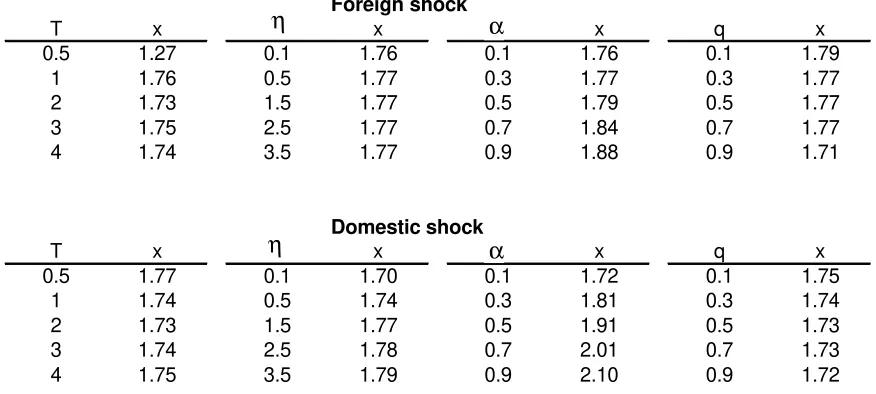
Using (33) and the optimal tax rate from section 3.2. one can calculate the value of Tˆ such that
the welfare benefit of the tax on inflows is exactly zero. Table 2 reports Tˆ expressed as a ratio to T .
It is clear that, for both types of shocks, the welfare benefit typically disappears after just less than
twice the number of years that the shock lasted. After that point, of course, the welfare benefit is
negative. The reason Tˆ is roughly the same for both types of shocks even though the welfare benefit
of taxes is different is that the optimal tax rate is higher when the welfare benefit of the inflow tax is
higher, and thus procrastination reduces the welfare benefit at roughly the same rate per unit of time.
4. Externalities and the overborrowing distortion
The source of the welfare benefit of a tax on capital inflows above is that a temporary shock
to interest rates causes excessive consumption and foreign borrowing due to a monetary distortion.
These welfare benefits are small because the quantitative significance of this distortion is, for
reasonable parameter values, small.
Rebelo and Vegh (1995) study temporary reductions of inflation rates in a generalized
open-economy model that includes endogenous production and a flexible transactions technology. These
generalizations complicate the transmission mechanism linking a shock to social welfare, but the
borrowing to the shocks considered above are not likely to be significantly altered. In fact, for the
temporary stabilization “shock” discussed above quarterly consumption in the model considered by
Rebelo and Vegh increases by between 5 and 10 percent from its steady state level, whereas in the
model studied above consumption rises by about 18 percent relative to the steady state. As a result,
because our primary interest is measuring the potential welfare benefit of taxes on capital inflows as
a policy response to excessive consumption and capital inflows, within this type of model the welfare
calculations discussed above may be generous.
An alternative approach is to alter the distortion underlying excessive consumption and capital
inflows. This section of the paper considers an extension to the model that relates over-borrowing
to a difference between the private and social costs of foreign borrowing. Specifically, imagine that
there are a large number of households in the domestic economy that individually consider the real
interest rate to be exogenous to their consumption-borrowing decisions. However, at the
economywide level, the cost of funds is an increasing function of the level of indebtedness of the
economy. Thus, in the absence of capital controls, the real return required by foreigners for lending
to the domestic economy is r(bt), where r(bt) is an increasing function.
For tractability the numerical experiments focus on the case of a discrete function r(bt).19 In
particular, the experiment studied has two main components. First, there is a temporary decrease in
the foreign inflation rate during [0,T) (below we also discuss the case of temporary monetary
stabilizations). As above, this shock tends to raise consumption of agents in the domestic economy
and increase economywide indebtedness, bt. Second, it is assumed that, if the level of indebtedness
exceeds a threshold level at some (endogenous) time T1∈(0,T), then the required real return
demanded by foreigners rises from r* to r~ , where ~r >r*, until time T when the initial shock is
reversed and the consumption path jumps downward (thereby reversing the course of foreign debt).20
If capital controls are to have substantially greater welfare benefits than in the earlier analysis then
19
There is no closed-form solution for a continuous interest rate function.
20The higher real interest rate on impact tends to reduce consumption but leads to higher debt servicing costs. In all of
it would have to be because they discourage borrowing and consequently prevent the economywide
cost of financing from increasing.
In the absence of capital controls, aggregate debt for t∈(0,T1)satisfies:
. 1 )]
~ ( 1 [ ) 1
( *
) / 1 1 ( 1
1
* *
) / 1 1 )( 1 (
* *
0
* *
*
−
+ + +
+ − −
= − − − −
r e r
qy e
r y b e b
t r q
q t
r t
r t
η η
ε π α
ϕ (34)
Debt in the presence of capital controls behaves similarly except that the nominal interest rate in the
denominator of the third term reflects the effect of capital controls on the domestic real interest rate
and the marginal utility of wealth ϕis also affected. In all experiments it is verified that the debt level
under the optimal tax never reaches the threshold level during (0,T].
The welfare benefits of capital controls are calculated using the same procedure as above for
the two types of shocks.21
For comparison with the earlier findings, the main focus is on the baseline
parameterization. Various values for T1 (and thus implicitly various threshold debt levels) and r~ are
considered. We use as a baseline ~r =0.035and T1 =0.5.
For the case of a foreign inflation shock, the main conclusion is that the welfare benefits of
capital controls are magnified considerably: they are more than 50 times larger than the earlier welfare
calculations for the baseline case (see Table 3). Nonetheless, the absolute level of the welfare benefit
is still small, amounting to just 0.12 percent of current GDP. A larger value of r~ increases these
welfare benefits, but they remain small. For example, if ~r =0.045--i.e., a 50 percent increase in the
real interest rate in the home country—the welfare benefit increases to 0.37 percent of current GDP.22
The welfare benefit for all parameterizations shown in Figure 3 never exceeds 0.4 percent.
For the case of temporary reductions in the domestic inflation rate, unless the externality is
very large, the welfare benefits are not greatly affected. The reason is that the original distortion is
not trivial, so a fairly small increase in the real interest rate due to debt accumulation does not greatly
alter that conclusion. However, a large externality from debt accumulation does alter this conclusion
21
to some degree. For the baseline case, the welfare benefits increase from 0.84 to 1.2 percent of GDP
when ~r =0.045, and a tripling of the real interest rate (not shown in Table 3) to ~r =0.09increases
the welfare benefits to 2.3 percent.23
The effects of other parameters mirrors the previous analysis,
scaled roughly by the multiples reflected in Table 3 to account for the externality.24
For this extended model we also calculated how much procrastination in the removal of the
tax on inflows can be tolerated before the welfare benefits vanish. The only exception to the earlier
conclusion of just less than twice the period of time as the shock itself lasts is for the foreign shock.
In that case, the amount of procrastination that can be tolerated is slightly greater for some
parameterizations.
5. Concluding remarks
There are four main findings of this paper. First, temporary controls on capital inflows are
only likely to be effective if the controls are highly punitive and the associated domestic real interest
rates are very high. Second, the use of capital inflow taxes to inhibit inefficient private sector
borrowing abroad generally has a relatively small welfare benefit. Third, because there is potential for
only modest welfare benefits of taxing capital inflows, if the tax rate on capital inflows is not
sufficiently close to the optimal tax rate then these welfare benefits could easily be lost and may in
fact be negative (welfare losses) and significant. Fourth, the potential welfare benefits can also be lost,
or even reversed, in a relatively short period of time when there is procrastination in removing the
capital inflow tax.
The analysis in the paper is centered on well-defined distortions that, in tandem with a shock
to domestic or foreign interest rates, are the ultimate cause of excessive capital inflows. This
possibility is of interest because several experiences with controls on inflows were motivated in part
22
For higher values of r~(and the other parameters set at the baseline parameterization) there does not exist a perfect foresight equilibrium in which the debt level at T1in the absence of controls exceeds the debt level at T under optimal taxation of foreign borrowing.
23
In contrast to the case of a shock to the foreign inflation rate, there do exist perfect foresight equilibria for quite high values of r~ . The reason is that the shock is much larger so even a large increase in the real interest rate is likely to not reduce the debt level below the debt level that prevails at the same point in time but when inflows are taxed.
24
by a concern that a surge in capital inflows was being used mainly to finance excessive private
consumption. The calculations are a direct measure of the welfare benefits of using taxes on capital
inflows in these circumstances.
There are, of course, other distortions and associated reasons why capital inflows might be
inefficiently large. For example, Summers (1988) has suggested that it might be desirable for
governments temporarily to stem capital inflows if the inflows are purely speculative. Krugman
(1987) suggests that this sort of policy might also be desirable if capital inflows cause a real exchange
rate appreciation that has hysteresis effects on exports. Taxing capital inflows might also be desirable
if capital inflows distort the incentives and decisions of financial intermediaries, or if large reversals
of capital inflows can cause financial and balance-of-payments crises (see Dooley (1996)). It would
be interesting in future research to study in a general equilibrium framework the potential welfare
benefit of taxes on capital inflows when these types of distortions are present. An interesting question
in this regard is whether the potential welfare benefit of taxes on inflows in these types of
References
Ariyoshi, Akira, Karl Habermeier, Bernard Laurens, Inci Otker-Robe, Jorge Ivan Canales-Kriljenko,
and Andrei Kirilenko (2000) Capital Controls: Country Experiences with Their Use and
Liberalization, IMF Occasional Paper 190, (Washington: International Monetary Fund).
Bartolini, Leonardo, and Allan Drazen, (1997) “Capital Account Liberalization as a Signal,”
American Economic Review, 87, 138-54.
Calvo, Guillermo A. (1986) “Temporary Stabilization: Predetermined Exchange Rates,” Journal of
Political Economy, 94, 1319-29.
Calvo, Guillermo A., Leiderman, Leonardo, and Carmen A. Reinhart (1993) “Capital Inflows and
Real Exchange Rate Appreciation in Latin America: The Role of External Factors,” IMF Staff
Papers, 40, 108-51.
Calvo, Guillermo A. and Carlos A. Vegh (1993) “Exchange-Rate Based Stabilization under Imperfect
Credibility,” in Helmut Frisch and Andreas Worgotter (eds.) Open-Economy Macroeconomics,
Chapter 1, pages 3-28 (London: The Macmillan Press).
Calvo, Guillermo A., Reinhart, Carmen M., and Carlos A. Vegh (1995) “Targeting the Real Exchange
Rate: Theory and Evidence,” Journal of Development Economics, 47, 97-133.
Chang, Roberto and Andres Velasco (1999) “Liquidity Crises in Emerging Markets: Theory and
Policy,” forthcoming 1999 NBER Macroeconomics Annual.
De Gregorio, Jose, Edwards, Sebastian, and Rodrigo O. Valdes (2000) “Controls on Capital Inflows: Do They Work?” mimeo., University of California Los Angeles.
Dooley, Michael P. (1996) “A Survey of Academic Literature on Controls Over International Capital
Transactions,” IMF Staff Papers,43, 639-687.
Eichengreen, Barry and Andrew K. Rose (1998) “Staying Afloat when the Wind Shifts: External Factors and Emerging-Market Banking Crises,” Working Paper 6370, National Bureau of Economic Research.
Feldstein, Martin (1999) “Avoiding Currency Crises,” remarks presented at the Jackson Hole Federal Reserve Conference, August 28.
Frankel, Jeffrey A. and Andrew K. Rose (1996) “Currency Crashes in Emerging Markets: An
Empirical Treatment,” Journal of International Economics, 41, 351-66.
Furman, Jason and Joseph E. Stiglitz (1998) “Economic Crises: Evidence and Insights from East
Gros, Daniel (1987) “The Effectiveness of Capital Controls: Implications for Monetary Autonomy
in the Presence of Incomplete Market Separation,” IMF Staff Papers, 34, 621-42.
Harberger, Arnold C. (1986) “Welfare Consequences of Capital Inflows,” in A.M. Choksi and D.
Papageorgiou (eds.) Economic Liberalization in Developing Countries, 157-78 (Oxford: Basil
Blackwell).
Krugman, Paul (1987) “The Narrow Moving Band, the Dutch Disease, and the Competitive
Consequences of Mrs. Thatcher: Notes on Trade in the Presence of Scale Economies,” Journal
of Development Economics, 27, 41-55.
Mathieson, Donald J., and Liliana Rojas-Suarez (1993) Liberalization of the Capital Account,
Experiences and Issues, IMF Occasional Paper 103, (Washington: International Monetary Fund).
Montiel, Peter and Carmen M. Reinhart (1999) “Do Capital Controls and Macroeconomic Policies Influence the Volume and Composition of Capital Flows? Evidence from the 1990s,” mimeo., University of Maryland.
Ostry, Jonathan, and Carmen M. Reinhart (1992) “Private Saving and Terms of Trade Shocks:
Evidence from Developing Countries,” IMF Staff Papers 39, 495-517.
Rebelo, Sergio and Carlos A. Vegh (1995) “Real Effects of Exchange-Rate Based Stabilization: An
Analysis of Competing Theories,” in B.S. Bernanke and J. Rotemberg (eds.) NBER
Macroeconomics Annual 1995, 125-174 (Cambridge: MIT Press).
Reinhart, Carmen M., and R. Todd Smith (1998) “Too Much of a Good Thing: the Macroeconomic
Effects of Taxing Capital Inflows,” Chapter 14 in R. Glick (ed.) Managing Capital Flows and
Exchange Rates: Perspectives from the Pacific Basin, (Cambridge: Cambridge University Press).
Reinhart, Carmen M. and Carlos A. Végh (1995) “Intertemporal Consumption Substitution and Inflation Stabilization: an Empirical Investigation,” University of Maryland Working Papers in International Economics No. 3.
Summers, Lawrence J. (1988) “Tax Policy and International Competitiveness,” in Jacob Frenkel (ed.)
Table 1: Recent Surges in Capital Inflows
(Net long-term international private capital inflows as a percentage of GDP)
country inflow episode* cumulative inflows/GDP largest annual at end of episode inflow
Argentina 1991-94 9.7 3.8
Brazil 1992-94 9.4 4.8
Chile 1989-94 25.8 8.6
Colombia 1992-94 16.2 6.2
Hungary 1993-94 41.5 18.4
India 1992-94 6.4 2.7
Indonesia 1990-94 8.3 3.6
Korea 1991-94 9.3 3.5
Malaysia 1989-94 45.8 23.2
Mexico 1989-94 27.1 8.5
Morocco 1990-94 18.3 5.0
Pakistan 1992-94 13.0 4.9
Peru 1991-94 30.4 10.8
Philippines 1989-94 23.1 7.9
Poland 1992-94 22.3 12.0
Sri Lanka 1991-94 22.6 8.2
Thailand 1988-94 51.5 12.3
Tunisia 1992-94 17.6 7.1
Turkey 1992-93 5.7 4.1
Venezuela 1992-93 5.4 3.3
*
The period during which the country experienced a significant surge in net private capital inflows.
Sources: World Bank data; IMF, World Economic Outlook data base; IMF, International Financial
Table 2: Years That Controls Are Left in Place Before Welfare Benefits Vanish (as a ratio (x) to the duration of the shock)
Foreign shock
T x x x q x
0.5 1.27 0.1 1.76 0.1 1.76 0.1 1.79
1 1.76 0.5 1.77 0.3 1.77 0.3 1.77
2 1.73 1.5 1.77 0.5 1.79 0.5 1.77
3 1.75 2.5 1.77 0.7 1.84 0.7 1.77
4 1.74 3.5 1.77 0.9 1.88 0.9 1.71
Domestic shock
T x x x q x
0.5 1.77 0.1 1.70 0.1 1.72 0.1 1.75
1 1.74 0.5 1.74 0.3 1.81 0.3 1.74
2 1.73 1.5 1.77 0.5 1.91 0.5 1.73
3 1.74 2.5 1.78 0.7 2.01 0.7 1.73
4 1.75 3.5 1.79 0.9 2.10 0.9 1.72
η
η
α
Table 3: Debt Externalities and the Welfare Benefits of Taxes on Inflows
Foreign Shock
Relative to Relative to
Benefit no Externality Benefit no Externality
0.25 0.186 77.5 0.031 0.0268 11.15
0.5 0.124 51.67 0.035 0.124 51.67
0.75 0.063 26.25 0.041 0.2713 113.04
1.00 0.0024 1.00 0.045 0.369 153.75
Domestic Shock
Relative to Relative to
Benefit no Externality Benefit no Externality
0.25 1.02 1.21 0.031 0.865 1.02
0.5 0.96 1.14 0.035 0.961 1.14
0.75 0.9 1.07 0.041 1.08 1.28
1.00 0.841 1.00 0.045 1.2 1.42
1
T r~
1
Notes: net capital flows includes short-term and long-term flows. The source for the data is IMF, World Economic Outlook Database.
Figure 1: Large Reversals in Net Private Capital Flows
0 5 10 15 20 25
Argentina 1982-83 Mexico 1981-83 Malaysia 1993-94 Turkey 1993-94 Venezuela 1992-94 Chile 1990-91 Chile 1981-83 Mexico 1993-95 Venezuela 1988-89 Argentina 1993-94
Figure 2: Tax/Interest Rate Required to Reduce Foreign Debt by 5% of GDP
(a) Effect of T
0 2 4 6 8 10 12 14
0.50 1.00 1.50 2.00 2.50 3.00 3.50 4.50
interest rate 0 20 40 60 80 100 120 tax rate interest rate tax rate
(b) Effect of elasticity of substitution
0 2 4 6 8 10 12
0.1 0.5 0.9 1.3 2.0 3.0 4.0 5.0 6.0 7.0 8.0 9.0 10.0
interest rate 0 20 40 60 80 100 120 tax rate interest rate tax rate
(c) Effect of alpha
0 0.5 1 1.5 2 2.5 3 3.5 4
0.0 0.1 0.2 0.3 0.4 0.5 0.6 0.7 0.8 0.9 1.0
interest rate 74 76 78 80 82 84 86 88 90 92 94 tax rate interest rate tax rate
(d) Effect of domestic inflation rate
2.55 2.56 2.57 2.58 2.59 2.6 2.61 2.62 2.63 2.64 2.65 2.66
0.00 0.10 0.20 0.30 0.40 0.50 0.60 0.75
interest rate 88.75 88.8 88.85 88.9 88.95 89 89.05 89.1 89.15 tax rate interest rate tax rate
(e) Effect of traded goods share
0 0.5 1 1.5 2 2.5 3 3.5 4
0.0 0.1 0.2 0.3 0.4 0.5 0.6 0.7 0.8
interest rate 82 83 84 85 86 87 88 89 90 91 92 tax rate interest rate tax rate
Notes: the tax rate (monthly interest rate, respectively) for the baseline parameterization is 88.94% (2.6%). The baseline parameterization is:
1 , 1 , 5 . 0 , 13 . 0 , 03 . 0 , 15 . 0 , 4 .
0 = = * = * = = = * = 0 =
= r i y y b
Figure 3: Welfare Benefit of Taxes: World Nominal Rate Falls 9 Percentage Points
(b) Effect of eta
0 0.001 0.002 0.003 0.004 0.005 0.006
0.5 2.5 4.5 6.5 8.5
(d) Effect of q
0 0.0005 0.001 0.0015 0.002 0.0025 0.003 0.0035
0.1 0.2 0.3 0.4 0.5 0.6 0.7 0.8
(a) Effect of T
0 0.001 0.002 0.003 0.004 0.005 0.006 0.007 0.008 0.009 0.01
0.25 0.75 1.25 1.75 2.25 2.75 3.25 3.75 4.25 4.75
(c) Effect of alpha
0 0.02 0.04 0.06 0.08 0.1 0.12
0.00 0.20 0.40 0.60 0.80 1.00
Figure 4: Welfare Benefit of Taxes: Temporary Domestic Stabilization
(b) Effect of eta
0 0.5 1 1.5 2 2.5
0.5 2.5 4.5 6.5 8.5
(d) Effect of q
0 0.2 0.4 0.6 0.8 1 1.2
0.1 0.2 0.3 0.4 0.5 0.6 0.7 0.8
(a) Effect of T
0 0.5 1 1.5 2 2.5 3 3.5
0.25 0.75 1.25 1.75 2.25 2.75 3.25 3.75 4.25 4.75
(c) Effect of alpha
0 2 4 6 8 10 12 14 16 18 20
0.00 0.20 0.40 0.60 0.80 1.00