Munich Personal RePEc Archive
Absorption Capacity, Structural
Similarity and Embodied Technology
Spillovers in A ‘Macro’ Model: An
Implementation within a CGE
Framework
Das, Gouranga and Powell, Alan A. L.
University of Florida, Gainesville, USA, Monash University,
Melbourne, Clayton Campus, Australia
1 January 2000
Absorption Capacity, Structural Similarity and Embodied
Technology Spillovers in A ‘Macro’ Model: An Implementation
within a Computable General Equilibrium Framework
Gouranga G. Das
0Fa
and Alan A. Powell
1Fb
Abstract
In this paper, all technology transfers are embodied in trade flows within a
three-region, one-traded-commodity version of the GTAP model. Exogenous Hicks-Neutral
technical progress in one region can have uneven impacts on productivity elsewhere.
Why? Destination regions’ ability to harness new technology depends on their
absorptive capacity
and the
structural congruence
of the source and destination.
Together with trade volume, these two factors determine the recipient’s
spillover
coefficient
(which measures its success in capturing foreign technology). Armington
competition between the outputs of the three economies and shifts in their terms of
trade loom large in the general equilibrium adjustment.
JEL Classification
: D58, F1, O3.
Key Words
: Absorption Capacity, Capture Parameter, Trade, Technology Spillover,
and CGE.
a
Post-Doctoral Research Fellow, School of Forest Resources and Conservation/ Institute of Food and Agricultural Sciences, University of Florida, PO Box 110 410, Gainesville, FL 32611-0410. USA,
Contact Telephone No: [1] 352 846 0877 (Office), Fax No: [1] 352 846 1277, E-mail:
[email protected](Corresponding Author).
b
1. Introduction
Thelinksbetweeninternationaltrade,growthandinventionarewell-establishedinthe
literature. Manylessdevelopedcountries(LDCs)havepursuedliberaltradeandtechnology
policiesandhavereliedontechnologiesoriginatingintheindustrialised,developedcountries
(DCs) of the world. Giventhat the latest state-of-the-art isresearched anddeveloped in the
DCs, we address the problem of “effective assimilation” and “absorption” of advanced
technologyintheLDCs.
There is evidence that knowledge spills over from the sources of innovation to the
destinations through different channels. Two principal channels through which such
transmission of advanced knowledge-capital occurs are (a) International Trade in goods and
services and (b) Foreign Direct Investment (of which Joint-Ventures are special case). The
literature has highlighted the role of trade in technology spillovers from North to South [Coe,
Helpman and Hoffmaister 1995 & 1997), Connolly (1997), Keller (1997), Edwards (1997),
Hall and Jones (1998), Padoan (1996)]. This paper is about “embodied” spillovers of
knowledge through international trade in commodities. Technology transferred via bilateral
trade in goods embodying technological advances leads to enhancement of productivity in the
receiving countries. Here, we consider the effects of ‘Absorptive Capacity (AC)’ and
‘Structural Similarity (SS)’ in fostering technology acquisition. Among the plethora of
papers on the determinants of technological innovation, the bulk has been in the context of
DCs. The paper by Hans van Meijl and Frank van Tongeren (April, 1997) (henceforth,
referred to as MT) is a stepping stone for modelling issues of technology transfer from the
countries at the frontiers of technology creation to the relatively laggard recipient countries
within the global applied general equilibrium model, GTAP2F
1
. It is argued that “local” or
domestic usability of the foreign technology depends on the destination’s capacity to identify,
procure and use the diffused state-of-the-art.
We implement the ‘embodied’ knowledge spillovers in a highly aggregated version
of the GTAP model—that is, a one-traded-commodity, three-region version of GTAP.3F
2
GTAP, like many CGE models, adopts Armington’s (1969) treatment of commodity
substitution, so that even if all regions produce the same generic commodity, the substitution
elasticity between that commodity produced in region A and the “same” commodity
produced in region B, is not infinite. Thus, even in a one-commodity version of GTAP the
‘Law of One Price’ does not hold. Working at the one-commodity level has the advantage of
concentrating on inter-regional competition in the goods market without having to deal with
the large amount of detail entailed in keeping track also of inter-generic commodity
substitution.
We aggregate the GTAP database to one-commodity and three-region (USA, EU, and
ROW) database. The generic commodity that is traded internationally will be called “Stuff”.
Each region produces one tradable good (its own type of “Stuff”) and one non-tradable (its
own Capital Goods). It is necessary to include a non-tradable in each region because GTAP
specifies that capital formation is supplied completely by a domestic industry which does not
export. Note, however, that the domestic capital goods industry in any country merely
assembles a bundle of traded goods (which include foreign tradables). Consumers absorb
Stuff produced at home, as well as the two imported varieties. We consider a Hicks-Neutral
general total factor productivity (TFP) shock in the “Stuff” sector originating in one of the
three regions, viz. the USA. Such a TFP shock is general output-augmenting by nature. Its
impact on productivity in the destinations via an embodiment index, an absorption capacity
index, and a structural similarity index, are studied. Section 2 and 3 describe the theoretical
premise and the database corresponding to our aggregation respectively. Section 4 documents
the GTAP implementation, the closure and the perturbation introduced into the system.
2. Theoretical Premise
2.1 Embodied Spillover Hypothesis
4F3
Growth and development of the LDCs depend not only on the extent and nature of
the foreign technology which is available to them via participation in international trade in
goods and services, but also on their capabilities for effectively absorbing the diffused
state-of-the-art. Current state-of-the-art technologies created by concerted research efforts are
embodied in the commodities produced using the newly created ‘ideas’. The
knowledge-capital generated at the sources of inventions, spills over to the destinations through bilateral
trade linkages. This is the “embodiment hypothesis”: technical knowledge flows through
traded goods. Note that the creation (as distinct from the transmission) of knowledge-capital
is beyond the scope of this model.
The adaptability and local usability of the diffused technologies depends on the
Absorptive Capacity [Cohen and Levinthal5F
4
(1990)] of the destinations and the Structural
Similarity [Hayami and Ruttan (1985)] between the trading nations. In the literature, the
importance of ‘SS’ has been discussed especially in the context of agriculture. Here in a
single-sector model with one trading sector per region, this focus is not valid. However, the
maximum potential for productivity enhancement attainable with a given stock of ideas can
be achieved only if both AC and SS are high.6F
5
Productivity growth rates of countries are related through international trade linkages
and associated “embodied” knowledge-spillovers. In their model, AC is constructed as a
binary (source- and destination-specific) index of human-capital-induced absorption capacity
of Country A vis-a-vis Country B. They also use a binary index for SS. It is based on the
3
Our approach is more modest than the approach by Eaton and Kortum (1994, 1996a & b) [henceforth, EK], Grossman and Helpman (1991a & b), Jones (1995). All of these dynamic general equilibrium models have considered the possible interlinkages between invention, technology diffusion, growth and productivity. Eaton and Kortum have developed an empirical dynamic general equilibrium model of technology-diffusion based on a “quality-ladder” approach. Better quality inputs embodying the latest ‘ideas’ always replace the ‘state-of-the-art’ currently in practice.
4 To the best of our knowledge, the role of such factors in assimilating the foreign technology was first emphasised in the literarure by Cohen and Levinthal. Based on their notion of absorption capacity and its importance, some authors like Keller (1997), Nelson (1990), to name a few, have extended the discussion initiated by them.
similarity of factor proportions in the two regions (but unlike AC, SS is symmetric). These
two indexes conjointly determine the ‘productive efficiency’ parameter for effective
assimilation of the technology by the recipient countries.7F
6
Our model differs in several details. Firstly, we restrict ourselves to a one-sector
(‘tradable’ Stuff) technology for production. ‘Stuff’ is produced in a world divided into three
regions. Like “ectoplasm” in the one sector Neo-Classical growth model, ‘Stuff’ is easily
transmutable from consumable to investment goods. Second, unlike MT where AC is a binary
index involving both ‘source’ and ‘destination’, we make the ‘AC’ factor destination-specific
only. The ‘SS’ factor retains its ‘binary’ affix, though. Third, as will become evident below,
we have modified MT’s ‘embodied spillover function’.
It is argued that domestic usability of the transmitted foreign technology depends
mainly on the recipient’s capability to identify, procure and utilise the diffused technology.
This simplification reflects our desire to keep the model simple by concentrating on
first-order effects. It seems likely that if region ‘C’ is good at absorbing technology from region
‘A’, it will be equally good at absorbing technology from another region ‘B’ which (from C’s
point of view) is structurally similar to ‘A’. Thus, the AC factor is made destination-specific
only (unlike in MT where they carry both source and destination affixes). The basic spillover
equations are rationalised in the next section.
2.2 Production Technology and Spillover Function
2.2a Production Technology
The production technology tree in the GTAP model uses a nested production
function. Here we specialize the notation for use with the one-traded-commodity version.
At the top level, a composite outputYr is produced in region ‘r’ with a Leontief fixed
proportion technology using intermediate inputs Qr. and a primary input composite Q V
r.. Qr.
is intermediate input demand for Armington composite “stuff” by any region ‘r’. Each Qr. is
produced in a CES production nest using domestic stuff and a composite of foreign ‘stuff’
distinguished by country of origin (using the Armington assumption). Thus, we can write the
CES production function for the intermediate input nest as
Qr.= Ar {δDr(Qrr) -β
r. +(1-δD r)(Q
F r)
-β
r.}-1/βr. (2.1a)
where ‘r’ is the region using the domestically sourced tradable stuff Qrr and the foreign inputs
composite of stuff QFr. δ D
r is
the distribution parameter (positive constant). βr.≠-1 is the
substitution parameter. The superscripts ‘D’ and ‘F’ are used to identify domestic and
foreign components respectively. The substitution elasticity between domestic and foreign
stuff is [1/(1+βr.)].
For notational convenience, in Qrs the first subscript refers to the using region and the
second one refers to the foreign source of Stuff. For example, let the three regions in our
implementation be A, B and C so that r,s∈{A, B, C}. Then, if r=C is the ‘using’ region, and
s=B or A, Qrr=QCC is the domestically sourced ‘stuff’ in C while QCA and QCB are Stuff
imported by C from B and A respectively.
QFr is produced in region ‘r’ using the Stuff imported from other regions, say, ‘s’ and
‘t’. Let Qrs and Qrt be respectively the intermediate input demand for Stuff from ‘s’ and ‘t’ by
using region ‘r’. This leads us to write the CES production nest for QFr as below:
QFr = A F
r {δ F
r(Qrs) -β
rF +(1-δF r)(Qrt)
-β
rF }-1/βrF (2.1b)
where s,t≠r; s≠t. δFr is the distribution parameter associated with this production nest. The
elasticity of substitution in ‘r’ between imported stuffs is [1/(1+βrF)]. If βr.=βrF, (2.1b) is
equivalent to writing Qr. as a CES function in ‘stuff’ from all three sources.
Primary factor composite QVr is produced combining the primary factors land (T),
labor (L), and capital (K). Qfr is the demand for primary factor‘f’ in region ‘r’ where f∈{L,
QVr = A V
r {
δ
f
∑
Vrf (Q f r)
-ρ
r}-1/ρr (2.2)
where δVrf’s are distribution parameters (positive constants) (with
δ
f
∑
Vrf =1, ∀r) and ρr is
the substitution parameter. The substitution elasticity between primary factors in region ‘r’ is
[1/(1+ρr)]. In the above equations, Ar, A F
r and A V
r are technical progress parameters.
Qr. and QVr are combined using a fixed proportion technology with no scope for
substitution between intermediate inputs and the primary factors. However, as seen above,
there is scope for substitution between domestic and imported varieties of Stuff, as there is
between L, K and T. At the top level the (Leontief) production function is:
Yr=[AO]r min {AOrQr. , Q V
r} (2.3)
where Yr is the flow of final output and AOr is an intermediate input augmenting technical
change parameter. [AO]r is the Hicks-Neutral Technical Progress (HNTP) parameter.
2.2b Spillover Equation and Productivity Shock
The spillover hypothesis (as documented in Section 2.1 above) is captured by a
technology-transmission equation incorporating destination-specific AC and source- and
destination-specific SS. Exports from source ‘r’ to destination ‘s’ determine an
“Embodiment index’’ Ers. The latter, together with ACs and SSrs determine the value of a
“Spillover Coefficient” γs(Ers, ACs, SSrs) via the spillover function γs.
The details of this chain are now explained, starting at the top. Note that there is
only one source of ‘exogenous’ technological improvement in the current treatment, so that
‘r’ is unique.8F
7
Stuff produced using the improved technology embodies this technological
improvement. Exports of ‘Stuff’ from ‘r’ to the trade partners ‘s’ transmit these embodied
technological advances but do not necessarily lead to enhancement of productivity in the
define an “Embodiment Index” Ers (where
0
≤
E
rs≤
1
) that is proportional to the amountof embodied knowledge received via bilateral trade linkages between ‘r’ and ‘s’ so that
Ers= Xrs/Ys (2.4)
where Xrs is the bilateral exports of Stuff from source ‘r’ to the clients ‘s’ and Ys is the
domestic production of Stuff in ‘s’. Ers , thus, measures the amount of embodied knowledge
obtained via bilateral exports from ‘r’ to ‘s’ per unit of output of Stuff produced in client ‘s’.9F
8
The recipient-specific AC-index ACs (where 0
≤
ACs≤
1) and the binary structural similarityindex SSrs (where 0
≤
SSrs≤
1) interactively determine a “capture parameter” θs measuringthe efficiency with which the knowledge embodied in bilateral trade flows from source ‘r’ is
captured by the recipients ‘s’ :
θs=ACs.SSrs (2.5)
The realised productivity level from the potential streams of latest technology is dependent
on θs∈[0,1] with θs=1 implying full realisation of the foreign technology-induced
productivity improvement. θs and Ers jointly determine the value of the ‘Spillover
Coefficient’γs(Ers, θs) for the destination ‘s’. γs(.) is a strictly concave function of Ers with the
properties that
γs(0) =0, γs(1) =1,
γ
′ =
s (1−θs)Ers−θs >0,γ
′′
s = −θs(1−θs)/Ers 1+θs
<0.
where primes indicate the first (′) and the second (′′) derivatives with respect to Ers. We
consider an exogenous TFP improvement in the technology for producing “stuff” in region
‘r’. Specifically, the shock is a Hicks-neutral improvement in the productivity of each
primary factor there. Figure 1 shows the way in which technological knowledge embodied in
trade flows affects the spillover of productivity from a source to a destination region.
Figure 1: Flowchart for the transmission mechanism in the model.
The improvement in productive efficiency leads to value-added augmenting technical
change in ‘Stuff’. Hence, AVr in the value-added nest of the production tree [see equation
(2.2)] is the appropriate technological change parameter for considering HNTP. In GTAP
notation, this is AVA(r). The transmission equation showing how the productivity
improvement in ‘r’ affects productivity in ‘s’ is as follows:
ava(s) = γs(Ers, θs). ava(r) (2.6)
where ava(s) and ava(r) are respectively the percentage improvements in the productivity
‘levels’ (HNTP parameters, AVA) in the value-added nest of the production function of
regions ‘r’ and ‘s’ (the convention in the GTAP-system of notation being that the lower case
variables represent the percentage-changes in the corresponding ‘level’ variables). This
transmitted improvement is higher, the higher are the values of ACs and SSrs.
More specifically,
γ
s(
E
rsθ
s)
E
rs θs
Given the functional form,
γ
s(
E
rs,
θ
s)
≤
E
rs≤
1
for0
<
θ
s<
1
,
0
≤
E
rs≤
1
and∂γ
∂θ θ γ
′
= − − + < s
s
rs s
E s[1 ln ] 0. ∂γ
∂θ ′
< s s
0 implies that marginal returns of γs to Ers are a
decreasing function of θs . It can also be shown that
∂γ
∂θ
ss
= [–γs(E
rs).lnErs] >0 and
∂ γ
∂θ
2 2 s s= [ (lnErs) 2
.Ers 1−θ
s
]>0 i.e., γs is a convex function of θs.
Thus, the γs function shows increasing marginal returns to θs.10F
9
Substitution of (2.7) into (2.6) shows that, all told, the equation governing the
technological spillover is given by
ava(s)=Ers1-ACs.SSrs .ava(r) (2.8)
Substitution of (2.4) into equation (2.8) yields the fundamental spillover equation for
implementation in GTAP as
ava(s) = [Xrs/Ys]1−AC SSs. rs
.ava(r) (2.8a)
Being ‘neutral’ in nature, the exogenous HNTP shock uniformly reduces the input
requirements associated with producing a given level of output of Stuff.
3.The GTAP Database and Aggregation
The aggregation procedure involves working in several steps with necessary
computer files for performing the task. All these files are documented in details in the
Appendix. The MODHAR programme available in the Windows version [WINGEM] of
GEMPACK (General Equilibrium Modelling Package) was run interactively to create a
HAR (Header ARray) file named SET1BY3.HAR from a text file (SET1BY3.TXT) defining
the elements of the sets. We refer to our one-traded-commodity, three-region model as
1×3GTAP. The aggregated database comprising trade, production and input-output data was
produced by running Mark Horridge’s programme “DAGG” on the 3×3GTAP bilateral and
input-output data in Version 3 of the database. The procedure is described in details in the
Appendix.
9 With the determinants AC and SS of θ
The additional parameters introduced in the parameter file are HK(s) and SS(r, s).
HK(s) represents ACs as described in Section 2. Their values are set arbitrarily. Assuming
that the EU is more ‘similar’ to the US in both SS and AC than to the ROW, higher values
are assigned for these exogenous variables in case of EU as compared to ROW; that is, ACEU
> ACROW and SSEU,US > SSROW,US. The Appendix documents them as appended in the TABLO
file.
4.GTAP Implementation
5.2
Additional Equation
The economic model is the one described in Hertel (ed.) [1997] with an additional
behavioural equation, two new parameters and two new coefficients, plus some additional
national accounting identities coded by Philip D. Adams.
Equation (2.8a) in the notation of the GTAP-system of equations is:
ava(i,s)= [VXWD(i,r,s)/VOW(i,s)](1-ACs.SSrs) . ava(i,r) (2.8b)
where i ∈ TRAD_COMM. TRAD_COMM contains traded commodity ‘Stuff’ only,
VXWD(i,r,s) is the value of exports of tradable commodity ‘i’ from ‘r’ to ‘s’ evaluated at
world ‘fob’ prices [i.e., Xrs in equation (2.8a)]; VOW (i,s) is the value of output of tradable
commodity ‘i’ in ‘s’ evaluated at world ‘fob’ prices [i.e., Ys in (2.8a)]. The model is encoded
in TABLO language for GEMPACK software as reported in the Appendix. In our
implementation, we define one region at a time as the source of invention—set named ‘SRC’.
The countries other than the source belong to the set named ‘REG_NOT_SRC’. These two
equation only (i.e., equation (2.8b)) in TABLO11F
10
language.
TABLE 1: Key Technology Spillover Equation in the TABLO Source file
Equation MOD_EMB_SPLOVER
!This equation gives the Embodied Spillovers via Trade in the recepients!
(all, i, TRAD_COMM) (all, r, SRC) (all, s, REG_NOT_SRC)
ava(i,s)=[(VXWD(i,r,s)/VOW(i,s))^(1-HK(s)*SS(r,s))]*ava(i,r); (2.8b′)
The Appendix documents the changes made in the GTAP96.TAB by defining some additional
coefficients, variables and necessary equations.
5.2
Closure and Shock
All savers face a common price, PSAVE (which is the numeraire in the standard
closure of the model), for the savings commodity. The allocation of savings commodity
depends on the specification of the closure. Here it is assumed that the aggregate capital
stock is exogenous in all regions and that regional and global nett investment move together.
While no reallocation of regional shares in global investment is permitted, inter-industry
capital mobility within a region is allowed. This is known as the medium-run, or partial
long-run equilibrium standard closure in the GTAP literature. In all standard closures of
GTAP, the regional labor endowments are exogenous, while in the current closure new
investment does not add to the capital stock available in the solution period12F
11
. Hence the
productive capacities of all regions are unaffected in the period to which the simulation
results apply. However, as investment is a component of final demand, it affects economic
activity in the solution period via its impact on the demand. In the case of our 1×3 macro
aggregation of GTAP, these compositional influences are limited to the sourcing of “Stuff”
from different regions in the assembly of locally-specific capital goods.
Below we consider an arbitrary 2% TFP shock in the USA in the “Stuff” sector. In
the closure used here, prices, quantities of all non-endowment commodities, and regional
10 TABLO is an algebraic language for writing economic models and for defining the associated sets, equations, coefficients, and variables for subsequent solution specifically compatible with the GEMPACK software suite (see Harrison and Pearson, 1996).
incomes are endogenous, while policy variables, other technical change variables, and
population [POP(r)] are exogenous to the model.
5. Analysis of Simulation Results
5.1 Macroeconomic Effects in Each Region
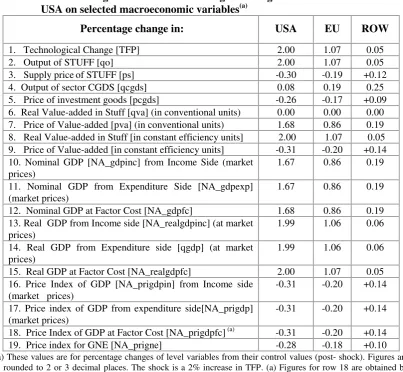
[image:14.595.96.500.223.595.2]Table 2 summarises the impact of the perturbation on the macro variables.
TABLE 2 Simulated regional effects of technological change in the USA on selected macroeconomic variables(a)
Percentage change in: USA EU ROW
1. Technological Change [TFP] 2.00 1.07 0.05
2. Output of STUFF [qo] 2.00 1.07 0.05
3. Supply priceof STUFF [ps] -0.30 -0.19 +0.12
4. Output of sector CGDS [qcgds] 0.08 0.19 0.25
5. Price of investment goods [pcgds] -0.26 -0.17 +0.09 6. Real Value-added in Stuff [qva] (in conventional units) 0.00 0.00 0.00 7. Price of Value-added [pva] (in conventional units) 1.68 0.86 0.19 8. Real Value-added in Stuff [in constant efficiency units] 2.00 1.07 0.05 9. Price of Value-added [in constant efficiency units] -0.31 -0.20 +0.14 10. Nominal GDP [NA_gdpinc] from Income Side (market
prices)
1.67 0.86 0.19
11. Nominal GDP from Expenditure Side [NA_gdpexp] (market prices)
1.67 0.86 0.19
12. Nominal GDP at Factor Cost [NA_gdpfc] 1.68 0.86 0.19 13. Real GDP from Income side [NA_realgdpinc] (at market
prices)
1.99 1.06 0.06
14. Real GDP from Expenditure side [qgdp] (at market prices)
1.99 1.06 0.06
15. Real GDP at Factor Cost [NA_realgdpfc] 2.00 1.07 0.05 16. Price Index of GDP [NA_prigdpin] from Income side
(market prices)
-0.31 -0.20 +0.14
17. Price index of GDP from expenditure side[NA_prigdp] (market prices)
-0.31 -0.20 +0.14
18. Price Index of GDP at Factor Cost [NA_prigdpfc] (a) -0.31 -0.20 +0.14
19. Price index for GNE [NA_prigne] -0.28 -0.18 +0.10
(a) These values are for percentage changes of level variables from their control values (post- shock). Figures are rounded to 2 or 3 decimal places. The shock is a 2% increase in TFP. (a) Figures for row 18 are obtained by modifying the existing equation for it in GTAP National Accounts module and incorporating into it the ‘Tec_Chg’ variable as documented in the Appendix. These are the same as figures in row 9 after this adjustment has been made.
With fixed supplies of land, labor and capital and no factor-bias, a 2% TFP-shock in
‘Stuff’ in the USA leads to an increase in output in that sector and real GDP at factor cost of
exactly 2%. After the HNTP shock, we effectively have 2-percent more of each factor after
input-composite value-added measured in terms of constant efficiency units applicable in the
base-period. Hence, there has been no change in the usage of primary factors of production (as
measured in conventional units) between the base case and the shocked solution. This leads
to a zero percentage change in value-added (not quality adjusted) by factors of production
[row 6, Table 2]. However, real value-added (measured in constant efficiency units) increases
in all three regions.
The increase in productive efficiency of the ‘raw’ primary composite input
(measured in conventional units) leads to an increase in its marginal productivity (MP)—i.e.,
2.00, 1.07, and 0.05 per cent for USA, EU and ROW respectively 13F
12
. Since factors are paid
according to their marginal products, these increases in MP lead to increases in the price of
value-added and their constituents in all three regions. Being neutral in nature, this TFP
improvement causes equal percentage increases in the real rewards of all primary factors
within any given region.
We observe that there has not been full transmission of technical change from the
source to the destinations–EU and ROW. Table 3 suggests that the value of the spillover
coefficient depends more strongly on θs than on Ers alone. Thus, whilst trade is the prime
vehicle for transmission of knowledge-flows, ACs and SSrs (and hence, θs ) are critical for
‘effective’ transmission of technology from ‘r’ to ‘s’. This is supported by the fact that even
when Ers has lower values, the magnification of them by θs can lead to a high rate of capture
of the technological improvement. Thus, EU with higher values of both ACs and SSrs, does
better than ROW at capturing the TFP improvement occurring in the USA despite ROW
12
The percentage changes in marginal (physical) productivities can be verified from computed GTAP variables as follows. In the levels, the value of the MPs of factors should equal their prices:
Pstuff * MPf = Pf (where f∈{L, K, T})
We have computed GTAP results for the percentage changes in Pstuff and in each Pf—pstuff, pL, pK, and pT (say)— in each region. Then, for example, we can use the above relationship to compute the percentage change in the marginal physical product of labour by:
% change in MPL= ({[Pf (initial) * (1+pf/100)] / [Pstuff (initial) * (1+pstuff/100)]}-1)*100 = 100* [{(pf/100)-(pstuff/100)}/(1+pstuff/100)]
having a higher value of Ers. Consequently, in Table 2 we see a greater improvement in
technology in EU (1.07) as compared to that in ROW (0.05).
TABLE 3 Values of embodiment-index, spillover coefficient and capture-parameter (a)
GTAP Regions
Embodiment Index (Ers)
Spillover Coefficient (γs)
Capture-Parameter (θs)
EU 0.014 0.540 0.855
ROW 0.020 0.023 0.030
USA 1.000 1.000 1.000
(a) Values shown relate to the pre-shock situation.
Stuff being the only sector whose production involves value-added, its share in total
value-added is unity in all three regions. As the TFP improvements cause real value-added
by factors of production (quality adjusted) to increase by the same percentages, the
percentage change in real GDP at factor cost in each region is equal to the respective TFP
shock (see rows 1 and 8, Table 2). Also, the price indexes for value-added in ‘Stuff’ (row 9
of Table 2) and for GDP at factor cost (row 18) are identical. Changes in real nett indirect
taxes (which are of fairly small magnitude) account for the wedges between real GDP at
market prices and real GDP at factor cost.
Now, the recorded NA_gdpfc (row 12, Table 2) is calculated on the basis of price
and quantity indexes of value-added measured in conventional units [pva]. These are taken
as given from the GTAP results. As the real value-added measured in constant efficiency
units (i.e., ‘quality-adjusted’) increases in all regions by the same percentage as the TFP
improvement, the effective price of value-added has to adjust accordingly so that the nominal
value-added measured in constant efficiency units matches the GTAP results. The increases
in real value-added (measured in constant efficiency units) of about 2 and 1 percent
respectively in USA and EU lead to falls in the corresponding price indices of about 0.3 and
attendant general equilibrium effects (to be discussed below)—in fact, it rises (0.14 per cent)
there.
5.2
Inter-regional Competition Effects
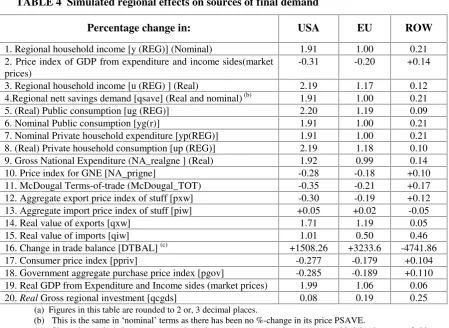
Table 4 shows that, region by region, there have been increases in nominal regional
[image:17.595.74.524.204.532.2]household income [y(r)] and its uses ( rows 1, 7, 5 and 4).
TABLE 4 Simulated regional effects on sources of final demand(a)
Percentage change in: USA EU ROW
1. Regional household income [y (REG)] (Nominal) 1.91 1.00 0.21 2. Price index of GDP from expenditure and income sides(market
prices)
-0.31 -0.20 +0.14
3. Regional household income [u (REG) ] (Real) 2.19 1.17 0.12
4.Regional nett savings demand [qsave] (Real and nominal) (b) 1.91 1.00 0.21
5. (Real) Public consumption [ug (REG)] 2.20 1.19 0.09
6. Nominal Public consumption [yg(r)] 1.91 1.00 0.21
7. Nominal Private household expenditure [yp(REG)] 1.91 1.00 0.21 8. (Real) Private household consumption [up (REG)] 2.19 1.18 0.10 9. Gross National Expenditure (NA_realgne ] (Real) 1.92 0.99 0.14
10. Price index for GNE [NA_prigne] -0.28 -0.18 +0.10
11. McDougal Terms-of-trade (McDougal_TOT) -0.35 -0.21 +0.17
12. Aggregate export price index of stuff [pxw] -0.30 -0.19 +0.12 13. Aggregate import price index of stuff [piw] +0.05 +0.02 -0.05
14. Real value of exports [qxw] 1.71 1.19 0.05
15. Real value of imports [qiw] 1.01 0.50 0.46
16. Change in trade balance [DTBAL] (c) +1508.26 +3233.6 -4741.86
17. Consumer price index [ppriv] -0.277 -0.179 +0.104
18. Government aggregate purchase price index [pgov] -0.285 -0.189 +0.110 19. Real GDP from Expenditure and Income sides (market prices) 1.99 1.06 0.06
20. Real Gross regional investment [qcgds] 0.08 0.19 0.25
(a) Figures in this table are rounded to 2 or, 3 decimal places.
(b) This is the same in ‘nominal’ terms as there has been no %-change in its price PSAVE.
(c) Since the trade balance can pass through zero, percentage changes are avoided in the case of this variable. The change reported here is an ordinary change (million US $) changes of level values.
We first explain post-shock differential impacts on nominal income [y(r) ] which is
the sum of primary factor payments and receipts from various transactions taxes nett of
depreciation. Table 5 breaks up the component-wise effects on y(r). Earlier discussion shows
that the HNTP shock increases ‘pva’ and its components (row 7, Table 2). The increase in
y(r) has primarily been caused by the uniform increases in primary factor payments in all
TABLE 5 Simulated effects on nominal regional income(a)
Percentage change in: USA EU ROW
1. Nominal Regional Household income [y(REG)] 1.908 1.000 0.206
2. Contribution of Endowment income [pfac] 1.721 0.936 0.193
3. Contribution of Physical Depreciation 0.000 0.000 0.000
4. Contribution of pcgds to cost of replacing depreciated capital (nominal changes)
+0.031 +0.024 -0.013
5. Contribution of Output tax revenues 0.143 0.004 0.011
(a) Figures in this table are rounded to 3 or, 4 decimal places. Figures in row 1, when rounded to 2 decimal places, yield the same figures as in row 1 of Table 4. We do not report here the figures for all component-wise effects from tax receipts. Figures of very small magnitude (< 0.00003) are excluded.
We now turn to the discussion of impacts on sources of various income-uses.
5.2.a Region-wide impact on sources of final demands
In GTAP, each region’s demands for private expenditure [PRIVEXP (r)], public
expenditure [GOVEXP (r)] and saving [SAVE (r)] are determined by maximisation of a per
capita Cobb-Douglas utility function subject to the constraint that these three items totally
exhaust the regional income [INCOME(r)]. Under this specification, their fixed shares of
income result in the equality of percentage increases in nominal demand for the income uses
with the percentage increases in total nominal income.
Given the equality of percentage changes in the nominal variables14F
13
PRIVEXP and
GOVEXP in each region, we observe that the corresponding real variables in each region
move together but not strictly in proportion to each other (see rows 5 and 7, Table 4). The
changes in real consumption expenditures are attributed to the differential impacts of
movements in pgov (the aggregate government purchase price index) and ppriv (the
consumer price index or, CPI)—the divergence being caused by the diverse purchase patterns
of the private and public ‘households’15F
14
. Back-of-the-envelope calculation shows that
changes up(r) and ug (r) are almost exactly the differences between percentage changes in
nominal PRIVEXP and GOVEXP (rows 6 and 7, Table 4) and ppriv and pgov respectively
13 In terms of the TABLO file, strictly speaking, PRIVEXP and GOVEXP are coefficients which are equal to the levels values of the variables ‘yp’ and ‘yg’. The latter one is added in the original TABLO file for computational conveniences.
(rows 17 and 18, Table 4).
The percentage increases in real private and public consumption demand for
composite Stuff are larger than the corresponding increases in domestic supply in every
region (rows 5 and 8, Table 4 and row 2, Table 2). In spite of the small percentage
increments in the market price of composite imports in USA (0.05) and EU (0.02), this leads
to increases in private household import demands of 1.35 and 0.7% in USA and EU
respectively16F
15
. The much larger fall in the price of domestically sourced Stuff—0.3 percent
in USA and 0.19 percent in EU—causes the relative price of domestic- vis-a-vis
foreign-sourced Stuff to fall by 0.35 and 0.21 percent in USA and EU respectively. Given the
expansionary effect on demand (qp) for composite Stuff due to the general increase in
consumption demand, this leads to substitution in favour of domestic ‘Stuff’ in USA and EU
and reinforces the expansion effect. This is reflected in increases of 2.2 and 1.2 per cent in
private consumption demand for domestic Stuff in USA and EU respectively.
As opposed to this, in the case of ROW, a decline in the price of composite imports
by 0.05 percent and a rise of 0.12 percent in the price of domestic Stuff causes the relative
price of domestic Stuff to increase by 0.17 percent. This leads to substitution in favour of
imported stuff with a relatively larger percentage increase (0.5) in demand for foreign
composite Stuff as compared to that in domestic stuff (0.07). Since Armington elasticities are
the same across uses and regions, similar considerations apply in the case of public
consumption. The aggregate utility index [u(r) ] proxies regional real income. In the model,
percentage changes in the sub-utility indexes for the public [ug(r)] and private [up(r)]
household consumption are equal to the percentage changes in real quantities purchased by
the representative government and private households respectively. The Cobb-Douglas utility
function is self-dual17F
16
as it generates a unit cost function of the same functional form as the
primal. Following this property, the income deflator [incdeflator(r)] for y(r) is defined as the
sum over the products obtained by multiplying the Cobb-Douglas price indexes for each
income use viz., ppriv(r), pgov(r) and psave with their corresponding region-wise shares in
total income18F
17
. Table 6 reports the values of the shares—i.e., PRIVEXP/INCOME,
GOVEXP/INCOME, SAVE/INCOME and the incdefaltor(r). Row 4 in Table 6 shows that
incdeflator(r) preserves the same ranking, sign and order of magnitude as the ppriv and pgov
(rows 17 and 18, Table 4). Subtracting row 4 of Table 6 from row 1 of Table 4, we
[image:20.595.81.516.323.412.2]reproduce, almost exactly, the results on realincome (row 3, Table 4).
TABLE 6 Budget shares of each income use category and incdeflator (a)
Values of: USA EU ROW
1. PRIVEXP/INCOME 0.7711 0.7017 0.6926
2. GOVEXP/INCOME 0.2108 0.2158 0.1515
3. QSAVE/INCOME 0.0181 0.0825 0.1559
4. incdeflator -0.27 -0.17 +0.09
(a) The shares are calculated from base-period data and hence these are base-case values; under the Cobb-Douglas specification, these are unchanging parameters.
Now, the GDP deflator (pgdp) is weighted sum of percentage changes in the index of the
price of the domestic absorption (NA_prigne), in the export price index (pxw), in the price
index for exports to the international transportation sector (pm) and in the aggregate import
price index (pim)—the weights being the shares in GDP of gross national expenditure
(GNE), of exports (VXWD), of sales to the global transport sector (VST), and of imports
16 The duality between production and cost function is formally analogous to the duality between utility and expenditure function—this implies that minimization of total outlay on public and private consumption and saving subject to the specified level of utility will give the same demand equations for these income uses. For a discussion on ‘self-duality’ between Cobb-Douglas production and cost function, see Varian (1984) Microeconomic Analysis, 2nd edition, pp. 62-64, and 69-73.
17 The mathematical expression for incdeflator (r) is:
(VIWS)19F
18
. pgdp includes the change in the price of exportable Stuff (pxw) with a positive
weight that includes exports rather than just domestic consumption—as in the case of
NA_prigne. Also, pgdp includes ‘pim’ with a negative weight. Hence, the percentage
increase ‘pim’ and the percentage fall ‘pxw’ lead to a more negative change in pgdp than
NA_prigne. Now, the consumption deflators include the price of imports with positive
weight. These consumption deflators are included in NA_prigne and thus, it includes the
[image:21.595.64.534.260.359.2]import price index with a positive weight.
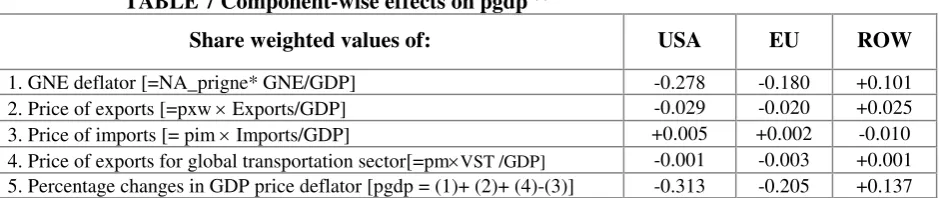
TABLE 7 Component-wise effects on pgdp (a)
Share weighted values of: USA EU ROW
1. GNE deflator [=NA_prigne* GNE/GDP] -0.278 -0.180 +0.101
2. Price of exports [=pxw × Exports/GDP] -0.029 -0.020 +0.025
3. Price of imports [= pim × Imports/GDP] +0.005 +0.002 -0.010
4. Price of exports for global transportation sector[=pm×VST /GDP] -0.001 -0.003 +0.001 5. Percentage changes in GDP price deflator [pgdp = (1)+ (2)+ (4)-(3)] -0.313 -0.205 +0.137
(a) Calculated from base-period data. Figures in row 5 match the figures in row 2 in Table 4 when we do ‘rounding’ to 2 decimal places.
From Table 7, it is evident that the difference between pgdp and NA_prigne clearly
relates to the percentage deviation of the terms-of-trade (TOT) from the control scenario20F
19
.
The fall in TOT in USA and EU does not cause CPI, pgov and hence, NA_prigne to fall as
much as pgdp—see rows 1 and 5 in Table 7. This implies that a decline in TOT implies a
rise in the consumption deflators (which include price of imports) relative to pgdp (which
includes price of exports) in these regions.
18 The GDP deflator, pgdp, can be broken down into the following components as below: pgdp= NA_prigne*(GNE/GDP)+ pxw*(VXWD/GDP)+ pm*(VST/GDP)—pim*(VIWS/GDP)
It is to be noted that ‘pm’ and ‘pxw’ are the same. Nominal domestic absorption, GNE(r) is expressed as: GNE(r)= PRIVEXP(r)+GOVEXP(r)+REGINV(r). Thus, the GNE deflator is:
NA_prigne (r)= ppriv (r)∗ [PRIVEXP(r)/GNE (r)] + pgov (r)∗[GOVEXP(r)/GNE (r)] + pcgds (r)∗ [REGINV (r)/GNE (r)]
19 After some algebraic manipulation, we can re-write the expression in Footnote 18 as:
pgdp−NA_prigne=[pxw*{(VXWD+VST)/GNE}]−[pim*(VIWS/GNE)]−pgdp*(TradeBalance/GNE)] In the case of balanced trade, VXWD+VST=VXW=VIWS, this equation becomes:
pgdp−NA_prigne = (VIWS/GNE) (pxw − pim). Also, in case of balanced trade, GNE (r)=GDP (r). Thus, multiplying both sides of the above expression by [GNE/GDP], we re-write it as:
pgdp−NA_prigne = [pxw−pim]∗[VIWS/GDP] = [VXW/GDP] ∗ [pxw−pim]
Similar considerations explain relatively larger percentage changes in pgdp relative to
NA_prigne and the consumption deflators in case of ROW. We now elaborate the trade
competition in the wake of relative price divergences.
5.2.b Regional composition of International Trade
Due to the Armington specification of commodity substitution, even in a world with
one generic traded-commodity in every region, the relative price divergences (between the
three varieties of Stuff) across regions (after the TFP shock) induce changes in regional TOT
and open up the scope for inter-regional competition via trade. Consequently, these lead to
changes in the regional composition of exports and imports depending, inter alia, on the
movements in TOT. Looking at the global economy as a whole, we observe that after the
shock there has been an increase in the quantity index of global merchandise exports and
imports of Armington substitutable Stuffs by 0.57%21F
20
. However, ROW experiences a small
percentage rise in the price of domestically produced Stuff as compared to relatively large
percentage falls in the prices of Stuff exported by USA and EU (as explained in subsections
5.1 and 5.2.a). Thus, the price index of global merchandise exports of Stuff [pxwcom(Stuff)]
falls by 0.02%.22F
21
Similar considerations explain the percentage fall in the index of world
prices of total supplies of Stuff [pw (Stuff)].23F
22
Decomposition of region-specific differential TOT effects identifies the forces
behind such changes. We follow the decomposition à la McDougall (1993)24F
23
where the
percentage change in regional terms of trade [tot (r)] is split into two components as below:
tot(r) = px (•, r ) − pm (•, r ) (5.2.1)
20 The calculation involves multiplying region-wise shares of exports of Stuff in aggregate worldwide exports (at
fob prices) by the corresponding percentage increases in regional aggregate volume of exports of Stuff and summation over the products thus obtained. ROW has a higher share (62 percent) in total world exports of Stuff than USA (17 percent) and EU (21 percent). Thus, 0.57 = (1.71×0.17)+(1.19×0.21)+ (0.05 × 0.62). 21 This is calculated as: (0.17 × -0.30) + (0.21 × -0.19) + (0.62 × 0.12) ].The price index of world trade [pxwwld]
falls by 0.02 percent as well (similar calculations are involved).
22 The base-case shares of value of output of Stuff of each region at world prices (
where px (•, r ) is the percentage change in the price received for exports and pm (•, r ) is the
percentage change in the price paid for imports. Suppose pxw (i, r) and piw (i, r) are
respectively the percentage changes of the export and import prices of traded commodity ‘i’
in any region ‘r’, and EXP_SHR (i, r) and IMP_SHR (i, r) are respectively the export share of
commodity ‘i’ in total export expenditure and import share of commodity ‘i’ in total import
expenditure in any region ‘r’. Thus,
px (•, r ) =A
∑
i
EXP_SHR(i, r) pxw(i,E r)EA (5.2.2a)
and
pm (•, r ) = A
∑
i
IMP_SHR(i, r) piw(i,E r)EA (5.2.2b)
Then the above expression for region r’s terms of trade can be written as:
tot(r) = A
∑
i
EXP_SHR(i, r) pxw(i,E r)EA − A
∑
i
IMP_SHR(i, r) piw(i,E r)EA
With further manipulation following McDougall (1993), this expression yields:
tot(r) = A
∑
i
(EXP_SHR(i, r) - IMP_SHR(i,E r)) (pw(i) -pxwwld)EA
+A
∑
i
EXP_SHR(i, r) (pxw(i,E r) -pw(i))E
− A
∑
i
IMP_SHR(i, r) (piw(i,E r) -pw(i))EA (5.2.3)
where pw(i) is the world price index for total supplies of good ‘i’ and pxwwld is the price
index of world trade (average of world prices of merchandise exports). The first term on the
right of (5.2.3), Wpe, captures the world price effect, whilst the last two terms show the
export price effect (Xpe) and the import price effect (Mpe) respectively.
‘Wpe’ shows that if the world price of commodity ‘i’ falls/rises relative to the
average of all world commodity prices [i.e., pw(i )≠pxwwld ], then, depending on the sign of
the regional nett trade share of good ‘i’, the direction of movement of regional TOT will be
determined. If ‘r’ is a nett exporter of ‘i’, and the world price of ‘i’ in general (i.e., averaged
over the sources) inflates relative to all prices, then, ceteris paribus, this is good for region
‘Xpe’ shows that if in any region, the exporters’ price of good ‘i’ falls relative to the
world price of ‘i’ [i.e., pw (i) ≠pxw (i, r) ], then TOT will deteriorate. Besides the size of the
shock, the extent of changes in such relativities [measured by (pxw (i, r) − pw (i))] reflect the
degree of product diversification in the market for ‘i’ (à la Armington assumption). With
low Armington elasticities, ceteris paribus, the spread between the two prices will tend to be
larger. By contrast, with a very large substitution elasticity, the absolute difference between
pxw(i, r) and pw(i) tends to be smaller so that they are almost equal. If there is erosion of
competitiveness following a shock, the large Armington elasticity coupled with the loss in
competitive edge can lead to big loss of export shares of a region and consequently, can have
adverse effect on TOT. That is, there may be a large fall in EXP_SHR(i,r) − IMP_SHR(i,r)
between the base case and the post-shock solution.
‘Mpe’ captures the effect of divergences [ piw(i, r) − pw(i) ]between the
region-specific import price of good ‘i’ and the world price of ‘i’ :it shows that if the latter rises
more than the former, then TOT will improve if there are no offsetting changes in ‘Wpe’ and
‘Xpe’.
In a one-traded-commodity world, since EXP_SHR (Stuff, r) is identical to IMP_SHR
(Stuff, r) and both are equal to unity, the first term on the right of Equation (5.2.3) for tot (r)
vanishes, so that this expression simplifies to the following:
tot(r) = pxw(stuff, r) − piw(stuff, r) (5.2.4)
Thus, in Table 8, ‘Wpe’ is zero across all regions. The intuition behind this result is
that ‘Wpe’ is meant to capture inter-generic-commodity competition, of which there is none
in this one-commodity version of GTAP. Since the share of Stuff in every region’s exports is
unity, ‘Xpe’ shows in its entirety the effect of changes in the export supply price of Stuff in a
region relative to an index of the average world price of Stuff. Analogously, ‘Mpe’ totally
TABLE 8 Decomposition of percentage changes in regional TOT(a)
GTAP Region
World price effect (Wpe)
(1)
Export price effect (Xpe) (2)
Import price effect (Mpe) (3)
Total TOT effect [tot(r)]
(4)= (1)+(2)−(3)
USA 0.00 -0.23 +0.12 -0.35
EU 0.00 -0.12 +0.09 -0.21
ROW 0.00 +0.18 +0.01 +0.17
(a) We have rounded percentage changes to 2 decimal places.
Table 8 shows that in all three regions, ‘Xpe’ is the most important source of the
change in TOT. The changes in regional export volumes can be ascribed to two-fold
movements: along the export demand schedule and shifts of the demand curve.
As the individual regions as exporters of Stuff face downward sloping foreign
demand curves for their region-specific Stuffs, a fall in the price of exports in USA and EU
(as opposed to a rise in the case of ROW) is consistent with percentage rises in exports from
USA and EU which are larger than the percentage expansion of exports from ROW to both of
these regions—see row 14 in Table 4. In part, this has been caused by the movements along
the export demand curve governed by the changes in price relativities between regions. Now,
the expansion in activity level (i.e., increase in regional aggregate import demand) in each
region results in outward shifts of the regional export demand curves. These changed trading
conditions entail allocation of demand for aggregate composite imports of Stuff by a region
across different sources of imports depending on relative price changes. Given the
expansionary effect on demand for all imports of Stuff [qim (stuff,r) ] by any region ‘r’ due to
the increase in intermediate input demand for it by firms producing Stuff and CGDS as well
as that in final demand by the public and private sectors (explained before in subsection
5.2.a), changes in relativities between the price of imported Stuff from any source ‘k’ (pms
(stuff,k,r)) and the aggregate import price index (pim (stuff, r)) confronting ‘r’ determine
changes in source-specific import demand by any region.
As products are differentiated by origin, divergences between the export prices for
Stuff produced in any region and the average world price for Stuff have given rise to changes
‘s’ and ‘k’, given the Armington elasticity, the expansionary effect on aggregate imports of
stuff (qim (stuff, r)) and the import share of ‘k’ in aggregate imports of ‘r’, then import of
Stuff from ‘s’ to ‘r’ [qxs (i,s,r) ] depends on the changes in relativities between the price of
imports of stuff from ‘k’ vis-a-vis that from ‘s’25F
24
. We discuss the change in composition of
bilateral export sales which is contingent on these shock-induced relative price effects.
Aggregate imports into the USA increase by 1.0108 percent. In USA, the market
shares of EU and ROW in aggregate imports of tradable Stuff are 18 and 82 percent
respectively. A relatively large decline (0.183%) in the price of imported Stuff from EU to
USA as compared to a rise (0.104%) in case of imports from ROW to USA causes a 2.2
percent increase in imports of Stuff in USA from EU, whereas imports from ROW to USA
rise by 0.75 percent only. Given identical Armington elasticities across all regions (all equal
to 5), this translates into an increase in demand for Stuff from EU even though initially EU
has a lower export share in USA than ROW.
In the case of EU, aggregate imports increase by 0.4951 per cent, while the market
shares of USA and ROW in total imports are 20 and 80 percents respectively. The decline in
‘pms’ for USA (0.29%) as opposed to an increase (0.1%) in case of ROW translates into a
relatively larger increase of exports from USA (2.1%) to EU than in case of ROW (0.10%).
In its own market, ROW (a composite region) supplies 52 % of its total import
demand whereas USA and EU supply 22 and 26 % respectively26F
25
. USA and EU export
respectively 73 % and 83 % of their total bilateral exports (i.e., excluding exports to the
24 In GTAP, we assume that imports of region ‘r’ from region ‘s’ are exactly the same as the exports of region ‘s’ to ‘r’. Hence, the percentage change in demand for exports of ‘i’ from ‘s’ to ‘r’ can be expressed as:
qxs(i, s, r)=qim(i, r)− ESUBM∗MSHRS (i, k, r)∗[pms (i, s, r)−pms(i, k, r)] , where k ≠ s.
where MSHRS (i, k, r) is the share of imports from ‘k’ to ‘r’ in aggregate imports from both ‘k’ and ‘s’ to ‘r’ and ESUBM (=5 in the database) is the Armington elasticity for imports from sources ‘k’ and ‘s’. Thus, we can write MSHRS (i, k, r)+ MSHRS (i, s, r)=1.
25 For ROW as composite region supplying in its own market, the equation in Footnote 24 can be modified as below:
qxs (i, s, r)= qim (i, r)−ESUBM∗MSHRS (i, k, r)∗[pms (i, s, r) − pms (i, k, r)]
global transportation sector) to ROW whereas for ROW the intra-regional export is 49%. In
ROW, USA faces competition from composite region ROW itself (supplying 52% of total
imports) and EU (supplying 26% of its imports). In the post-simulation scenario, ROW
experiences a rise in the market price of Stuff by 0.12%. The rise in the price of imports of
composite Stuff from its own constituent regions is 0.103%. USA as the source of
innovation experiences the maximum fall in the relative price of its Stuff after the HNTP
shock. Now, the price of imported Stuff from USA to ROW fell by 0.283 % whereas it fell
by 0.183 % in case of imports from EU. This led to a relatively larger percentage increase in
export sales from USA to ROW (1.6) as compared to that in export sales from EU to ROW
(1.1). On the other hand, the rise in the price of intra-regional imports from constituent
regions by 0.103% causes a decline in intra-regional exports in ROW by 0.33 per cent27F
26
[image:27.595.127.467.386.466.2].
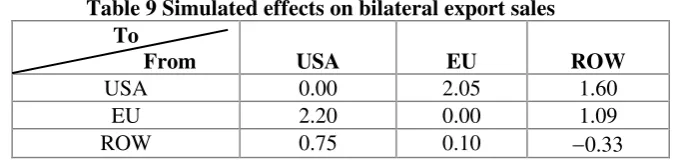
Table 9 displays all these figures for percentage changes in bi-lateral export sales.
Table 9 Simulated effects on bilateral export sales To
From USA EU ROW
USA 0.00 2.05 1.60
EU 2.20 0.00 1.09
ROW 0.75 0.10 −0.33
Sectoral performance is described below.
5.2
Sectoral Effect: Effects on Traded ‘Stuff’ Sector
Our foregoing discussion documents that for each region, marginal productivity of
‘raw’ primary composite factor inputs (in conventional units), real value-added in effective
units and production of Stuff go up exactly by the same percentage as the TFP improvement.
Demand for real value-added measured in conventional units does not change (see row 6,
Table 2). Effective price of value-added (quality-adjusted) declines in USA and EU and rises
in ROW. More pronounced TFP changes lead to a more productive primary factor composite
and to falling costs in USA and EU.
26 These calculations are:
for USA as the source, 1.588=0.462−5 × 0.26 × [-0.283 −
(−0.183) ]−5 × 0.52 × [−0.283 − (+0.103) ]; for EU as the source, 1.09 = 0.462−5×0.22×[-0.183−(−0.283) ]−5
× 0.52 × [ (−0.183−(+0.103) ]; for ROW as the source, −0.33 = 0.462−5 × 0.26 × [0.103 − (−0.183) ]− 5 × 0.22
Stuff is produced combining the value-added composite and composite material
inputs of Stuff using the Leontief technology at the top nest of the production tree (where
intermediate inputs and value-added are not substitutable). Due to the expansionary effect of
an increased demand, increased production of Stuff entails an equivalent increase in
intermediate input demand [qf (stuff, stuff, r) ]going into its own production in each region—
i.e., 2, 1.07 and 0.05% in USA, EU and ROW respectively.
The percentage falls in the price indexes for purchases of domestic ‘Stuff’ as
intermediate input [pfd (stuff, stuff, r)]—0.3 % in USA and 0.19 % in EU—are relatively
larger than percentage increments in price indexes of composite imports of foreign-sourced
Stuff [pfm (stuff, stuff, r) ]—0.05 in USA and 0.02 in EU. Given qf (stuff, stuff, r), the
decline in relative price of domestic vis-a-vis foreign sourced Stuff—0.35 % in USA and
0.21 % in EU—leads to substitution in favour of domestic intermediate stuff.28F
27
Thus, the
Armington structure causes a larger percentage increase in intermediate input demand for
domestic Stuff [ qfd (stuff, stuff, r) ] i.e., 2.07 and 1.13 % in USA and EU respectively. For
demand for the composite import of Stuff [qfm (stuff, stuff, r) ], these are 1.19 (USA) and
0.604 (EU).29F
28
The decline in relative price of composite imports vis-a-vis domestic Stuff by 0.17 %
in ROW results in a 0.41 % increase in intermediate input demand for imported Stuff
whereas intermediate input demand for domestic Stuff falls by 0.01 %. In all regions
domestically-sourced stuff has a much larger share than the foreign-sourced stuff in its
production (row 3, Table 10). The supply price of Stuff depends on the pva components and
price of intermediate Stuff. Now, the price of value-added in constant efficiency units falls in
USA and EU and rises in ROW (see row 9, Table 2). Also, the price of intermediate input
Stuff falls in USA and EU and rises in ROW. Consequently, the zero-pure-profits equation
27 Intermediate input demand for domestic Stuff by firms producing Stuff can be written as:
determines that the industry price of composite tradable Stuff falls in USA and EU and rises
in ROW.
TABLE 10 Simulated regional effects of technology shock on Stuff (a)
Percentage change in: USA EU ROW
1.Output of Stuff 2.00 1.07 0.05
2.Supply Price of Stuff -0.30 -0.19 +0.12
3.Share of domestically-sourced stuff 0.92 0.89 0.85
4.Share of foreign-sourced stuff 0.08 0.11 0.15
5.Demand for imported Stuff as an input 1.18 0.59 0.41 6. Demand for domestic Stuff as an input 2.07 1.13 -0.02
(a) Figures are rounded upto 2 decimal places.
6. Conclusion
In this paper, embodied technology spillovers through bilateral trade linkages have
been analyzed within the GTAP framework. The analysis is embedded in a setup where each
region produces a traded ‘Stuff’ along with a non-traded capital good. However, the
Armington assumption of product differentiation by origin opens the scope for international
trade in the source-specific ‘Stuff’. Embodied technology spillover occurs via bilateral trade
in Stuff between source (viz., USA) and destination (viz., EU and ROW). Absorption
capacity (AC) and structural congruence (SS) jointly determine a capture-parameter which,
together with the trade volume, endogenize the spillover coefficient. We considered an
exogenous 2% value-added augmenting TFP shock in the source country USA. Following
the shock, the higher value of the capture parameter in EU allows this region to realise a high
percentage of the potential productivity improvement, whereas ROW experiences a relatively
less pronounced TFP improvement despite a larger proportional stimulus in imports from
USA than that from EU.
The TFP shock leads to an increase in the marginal productivity (in conventional
units) of the ‘raw’ primary factor composite in all three regions whilst the effective price of
value-added (quality-adjusted) declines in USA and EU. Owing to the Armington structure
and identical Armington elasticities across uses and regions, the relatively larger percentage
percentage rises in the price indexes of composite imports of foreign-sourced stuff, resulted
in substitution in favour of domestic stuff in USA and EU. On the other hand, the decline in
the relative price of foreign composite imports and an increase in the price of domestic stuff
in ROW cause substitution in favour of imported Stuff. Given the expansionary effects due
to increased general activity levels, changes in the price relativities between regions alter the
trading conditions.
Divergences between the export supply price of Stuff in the regions and its average
world price have led to changes in regional terms of trade. Thus, the rise in the price of Stuff
in ROW erodes its competitive edge in the global market for Stuff. In particular, a decline in
the price of exports in USA and EU translated into a larger percentage expansion of exports
from USA and EU to ROW than that from ROW to both of these regions. ROW loses its
export share in its own market. With no scope for inter-generic-commodity competition, the
terms-of-trade effect predominantly reflects the export price effect.
Given the general−equilibrium relative price effects, a higher percentage increase in
the value of exports than in the value of imports in both USA and EU has caused their initial
trade deficits to decline. For ROW, the TFP shock causes the value of imports to rise by a
larger proportion than that of its exports leading to a fall in its initial trade surplus. Thus,
trade creation between the regions is manifest as an increase in bilateral and global trade
volumes. However, in the case of the composite region ROW, the loss in competitiveness has