Remote User Authentication Scheme in Multi-server
Environment using Smart Card
Jitendra Kumar Tyagi
I.E.T., Alwar, IndiaA.K. Srivastava
I.E.T., Alwar, IndiaPratap Singh Patwal
I.E.T., Alwar, IndiaABSTRACT
In a single server environment, one server is responsible for providing services to all the authorized remote users. However, the problem exists if a user wishes to access several network services. To overcome this weakness, various multi-server authentication schemes have been proposed. Though, these schemes are exposed to one or the other network security attack. This paper suggests robust multi-server authentication scheme using smart cards. Its security is based on cryptographic one-way hash function and the discrete logarithm problem. This scheme allows remote users to access multiple servers without separately registering with each server. Furthermore, it eliminates the use of verification table, allows users to choose and change the password securely without taking any assistance from the server or registration center, provides mutual authentication and establishes a common session key between user and the server. Additionally, the proposed scheme withstands user impersonation attack, server impersonation attack, replay attack, reflection and parallel session attacks, password guessing attack, insider attack, smart card loss attack and stolen verifier attack.
Keywords
Authentication, Multi-server, Nonce, Session key, Smart card
1.
INTRODUCTION
In order to authenticate the remote users, password based schemes have been widely used. In these schemes, server keeps a verification table secretly to verify the legitimacy of a remote user. Based on one way hash function, Lamport [1] proposed a password authentication scheme to authenticate remote users. Though, this scheme has a security pitfall as an intruder can steal or modify the verification table and masquerade as a legitimate user. To solve the stolen problem related to verification table, various elegant single server smart card authentication schemes have been proposed. Wu [2] suggested a remote login authentication scheme based on a geometric approach and claimed that the scheme eliminates use of verification table, provides security against replay attack and impersonation attack. However, Hwang [3] proved that Wu’s scheme has security flaws as an unauthorized user can easily forge a valid login request. Using RSA cryptosystem, Yang and Shieh [4] proposed ID-based scheme. Nevertheless, Chan and Cheng [5] showed that Yang-Shieh’s scheme is weak against impersonation attack. Hwang and Li [6] presented a remote user authentication scheme based on ElGamal’s cryptosystem and claimed that their scheme is free from maintaining verification table and resists replay attack. Though, Chan and Cheng [7] pointed out that Hwang-Li’s scheme is susceptible to impersonation attack.
To improve efficiency, Sun [8] proposed a remote user authentication scheme using one way hash function.
However, Hsu [9] found that Sun’s scheme fails to resist offline and online password guessing attacks. Chien et al. [10] also suggested improvement over Sun’s scheme and claimed that their scheme is free from maintaining verification table, allows users to choose the password freely and provides mutual authentication between remote user and the server. Nevertheless, Hsu [9] proved that Chien et al.’s scheme is vulnerable to parallel session attack. These entire schemes use timestamp to avoid replay attack and require synchronized environment which is very difficult to achieve in real world applications. For some applications, user and the server need a session key in order to keep the information secret for the successive communications after they authenticate each other. Considering these issues, Juang [11] proposed a nonce based scheme with an added feature of session key agreement. Though, it is analyzed that this scheme is weak against insider attack and user is not allowed to change the password freely. Das et al. [12] offered a dynamic ID-based scheme using one way hash function. They claimed that their scheme permits users to choose and change the passwords freely and provides security against replay attack, forgery attack, guessing attack, insider attack and stolen verifier attack. Nevertheless, Liao et al. [13] showed that Das et al.’s scheme is exposed to guessing attack, insider attack and does not provide mutual authentication. Based on symmetric key cryptography, Song [14] proposed an authentication scheme and claimed that the scheme provides mutual authentication and shared session key and it is secure against impersonation attack, parallel session attack, replay attack and modification attack. However, Pippal et al. [15] proved that Song’s scheme fails to provide perfect forward secrecy and insecure against Denial-of-Service attack.
The remainder of this paper is organized as follows. Section 2 describes the work related to multi-server authentication scheme. The proposed scheme is discussed in section 3. Section 4 analyzes the security of proposed scheme and section 5 concludes the paper.
2.
RELATED WORK
proved that Lin et al.’s scheme is exposed to impersonation attack and is unrealistic as every user must have a large amount of memory to store the public parameters for authentication. Using one-way hash function and symmetric cryptosystem, Juang [19] proposed a nonce based scheme which covers all the previous advantages with an additional trait of generating a session key. Nevertheless, Ku et al. [20] proved that Juang’s scheme is exposed to insider attack and fails to provide forward secrecy. Chang and Lee [21] suggested improvement over Juang’s scheme and claimed that their scheme is able to resist stolen-verified attack, server spoofing attack, smart card loss attack, replay attack and provides mutual authentication and provides forward secrecy.
Liao and Wang [22] presented a dynamic ID-based remote user authentication scheme using one way hash function [22]. However, Chen et al. [23] pointed out that Liao-Wang’s scheme does not provide forward secrecy. Hsiang and Shih [24] found that Liao-Wang’s scheme fails to resist insider attack, impersonation attack, server spoofing attack and shows inadequacy in providing mutual authentication. To overcome these weaknesses, they also proposed an improved scheme. Though, Sood et al. [25] showed that Hsiang-Shih’s improved scheme fails to provide security against replay attack, impersonation attack, stolen smart card attack and has incorrect password change phase. Tsai [26] offered a nonce based scheme using one way hash function. However, Zhu [27] proved that Tsai’s scheme is vulnerable to denning-sacco attack, server spoofing attack and does not provide perfect forward secrecy. To overcome these drawbacks, they proposed an improved scheme also.
Based on these motivations, this paper presents secure multi-server authentication scheme using smart cards. Breaking this scheme is as complex as solving the discrete logarithm problem and cryptographic one-way hash function. This scheme allows remote users to access multiple servers without separate registration. It eliminates the need of verification table, permits users to choose and change the password securely, provides mutual authentication session key generation. Moreover, it provides security against user impersonation attack, server impersonation attack, replay attack, reflection and parallel session attacks, password guessing attack, insider attack, smart card loss attack and stolen verifier attack. Thus, the proposed scheme is really appropriate in distributed multi-server environment such as the Internet.
3.
PROPOSED SCHEME
This section describes the proposed smart card authentication scheme. Suppose, there are n servers with which the new user can communicate. Every user and server has to register first with the registration center. The notations used throughout this paper are summarized as follows:
RC → registration center
Ui → ith remote user
IDi → identity of Ui
PWi → password chosen by Ui
PWi* → password guessed by the adversary
Sj → jth authentication server (1≤j≤n)
SIDj → identity of Sj
x → secret key of RC
d → secret number of RC
p → large prime number
g → primitive element
h(•) → cryptographic one way hash function
→ bitwise XOR operationSKeyij → session key shared between Ui and Sj
N1 → random nonce generated by Ui
N2 → random nonce generated by Sj
The scheme consists of four phases: Registration phase, Login phase, Authentication phase and Password Change phase.
3.1 Registration phase
This phase is divided into two sub-phases: Server Registration phase and User Registration phase.
3.1.1 Server Registration phase
In this phase, Sj selects SIDj and submits it to RC over a
secure channel. Upon receiving the registration request from Sj, RC computes the server secret parameter SSj = (gh(SIDj, h(x))
mod p)
h(d) and sends {SSj, h(d)} to Sj through a securechannel.
3.1.2 User Registration phase
Ui selects IDi and PWi, computes h(PWi) and submits {IDi,
h(PWi)} to RC over a secure channel. Once the registration
request is received, RC computes xi = (gh(PWi) mod p)
h(x),yi = h(IDi, h(d)), zi = yi
h(PWi) and issues a smart card oversecure channel to Ui by storing {xi, yi, zi, p, g, h(•)} into smart
card memory.
3.2 Login phase
Ui inserts the smart card to the card reader and keys in IDi and
PWi. The reader computes zi' = yi
h(PWi') and checkswhether computed zi' equals stored zi or not. If true, reader
generates a random nonce N1, computes ai = gyi mod p, bi =
aiyi × N1 mod p, ci = aih(PWi) × N1 mod p, di = gh(PWi) mod p, Qj =
gh(SIDj, (xi
di)) mod p, ei = (h(PWi) + yi × h(IDi, ai, bi, ci, di,N1, Qj)) mod (p-1) and sends the login request {IDi, SIDj, di,
ei, N1} to Sj.
3.3 Authentication phase
Upon receiving the login request {IDi, SIDj, di, ei, N1}; Sj first
checks the validity of IDi to accept/reject the login request. If
true, Sj computes yi = h(IDi, h(d)), ai = gyi mod p, bi = aiyi × N1
mod p, ci = diyi × N1 mod p, Qj = SSj
h(d)and checks whethergei = di × ai
h(IDi, ai, bi, ci, di, N1, Qj)
mod p is true or not.
gei = g(h(PWi) + yi × h(IDi, ai, bi, ci, di, N1, Qj)) mod p, gei = gh(PWi) × gyi × h(IDi, ai, bi, ci, di, N1, Qj) mod p,
gei = gh(PWi) mod p × gyi × h(IDi, ai, bi, ci, di, N1, Qj) mod p, gei = d
i × aih(IDi, ai, bi, ci, di, N1, Qj) mod p.
If this equation holds, Sj checks whether aiei × N1 = ci × bih(IDi, ai, bi, ci, di, N1, Qj)
mod p is true or not.
aiei × N1 = ai(h(PWi) + yi × h(IDi, ai, bi, ci, di, N1, Qj)) × N1 mod p,
aiei × N1 = aih(PWi) × N1 × aiyi × h(IDi, ai, bi, ci, di, N1, Qj) × N1 mod p,
ai ei × N1
= ai h(PWi) × N1
mod p × ai
yi × N1 × h(IDi, ai, bi, ci, di, N1, Qj)
aiei × N1 = ci × bih(IDi, ai, bi, ci, di, N1, Qj) mod p.
If both the equations hold, Sj generates a nonce N2, computes
X1 = yi
N1
N2, X2 = Qj N2mod p and sends the message {IDi, X1, X2} to Ui. After getting the message {IDi, X1, X2}
from Sj, Ui computes N2 = yi
X1
N1, X2' = QjN2 mod pand checks whether X2 and X2' are equal or not. If it holds, Sj
is authentic otherwise terminate the session. Subsequently, Ui
computes X3 = QjN1 × N2 mod p and sends {IDi, X3} to Sj.
Once the message {IDi, X3} is received, Sj computes X3' =
QjN1 × N2 mod p and checks whether X3 and X3' are equal or
not. If it holds, mutual authentication is achieved. Both the parties agree upon a common shared session key SKeyij =
h(IDi, SIDj, Qj, N1, N2).
3.4 Password Change phase
This phase is invoked when Ui wants to change the password.
Ui inserts the smart card to the card reader and keys in IDi and
PWi'. The reader computes zi' = yi
h(PWi') and checkswhether computed zi' equals stored zi or not. If true, Ui enters
a new password PWinew. The card reader computes zinew = yi
h(PWinew), xinew = xi
gh(PWi)
gh(PWinew) mod p and storeszinew, xinew instead of zi, xi respectively in the smart card
memory. Thus, Ui can change the password without taking
any assistance from Sj.
4.
SECURITY ANALYSIS AND
DISCUSSION
This section demonstrates the proof of correctness of the proposed authentication scheme on the basis of following possible attacks and user needed features.
4.1 User impersonation attack
The login request contains {IDi, SIDj, di, ei, N1} where di =
gh(PWi) mod p and ei = (h(PWi) + yi × h(IDi, ai, bi, ci, di, N1,
Qj)) mod (p-1). To securely perform impersonation attack,
the attacker needs to guess the correct values of PWi, ai, ci and
yi. Let’s assume attacker guesses the password PWi*, the
correct values of xi and ‘d’ are still required to forge the login
request. In addition, attacker is unable to extract any of the nonce values from the eavesdropped response message as the value of yi is unknown. It is difficult to derive h(PWi) from di
because of discrete logarithm problem. Hence, attacker is unable to forge the login request to impersonate a valid Ui.
4.2 Server impersonation attack
It is not possible for an adversary to masquerade as a legitimate server and try to cheat an authentic user because the server response message {IDi, X1, X2} is prepared by using
the secret parameter Qj which can be computed by Sj only.
Hence, the proposed authentication scheme prevents server spoofing.
4.3 Replay attack
The replay attack will fail because the freshness of the messages transmitted in the login and authentication phases is provided by the random nonces N1 and N2. These are
generated independently, and their values differ among sessions. As a result, attackers cannot enter the system by resending the previously transmitted messages to impersonate legal users. Assume that the intercepted login request {IDi,
SIDj, di, ei, N1} is replayed to pass the authentication phase.
Attacker is unable to retrieve N2 correctly from the response
message {IDi, X1, X2} to compute the correct message {IDi,
X3} for mutual authentication. Consequently, Sj rejects the
message by comparing X3 with X3'.
4.4 Reflection and parallel session attacks
To resist reflection and parallel session attacks, the given scheme employs asymmetric structure of communicating messages, i.e., {IDi, SIDj, di, ei, N1}, {IDi, X1, X2} and {IDi,
X3}. There is no symmetry in the values of di = gh(PWi) mod p,
ei = (h(PWi) + yi × h(IDi, ai, bi, ci, di, N1, Qj)) mod (p-1), X1 =
yi
N1
N2, X2 = Qj N2mod p and X3 = Qj N1 × N2
mod p. Hence, attacker is unable to launch parallel session attack by replaying server response message as the user login request or reflection attack by resending user login request as the server response message.
4.5 Password guessing attack
In the proposed scheme, h(PWi) is used to compute di = gh(PWi)
mod p and ei = (h(PWi) + yi × h(IDi, ai, bi, ci, di, N1, Qj)) mod
(p-1). Let us assume that the adversary intercepts login request {IDi, SIDj, di, ei, N1} during the transmission from Ui
to Sj. It is hard to guess the all three parameters ai, ci and yi
correctly at the same time to check whether each of the guessed passwords is correct or not. Moreover, to derive PWi
from di, adversary needs to solve the discrete logarithm
problem and break the security of one way hash function. Therefore, the scheme is secure against password guessing attack.
4.6 Insider attack
Since, Ui registers to RC by presenting h(PWi) instead of PWi, the insider of RC cannot directly obtain Ui‘s password PWi
because of the property of one-way hash function. Hence, the proposed scheme is able to resist insider attack.
4.7 Security of the session key
The session key SKeyij = h(IDi, SIDj, Qj, N1, N2) is associated
with Qj and N2, which are unknown to the adversary. Even
though the past session key is compromised, the adversary cannot extract these parameters due to the security of one-way hash function. Moreover, it is infeasible to guess both of these values simultaneously. Thus, the adversary cannot obtain any further session key.
4.8 Smart card loss attack
When a smart card is lost or stolen, unauthorized user, who obtains Ui’s smart card, can guess the password of Ui by using
password guessing attacks or impersonate Ui to login into Sj.
In the proposed scheme, if Ui’s smart card is lost or stolen, it
is difficult for any attacker to derive or change the password PWi. Moreover, no one can impersonate the smart card owner
to login into Sj without knowing the correct IDi and PWi of Ui.
4.9 Stolen verifier attack
An adversary can penetrate the server and modify the contents of the verification table if the server maintains a verification table. As the servers and the registration center do not m
aintain any verification table, the proposed authentication
scheme is secure against stolen-verifier attack.
4.10 Single registration
4.11 No verification table
None of the registered servers need to maintain a verification table.
4.12 User can choose and change the
password securely without taking any
assistance from the server or RC
In the scheme, a valid user can change the password freely and securely without any assistance from the servers or registration center. As the card reader verifies the old password first in the password change phase, unauthorized users cannot change the authorized user’s password even if they get the corresponding smart card.
4.13 Early wrong password detection
If the user Ui inputs a wrong password by mistake, this
password will be quickly detected by the card reader itself since reader compares zi' = yi
h(PWi') with the stored ziduring the login phase. Hence, the scheme provides early wrong password detection.
4.14 Each server uses unique secret
parameter
In the scheme, each server has unique secret parameter SSj =
(gh(SIDj, h(x)) mod p)
h(d) used to authenticate the user. Hence, there is no need to store the secret parameter of all the servers in the smart card memory.4.15 Mutual authentication and session key
agreement without the support of RC
Valid users and valid servers can authenticate each other and then agree on a session key without any support from the registration center. The generated session key SKeyij = h(IDi,
SIDj, Qj, N1, N2) will be different for each login session.
4.16
The
scheme
solves
time
synchronization problem
The proposed scheme uses randomly generated nonces N1 and
N2 instead of timestamps to avoid time synchronization
problem.
5.
COMPARISON
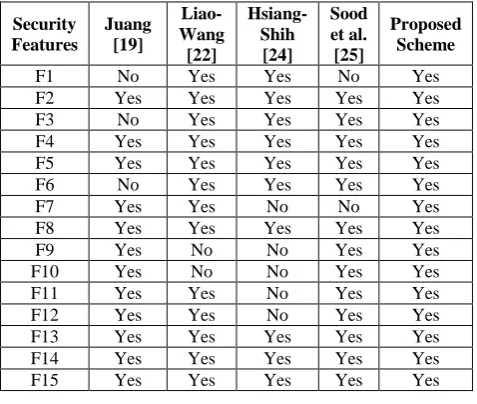
This section describes comparison among various multi-server authentication schemes with our proposed scheme on the basis of security features as well as possible attacks. Table 1 shows this comparison. Here,
F1 = Free from maintaining verification table F2 = User is allowed to choose the password F3 = User is allowed to change the password
F4 = Free from involvement of RC/server during password change phase
F5 = Provides mutual authentication
F6 = Provides early wrong password detection
F7 = Provides mutual authentication without the support of RC
F8 = Provides session key agreement F9 = Resists user impersonation attack F10 = Resists server spoofing attack F11 = Resists replay attack
F12 = Resists password guessing attack F13 = Resists reflection attack
F14 = Resists parallel session attack F15 = Resists known session key attack
Table 1. Comparison among various multi-server authentication schemes with our proposed scheme
Security Features
Juang [19]
Liao-Wang
[22]
Hsiang-Shih [24]
Sood et al. [25]
Proposed Scheme
F1 No Yes Yes No Yes
F2 Yes Yes Yes Yes Yes
F3 No Yes Yes Yes Yes
F4 Yes Yes Yes Yes Yes
F5 Yes Yes Yes Yes Yes
F6 No Yes Yes Yes Yes
F7 Yes Yes No No Yes
F8 Yes Yes Yes Yes Yes
F9 Yes No No Yes Yes
F10 Yes No No Yes Yes
F11 Yes Yes No Yes Yes
F12 Yes Yes No Yes Yes
F13 Yes Yes Yes Yes Yes
F14 Yes Yes Yes Yes Yes
F15 Yes Yes Yes Yes Yes
6.
CONCLUSION
This paper portraits robust smart card authentication scheme for multi-server environment. It is shown that the proposed scheme satisfies all of the essential security requirements as it is secure against user and server impersonation attacks, replay attack, reflection and parallel session attacks, password guessing attack, stolen verifier attack, insider attack and smart card loss attack. The other merits include: (1) it eliminates the use of verification table; (2) it allows users to choose and change their passwords freely without taking any assistance from the server or registration center; (3) it permits users to access multiple servers without separately registering with each server; (4) it detects wrong password early; (5) it provides mutual authentication and session key agreement; (6) it is a nonce based scheme to avoid the time-synchronization problem.
7.
ACKNOWLEDGMENTS
The authors are thankful to Institute of Engineering and Technology, Alwar, India for providing the academic support.
8.
REFERENCES
[1] Lamport, L. 1981. Password authentication with insecure communication. Communications of the ACM 24, 770-772.
[2] Wu, T. C. 1995. Remote login authentication scheme based on a geometric approach. Computer Communications 18, 959-963.
[3] Hwang, M. S. 1999. Cryptanalysis of a remote login authentication scheme. Computer Communications 22, 742-744.
[4] Yang, W. H, Shieh, S. P. 1999. Password authentication schemes with smart cards. Computers & Security 18, 727-733.
[image:4.595.310.549.129.331.2][6] Hwang, M. S, Li, L. H. 2000. A new remote user authentication scheme using smart cards. IEEE Transactions on Consumer Electronics. 46, 28-30.
[7] Chan, C. K, Cheng, L. M. 2000. Cryptanalysis of a remote user authentication scheme using smart cards. IEEE Transactions on Consumer Electronics 46, 992-993.
[8] Sun, H. M. 2000. An efficient remote user authentication scheme using smart cards. IEEE Transactions on Consumer Electronics 46, 958-961.
[9] Hsu, C. L. 2003. Security of two remote user authentication schemes using smart cards. IEEE Transactions on Consumer Electronics 49, 1196-1198.
[10]Chien, H. Y, Jan, J. K., Tseng, Y. M. 2002. An efficient and practical solution to remote authentication: smart card. Computers & Security 21, 372-375.
[11]Juang, W. S. 2004. Efficient password authenticated key agreement using smart cards. Computers & Security 23, 167-173.
[12] Das, M. L., Saxena, A., Gulati, V. P. 2004. A dynamic ID-based remote user authentication scheme. IEEE Transactions on Consumer Electronics 50, 629-631.
[13]Liao, I. E, Lee, C. C. and Hwang, M. S. 2005. Security enhancement for a dynamic ID-based remote user authentication scheme. In Proceedings of the International Conference on Next Generation Web Services Practices.
[14]Song, R. 2010. Advanced smart card based password authentication protocol. Computer Standards & Interfaces 32, 321-325.
[15]Pippal, R. S., Jaidhar, C. D. and Tapaswi, S. 2010. Comments on symmetric key encryption based smart card authentication scheme. In Proceedings of the 2nd International Conference on Computer Technology and Development.
[16]Li, L., Lin, I., Hwang, M. S. 2001. A remote password authentication scheme for multi-server architecture using neural networks. IEEE Transaction on Neural Networks 12, 1498-1504.
[17]Lin, I. C., Hwang, M. S., Li, L. H. 2003. A new remote user authentication scheme for multi-server architecture. Future Generation Computer Systems 19, 13-22.
[18]Cao, X., Zhong, S. 2006. Breaking a remote user authentication scheme for multi-server architecture. IEEE Communications Letters 10, 580-581.
[19]Juang, W. S. 2004. Efficient multi-server password authenticated key agreement using smart cards. IEEE Transactions on Consumer Electronics 50, 251-255.
[20]Ku, W. C., Chuang, H. M., Chiang, M. H. and Chang, K. T. 2005. Weaknesses of a multi-server password authenticated key agreement scheme. In Proceedings of the 2005 National computer Symposium.
[21]Chang, C. C., Lee, J. S. 2004. An efficient and secure multi-server password authentication scheme using smart cards. In Proceedings of the International Conference on Cyberworlds.
[22]Liao, Y. P., Wang, S. S. 2009. A secure dynamic ID based remote user authentication scheme for multi-server environment. Computer Standards & Interfaces 31, 24-29.
[23]Chen, T. Y., Hwang, M. S., Lee, C. C. and Jan, J. K. 2009. Cryptanalysis of a secure dynamic ID based remote user authentication scheme for multi-server environment. In Proceedings of the 4th International Conference on Innovative Computing, Information and Control.
[24]Hsiang, C., Shih, W. K. 2009. Improvement of the secure dynamic ID based remote user authentication scheme for multi-server environment. Computer Standards & Interfaces 31, 1118-1123.
[25]Sood, S. K., Sarje, A. K., Singh, K. 2011. A secure dynamic identity based authentication protocol for multi-server architecture. Journal of Network and Computer Applications 34, 609-618.
[26]Tsai, J. L. 2008. Efficient multi-server authentication scheme based on one-way hash function without verification table. Computers & Security 27, 115-121.