33
Performance Measurement System in the Public
Organizations: A Framework and its Application
Patthera Suwannathat
Technopreneuship and innovation
Management Program,
Chulalongkorn University,
Phayathai road, Pathumwan,
Bangkok 10330, Thailand
Pasu Decharin
Ph.D
Chulalongkorn Business School
Chulalongkorn University,
Phayathai road, Pathumwan,
Bangkok 10330, Thailand
Wiwat Vatanawood
Ph.D
Department of Computer Engineering
Chulalongkorn University,
Phayathai road, Pathumwan,
Bangkok 10330, Thailand
ABSTRACT
This paper presents the database and decision support instrument in measuring public organizations intended to stimulate innovation. This tool can be used to help public organizations in Thailand self-assessment and manage the indicators‘ structure for performance assessment. Following a brief outline of a model for assessing performance including innovation capability. The process of user requirement and gathering database for assessment questions is discussed. It is demonstrated that the propose system is a flexible tool capable of handling different types of data in self-assessment and external assessment. The framework can be managed uncertain data, and providing a wide range of information including scores, performance diversity.
General Terms
SQL Server, Metadata, MVCKeywords
Public organization, Information Management, Policy, ER, Innovation, Thailand
1.
INTRODUCTION
The idea that measurement and evaluation information should be regarded as one of the principal tools of public organization appears trivial because of the huge data from various classifications of the public organizations. A major challenge in building next generation information system in public organization is to develop technologies and that permit continuous enhancement and evolution of current performance assessment. To serve citizen‘s satisfaction, the public organizations need improvement of public services, i.e., being more responsive to the dynamics of politic, economic, social and technology policies.
The evaluation is used either to design/modify a system, or to control an existing system. It is an essential element of effective planning and control. In terms of data management, the support in exchange of data, information, and knowledge exchange is becoming the key issue in computer technology. The framework conceptualizes public administration from [1] proposes appropriate types of systems (such as decision support systems, executive support systems, expert systems, etc) for realizing appropriate support from IT [5].
Policy improvement then comes to be seen as requiring more data management applying rational techniques to support rational decision-making and extending surveillance in implementation via the assessment tool.
A common definition of a database is a collection of data designed to serve many applications efficiently by storing data in only one location and minimizing redundant data, whereas a database management system (DBMS) is the software that allows an information system to centralize data, manage them efficiently, and provide easy retrieval.
2.
LITERATURE REVIEW
2.1
Performance
Measurement
Systems
(PMS)
It appears that often no distinction is made between private and public organizations in conceptualizing organizational decision making. However this does not provide a complete picture for public administration, strategies of public authorities and also the indicators for measurement rely on those strategies are much more complicated than those of private organizations.
34
accountability and management effectiveness, the need for alignment of public management processes and a focus on results seems apparent.
2.2 Innovation Assessment
The nature of the public organizations that always with the resistance to change culture. However, the successful organizations are always building or generating new ideas— getting those ideas translated into program concepts that can be supported and funded by management, however, remain a challenge. The art of idea generation and development requires a supportive environment and a culture of discovery and innovation.
In order to achieve the ultimate goal, an innovation building assessment model was developed by the researchers, taking into account the specific needs and characteristics of public organizations in Thailand. To assess the performance plus potential in building innovation of the public organizations, the study of [4] extracts some of the indicators relevant to conduct innovation. Together with innovation embedding in the model for one of the performance measurement [6]. Similarly, the development of accounting technologies such as planning, programming, and budgeting systems, zero-based budgeting, and total quality management, are promoted as enabling policy makers to focus more closely on the public value and social value. In summary, information and accounting technologies are being mobilized as scientific aids in the making and implementation of policy decisions. These bodies of knowledge are intended to enable public managers to monitor the total web of activity that is integral to policy decision-making and implementation.
3.
METHODOLOGY
3.1 Design Considerations
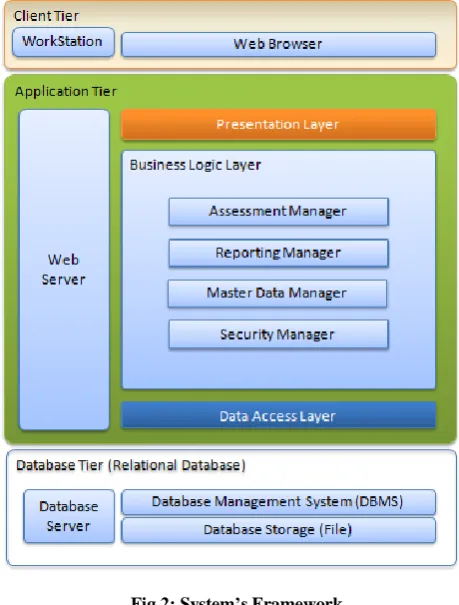
The model covers seven areas base on Public Management Quality Award (PMQA) in Thailand. Under each area, 10 to 30 questions are asked about the approach and deployment method. Some questions are divided into a few sub-questions. Therefore the assessment model is in a hierarchical structure. The overall system‘s framework as shown in Figure 2.
Assessment models, however, also have the following two features. The first feature is that they are normally pre-structured. The same fixed models will be used by many different organizations to ensure that assessments are based on the same standards. The other feature is that they normally consist of tens, sometimes hundreds, of questions. The PMQA model lists 7 areas for assessment to consider when using the model for self-assessment and for award applications. The relational model is the most commonly used one. It is mature, having excellent implementations (e.g., the ORACLE, DB2 and MySQL R-DBMS). The ER model has substantial more semantics power than the relational one, yet its implementations are rather poor. Therefore, instead of using an ER DBMS, one logically models his data using the ER model and then converts (maps) it to an equivalent relational model. This approach preserves the semantics power of the ER model while storing the data into mature (and fast) relational DBMSs.
3.2 Users requirement
Like many other business performance assessment models, the model is also pre-structured. The questions, answers and scoring scheme are designed mainly based on experiences, other similar models and consultation with advisors and the managerial from the organizations that won the quality awards.
The users can be categorized into three groups:
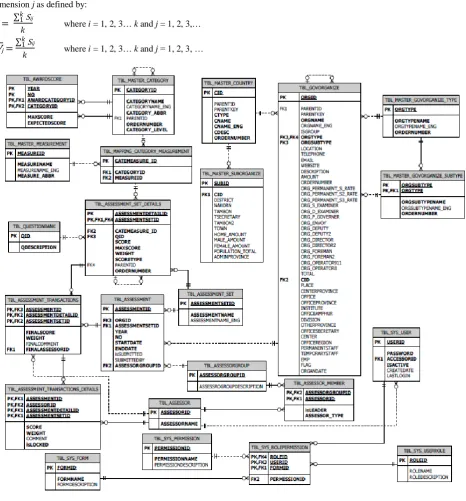
1) The authorized officer from Office of the Public Sector Development (OPDC) in Thailand can assign the structure of indicators follow with the questions under each performance area and its weight as shown in TBL_ASSESSMENT and TBL_ASSESSMENT_SET in Figure 1. The attribute can be flexible arranged for different functions from various organizations such as education, general public service, economic affairs etc. It is very essential in a successful performance evaluation process. The assessment must have high credibility by involving managerial level to provide the policy for awarding scores for each dimension (e.g., liquidity ability, financial structure, activity ability, and profitability). Then the authorized officer need to give the scores and corresponding weights for relative key dimensions based upon their own managerial experiences.
2) The external assessment: The awarding scores for a specific dimension can be collected from qualified assessors.
3) The internal assessor for self-assessment in the public organizations: Submission for the evidence and document and the progress for each performance assessment dimension via the system. The corresponding weights of each dimension assigned by OPDC in the group assessment are also summed and averaged.
In the following section, the model will be outlined and the ER approach will briefly described. The features, advantages and benefits of using this system for self-assessment will be demonstrated.
3.3 Assessment Model
The model was developed based on the Public Management Quality Award (PMQA) which is applied from the TQM. It covers the following 7 areas:
Leadership,
Strategy,
Stakeholder,
Knowledge management,
Human Resource management,
Process management, and
Result and performance management.
The assessment sheet contains about 20 questions under each area as shown in TBL_QUESTIONBANK in Figure 1. Each question is explained to help users to understand it. Each answer is also explained. The explanations to each answer act as guidelines to help assessors to choose the most appropriate answer or answers. The explanations will also form the basis for generating a assessment profile report.
All questions are multiple-choice type, such as how would you rate the organizations in terms of innovation strategy? The answers to this question could be very good, good, fair, need improvement. The number and wording of answers vary from question to question. A special case is the Yes/No, or Yes/Partially/No type of questions.
The method of computation for the group assessment is shown as the following steps:
1. Assume that there are k assessors in a group assessment team and n dimensions will affect organization performance; each assessor in the group assigns a score for each dimension in a scale of 0–5, and grants a weight to each measure in a range of 0–1.
35
Fig 1: The design and sample selection part of the database
3. Compute the averaged score Sjj and average weight for dimension j as defined by:
S
j=
Sij𝑘 1
𝑘 where i = 1, 2, 3… k and j = 1, 2, 3,…
W
j=
Sij𝑘 1
𝑘 where i = 1, 2, 3… k and j = 1, 2, 3, …
4. Calculate score of dimension Xj as defined by:
X
j=S
jW
jwhere j = 1, 2, 3,…, n
When the scores of dimensions Xj, are obtained, the measuring process begins as mentioned in the following sections.
The questions as in the TBL_QUESTIONBANK in Figure 1. and answers in the model have been designed to be as friendly as possible. The explanations to each question and its answers, and the heterogeneous nature of the questions in the model reflect such intention.
3.4 Achieving results
Organizational processes and structures oriented to new product development are not the same as those needed to foster and facilitate new policy from considering the effective performance review and decision-making from managerial level. To enhance the development and growth of quality and service improvement to serve citizen, organizations must have effective and efficient processes for the following activities:
Monitoring and understanding citizen needs, including changes in the external environment (sociopolitical trends, regulatory pressures, etc.).
36
Fig 2: System’s Framework
Performance evaluation should be based on a staged approach. ‗‗pass,‘‘ ‗‗not pass,‘‘ ‗‗hold,‘‘ and ‗‗revise‘‘ decision of the assessors‘ consensus. The system will alert for ―no go‖ points are built into the process between initiative stages (e.g. idea selection, proof of concept) and at other points deemed appropriate.
4.
APPLICATIONS
4.1
The functions and processes of the
database
The database consists of 18 tables, including three main groups: 1) public organizations structure and group classification, 2) questionnaire inventory and indicators and 3) assessment results from the assessor. The attributes for each group are shown in Figure 1. The measurement result is the creation of the logic computation from all assessors and measurable links between the activities and their outcomes. The interface including with logic models contain two core components: activities, outputs/outcomes of the initiative:
(1) Activities consist of the specific actions that will be carried out in the initiative. These include the specific activities rely on the questions‘ structure creating from OPDC that lead to the attainment of the final outcomes of the initiative and exclude activities such as administrative work.
(2) Outputs are the initial tangible results of the planned activities and provide measurable evidence that an activity has been accomplished (milestone assessment). For the outcomes are typically critical associated with innovation in the private sector do not always have direct applicability to the public sector.
The two major categories of performance measures: output-based measures and outcome-output-based measures. Simply put, output-based measures indicate the amount of service completed or produced, while outcome-based measures indicate the extent to which desired program and results have been achieved.
For the process determining and verification. The data sources used to calculate performance measures are the focal point of control system. Common sources of performance data include surveys and databases. The step for performance measurement verification in [7] as described below:
1) Determine which of the department's measures to verify 2) Determine if the department can re-create the number reported in internal management documents and/or the annual budget
3) Determine the method the department used to collect and calculate the performance data
4) Determine if the department followed the measure definition
5) Determine whether the department keeps data on a manual or automated system
6) Determine whether adequate controls over performance measure data exist to ensure consistent reporting of accurate information
7) Obtain a list of items to be sampled from the department 8) Choose a sample
9) Test the department's source documentation for accuracy 10) Determine each performance measure's certification category
4.2 Develop a plan to implement the novel
assessment tool
To ensure that staff or the public officer who responsible for representative for self-assessment in the public organizations understood the goals and visions of the organization, and how introduction of new technology would improve their daily work.
It used a project team approach, which emphasized the importance of teamwork and ownership during change. Providing strategic foresight and participated in developing a robust project plan which helped to activate the. Every employee was trained in basic project management skills. This gave them a common language to share ideas. in different functions at various types of organizations. The project encouraged sharing of experience and broadly based decision making. This was very different from the strict hierarchical style adopted in the past. The involvement of staff in the development, planning and execution phases encouraged them to accept ownership helping them acculturate with the use of new tool.
5.
FURTHER WORK
Designing this architecture is just the starting point. Available data warehousing solutions would be greatly improved by using the proposed architecture, and methods and tools can be developed to take advantage of the combined presence of the metadata base. A next key feature of our model is that users can add new Transformations to the system. There are many different ways to achieve this.
- Providing a standard way of describing data for allows users to drive down IT costs. Data is often still raw inaccessible, in consistent, fragmented and underutilized.
37
6.
ACKNOWLEDGMENTS
This research has been supported by a grant from THE 90th ANIVERSARY OF CHULALONGKORN UNIVERSITY FUND (Ratchadaphiseksomphot Endowment Fund).
7. REFERENCES
[1] K. BC Saxina and Ammaly. 1995. ―Information Technology Support for Reengineering Public Administration: A Conceptual Framework.‖ International Journal of Information Management, Vol. 15, No. 4, pp. 271-293.
[2] C.A. Bana e Costa, P.M. Chagas, 2004. ―A career choice problem: an example of how to use MACBETH to build a quantitative value model based on qualitative value judgments‖, European Journal of Operation Research, Vol. 153, pp. 323–331.
[3] D. Arnott, G. Pervan. 2008. ―Eight key issues for the decision support systems discipline‖, Decision Support Systems, Vol. 44, pp. 657–672.
[4] Patthera Ruenpitak, 2010. ―Innovative Organization in Public Sector‖, Proceeding of 2010 International Conference on Asia Pacific Business Innovation & Technology Management.
[5] Danziger, J.N., Andersen, K.V., 2002. ―The impacts of information technology on public administration: an analysis of empirical research from the ‗golden age‘ of transformation.‖ International Journal of Public Administration 25, pp.591–627.
[6] O‘Sullivan, D. 2002. ―Framework for managing development in the networked organisations‖, Journal of Computers in Industry, Vol. 47 No. 1, pp. 77-88. [7] W. Anderson Willians, 2002. ―Trusting the Numbers: