Personalized Web Search
Miss. Ashna Sayyad1, Miss. Akshada Gaikwad2, Miss. Rupali Khule3, Miss. Bhavana Deoker4
B.E, IT, Amrutvahini College Of Engineering, Sangamner, Maharashtra, India1, 2, 3, 4
Abstract: The amount of information on the World Wide Web is growing rapidly, and in this information explosion era the number of new users inexperienced in the art of web research. While searching what users lack is not scale of information but how to obtain information
that meets user’s search intention rapidly and accurately. The main problemcurrent search engines are facing is to meet the user’s need.
In this paper, we combined two basic strategies (1) user interest and (2) collaborative filtering to reorder and to make the search results
more personalized, we implemented the approach using multi-agents technology
.
Keywords: Personalized web search, Reordering, User interest, Collaborative filtering, Multi agents.
1. INTRODUCTION:
The information floods everywhere on the World
Wide Web nowadays. What users lack is not the scale of the
information but the way to obtain the needed information
rapidly and accurately. Search engine is one of the most used
ways by the users to get vast amount information on web. But
obviously, it has the problem that no matter how different the
user’s search intentions are the search results referred to the
same query keeps the same ignoring the difference of users on
their personalized features such as interests, hobbies, needs
and intentions. For example, two users searching for the ‘jaguar’ may have different perspective however; search
engines are not able to differentiate the meaning of the word
in terms of the user’s interest. The best way to solve the
problem is to reorder the search results according to the users'
personalization features. The basic idea behind personalized
reordering is to discover individual characters of different
(2) It should be considered to be useful by most other users.
For the first feature, we built a model called user interest
model considering the user's experience, interest and
knowledge background to provide search results based on
individual needs. For the second one, we implemented
collaborative filtering according to the other users' evaluation
to the search results.
In this paper, we implemented user interest model
based on user’s interest and further interest value is calculated
for each search result items. After this, we calculated the
recommendation value in collaborative filtering based on
other users' evaluation of the search result items. Finally, we
reordered the search results combining strategies, the interest
value and recommendation value. We implemented this
personalized web search using multi-agents. The second
section introduced the related work of personalized web
search. The third section described our approach and the
2. RELATED WORK
Lots of research has been done on personalized web
search. A common way is to achieve personalized web search
by content analysis including query expansion[1], web content
and user profile analysis[3], user behavior analysis[4] and
result processing[2], etc.
Also the research has been done on analyzing the
hyper link structure of the web [5]. Another common way to
achieve personalized web search is based on user interest and
collaborative filtering.
There are various personalized systems. Based on
recommendation technology, they can be assigned as systems
based on information filtering and collaborative filtering and
rules. Systems based on rules are simple and direct. But it's
hard to keep the rules appropriate and it will be harder to
manage the system as the rules increase. System based on
content filtering can reflect users' individual information well.
The static keywords based interest model build the
users' interest models with interest keywords that the users
feedback, and it is relatively simple (i.e. iGoogle) [6]. The
shortcomings are that the description of user interest is based
on the user's feedback information and it cannot recognize the
interest points and changing processes. The keyword space
vector model is a kind of dynamic interest models (i.e.
Amalthaea System) [7]. Its shortcoming is that the accuracy of
this model is affected by the ambiguity of the keywords
seriously. Another dynamic interest model is based on
semantic web (i.e. InfoWeb) [8] which can be regarded as an
improvement of weighted keyword vector model, and it's still
not accurate enough. Alexander Pretschner from German and
hierarchy model of user interest [9] based on individual user's
browse history on web, which is a concept based model and
improved the personalized web search system's performance.
However it needs to build a hierarchy concept structure in
advance and its process of computation is complicated.
Another dynamic interest model is the interest model based on
probability [10]
In this paper, we will combine both the content
filtering that is based on user interest and the collaborative filtering to share neighboring users’ profiles in our approach.
Specifically, content filtering will be achieved by user interest
model.
3. OUR APPROACH TO PERSONALIZED WEB
SEARCH
A. Architecture:
Below is the framework of personalized web search
approach as figure 1. Users send queries at the search entrance
of the tool. First, we get the search results referring to the
user's query without any filtration. Then we calculate the
interest value of each searching item based on the user's
interest model and the recommendation value of each item
based on collaborative filtering. Then we combine these two
values according to some strategies and as the second step we
reorder the search results. Furthermore, the reordered search
results are presented to therequested user and user’sclicking
actions would be gathered as logs. Finally, the user’s logs are
analyzed to update the interest model and collaborative
Figure1. Framework of personalized web search
B. User Interest Model:
1) Description of User Interest Model:
There are typically three kinds of user interest
model that are, implicit dynamic model, explicit dynamic
model and static model. User interest model contains formalized description of user’s interest information. We
adopted one of the explicit dynamic model that is weighted
keyword vector model, in our paper.
The weighted keyword vector model consists of
following formula:
Interesti= {(k1,w1),……..,(kn,wn)} (1)
Where, Interestiis the interest model of user ui, ki
is the i-th keyword which can be either extracted from the
user's logs, queries and typed in by the user in advance and
wiis the weight of keyword kiwhich shows how interested
the user is in ki. The weight wican also be called as interest
value .
2) Update User Interest Model:
out whether the keyword ki is in user’sinterest model. If
the item (ki, wi) is in Interesti, a unit score is added to wi
Otherwise a new item (ki, wi) will be added into Interesti
where wiis the default value.
For any user ui, the interest value wi of Interesti
will decrease according to the Ebbinghaus Curve.
Assume that wi_pre is the interest value before
decrease and wi_newis the interest value after decrease.
Wi_new = wi_prev × λ (2)
λ = ( ′)/ (3)
Where λ is the attenuate coefficient, t is the current time and t’ is the time when interest value was
lastly updated. The item (ki, wi) will be removed from
Interestiif wi_newis less than the threshold.
3) Compute the User Interest Value:
According to the user's query, our tool will get back
some search results. Then for each result ri, we will
Output: Interest value Ikj of uito rj
Process: Ikj= 0;
For each (ki, wi) ЄInterestk
if rjcontains ki
Ik j= Ikj + wi
return Ikj
C. Collaborative Filtering Model
Collaborative filtering system worked by collecting the
human judgments (known as rating) for items in a given
domain and matching together people who share same
information needs or same tastes. User of collaborative
filtering system shares their analytical statements.
Assume U is the set of all the users. For each uiЄU, Ri
is the set of the resources (search results) that ui had
clicked. So we obtained the matrix M as figure 2.
items
users
r1 …. rn
u1 M11 …. M1n
…. …. Mij ….
um Mm1 …. Mmn
Figure 2. Recommendation matrix
In the matrix, uiЄU and riЄR where Mij is the
recommendation value of user Ui to item rj. In this paper
we take the count of clicks as the recommendation value. If
user Ui has never clicked item rj, Mij will be set as zero.
Then the similarity of two users is computed based on the
cosine similarity:
, = , = ∙
× (4)
Where, uiis the vector (Mi1, Mi2, ... , Min) and ujis
the vector (Mj1, Mj2, ... , Mjn).
For each user ui, we compute the set of its nearest
neighbors as Ciand its recommendation value Rijto item rj
based on Ci. Then we record the value Rij in the i-th row
and j-th column of matrix Mout.
Rij = Mij if Mij ≠ 0Pij if Mij = 0 (5) Pij=
( , )× ∈
( , )
∈ (6)
When user u sends a search query, we first get the
search results. And for each result, we check the
corresponding recommendation value in the matrix Mout. If
rj is not contained in matrix Mout its recommendation
value will be set as zero. Then we update the matrix M
when user u has clicked any search results and update the
matrix Mout in an iteration way.
D. Personalized Web Search Strategy
After the previous steps, for each search result rj,
we have obtained the interest value Iijand recommendation
value Rij of user ui to rj. Then we compute the
corresponding reordering value Scoreijas following.
Scoreij = α × Iij + (1 -α) × Rij (7)
Finally, we reorder all the search results according
to the descending order of Scoreijand show user uithe final
results. The α in formula (7) is computed in an iteration
way. By analyzing of the user logs in period T, we found the best α value (αT) of T. And in period T+1, we use αTto
E. Design and implementation of the Approach Based on
Multi-Agent:
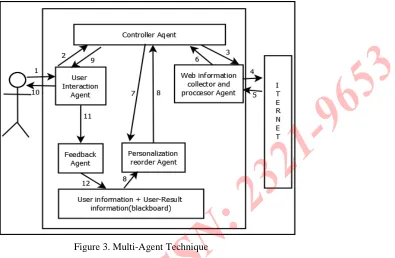
In this paper, we used a Agent System which
[image:6.612.119.514.142.400.2]contain 5 agents, these are user interaction
Figure 3. Multi-Agent Technique
agent, controller agent, web information collector and
processor agent, personalization reordering agent and
feedback agent. This system used distributed planning based
centralized scheduling.
The interaction with user and visualization is
performed by the user interaction agent. Together user's
queries and show the personalized search results after
reordering is a main task. Each task is completed by the
corresponding agent. But the controller agent is very
important agent allocation and scheduling of tasks is
competed by it. The web information collector and processor
agent collect the web information according to users' queries
and perform the process on it. It is connected to the network
users' actions on the search result page and then adjusts it to
improve the personalization service. Each agent is unique and
they can work independently .The cooperation and
communication of all the agents is a task of controller agent.
The figure 3 shows the process of personalized web
search and communication among agents. The user interest
model and user-resource information are used by more than
one agent. The communication among agents is necessary. In
this, we used the "blackboard" method to implement the
communication between the agents.
4. RESULT IMPLEMENTATION
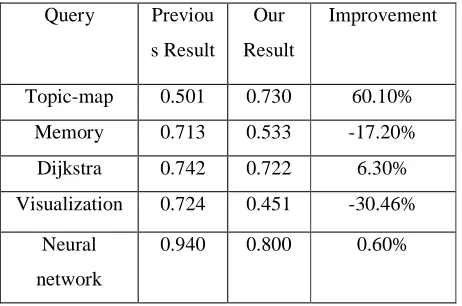
Table 1. Experimental results
In the experiment, the users searched many queries.
The queries with high search frequency are topic-map,
memory, Dijkstra, neural lnetwork, visualization. The
following table shows experimental results for above queries.
Finally, from the topic-map row in Table 1 we can
conclude that, comparing with the order given out by Google
API (Previous result) our approach can do some improving by
doing reordering based on the values given by our approach.
4) CONCLUSION AND FUTURE SCOPE
We can conclude from the experimental result that
our approach can obtain a good result when the query is
ambiguous or can be divided into some categories or the
search results contain much spam information
When the query is explicit and the search result is
precise this approach doesn’t works well, so there is need to
add various hybrid approaches in order to remove the
drawbacks. On the whole, our approach can do some
contribution in personalized web search comparing with the
order of the search results given out by Google API.
The interest model based on keyword vector is
simple and convenient but has some disadvantages because of
semantic network to improve our interest model. And the
collaborative filtering model also has some problems like
sparseness, cold boot and difficulties in expansibility which
should be solved in further work. In future work, we need to
find a method to update database in real time. Moreover, it is
possible that, after a long-time using the content of our models
can become more rich and the effect of our approach may be
improving, but it will still need experimental verifications.
REFERENCES
[1]. P.Chirita, Claudiu S.Firan, W. Nejdl. Personalized Query
Expansion for the Web. SIGIR, 2007.
[2]. Oyama S. , Kokubo T. et al. Domain-specific Web search
with keyword spices. IEEE Trans. Knowl. Data Engin.
16, I, 17- 27. 2004.
[3]. Xiaogang Han, Zhiqi Shen, et al. Folksonomy-Based
Ontological User Interest Profile Modeling and Its
Application in Personalized Search [A]. (Eds.): AMT
2010, LNCS 6335, pp. 34-46, 20 I O.
[4]. Cheqian Chen, Kequan Lin, et al. Personalized Search
Based on Learning User Click History [Z]. Proc. 9th
IEEE Tnt. Conf. on Cognitive lnformatics,20 I O.
[5]. T. Sarlos, et al. To Randomize or Not to Randomize:
Space Optimal Summaries for Hyperlink Analysis[Z].
Proc. 15th Int'l World Wide Web Conf. pp. 297-306,
2006.
[6]. http://www.google.com. hklig?hl=zh-CN.
[7]. Gauch S, Speretta M, Aravind C, et al. User profiles for
personalized information access[J]. The Adaptive Web
Methods and Strategies of Web Personalization, 2007:
54-89lxii+ 762. Query Previou s Result Our Result Improvement
Topic-map 0.501 0.730 60.10%
Memory 0.713 0.533 -17.20%
Dijkstra 0.742 0.722 6.30%
Visualization 0.724 0.451 -30.46%
Neural
network
[8]. Gentili G, Micarelli A, Sciarrone F. InfoWeb: An
adaptive information filtering system for the cultural
heritage domain. Applied Artificial Intelligence, 2003, 17
(8-9): 715-744.
[9]. Alexander Pretschner,Susan Gauch.Ontology Based
Personalized Search[C]. Proc.llth IEEE Intl.Conf.on
Tools with Artificiallntelligence.
Chicago.November,1999.
[10]. Hao Wang. Research on Change Pattern of Interest in
Learning for e-Learner[D].Xi'an:Xi'an Jiaotong