5
IV
April 2017
Technology (IJRASET)
Data Handling using Oracle Data Guard by the
Transfer of Log Sequence
Rishi Mohan Awasthi1, Rishi Kumar2, Raghav Garg3
1,2,3
B.Tech, Computer Science & Engineering, IMS Engineering College, Ghaziabad
Abstract: Oracle Data Guard ensures high availability, data protection, and disaster recovery for enterprise data. Data Guard provides a comprehensive set of services that create, maintain, manage, and monitor one or more standby databases to enable production Oracle databases to survive disasters and data corruptions. Data Guard 10g is a complete, reliable, data recovery solution for the Oracle’s global business operations. The user and client transaction separating the production and disaster recovery site – not a problem for Data Guard. Aiming at the disaster recovery, this paper brings forward a resolution basing on the Oracle Data Guard technology. By building a physical standby database, transferring the redo log which record the change of the primary database to the standby database, it ensures the data consistence, and thus resolves the disaster recovery. Basing on the resolution, this paper designs a platform which helps in disaster recovery and management of big enterprise data.
Keywords: Primary database; Standby database; Oracle Data Guard; Disaster recovery
I. INTRODUCTION
Oracle Data Guard is designed to address the highly important business continuity need for the enterprise. It provides an extensive set of data protection and disaster recovery (DR) features to help businesses survive disasters, human errors and corruptions that can adversely affect their Oracle databases. Oracle Data Guard is the management, monitoring, and automation software infrastructure that creates, maintains, and monitors one or more standby databases to protect enterprise data from failures, disasters, errors, and corruptions.
Database backup and disaster recovery technology develops along with the foundation of the database. Because of the existences of database backup and disaster recovery technology, database can give us more confidence when we store critical information in it, which promotes the development of database. So we can say it is the database backup and recovery technology that makes the database system more complete and developing more rapidly.
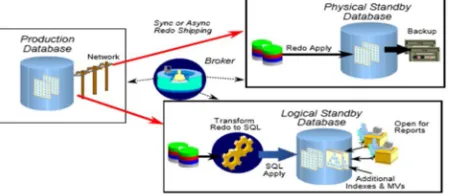
Available as a feature of the Enterprise Edition of Oracle Database, Data Guard can be used in combination with other Oracle High Availability (HA) solutions such as Real Application Clusters (RAC) and Recovery Manager (RMAN), to provide a high level of data protection and data availability that is unprecedented in the industry. The following diagram presents an overview of oracle data guard:
Technology (IJRASET)
II. LITERATURE SURVEY
Business continuity and disaster recovery are top priorities for the senior management of most global enterprises. Economic fluctuations, rapid changes in market trends, and competitive pressures imply that the global enterprise of today must operate in a 24x7 environment, and must be able to swiftly and efficiently deal with unforeseen business interruptions[1].
Oracle Data Guard is one of the most effective solutions available today to protect the core asset of any enterprise – its data, and make it available on a 24x7 basis despite disasters and other outages. This paper discusses Data Guard technology in Oracle Database 10g, and demonstrates how it is a key factor in the business continuity infrastructure of any enterprise. With the proliferation of e-business, an enterprise today operates in an extremely complex and a highly networked, global economy, and is more susceptible to interruptions than in the past. The cost of interruptions, or downtime, varies across industries and can be as much as millions of dollars an hour. While that number is staggering, the reasons are quite obvious[2].
The Internet has brought millions of customers directly to the electronic storefronts. Critical and interdependent business matters such as customer relationships, competitive advantages, legal obligations, industry reputation and shareholder confidence are even more critical now because of their increased vulnerability to business disruptions and downtimes. Oracle Data Guard is the management, monitoring, and automation software infrastructure that creates, maintains, and monitors one or more standby databases to protect enterprise data from failures, disasters, errors, and corruptions. Data Guard maintains standby databases as transactionally consistent copies of the production database. These standby databases can be located at remote disaster recovery sites thousands of miles away from the production data center, or they may be located in the same city, same campus, or even in the same building[2].
The logistics distribution management platform can simultaneously provide logistic distribution information service with multi-species, multi-channel, multi-transport infonnative services for hundred of logistic enterprises. Through the application of enterprise-level computing technology, the platform is more availability and reliability. It takes a lead among domestic logistic software by adopting national logistic standards, develops standardized software components for logistic distribution. By using the intelligent planning techniques, it realizes the intelligent planning and layout for the cargos, channels, transportations, routes and distribution centers. It achieves full & real time monitoring to distribution business, by vitally combining GIS, GPS, SMS, WA P and other advanced technology. Its system structure is shown as Figure 2[5].
Fig 2. The logistics distribution management platform's system architecture
Technology (IJRASET)
III. SIGNIFICANCE
Oracle Data Guard offers the following benefits:
A. Maximum Availability
Data Guard provides an efficient and comprehensive disaster recovery and high availability solution. Easy-to-manage switchover and failover capabilities allow role reversals between primary and standby databases, minimizing the downtime of the primary database for planned and unplanned outages.
B. Maximum Protection
With standby databases, Data Guard ensures no data loss, even in the face of unforeseen disasters. A standby database provides a safeguard against data corruption and user errors. Physical corruptions on the primary database at the storage level does not spread to the standby database. Similarly, logical corruptions or user errors that cause the primary database to be permanently damaged can be resolved. Finally, the redo data is validated at the time it is applied to the standby database.
C. Maximum Performance
The standby database tables that are updated with redo data received from the primary database can be used for other tasks such as backup operations, reporting, summations, and queries, thereby reducing the primary database workload necessary to perform these tasks, saving valuable CPU and I/O cycles. With a logical standby database, users can perform data manipulation operations on tables in schemas that are not updated from the primary database. A logical standby database can remain open while the tables are updated from the primary database and the tables are simultaneously available for read-only access. Finally, additional indexes and materialized views can be created on the maintained tables for better query performance and to suit specific business requirements.
D. Maximum Protection
Oracle Data Guard offers the Maximum Protection, Maximum Availability and Maximum Performance modes to help enterprises balance data protection against system performance requirements.
E. Automatic Missing Log Sequence Detection and Resolution
If the connection between primary and standby databases is lost, redo data that is generated on the primary database cannot be sent to those standby databases. Once the connection is re-established, the missing archive log sequence (or the gap) is automatically detected by Data Guard and the necessary archive logs are automatically transmitted to the standby databases. The standby databases are resynchronized with the primary database, with no manual intervention by the administrator.
F. Centralized and Simple Management
The Data Guard Broker automates the management and operational tasks across the multiple databases in a Data Guard configuration. The Broker also monitors all of the systems within a single Data Guard configuration. Administrators may use either Oracle Enterprise Manager or the Broker’s own specialized command-line interface (DGMGRL) to take advantage of this integrated management framework.
G. Integrated with Oracle database
[image:4.612.195.420.601.699.2]Technology (IJRASET)
IV. IMPLEMENTATION
A. Origin and Definition of Data Guard Oracle
Data Guard produced in Oracle 7.3 version. It was formerly known as the standby database and then was renamed to Data Guard in oracle9i. It was the infrastructure of the management, monitor and automation software. Data Guard creates maintains and monitors one or more standby databases to protect enterprise data from failures, disasters, errors, and crash. Data Guard was mainly used for Oracle database disaster recovery and it was one of the Oracle database backup and disaster recovery solutions[l].
Oracle Data Guard makes standby database easier to use, with more robust failover features and an easy to use GUI interface. It essentially combines the primary and standby databases into a single "high availability" resource. Oracle's native standby database functionality (which can be managed under the Data Guard umbrella) has been enhanced to allow the primary database to be used as the new standby, instead of being discarded as in previous versions of Oracle.[ 2]
B. The Architecture of Data Guard Disaster Recovery Technology
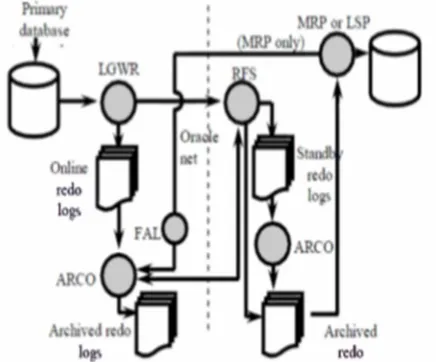
A DATA GUARD disaster recovery system includes one primary database and maximum nine standby databases. DATAGUARD disaster recovery system connects each other with the Oracle network protocol, and can be dispersed in various regions. The place the database is installed has no limit, as long as they can communicate with each other through the network. For example, you can have a main database and the standby database in the same system, but can also have two standby databases on the other system. A Data Guard disaster recovery system contains only one production database, namely the primary database. Applications will connect to the database primarily[3].
[image:5.612.197.415.358.539.2]A standby database is a copy of the primary database in transaction-level. Standby database forms from an initialization backup of the primary database. Once the standby database is established, Data Guard will automatically transfer the redo log files from the primary database to the standby database, and apply them to maintain the standby database[8].
Fig 4. The architecture of data guard disaster recovery technology
C. Log Transfer of Data Guard
The working mechanism of Data Guard is to transport logs to the standby machine, and then apply them on the standby machine to keep the standby database consistent with the primary database. Logs are transported under the following situations [5]:
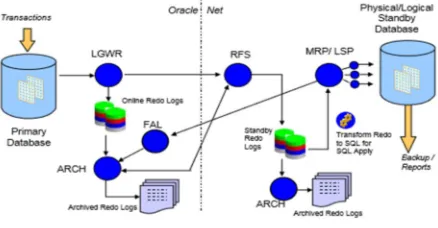
1) To Make Logs Synchronous by Setting LGWR Processes: In this case, when the network is unblocked, the primary database writes online redo logs using LGWR as well as standby redo logs using the RFS process. when the primary database switches logs, the standby database also switches standby redo logs ,generates archived redo logs and applies the logs by MRP or LSP processes. When the network is disconnected, there will be a gap between the primary database and standby database. After the network is connected, the standby database will initiatively search the needed archived log from the primary database, get down it, and apply it to the standby base by the MRP or LSP process to make up the gap.
Technology (IJRASET)
D. Log Apply of Data Guard
Data Guard provides two methods to apply this redo data to the standby database and keep it transactional consistent with the primary, and these methods correspond to the two types of standby database supported by Data Guard[6]:
1) Redo Apply, used for physical standby databases
2) SQL Apply, used for logical standby databases.
E. Equations Disaster Recovery Subsystem's Implementation based on DATAGUARD Technology
1) Generate the required files in the primary database. Generate a static parameter file named Pfile using dynamically parameter
file, and then create a standby control file.
2) Copy the required files to the standby database. Generate a list of data files to be copied. Generate a list of log files to be copied. Shut down the main database. Copy parameter file initstd.ora, standby control file stactlOl.ctt, data files in the list and log files in the list to the standby system. Start up the main database.
3) Alter the parameter file and generate the standby database. Alter the parameter file and add the required parameters of the physical standby database whose suffix is as follows: remote_archive_ enable,standby_ archive _d est,standby _file_rnanagement, fal_server, fal_c1ient;
Create the password file, and start up the database to the standby database; Run the restore command to let the standby database consist with the primary database.
4) Alter the parameters of the primary database for data synchronization First, Alter the parameters of the primary database to archive the redo log files to the standby database, i.e. add network service name 'standby' to the tnsnames.ora which point to the standby database. Second, Alter the parameters of the primary database and then start the remote archive to ensure the data consistency between the primary database and the standby database.
5) Switch redo log to ensure the synchronization After configuration, we should execute command to switch the redo log file of
the primary database, and see the number of the newest redo log number from the alert log. And then we should check the alert log of the standby base to ensure the synchronization. We also need to check the dictionary view to ensure the log has been applied to the standby database.
[image:6.612.197.416.441.555.2]Through the above steps, we can successfully configure the standby database in the local area. When the crash occurred in the primary database, we can recover the data through the standby database and ensure the database not losing data[5][6].
Fig 3. Oracle Data Guard Process Architecture
V. CONCLUSION
Oracle Data Guard is a disaster recovery, high availability solution and comprehensive data protection for the enterprise. It offers an easy-to-manage framework that addresses both planned and unplanned outages or power surges. Physical and logical standby databases complement each other and can be maintained simultaneously providing high-value data protection, while offloading overhead from primary databases. The various data protection modes provide flexibility to adapt to various protection, performance and infrastructure requirements.
Technology (IJRASET)
REFERENCES
[1] Sam R. AJapati, "Expert Oracle9i Database Administration", Apress , 2003
[2] Biju Thomas, Bob Brylaz ,"OCA/OCP:Oracle9i DBA Fundamental I Study Guide", SYBEX Inc. ,2002 [3] RamezElmasri and Shamkant B. Navathe, "Fundamentals Of Database System", Cummings Publishing, 1994. [4] Bipul Kumar, Oracle Data Guard Standby Database Failover Handbook, Rampant Tech press, 2004.
[5] Matthew Hart and Scott Jesse, "Oracle Database 109 High Availability with RAC, Flashback & Data Guard", McGraw-Hili Companies, 2004 [6] "Oracle Data Guard in Oracle Database 109 Disaster Recovery for the Enterprise", An oracle white Paper, 2003