5
II
February 2017
Technology (IJRASET)
Evolution of Routing Protocols for Wireless
Sensor Networks – A Survey
Nami Susan Kurian1, Surendran R2
1Assistant Professor, Rajalakshmi Institute of Technology
2UG Scholar, Dept. of Electronics and Communication Engineering, Rajiv Gandhi College of Engineering, Chennai, India
Abstract— WSN is a set of small power energy confined sensor nodes which can dynamically forms a network without the use of an existing network or without the use of a centralized administration. In WSN, the biggest constraint is to employ an efficient power consumption scheme. Different protocols were described for WSN out of which the research paper has been done on four major categories namely - Data centric based protocols, Location-based protocols, Hierarchical based protocols and QoS based protocols. The difference in the operation of each protocols, pros and cons of each protocol with respect to other protocols are mentioned in this research.
Keywords— Wireless sensor networks, energy efficiency, lifetime, fault tolerance
I. INTRODUCTION
A wireless sensor network is a network consists of devices equipped with radio transceiver that works co-operatively to maintain a full-fledged connected network of sensor nodes. Each sensor network node [1] has typically several parts: a radio transceiver with an internal antenna or connection to an external antenna, a microcontroller, an electronic circuit for interfacing with the sensors and
an energy source, usually a battery or an embedded form of energyharvesting. The transducer generates electrical signals based on
sensed physical effects and phenomena. The microcontroller processes and stores the sensor output.
Routing protocols have a large scope of research work when implemented in a WSN, because the functioning of these protocols depends upon the type of network structure designed for the application or the network operations carried out using these protocols for a specific application model.
II. FACTORSINFLUENCINGWSNDESIGN
These factors are important because they serve as a guideline to design a protocol or an algorithm for sensor networks. In addition, these influencing factors can be used to compare different schemes.
Fault Tolerance: Some sensor nodes may fail or be blocked due to lack of power [2], have physical damage or environmental interference. The failure of sensor nodes should not affect the overall task of the sensor network. This is the reliability or fault tolerance issue. Fault tolerance is the ability to sustain sensor network functionalities without any interruption due to sensor node failures.
Scalability: The number of sensor nodes deployed in studying a phenomenon may be in the order of hundreds or thousands. Depending on the application, the number may reach an extreme value of millions. The new schemes must be able to work with this number of nodes. They must also utilize the high density nature of the sensor networks.
Production Costs: Since the sensor networks consist of a large number of sensor nodes, the cost of a single node is very important to justify the overall cost of the networks. If the cost of the network is more expensive than deploying traditional sensors, then the sensor network is not cost-justified. As a result, the cost of each sensor node has to be kept low.
Hardware constraints: All of the subunits may need to fit into a matchbox-sized module. The required size may be smaller than even a cubic centimeter which is light enough to remain suspended in the air. Apart from the size, there are also some other stringent constraints for sensor nodes. These nodes must consume extremely low power, operate in high volumetric densities, have low production cost and be dispensable, be autonomous and operate unattended and be adaptive to the environment.
Sensor Network Topology: Sheer numbers of inaccessible and unattended sensor nodes, which are prone to frequent failures, make topology maintenance a challenging task. Hundreds to several thousands of nodes are deployed throughout the sensor field. They
are deployed within tens of feet of each other. The node densities may be as high as 20 nodes/m3. Deploying high number of nodes
densely requires careful handling of topology maintenance.
Technology (IJRASET)
503
nments such as debris or a battlefield, under extreme heat and cold such as in the nozzle of an aircraft engine or in arctic regions, and in an extremely noisy environment such as under intentional jamming.
Transmission media: In a multi-hop sensor network, communicating nodes are linked by a wireless medium. These links can be formed by radio, infrared or optical media.
To enable global operation of these networks, the chosen transmission medium must be available worldwide.
Power consumption: The wireless sensor node, being a micro-electronic device, can only be equipped with a limited power source (<0.5 Ah, 1.2 V). In some application scenarios, replenishment of power resources might be impossible. Sensor node lifetime, therefore, shows a strong dependence on battery lifetime. In a multi-hop ad hoc sensor network, each node plays the dual role of data originator and data router. The mal functioning of few nodes can cause significant topological changes and might require re-routing of packets and re-organization of the network.
I. CLASSIFICATIONOFROUTINGPROTOCOLS
Table1:classification of routing protocols
II. HIERARCHICALROUTING
In this routing technique [4], all the routing sensors in the network are clustered and a cluster head collects and aggregates the data and checks for redundancy of the data that is collected before it is sent to the sink. This saves communication and processing work and also saves energy.
Fig.1. Hierarchical Routing
In this type of protocols, a network is composed of several clumps or clusters of sensors. Each clump is managed by a special node called cluster head. It is responsible for controlling the data transmission activities of all the nodes within the cluster.
The above figure shows that, in a hierarchical approach, network is divided into different clustered layers. Each cluster is composed of many nodes. Data travel from lower clustered layer to the higher clustered layer. Optimization is maintained at the cluster heads. The different types of hierarchical protocols are discussed in the below sections.
A. Leach
Category Protocols
Data-Centric Based
Protocols
SPIN , DD, RR, COUGHAR, ACQUIRE
Location Based Protocols SPAN, GAF, TBF, BVGF, MECN, SMECN, GEAR
Hierarchical Based
Protocols
LEACH, TEEN, APTEEN,PEGASIS,VGA, HEED
Technology (IJRASET)
LEACH [8] stands for Low-Energy Adaptive Clustering Hierarchy. It is the first and most popular hierarchical clustering algorithm. It is a TDMA based protocol incorporated with clustering technique. It was proposed for reducing the power consumption. All nodes are static, identical and charged with the same amount of initial energy. The consumption of energy by all the nodes will be at same rate and are able to know the residual energy and control transmission power and distance. LEACH is based on aggregation technique that combines original data into smaller size of data that carries only meaningful information to all the sensors. In LEACH, nodes transmit data to cluster heads(CH), CH aggregates and compress the data and forward it to sink. Random selection of CH is carried out in LEACH for each round. Nodes that act as the CH cannot be the cluster head next time. CH creates a schedule using TDMA for transmission of data for each node in the cluster.
There are two main stages in LEACH protocol:Setup phase Divides network into clusters
CH advertisement
Transmission schedule creation Steady state phase
Data aggregation Data compression
Transmission to sinkAdvantages:
Leach achieves a factor of 8 improvement compared to direct transmission.
Disadvantages:As the cluster heads are elected randomly, so the optimal number and distribution of cluster heads cannot be guaranteed. The nodes with low residual energy have the same priority to be a CH as the node with high residual energy. Therefore, when those nodes with less remaining energy may be chosen as the cluster heads which will result in the dying of nodes.
The cluster heads communicate with the base station in single-hop mode which makes LEACH cannot be used in large-scale WSN.
B. Pegasis
PEGASIS [10] stands for Power Efficient Gathering in Sensor Information systems. It is an enhanced version of LEACH protocol. No cluster formation is involved I this protocol. It is an optimal chain based protocol in which the chain is accomplished by greedy algorithm. In this protocol, each node communicates only with a close neighbor and takes turns transmitting to the base station. This reduces the amount of energy spent per round. LEACH uses randomization to rotate the cluster heads(CHs), providing higher achievement over direct path approach. Each node communicates with only the close neighbors and the designated node only will sent the combined data to the BS in each round.
Operation:The working is as follows: Formation of chain among the sensor nodes. Each node will receive and transmit data.
The gathered data moves from node to node, get fused and atlast the designated node only will transmit to BS. AdvantagesFormation of chains minimizes the distance.Limiting the number of transmissions.
Disadvantages When a head node is selected, there is consideration how far the base station is located from the head node. When a head node is selected, its energy level is not considered.
Since there is only ne node head, it may be the bottle neck of the network causing delay. Redundant data transmission of data as only one head node is selected.
C.Heed
The four primary goals of HEED protocol [11] are:
prolonging the network lifetime by distributing energy consumption in the whole network. terminating the clustering process
controlling the overhead to minimum.
producing well distributed CHs and compact CH Operation
In HEED protocol, algorithm selects CHs on the basis of two parameters- residual energy of the sensor node and inter-cluster communication cost ( on the basis of number of neighbors). With the knowledge on residual energy, cluster head can be selected. Inter-cluster communication cost helps in breaking ties.
Technology (IJRASET)
505
Does not make assumptions about node distribution.Operates correctly even when nodes are not synchronized.Reduce energy load DisadvantagesRandom selection of cluster head results in higher overhead. The periodic cluster head rotation or election needs extra energy to rebuild clusters.
D. Teen
TEEN stands for Threshold Sensitive Energy Efficient Sensor Network protocol. It is a hierarchical clustering protocol. In this protocol, grouping of sensor nodes into clusters with each group consists of a cluster head(CH). The CH sends aggregated data to higher level CH until it reaches the sink.
Advantages:ster head sends its members a hard threshold and a soft threshold. Suitability for time-critical sensing applications.
Efficient in terms of energy consumption and response time.
Allows users to control the energy consumption accuracy to suit the application.
Disadvantages If the thresholds are not reached, the nodes will never communicate and the used will not get any data from the network.
Chances of collisions in the cluster. Delay in reporting the time critical data.
E. Apteen
APTEEN stands for Adaptive Periodic Threshold Sensitive Energy Efficient Sensor Network Protocol. It is the improved version of TEEN [5] in which the disadvantages of TEEN are overcome.
Two main aims includes uring periodic data collections (LEACH). Reacting to time-critical events (TEEN).
APTEEN is a hybrid clustering-based routing protocol. It allows the sensor to send their sensed data periodically and react to any sudden change in the value of the sensed attribute by reporting the corresponding values to their CHs. The architecture of APTEEN is same as TEEN.
Three query types APTEEN supports are: Historical query, to analyze past data values,
One-time query, to take a snapshot view of the network Persistent queries, to monitor an event for a period of time.
APTEEN guarantees lower energy dissipation and larger lifetime of node.
III. QOSBASEDPROTOCOLS
In this type of routing protocol, a sink requests for data from the sensed nodes in the network and the transmission has to satisfy certain quality-of-service parameters, such as, for example, bounded latency and bandwidth consumed. SPEED and Sequential Assignment Routing (SAR) are the two most important routing protocols that used the notion of QOS in routing decisions.
A. Speed
It is a type of protocol that provides soft real time end-to-end guarantees. The protocol requires every node to maintain information about the neighboring nodes. The protocol finds paths by geographical forwarding. The protocol also ensures a certain speed for each packet in the network such that before taking the admission decision, each application can estimate the end-to-end delay for the packets by dividing the distance to the sink by the speed of the packet. SPEED [7] protocol provides congestion avoidance when the network is too congested. SNGF (Stateless Geographic Non-Deterministic forwarding) is the routing module used in SPEED. OperationInformation about the nodes and their location is collected by the beacon exchange mechanism.
The delay estimation is calculated at each node by the elapsed time.
On d basis of delays, SNGF selects the node which meets the speed requirements. If it fails, the relay ration of node is checked.
Advantages e in terms of end-to-end delay and miss ratio.Total transmission energy is less. Control overhead is less.
B. Sar
Technology (IJRASET)
ons. The two main aims of this protocol are energy efficiency [4] and fault tolerance [5]. The three important factors that determine the routing decisions in SAR are (a) energy resources (b) QoS on each path (c) priority level of each packet.
OperationThe SAR protocol creates trees that is rooted at one-hop neighbors of the sink by taking into consideration of QoS metric, energy resource on each path and priority level of each packet.
By the created trees, multiple paths from sink to sensors are formed.
One of these paths is selected according to the energy resources and QoS on the path.
Failure recovery is done by maintaining routing table consistency between upstream and downstream nodes on each path. If any local failure occurs, it causes an automatic path restoration procedure locally.
IV.LOCATIONBASEDROUTINGPROTOCOL
In this routing technique, node sensors are addressed by their location. The based on the incoming signal strength the distance between the nodes are found. The coordinates of the nodes are obtained by interchanging the information between them. The other way of knowing the location is by communicating with the satellite, using GPS. In this method the inactive nodes go to sleep to save energy. Below we discuss the types of location based protocols Span,Gaf,Tbf,Bygf,Mecn,Smecn,Gear.
A. Geographic adaptive fidelity (GAF
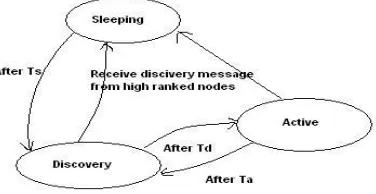
GAF is made for ad-hoc networks with energy saving algorithm and is applicable for network sensors. By this algorithm the area of the network is divided into fixed number of zones and form a imaginary grid structure. Here each node plays different roles by communicating with each other. The radio is turned off when the node enters sleep mode. By using discover state nodes know the state of other nodes.
OperationsFirst the entire nodes form a virtual grid with the information shared. the node with maximum residual value will become the master grid.
The node which is awake is responsible for updating the information about other nodes and called as the master node in each grid. he slave nodes will turn ON only when required and save power.
AdvantagesOnly one master node for grid , which stays ON and updates information. The master node will not aggregate or fuse as in hierarchical protocol.
The entire network is divided into zones, so power saved.Maintains the routing fidelity by the above steps.
Disadvantages It’s considered as hierarchical protocol based on geographic location. There is dynamic changing of range in transmitter node.
Fig 3State transitions in GAF protocols
B. Geographic and energy aware routing (GEAR)
GEAR is a energy saving routing protocol for routing problems to reach the target region in the sensor field. To know the current location a GPS unit is used. An energy efficient mechanism is used to route the packet from source to destination. All the nodes keep approximate cost and learned cost to reach the destination. The approximate cost is calculated by adding the residual cost with distance to the destination. When there is no neighboring nodes then a hole state occurs. If there is no hole state , then learned cost is equal to the approximate cost calculated.
[image:6.612.198.386.457.554.2]Technology (IJRASET)
507
Advantages Uses energy aware algorithm so more energy saving. Reduced number of direct diffusion.
Disadvantage Occurrence of holes in the network.
Making learned cost & estimated cost equal is difficult with the presence of holes in the network.
SPAN is another type based on position , using few node coordinate based o their positions. These coordinates together form the back bone of the protocol for data forwarding. Sometimes the neighboring nodes cannot reach the nearby nodes directly , at that time the nodes act as coordinators. Sometimes the new and existing coordinator need not be neighbors. By this the difficulty to maintain the position of hops to neighbor in this protocol is avoided.
Reduced energy consumption.Radio is off when in idle state.No need for location sensors.
Disadvantage Requires an advertising sensor for status advertisement.
V. DATA-CENTRICBASEDPROTOCOLS
Data-Centric Based Protocols [9] is not like address centric protocol. In address centric protocols, every source sensor has to send data to sink independently. But in data centric protocol, the source sensor will send data to sink , but in the middle the intermediate sensors will aggregate the data with other data from other sensors and send it towards the sink. This will reduce power consumption.
A. Sensor Protocol for Information via Negotiation (SPIN):
This type was developed to overcome implosion and overlap problems in flooding protocols. It is resource aware and resource adaptive in nature. It uses informed decisions for efficient use of the resources. It has two protocols namely SPIN-1 and SPIN- has two major mechanisms namely negotiation and resource adaption:
Sensor negotiates is the process of allowing the nodes to communicate with each other before any transfer. This is done to avoid non-useful transfer. The meta data is used to avoid overlapping and transfer only the required data.
By the use of the resource manager the nodes will take care of the resource consumption and process the data. Bythis Spin1 reduces sensor consumption.
Spin2 is energy saving.
It uses three-way hand shaking process. Spin 2 uses one - many broadcasting techniques. Disadvantage
It is applicable to only lossless network and sometime to lossy mobile networks. High residual energy the spin1 and spin2 are identical.
B. Directed diffusion (DD)
This protocol is for sensor query dissemination and processing. The sensing is listed by attribute value pair. Initially the incoming rate of data is slow but later after reinforcement the rate in increased. Once the interest for higher rate is received then the nearby nodes will send high rate data.
Operations Data naming for avoid confusion. Interest and gradient methods. Data propagation is used to send data properly from source to destination. Reinforcement the protocol and data send.
Advantages Energy saving. Scalable protocol. Robust in nature.
It will increase the rate only when interest is received. At the beginning the rate is too slow so longer time.
B. Rumor Routing (RR)
The logical way of solving query flooding and event flooding is done by this protocol. This protocol makes the queries between the nodes equal to the query and event flooding.
Operation
Technology (IJRASET)
Agents are long lived packets for the network and its sensors. The agent will maintain a hop list and distance event pair. The event list of the sensor and agent will synchronous and work. Maintains the shortest path to destination.
Better information communication between the agent and sensors Avoids problems created by flooding.
This protocol always synchronous with agent and sensor list.
D. Cougar
In this protocol the tasking in sensor network are done based on database. It provides a detailed query about the sensed information. Here the user will not know how the data is sent from source to destination i.e.., the exact path.
Operation It uses query layer in which all query proxy details are stored. Query proxy lies between network and application layer.
Higher level of service through queries from gateway nodes. Advantages It is applicable in WSN.
It has higher level of service.
Saves energy by in-network processing. More beneficial to user if fused into one.
Disadvantage Can be viewed as huge distributed database only. Each sensor will have a subset data. Current approach cannot be used directly in real time applications, it needs modifications.
VI.CONCLUSION
To make an energy efficient design for routing protocol in WSN is the major challenge faced now a days. The main aim is to make the sensor to work for long time with less usage of energy. Generally the major energy consumption is due to data transfer and reception. So we to design in such a way that the WSN is less energy consuming, has long lifetime usage and longer network lifetime. In this paper, we have surveyed all most all the types of routing protocols like location based, data centric based, hierarchic based and many more too. We have surveyed the examples of all the above mentioned types.
REFERENCES
[1] Miguel Angel Erazo Villegas, Seok Yee Tang,Yi Qian, “Wireless Sensor Network Communication Architecture for Wide-Area Large Scale Soil Moisture Estimation and Wetlands Monitoring”.
[2] Adinya John Odey, Daoliang Li, “Low Power Transceiver Design Parameters for Wireless Sensor Networks,” in Wireless Sensor Network.
[3] Rajashree.V.Biradar , V.C .Patil, Dr. S. R. Sawant , Dr. R. R. Mudholkar, “Classification and comparison of routing protocols in wireless sensor networks”, in Special Issue on
[4] Ubiquitous Computing Security Systems. Bhavana Narain, Anuradha Sharma, Sanjay Kumar and Vinod Patle, “Energy efficient mac protocols for wireless sensor networks: a survey”, in International Journal of Computer Science & Engineering Survey (IJCSES) Vol.2, No.3, August 2011.
[5] Shio Kumar Singh 1, M P Singh 2, and D K Singh, “Routing Protocols in Wireless Sensor Networks – A Survey”, in International Journal of Computer Science & Engineering Survey (IJCSES) Vol.1, No.2, November 2010.
[6] Owais Ahmed, Ahthsham Sajid and Mirza Aamir, Comparison of Routing Protocols to Assess Network Lifetime of WSN”, IJCSI International Journal of Computer Science Issues, Vol. 8, Issue 6, No 3, November 2011.
[7] Pallavi S. Katkar, Prof. (Dr.) Vijay R. Ghorpade, “A Survey on Energy Efficient Routing Protocols”, in International Journal of Computer Science and Information Technologies, Vol. 6 (1) , 2015, 81-83.
[8] Ravneet Kaur, Deepika Sharma and Navdeep Kaur, “Comparative Analysis Of Leach And Its Descendant Protocols In Wireless Sensor Network”, in International Journal of P2P Network Trends and Technology- Volume3Issue1- 2013.
[9] Jamal N. Al-Karaki Ahmed E. Kamal, “Routing Techniques in Wireless Sensor Networks: A Survey”. Stephanie [10] Lindsey, Cauligi S. Raghavendra, “PEGASIS: Power-Efficient Gathering in Sensor Information Systems”.
[11] Ossama Younis and Sonia Fahmy, “HEED: A Hybrid, Energy-Efficient, Distributed Clustering Approach for Ad-hoc Sensor Networks”.
[12] Mohammad Arifuzzaman, Mitsuji Matsumoto and Takuro Sato, “An intelligent hybrid MAC with Traffic-Differentiated-based QoS for wireless sensor networks,” in IEEE sensors journal vol.13, no.6, june 2013.
Technology (IJRASET)
509
[14] V. Rajendran, K. Obraczka, and J.J. Garcia- Luna-Aceves, “Energy-Efficient Collision-Free Medium Access Control for Wireless Sensor Networks,” in ACMSenSys November 2003.