6
I
January 2018
Sound Assisted Fluidized Bed and its Effects on
Micro Particles
M. Shakebuddin1, Dr. Akash Langde 2 1
Research Scholar MIET, Gondia
2
Prof. Mechanical department A.C.E.T Nagpur
Abstract: The aim of this research work is to improve the quality of fluidization of fine powders (cohesive powder) with the help of sound assisted fluidization. The work presents the main results obtained in the field of sound assisted fluidization of fine particles. Our aim is to emphasize on the role of acoustic fields in enhancing the gas-solid contact efficiency, we have characterized the fluidization behavior of bentonite powders in terms of pressure drops, minimum fluidization, bed expansion, and velocity as affected by acoustic fields of different intensity and frequency. Remarkable effect was noted after application of sound intensity with decrease in minimum fluidization velocity and with good bed expansion.
Keywords: Fluidization, acoustics, agglomerates, micro particles
I. INTRODUCTION
Fluidization is the operation by which solid particles are transformed into a fluid-like state through suspension in a gas or liquid. One of the most prominent features of fluidized beds is their ability to mix According to the fluidization of fine powders (diameter of the primary particles less than 100μm) is complex. Due to the cohesive structure and, in particular, to the physical forces between the primary particles it is difficult to suspend these particles in fluidizing gas. This is due to the unpredictable behavior of the cohesive powders. This strong interaction between the powders affects the flow properties of the powders; these tend to form agglomerates of random size and shape by the action of the inter particle forces between the primary particles. In many industrial processes, the cohesive powders are fluidized in the form of agglomerates. For this, it is necessary to break the strong inter particle bond by applying external energy like magnetic pulsation, vibration, acoustic energy and by using binary particles. The smooth fluidizations of gas-solid particles are the result of equilibrium between the hydrodynamic, gravitational and inter particle forces. This is of great importance for many industrial processes.
II. LITERATURE REVIEW
Initially the work is done by Morse [1] who studied the effect of sound on a fluidized bed. During research, the loudspeaker was kept at the bottom of the bed. Sonic energy of sufficient intensity (above110dB) of low frequency (from50to500Hz)would cause non-easy to fluidize group C particles to fluidize well, so that fluidization is possible without channeling and stagnation.
Chironeet al. [2] formulated the cluster/sub cluster oscillator model based on the theory that the cluster is due the effect of cohesive Vander Waals forces, which fuse to each other and forms large agglomerates. As a result, the bed has been structured in clusters that can break up into sub clusters, due to the sound intensity..
Now a ketal. [3] Developed the correlation sound assisted minimum fluidization and used the sound at the to pas well as bottom of the unit. The measurement was done at variable frequencies and decrease in min. fluidization velocity occurredat97,157, and 894Hz.The heat transfer improves characteristic of non-fluidized solid at low acoustic frequency.
Levy et al. [4] determined the effects of acoustic waves in fluidized beds. Sound pressure measurements within the bed showed the presence of acoustic standing waves throughout the bed. According to acoustic standing wave theory, the bed behavesasa1-D,quasifluid and establish the parameter kh, where k is the wave number and h is the bed depth, determines the amplitude of sound pressure throughout the bed.
Levyetal.[6]investigated the effect of sound intensity on gas-fluidized bed for separation of the bed materials into low and high-density component. The experimentation performed with fly ash particles and showed the strong effect.
Russoetal.[7] reported the effects of bed weight and intensity of the acoustic field (from no sound to sound pressure level– SPL,at140dB).The maintained constant frequency 120 Hz in all the experiments. The results of the experiment showed, for a certain bed weight, an acoustic field of appropriate SPL changes the channeling typically observed with group C cohesive powders into the homogeneous bubble free bed.
In his latter studies, Lev yet al.[8 ] investigated the effect of sound, promoting more homogeneous fluidization and bed expansion. In his study, by using fiber optic probe they found the combined effects of gas frequency, velocity and intensity of sound waves on bubble dynamics..
Xuet al. [9] suggested that, with the assistance of a sound field, fluidization quality of fine particles can be enhanced. By applying sound field results, in higher pressure drop and lower minimum fluidization velocity. In study, application of an acoustic field was attempted to identify Geldart groups C and A particles. For the first time sound field is used to distinguish group C particles from group A particles.
Leuetal.[10]studiedthebehaviorofeightdifferenttypesofGeldartgroupCparti- cles in the sound vibrated fluidized bed and estimated the inter particle force.
Guoet al. [11] investigated the fluidization behaviors of ultrafine particles in an acoustic fluidized bed with one type of micron particles and two types of nanoparticles(dp=500nm-10.69mm).
Xuet al. [12] reported the effects of vibration on fluidization of fine particles (4.8-216 mm average in size) show that the fluidization quality of fine particles can be enhanced under mechanical vibration, leading to larger bed pressure drops at low superficial gas velocities and lower values of Umf.
Levy et al. [13] studied the combined effects of mechanical and acoustic vibrations on fluidization of cohesive power. With the introduction of acoustic and mechanical vibrations, both the minimum fluidization velocity and agglomerate size got reduced. They came to the conclusion that, acoustic vibrations were more effective compared to mechanical vibration.
III. EXPERIMENTAL SETUP
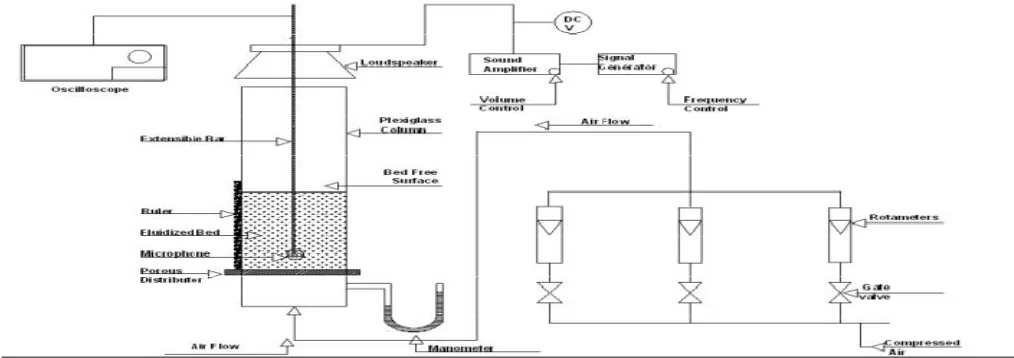
Experiments were performed at room temperature and atmospheric conditions. The fluidization gas was air, provided by an air compressor. The compressor has capacity to deliver the air up to 8 bar. A gate valve was provided to maintain uniform inlet rot meter pressure. The experimental works were carried out on two clear Plexiglas column of inner diameters 100mm and heights of 500mm, respectively. A porous distributor located at the bottom of the column, distributes air uniformly into the bed. Water manometer was used to measure the pressure drop across the distributor and bed.
The sound source includes a sound amplifier, a function signal generator and a loud speaker 8”. The speaker was located at the top of the bed to generate sound as the source of acoustic field.
A signal generator was used to produce different types of electric pulse waves. the sound frequency was controlled by simply adjusting the function generator.
[image:3.612.51.558.540.719.2]Table 1: Shows the specification of the material used Sound-assisted fluidization of Bentonite powder Sr. No. Name of Material Mean Diameter “dp”
L/D ratio Weight of Material (kg) Density (kg/m3) “ρp”
Fluidizing bed diameter “D”
Cohesive/Non Cohesive
1 Bentonite 64μm 0.7 500gm 980 10 cm Cohesive
[image:4.612.93.508.252.553.2]IV.RESULTS AND DISCUSSION
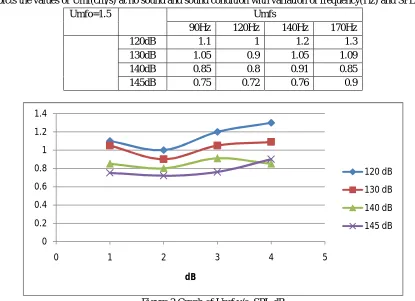
Table 2: Depicts the values of Umf(cm/s) at no sound and sound condition with variation of frequency(Hz) and SPL (dB)
Umfo=1.5 Umfs
90Hz 120Hz 140Hz 170Hz
120dB 1.1 1 1.2 1.3
130dB 1.05 0.9 1.05 1.09 140dB 0.85 0.8 0.91 0.85 145dB 0.75 0.72 0.76 0.9
[image:4.612.87.455.583.729.2]Figure 2 Graph of Umf v/s SPL dB
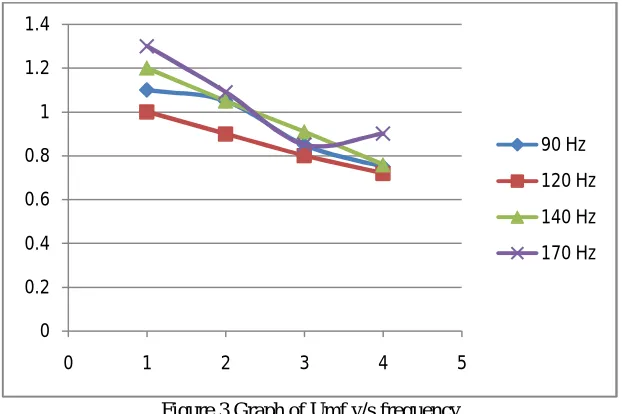
Table 3: Depicts the values of Umf(cm/s) at no sound and sound condition with variation of frequency(Hz) and SPL (dB)
Umfo=1.5 Umfs
90Hz 120Hz 140Hz 170Hz 120dB 1.1 1.05 0.85 0.75
130dB 1 0.9 0.8 0.72
140dB 1.2 1.05 0.91 0.76 145dB 1.3 1.09 0.85 0.9
0 0.2 0.4 0.6 0.8 1 1.2 1.4
0 1 2 3 4 5
dB
120 dB
130 dB
140 dB
Figure 3 Graph of Umf v/s frequency
Table4: Depicts the values of (Umfo- Umfs)/Umfo with variation of frequency(Hz) and SPL (dB) (Umfo- Umfs)/Umfo
90Hz 120Hz 140Hz 170Hz
120dB 0.266 0.333 0.2 0.133
130dB 0.3 0.4 0.3 0.273
140dB 0.433 0.466 0.393 0.433
145dB 0.5 0.52 0.493 0.4
Figure 4 Graph of (Umfo- Umfs)/Umfo v/s SPL(dB) The characteristic parameter in this case is as follows:
1) The bed aspect ratio (L/D) at minimum fluidization, which is related to the total amount bed material.
2) The properties of the fluidized bed system which are independent of particle properties. These include
0 0.2 0.4 0.6 0.8 1 1.2 1.4
0 1 2 3 4 5
90 Hz
120 Hz
140 Hz
170 Hz
0 0.1 0.2 0.3 0.4 0.5 0.6
0 1 2 3 4 5
120 dB
130 dB
140 dB
b) The bed operating conditions such as superficial gas velocities.
Benton idée (dp= 64μm) are difficult to fluidized in absence of sound intensity with elutriation loss at higher gas velocity. When acoustic field was applied their fluidization quality improved with homogeneous fluidization. It was also observed that, material responds to the sound intensity from 120dB.
A. Effect of sound intensity on minimum fluidization velocity
It has been observed that, material with particle size dp= 64μm, gave good response to the sound intensity with decrease in Umf.
B. Effect of sound intensity on minimum bubbling velocity
Minimum bubbling velocity recorded when first bubble appeared on the surface of bed by visual observation. The observation was noticed for most of the material is that, minimum value of Umbs seen at 120Hz due to the maximum response of column to this frequency.
C. Bed expansion in presence of acoustic field
It has been also noted that, bed expansion increased with the application of acoustic field. Bed expansion of bentonite gave best response to the sound intensity. The bed expansion was almost twice and small amount of air was sufficient to expand the bed at 145dB.
V. CONCLUSIONS
The remarkable effect was observed, when acoustic field was applied on bentonite powder. Experiment was done on bentonite powder having approximately the size in between the range of 37µm to 90 µm. the average size of the particle considered for experiment purpose is 64µm.
The experimentation is carried out at room temperature and air as fluidizing gas in presence of sound assisted variable acoustic field. The experiment was performed for the L/D ratio of 0.7
As sound intensity increases Umfsdecreases from 1.1 dB to 0.7 dB. The range of frequencies is between90Hzand170HzIt was also seen that, Umfsdecreases with increase in frequency and then increases.
The material which was very difficult to Fluidized with the supply of high velocity of air flow, Fluidized very easily with low velocity of air with the application of acoustic field. It has been also seen that the size of the agglomerates decreases and shows good bed expansion in presence of acoustic field.
REFERENCES
[1] Morse,R.D.,SonicEnergyinGranularSolidFluidization,Industrial&EngineeringChemistry,47 (1995), 6, pp. 1170-1175
[2] Chirone, R., Massimila, L., Russo, S., Bubble-Free Fluidization of a Cohesive Powder in an Acoustic field, Chemical Engg. Science, 48 (1993), 1, pp.41-52
[3] Nowak, W., Hasatani, M., Derczynski, M., Fluidization & Heat Transfer of Fine Particles in an Acoustic field, AIChEsymp, 89 (1993), 296, pp.137-149 [4] Levy,E.K.,Herrera,C.A.,CharacteristicsofAcousticStandingWawesinFluidizedBeds,AIChEJour- nal, 48 (1993), pp.41-52
[5] Chirone,R.,Massimila,L.,SoundAssistedAerationofBedsatCohesiveSolids,ChemicalEngg.Science, 49 (1994), 8, pp. 1184-1194
[6] Levy,E.K.,Herrera,C.A.,Masaki,T.,BubblingFluidizationofFinePowdersinaHighIntensityAcous- tic Field, Proceedings, International Fluidization Conference, Durango, Col., USA,1998
[7] Russo, P., et al., The Influence of the Frequency of Acoustic Waves on Sound Assisted Fluidization of Beds of Fine Particles, Powder Technology, 82 (1995), 3, pp.219-230
[8] Levy,E.K.,etal.,EffectofanAcousticFieldonBubblinginaGasFluidizedBed,PowderTechnology,90 (1997), 1, pp. 53-57
[9] Xu,C.,Cheng,Y.,Zhu,J.,FluidizationofFineParticlesinaSoundFieldandIdentificationofGroupC/A Particles Using Acoustic Waves, Powder Technology, 161 (2006), 3, pp. 227-234
[10] Leu,L.P.,HuangC.T.,FluidizationofCohesivePowdersinaSoundWaveVibratedFluidizedBed, AIChEsymp. ser., 90, 301, 1994, pp. 124-141
[11] Guo,Q.,etal.,InfluenceofSoundWaveCharacteristicsonFluidizationBehaviorsofUltrafineParticles,Chemical Engineerint Journal, 119 (2006), 1, pp. 1-9 [12] Xu,C.,Zhu,J.,ParametricStudyofFineParticleFluidizationUnderMechanicalVibration,PowderTech- nology, 161 (2006), 2, pp.135-144