Technology (IJRASET)
A Survey on Energy Efficient Routing Protocol for
Wireless Sensor Networks
K. Kaviya Aarthi1,R.Elavarasan2 1,2
Department of Electronics and Instrumentation,
St. Joseph’s college of Engineering, Chennai - 600119, Tamil Nadu, India.
Abstract—Wireless sensor network (WSN) consists of thousands of sensor nodes are presented which required transmitting data between the nodes and to the base station. As sensor nodes are generally battery operated, the efficient exploitation of power is necessary. Routing is the process of selecting the optimal path in the network. Routing helps the data transmission in the network without losing much energy. Some techniques or protocol have been designed to achieve energy efficient routing in the wireless sensor networks. This paper provides the review about the various techniques, algorithms and protocols for energy efficiency in the routing the data.
Keywords— wireless sensor networks (WSN); network; lifetime; survey; routing; energy efficiency.
I. INTRODUCTION
[image:2.612.200.414.375.521.2]Wireless sensor networks is an infrastructure of sensor nodes comprised of sensing, computing and communication that gives user the ability to observe, instrument and react to events in a specified environment as shown in figure1. Sensors are deployed in a high density manner and in large quantities. Wireless sensor networks consist of sensors nodes which collects information from environment events. Sensor nodes lose energy for computation and communication.
Figure 1 Sensor node
It is very difficult to recharge their battery as they are deployed in an isolated area. The unique characteristics of wireless sensor networks are limited battery life of sensor nodes, data acquisition and low duty cycle etc. wireless sensor network is an emerging technology which consists of wide range of applications. It development depends most on low cost and low power systems.
The main task of wireless sensor nodes is to sense, collect and process the data and transmit the information to the sink (base station). This task is to be achieved efficiently requires the development of an energy efficient routing protocol to set path between sensor nodes and the sink. The path selection must increase the lifetime of the network. The characteristics of the sensor nodes fixed with limitation in energy and resources thus making the routing protocol challenging. The goal is to highlight the unique features of nature of the traffic and different strategies used to develop routing protocols for these networks.
In the design of routing protocol, one must consider the power and resource limitations of the nodes, the time varying of the network channel and the possibility of data loss and delay. To overcome these requirements several routing protocol have been proposed. This paper is organized as follows: Section II describes various energy efficient routing protocol and techniques by different authors and finally conclusion is presented in section III.
II. LITERATURE REVIEW
Technology (IJRASET)
and their sensing range according to the required sensing spatial coverage. This new algorithm is embedded into the augmentation algorithm. The author combined the two techniques such as life aware routing and desired sensing spatial coverage and formed the new algorithm Effective lifetime aware routing. In this paper, the normalized network lifetime is calculated for several circumstances using the solutions of the linear programming equations. It provides fair basis of comparisons such as multi fault tolerant flow augmentation, minimum sensing spatial coverage criterion, fixed number of available nodes and fixed sensing areas. The author used two approaches, one with a fixed number of nodes and a varying node sensing range and the other one with a fixed sensing radius and a varying number of network nodes. The proposed method is considerably more robust to the routing algorithm parameters compared to the performance achieved by the previous augmentation algorithm.
Future Work It can be directed towards experimental verification of the obtained lifetime results and enhancing the SSC evaluation methods to be more consistent with practical sensor model.
[image:3.612.191.422.304.396.2]Prativa Rai et al2 proposed a protocol about hierarchical and cluster based. In this new protocol, it consists of base station (BS) and cluster of nodes. The base station (BS) selects the cluster head (CH) and the selection procedures are of two stages. The first stage is, all the aspirant nodes are listed based on the relative distance between the nodes and base station. Then the second stage begins with calculating the remaining energy level, number of times the candidate node have become the cluster head (CH). The data transmission inside the cluster and from the cluster head (CH) to the base station (BS) takes place in multihop fashion. Cluster head (CH) generates two schedules for cluster members such as sleep and TDMA (Time Division Multiple Access) based on transmit properties as shown in figure 2.
Figure 2 TDMA time slot structure
The session ends when the energy level of any one of the selected cluster head (CH) reduces to half of its initial energy amount. In this paper, the author compared his new protocol with existing protocol namely LEACH (Low Energy Adaptive Clustering Hierarchy) as shown in figure 3. In the comparison, the proposed protocol outperforms the existing protocol and results better in scalability and highly energy efficient.
Figure 3 Operation and communication structure in LEACH
Future Work The protocol can be improved for dealing with nodes mobility. In this paper, the author used static nodes where in future the nodes can be made dynamic and this may give better scalability to the protocol for dealing with very large wireless sensor networks.
Uysal et al3 proposed a new protocol named hybrid energy efficient routing protocol. The protocol is the combination of direct transmission (DT) and minimum energy transmission (MTE). The procedure of this protocol describes by calculating the energy dissipation of the new routing protocol is started in choosing one node as a source node or starting point. In this paper, the direct transmission method and minimum energy transmission method is compared with the hybrid energy efficient (HEE) routing protocol. In direct transmission method, each node sends its own data directly to the sink node. In the minimum energy transmission method, the nodes transmit data through intermediate nodes. Hence the shortest path can be found and long transmission can be avoided. The amount of required energy for both transmissions will be calculated separately. In hybrid, the amount of required energy using direct method for transmission will be calculated as
X X 2
Technology (IJRASET)
Where k is the number of bits in a packet, Eelec is the consumed energy in the electric circuitry to process one bit, ∑amp is the
amplification energy in transceiver, d is the distance between the transmitter and receiver.
Then the required energy of the MTE method, in order to transmit the same packet of data from same source node to the base station, will be computed as
21
2
[
1
]
n
ntoB MTE X elec amp i
i
E
k
n
E
d
Where EntoB(MTE) is the required energy in order to send k-bit data from node n to the gateway via n nodes in the path.
Therefore, by comparing these two values, the one which is more efficient can be selected as a desired method of transmission for the specific node. As the simulation results represents the energy efficiency regardless of the network size and message length. The proposed method is applicable for both small and large area networks.
Future Work In the derived protocol, the size of the message is minimum whereas in further research the message size can be increased and experimented for energy efficiency.
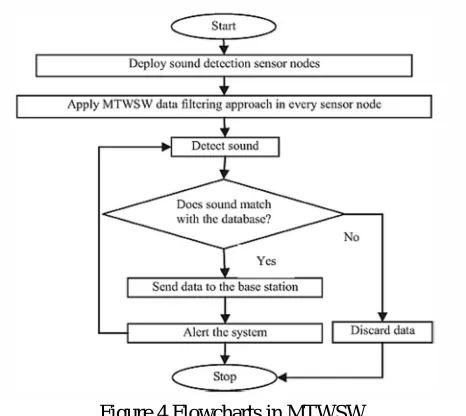
[image:4.612.190.423.423.631.2]Renu Vig et al4 proposed a new method as energy efficient approach through clustering and data filtering. In the routing protocol, the clustering and data aggregation have become more important in the energy constraints of the nodes. In this paper, the clustering and data filtering method has been used in heterogeneous networks. Among clustering algorithms, VAS (Voroni Ant Systems) and LEACH-C (low energy adaptive clustering hierarchy-centralized) are compared and computed. Among data filtering, MTWSW (modified two way sliding window) and TWSW (two way sliding window) are compared and computed. In the comparison of clustering algorithms, it shows that the VAS shows better performance than LEACH-C based on average packet delay ratio, energy consumption rate and data delivery ratio with varying cluster head node density and sensor density. In the comparison of data filtering, MTWSW is better than TWSW based on MTWSW sends only three data values unlike TWSW which sends whole of the data items if the data items are different from the previously sent values and also MTWSW was able to deliver approximately 75 percent of the data accurately whereas TWSW has delivered approximately 62 percent of the data accurately. The proposed method is applicable for both critical and non-critical applications. The approach used in case study as described below in figure 4.
Figure 4 Flowcharts in MTWSW
Future Work Mobility with few sensor nodes of heterogeneous network can be applied. The security aspects are not considered in this protocol. Hence security aspects can be a topic for the future work.
Technology (IJRASET)
node and sink node. After finding the shortest path, the lifetime of the shortest path will be calculated. With the value of lifetime, the phase will update the battery of all sensor nodes presented in the shortest path. This algorithm observes the total lifetime parameter of the sensor network to achieve optimal solution. In the simulation results, effectiveness of proposed algorithm is higher when compared with the existing approaches. This method evaluates the performance of QOS based routing algorithm with energy efficient routing algorithm. The main objective is to maximize the total network lifetime with battery constraint while finding routes from source to sink.
Future Work In this paper, it consists of many steps to find the optimal path. In future research, various shortest path can be found within minimum steps.
Sohini Roy et al 6 proposed a routing protocol which deals with the cluster formation based on different events such as cluster head selection, aggregation of the data within a cluster and sending the data to the base station in an energy efficient way. The author named this protocol as energy efficient cluster based routing protocol (EECBRP). EECBRP follows a multi-hop path to direct the data to the base station. The proposed protocol makes cluster only if there are events. EECBRP considers both the remaining energy of the nodes and the relative distance while selecting the optimal path to the base station. The author used MATLAB as simulation tool and the simulation results proves that EECBRP is better than energy efficient heterogeneous clustered scheme (EEHC) and smart cluster head selection scheme for clustering algorithm (SCHS). This algorithm’s average residual energy of the network is not going down very quickly, thus the network lifetime increases.
Future Work The proposed protocol EECBRP makes clusters only if there are events. In future work, without events cluster formation can be verified for network lifetime.
A simple routing algorithms based on energy consumption has proposed by Ishita Chakraborty et al7.The main objective of this
method is to achieve minimum energy routing. A simple routing algorithm which can be implemented in both centralized and decentralized manner. Energy consumed in each of the route is calculated and less energy consumption route will be selected for the communication. The proposed algorithms are minimum distance routing algorithm which the user node sends the data to the base station in chosen intermediate node and vice versa. If the user nodes initiates then it is termed as minimum distance distributed routing and if base station initiates then it is minimum distance centralized routing. In the minimum angle routing algorithm, the user node firstly draws a reference line to the base station with in the transmission range and it chooses the intermediate node which makes the minimum angle. In minimum distance minimum angle routing algorithm (MDMA), it is the combination of both minimum distance and minimum angle algorithm. In minimum angle minimum distance (MAMD), it specifies single hop which is transverse by minimum angle and the rest by minimum distance. The MAMD and MDMA perform better and consume less energy without degrading the throughput and increases the lifetime of the network.
Future Work The further reports on more number of network configurations to check the performance for both centralized and distributed routing.
Power control delay aware routing (PCDARM) is proposed by Sandhya Rachamalla et al8.The proposed method derives frame work.
This method can be used for sensitive applications. The framework aims to route the packets along multiple paths with the delay and with energy constraints in routing phase and TDMA (Time Division Multiple Access) based slot assignment in power efficient manner in medium control access phase. In this phase, slot allocation in TDMA frames with sleep and wakeup cycles for the nodes which results in efficient power control. This algorithm is compared with Delay-bounded Energy-constrained Adaptive Routing (DEAR). The delay experienced by the data packets is comparatively less in PCDARM and also it outperforms in the term of energy consumption.
Future Work In this paper, the author placed the sensor nodes at the distance of 250 meters in 1000x1000 meter region. In future research, the distance can be increased to study the delay ratio and network lifetime of the nodes.
The applications used in wireless sensor networks become advanced over years such as advance health care, industrial process control,
traffic congestion avoidance systems etc. Dr.Malarvizhi.K, et al9 has proposed new technique which is called as Energy Efficient Qos
Technology (IJRASET)
algorithm shows high efficiency in network lifetime and quality of service in several performance indexes of wireless sensor networks.
Future Work The sensor nodes are placed in cellular topology whereas in future sensor nodes can be placed in different topology with the same technique to study the energy efficiency.
Geographic routing in clustered wireless sensor networks among obstacles proposed by Tanima Dutta et al10. It is a clustering
technique which is named as energy efficient homogenous clustering that periodically selects the cluster heads according to a hybrid of their residual energy and the utility of the sensor to its neighbors. The cluster head which is selected have equal number of neighbors and residual energy. This paper consists of stages such as network model, energy efficient homogenous clustering (EHC) and route optimization techniques (ROT). The algorithm presents a route optimization technique in clustered sensor networks among obstacles using Dijkstra’s shortest path algorithm. The major constraints to avoid are clustering in the networks and local minimum problem. The proposed algorithm is tested in various scenarios such as message and time complexity, energy consumption calculation, average hop count. The simulation shows the performance of the proposed EHC and ROT for different network scenarios in energy efficiency.
Future Work In this protocol, the sensor nodes are placed in homogenous environment. In future research, the heterogeneous environment can be used and also in ROT, different shortest path technique can be used other than Dijkstra’s algorithm.
Moumita Pramanick et al11 proposed a new technique namely Energy aware sleep scheduling clustering based routing scheme. In the wireless sensor networks, some nodes are put to sleep to prolong the network lifetime. The proposed algorithm selects a node as cluster head if its residual energy is more than system average energy. If a node remaining energy reaches five percent of its primary energy then it directly sends data to BS avoiding node failure during aggregation. EASSCR model consists of steps such as node pairing, cluster head selections, data transmission and data aggregation. In this paper, the EASSCR is compared with LEACH (Low Energy Adaptive Clustering Hierarchy) and SEP (Stable Election Protocol) in both features as network and energy model. In the proposed work, nodes switch between sleep and active stages which gives low energy consumption. Thus EASSCR is adaptable for heterogeneous sensor networks.
Future Work Inter cluster head communication can be introduced to increase the lifetime of cluster heads far away from the BS. Energy-efficient security mechanism involving efficient key distribution and management mechanisms can be applied to ensure data
reliability. Selva reegan et al12proposed a new method called An Effective Model of the Neighbour Discovery and Energy Efficient
Routing Method for Wireless Sensor Networks. The Location Based Energy Aware Routing Protocol (LBER) is proposed in this
paper. In LBER, a node select their neighbour node (Neighbour Discovery) using a beacon message and properly maintain the path for data transmission even a node failure. LBER consume a small amount of energy during node discovery, network activities and data broadcast. In case of node failure, LBER protocol easy to handle the situation. In the proposed work, LBER is compared with GPSR and LSR protocol, simulation results shows that LBER outperforms GPSR and LSR, which reduce the energy consumption, increase network lifetime and provide QOS of WSN. The main aim of this protocol is saving the energy during communication
Future Work No of nodes used in the performance evaluation is less than 30 nodes which is a very small environment. Hence larger
number of nodes greater than 100 can be used in this method and its performance evaluation can be studied. Vijayan et al13 proposed
Technology (IJRASET)
Figure 5 Flowchart of CAERP
Future Work the proposed protocol CAERP is compared with Q-LEACH protocol and the performance evaluation is studied. For future work, the CAERP protocol can be compared with other architecture based routing protocols.
III. CONCLUSION
In this survey paper, various energy efficient routing protocol and techniques has been reviewed from the most recent published research work and future work for each paper is suggested.
REFERENCES
[1] Karkvandi H R, Pecht E, Yadid-Pecht O. Effective Lifetime-Aware Routing in Wireless Sensor Networks. IEEE Sensors Journal.2011; 11(12): pp. 3359-67. [2] Rai P, Sarma H K D, Barfunga S P. Energy Efficient Cluster Based Routing Protocol for Wireless Sensor Networks. 2012 International Conference on Computer
and Communication Engineering (ICCCE). Kuala Lumpur, 2012; pp. 603-607.
[3] Farazandeh F, Abrishambafy R, Uysal S, Gomesy T, Cabraly J. A Hybrid Energy Efficient Routing protocol for Wireless Sensor Networks. 11th IEEE International Conference on Industrial Informatics (INDIN). Bochum, 2013; pp. 18-23.
[4] Gautam N, Vig R. Energy Efficient Approach through Clustering and Data Filtering in WSN. 2014 IEEE Conference on Advances in Computing, Communications and Informatics (IACCI). New Delhi, 2014; pp. 2142-48.
[5] Khatana G, Manju. Energy Efficient Algorithm for Routing Problem in Wireless Sensor Networks. 2014 IEEE International Conference on Recent Advances and Innovations in Engineering, (ICRAIE). Jaipur; 2014; pp. 1-6.
[6] Roy S, Kumar Das A. Energy Efficient Cluster Based Routing Protocol (EECBRP) for Wireless Sensor Network. 2014 1st International conference of networking and soft computing, (ICNSC). Guntur; 2014; pp. 25-29.
Technology (IJRASET)
[8] Rachamalla S, Kancharla A S. Power-Control Delay-Aware Routing and MAC Protocol for Wireless Sensor Networks. 2015 IEEE 12th International Conference on Networking, Sensing and Control. Taipei; 2015; pp. 527-32.
[9] Malarvizhi K, Brindha M, Kumar M. Evaluation of Energy Efficient Routing in Wireless Multimedia Sensor Networks. 2015 IEEE sponsored 2nd international conference on Electronics and communication system. Coimbatore; 2015; pp. 1387-91.
[10] Gupta H P, Rao S V, Yadav A K, Dutta T. Geographic Routing in Clustered Wireless Sensor Networks among Obstacles. IEEE Sensors Journal. 2015;15(5), pp. 2984-92.
[11] Tim K T, Lee B J, Choi J H, Jung B Y. An Energy Efficient Routing Protocol for Wireless Sensor Networks. IEEE International Conference on Computational Science and Engineering. 2009; pp. 132-39.
[12] Selva Reegan A, Baburaj E. An Effective Model of the Neighbor Discovery and Energy Efficient Routing Method for Wireless Sensor Networks. Indian Journal of Science and Technology. September 2015; Vol 8(23).