Technology (IJRASET)
THD and Reactive Power Compensation Using
Neural Network Based DSTATCOM
P. Mahes Kumar1 Dr .M. Sudhakaran2
1
Research Scholar, Department of EEE, Pondicherry Engineering College, Puducherry, India.
2
Professor, Department of EEE, Pondicherry Engineering College, Puducherry, India
Abstract— This paper investigates on distribution static compensator (DSTATCOM) to compensate total harmonic distortion (THD) and reactive power. Fixed hysteresis current control (HCC) technique is designed for regulating DSTATCOM. In fixed HCC, the current error signal is minimized using fixed upper and lower hysteresis band limit. The current error signal is difference of actual and reference currents. Effective compensation of DSTATCOM is achieved by control of current error signal. Under dynamic load conditions, the fixed HCC exhibits poor performance. This work explores the application of neural network to minimise current error signal and for improving compensation of the DSTATCOM under dynamic load conditions. The reliability of the system is validated in matlab/simulink environment.
Keywords—DSTATCOM, Hysteresis current control, THD, reactive power and Neural Network.
I. INTRODUCTION
The power electronics growth brought consciousness on THD and reactive power issues in distribution system. The sophistication of power electronic is incorporated with the electrical loads, power converters, measuring instruments etc. increased these issues in the distribution system. These power electronics based loads are termed as nonlinear loads and generate the unwanted THD in the power system network [1-3]. These unwanted THD increased overheating, reduced life time, acoustic noise emission, pulsating torque, malfunction of equipment etc. These issues resulted in huge economic loss to the end users in the distribution system. All these snags resulted in innovation of devices to compensation of these problems in the distribution system. [4-6].
To compensate these distortions, custom power device (CPD) is generally designed. There are different kind of CPD is available. From various compensation devices, DSTATCOM is an appropriate compensation device for mitigating THD and reactive power issues. It is constructed using voltage source inverter (VSI) and DC capacitor and it injects compensation signal at point of common integration (PCI).
From the various survey, HCC is a finest control technique for governing the DSTATCOM [14-18]. The HCC is a familiar time domain based control techniques designed and analysed in this paper. The advantage of the HCC is simple to implement, easy to analyse and it has high reliability on the compensation of the THD and reactive power issues. In this control technique, the current error signal is minimised using hysteresis band limits. However, the drawback of this method is fixed hysteresis band limits are used to minimise current error signal. This drawback results in poor performance of DSTATCOM. In order to solve this problem, a neural network (NN) is designed in this paper.
This paper investigates the performance of a DSTATCOM on compensating power quality issues. The investigations are carried out for before and after joining DSTATCOM. The neural network based HCC is designed to control the reference and actual source current. The performance of the device analysed using fixed HCC and NN based HCC under different operating conditions.
The description to the issues of THD and reactive power is described in introduction, the configuration of DSTATCOM is represented in section 2, the control technique for the minimising current error using fixed HCC and the neural network based HCC are discussed in the section 3 and 4 respectively, mathematical description for this technique benefits of compensation of THD and reactive power is elaborated in the section 5, the results for quantifying the proposed system is placed in section 6, finally the conclusions is presented in section 7.
II. DISTRIBUTIONSTATICCOMPENSATOR(DSTATCOM)
Technology (IJRASET)
the point of common interface. The injected THD cancelled the distortions in the system and thereby percentage of THD is considerably minimised and the reactive power consumed by the load is compensated and hence quality of the entire system is improved. Control scheme for DSTATCOM is discussed in following sections.
III. CONTROLTECHNIQUEUSEDINDSTATCOM
The control scheme used to control the reference and actual source current for DSTATCOM is the fixed HCC [2]. Voltage is across the DC capacitor is sense sensor and compared with the reference value. Voltage error is compute by this comparison. The PI controller minimised the voltage error and estimated the source current magnitude. The reference current is the product of an estimated current magnitude and unit vector calculated from the phase lock loop. THD produced by the nonlinear load is extract by subtracting the actual source current from the reference source current and it fed to the hysteresis current controller.
Fig.1. Test system of DSTATCOM for Distribution system DSTATCOM
Source voltage (Vsabc)
Source current (Isabc)
RS, LS
RL, LL
RC, LC
Nonlinear Load
PI V
dc*
V dc
Fig.2. HCC Control technique used in DSTATCOM
I
a*Ia
S1
S2
Ib
S3
S4
I
b *
I
c *
Ic
S5
S6
Technology (IJRASET)
The pulses for controlling DSTATCOM are produced from the hysteresis current controller and fed to the VSI. Then the VSI injected the compensation signal in the system at point of common interfacing and thereby reduces the harmonics and improved the quality of the system. The diagram for a control technique used in the DSTATCOM is represented in Fig. 2. The following section deals with the neural network based current scheme.
IV. NEURALLEARNINGALGORITHM
The THD compensation depended on controlling of reference and actual source current. The property of the neural network (NN) is the abilities of learning, parallel operation and mapping of input and target data. It is used to control current error signal for DSTATCOM. The two layer ANN is trained off line from the training data and by using the neural learning algorithm in order to generate hysteresis band limit. The neural network for the proposed learning algorithm is highlighted in Fig. 3. The input of the network is load current magnitude and feedback output signal. Each off-line training epoch consists of propagating the NN computed its output, comparing this output with a reference current to compute the training error, and modifying the weights to reduce the error for obtaining optimum value. Difference of reference and actual source current is compared with error tolerant. The weight of the neuron is updated in order to minimize the error and generate the finest hysteresis band limit with minimum oscillation.
V. MATHEMATICALMODELLING
A. Estimation of three phase unit sine vectors
The three phase unit sine vector is representation of three phase unit source voltage. The unit sine vector is generated by PLL with instantaneous three phase source voltage. Three phase source voltage is sensed and is given to PLL.
The three phase supply voltage is computed using following equation.
sin sin 120 sin 120 sa sm sb sm sc smV V t
V V t
V V t
(1)
Where, Vsm is the peak supply voltage magnitude. The generated three phase unit sine vector is expressed as,
sin sin 120 sin 120 sa sa sm sb sb sm sc sc sm V U t V V U t V V U t V (2)For unit power factor, both supply voltage and current are in phase, so that there is no harmonic content. When the load is dynamic
Y
Fig3. Back propagation based artificial neural network Back Propagation β B ∑ Training input
Input layer Hidden
layer
Output layer
Technology (IJRASET)
i.e. non-linear or critical load is connected, the power factor is varied depends upon the load connected. The important function of this control technique is to optimize current error signal, dc link voltage control, to produce reference source current and hence to generate switching pulses for inverter.
B. Estimation of reference source current
The required reference source current is generated by HCC technique part along with controller part which may be either PI controller. In this paper, PI controller is implanted, accuracy and settling time depends upon the parameter values of controller gains. This parameter istuned to achieve the more accuracy. The principle of this controller part is to hysteresis band limit. This is carried out by making a difference of reference and actual source current.
*
( )
sa sa
e t
i
i
(3)Where, e(t) be the error, * sa
i
andi
sabe the actual and reference source current respectively. The output error signal is the hysteresis band and it is used to generate pulse.The instantaneous value of source current can be given as,
( )
( )
( )
s L c
i t
i t
i t
(4)If a non-linear load is applied, then the load current will have a fundamental and harmonic components which can be represented as,
1
( )
( )
( )
L L Ln
i t
i
t
i
t
(5)Source current supplied by the load after compensation is,
( )
( ) /
( )
s f s
i t
P t
V t
(6)When non-linear load is connected, the compensation device must have to provide the total reactive power and harmonic power, and then is (t) will be in phase with the source voltage and becomes sinusoidal.
The estimated reference source current is derived as,
* * * * * * sin sin 120 sin 120 sb s sa s sc sI I t
I I t
I I t
(7)
At this time the compensation current of the active power filter is,
( )
( )
( )
c L s
i t
i t
i t
(8)This compensation current is injected at PCI in order to cancel the harmonic produced by the non-linear or critical loads.
(iii) Derivation for neural network learning algorithm
Let E be the error, B is the bias function, β and µ are weight value corresponding to input and feedback signal, Y is the output of artificial neural network Y (k) and Y (k-1) are present and past value of network output
The update equation to minimize the error is given as,
(9) The output of artificial neural network is given as
(10) The Reference current can be given as,
( ) * ( )
HB k y E k (11)
The network input is error which multiplied with weight function β. These values are summed bias B. the final output Y is called hysteresis band limit, and is feed forward to input side. Up to required result gained, the NN is train at number of epochs. Each training the weight function is updated.
VI. SIMULATIONRESULTSANDDISCUSSION
A. Operating Conditions
Technology (IJRASET)
2) Source Frequency = 50 Hz
3) Source Impedance = 1 Ohms and 0.1mH
4) Filter impedance = 1 Ohms and 10mH
5) Load impedance = 1 Ohms and 8mH
6) Load – Rectifier RL Load, R=25Ohms and L=20mH
Case Studies
Case 1 – 10KVA rectifier Load is connected Case 2 – 20 KVA rectifier Load is connected
For each cases the performance of the DSTATCOM is analysed using fixed HCC and NN based HCC.
B. Analysis on Tracking reference and actual source current
The simulation results for tracking of reference and actual source current for case 1 and case 2 using fixed HCC and NN based HCC are shown in Fig.4.1 to Fig.4.4. Under case 1 conditions, both fixed HCC and NN based HCC tracked current optimally. For case 2, Fixed HCC is failed to track the reference and actual source current. This issue is mainly due to fixed hysteresis band limit failed to regulate reference and actual control. While using NN based HCC, the reference and actual current is successfully tracked.
Fig.4.1 Tracking of reference and actual source current for case 1 using
Fixed HCC Fig.4.2 Tracking of reference and actual source current for case 1 using NN based HCC
Fig.4.3 Tracking of reference and actual source current for case 2 using
Technology (IJRASET)
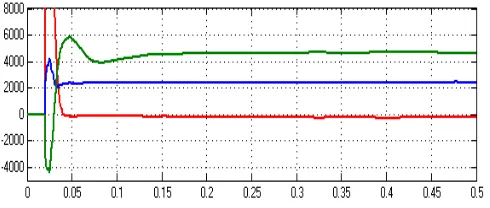
The simulation results for current error signal for case 1 and case 2 using fixed HCC and NN based HCC are shown in Fig.5.1 to Fig.5.4. Under case 1 conditions, both fixed HCC and NN based HCC minimised current error signal. For case 2, Fixed HCC is failed to minimise current error signal. This issue is mainly due to fixed hysteresis band limit failed to regulate reference and actual control. While using NN based HCC, the current error is successfully minimised. The simulation results for pulse generation for case 2 using fixed HCC and NN based HCC are shown in Fig.6.1 and Fig.6.2. For case 2, Fixed HCC is failed to generate optimum pulse due to fixed hysteresis band limit failed to regulate reference and actual control. While using NN based HCC, the optimally generated pulse to the VSI.
Fig.5.1 Current error for case 1 using Fixed HCC Fig.5.2 Current error for case 1 using NN based HCC
Fig.5.3 Current error for case 2 using Fixed HCC Fig.5.4 Current error for case 2 using NN based HCC
Technology (IJRASET)
C. Analysis on Compensation of THD
The simulation results for compensation of source current THD for case 1 and case 2 using fixed HCC and NN based HCC are shown in Fig.7.1 to Fig.7.4. Under case 1 conditions, both fixed HCC and NN based HCC optimally compensated source THD. For case 2, Fixed HCC is failed to compensate source THD. This issue is mainly due to fixed hysteresis band limit failed to regulate reference and actual control. While using NN based HCC, the THD is successfully compensated.
D. Analysis on Compensation of reactive power
The simulation results for compensation of reactive power for case 1 and case 2 using fixed HCC and NN based HCC are shown in Fig.8.1 to Fig.8.4. Under case 1 conditions, both fixed HCC and NN based HCC optimally compensated reactive power. For case 2, Fixed HCC is failed to compensate reactive power. This issue is mainly due to fixed hysteresis band limit failed to regulate reference and actual control. While using NN based HCC, the THD is successfully compensated. Overall compensation of DSTATCOM using fixed HCC and NN based HCC is given in table 1 and table 2 respectively.
Fig.7.1. THD compensation for case 1 using Fixed HCC Fig.7.2 THD compensation for case 1 using NN based HCC
Technology (IJRASET)
r analysis of real, reactive and true power consumption by load using PI and NLA is shown in Fig. 9 –B, C and D respectively.
Table 1. Compensation of DSTATCOM using fixed HCC
Compensation Parameter
Phases
Before compensatio
n (%)
After Compensation
(%)
Reduced in %
Current THD
Case 1 30.92 3.42 88.93
Case 2 30.94 11.5 62.78
Voltage THD
Case 1 8.14 0.88 89.18
Case 2 8.10 6.1 24.69
Reactive Power Consumption
Real Power 10KVAR 150 98.5
[image:9.612.41.286.92.196.2]Reactive 10KVAR 5KVAR 50
Table 2. Compensation of DSTATCOM using NN based HCC
Compensation Parameter
Phases
Before compensatio
n (%)
After Compensation
(%)
Reduced in %
Current THD
Case 1 30.92 3.42 88.93
Case 2 30.94 2.5 91.9
Voltage THD
Case 1 8.14 0.88 89.18
Case 2 8.10 0.61 92.47
Reactive Power Consumption
Real Power 10KVAR 150 98.5
Reactive 10KVAR 5KVAR 50
VII.CONCLUSION
This paper investigates the dynamic behaviour of the DSTATCOM for the compensation THD and reactive power issues in the Fig.8.1. Reactive power compensation for case 1 using Fixed HCC Fig.8.2 Reactive power compensation for case 1 using NN based HCC
[image:9.612.312.551.98.193.2] [image:9.612.101.492.418.695.2]Technology (IJRASET)
compensation of DSTATCOM is analysed for two case conditions. Overall results stated that, under case 1 conditions, both fixed HCC and NN based HCC optimally compensated source THD and reactive power. For case 2, Fixed HCC is failed to compensate source THD. This issue is mainly due to fixed hysteresis band limit failed to regulate reference and actual control. While using NN based HCC, the THD is successfully compensated. The better compensation of DSTATCOM is achieved by the neural network based hysteresis current control scheme.
REFERENCES
[1] B Singh, and J Solanki, “A Comparison of Control Algorithms for DSTATCOM”, IEEE Transactions on Industrial Electronics. July 2009:56(7): p. 2738-2745. [2] P. Bapaiah, “Power Quality Improvement by using DSTATCOM”, International Journal of Emerging Trends in Electrical and Electronics.2013; 2 (4): p.1-12. [3] O P Mahela, A G Shaik," A review of distribution static compensator”, Renewable and Sustainable Energy Reviews. 2015; 50, p. 531-546.
[4] Phipps JK, Nelson JP, Sen PK, “Power quality and harmonic distortion on distribution systems”, IEEE Trans. Ind. Appl. 1994, 30, p-476–84.
[5] Singh B, Arya Sabha Raj, “Back-propagation control algorithm for power quality improvement using DSTATCOM”, IEEE Trans. Ind. Electron. 2009; 61(3):1204–12.
[6] Bhattacharya A, Chakraborty C, “A shunt active power filter with enhanced performance using ANN-based predictive and adaptive controller”, IEEE Trans. Ind. Electron. 2011;58 (2):421–8.
[7] Chen B S, Hsu Y Y, “A minimal harmonic controller for a STATCOM”, .IEEE Trans. Ind. Electron. Feb. 2008; 55(2): pp. 655–664.
[8] Karanki S.B., Nagesh G., Mishra M.K. and Kumar B.K., “A hybrid topology for reducing DC link voltage rating in DSTATCOM applications”, Energy tech, 2011 IEEE Digital Object Identifier: 10.1109/Energy Tech. 2011, 5948517, 1–6 (2011)
[9] Singh Bhim, Jayaprakash P and Kothari D.P., “ A three-phase four-wire DSTATCOM for power quality improvement”, Journal of Power Electronics, 2008, vol.8, no.3, pp.259-26.
[10] Ravit Gautam, Dipen A. Mistry, Manmohan Singh Meena, Bhupelly Dheeraj, Suresh Mikkili, “Adaptive Hysteresis Based SHAF Using PI and FLC Controller for Current Harmonics Mitigation”, International Journal of Electrical, Robotics, Electronics and Communications Engineering Vol:8 No:5, 2014.
[11] Bose Bimal K, “An adaptive hysteresis-band current control technique of a voltage-fed PWM inverter for machine drive system”, IEEE Trans. Industrial Electronics1990;31(5):402–8.
[12] “IEEE Guide for Application of Power Electronics for Power Quality Improvement on Distribution Systems Rated 1 kV Through 38 kV”, Transmission and Distribution Committee of IEEE Power & Energy Society, New York, April 2012
[13] Widrow and M. A. Lehr, “30 years of adaptive neural networks: Perceptron, adaline and back propagation,” Proc. IEEE, vol. 78, no. 9, pp. 1415–1442, Sep. 1990.
[14] C.-C. Tsai, H.-C. Huang, and S.-C. Lin, “Adaptive neural network control of a self-balancing two-wheeled scooter,” IEEE Trans. Ind. Electron., vol. 57, no. 4, pp. 1420–1428, Apr. 2010.
[15] Y. M. Chen and R. M. O’Connell, “Active power line conditioner with a neural network control,” IEEE Trans. Ind. Appl., vol. 33, no. 4, pp. 1131– 1136, Jul./Aug. 1997.
[16] A. Senthilkumar and P. Ajay-D-VimalRaj, “Neural Learning Algorithm based Power Quality Enhancement for Three Phase Three Wire Distribution System Utilizing Shunt Active Power Filter Strategy,” International Conference on Power System, IIT madras - December 22-24, 2011.
[17] Singh, V. Verma, and J. Solanki, “Neural network-based selective compensation of current quality problems in distribution system,” IEEE Trans. Ind. Electron., vol. 54, no. 1, pp. 53–60, Feb. 2007.