Study of Dynamic State Routing Protocol (DSR)
Anjali Jagtap1, Parag Hirulkar2, Smita Kadam3, Dipak Raut4, Ashok Shinde5 1,2,3,4,5
Departmnt of Electronics & Telecommunication, International Institute of Information Technology, Pune
Abstract: Mobile Ad-hoc Network (MANET) is an infrastructure less, decentralized, network consisting of wireless mobile nodes which changes the topology dynamically. Because of dynamic change in the network topology, the routing protocols are critical issues in MANET. In this paper the conventional On Demand Distance Vector routing protocol, Dynamic State Routing protocol is simulated in NS2 environment. DSR is an on demand reactive protocol as it determines the routes only when nodes have some data to send/transmit. The Simulations are carried to observe the effect of variation in number of nodes i. e. Network size and simulation time. For each variation of the parameters, the performance of DSR is evaluated in terms of average network Throughput, Packet Delivery Ratio, End to End Delay and Routing Overhead.
Keywords: MANET, DSR, PDR, Throughput, NRL
I. INTRODUCTION
Ad-hoc network is self-organizing wireless network which relies neither on fixed infrastructure nor on predetermined connectivity. The earliest wireless ad-hoc network was “packet radio” network in 1970. Ad-hoc network is characterized by decentralized, infrastructure-less, self configuration, high node mobility, and rapid deployment. Routing management is challenging task in these situations. Because of these characteristics, Ad hoc networks have many applications, such as in disaster relief or in search and rescue. Ad-hoc networks are classified as mobile Ad-hoc Network (MANET), Wireless Sensor Network (WSN) and Wireless Mesh Network (WMN). Mobile Ad-hoc Network is an autonomous wireless network consisting mobile nodes which can be connected randomly. Every node also acts as router for forwarding the traffic.
Routing is process of moving the packets from source to destination. Since the nodes are mobile, the multihop routing is used in MANET. Due to mobility on nodes routing is challenging task in Ad-hoc network. Various routing algorithms are proposed for the MANET of which reactive routing protocols are most efficient in the performance considering the worst case scenarios also. A reactive routing protocol reduces routing overhead because they do not need to search for and maintain the routes on which there is no data traffic. This property is very appealing in the resource-limited environment. This type of protocols finds a route on demand by flooding the network with Route Request packets. These algorithms faces problem of high latency time in finding route and network clogging. The reactive routing protocols are Ad-hoc On Demand Distance Vector Routing Protocol, dynamic source routing, Associatively Based Routing, Signal Stability Based Adaptive Routing Protocol, Location Aided Routing.
II. DYNAMIC STATE ROUTING (DSR)
The first reactive protocol which was proposed is called as Dynamic source routing protocol which had goal of imposing the routing mechanism in MANET network which size up to the 200 mobile nodes, with the high mobility. As compare to other unicast routing protocols, dynamic source routing protocol does not use the concept on routing table. Rather than the routing tables, DSR uses the source routing option in the packet itself which is on transmit and the mechanism of route cache which stores the full list of IP addresses of the mobile nodes in the MANET network in order to recognize the route towards to destination node.
This protocol is a pure on demand protocol. DSR does even employ beacon packets like some other on demand protocols. Consequently DSR applies on demand schemes for both route discovery and route maintenance. The main advantage of DSR is it scales to the actual needed size automatically. DSR employs source routing, so that each data packet contains the full path it should traverse to its destination. For route discovery, a node which wants to send packets to a specific destination floods the network with a route request packet, this packets is flooded by all intermediate nodes in the network until it arrives to the destination which in turn replies by a route reply packets. In this paper, DSR is implemented in NS2 software as it is for study purpose. Various parameters are varied to see the effect of DSR on its performance parameters such as throughput, routing load, energy consumption and packet delivery loss. From the result observed, analysis is done to comment on applications, usage and advantages.
The basic working procedure of DSR is:
Here the route request packet is used to find out the route towards the destination if the source node doesn’t find any route in the route cache. Throughout the MANET such route request packet is broadcasted. While packet traversing from the
source to destination using the intermediate mobile nodes, each intermediate nodes add its own IP address into that route request packet IP list. Thus when the destination node receives the packet, the request packet contains the all the route from source to the destination which is called as path accumulation also. After receiving the packet from the source node, destination node again start the route discovery mechanism in order to transfer the route reply packet back to the destination again. It can either use the source route which is recorded into the request packet in order to send the route reply packet in reverse order. Finally in this approach after the route discovery mechanism, both source node and destination node have the complete route from source to the destination. Fig 3.1 shows route discovery for DSR.
B. Route Maintenance
In the DSR protocol, every mobile node in the network is responsible for the maintenance of the routing protocol in between the node and next hop in route from source to the destination. This route is detected by the MAC layer or software acknowledgement which is DSR specific. In the any link lost in between, then source route error packet is used to notify by the source node of particular route path and again initiate route discovery mechanism. In the DSR, route cache is mostly used for the same purpose. Routing overhead is greatly reduced by the routing cache concept in following way:
1) While route discovery phase, if the intermediate node encounters the route from the source to destination or route towards the destination from the its own routing cache, then this node reply with the route reply packet and then send the route from the source to destination on same time.
2) DSR is based on the multi paths concept, thus if any link break and source receives the route error packet, then it can directly use the alternate route which is available in source route cache, this resulted into the reduced routing overhead.
3) The concept of packet salvaging, in which if the any intermediate route from the source to destination route detects next hop link breakage, then in such case if that intermediate route has another route available towards the destination in its route cache, it can directly used the same route to forward the packet towards the destination.
III. RESULT & ANALYSIS
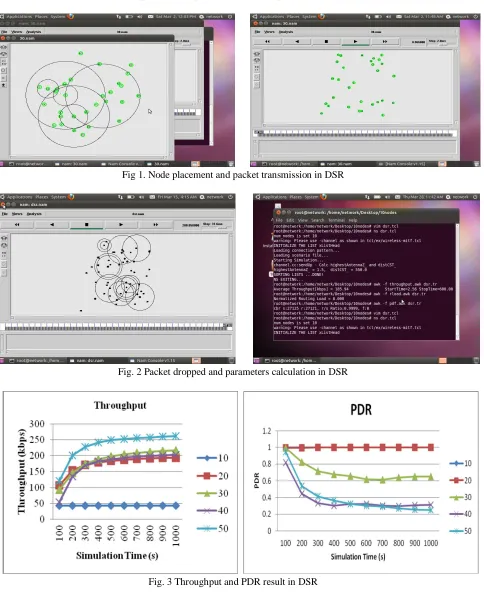
The DSR is simulated using Network Simulator (NS 2.34) software. NS 2.34 is open source software having substantial support to design routing protocol. For simulation of this protocol, various network scenarios were considered. For a 1000 X 1000 network, the simulations were carried out by varying the number of nodes in the network (network size) from 10 to 50 nodes. Simulation time is also varied from 100s to 1000s for 10 to 50 nodes. After the simulation, performance is tested with the performance metrics such as throughput, packet delivery ratio, routing overhead, energy consumption. The parameters selected for the simulation are as shown in the table I below. The NAM editor, an animated window is used to imagine the actual scenario of packet transmission for the protocol. This gives the clear picture about the behaviour of protocol as the nodes are mobile. The fig. 1 shows the node placement, route discovery and fig. 2 packet transmission using AODV protocol in NAM window.
The network throughput represents the numbers of data packets generated by the source node to the number of data packets received in the destination. A routing protocol should try to maximize this value. Packet Delivery Ratio is defined as the ratio of the total number of data packets received by the destination node to the number of data packets sent by the source node. Normalized routing load metrics is used to calculate the number of routing packets which are transmitting with the original data packet over the network. The energy consumption metric is measured as the percent of energy consumed by a node with respect to its initial energy.
TABLE I
SIMULATION ENVIRONMENT
Simulator NS 2.34
Number of nodes 10/20/30/40/50
Network Size 1000 X 1000
Max. Speed 10 m/s
Simulation Time 100s, 200s, 300s, 400s, 500s, 600s, 700s, 800s, 900s, 1000s
Routing Protocol AODV
Traffic Pattern CBR
With above defined network condition and performance parameters, ARA implementation analysis is done as shown in below.
[image:4.612.73.557.95.687.2]
Fig 1. Node placement and packet transmission in DSR
Fig. 2 Packet dropped and parameters calculation in DSR
Fig. 3 Throughput and PDR result in DSR
Fig. 4 Routing load and energy loss in DSR
From the simulation results (fig 4), we can conclude that the routing load is increases as network size increases and As network size increases energy consumption also increases.
IV. CONCLUSIONS
Routing is the most challenging task in Mobile Ad-Hoc Network due to node mobility. We simulated the DSR protocol for different network conditions. DSR is source routing protocol and finds the route by flooding. The protocol can be used for small and large networks for different simulation time. In small network (with less number of nodes) the protocols work best in terms of throughput, PDR and routing load. As the network size increases the protocols are better during initial or for small simulation time. In DSR, throughput was higher, PDR is worst but less routing loads were generated. By observing these results and considering all the parameters we concluded that both the protocols are useful in different network scenarios and applications. However for small network size and/ or for less simulation duration DSR is best. But energy consumption and routing load is still a major issue.
REFERENCES
[1] C.E. Perkins and E.M. Royer, “Ad hoc on demand Distance Vector routing,” mobile computing systems and applications, 1999. Proceedings. WMCSA ‘99. Second IEEE Workshop on, 1999, p90 - p10.
[2] J.Broch, D. Johnson, and D. Maltz, “The Dynamic Source Routing Protocol for Mobile Ad Hoc Networks,” http://www.ietf.org/internet-drafts/draft-ietfmanet-dsr-03.txt, IETF Internet draft, Oct. 1999, work in progress
[3] G. Rajkumar, Dr. K. Duraisamya, “Review of Ad Hoc On-Demand Distance Vector Routing Protocol for Mobile Ad Hoc Networks,” Journal of Theoretical and Applied Information Technology 15th February 2012. Vol. 36 No.1.
[4] Amit N. Thakare Mrs. M. Y. Joshi, “Performance Analysis of AODV & DSR Routing Protocol in Mobile Ad hoc Networks,” International Journal on Computer Application Special Issue on “Mobile Ad-hoc Networks” MANETs, 2010.
[5] Qian Feng, Zhongmin Cai, Jin Yang, Xunchao Hu, “A Performance Comparison of the Ad Hoc Network Protocols,” Second International Workshop on Computer Science and Engineering 2009.
[6] Seyed Ali Hosseini, Hamid Farrokhi, “ The Impacts of Network Size On The Performance Of Routing Protocol in Mobile Ad-Hoc Networks,” 2010 Second Pacific-Asia Conference On Circuits, Communication and System (PACCS).
[7] R. M. Sharma., "Performance comparision od AODV, DSR and AntHocNet Protocols," Internation Journal Of Computer Science and Technology, vol. 1, issue. 1, Sept 2010.
[8] Satveer Kaur, "Performance Comparison of DSR and AODV Routing Protocols with Efficient Mobility Model in Mobile Ad-Hoc Network," Internation Journal Of Computer Science and Technology, vol. 2, issue. 2, June 2011.
[9] Annapurna P Patil et. al., “Implementation and Performance Evaluation of an Adaptive Routing Algorithm in MANETs,” 2011 International Joint Conference of IEEE TrustCom-11/IEEE ICESS-11/FCST-11 © 2011 IEEE.