Technology (IJRASET)
LTE Advanced: The Next Generation Wireless
Technology
Dr. Vibhakar Shrimali1, Mr. Abhishek Gaur2 1
(Associate Professor & Head, ECE Deptt. GB Pant Govt. Engg. College, Delhi, India)
2
(Assistant Professor, ECE Deptt., GB Pant Govt. Engg. College, Delhi, India)
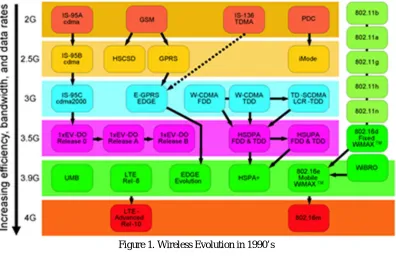
[image:2.612.110.506.338.599.2]Abstract: LTE-Advanced (LTE-A) is the project name of the evolved version of LTE that is being developed by 3GPP. LTE-A will meet or exceed the requirements of the International Telecommunication Union (ITU) for the fourth generation (4G) radio communication standard known as IMT-Advanced. LTE-Advanced is being specified initially as part of Release 10 of the 3GPP specifications, with a functional freeze targeted for March 2011. The LTE specifications will continue to be developed in subsequent 3GPP releases. Wireless communications have evolved from the so-called second generation (2G) systems of the early 1990s, which first introduced digital cellular technology, through the deployment of third generation (3G) systems with their higher speed data networks to the much-anticipated fourth generation technology being developed today. This evolution is illustrated in Figure 1, which shows that fewer standards are being proposed for 4G than in previous generations, with only two 4G candidates being actively developed today: 3GPP LTE-Advanced and IEEE 802.16m, which is the evolution of the WiMAX standard known as Mobile WiMAX™.
Figure 1. Wireless Evolution in 1990’s
I. OVERVIEW OF LTE TECHNOLOGY
Technology (IJRASET)
such as GSM and some systems in the U.S. based on 1.25 MHz. Speed is probably the feature most associated with LTE. Examples of downlink and uplink peak data rates for a 20 MHz channel bandwidth are shown in Table 2. Downlink figures are shown for single input single output (SISO) and multiple input multiple output (MIMO) antenna configurations at a fixed 64QAM modulation depth, whereas the uplink figures are for SISO but at different modulation depths. These figures represent the physical limitation of the LTE frequency division duplex (FDD) radio access mode in ideal radio conditions with allowance for signaling overheads. Lower rates are specified for specific UE categories, and performance requirements under non-ideal radio conditions have also been developed. Figures for LTE’s time division duplex (TDD) radio access mode are comparable, scaled by the variable uplink and downlink ratios. Unlike previous systems, LTE is designed from the beginning to use MIMO technology, which results in a more integrated approach to this advanced antenna technology than does the addition of MIMO to legacy system such as HSPA. Finally, in terms of mobility, LTE is aimed primarily at low mobility applications in the 0 to 15 km/h range, where the highest performance will be seen. The system is capable of working at higher speeds and will be supported with high performance from 15 to 120 km/h and functional support from 120 to 350 km/h. Support for speeds of 350 to 500 km/h is under consideration.
II. WHAT’S NEW IN LTE-ADVANCED
In the feasibility study for LTE-Advanced, 3GPP determined that LTE-Advanced would meet the ITU-R requirements for 4G. The results of the study are published in 3GPP Technical Report (TR) 36.912. Further, it was determined that 3GPP Release 8 LTE could meet most of the 4G requirements apart from uplink spectral efficiency and the peak data rates. These higher requirements are addressed with the addition of the following LTE-Advanced features:
Wider bandwidths, enabled by carrier aggregation •
Higher efficiency enabled by enhanced uplink multiple access and enhanced multiple antenna transmission (advanced MIMO techniques) Other performance enhancements are under consideration for Release 10 and beyond, even though they are not critical to meeting 4G requirements:
A. Coordinated multipoint transmission and reception (CoMP) B. Relaying
C. Support for heterogeneous networks
D. LTE self-optimizing network (SON) enhancements E. Home enhanced-node-B (HeNB) mobility enhancements
F. Fixed wireless customer premises equipment (CPE) RF requirements
These features and their implications for the design and test of LTE-Advanced systems will be discussed in detail later in this application note.
III. GPP REQUIREMENTS FOR LTE-ADVANCED
The work by 3GPP to define a 4G candidate radio interface technology started in Release 9 with the study phase for LTE-Advanced. The requirements for LTE-Advanced are defined in 3GPP Technical Report (TR) 36.913, “Requirements for Further Advancements for E-UTRA (LTE-Advanced) [6].” These requirements are based on the ITU requirements for 4G and on 3GPP operators’ own requirements for advancing LTE. Major technical considerations include the following:
Continual improvement to the LTE radio technology and architecture
Scenarios and performance requirements for interworking with legacy radio access technologies
Backward compatibility of LTE-Advanced with LTE. An LTE terminal should be able to work in an LTE-Advanced network and vice versa. Any exceptions will be considered by 3GPP.
Account taken of recent World Radio communication Conference (WRC-07) decisions regarding new IMT spectrum as well as existing frequency bands to ensure that LTE-Advanced geographically accommodates available spectrum for channel allocations above 20 MHz.
Technology (IJRASET)
What then drives deployment of specific technologies in specific bands will depend on local circumstances. It could be argued this ITU decision frees up the industry to make appropriate local decisions but it also has the effect of increasing the likely fragmentation of markets. The frequency band choices for early 2G and 3G systems were far simpler and focused the industry on one or two key bands (900 MHz for GSM and 2.1 GHz for W-CDMA). No comparable focus exists for LTE and LTE-Advanced, with Release 10 having upwards of 30 bands defined from the outset.
IV. SYSTEM PERFORMANCE REQUIREMENTS
In addition to the bands currently defined for LTE Release 8, TR 36.913 identifies the following new bands: 450–470 MHz band • 698–862 MHz band
790–862 MHz band • 2.3–2.4 GHz band 3.4–4.2 GHz band • 4.4–4.99 GHz band
Some of these bands are now formally included in the 3GPP Release 9 and Release 10 specifications. Note that frequency bands are considered release independent features, which means that it is acceptable to deploy an earlier release product in a band not defined until a later release. LTE-Advanced is designed to operate in spectrum allocations of different sizes, including allocations wider than the 20 MHz in Release 8, in order to achieve higher performance and target data rates. Although it is desirable to have bandwidths greater than 20 MHz deployed in adjacent spectrum, the limited availability of spectrum means that aggregation from different bands is necessary to meet the higher bandwidth requirements. This option has been allowed for in the IMT-Advanced specifications.
V. LTE Advanced Solution Proposals
Proposed solutions for achieving LTE-Advanced performance targets for the radio interface are defined in 3GPP TR 36.814, “Further Advancements for E-UTRA Physical Layer Aspects.” [12] A comprehensive summary of the overall LTE-Advanced proposals including radio, network, and system performance can be found in the 3GPP submissions to the first IMT-Advanced evaluation workshop. [13] The remainder of this application note will focus on the radio interface of LTE-Advanced and other Release 10 features. The following are current solution proposals for the LTE-Advanced radio interface. LTE-Advanced key technologies
Carrier aggregation
Enhanced uplink multiple access
Enhanced multiple antenna transmission Within Release 10 there is other ongoing work that is complementary to LTE Advanced but not considered essential for meeting the ITU requirements. Release 10 and beyond: Technologies under consideration
Coordinated multipoint transmission and reception (CoMP) Relaying • Support for heterogeneous networks
LTE self-optimizing networks (SON) HNB and HeNB mobility enhancements
CPE RF requirements We’ll examine each of these categories from the physical layer perspective, along with some of the associated design and test challenges. Prior to the elaboration of the Release 10 UE radio specifications in 36.101, Technical Report (TR) 36.807 [14] is being drafted. This will cover the following Release 10 features:
Carrier Aggregation (CA)
Enhanced DL multiple antenna (DLMA) transmission UL multiple antenna (ULMA) transmission
Fixed wireless CPE RF requirements Like most technical reports, this document contains useful background information on how the requirements were developed which will not necessarily be evident in the final technical specifications.
VI. LTE CoMP(COORDINATED MULTIPOINT TRANSMISSION AND RECEPTION)
Technology (IJRASET)
particular 4G LTE Advanced is the high data rates that are achievable. These data rates are relatively easy to maintain close to the base station, but as distances increase they become more difficult to maintain. Obviously the cell edges are the most challenging. Not only is the signal lower in strength because of the distance from the base station (eNB), but also interference levels from neighbouring eNBs are likely to be higher as the UE will be closer to them.4G LTE CoMP, Coordinated Multipoint requires close coordination between a number of geographically separated eNBs. They dynamically coordinate to provide joint scheduling and transmissions as well as proving joint processing of the received signals. In this way a UE at the edge of a cell is able to be served by two or more eNBs to improve signals reception / transmission and increase throughput particularly under cell edge conditions.
Fig.2 LTE-Advanced Comp (Coordinated multipoint transmission and reception) A comparative study between LTE , LTE-Advanced & IMT-Advanced(4G)
VII. CONCLUSION
In this technical paper various technologies related to LTE-Advanced, their system requirement, deploy ability and other research issues has been discussed briefly.There is no doubt that LTE-Advanced in true aspect is the future of our NEXT-Generation wireless communication on which 5G systems has been based.Various technologies still needs to be developed in implementing these technologies in an efficient manner.
Technology (IJRASET)
[2] http://www.3gpp.org/LTE[3] http://www.globalcertificationforum.org/WebSite/Public/LTE_Certification.aspx [4] http://3gpp.org/ITU-R-Confers-IMT-Advanced-4G
[5] ITU-R M [IMT-TECH], “Requirements related to technical performance for IMT-Advanced radio interface(s),” August 2008. [6] 3GPP TR 36.913 V9.0.0 (2009-12): http://www.3gpp.org/ftp/Specs/archive/ 36_series/36.913.
[7] http://www.3gpp.org/LTE-Advanced
[8] http://www.3gpp.org/IMG/pdf/2009_10_3gpp_IMT.pdf [9] 3GPP TSG RAN Tdoc RP-070466
[10] 3GPP TR 36.913 V9.0.0 (2009-12), “Requirements for Further Advancements of E-UTRA (LTE-Advanced).” [11] ITU-R M.[IMT-TECH] “Requirements related to technical performance for IMT-Advanced radio interface(s),” August 2008.
[12] 3GPP TR 36.814, www.3gpp.org/ftp/Specs/archive/36_series/36.814/
[13] 3GPP IMT-Advanced Evaluation Workshop papers, http://www.3gpp.org/ftp/ workshop/2009-12-17_ITU-R_IMT-Adv_eval/docs/ [14] 3GPP TR 36.807 ftp.3gpp.org/Specs/html-info/36807.htm
[15] 3GPP TS 36.211 V10.0.0
[16] ftp://ftp.3gpp.org/tsg_ran/TSG_RAN/TSGR_48/Docs/RP-100661.zip and ftp://ftp.3gpp.org/tsg_ran/WG4_Radio/TSGR4_56/Documents/R4-102882.zip [17] ftp.3gpp.org/tsg_ran/WG1_RL1/TSGR1_61b/Docs/R1-104177.zip
[18] ftp.3gpp.org/tsg_ran/WG1_RL1/TSGR1_61b/Docs/R1-104263.zip [19] http://www.easy-c.de/PublicWS_eng_Fachmedien.pdf
[20] 3GPP TR 36.814 V9.0.0, A2.1.1.2
[21] http://www.3gpp.org/ftp/Specs/html-info/36807.htm
[22] ftp://ftp.3gpp.org/tsg_ran/WG4_Radio/TSGR4_54/Documents/R4-100427.zip
Dr. VIBHAKAR SHRIMALI ([email protected]) Dr. Vibhakar Shrimali graduated in Electronics and Communication Engineering from MBM Engineering College, Jodhpur, India, in 1987, and received his Post Graduation degree in Electronics and Communication Engineering from Delhi College of Engineering, Delhi. He completed his PhD from IIT Roorkee, and his research interest includes image processing, signal processing, Optical communications, microprocessors & wireless communication. He has been teaching electronics for the last around 22 years with emphasis to Medical Electronics. He is a member of Institute of Electrical and Electronics Engineers (IEEE), USA, Society of Engineering in Medicine and Biology, Society (EMBS), USA, a fellow member of Institute of Electronics and Telecommunication Engineers (IETE), India, Institute of Engineering (IE), India and Life member of Computer Society of India (CSI).He is currently an HEAD of the ECE department of G.B Pant Engg. College (Govt. of NCT of Delhi) after getting prestigious selection for the post of Associate Professor from Union Public Service Commission, India. He is also an in charge of Research & Development wing of the Institute. He has presented & published various research papers in the field of Electronics & Communication in many reputed journals.