2804
AN INTELLIGENT COOPERATIVE MULTI-AGENTS BASED
PARKING SYSTEM: DESIGN AND IMPLEMENTATION
ABDEL RAHMAN A. ALKHARABSHEH
Assistant Professor, Department of Computer Engineering, Faculty of Engineering and Computer Science Qassim Private Colleges
Kingdom of Saudi Arabia Email: [email protected]
ABSTRACT
Currently, normal parking systems are inefficient, frustrating and time consuming. The number of cars increased rapidly; as a result of this many problems are appeared remarkably. One of the most problem is drivers cannot find parking as easily as they would like. In addition, the drivers need more cost and time during finding a car space. Accordingly, the drivers spend more time searching inside the cars park looking for free slot and so the petrol cost, the congestion and car accident can be increased. As a result, various negative impact may appear in traditional parking systems i.e. traffic congestion, pollution, fuel consumption, time consumption and car accidents. Such problems will be evident in most of capital cities, in special events and in malls.
Such problems motivated the researcher to look deeper and find appropriate solutions. To cope with such growing problems of parking management, the researcher proposes an advanced solution for monitoring free and busy parking slots. Such system will help the drivers to find out the free slots in easy way. In addition, the proposed system will show them on mobile screen the busy slot, the free slot number, floor number in big car parking which is consisting of several floors or will appear to them the available slot.
The proposed system will mainly consist of multi-agent system cooperated with hardware components such as IR sensor nodes to sense the status of the slots and accordingly send the data to Arduino. A gateway device will be used to collect wirelessly the status from the sensor nods. Agents system will be used to analyse the collected data then provide the drivers through web with the needed important information in real time.
The proposed system is implemented and prototyped to solve the above problems. The main contribution of the proposed system is the ability of solving more than five car parking system problems in one application. In addition, new ideas have been added to such system compared with current systems.
Keywords— Multi-agents, Intelligent Parking System, Wireless Sensors
1.INTRODUCTION
The current car parking is inefficient, frustrating and time consuming. The number of cars increased rapidly; as a result of this many problems are remarkably appeared. A common problem is drivers cannot find parking as easily as they would like, this leads to an increase in cost and time. Such problems will appear clearly in most of capital cities, in special events and in malls.
These problems motivated the researcher to look deeper and find appropriate solutions. To cope with such growing problems of parking management, the researcher proposed an advanced solution for monitoring free and busy parking slots. Such
system will help the drivers to find out the empty slots in easy and fast way. In addition, the proposed system will illustrate the busy/empty slot, the slot number, floor number in large car parking which consists of several floors.
2805 addition, this revolution help to implement wireless sensor networks, allowing easily interfaced, programming and configured sensors to be placed anywhere indoor or outdoor. The sensor observations similarly intelligently analysed and transported over large distance via networks.
Multi-Agent System or Smart Agent Group is a system which divides rules between agents for fast execution and treatment of more tasks in one time (Parallelism) [2]. An agent is simply another kind of software abstraction, an abstraction in the same way that methods, functions, and objects are software abstractions. An object is a high-level abstraction that describes methods and attributes of a software component. An agent, however, is an extremely high-level software abstraction which provides a convenient and powerful way to describe a complex software entity. Rather than being defined in terms of methods and
attributes, an agent is defined in terms of its behavior [3]. This is important because programming an agent-based system is primarily a matter of specifying agent behavior instead of identifying classes, methods and attributes. It is much easier and more natural to specify behavior than to write code [3].
Agents are now widely discussed by researchers in mainstream computer science, as well as those working in data communication and user interface design. A multi agent system is a system that consists of a number of agents, which is tract with each other, typically by exchanging messages through system or between different systems. By this, agents are capable of sensing their environment (via sensors), and have a repertoire of possible actions that they can perform (via effectors or actuators) in order to modify their environment. In addition, a multi agent system is a dynamic society made up of a number of intelligent agents, so it is an intelligent society [3].
In this paper, a multi-agent system for intelligent car parking has been created and designed. Such system mainly consists of nine agents cooperate and communicate together to manage such intelligent car parking. The proposed multi-agents system facilitates the search for available slots, parking price, reservation of parking slot and car location. Furthermore, car parking prototype has been designed and implemented based on wireless sensors and arduino controller. Such system used as a sensory input to multi-agent system. Finally, an integrating Multi-agent System with sensory input for intelligent car Parking has been proposed.
2.AIMS AND OBJECTIVES
The main aim of this research is to assess the effects of using multi-agents software in car parking management systems. In addition to investigate and design a new multi-agents frame work to deal with current car parking methods problems. Following research objectives would facilitate the achievement of this aim:
1. Identify the main negative impacts of current used methods in car parking management applications.
2. Propose, define and design an intelligent car parking multi-agents system.
3. Design and implement a prototype of car parking system to be used as sensory input for agents.
4. Test and verify the final design of the proposed system as well as the proposed prototype.
3.RELATEDWORK
Some works of other researchers in the area of intelligent parking system using multi-agents were explored.
Chou et al. have done a studied an intelligent agent system, and considering negotiable parking prices to select the optimal car park for the driver. An agent-based coordination network was proposed in their study to bring true benefit to drivers and car park operators [4].
Dia [5] has presented an agent-based approach to modeling individual driver behavior under the influence of real-time traffic information. The agent behavior parameters which define driver characteristics, knowledge and preferences were identified and their values determined.
Benhassine et al, proposed a network of intelligent agents which can reduce the search time needed to finding a parking place. Three services were offered: the search for a vacant place, directions to a parking space and booking a place for parking. The results of their study are generating a platform MATSim transport simulation [6].
2806
4.PROPOSEDSYSTEM
In this paper, designing and implementing of a multi-agent system for managing and monitoring the empty slots in a car parking was proposed. An intelligent concept for agents is proposed that would deal with any driver’s needed in an independent and efficient way, with different agents cooperating and communicating through message exchange, each agent is specialized in specific tasks of the requested services. Nine types of agents have been proposed to deal with these services in hierarchical way. In addition, one of the most promising methods for dynamic calculation of parking fees based on a novel multi-agent approach was proposed and discussed.
5.SYSTEMCOMPONENTS
The intelligent car parking system would consist of both hard and soft parts. The overall system is composed of two subsystems (platforms), namely the driver-based side system and park–based side system.
5.1Software Part
The selected architecture for the multi-agent system in this paper is the Belief, Desire and Intention (BDI) architecture in which decision making depends upon the manipulation of data structures representing the beliefs, desires, and intentions of the agent. The Prometheus methodology [7] was used to develop the multi-agent system of the car parking system. As a result of this detailed process, nine agents were developed; seven of them located on the park side; Decision maker agent, Price agent, Database agent, Communicator agent, Reservation agent, Slot agent and Car location agent. In addition, another two agents are located on the driver side; Driver agent and Communicator agent. These agents are selected according to iterative process where data coupling diagrams and agent acquaintance diagrams were used. Based on the proposed design, the agents within the same platform would communicate through messages while the agents at different platforms (parking side and driver side) would communicate though the web.
Figure 1 presents the agents’ interaction diagram for the car parking system. The agents and their roles are as follows. The decision maker agent
2807
Figure 1: The Agents’ Interaction Diagram for the Proposed Car Parking System.
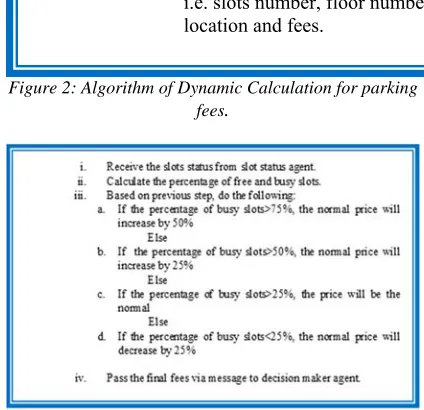
The price agent initiated to inform the decision maker agent about the real-time fees of the parking. An algorithm is proposed to calculate dynamic fees based on the percentage of the occupied slots. The increment/decrement percentage is calculated through the multiplication of normal price by percentage of increase/decrease based on slots status as showing in figure 2.
The reservation agent responsibility is to analyse the driver request which will be received from the communicator agent. In addition, the slots status will be passed via message to reservation agent from slots status agent. The reservation information (slot number, floor number) will be passed via message to the decision maker agent to make the final decision.
The driver Agent is assumed to have total knowledge about the park side. An algorithm is proposed to manage the driver needed based on this agent as shown in figure 3.
The communicator agents are responsible for the communication between the parking- based agents’ side and driver-based agents’ side.
[image:4.612.90.535.58.309.2]The communicator agents are responsible for the communication between the parking- based agents’ side and driver-based agents’ side.
Figure 2: Algorithm of Dynamic Calculation for parking fees.
Figure 3: Driver Agent Algorithm
5.1.1 Analysis, Design and Implementation
The first step of designing a multi agent system is selecting a suitable methodology for the i. The driver will request through
message the parking service (price, availability).
ii. Wait the reply from park-side agents.
iii. In case of slot availability, request reservation for slot.
[image:4.612.312.524.467.672.2]2808 description and design of system software architectures based on the agent approach.
As a result of comparing many methodologies [8]-[9], it has been noticed that Prometheus methodology is an appropriate methodology to design and implement car parking system using multi agent approach.
In this work, the Prometheus methodology was used in determining the specifications of the car parking system. In the system specification phase, the goals of the system were identified, case scenarios were developed, the functions of the system were illustrated, and the interface between the system and its environment in term of actions and percepts were specified. Based on the Prometheus methodology, nine agents were developed. These agents would communicate through messages. The architecture design of such system has been illustrated. The agent’s rules also are configured based on the system requirements. The details of designing car parking multi-agents system are illustrated below.
5.1.2 System Specification
During system specification, system description must be elaborated and explored, to provide a sound basis for system design and development. In the proposed system, the car parking agents system was described as a system with six distinct phases in which the system must operate: driver request, check availability, calculate parking fees, car location and final decision making. During the driver request phase, a message will be passed through communicator agents asking for parking information i.e. available slots and price. The slot
status agent will wirelessly communicate with sensory input to collect all needed information about slots status then send such information via
message to price, decision maker and reservation agents. In price agent, the parking fees will be calculated based on the dynamic fees calculation algorithm which is proposed in previous page. A message holding the fees will pass to decision maker agent. The decision maker agent will reply to the driver request through communicator agents. In case of accept the offer from driver; a reservation request will be sent back to park-side-agents system. Finally, agent’s rules would be used to make a final decision based on all previous analysis results. The decision would be broadcasted to reservation agent, slot status agent, car location agent and database agent. In addition, a reserve confirmation will be send to the car-based- agents system with all needed information such as slot information, fees and car location.
Typically, using Prometheus, the development of the system specification begins with identifying the external entities (referred to as actors) that will use or interact in some way with the system, and the key scenarios around which interaction will occur. This is done by utilising Prometheus Design Tool (PDT) using the analysis overview diagram. PDT is a graphical editor which supports the design tasks specified within the Prometheus methodology for designing agent system [10].
5.1.3 Functionalities
2809
Figure 4: Agent Role Grouping Overview
5.1.4 Scenario Development
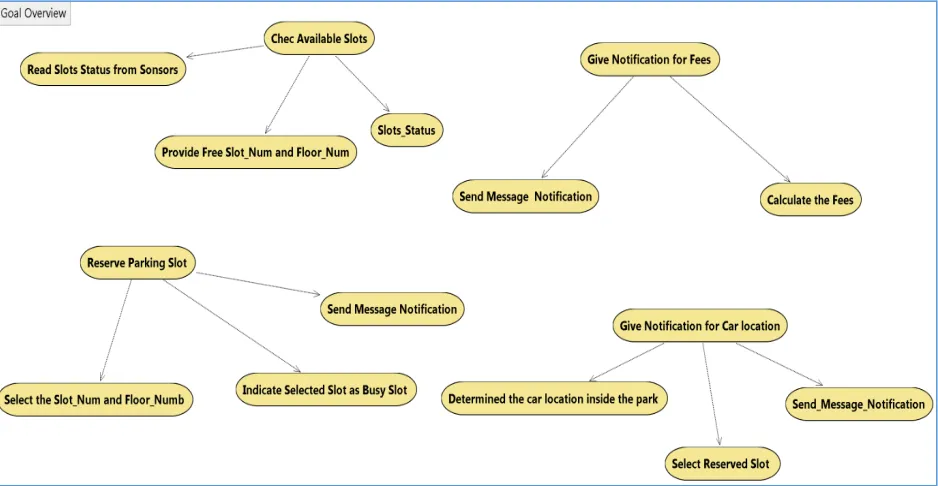
Developing scenarios is one of the convenient ways that show the sequence of steps that take place within the system. Scenarios become even more important in the case of community-managed resources that are shared among many agents. They are used primarily to illustrate the normal running of the system and they also can be useful when used to indicate what is expected to happen when something goes wrong. Five scenarios were developed; check availability of slots, slots
status, reservation, parking fees and car location scenario. The steps and sequences of these scenarios are configured. All the previous scenarios have been developed using the PDT tool.
5.1.5 Goal Specification
The initial set of goals for the proposed car parking system are configured and implemented using PDT toll as shown in Figure 5.
[image:6.612.93.562.471.714.2]2810
5.1.6 Detailed Design
In detailed design phase, the agents interact to achieve the goals associated via their roles and associated goals. A generic detailed design describes agents in terms of capabilities, or modules. These capabilities are then finally specified in terms of plans and events, which are of necessity more specific to the implementation paradigm or platform, than the preceding steps. At this point the abstract design of the system was
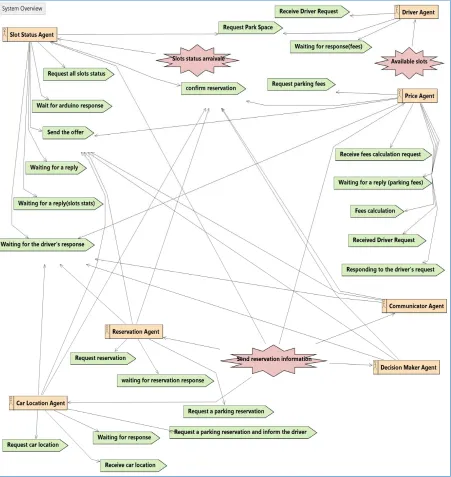
completed, since the structure, the functions and the internal design had been reached. The final system overview and system role overview are illustrated in Figures 6 and 7.
[image:7.612.93.544.233.710.2]At the end of the design process the system is ready for implementation. It would be programmed using agent speak Language (JASON) software.
2811
Figure 7: System Role Overview Diagram
5.1.7 Hardware Parts
The car parking management device will be located inside the car parking side where its hardware components would consist of Arduino controller, infra-red sensors, a Wi-Fi kit, and gateway server.
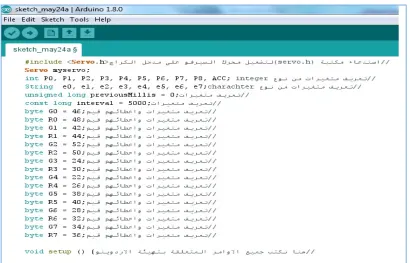
The hardware components were selected based on system analysis and requirements. The sensors were interfaced with Arduino device pins. In addition, The Wi-Fi selected kit was interfaced
with Arduino board to wirelessly send the sensors readings.
2812
Figure 8: The Prototype of the Proposed System
Figure 9: The Implemented Code for Arduino Programming.
6. DISCCUSIONANDRESULTS
Now a day, intelligent multi-agents systems are increasingly present in the car parking
[image:9.612.102.512.387.650.2]2813 communicating via message exchange to ensure the management process. The notion of an intelligent car parking multi-agent system has been presented along with the benefits that are to be gained from this particular approach.
In addition, the specific agent architecture along with the internal workings of each agent has been discussed and commented as well as the method of communication between the agents. In the proposed system, negotiations between different presented agents help the system to improve and solve current parking problems by giving an efficient decision.
Real-time sensors reading seem to be the most promising way to inform about the status of car parking (busy or free). The implementation of the prototype of car parking system has been done in this work. The real-time readings of the infra-red sensors are sent wirelessly to the gateway server where they will be saved and analysed.
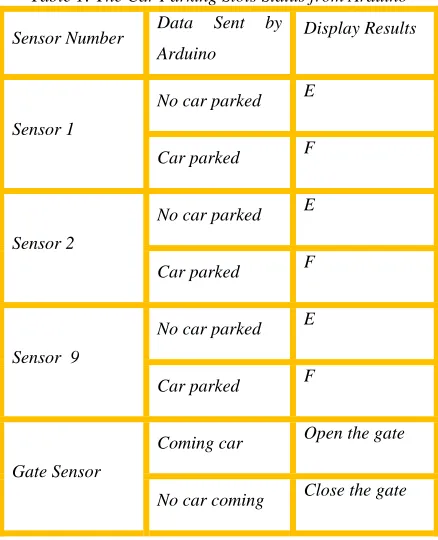
[image:10.612.84.303.410.680.2]After implemented the prototype, the Arduino unit responds to the received data from sensors. The WIFI kit was used to communicate with mobile application using MiWi Protocol. The final achieved results from the whole system are illustrated in Table 1.
Table 1: The Car Parking Slots Status from Arduino
Sensor Number Data Sent by
Arduino
Display Results
Sensor 1
No car parked E
Car parked F
Sensor 2
No car parked E
Car parked F
Sensor 9
No car parked E
Car parked F
Gate Sensor
Coming car Open the gate
No car coming Close the gate
The above table includes samples used sensors in prototype, samples of data which was wirelessly sent via Arduino through WIFI and samples of results which were displayed on mobile screen. For
example, sensor 1 was located at empty slot and the sensor reading mentioned that the slot status is empty and available as shown in figure 10. On other hand, sensor 5 was located at busy slot and the sensor reading mentioned that the slot status is full and not available as shown in figure 10. Furthermore, the exact location of each slot (floor number, direction to each slot) will be available to the driver to save the time needed to reach such slot. The prototype was implemented with an efficient result. As a result, most of negative impacts of current car parking methods i.e. traffic congestion, pollution, fuel consumption time consumption and car accident dramatically would be reduced and eliminated. Figure 10 shows that when no car parked in the slot, a notification message will display on mobile screen to indicate that the slot is empty (E). On the other hand, when a car is parked on the slot, the message will be full (F). The wireless communication via WiFi between prototype and mobile device has been done successfully. The sensors readings appeared on mobile screen in 100% accuracy as shown in Figure 10.
2814
Figure 10: sensors Reading on Mobile Screen
7.CONCLUSION
One of the most difficult challenges of current car parking system is how to make sure there are empty parking spaces before arrival. Such challenge will lead to many problems and causing troubles for the driver. The paper discusses the importance of using a intelligent software based parking management system along with Infrared sensor(IR). In this paper, an intelligent car parking system using multi-agent is proposed and designed. A new dynamic method for car parking fees calculation is presented. A prototype of agents’ sensory input is implemented and tested.
The researcher attempted to replace the current car parking method with an intelligent method based on agents’ system that would use the agent’s features to maximize the potential quality of car parking services, reduce the time needed to find the free space. Furthermore, a new technique was investigated that would help to dynamically calculate the parking fees based on percentage of parking spaces. In addition, car location service will
help the driver to find the location of his/her car inside the park. Such problem usually appeared in large car parking.
The proposed intelligent car parking system will solve most of current parking system problems. In addition, many of driver troubles will be eliminated. Other factors will be taking into account with such system such as save energy, reduce carbon emissions, traffic flow/jams, etc. with such proposed system, the car parking operation will be more efficient and comfort than before. In addition, economically the system will more useful based on the new proposed dynamic fees calculation method.
REFERENCES:
[1]United Nations Commission on Science and Technology for Development Inter-Sectional Pane, Budapest, Hungary, 11-13 January 2016, available online at: http://unctad.org.
[2]B Chaudhry, “Improving the response to road death and injury Road Peace conference. [3]Rafael H Bordini, Jomi Fred and Michael
Wooldridge, “Programming multi-agent Systems in Agent Speak using Jason”, WILEY 2007.
[4]Shuo-YanChou et al, “Dynamic parking negotiation and guidance using an agent-based platform”, Expert Systems with Applications, Volume 35, Issue 3, October 2008, Pages 805-817
[5]Hussein Dia, “An agent-based approach to modelling driver route choice behavior under the influence of real-time information”, Transportation Research Part C: Emerging Technologies Volume 10, Issues 5–6, October– December 2002, pp. 331-349.
[6]Sana Benhassine, Riadh Harizi, Rafaa Mraihi, “Intelligent parking management system by multi-agent approach: The case of urban area of Tunis”, Advanced Logistics and Transport (ICALT), Tunisia, 1-3 May 2014,
[7]L. Padgham and M. Winikoff, “Developing Intelligent Agent System: A Practical
[8]Guide”, Wiley, 2004.
2815 [10] Dam, Khanh Hoa and Winikoff, Michael ,
“Comparing agent-oriented methodologies”, Proceedings of the Fifth International Bi-Conference Workshop on Agent-Oriented Information Systems, Melbourne, Australia,2003, pp. 52–59.