LTE Scheduling Algorithm with Balanced
Throughput and Fairness
J. C. Vijayshree 1, Dr. J. Vaideeswaran 2, Dr. T. G. Palanivelu3
1Research Scholar, SCSVMV University, Kanchipuram, 631561, India 2Professor & Head, Dept of ECE, SCSVMV University, Kanchipuram, 631561, India
3Former Principal, Pondicherry Engineering College, Puducherry, 605104, India
Abstract: Long Term Evolution, the recent technology in Mobile Communication can handle the high Data Rate traffic in a better way. Packet scheduling plays a vital role in handling the data traffic by allocating resources in frequency and time domain for the active users. This article propose a new packet scheduling algorithm called Balanced LTE scheduling algorithm, which allocates resources in such a way to maximize throughput, while achieving reasonable fairness and power efficiency in the allocation. The performance is evaluated by the comparison of simulation results with that of Best Channel Quality Indicator and Proportional Fairness Scheduling algorithms.
Keywords: LTE, Packet Scheduling, Balanced Scheduling Algorithm
I. INTRODUCTION
With the continuous growth on the number of mobile users, the number of applications to be handled and the amount of data to be carried by the mobile communication, the role of scheduling becomes more important. The scheduler directs the allocation of radio resources to users with the consideration on Quality of Service requirements. The packet scheduler should include the objective of maximizing the Data Rate on the link, Resource Allocation between User Equipments with fairness, maximizing the Quality of Service support with minimum power utilization. In Round Robin scheduling, the resource blocks are assigned to User Equipments as equally scheduled without bothering the channel quality. Proportional Fairness algorithms provide a balance between throughput and fairness across the mobile users. Best Channel Quality Indicator scheduling algorithm is a scheduling method to allocate the resource blocks for the user with best channel conditions that are indicated by the Channel Quality Indicator. MaxMin scheduler is the scheduler that maximizes the minimum Data Rate / Throughput of the User Equipments. This work presented a new scheduling algorithm called Balanced Scheduler which tries to provide maximum resources in a fairway to the users attempting to make a call, with the focus on not exceeding the power threshold.
II. RELATED WORKS
Fei Liu et al designed two LTE scheduling algorithms for energy efficiency namely serving the longest queue and round robin with priority by reducing the transmit power [1]. Yen – Wen Chen et al have developed an uplink scheduling method to use the energy in efficient way while fulfilling the Quality of Service requirements in Wi-Max networks [2].Elgazzar et al provided the assessment atmosphere for noting down the quantum performance of different LTE schedulers [3]. An LTE uplink scheduler of Proportional fairness is presented by Calabrese et al based on binary search tree, that enhances the throughput than that of Round Robin scheduler [4]. In the LTE uplink process, the performances are compared between Recursive Maximum Expansion method, Riding Peak scheduling method and the First Maximum Expansion scheduling by Haidar Safa and Kamal Tohme [5]. Wen et al taken the two metrices Proportional Fairness and Guarateed Bit Rate for uplink scheduling of the User Equipments, with the focus on improving the fairness with the flows that does not require guaranteed bit rate and quality preservation with the guaranteed bit rate flows [6]. Oscar Delgado et al have considered the Guaranteed Bit Rate and delay provisioning on forming the LTE scheduling algorithms [7]. Researches carried out by Li et al [8] and Sokmen et al [9] formed the scheduling algorithms to reduce the transmitted power while ensuring the attainment of minimal quality requirements.
III. SYSTEM MODEL
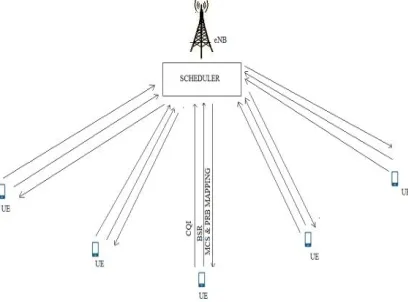
Channel Quality Indicator. The Buffer Status Report send by the User Equipment to the evolved Node Base Station places the request to make communication and indicates the required Quality of Service. The scheduler at the evolved Node Base Station performs the scheduling using the algorithm proposed and sends the Modulation and Coding Scheme and Physical Resource Block Mapping. The LTE scheduler allocates the resource blocks with the conjunction of one time slot in time domain and one resource block in frequency domain [12]. For every time slot, the scheduling has to be done continuously. The scheduling is to be distributed to all User Equipments. The LTE scheduler is designed in such a way that the spectrum is used efficiently and effectively, with low transmission power and less complexity while satisfying the required Quality of Service. The trade-off between throughput and fairness is tried to achieve here. The LTE scheduler model is shown in fig1.
Fig 1. System Model for Balanced LTE Scheduler
IV. BALANCED SCHEDULER
We propose a channel aware scheduling algorithm, where the channel quality indicators are used to maximize the throughput with the consideration on power efficiency and fairness in allocation.
The intention of the scheduling algorithm proposed is to do allocation fairly and also to enhance the throughput. The maximum allowable Data Rate of user i over the Resource Block x can be calculated by the Shannon’s channel capacity theorem as
Ci(x) = B log(1+SNR(i,x)) with the Signal to Noise Ratio between the user i and resource block x is known.
A two dimensional scheduling matrix S1 can be formed with i users in one dimension and x resource blocks in another dimension in such a way to have the throughput as the scheduling parameter.
The scheduling priority function of S1 based on Proportional Fairness scheduling algorithm can be given by, Si,x = Ri / Ti,x Where, Ri is the Average Data Rate for the I users
Ti,x is the Average Throughput of I users
Another two dimensional scheduling matrix S2 is formed for the I users among x resource blocks with fairness index as the scheduling parameter.
The scheduling priority function of S2 based on Best Channel quality Indicator scheduling algorithm can be given by, Si,x = Ri / max(Ri)
Where, Ri is the Achievable Data Rate for the user I with resource block x Max(Ri) is the Average Data Rate for the I users
U
se
rs
Resource Blocks S1,1 S1,2 … S1,x S2,1 S2,2 … S2,x
. .
. . .
. . .
For I = 1, 2, . . . , i users with X = 1,2 . . . , x resource blocks, S1 represent the scheduling matrix focusing on throughput and S2 represent the scheduling matrix focusing on fairness. Whenever an user tries to make a call, the scheduling matrix S1 identifies the resource block that can support maximum throughput for it. Then, from the scheduling matrix S2, it is verified that whether the particular resource block provides fairness within top 50%. If the resource block satisfies the specified condition, then the transmission power is calculated for the user with that resource block and checked to be less than 23dBm. If the chosen maximum throughput resource block does not have fairness index of more than 0.5, then the second maximum is selected and the same above procedure is repeated and so on.
The User Equipment’s transmission power can be specified as [12]
PTi = min (PMAX, P0+α·PL+10 log10 (N) + ΔMCS + f (Δi)) - - - (1) Where, PMAX - The maximum user transmission power
M - The number of allocated PRB at a given TTI
P0 - Open loop path-loss power value. Typically -53 dBm per RB
α - Open loop path-loss factor. Typically 0.4 to 0.6. PL - Downlink path-loss measured in the UE
N - The number of allocated PRB at a given TTI
ΔMCS - Cell dependent factor
f (Δi) - User specific closed loop PMAX
The transmission power from a Mobile Terminal should be 23dBm [13].
If the transmission power requirement is less than 23dBm, then the particular resource block is assigned to the user and allowed to proceed the communication. Otherwise, the same procedure is repeated with the next best throughput providing resource block and so on.
V. SIMULATION RESULTS
The performance of the proposed algorithm is evaluated with the help of simulation experiments and the results were compared with that of BCQI algorithm and Proportional Fair Scheduling algorithm.
Simulation Parameters
Parameter Value
System BW 6 MHz
Number of RBs 30 Number of users 10, 25, 50
Timeslot 0.5ms
Average SNR of users 25dB to 0dB Channel Mode 3GPP
Schedulers BCQI, Proportional Fairness, Proposed
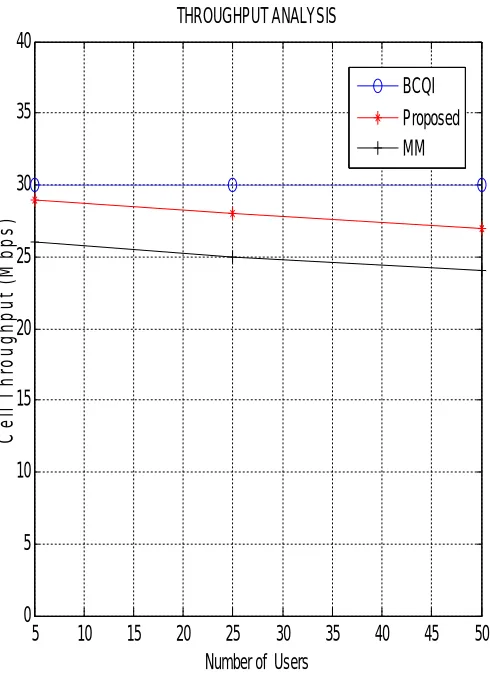
[image:5.612.182.427.294.634.2]The throughput analysis for the proposed algorithm in comparison with that of BCQI and Proportional Fairness algorithms is provided in fig 3. The BCQI algorithm provides highest throughput at all times, since its objective is always to provide resources to the users with best channel condition. The analysis infer that the proposed algorithm is able to provide better throughput than the Proportional Fairness algorithm and its performance decays only a little with the increasing number of users.
Fig 3. Throughput Analysis
Fig 4 shows the performance of the three scheduling algorithms in terms of fairness. From the graph, it can be proved that the proposed algorithm is much better in fairness than the BCQI algorithm, though it is not able to provided constant fairness as Proportional Fairness algorithm. The proposed algorithm provided a fairness of more than 0.7 at all occasions.
5 10 15 20 25 30 35 40 45 50 0 5 10 15 20 25 30 35 40 THROUGHPUT ANALYSIS
Number of Users
Fig 4. Fairness Analyst
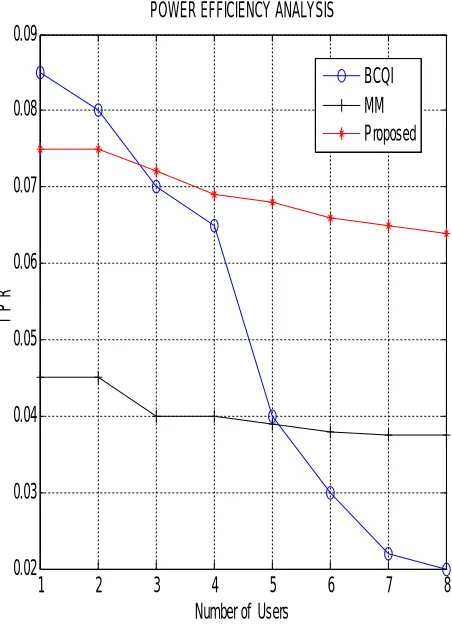
The analysis of power efficiency with the User Equipment index is given in figure 5. The BCQI algorithm provided better power efficiency only when the user index is less and they are in good channel condition. The power efficiency of BCQI algorithm is poor with increased users. The proposed algorithm is able to provide sustained power efficiency at varying user index as like Proportional Fairness algorithm, but its efficiency is much better than Proportional Fairness algorithm.
Fig 5. Power Efficiency Analysis
5 10 15 20 25 30 35 40 45 50
0 0.1 0.2 0.3 0.4 0.5 0.6 0.7 0.8 0.9 1 FAIRNESS ANALYSIS
Number of Users
F a ir n e s s I n d e x BCQI Proposed MM
1 2 3 4 5 6 7 8
0.02 0.03 0.04 0.05 0.06 0.07 0.08 0.09
POWER EFFICIENCY ANALYSIS
Number of Users
[image:6.612.207.433.384.696.2]VI. CONCLUSION
The proposed balanced scheduling algorithm tries to provide maximum throughput as like BCQI algorithm, while trying to have a meaningful fairness and power efficiency with the scheduling too. The performance of the proposed algorithm was evaluated with simulation. The result comparison with BCQI and Proportional Fairness scheduling algorithms proved the better performance of the proposed scheduling algorithm.
REFERENCES
[1] Fei Liu, Kan Zheng, Wei Xiang, Hui Zhao, “Design and Performance Analysis of An Energy-Efficient Uplink Carrier Aggregation Scheme,” IEEE Journal on Selected Areas in Communications, Volume: 32, Issue: 2, pp: 197 – 207, February 201
[2] Yen-Wen Chen, Yen-Yin Chu and I-Hsuan Peng, “Energy-saving centric uplink scheduling scheme for broadband wireless access networks,” EURASIP Journal on Wireless Communications and Networking Vol 70, No 1, pp 1 – 20, 201
[3] K. Elgazzar, M. Salah, A.-E. M. Taha, and H. Hassanein, “Comparing uplink schedulers for LTE,” Proceedings of the 6th International Wireless Communications and Mobile Computing Conference, pp 189–193, 2010.
[4] F. Calabrese, P. Michaelsen, C. Rosa, M. Anas, C. Castellanos, D. Villa, K. Pedersen, and P. Mogensen, “Search-Tree Based Uplink Channel Aware Packet Scheduling for UTRAN LTE”, Proceedings of the IEEE Vehicular Technology Conference, pp 1949 –1953, 2008.
[5] Haidar Safa and Kamal Tohme, LTE Uplink Scheduling Algorithms: Performance and Challenges”, Proceedings of the 19th International Conference on Telecommunications , pp 1-6, 2012.
[6] P. Wen, M. You, S. Wu, and J. Liu, “Scheduling for streaming application over wideband cellular network in mixed service scenarios," Proceedings of the IEEE Military Communications Conference, IEEE, pp. 1-7, Oct. 2007
[7] Oscar Delgado, Bridgite jaumard,”Scheduling and Resource Allocation for Multiclass Services in LTE Uplink systems”, Proceedings of the 6th international conference on wireless and mobile computing, networking and communications, 2010
[8] Z. Li, C. Yin, and G. Yue, “Delay-bounded power-e_cient packet scheduling for uplink systems of LTE," Proceedings of the 5th International Conference on
Wireless Communications, Networking and Mobile Computing, pp. 1 - 4, Sept. 2009.