5
IX
September 2017
Emergency Mobile Robot by Using Wi-Fi and
Android Based Application
Osman Ishag Abdelrahim Abdalla¹, Dr. Eltahir Mohamed Hussein²
¹Department of Computer Engineering Faculty of Engineering, Alneelain University
²College of Engineering, Sudan university of Science and Technology, Khartoum, Sudan
Abstract: The theme of this paper is to design Emergency Robot which is remotely controlled through Wi-Fi technology and android application by using smart phone, this is of use in providing a visible and obviously evinced interface that is access remotely from hundred meters. The robots consist of a wireless camera transmitting video data to the controlling side thence intervention team. The robot able to move in all direction transmitting life video and audio. This project is very helpful in the hazardous places where a human cannot go in, places like ground canals, smoke oriented caves and all emergency situations. KeyWards: Wi-Fi module, EPS8266 module, android application, stepper motor, robot.
I. INTRODUCTION
Nowadays, there has been much research and development of intelligent robots that can interact with humans in daily life, for example HANASERT (insertion machine), Sony AIBO and Honda ASIMO. The research is prepared to design a remotely controlled robotic vehicle using Wi-Fi protocol for its movement. An ESP8266 has been used to realize the wireless communication. A robots are automatic task performing machine or with leading. Robotics is generally a mix of of computational intelligence and physical machines (Actuators and motors). [1, 2, 3, 5, 7]. Computational intelligence involves the programmed instructions, communication between the robots and humans is emphasized in contrast to industrial robots performing specialized tasks. Some researchers have tackled this problem. Such as Qusai Awadalla et al. [1] implement a method to control a wheeled robot remotely Through the Internet, for monitoring and controlling purpose. However, the internet is available today but high data rate of monitory data cost significant money, Vaghela Ankit1, Patel Jigar2, Vaghela Savan3 et al [2] designed obstacle avoidance robot controlled over Bluetooth communication, the project is an intelligence build in a combination of obstacle avoidance by using ultra sonic sensor and wireless controlled robot over Bluetooth communication. Bluetooth technology is helpful when transferring data between nearby devices when speed is not an issue, like radio, headsets, telephones etc. The low-bandwidth applications like phone transmitting are well suited with Bluetooth technology. In this research I used Wi-Fi technology because of Wi-Fi is well adequate for full-scale networks because of faster connection enabling, the best wireless security (then the configuration is proper) than Bluetooth.
II. HARDWARE ARCHITECTURE OF THE ROBOT
The hardware architecture of the Robot is briefly described in this section.
The design philosophy is to realize a robot with various functions so that it can be used not only in controlling movement but in live video transmitting as well. The hardware architecture of the mobile robot consists of the following five parts, mobile robot mechanism, ESP8266 Wi-Fi module, electronic driver module, smart phone with android operating system and wireless camera module. This architecture makes mobile robot possible to control remotely its motion with live video transmitting. The overall hardware architecture of the mobile robot is shown in Figure. 1.
Figure. 1. Overall hardware architecture of the mobile robot
A. Mobile Robot Mechanism
The mobile robot is a four-wheeled vehicle with rear wheel driven and front steering wheel. The system has several subsystems that are explained clearly by Figure.1. The smart phone is the end user of this system who is a roaming individual. The end user sends the commands to the robot using smart phone through Wi-Fi protocol. The embedded Wi-Fi module in the robot received the commands and transfer it to the central processing unit (CPU), the CPU process the commands and send it to the driver circuit.
B. smart phone
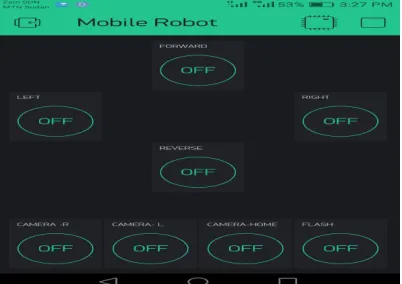
The Android Mobile Phone Platform which founded in palto of California, U.S. by Andy Rubin, Rich miner, Nick sear and Chris White in 2003 becomes more and more popular among software developers, [3] because of it's not just powerful operating system supporting a large number of application, but it's an open architecture. Android is an open source and this is very useful to researcher to develop applications which can be further used for selling in android market. Of course it's a great platform for a robotic system control, as it provides plenty of resources and already integrates a lot of sensor. Android depend on Linux version 2.6 core system services like process management, network stack, security etc. In our research smartphone is as end user interface, contain comfortable graphical user interface (GUI) as in figure.2 below. The GUI realize the interaction between the end user and the robot much easy.
Figure.2 Graphical user interface
Smart phone with android app
Wi-Fi EPS8266 Wi-Fi module Indicators Driver circuit Front wheels (Left/Right) Back wheels Backward/forward
Stepper motor for (camera rotation) Internet
IP camera
[image:3.612.225.426.574.716.2]The ESP8266 is an impressive, cheap, and configurable with an existing microcontroller project via wireless or wired connection. [4] ESP8266-based modules made by Espressif, it has been designed for mobile, wearable electronics and Internet of Things applications with the aim of achieving a very low power function with a mixture of few proprietary mechanisms. It has three operation modes for power saving: active mode, sleep mode and deep sleep mode. The ESP8266 offer a great power management function and there is no logic to power-down functions are needed , ESP8266EX power consumption more than 60uA in deep sleep mode (with real time clock still running) and lower than 1.0mA (DTIM=3) or lower than 0.5mA (DTIM=10) to stay connected to the access point [4]. The frequency range is 2.4G-2.5G (2400M-2483.5M). The IEEE standard for it is 802.11 b/g/n. Here we configure the Wi-Fi module to gets commands from the smartphone to the Microcontroller where it has be executed.
D. Microcontroller
The microcontroller in its most fundamental form is a complete computer system fabricated within a single chip. The micro C can be distributing on the armature of internal bus width, architecture, memory and instruction set. [5]. The ATmega16 is manufactured from CMOS which is low power and 8-bit family standard on the Atmel promoted RISC architecture. When powerful instructions executing in a single clock cycle, the ATmega16L gets throughputs approaching 1 MIPS per MHz allowing the system designed to optimize power exhaustion against processing speed.[6].
E. Diver circuit
A driver circuit is an electrical circuit used to control another circuit or component, like relay, a high power transistor motors, etc. They are usually used to regulate current flowing through a circuit, [1] ULN2003 and L293D are a typical motor driver IC which allows stepper/DC motors to drive on either direction. The L293D is an IC with 16 pin which able to control up to two DC motors simultaneously in all directions.
F. wireless Camera
Nowadays Wireless security cameras become most common, in its most fundamental form is that transmit a video and audio signal to a wireless receiver through a radio band. There are many types of IP cameras such as S06 3G IP camera module figure.3, which is a good choose to our project because of its amazing features like: Easy View - Support Smartphone Tablet APP Remote View and Control, Support PC Computer View and Control. So checking in on what you care about has never been easier: all you need is an internet connection. Instantly receive a securely encrypted signal, live video or audio feed via personal computer, mobile phone, or tablet, from any place at any time. Power consumption: 260MA/3.7V.
Figure.3, S06 3G IP Camera
G. Motors
Figure.4a, stepper motor architecture
Figure.4b, DC motor architecture
III. SYSTEM SIMULATION
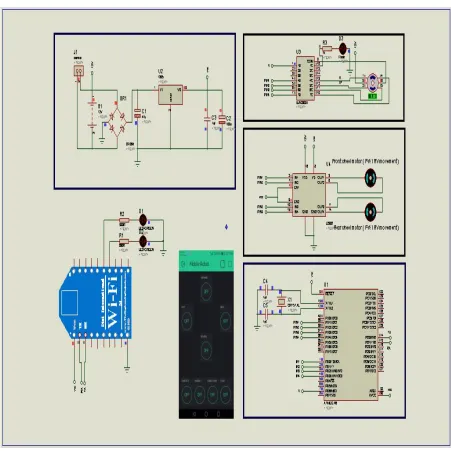
Figure. 5. System simulation
The microcontroller connected with the Wi-Fi module along with motors driver circuit L293D and uln2003 [1].The system standalone simulation is shown in Figure. 5. And that mean all of the data transitions is done on one machine including the smartphone. the software that control the data conditioning in the microcontroller has been done using AVR micro-c compiler, based on a predefined condition the microcontroller is then acts as desired . As shown on Figure. 5. The a command sent from smartphone will be received by EPS8266 Wi-Fi module then some commands executed in eps8266 and other will be translated as a ‘a’ letter which is then received by the microcontroller, the microcontroller in it turn translate the received commands according to the established conditions and then execute the specific action by sending the activating the required actuators signals.
IV. SYSTEM IMPLEMENTATION
Fig.6 system implementation
V. RESULT AND CONCLUSION
In this paper, an approach to control an experimental wheeled robot remotely over Wi-Fi protocol has been delivered. Where mobile robot mechanism, EPS8266 module, smartphSone GUI, electronic driver module, microcontroller and wireless camera, have been set up.
Thus, it can be concluded that features like movement, flash light, life video, and portability of android GUI based smart phone has overtaken the sophistication of technologies like Wi-Fi protocol, become outright. All computer simulations and practically experimental results illustrate that the propounded emergency robot are indeed effective and feasible.
[1] Salma Hisham, Musaab Abdelbagi and Qusai Awadalla, "Implementation of Remotely Controlled Robot over internet," International Conference on Computing, Control, Networking, Electronics and Embedded Systems Engineering, 2015.
[2] Vaghela Ankit1, Patel Jigar2, Vaghela Savan3" Obstacle Avoidance Robotic Vehicle Using Ultrasonic Sensor, Android and Bluetooth for Obstacle Detection" International Research Journal of Engineering and Technology, Issue: 02 | Feb-2016.
[3] Takashi Minato1, Michihiro Shimada1, Hiroshi Ishiguro1, "Development of an Android Robot for Studying Human-Robot Interaction" Yoshida Honmachi, Sakyo-ku, Kyoto 606-8501, Japan, 2007.
[4] ESP8266 Datasheet.
[5] Singh and S. A. Kumar" Microcontroller and Embedded System" New Age International, 2008. [6] Atmel, "Microcontroller Atmega16l datasheet" ed.
[7] RK Mittal and IJ Nagarath,"Robotics and Control" BITS Pilani, 2003.