2013
©IJRASET (UGC Approved Journal): All Rights are Reserved
Suspicious Movement Detection and Tracking of
Human Behavior and Object with Fire Detection
using A Closed Circuit TV (CCTV) cameras.
Prof. Jitendra Musale1, Miss. Akshata Gavhane2, Mr. Liyakat Shaikh.3, Miss.Pournima Hagwane4 , Miss.
Snehalata Tadge5
1, 2, 3, 4, 5
ABMSP Anantrao Pawar College of Enginering and research ,Pune
Abstract: Now days the crime and terrorist attack has increased drastically many organizations who needs high security has been installing a video surveillance system , But it is not that reliable as it store offline videos which can be easily fooled. We are proposing a system which works as a Automated Video System to detect and track suspicious human behavior. However Human Behavior is random and unpredictable, classification of suspicious behavior of human can be very difficult. Our primary goal is defining a system that can Automatically Track and detect Peoples unusual or suspicious movements in Closed Circuit TV(CCTV). Detection of Suspicious Movement or Activities had attracted an increasing level of attention. Automated offline video processing systems have been used for various purpose such as a proof of a crime or in a forensic labs. However, very little success has been achieved on this matter. In this paper we are introducing a system that works for surveillance systems installed in indoor environments like entrances/exits of buildings, corridors, High Sensitive area etc. We are proposing a framework that processes video data obtained from a CCTV camera fixed at a particular location. First we are obtaining the foreground objects and subtracting that foreground image from background subtraction. After subtracting this objects are then classified into people and inanimate objects Using Haar like features for face, head and people Detection in video sequences. Algorithm for detection of group of peoples suspicious movements and detection of Single persons suspicions actions and behavior. We track those objects by using Real-Time blob matching algorithm. We are also adding the fire detection facility into the proposed system. Hence we can know the cause of Fire.
Keywords: object detection, image processing, background subtraction, tracking, surveillance, Blob matching, Haar, fainting, fire detection.
I. INTRODUCTION
Video Surveillance System is a collection of various types electronic and wireless components as well as video. It records videos of the various important locations for monitoring purpose. Due to the increasing rate of the crime around the world, many organizations are deploying Video Surveillance System at their locations for monitoring purpose. Increasingly, police and security staff relay on Video Surveillance System to facilitate their work. This practice is most evident in large public transportation areas such as metro stations, Airport as well as highly sensitive areas. However these systems remain highly insensible and the person monitoring the video displays find it extremely difficult to be attentive to randomly occurring incidence as the concentration of an operator will reduce drastically as time passes. Although automated Video Surveillance System do exist, they have been used mainly for offline videos analysis after an event has occurred, most notably in the case of riot investigations and forensics. At present, these surveillance systems are of magical help for real-time alerts. The functions of a automated surveillance system is to attract the attention of monitoring human Operator to the occurrence of a user defined suspicious behaviour when it happens. Mainly there are two challenges that stand in the face of developing fully automated behaviour recognition. First, objects of interest, such as people and luggage instable means of describing events must be found. The majority of researches till now day have involve machine learning to detect suspicious behaviour. To our knowledge, we purpose here a complete semantic based solution to the behaviour detection problem that addresses the whole Process from pixel to behaviour level.
Here, we are using Haar like Feature algorithm for finding the suspicious activity in crowded area or group of people and to find the single persons suspicious activity and its behaviour. To find single person’s suspicious activity we are using Haar like algorithm in our proposed system. It is mainly used for adjusting the image intensities to enhance the contrast. To find the suspicious activity in crowded area or a group of peoples we are also use a Haar algorithm.
2014
©IJRASET (UGC Approved Journal): All Rights are Reserved
add in the group)which is our daily life scenario in a public transport area or in crowded areas , while grad algorithm allowed us to detect the suspicious activity for any number of peoples in a group even after the variation into the group of people.
Also we have also add a feature known as Fire Detection which comes in handy to know the actual Cause of the fire in sensitive areas and could be avoided in the future.
II. SCOPE
The system works mainly in indoor environment like entrance or exits of the building, corridors etc. The orientation and location is a important feature of a camera. The proper position to capture perfect human body shape would be to directly place the camera in front. But it is not possible in real-life scenario's. Hence the camera is placed overhead in a downward angle. The exact degree of inclination is not important. Not as an independent document. Please do not revise any of the current designations.
III. EXISTING SYSTEM
Many researchers has been worked in this area. Most of the work is focused on machine learning for training the system to identify various anomalous scenario's. Recognition of human behaviour is a vast term which covers different categories and activities.[7] for example, crowd recognition, it should recognize the behaviour or movement of crowd or group of people rather than focusing on individual behaviour. On the other hand other human activities like[8]stretching, exercises and other gestures are[9] relatively simpler and periodic.
These are different human nature and therefore require[5] different detection techniques with the
help of body models and[6]space-time space. Some work also made use of the stereo cameras to model the objects that are present in the scene in 3-D.
Elhamod and Levine [1] proposed a system for detecting suspicious activities in public transport Area. 3-D object -level information is obtained by detecting and tracking object/people using blob matching technique. Colour histograms are used for blob matching technique.
This paper is focuses on automatically flagging suspicious behaviour in public areas or sensitive
areas. For example[5] loitering [6] [10] abandoned objects and fighting. This behaviour may occur after a significant period of time. Sometimes they involve more than one object therefore such matters as finding identity of tracking persona and object classification must be addressed.[1] Elhmod and Levine introduced an approach that detect semantic behaviour based on object sand inter-objects motion features. kim at el deals with the detecting and tracking moving objects through single camera. The proposed system used RGB colour background modelling to extract
Moving regions. Blob labelling is often used to group moving object. Some work [3] [4] also involves using a stereo camera. A stereo camera is a set of two camera mounted adjacent to each other, but separated by a small distance. These cameras face in same directions, but the images captured by them differs slightly due to the spatial difference between the lenses of both cameras. These images can be processed together to get 3-D locations of the objects. Such types of camera allowed for good occlusion detection and removal. But the Computation cost increases as we need to process two similar images for detecting suspicious activity more work has to be done in a machine learning area. Elhamod etal has used simple approach called as semantic-based approach. This allow us to define
Suspicious activities based on human reasoning and logic. This eliminates the use of training the system, as it done in machine learning program, for identifying suspicious activities. This approach gives better result than machine learning as latter depends on a standard reliable dataset for training. Thus it makes Machine Learning approach less reliable. Therefore we are using a semantic-based approach.
IV. PROPOSED SYSTEM
We are proposing a system which is able to process off-line as well online video surveillance for detecting suspicious activities based on a Human behaviour. We have also added a extra feature in our system known as fire detection.
Here we are using semantic knowledge to detect the suspicious behaviour of single person as well as behaviour of number of peoples(i.e. group of peoples)like walking together, fighting in a group, terrorist group attack etc.
We are using a monitor displays which are connected via internet to the cameras for monitoring the activities, Once it has captured a any suspicious behaviour of human or any lathering object it will take a snapshot of a that activity and send it to the user(i.e. monitor display) as well as it will generate the Alert at the same time for every suspicious activity.
2015
[image:4.612.175.439.98.277.2]©IJRASET (UGC Approved Journal): All Rights are Reserved
Figure. Proposed System
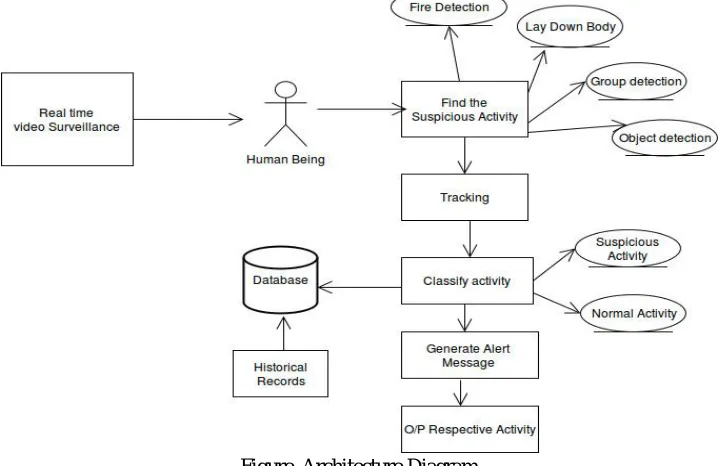
V. ARCHITECTURE DIAGRAM
A. Find the Suspicious Activity
In this section we are finding the type of different suspicious activities like:
B. Lay down body
Which means if there is any human body in a 90 degree position on a ground (i.e. activity like fainting) it will go into the categories of lay down body.
Figure. Architecture Diagram
C. Group Detection:
If there is any suspicious activity in group like walking together, or fighting in a group or any terrorist activities perform in a group then it will go in the categories of group detection and generate a Alert indicating suspicious activity related to Group Detection.
D. Object detection:
[image:4.612.127.486.399.632.2]2016
©IJRASET (UGC Approved Journal): All Rights are Reserved
E. Fire Detection
if there is a smoke or fire(i.e. suddenly rise in a temperature) then system will take its snapshot and will send it to the human operator which is monitoring that system and will generate the Alert under the categories of Fire detection, which is also useful in knowing the cause of fire in the area.
F. Classify Activity
After capturing the image it processes the image then decide whether it is a suspicious activity or a Normal Activity based on the Semantic knowledge. it processed the image from the database. It also processed the images from the Historical Records.
G. Generate Alert message
After classifying stage if the Activity is classify as Suspicious then it will Generate a alert message related to the categories of suspicious activity and will send to human operator monitoring the display monitors.
H. Output Respective Activity
After generating the alert message it will send the message to the human operator that is monitoring the display which are connected via internet to the display monitors it will also specify the categories of activity like whether it is lay down body or it is group detection or it is Object Detection or fire Detection.
I. Haar like Algorithm
It is analyzing the video content at real-time frame rate and with a false alarms detection rate as small as possible. This algorithm can be dedicated and specifically parameterized in certain application and restrained Environment. They also face on many challenging issues in order to correctly analyze human activities. We here present a novel people, head and face detection algorithm using Haar like features which we refer to as couple cell features. Main attention is focused in detecting face, head and people body in videos. Faces can be seen as small objects when people are distant from the camera.
1) Face detection using couple cell response features: A couple cell feature consists of two adjacent cells c = {1, 2} forming a ells.
The couple can be oriented horizontally, vertically or in diagonal. Pixel distributions v1 and v2 of the two cells c1 and c2 respectively are compared to give the feature response.
Acell pixel distribution is represented by an average E (the expectation term) ofthe pixel grey levels within this cell. Dimension X = {x, y,w, h}
the magnitude and sign of the difference ∆ between these two mean values: ∆ = ∁(I(x)) (1)
∆ = v2 − v1 (2)
= b sign(∆ ) , 2b <∆ < 2b+1 (3)
The CRR feature is of dimension 17 and its features represent varying ranges of pixel distribution differences: (b; ∆ ) = (−8; [−255 :−128[), (−7; [−127 : −64[)...(0; [−1 : 1[), (4)
(1; [1 : 2[), (2; [2 : 4[)...(8; [128 : 255]) (5)
The couple cell feature is calculated across an image at various scales byvarying the cell width w and height h as follows: (w, h) = {(1, 1)(1, 2)..(1, 8), (2, 1)..(8, 8)} (6)
Adaboost training: feature position = x dimension width = w height= h
That we encapsulate into X= {x,w, h}, a weight probability distribution is calculated in equation from all samples indexed by i. The positive (object) samples defined by = 0 and labelled( I) = 0
The negative (non-object) samples defined by ¸ = 1 and labelled( I) = 1.
2017
©IJRASET (UGC Approved Journal): All Rights are Reserved
The initial sample weights w (i) are normalized
over the distribution of samples ∑ ( ) = 1 A classifier ℎ (i) at iteration t is associated with each feature position X in the samples template area. It classifies samples according to their feature response and their weight
The Adaboost weak classifier ℎ (i) at iteration t is chosen at the featureposition where the classifier is the most discriminative among all other classifiers
In this equation the error term represents the sum of sample weights of the badly classified samples at feature location X. Sample weights are then updated in the following equation where Z represents a normalizing factor:
Objects are detected as positive candidate using the trained data
VI. RESULT AND DISCUSSION
The evaluation of activity recognition has been challenged by number of different difficulties. Firstly measures of activities of the interest are of high complexity, which has become a issue in the presence of clutter in the test scenario. Second issue is the delinquency of professional and challenging high quality data sets currently available for testing. The definition of suspicious activity is dependent on its Scenario. For example person waiting for a bus for 15 minute is normal; whereas for ATM, a person waiting for such a long time is highly suspicious. These challenges lead to the inconsistencies among the experimental results in different literature papers. We have used carefully selected standard public data sets to test the proposed framework. These data sets are CAVIAR (PETS 2004) and PETS 2006. The major limiting factor in the field's
Development is a trend toward focusing on non-professional data sets.
A. By using proposed algorithm we can track multiple peoples simultaneously. In the System two outgoing people are tracked. The bounding box is drawn around the each person. Every person is given a unique ID. In all the subsequent frames , the detected objects are compared with objects in previous frames. if an object in a current frame is found match to previous frame, it is assigned the same ID.
VII. DETECTION OF SUSPICIOUS ACTIVITYVARIOUS
Cases of the suspicious activities are explained below.
A. case 1: Loitering at an ATM
Identifying loitering at an ATM is crucial from a security point of view. Today though the ATM provides lot of different services to the users; though they are still predominately used for their basic function of withdrawing money. The activity of withdrawing money is usually takes around 50-60 seconds under normal circumstances.
B. case 2: Loitering at Bus Station
2018
©IJRASET (UGC Approved Journal): All Rights are Reserved
C. case 3: Abandoned Luggage at Bus Station
Identification of the abandoned luggage is crucial from security point of view as the abandoned luggage item may contain explosive. The luggage item is marked as abandoned if its owner goes away leaving the luggage
Item behind.
E. case 4 : Fire Detection
In public or private places there are some cases whereas suddenly that place is sets on fire and we don't know the cause of it.
For example in a bus station or in shopping malls there are cases of suddenly in particular areas of shopping malls are on fire and the staff and mall manager does not know the cause of it.
VIII. CONCLUSION
In this research work, a complete semantic-based simple approach that depends on object tracking has been introduced. Our approach begins with translating the object obtained by background segmentation into semantic entities in the scene. These objects are tracked in 2-D and classified either being animated or inanimate. Then, their motion features are calculated and recorded in the form of historical records. Finally, behaviours are semantically define and detected by continuously checking those records against predefined rules and conditions. This approach ensures Real-Time performance, adaptability, robustness against clutter and camera non-linearity, ease of interfacing with human operators, and elimination of the training required by machine-learning-based methods.
REFERENCES
[1] MohannadElhamod, and Martin D. Levine, "Automated real-time detection of potentially suspiciousBehaviour in public transport areas" , IEEE transactions on Intelligent transportation systems, vol.14, No.2,June 2013
[2] AlperYilmaz, Omar Javed, and Mubarak shah;" Object tracking : A survey", ACM computing surveys,Vol.38 , No.4, Article 13 ,December 2006.
[3] Qian Zhang and king ngingan; Segmentation and Tracking Multiple objects under occlusion frommultiview video", IEEE on transactions on image processing, Vol.20 , No,11, November 2011.
[4] Jorge Gracia; AlferdoGardel; Iganacio Bravo; Jose Luis Lazaro; and Mighuel Martinez; "Tracking PeopleMotion based on Extended consolation algorithm", IEEE transactions On Systems, man and cyber-netics:systems, Vol.43 , No.3, May 2013.
[5] D.Weinland, R.Ronfard , and E.Boyer , "A survey of visions-based-methods for action representation,Segmentation and recognition", Comput.Vis.ImageUnderst., vol.115, No.2 ,pp. 224-241, Feb 2011.
[6] M. Blank, L. Gorelick, E. Shechtman, M. Irani, and R. Basri, “Actionsas space–time shapes,” in Proc. 10thIEEE ICCV, 2005, vol. 2, pp. 1395–1402 [7] L. M. Fuentes and S. A. Velastin, “Tracking-based event detection for CCTV systems,” Pattern Anal. Appl.,vol. 7, no. 4, pp. 356–364, Dec. 2004.
[8] Z. Zhang, T. Tieniu, and H. Kaiqi, “An extended grammar system for learning and recognizing complexvisual events,” IEEE Trans. Pattern Anal. Mach. Intell., vol. 33, no. 2, pp. 240–255, Feb. 2011.
[9] D. Demirdjian and C. Varri, “Recognizing events with temporal random forests,” in Proc. Int. Conf.Multimodal Interfaces, Cambridge, MA, 2009, pp. 293–296. [10] N. D. Bird, O. Masoud, N. P. Papanikolopoulos, and A. Isaacs, “Detection of loitering individuals in publictransportation areas,” IEEE Trans. Intell. Transp. Syst.,
vol. 6, no. 2, pp. 167–177, Jun. 2005.
[11] MohannadElhamod, and Martin D. Levine, “Real-Time Semantics-Based Detection of SuspiciousActivities in Public Spaces”, in Proc. 9th Conf. CRV, Toronto, ON, Canada, 2012, pp. 268-275.
[12] Jong Sun Kim, Dong HaeYeom, and Young HoonJoo; “Fast and Robust Algorithm of Tracking MultipleMoving Objects for Intelligent Video Surveillance Systems,” IEEE Transactions on Consumer Electronics, 57, No. 3, August 2011.
[13] P. KaewTrsKulPong and R. Bowden, “An Improved Adaptive Background Mixture Model for Real-timeTracking with Shadow Detection,” in Proc. 2nd European Workshop on Advanced Video Based SurveillanceSystems, AVBS01. Sept 2001