COLLABORATIVE LEARNING: INTERACTIVE DEBATES USING PADLET IN A
HIGHER EDUCATION INSTITUTION
Dorothy DEWITT, Norlidah ALIAS, Saedah SIRAJ Department of Curriculum and Instructional Technology,
Education Faculty, University of Malaya, Kuala Lumpur, Malaysia
[email protected]; [email protected], [email protected]
ABSTRACT
Teaching the advantages and disadvantages of ICT can be boring and unchallenging to students. Hence, a lesson was designed for interactivity and collaboration using Padlet. Padlet is an online tool and has been used for maintaining interactions and communication for collaborative learning. In this study, Padlet was used in a synchronous online debate among 40 students learning about computers in an institute of higher education. A survey of the usability of this tool for constructing new knowledge and for collaborative learning was done. In addition, students were interviewed to gather their opinion on the use of the tool. The findings indicated that students could learn and generate new ideas when using this tool. Hence, Padlet can be used for collaborative learning in the format of a debate to get new ideas. Further studies can be carried out to determine other models for using Padlet as an instructional tool for subjects in higher education institutions.
INTRODUCTION
The aspiration of the Malaysia Education Blueprint 2015 - 2025 (Higher Education) is to produce innovative students who have mastery of core subjects and general knowledge about the world, can solve problems by applying, creating, and connecting knowledge, as well as which use experiential and technology-enabled learning models for personalised and engaging learning experiences (Ministry of Education (MOE), 2015). Information communication technology (ICT) is believed to be important for providing quality education. Students who use ICT for learning are active and responsible for their own learning, while among academic staff, ICT use in instruction can promote a culture of innovation (MOHE, 2011).
In the institutes of higher learning in Malaysia, ICT in integrated in many of the programs offered, especially at undergraduate level. Most courses in universities are conducted using blended learning, and Massive Open Online Courses (MOOCs) is being piloted for innovative learning solutions (MOE, 2015). However, the courses in institutes of higher learning should involve not only the transmission of knowledge. In order for students to acquire skills of problem-solving, and for students to apply, create and connect knowledge, higher level thinking is required.
This means that students in institutes of higher learning should not just be taught facts and concepts as content, but more importantly the skills of acquiring, internalizing, applying and creating new knowledge (Ronen & Pasher, 2011). Cognitive and social interactions during collaborative learning can encourage higher level thinking for creation of new knowledge among undergraduates (DeWitt, Alias, Siraj, Zakaria, 2014; DeWitt, Alias, Siraj & Hutagalung, 2014). These interactions have been shown to take place when collaborative problem-solving tasks on wikis to encourage creativity and innovation in learning at undergraduate level (DeWitt, Alias, Siraj & Hutagalung, 2014).
Although information literacy is taught in some institutions, the emphasis is on the acquisition, evaluation and the use of information to address issues and problems while there is less emphasis on teaching the creation of new knowledge (Cranfield & Taylor, 2008; Biasutti & El-Deghaidy, 2012; Martin, 2006). Hence, there is a need to further investigate other instructional models and collaborative tools which can be used for generating new knowledge among undergraduates (DeWitt, Alias, Siraj & Hutagalung, 2014).
Naimie, & Siraj, 2013). Hence, it would be useful to investigate whether other tools such as Padlet, can be used to create new knowledge.
WEB 2.0 IN HIGHER EDUCATION
Technology has been used for instruction with resources such as tutorials, simulations, drill and practice activities, games and exploratory environments to explore course content (Grabe & Grabe, 2004). With high speed broadband internet access, delivery of the resources has moved from storage devices such as CD-ROMs to the cloud storage, thus enabling the sharing and collaboration activities to be online, anywhere and anytime. Emerging technologies in the 21st century such as web 2.0, mobile learning and interactive surfaces have brought about new opportunities and affordances for learning (Bishop & Elen, 2014). This paper focuses on a software for an emerging technology, web 2.0.
There are many Web 2.0 tools which are free, easy to use, and do not need hardware with high specifications to be installed on the device to run. Research on web 2.0 tools seem mainly to focus on use of blogs and wikis, perhaps because these were the earlier emerging technologies (Hsu, Ching, and Grabowski, 2014). At present, many other web 2.0 tools have been used for instruction such as Facebook, Twitter, Youtube for video sharing, and other collaborative document sharing tools. Hsu, Ching, and Grabowski (2014) analysed the research on web 2.0 tools and inferred that the practice of using Web 2.0 tool are for the following: publishing and sharing information on learning to show progress and achievement; collaborating on learning tasks; enabling thinking processes and products to be evidenced; communicating and disseminating information; social networking in authentic environments; and building authentic and meaningful communities of practice.
Blogs can be used for publishing and sharing information, for enabling thinking processes and for building communities of practice, while wikis can be used mainly for collaborating on learning tasks and enabling thinking processes to be evidenced (Hsu, Ching, and Grabowski, 2014). Although web 2.0 tools had rich affordances and could be used innovatively in learning and instruction, not all tools maximised the full potential of collaborative learning. This was because some of these tools were eventually used only for displaying information online, and not for collaboration or interaction. Hsu, Ching, and Grabowski (2014) suggests that the activities designed for web 2.0 should begin with having a shared goal which is common to the group and meaningful for construction of knowledge to the community.
There are many other new web 2.0 tools such as Google+, Crocodoc, Edmodo, Bubbl.us, Prezi and Socratic. Research on these tools is needed to investigate the capabilities of using these tools for collaborative learning and instruction in higher education (Hsu, Ching, and Grabowski, 2014). For this purpose, one of these tools,
Padlet, was used for this study. Padlet, is a web 2.0 tool for interaction on a virtual wall and has been used for simple instructional tasks, as well as for more complicated tasks among experts (Weller, 2013; Padlet Blog, 2013). When used for collaboration and communication between deaf students and students with normal hearing,, it has been shown to be usable for learning and interaction (Dewitt, Alias, Ibrahim, Ngu, and Mohd Rashid, 2014). Documents and multimedia files from the virtual wall can be saved, copied and pasted into any other application and placed dynamically by using several techniques. It can be used for simple tasks for beginners or for expert instruction, and does not require special training (Weller, 2013; Padlet Blog, 2013).
There seems to be not much research done on the use of models of instruction using web 2.0 tools. In addition, there does not seem to be many modules developed for teaching at higher education using design and developmental approach (Norlidah Alias, 2010; Dewitt, 2010; Vanitha Thanabalan, 2011; Ma Ping, 2012; and Muhammad Sabri & Nor Aziah Alias, & Zawawi Ismail & Nurulhuda Osman, 2012). Hence, there is a need for more studies in developing interesting instructional designs to encourage collaborative learning for higher level thinking skills.
INTERACTIONS FOR COLLABORATIVE LEARNING
Cognitive interactions in online learning platforms can enable the learning of concepts and principles as learners build knowledge, while social interactions engage and motivate learners in the learning activity (DeWitt, Alias, Siraj, & Zakaria, 2014). In a study among 30 undergraduate students who used discussion forums for learning, a large proportion of cognitive interactions (46.0%) were seen, which indicated that they were learning during the collaboration (DeWitt, Alias, Siraj, & Zakaria, 2014). In addition, the students perceived that discussion forums were effective for collaborative learning (60.0%) and enabled ICT and communication skills (16.7% each), as well as self-regulated learning skills (13.3%) to be developed. This indicates that interactions on collaborative tools may be useful for learning (DeWitt, Alias, Siraj, & Zakaria, 2014).
Collaborative tools have been shown to be useful for learning. In the Collaborative mLearning (CmL) module prototype, students were able to use the collaborative tools: wiki, discussion forums and text messaging, to increase interactions in learning the language of science (DeWitt, Alias, & Siraj, 2014a). The CmL module was used for peer support to scaffold learning (Boticki, Looi, & Wong, 2011; Timmis, 2012), generate ideas (So, Tan, & Tay, 2012), and knowledge-creation (Palloff & Pratt, 1999; Rogers, Connelly, Hazlewood, & Tedesco, 2010). Collaborative learning enables learning experiences to be interpreted for the construction of knowledge (DeWitt, Siraj, & Alias, 2014b).
Interactions that enable the process of meaning-making in science (Sharma & Anderson, 2009; Tubbs, 1995). As learners interact, both face-to-face and online, and reflect on their discussions, a learning community for sharing learning experiences is built (So & Bonk, 2010, Palloff & Pratt, 1999). Dialogue and interaction internalizes learning (Gredler, 1997; Schunk, 2000). Cultural tools such as computers and mobile phones; and abstract social tools, such as language, assist in developing the learners’ thinking. CMC tools enable cognitive change in the learner as ideas are exchanged and debated upon to create new knowledge (Gredler, 1997; So & Bonk, 2010; So, Tan, & Tay, 2012; Rogers, Connelly, Hazlewood, & Tedesco, 2010; Zhu, 201;).
A collaborative problem-solving task can enable knowledge management processes for encouraging creativity and innovation in learning at undergraduate level using wikis (DeWitt et al. 2014). A knowledge management framework is used to evaluate the value of the interactions. This is because in KM processes of knowledge acquisition, knowledge internalisation, knowledge creation, knowledge sharing, and knowledge application enable knowledge to be transformed (Kappes & Thomas 1993).
The use of ICT and web 2.0 tools such as Padlet, enable enables information to be accessed for knowledge acquisition and then transferred into an effective representation in the minds of the learner through internalization (Dalkir, 2011, Kappes & Thomas 1993; Vásquez-Bravo, Sánchez-Segura, Medina-Domínguez, & Amescua, 2013). The tactic knowledge which is highly informal, personal, unverbalized, intuitive and derived from experience, is modelled into explicit knowledge which is more formal and systematic, and expressed through writing, mental maps and externalized to be published shared in the community using different tools (Dalkir, 2011, Kappes & Thomas 1993; Vásquez-Bravo, Sánchez-Segura, Medina-Domínguez, & Amescua, 2013).
The process of collaboration and interaction enables the application and transfer of knowledge through the sharing of experiences among the members of the community (Vásquez-Bravo, Sánchez-Segura, Medina-Domínguez, & Amescua, 2013). The creation of new knowledge occurs when the personal explicit knowledge of the members is combined into the explicit knowledge of the community and organization by means of categorizing, reclassifying and synthesis of existing knowledge (Vásquez-Bravo, Sánchez-Segura, Medina-Domínguez, & Antonio Amescua, 2013). There is a need for more research on Web 2.0 tools to to explore emerging technolgies and to determine if these tools could improve learning.
THE STUDY
In this study a collaborative learning tool, Padlet, was used in an instructional model for a course for undergraduate students in a public university. During the implementation, the learning process was observed to determine whether new knowledge was created using the knowledge management processes as the framework of the study. The research questions are as follows:
To what extend does the processes of acquiring, internalization, creation, sharing and application of knowledge occur during instruction using this model?
What are the participants’ perceptions of the interactive debate on Padlet?
take part in the study. The students were required to know the advantages and disadvantages of ICT. In order to teach in an innovative manner, the students were given the task of a debate between 2 teams, using a technology application which was new to the students, the virtual wall, Padlet. The students had to post individually, and could use the application to post or link text, graphics, or videos on Padlet. They were given time to familiarize with the tool, and then informed of their task. The task was done in a computer laboratory where each student had access to a computer.
The task was an interactive debate on Padlet to debate the advantages and disadvantages of ICT. The empty wall was prepared before the task by the facilitator. The link to the wall was given to the students during the lesson. Firstly, one team was given 10 minutes to post on the virtual wall on the advantages of ICT. The postings were viewed synchronously on the wall by the other team members, who could plan their rebuttal. At the end of the time limit, the opponents were given 10 minutes to post the disadvantages of ICT, which was viewed synchronously as well. A second round was conducted, followed by a final conclusion round.
Procedure
On completion of the tasks, the students were given the Knowledge Management Questionnaire (KMQ). Data was also collected from interviews with the students on their perception of the task and the collaboration processes. In addition, a content analysis of the written documentation of the task on the Padlet was done according to the five domains of knowledge management (Kappes & Thomas 1993).
Instrument
The Knowledge Management Questionnaire (KMQ) which measures the application of Knowledge Management processes using a 5-point Likert Scale and is reliable above the 0.70 standard of reliability with a total Cronbach alpha of 0.86 (Biasutti & El-Deghaidy, 2012).
FINDINGS
The participants were ‘digital natives’ who use social networking tools (all of them use the microblog,
Facebook), but none of them had used virtual walls like Padlet.
Knowledge management processes
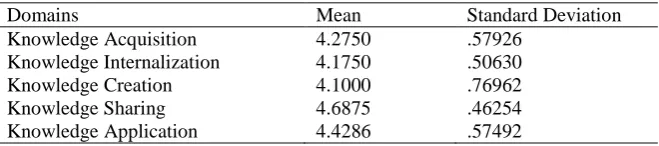
Participants perceived that they shared, applied and acquired knowledge. The analysis of the KM processes from the KMQ showed higher scores for the sharing and application of knowledge (Mean=4. 6875; S.D. = 0.46254; and Mean=4.4286; S.D.=0.57492, respectively) (see Table 1). The students had shared Knowledge: “exchanged
[image:4.595.134.464.627.700.2]opinions”; “We shared opinions openly and positively with friends”, “Sharing encouraged better and stronger ideas among us”, “Information was rapidly shared directly with the group.” The sharing gave the learner a responsibility to ensure information posted was accurate and well-organized. In addition there was application of Knowledge: “With Padlet I am able to learn to think fast”, “The sharing with my friends enabled me to understand the issues from different perspectives”, “I am able to connect all the information from my friends post to come up with important information.” And these processes led to the internalization and application of knowledge.
Table 1: Mean and standard deviation on KM domains
Domains Mean Standard Deviation
Knowledge Acquisition 4.2750 .57926 Knowledge Internalization 4.1750 .50630
Knowledge Creation 4.1000 .76962
Knowledge Sharing 4.6875 .46254
Knowledge Application 4.4286 .57492
Further analysis of the individual items showed that the students scored lowest on the knowledge creation aspect as they were uncertain whether they had generated knowledge (Mean=4.100; S.D. =0.76962). However, the analysis of the interviews indicated that the students had acquired useful knowledge: “I got to learn new knowledge that was useful”, “Many things I did not know, until my friends shared on the wall,” and “Got to
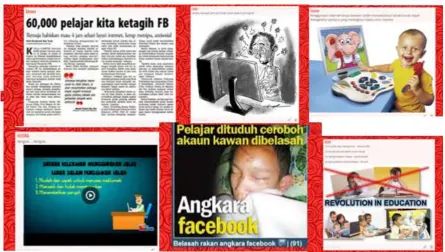
knowledge using search engines such as Google. This included pictures, text, web pages and videos as shown in Figure 1.
Figure 1: Screen captures of Post on Padlet using text, graphic and videos.
Although the students perceive that there was low knowledge internalization (Mean=4.1750; S.D. =0.50630), there was evidence of knowledge internalization “I am able to express my ideas better” and“Able to get others viewpoint and broaden my knowledge.” It was also observed that students were able to represent the knowledge acquired in different formats. The knowledge on the advantages and disadvantages of ICT had to be internalized so that new knowledge could be created among the students. Students had to use their internalized knowledge to summarize the information acquired, or to depict it in graphic form.
There was evidence of knowledge creation from the students’ response: “Generated new ideas”, “I thought out of the box, creatively and critically, got to train my mind to think fast and accurately.” The new knowledge created was transformed and displayed in different ways. The community of learners was learning new knowledge by observing their friends posts as well.
Table 2: Padlet as a learning tool
Items Mean S. D.
I like to see my friends comments on Padlet 4.5385 0.5970
Padlet enables me to share ideas with my friends 4.7436 0.4385
Because of Padlet, my class members are able to reach an agreement 4.3077 0.7579
I developed new ideas from the activities on Padlet 4.7436 0.4935
I learned new concepts from the other posts on Padlet 4.4872 0.5991
I learned through collaborative learning with Padlet 4.5128 0.6789
The materials posted on Padlet were clear 3.9744 0.6405
The materials posted on Padlet were useful 4.2564 0.6400
The activity on Padlet was challenging 3.5641 1.0595
I got ideas on the advantages and disadvantages of ICT from the materials posted on
Students’ Perceptions of Padlet
The students seemed to find Padlet a suitable tool for learning (see Table 2). They were interested in seeing their friends comments, and sharing on the platform (Mean = 4.5385, S. D. = 0.5970, and Mean = 4.7436, S. D. = 0.4385 respectively). Besides learning new concepts and through collaboration (Mean = 4.4872, S. D. = 0.5991, and Mean = 4.5128, S. D. = 0.6789), the students seemed to agree that they developed new ideas from the interactive debate (Mean = 4.7436, S. D. = 0.4935 and Mean = 4.5128, S. D. = 0.5057). There was less agreement on whether the activity was challenging (Mean = 3.5641, S. D. = 1.0595). This was perhaps due to the fact that the tool was easy to use.
CONCLUSIONS
The findings show that interactive debates using Padlet could be used for instruction. The students seem to agree that there was learning and sharing of information as they generated new knowledge while going through the processes of knowledge acquisition, sharing, internalization, application and creation (Dalkir, 2011, Kappes & Thomas 1993; Vásquez-Bravo, Sánchez-Segura, Medina-Domínguez, & Amescua, 2013). In addition, this was an interesting way of learning which could motivate students to learn better. This was evidenced through the many forms of knowledge generated after internalization occurred. An interesting point to note was that students in many of these studies seemed to perceive that there was little new knowledge generated, but analysis indicated that the learners were internalizing and generating new knowledge (DeWitt, Alias, Siraj, & Hutagalung, 2014; DeWitt, Alias, Siraj, & Zakaria, 2014).
Padlet was a web 2.0 tool which enabled interaction and collaboration. Hence, Padlet is a good alternative to reduce the communication gap among student teachers and peers. The use of Web 2.0 tools may indeed facilitate communication and interaction among students. As a cultural tool, Padlet provided the platform for generating new knowledge (Gredler, 1997; So & Bonk, 2010; So, Tan, & Tay, 2012; Rogers, Connelly, Hazlewood, & Tedesco, 2010; Zhu, 2012). This further proved that collaborative learning encouraged cognitive processes during the interactions as the learners acquired new ideas from knowledge shared (DeWitt, Alias, Siraj, & Zakaria, 2014; Palloff & Pratt, 1999; Rogers, Connelly, Hazlewood, & Tedesco, 2010; So, Tan, & Tay, 2012).
.
Although many studies have been conducted using web 2.0 tools to investigate the learning process, there has not been many done in the Malaysian context, and studies done have mainly concentrated on discussion forums and wikis (DeWitt, Alias, & Siraj, 2014; DeWitt, Alias, Siraj, & Hutagalung, 2014; DeWitt, Alias, Siraj, & Zakaria, 2014). There is a lack of studies done to investigate the different instructional designs for learning using web 2.0 tools. Hence, more studies can be done to investigate the use of this free tool, Padlet, and to investigate different systems which can be used for instruction and learning in different subject areas, and for different samples.
In order to produce innovative and knowledgeable students who have higher level thinking skills, web 2.0 tools may be a possible solution. Hence, designs and models for instruction for learners to generate new knowledge and use these skills are required for instructors to be creative and effective in their teaching.
REFERENCES
Biasutti M. & El-Deghaidy, H. (2012). Using wikis in teacher education: Impact on knowledge management processes and student satisfaction. Computers and Education 59, 861–872.
Bishop, M. J. & Elen, J. (2014). Emerging Technologies. In J.M. Spector, M. D. Merrill, M. J. Bishop, & J. Elen, J. (eds.), Handbook of Research on Educational Communications and Technology (pp. 673-674). New York, NY : Springer Science+Business Media. doi: 10.1007/978-1-4614-3185-5_60
Bligh, D. (2000). What’s the point in discussion? Exeter, UK: Intellect Books.
Bonk, C. J., Lee, M. M., Kim, N., & Lin, M.-F. G. (2009). The tensions of transformation in three cross-institutional wikibook projects. The Internet and Higher Education, 12, 126–135. doi: 10.1016/j.iheduc.2009.04.002
Boticki, I., Looi, C. K., & Wong, L. H. (2011). Supporting mobile collaborative activities through scaffolded flexible grouping. Educational Technology and Society, 14(3), 190-202.
Cranfield, D.J. & Taylor, J. 2008. Knowledge management and higher education: A UK case study. The Electronic Journal of Knowledge Management 62, 85–100.
Dalkir, K. 2011. Knowledge Management in Theory and Practice (2nd Ed.). Cambridge, MA: MIT Press. DeWitt, D., Alias, A., Siraj, S., & Zakaria, A. R. (2014). Interactions in Online Forums: A Case Study Among
DeWitt, D., Alias, N. & Siraj, S. (2014). The design and development of a collaborative mLearning prototype for Malaysian secondary school science. Educational Technology Research and Development, 62 (4), 461-480
DeWitt, D., Siraj, S., & Alias, N. (2014). Collaborative mLearning: A Module for Learning Secondary School Science. Educational Technology & Society, 17 (1), 89–101.
DeWitt, D., Norlidah Alias, Zainuddin Ibrahim, Ngu Kee Shing, & Syar Meeze Mohd. Rashid (2014). Design of a learning module for the deaf in a higher education institution using padlet. In: International Educational Technology Conference 2014, 03-05 Sep 2014, Chicago, USA.
DeWitt, D., Naimie, Z., & Siraj, S. (2013). Technology Applications Used by First year Undergraduates in a Malaysian Public University. Procedia - Social and Behavioral Sciences, 13th International Educational Technology Conference, 103, 937 945 doi: 10.1016/j.sbspro.2013.10.416 ScienceDirect
Dewitt, D., Alias, N., Siraj, S. & Hutagalung, F. (2014). Designing instruction for Knowledge management processes using a wiki. CrC/Balkema Taylor & Francis Group Netherland, pp. 02-106. ISBN.978-1-138-133- 6.e-Book. ISBN:978-1-315-77552-4
Grabe, M. & Grabe, C. (2004). Integrating technology for meaningful learning (4th ed.). Boston, MA: Houghton Mifflin Co.
Hsu, Y.-C., Ching, Y.-C. and Grabowski, B. L. (2014). Web 2.0 applications and practices for learning through collaboration. In J.M. Spector, M. D. Merrill, M. J. Bishop, & J. Elen, J. (eds.), Handbook of Research on Educational Communications and Technology, (pp. 747-758). New York : Springer Science+Business Media. doi: 10.1007/978-1-4614-3185-5_60.
Johnson, D. W., & Johnson, R. T. (2004). Cooperation and the use of technology. In D. H. Jonassen (Ed.),
Handbook of research on educational communications and technology (2nd ed.) (pp. 785-812). Mahwah, NJ: Erlbaum..
Kuo, F.-R., Hwang, G.-J., Chen, S.-C., & Chen, S. Y. (2012). A cognitive apprenticeship approach to facilitating web-based collaborative problem solving. Educational Technology & Society, 15(4), 319–331.
Martin, A. 2006. Literacies for the Digital Age. In A. Martin & D. Madigan, (eds.), Digital literacies for learning, ( pp. 3-25). London: Facet Publishing,
Ma Ping. (2012). Development of a self-regulated vocabulary learning strategy instrucional module for Chinese EFL learners. Unpublished Doctoral thesis University of Malaya, Kuala Lumpur
Ministry of Education (2015). Malaysia Education Blueprint 2015 - 2025 (Higher Education). Putrajaya: Ministry of Education.
Ministry of Higher Education (2011). The National Higher Education Action Plan (2011-2015). Retrieved from http://www.mohe.gov.my/transformasi/fasa2/psptn2-eng.pdf
Muhammad Sabri & Nor Aziah Alias&Zawawi Ismail & Nurulhuda Osman. (2012). Employing design and development reserach(ddr) approaches in the design and development of online arabic vocabulary learning games prototype, Turkish Online Journal of Educational Technology,11(2), 108–119
Norlidah Alias. (2010). Pembangunan Modul Pedagogi Berasaskan Teknologi Dan Gaya Pembelajaran Felder-Silverman Kurikulum Fizik Sekolah Menengah. Tesis Universiti Malaya.
Palloff, R. M., & Pratt, K. (1999). Building learning communities in cyberspace: Effective strategies for the online classroom. San Franscisco, CA: Jossey-Bass.
Puntambekar, S. (2006). Analyzing collaborative interactions: Divergence, shared understanding and construction of knowledge. Computers and Education, 47, 332–351. doi:10.1016/j.compedu.2004.10.012 Padlet Blog (2013). Graffiti : The Padlet/Wallwisher blog. Retrived http://blog.padlet.com/
2013/03/1000-uses-of-padlet-8-managing-tasks.html
Rogers, Y., Connelly, K., Hazlewood, W., & Tedesco, L. (2010). Enhancing learning: A study of how mobile devices can facilitate sensemaking. Personal Ubiquitous Computing, 14, 111-124.
Ronen, T. & Pasher, E. 2011. Complete Guide to Knowledge Management A Strategic Plan to Leverage Your Company's Intellectual Capital. Hoboken, NJ: Wiley.
Sharma, A., & Anderson, C.W. (2009). Recontextualization of Science from Lab to School: Implications for Science Literacy. Science & Education, 18:1253–1275, DOI 10.1007/s11191-007-9112-8
Schunk, D. H. (2000). Learning theories: An educational perspective (3rd ed.). Upper Saddle River, NJ: Merrill Prentice Hall.
Shedletsky, S. (2010). Critical Thinking in Discussions; Online verses face to face. In Russell D, Cases on Collaboration in Virtual Learning Environments: Processes & interactions. Hershey: Information Science Reference.
So, H.-J., & Bonk, C. J. (2010). Examining the Roles of Blended Learning Approaches in Computer-Supported Collaborative Learning (CSCL) Environments: A Delphi Study. Educational Technology & Society, 13
(3), 189–200.
So, H. J., Tan, E., & Tay, J. (2012). Collaborative mobile learning in situ from knowledge-building perspectives.
Timmis, S. (2012). Constant companions: Instant messaging conversations as sustainable supportive study structures amongst undergraduate peers. Computers and Education, 59(1), 3-18.
Tubbs, S. L. (1995). A systems approach to small group interaction (5th ed.). New York, NY: McGraw-Hill. Vanitha Thanabalan. (2011). Development of a digital story pedagogical module to facilitate reading among
indigenous primary school students. Unpublished Doctoral Thesis. University Malaya.
Vasquez-Bravo, D-M., Sánchez-Segura, M.I., Medina-Dominguez, F. & de Amescua, A. (2013) Knowledge Management Acquisition Improvement by using Software Engineering Elicitation Techniques. Computers in Human Behavior, 30, 721-730
Weller, A. (2013). Learning in science education. Research in Teacher education, 3(2), 40–46.
Zhu, C. (2012). Student satisfaction, performance, and knowledge construction in online collaborative learning.