© 2016, IRJET ISO 9001:2008 Certified Journal
Page 338
Re-Ranking Classification in MMQA Using Intelligent Query Specific
Semantic Signatures
Chandramoorthy.M
1, Padmapriya.B
2, Sirpa.M.R
3, Vyshnavi.G.K.P
41234
M.E/Dept. of CSE
---***---Abstract
-
Multimedia re-ranking system is an effective approach for refine the text based image and video search. In most of the proposed method is based on low level visual features. In this paper, we propose to exploit intelligent query specific semantic signatures for multimedia search re-ranking by given user keywords. The most existing systems is keywords are proceedings with randomly, then it achieves the results. Those results are classified into text, image and video from the web usage data’s with random results. In this work to solve automated questions and answering systems by using Stemming algorithm and hyper graph learning. The proposed method to find the answers using Google Application Program Interface technology for retrieve the Multimedia data’s from over the Internet. An existing system, question and answer are based on only texting. In this method the retrieval answers are enriched multimedia content, then user can understand with easily for their industry and academic domain usage. Here the Google search engine, as a tool for retrieve appropriate answers from the web data or web mining with given user keywords or questions. Here results are classified into text, images and videos by their pre-defined attribute features by the using of hyper graph learning methodology. In proposed system is designed to achieve appropriate searching results with more efficient.Keywords: Google API Technology, Hyper graph, Multimedia,
Attributes, Question and Answering and MMQA.
1.
INTRODUCTION
The multimedia online searching is most important application in the field of academic and Industrial purpose. Many multimedia search engines such as Google, Bing and Ask have relied on matching information about images and videos against the queries given by users. The main objective is to extend text based question answering to multimedia question answering. Here used stemming and partial-match retrieval algorithm for getting the best solution. The intelligent semantic signatures can more accurate model the images and videos to be re-ranked, since they have [3] excluded other potentially unlimited number of irrelevant concepts, which serve only as noise and deteriorate the
re-ranking performance on both accuracy and computational cost. Different query images, the effective low-level visual features are different. Therefore, queries classified query images into predefined intention categories and gave different feature weighting schemes to different types of query images. To solve automated QA systems [2], Using Stemming algorithm and partial match retrieval algorithm in Google API technology. If the answer is enriched with multimedia content, then the user will understand the answers easily. For searching the multimedia answer are getting by using the Google search engine as a tool so the answer will get from the web data so here we need to analyse and Re-Rank the search results with an effective approach to refine the text-based image search result. Most existing re-ranking approaches are based on low-level visual features. In this paper, to exploit semantic attributes for Image search re-ranking. Based on the classifiers for all the predefined attributes, each image is represented by an attribute feature consisting of the responses from these classifiers. A hyper graph [3], [9] is used to model the relationship between images by integrating low-level visual features and attribute features. Hyper graph ranking [9] is performed to order the images. Its basic principle is that visually similar images should have similar ranking scores. In this work, the proposed system is visual-attribute joint hyper graph learning approach to simultaneously explore two information sources. A hyper graph is constructed to model the relationship of all images. It will give more relevant answers for the given input query from the user.
1.1.
Web mining
© 2016, IRJET ISO 9001:2008 Certified Journal
Page 339
Internet. Some users might be looking at only textual data, whereas some others might be interested in multimedia data. Web Usage Mining is the application of data mining techniques to discover interesting usage patterns from the Web data in order to understand and better serve the needs of Web-based applications. Web usage mining itself can be classified further depending on the kind of usage data considered:
Web Server Data: The user logs are collected by the
Web server. Typical data includes IP address, page reference and access time.
Application Server Data: Commercial application
servers have significant features to enable e-commerce applications to be built on top of them with little effort.
Application Level Data: New kinds of events can be defined in an application, and logging can be turned on for them thus generating histories of these specially defined events. It must be noted, however, that many end applications require a combination of one or more of the techniques applied in the categories above.
Web mining is an important component of content pipeline for web portals. It is used in data confirmation and validity verification, data integrity, building taxonomies, etc.
2.
RELATED WORK
Image search re-ranking is an effective approach to refine the text-based image search result. Most existing re-ranking approaches are based on low-level visual features. In this paper [3] to exploit semantic attributes for image search re-ranking. Based on the classifiers for all the predefined attributes, each image is represented by an attribute feature consisting of the responses from these classifiers. A hyper graph [9] is then used to model the relationship between images by integrating low-level visual features and attribute features. Hyper graph ranking is then performed to order the images. The article [1] contains a historical perspective on question answering over restricted domains and an overview of the current methods and applications used in restricted domains. Recently, visual re-ranking has been proposed to refine text based search result by exploiting the visual information contained in the images. The existing visual re-ranking [3] methods can be typically categorized into three categories as the clustering based, classification based and graph based methods. Image search re-ranking has been studied for several years and various
approaches have been developed recently to boost the performance of text-based image search engine [3] for general queries. We observe that semantic attributes are expected to narrow down the semantic gap between low-level visual features and high-low-level semantic meanings. Its basic principle is that visually similar images should have similar ranking scores and a visual-attribute joint hyper graph learning approach has been proposed to simultaneously explore two information sources. This experiment conduct on 1000 queries in MSRA-MM V2.0 dataset [3]. Content-based video search re-ranking can be regarded as a process that uses visual content to recover the “true” ranking list from the noisy one generated based on textual information [6].
3. OBJECTIVES & OVERVIEW OF THE PROPOSED
MECHANISM
3.1. Objectives of the proposed mechanism
Question-Answering (QA) is a technique for automatically answering a question posed in natural language. Compared to keyword-based search systems, it greatly facilitates the communication between humans and computers by naturally stating user’s intention in plain sentences. It also avoids the pain staking browsing of a vast quantity of information contents returned by search engines for the correct answers. However, fully automated QA still faces challenges that are not easy to tackle, such as the deep understanding of complex questions and the sophisticated syntactic, semantic and contextual processing to generate answers. In this system, we use MMQA that automatically determines which type of media information should be added for textual answer by collecting data from web to enrich the answer with appropriate results and more efficient.
3.2. Overview of the Proposed Mechanism
© 2016, IRJET ISO 9001:2008 Certified Journal
Page 340
classified query images into eight predefined intention categories and gave different feature weighting schemes to different types of query images. To solve automated QA systems, Using Stemming algorithm and partial match retrieval algorithm in Google API technology. For searching the multimedia answer we are using the Google search engine as a tool so the answer will get from the web data so here we need to analyse. Most existing re-ranking approaches are based on low-level visual features. In this paper to exploit semantic attributes for image search re-ranking. Based on the classifiers for all the predefined attributes, each image is represented by an attribute feature
consisting of the responses from these classifiers. A hyper graph is used to model the relationship between images by integrating low-level visual features and attribute features. Hyper graph ranking is performed to order the images. A hyper graph is constructed to model the relationship of all images. This experiment conducted by using Google API technology over the internet it demonstrates more effectiveness and appropriate searching results.
3.
EXPERIMENTAL ARCHITECTURE AND
IMPLEMENTATION
3.1 Query Result by using Google API
[image:3.612.77.568.309.601.2]© 2016, IRJET ISO 9001:2008 Certified Journal
Page 341
Google search engine has a market share of over 60%. For some advanced features, such as searching metadata or relevant info of an object, we maybe want to integrate search result of Google search engine instead of inventing our own one. Here the steps how we can consume Google Custom Search API in .Net. The code itself is pretty short. However, because of lacking documentation it’s really time consuming to find out how the code should be, where to get the API Key or Search Engine ID for authentication. A Search Engine Results Page (SERP) is the listing of results returned by a search engine in response to a keyword query. A SERP may refer to a single page of links returned, or to the set of all links returned for a search query. Web search navigator: Search is useful to visitors who know exactly what they are looking for. Website navigation is important to the success of your website visitor’s experience to your website.
4.2 Pattern Selection
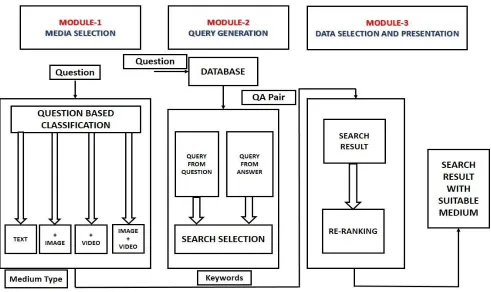
Text: - For the “yes/no”, “choice” and “quantity” questions, we categorize them into the class of answering with only text. Therefore, given a question, we first judge whether it should use only textual answer based on the interrogative word.
Text & image:- If the question is classified into “enumeration” and “description” class then the answer medium will be selected as “text + image” when we search answers in web we will add text search answers and the image search answers for the input query.
Text & Video: - The verbs in an answer will be useful for judging whether the answer can be enriched with video content. Intuitively, if a textual answer contains many complex verbs, it is more likely to describe a dynamic process and thus it has high probability to be well answered by videos. Therefore, verb can be an important clue.
Text & Image & Video: - The verbs in an answer will be useful for judging whether the answer can be enriched with stream of images as well as video content. If the questions contains following string then the answer medium is selected as “text + image + videos”.
4.3. Web search navigator
Search is useful to visitors who know exactly what they’re looking for. But including a search option isn’t an excuse to ignore good information architecture. It’s still important to make sure that your content is findable for visitors who might not know exactly what they’re looking for or are browsing to discover potentially interesting content.
4.4. Experimental Techniques
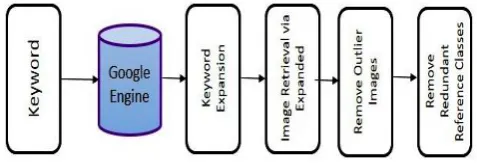
Ranking Method: For a keyword q, we
automatically define its reference classes through finding a set of keyword expansions E(q) most relevant to q. To achieve this, a set of images S(q) are retrieved by the search engine using q as query based on textual information. Keyword expansions are found from the words extracted from the images in S(q)3. A keyword expansion e € Eq is expected to frequently appear in S(q). In order for reference classes to well capture the visual content of images, we require that there is a subset of images which all contain e and have similar visual content. Based on these considerations, keyword expansions are found in a search-and-rank way as follows. For each image I € S(q), all the images in S(q) are reranked according to their visual similarities (defined in [10]) to I. The T most frequent words WI = {wI1 ;wI2,….wIT} among top D re-ranked images are found. If a word w is among the top ranked image, it has a ranking score rI (w) according to its ranking order,
Otherwise rI (w) = 0,
--- (1) The overall score of a word w is its accumulated ranking scores over all the images,
--- (2)
Stemming Algorithm: Stemming is the process for
reducing inflected (or sometimes derived) words to their stem, base or root form – generally a written word form. The process of stemming is often called conflation. These programs are commonly referred to as stemming algorithms or stemmers. The process of stemming is useful in search engines for Query expansion, Indexing and Natural language processing.
A stemming algorithm is a process of linguistic normalization, in which the variant forms of a word are reduced to a common form. Number of words per conflation class. This is the average size of the groups of words converted to a particular stem. The value is easily calculated as follows:
MWC=N/S --- (3)
Where, MWC - Mean number of words per conflation Class.
N - Number of unique words before Stemming S - Number of unique stems after Stemming.
Partial-Match Retrieval Algorithms: In this
© 2016, IRJET ISO 9001:2008 Certified Journal
Page 342
algorithms for retrieving from a file of k-letter words all words which match a partially-specified input query word (for example, retrieving all six-letter English words of the form S**R*H where “*” is a “don’t care” character). We precisely characterize those balanced hash-coding algorithms with minimum average number of lists examined. Use of the first few letters of each word as a list index is shown to be one such optimal algorithm. A new class of combinatorial designs provides better hash functions with a greatly reduced worst-case number of lists examined, yet with optimal average behaviour maintained. Another efficient variant involves storing each word in several lists. Tree-search algorithms are shown to be approximately as efficient as hash-coding algorithms, on the average. In general, these algorithms require time about find the orders
O (n^ {(k - s)/k}) --- (4) Where, s letters specified, given a file of nk-letter words.
Semantic Signatures: Given M reference classes for
keyword q and their training Images automatically retrieved, a multi-class classifier on the visual features of images is trained and it outputs an M-dimensional vector p, indicating the probabilities of a new image I belonging to different reference classes. Then p is used as semantic signature of I. The distance between two images Ia and Ib are measured as the L1-distance between
Their semantic signatures pa and pb.
d(Ia, Ib)=||pa-pb|| ---(5)
4.5. Information retrieval Textual QA Multimedia
Question Answering
Here need to identify the challenges in achieving MMQA from the aspects of user intent, data scope,
question processing, and answer presentation.
Determining User intent when users search for pictures, they might not have a clear idea about what they are looking for user’s browsers, surfers, and searchers based on the clarity of their intent. However, with QA, users can more specifically express what they want. Still, this field requires meaningful work toward more precisely capturing user intent and improving answer quality by better understanding user’s intent, for example, using question suggestion.
4.6. Choosing the Proper Medium
A QA system’s design should be influenced by the nature and scope of the data. In QA, data scope refers to data sources and mediums that are, determining the best
sources and mediums (image, audio, video, or a hybrid) to answer a query. The process covers three components. First, given a question and its community-contributed answer in the cQA corpus, it determines which type of medium we should add to enrich the textual answers. By deeply exploring the linguistic cues from QA contexts and potential media answers, each QA pair is categorized into one of the four predefined classes: text only; text and image; text and video, or text, image, and video. The proposed scheme then automatically extracts and selects the more informative query for multimedia search. Following that, with the generated query, the system vertically collects and selects relevant image and video data with visual content analysis.
Fig 2. Re-Ranking Framework module
4.7. Extracting Queries from Questions
The querying modalities supported by search systems include keywords, free text, image, graphics, and composites. Their processing methods have been broadly characterized from a system perspective as text-based, content based, composite, interactive-simple, and interactive-composite. However, the QA paradigm mainly utilizes the free-text modality because users enter natural-language questions. Samuel Huston and W. Bruce Croft examined query processing techniques that can be applied to verbose queries prior to submission to a search engine to improve the search engine’s results. Because search is key to QA, their proposed verbose query processing would be meaningful in a QA strategy design using Web knowledge. Real world Evaluation Datasets and forums Criteria Metrics Modules Medium analysis Visual signature Similarity measures Re-Rank Classification and clustering based on their predicted quality and selecting the top sub query.
4.8. “How-To” Question-Answering
[image:5.595.314.553.295.378.2]© 2016, IRJET ISO 9001:2008 Certified Journal
Page 343
The ability to answer such questions requires understanding of the relevant contents, and often involves the generation of specific answers. This is beyond the capability of current technologies unless it is for a very narrow domain. Because of the strong demands for such services, community-based QA services [2], such as Yahoo! Answers, have become very popular. Through Yahoo! Answers services, people ask a wide variety of "how-to" questions and obtain answers either by searching for similar questions on their own or waiting for other users to provide the answers. As large archives of question-answer pairs are built up through user collaboration, the knowledge is accumulated and is ready for sharing.
4.9. Presenting Answers
Traditional search presents results using a sorted list of descending relevancy. QA attempts to return a precise answer. Traditional QA employs a search technique for retrieving potential documents, further locates the paragraph that likely contains the answer, and finally analyzes the text segment to compose an answer, in essence providing a summarization. In contrast, MMQA can use multimodality summarization or semantic summarization to present an answer by summarizing the retrieved potential answers from various sources (text, image, audio, video, or a hybrid) at the semantic level.
3
4
2.5
0 0.5 1 1.5 2 2.5 3 3.5 4 4.5
Text Images Videos
Re-Ranking MMQA
Ranking
Re-Ranking
Chart 1. Averaged Re-Ranking in MMQA.
4.
CONCLUSION
In this novel is MMQA re-ranking framework, which learns intelligent semantic spaces to significantly improve the effectiveness and efficiency of online image and video searching. Mainly focused on narrow domains at a more general approach, propose a novel scheme to
answer questions using multimedia data by leveraging textual answers in QA. For a given QA pair, in this work first predicts which type of medium is select for enriching the original textual answer than it automatically generates with query based QA knowledge and performs multimedia searching. Finally, query adaptive re-ranking and duplicate removal are performed to obtain a set of images and videos. Different from the conventional MMQA research that aims to automatically generate multimedia answers with given questions which is help of community contributed answers and it can deal with more general questions and achieve better performance. Here adopt a method for removing more irrelevant searching results, it has better efficiency and performance of video search based QA systems.
REFERENCES
[1]. D. Molla and J. L. Vicedo,”Question answering in restricted domains: An overview Computat Linguist”, vol.13 pp.41-61, 2007.
[2]. L. A. Adamic, J. Zhang, E. Bakshy, and M. S. Ackerman,”Knowledge sharing and Yahoo answers: Everyone knows something,” in Proc. Int. World Wide Conf., 2008.
[3]. Junjie Cai, Zheng-Jun Zha,” An attribute-assisted Re-Ranking Model for Web Image Search” Vol.24, PP-261-272, Jan-2015.
[4]. Y.C. Wu and J.C.Yang,”A robust passage retrieval algorithm for video question answering” IEEE Trans.Circuits Syst.Video Technolo., vol.18, no.10, pp 1411-1421, 2008.
[5]. T.S.Chua,R.Hong,G.Li,and J.Tang, ”From Text question-answering to multimedia QA on web-scale media
resources,” in Proc.ACM Workshop Large-scale
Multimedia Retrieval and Mining,2009.
[6]. X.Tian, L.Yang, J.Wang, Y.Yang, X.Wu, and X.S.Hua,”Bayaesian video search rearranging,” in Proc.ACM Int.Conf.Multimtdia 2008.
[7]. R.Yan, A.Hauptmann, and R.Jin,”Multimedia search with pseudo relevance feedback,” in Proc.ACM Int.Conf.Image and video Retieval, 2003.
[8]. W.H.Hsu, L.S.Kennedy, and S.-F.Chang,”Video search rearranging through random walk over document-level context graph,” in Proc.ACM, Int.Conf, Multimedia, 2007. [9]. Teruhisa HOCHIN and Tatsuo TSUjI “A Directed Recursive Hypergraph Data Model for Representing the Contents of Multimedia Data”, Dept of Information Science, Aug-2000.
© 2016, IRJET ISO 9001:2008 Certified Journal
Page 344
BIOGRAPHIES
Chandramoorthy.M1 received the B.E. degree at the stream of Electronics and Communication Engineering from the
Thangavelu Engineering College,
Chennai, Anna University, India, in 2012. Currently doing M.E. at the stream of Computer Science and Engineering in Institute of Road and Transport Technology, Erode, Anna University, Chennai, India. His research interest includes in “Re-Ranking Classification in MMQA Using Intelligent Query Specific Semantic Signatures”.
Padmapriya.B2 received the B.E. degree at the stream of Computer Science and Engineering from the SNS College of Technology, Coimbatore, Anna University, Chennai, India, in 2014. Currently doing M.E. at the stream of Computer Science and Engineering in Institute of Road and Transport Technology, Erode, Anna University, Chennai, India. Her research interest includes in “Re-Ranking Classification in MMQA Using Intelligent Query Specific Semantic Signatures”.
Sirpa.MR3 received the B.E. degree at the stream of Computer Science and
Engineering from the Excel
Engineering College, Sankagiri, Anna University, India, in 2013. Currently doing M.E. at the stream of Computer Science and Engineering in Institute of Road and Transport Technology, Erode, Anna University, Chennai, India. Her research interest includes in “Re-Ranking Classification in MMQA Using Intelligent Query Specific Semantic Signatures”.
Vyshnavi.GKP4 received the B.E. degree at the stream of Computer Science and Engineering from the Vivekanandha
Institute of Engineering and