An Adaptive Video Coding Control Scheme
for Real-Time MPEG Applications
Shih-Chang Hsia
Department of Computer and Communication Engineering, National Kaohsiung First University of Science and Technology, Kaohsiung 824, Taiwan
Email:[email protected]
Received 27 February 2002 and in revised form 16 September 2002
This paper proposes a new rate control scheme to increase the coding efficiency for MPEG systems. Instead of using a static group of picture (GOP) structure, we present an adaptive GOP structure that uses more P- and B-frame coding, while the temporal correlation among the video frames maintains high. When there is a scene change, we immediately insert intramode coding to reduce the prediction error. Moreover, an enhanced prediction frame is used to improve the coding quality in the adaptive GOP. This rate control algorithm can both achieve better coding efficiency and solve the scene change problem. Even if the coding bit rate is over the predefined level, this coding scheme does not require re-encoding for real-time systems. Simulations demonstrate that our proposed algorithm can achieve better quality than TM5, and satisfactory reliability for detecting scene changes.
Keywords and phrases:control strategy, MPEG, rate control, scene change, temporal correlation.
1. INTRODUCTION
Recently, the video coding systems have been widely applied to digital TV, video conferencing, multimedia systems, and so forth, primarily, in order to reduce the bit rates [1,2,3]. It is well known that most coding techniques will generate variable bit rates in various video sequences. To transmit the variable rate bit stream over a fixed rate channel, a channel buffer is required. Therefore, the main purpose of the rate control algorithm is to prevent the buffer from overflowing and underflowing and to generate a constant bit rate for tar-gets. To regulate the fluctuation of the coding rate, we need to allocate the compressed bit of each frame by choosing a suit-able quantization parameter for each macroblock. The fun-damental buffer control strategy adjusts the quantizer scale according to the level of buffer utilization [4,5,6]. When the buffer utilization is high, the quantization level should be in-creased accordingly.
In a practical MPEG system, the picture type is selected from Intra, Predict or Bidirectional frames [7]. Moreover, there are many choices for macroblocks coding, including the intraframe code, the interframe code by motion compensa-tion, or simply a replica from the previous frame. The se-lection of quantization scale, coding mode, and picture type will decide the coding bit rate, and consequently affect the coding quality. Due to the extremely high complexity of the optimal coding, various suboptimal solutions have been pro-posed [8,9, 10]. Generally, the image quality is improved about 2 dB compared with TM5 method [11]. Based on the
model of rate distortion curve, the computation load be-comes very high. In addition, if the coding result is not sat-isfactory, re-encoding procedures are required in these ap-proaches. Because this re-encoding process will increase the computational time, it is not desirable for real-time applica-tions.
In this study, a novel coding strategy is proposed to im-prove the coding efficiency, especially for real-time applica-tions. Our method can decide the coding parameters at once and avoid the need for re-encoding procedures even if the coding bit rate is over the predefined maximum level or a scene change is detected. This paper is organized as follows. An adaptive control strategy is presented inSection 2, experi-mental results are described inSection 3, and conclusions are given inSection 4.
2. AN ADAPTIVE CODING CONTROL ALGORITHM
For video coding systems, first-in first-out (FIFO) memory is generally used to regulate the fluctuation of the coding rate. A basic control structure is shown inFigure 1. As the coding procedure continues, the current FIFO occupation becomes
FIFOcurrent=FIFOprevious+
Codingbit−Targetbit, (1)
Video
sequence Coding kernel Coding data FIFO buffer
Constant target rate
Coding control
Figure1: The basic coding control scheme.
coding bit rate and the target bit rate. Because the mem-ory size is limited, we need to adjust the quantization level to avoid the buffer to overflow or underflow. In MPEG cod-ing systems, the fixed group of picture (GOP) structure is IBBPBBPBBPBBI, where the I-frame is the basic reference for P- or B-frame coding. P-frame coding uses the motion prediction from the I-frame or the previous P-frame, and B-frame coding employs the bidirectional prediction between the neighboring I-frame and frame, or between two P-frames. Therefore, the total coding bit rate for one GOP is then the sum of the coding bits of each frame, which is
GOPbit rate=Ibit+ Pbit+ Bbit, (2)
where Ibit, Pbit, and Bbit are the coding bits for the I-frame, P-frame, and B-frame, respectively.
2.1. A new adaptive GOP structure
When the static GOP structure is used, the coding efficiency of its P- or B-frames becomes poor for low correlation se-quences due to high prediction errors. An extreme case is that if the video sequence changes suddenly, the coded image may produce serious distortions. On the other hand, while the temporal correlation among the video frames is high, we can obtain better performance by applying more P- and B-frames coding. Hence the coding quality will be much better since the motion compensation from the previous frame is done. This is particularly effective for low motion sequences. One of the effective compensation methods is the adaptive GOP (AGOP), where the structure is dynamically modified according to the temporal correlation between interframes.
The AGOP concepts are proposed as follows. First, the P-and B-frames are continuously coded by the prediction mode until one of the following conditions occurs:
(i) if the buffer utilization is very low, then the I-frame will be coded to avoid the buffer underflowing; (ii) if the video sequence changes suddenly, that is,
P(n)bit P(n−1)bit is detected, where P(i)bit is the coding bit rate for theith P-frame, then we re-encode thenth frame using an I-frame coding rather than a P-frame coding;
(iii) if the accumulated error gradually becomes high such that
the current P-frame coding rate is higher than the averaged bit rate of the previous m frames and over a predefined threshold, then thenth frame uses an I-frame coding.
In the above processing, the GOP structure is adaptively changed in accordance with the temporal correlation of the previous frames. If the intervening frames have high correla-tion, we use more prediction coding to reduce the temporal redundancy until the accumulated error becomes too large or a scene change is detected. When video sequences go on, the scene change point may be at the I-, B-, or P-frames. If the scene change is at the I-frame, the reference memory is reset by the I-frame itself, and so there will be no problems for the next P- or B-frame prediction. Since the B-frame has bidirec-tional prediction, there are no serious errors when the scene change occurs at the B-frame. However, if the scene change occurs on a P-frame, the predicted error will be high due to the lack of temporal correlation. Then the predicted error will accumulate to the next frame coding and the coding per-formance thus degrades seriously. It is a direct method that we can re-encode the current frame using an I-frame cod-ing for the off-line system when a scene change is detected or the temporal correlation becomes very low. However, we also aim to reduce the processing time as much as possible for the requirements of real-time applications.
For real-time processing requirements, we monitor the coding condition using the slice base in the MPEG system. First, letNbe the number of slices used in the coding system. The first N slices bit rate (slicefirstcurrent) of the current frame is then compared with the first Nslices (slicefirstprevious) of the previous frame. In addition, let Qfirst
currentand Qfirstpreviousdenote the averaged quantization scales for the firstN slices of the current and the previous frames, respectively. If the averaged coding bit rates of theNslices for the adjacent frames have changed drastically, that is,
Qfirst
FirstNslice FirstNslice FirstNslice
Previous framen−1 Current framen Next framen+ 1 Scene change
1-frame coding Predict coding Figure2: The frame coding as scene change between (n−1)th and nth frames.
Sequence 1 Sequence 2
BGOP structure AGOP structure AGOP/BGOP BGOP stucture Figure3: The proposed adaptive GOP structure.
Based on this concept, a new AGOP structure is pre-sented in Figure 3. First, the basic GOP (BGOP) structure is employed, consisting of one I-frame, three P-frames, and eight B-frames, where the frame order is the same as the con-ventional GOP structure for MPEG systems. Next, an AGOP structure is applied, whose length depends on the tempo-ral correlation. Consequently, its length will be considerably shortened if a scene change is detected. In order to enhance the advantage of our new coding scheme, there is no I-frame used in the AGOP structure. We also adopt 12 frames as a coding unit to keep bit rate balancing. The sequence order is then
PeBBPBBPBBPBBPeBBPBB. . . , (5)
where Pe is an enhanced P-frame with a higher coding bit rate than that of a normal P-frame. We use a Pe-frame rather than an I-frame for high-correlated video sequences in or-der to reduce the temporal redundancy and the coding bit rate. Hence, the total coding efficiency is increased due to this motion compensation. The AGOP coding scheme ends when a scene change is detected or the accumulated error becomes too large, and then the coding procedure begins an-other BGOP processing.
It is important to note that for AGOP coding, if the cor-relation of local blocks is very low between two continuous frames in one sequence, high prediction errors will not only occur in the current block but also will be transferred to the next predicted block. To overcome this drawback, we employ an intrablock coding instead of the interblock coding for low correlation blocks in local areas. The following criterion can determine whether or not the current coding block uses an intrablock coding for P- or B-frames. If the mean absolute
difference (MAD) [12] from the result of motion estimation is very large, which implies that the predicted error is very serious, then an I-block coding is employed to reduce the predicted error. The coding mode for a macroblock can be determined by
if MAD<Th0,MV=0, then inter (skip) mode else if Th0<MAD<Th1,then inter (MC+DCT) mode else if MAD>Th1,MV=0, then intramode,
(6)
where thresholds were selected such that Th1>Th0is always used. If the MAD of the motion estimation is very low and the motion vector (MV) is zero, this implies that the current block is almost the same as the referenced one. Then the ref-erenced block can be duplicated instead of using the current block coding, so this coding block is assigned asinter(skip) mode. However, if the MAD result of the motion estimation is large, we switch fromintermodetointramodeto avoid high prediction errors. For fast and instantaneous real-time pro-cessing, it is necessary to evaluate the block correlation based on motion estimations first. So the coding mode for the mac-roblock will be selected from either the intramode or the in-termode to achieve better coding quality for each local block.
2.2. The coding bit rate budget 2.2.1 For BGOP structure
First, we estimate the bit rate for the I-frame coding. Since the I-frame is the basic reference frame, its coding error would be accumulated and propagated to the next P- and B-frames. To reduce the prediction error, we must appoint higher a bit rate for the I-frame coding. In any case, the cod-ing bit rate of an I-frame depends on the target rate and the frame rate of the system. Therefore, the bit rate for the I-frame must be constrained in a range of
Target Rate
Frame Rate×IRH≥Ibit≥
Target Rate
Frame Rate×IRL, (7)
where IRHand IRLdenote the maximum and minimum fac-tors, respectively, which were determined by the buffer status of the system. As the buffer utilization is high, the coding bit rate will be reduced accordingly. In order to control the bit rate in the constrained range, the quantization level for the I-frame is adaptively adjusted dependent on both the previous coding results and the buffer status.
The coding status of the system is monitored by a slice-base method as follows. An initial quantization level is cho-sen for the first slice coding as
QI 0=
Qmax+ Qmin
2 ×k, (8)
is in the range of
Target Rate NO slice×Frame Rate
×IRH
≥sliceIn≥
Target Rate NO slice×Frame Rate
×IRL,
(9)
where NO slice is the number of slices in one frame, there will be no change in the quantization parameter. Otherwise, the quantization level is adjusted
if sliceIn≥ IRH×Target Rate
n and QIn+1 denote the quantization scales for the current slice and the next slice, respectively. If the coding bit rate is over the predefined levels in the current slice, the quantization scale is increased or deceased by one level for the next slice in order to keep the specified bit rate. Hence, the coding rate can keep a dynamic balance during each frame coding. The final slice quantization scale is then recorded as an initial value for the first slice of the next I-frame coding.
In order to prevent the buffer from overflowing or un-derflowing, there should be a warning system for checking buffer status. In our method, the status of the buffer occupa-tion is not frequently extracted for quantizaoccupa-tion adjustment. When the percentage of the buffer utilizationP0falls in the range of 0.2≤P0 ≤0.8, the buffer operates in normal con-dition and the quantization level is not adjusted. Otherwise, the quantization level will be adjusted for the next slice cod-ing as follows:
From (10) and (11), the maximum quantization scale is in-creased by three when the slice coding rate is over the prede-fined level and the buffer utilizationP0 ≥ 80%. In another case, when the slice coding is lower than the predefined min-imum level, butP0≥80%, we also increase the quantization scale by one for the next slice coding.
Next, we discuss the rate control for P-frame coding. Be-cause most of the temporal redundancy for P-frames can be removed by using motion compensations, the coding bit rate for the P-frame is not as high as that of an I-frame. The P-frame bit rate is then chosen close to the target bit rate with
Target Rate
Frame Rate×PRH≥Pbit≥
Target Rate
Frame Rate×PRL, (12)
where PRH and PRL denote the maximum and minimum control rates, respectively, and are usually close to unity. We
also control the bit rate for P-frame coding with slice base, which can be expressed as
Target Rate NO slice×Frame Rate
×PRH
≥slicePn≥
Target Rate NO slice×Frame Rate
×PRL.
(13)
Similarly, to the I-frame coding, the quantization level for each slice of a P-frame is adaptively adjusted
if slicePn≥ PRH×Target Rate
Hence, during one GOP coding, the total output bit rate is then
Outputbit rate=Target Rate×NGOP
Frame Rate , (15)
where NGOP is the number of frames in one GOP. It is desirable to control the GOPbit ratein (2), very close to the Outputbit rate, to obtain a dynamic balance in the entire GOP coding period. If the GOPbit rate is equal to Outputbit rate, then
Ibit+ 3Pbit+ 8Bbit∼=Target Rate×12
Frame Rate , (16)
that is, the GOP structure is contained in one I-frame, three frames, and eight B-frames, and thus we assume that all P-and B-frames have the same coding rate. In order to achieve the dynamic balance, the coding bit rates of B-frames are adaptively modified to compensate for those of the I- and P-frames. Since B-frames are not used as references for mo-tion predicmo-tion, the B-frame coding is not as important as that of the I-frame and P-frames. Moreover, B-frames use the bidirectional prediction, and so their coding errors will be smaller. From (9), (13), and (16), the B-frame bit rate is
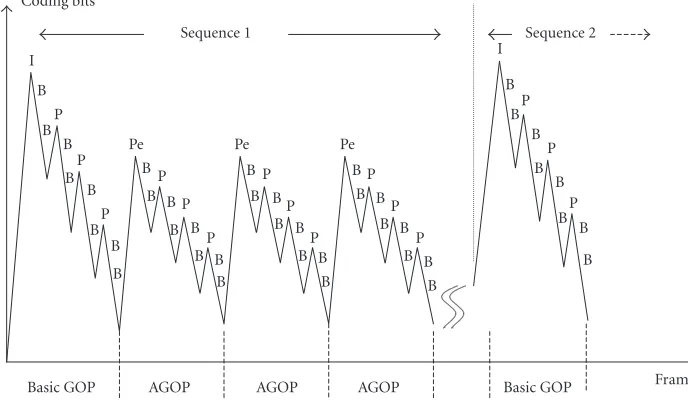
Sequence 1 Sequence 2 Coding bits
Basic GOP AGOP AGOP AGOP Basic GOP Frame
I
Figure4: The ideal buffer occupation in the proposed adaptive GOP.
2.3. For the AGOP
In order to obtain higher coding efficiency, the use of in-tracoding in the same video sequence should be avoided if the temporal correlation is high, which can be done as fol-lows. A video sequence can be partitioned into many AGOPs, and each AGOP consists of 12 frames as a coding unit that contains one enhanced P-frame (Pe), three P-frames, and eight B-frames. The enhanced P-frame is the starting point for each AGOP. Its position is like the I-frame of a BGOP, but its coding bit rate is not as high as an I-frame, which is given by
Target Rate NO slice×Frame Rate
NO slice×Frame Rate
×PeRL,
(18)
where PRH(L) < PeRH(L) < IRH(L). Its P- and B-frame cod-ing rates are similar to (12) and (17), respectively. The P- and B-coding bit rate may be slightly increased to improve the coding quality since the Pe-frame coding rate is usually less than that of the I-frame. The coding performance of the en-tire video sequence is then greatly improved from the motion compensation. The ideal buffer occupation of the proposed AGOP method is illustrated inFigure 4, where the coding bit rate can maintain dynamic balance during the entire GOP coding. However, coding bit rates can vary drastically for dif-ferent video sequences, so it is not easy to achieve an ideal buffer occupation for each GOP coding. Hence, we need to monitor the buffer status at the end of each GOP. If the buffer is occupied by one half or more at the end of the GOP cod-ing, the coding rate should be decreased in the next GOP to achieve the coding bit rate balance.
3. EXPERIMENTAL SIMULATIONS
In order to test the performance of our algorithm, four video sequences “Football,” “Susie,” “Flower-garden,” and “Sales-man,” the frame size with 352×288 resolutions, were em-ployed. To simulate the practical video sequences, we pasted the parts of each sequence together to form a test sequence as follows. The first 1–50 frames are from the “Football,” the 51–100 frames are from the “Phone-lady,” the 101–150 frames are from the “Flower-garden,” and finally the 151–200 frames are from the “Salesman.” For comparisons, we also tested this sequence using the well-known TM5 method [11].
The simulations were done under the condition of 400 k-bit buffer size, 1.2 M target bit rate, 30 frames per sec-ond, and the range of the motion search was−16∼+16. The initial parameters were set at IRH=5, IRL=4.5, PRH=1.5, and PRL = 1.2 for BGOP; and PeRH = 4, PeRL = 3.5, PRH = 1.7, and PRL = 1.4 for AGOP. These parameters may have±10% adjustments according to the buffer status.
0 20 40 60 80 100 120 140 160 180 200 Frame number
0 0.5 1 1.5 2 2.5
3 ×10⁵
Co
de
d
b
it
s
(bi
ts
)
Proposed TM5
(a) The coding rate for each frame.
0 20 40 60 80 100 120 140 160 180 200 Frame number
−1 0 1 2 3 4 ×10⁵
Bu
ff
er
status
(bits)
Proposed TM5
(b) The buffer occupation during 200 frames coding.
0 20 40 60 80 100 120 140 160 180 200 Frame number
20 25 30 35 40 45
PSNR
(dB)
Football Susie Flower-garden
Salesman Proposed
TM5
(c) The coding quality estimation for each frame. Figure5
was gradually increased for the next slice coding in order to avoid degradations of the coding quality suddenly. The buffer occupation was then slowly decreased as the coding contin-ues. During the 200 frames coding, the final buffer occupa-tion in our method is almost the same as that of the TM5, and the coding rate of our method was able to keep balance throughout the entire processing.
Next, we measured our coding quality using the above parameters with the results as shown inFigure 5c. Our adap-tive algorithm achieved an improvement of about 2∼ 5 dB PSNR on the average compared with the TM5 method for various sequences. The results show that our algorithm can provide much better quality for low motion sequences such as “Salesman.” We also notice the performance of the
(a) The decoded 151th image with our proposed method (PSNR=35.09 dB).
(b) The decoded 151th image with TM5 method (PSNR=23.78 dB).
Figure6
decoding sequence at the scene change. The decoded frames are individually shown inFigure 6using our algorithm and the TM5 coding at the 151th frame. The TM5 method usu-ally produces serious distortions in the decoded image due to high predicted errors at the scene change, but no visi-ble distortion was found from the reconstructed image by our method. Moreover, we compare the coding quality be-tween the I-frame of the static GOP using TM5 method and the enhanced P-frame of the proposed AGOP.Figure 7shows our enhanced P-frame and the decoded I-frame result at the 180th frame. Clearly, the proposed rate control scheme can improve the coding efficiency.
The coding performance is dependent on the reliability of scene change. To test and compare the function of scene change, two completing algorithms for scene change were evaluated [13,14]. We simulated two programs “Top Gun,” and “Weather Forecast.” To evaluate the detection perfor-mance of the scene change, we define a testing parameter as
Reliability=NcNc−N f
+Nm×100%, (19)
Table1 Comparisons of scene change detection performance.
Methods Kang et al. [13] Huang et al. [14] Proposed
Sequences
Top Gun (7630 frames)
Correct detection 149 150 151
False detection 6 4 9
Missed detection 7 6 5
Reliability 92% 94% 92%
Weather Forecast (6760 frames)
Correct detection 46 47 47
False detection 2 1 3
Missed detection 2 1 1
Reliability 92% 96% 92%
Enlarge
(a) The decoded 180th image with our proposed method (PSNR=42.55 dB).
Enlarge
(b) The decoded 180th image with TM5 method (PSNR=36.57 dB).
Figure7
The former has much higher motion and more scene changes than the later. The results are listed inTable 1. Simulations demonstrate that our scene change detection can achieve about 92% reliability, which is close to the other high-performance algorithms [13,14]. For practical video encod-ing applications, the number of missed detections should be as low as possible since the coding quality degrades se-riously if the scene change point cannot be found. So we can reduce the detection threshold in (4). However, the num-ber of false detections would be increased, and the length of AGOP is shortened accordingly. In the worst case, our perfor-mance is the same as static GOP since the minimum length of AGOP is set with 12 frames. This is acceptable for practical
coding systems since I-mode coding only increases the cod-ing bit rate but without serious prediction errors. Moreover, our scene detection method only extracts the coding param-eters, that is, slice coding rate and quantization scale, from the video encoder and adopts a simple analysis to find the scene change. Hence, the computational complexity of the proposed scene change detection is clearly lower than that of the other methods.
4. CONCLUSIONS
In this study, we proposed a novel video coding control algo-rithm by using an AGOP approach instead of the static GOP structure. The current temporal correlation between the two neighboring frames is monitored and used for BGOP/AGOP switching decision with low computational load to make it applicable to real-time systems. This is basically done by us-ing the expensive intramode codus-ing, only if a scene change is detected or the temporal correlation becomes low. An I-picture is adaptively replaced by an enhanced P-I-picture to improve the coding efficiency. The slice-based coding con-trol scheme is used to satisfy the real-time coding require-ments and to avoid re-encoding even if a scene change is found. Simulations demonstrated that the proposed method achieves better results than the TM5 model and provides enough accuracy to detect scene changes.
ACKNOWLEDGMENTS
The author acknowledges the suggestions made by the anonymous reviewers for improving the paper, and thanks the National Science Council, Taiwan, (NSC90-2213-E-327-010) for supporting this research, and thanks Chung-Long Chen for simulating partial algorithms.
REFERENCES
[1] M. Liou, “Overview of thep×64 kbits/s video coding stan-dard,”Communications of the ACM, vol. 34, no. 4, pp. 59–63, 1991.
[2] MPEG-2 video, ISO/IEC DIS 13818-2.
[4] C. F. Chang and J. S. Wang, “A stable buffer control strategy for MPEG coding,”IEEE Trans. Circuits and Systems for Video Technology, vol. 7, no. 6, pp. 920–924, 1997.
[5] L. Wang and A. Vincent, “Joint rate control for multi-program video coding,”IEEE Trans. Consumer Electronics, vol. 42, no. 3, pp. 300–305, 1996.
[6] M. R. Pickering and J. F. Arnold, “A perceptually efficient VBR rate control algorithm,” IEEE Trans. Image Processing, vol. 3, no. 5, pp. 527–532, 1996.
[7] J. Lee and B. W. Dickinson, “Rate-distortion optimized frame type selection for MPEG encoding,”IEEE Trans. Circuits and Systems for Video Technology, vol. 7, no. 3, pp. 501–509, 1997. [8] S. W. Wu and A. Gersho, “Rate-constrained optimal block-adaptive coding for digital tape recording of HDTV,” IEEE Trans. Circuits and Systems for Video Technology, vol. 1, no. 1, pp. 100–112, 1991.
[9] H. Sun, W. Kwok, M. Chien, and C. H. John, “MPEG cod-ing performance improvement by jointly optimizcod-ing codcod-ing mode decision and rate control,”IEEE Trans. Circuits and Sys-tems for Video Technology, vol. 7, no. 3, pp. 449–458, 1997. [10] T. Chiang and Y.-Q. Zhang, “A new rate control scheme
us-ing quadratic rate distortion model,”IEEE Trans. Circuits and Systems for Video Technology, vol. 7, no. 1, pp. 246–250, 1997. [11] ISO/IEC-JTC1/SC29/WG11: Test Model 5, MPEG93/N0400,
1993.
[12] H. Gharavi and M. Mills, “Block-matching motion estimation algorithms-new results,”IEEE Trans. Circuits and Systems, vol. 37, pp. 649–651, 1997.
[13] E. K. Kang, S. J. Kim, and J. S. Choi, “Video retrieval based on scene change detection in compressed streams,” IEEE Trans. Consumer Electronics, vol. 45, no. 3, pp. 932–936, 1999. [14] C. L. Huang and B. Y. Liao, “A robust scene-change detec-tion method for video segmentadetec-tion,” IEEE Trans. Circuits and Systems for Video Technology, vol. 11, no. 12, pp. 1281– 1288, 2001.
Shih-Chang Hsiawas born in Yuanlin, Tai-wan, in 1962. He received the Ph.D. de-gree from the Department of Electrical En-gineering, National Cheng Kung University, T’ai-nan, Taiwan, in 1997. During 1986– 1989, he was an Engineer in the R&D De-partment of Microtek International, Inc., Hsin-Chu. He was an Instructor and Asso-ciate Professor in the Department of elec-tronic engineering, Chung Chou Institute