© 2016, IRJET | Impact Factor value: 4.45 | ISO 9001:2008 Certified Journal
| Page 1088
EFFECT OF WASTE MARBLE POWDER REPLACEMENT ON
WORKABILITY OF SELF-COMPACTING CONCRETE
Amit Kumar Tomar
1, Arvind Kumar
2, Shravan kishor Gupta
3Ajay Singh
41,2,3
PG student, Dept. of Civil Engineering, Roorkee Institute of technology , Roorkee -247667, U.K, India
[email protected], [email protected], [email protected]
4
H.O.D., Dept. of Civil Engineering, Roorkee Institute of technology , Roorkee -247667, U.K, India
[email protected]
---***---Abstract -
Self-Compacting concrete (SCC) is defined as ahighly flowable, non-segregating concrete mix that can be placed even in the most congested reinforcement by means of its own weight, with little or no vibrations. An experimental study was undertaken to study the properties of self-compacting concrete (SCC) in plastic state. In the present study, the waste marble powder (WMP), finer than 4.75 mm were used for the replacement of fine-aggregate. The replacement is done partially in the proportion of 0%, 10%, 20%, 30%, 40%, 50% and its effect on workability of self-compacting concrete were investigated. The workability tests of self-compacting concrete used in this research were the slump flow test, T50cm slump flow, V-funnel test, J-ring test, L-box test and Orimet test. Slump flow test, T50cm slump flow, v-funnel test and Orimet test are used to evaluate the filling ability of SCC while j-ring test and L-box test are used to evaluate the passing ability of SCC. A comparative study of self-compacting concrete mix is carried out to find the effect on workability of self-compacting concrete replaced with waste marble powder.
Key Words: Self-compacting concrete (SCC), Waste marble powder (WMP), Workability, flowable, congested reinforcement
1. INTRODUCTION
Self-compacting concrete has ability involves not only high deformability of paste or mortar, but also resistance to segregation between coarse aggregate and mortar when the concrete flows through the confined zone of reinforcing bars [1]. Self-compacting concrete (SCC) is an innovative concrete that does not require vibration for placing and compaction. It is able to flow under its own weight completely filling formwork and achieving full compaction [2]. Self-compacting concrete is one of “the most revolutionary development’ in concrete research, this concrete is able to flow and to fill the most restacted places of the form work without vibration [3]. Self-compacting concrete (SCC) is a new category of high performance charactererized by its ability to spread into a heavily reinforced area under its own weight without the need of vibration and has excellent
deformability and high resistance to segregation. The use of SCC in considered having a number of advantages as- (i) Faster placement. (ii) Better consolidation around reinforcement.(iii) Easily placed in thin walled elements with limited access. (iv) Improves the quality, durability and reliability of concrete structures. (v) Ease of placement results in cost saving through reduced equipment and labor requirement. [4]. Self compacting concrete (SCC) is an innovative development of conventional concrete, which requires high binder content to increase its segregation resistance [5]. Self compacting concrete (SCC) can be defined as a fresh concrete which possesses superior flowability under maintained stability (i.e. no segregation), thus allowing self-compaction – that is, material consolidation without addition of energy. SCC was first developed in Japan in 1988 in order to achieve durable concrete structures by improving quality in the construction process [6]. Self compacting concrete (SCC) is a type of concrete that has the capacity to consolidate under its own weight [7].
2. MATERIALS AND METHODS
Cement: ordinary Portland cement (OPC) of 43 grade conforming to IS- 8112-1989 was used throughout the investigation. The Normal consistency of cement was 28%. Physical properties of cement are given in table-1.
Fine aggregate: Locally available, Ramganga river sand conforming to IS: 383-1970, Zone-II was used throughout the investigation. Specific gravity, Bulk density and Fineness modulus were 2.6, 1774 kg/m3 and 3.18 respectively.
Coarse aggregate: Locally available crushed stone aggregates conforming to IS: 383-1970, of 10 mm nominal maximum size was used throughout the investigation. Specific gravity, bulk density and Fineness modulus were 2.7, 1483 kg/m3 and 6.45 respectively.
© 2016, IRJET | Impact Factor value: 4.45 | ISO 9001:2008 Certified Journal
| Page 1089
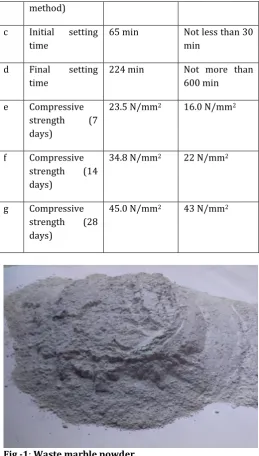
Moradabad (U.P.). It was initially in wet form (in slurry form), after that it is dried by exposing in the sun and finally sieves by IS 4.75 mm sieve before mixing (Fig-1). Physical properties of waste marble powder are given in table-2. Water: Potable water for mixing and curing of concrete specimens was used throughout the investigation.
Superplasticizer: Sika viscocrete 20-HE was used in present experimental research. It is a revolutionary high range water content reducer based on polycarboxylate ether (PCE). It has been developed for the production of concrete with high early strength and excellent workability requirements. SCC MIX DESIGN: Okamura method (Rational mix design method) was used for mix design of self compacting concrete. Okamura and Ozawa (1995) have proposed a simple mix proportioning system assuming general supply from ready mixed concrete plants. The coarse and fine aggregate contents are fixed so that self compactibility can be achieved easily by adjusting the water powder ratio and super-plasticizer dosage only. The coarse aggregate content in concrete is fixed at 50 % of the solid volume. The fine aggregate content is fixed at 40% of the mortar volume. The water power ratio in volume is assumed at 0.9 to 1.0 depending on the properties of the power. The super-plasticizer dosage and the final water-power ratio are determined so as to ensure self compactibility[10].
.In the present study, M-30 grade of SCC was used for all experimental work. All the test of Self-compacting concrete (SCC) in fresh state, performed in present study as per EFNARC specifications and guidelines[11]. The acceptance criteria of SCC as per EFNARC are given in table-3.
Table -1: Physical properties of cement
S. No.
Characteristic Experimental values
Codal Requirement
(IS: 8112-1989, OPC 43
grade specifications)
a Fineness of cement(% retained on IS 90 micron sieve)
4.83% 10%
b Soundness of cement(By Le-Chatelier
0.9 mm Not more than 10 mm
method) c Initial setting
time
65 min Not less than 30 min
d Final setting time
224 min Not more than 600 min
e Compressive strength (7 days)
23.5 N/mm2 16.0 N/mm2
f Compressive strength (14 days)
34.8 N/mm2 22 N/mm2
g Compressive strength (28 days)
45.0 N/mm2 43 N/mm2
[image:2.595.305.565.98.555.2]Fig -1: Waste marble powder
Table-2: Physical properties of waste marble powder
S. No. Characteristic Result
a Colour White
b Form Powder
c Odour Odourless
[image:2.595.36.571.577.798.2]© 2016, IRJET | Impact Factor value: 4.45 | ISO 9001:2008 Certified Journal
| Page 1090
Table-3: Acceptance criteria of Self-compactingconcrete (EFNARC, 2002)
Method
Unit
Typical range
of values
Mini
mum
Maxi
mum
Slump Flow by
Abram Cone
mm
650
800
T
50cmSlump Flow
sec
2
5
J-Ring
mm
0
10
V- Funnel
sec
6
12
Time increase at
V-funnel at T
5minutssec
0
3
L-box
(h
1/h
2)
0.8
1.0
U-box
(h
1-h
2)mm
0
30
Fill box
%
90
100
GTM screen
stability test
%
0
15
Orimet
sec
0
5
3.
RESULTS AND DISCUSSIONIn the present study, fresh properties of self-compacting concrete were investigated by using waste marble powder at six replacement rates of fine aggregate. The investigations were carried out according to appropriate criteria given by European standards. Several tests such as slump flow test, T50cm slump flow test, V-funnel test, J-ring test, L-box test and
orimet test were carried out to determine the properties of fresh SCC. It can be seen from table-4, In all the mixes of self-compacting concrete (SCC) with waste marble powder the slump flow test, T50cm slump flow test, V-funnel test, J-ring
test, L-box test and orimet test were carried out under limiting values. The graphical representations of all the tests are shown in Fig-2, Fig-3, Fig-4, Fig-5, Fig-6 and Fig-7. The results shows increase in workability of SCC with increase in proportion of waste marble powder.
Table-4: Results of Fresh properties of SCC with waste marble powder
Mix
Perc
enta
ge
of
wast
e
mar
ble
pow
der
in
SC
C
Slump test
V-Fun
nel
(sec)
J-Ring
L-Box
(H
2/
H
1)
ratio
Ori
met
test
(sec)
Slu
mp
flow
(mm
)
T
5(sec)
Heig
ht
diffe
renc
e
(mm
)
Limit
value
(EFN
ARC
2002)
650-800
2-5
6-12 3-10
0.8-1
0-5
SCC 1 0%
670
4.5
10.5 9.5
.902 5
SCC 2 10% 682
4
9.5
8.8
.915 4.8
SCC 3 20% 695
3.6
10.3 8.1
.923 4.2
SCC 4 30% 712
3.2
9.2
7.2
.935 3.5
SCC 5 40% 725
2.6
8.5
6.3
.946 3
© 2016, IRJET | Impact Factor value: 4.45 | ISO 9001:2008 Certified Journal
| Page 1091
Fig-2: Slump flow test with different mixes of WMPFig-3: T50cm Slump flow test with different mixes of WMP
Fig-4: V-Funnel test with different mixes of WMP
Fig-5: J-ring test with different mixes of WMP
Fig-6: L-box test with different mixes of WMP
Fig-7: Orimet test with different mixes of WMP
3. CONCLUSIONS
From the present study, following conclusions may be drawn:
1.
It has been observed that, on addition of waste marble powder, the filling ability of SCC by Slump flow test, T50cm test, V-Funnel test and Orimet test found to be increasing with increase in percentage of waste marble powder.2.
The passing ability of SCC by J-Ring test and L-Box test also found to be increasing with increase in percentage of waste marble powder.The workability of SCC found to be increasing with increase in waste marble powder percentage. So, the required values fulfilling the criteria of EFNARC can be obtained.
REFERENCES
© 2016, IRJET | Impact Factor value: 4.45 | ISO 9001:2008 Certified Journal
| Page 1092
[2] Gaywala N R and Raijiwala D B, 2011, “Self compacting concrete: A concrete of next decade” Journal of engineering Research and Studies, E-ISSN 0976-7916, Issue IV/ October-December,2011/ 213-218
[3] Zoran Grdic et.al., 2008, “Properties of self compacting concrete with different types of additives” FACTA UNIVERSITATIS, Series: Architecture and civil engineering vol. 6, N 2, pp. 173-177
[4] Aggarwal Paratibha et.al., 2005, “Properties of self compacting concrete- An overview” 30th Conference on our
world in concrete & Structures” 23-24 August 2005, Singapore, Article online id: 100030011.
[5] Mahajan Sumit and Singh Dilraj, 2013, “ Fresh and hardened properties of self compacting concrete Incorporating different binder materials” International Journal of emerging Technology and Advanced Engineering, ISSN 2250-2459,Volume 3, Issue 12, December 2013. [6] Goodier C I, 2003, “Development study on self compacting concrete” Proceedings of the ICE- Structures and buildings, 2003, 156(4), pp. 405-414.
[7]Pai B.H.V. et.al., 2014, “Experimental study on self compacting concrete containing Industrial by-products” European Journal April 2014 edition vol.10, no. 12, ISSN: 1857-7881(Print) e-ISSN: 1857-7431.
[8] IS: 8112-1989, “43 grade ordinary Portland cement- Specifications”
[9] IS: 383-1970, “Specifications for Coarse and Fine aggregates from natural sources for concrete (Second Revision)”
[10] Okamura H. and Ouchi M., “Self compacting concrete” Journal of Advanced concrete Technology vol. 1, 5-15 April 2003.