© 2015, IRJET ISO 9001:2008 Certified Journal
Page 508
EDM Process Parameters effects on Titanium Super Alloy
J. Laxman, K. Guru Raj, P. Venkateswara Rao
Department of Mechanical Engineering
Kakatiya Institute of Technology & Science, Warangal, Telangana, INDIA.
---***---Abstract:
Electric Discharge Machining is one of theunconventional machining processes used for machining of very hard and tough materials and complicated profiles can also be obtained. The metal is removed by metal erosion process in all types of electro conductive materials. The eroded metal on the surface of both work piece and the tool is flushed away by the dielectric fluid. The objective of this machining is to study the effect of input parameters on the machining characteristics. In this paper the machining characteristics are taken as metal removal rate, tool wear rate, surface roughness and input parameters considered are peak current, pulse on time, pulse off time and tool lift time to experiment on Titanium super alloy with copper Tool electrode on electric discharge machine (EDM). The results indicate that the MRR, TWR and SR increases with increase in current, but at 18A tool starts melting. With pulse on/off time MRR and TWR increases initially and there after decreases.
Keywords:
Metal removal rate, Tool wear rate, surface roughness, Titanium super alloy, Input parameters.1.
INTRODUCTION
Electrical discharge machining (EDM) is one of the most extensively used non-conventional machining process. It uses thermal energy to machine electrically conductive parts regardless of hardness of the material the distinctive advantage of EDM is in the manufacture of mould, die, and automotive, aerospace and surgical components. EDM does not make direct contact between the electrode and the work piece eliminating mechanical stresses, chatter and vibration during machining. The traditional machining techniques are often incapable to machine the titanium super alloys due to its high hardness and these can be machined economically by EDM. However, M.M. Rahman et al. [1] investigated the effect of the peak current and pulse duration on the performance characteristics of the EDM. The conclusions drawn were: the current and pulse on time greatly affected the MRR, TWR and SR, the MRR increases almost linearly with the increasing current, the SR increases linearly with current for different pulse on time, TWR increased with increasing peak current while decreased when the pulse on time was increased. S Dhar et al. [2] came to the following conclusions: with increase in peak current MRR, TWR and Radial overcut(ROC)
increased significantly in a nonlinear fashion; MRR and ROC increased with the increase in pulse on time and gap voltage was found to have some effect on the three responses. Yusuf and Selcuk [3] reported the effect of power, pulse on time and pulse off time on surface roughness using design of experiments and multiple regression method and concluded that pulse on time has significant effect on the roughness. Mahapatra and Patnaik [4] studied the factors like discharge current, pulse duration, pulse frequency, wire speed, wire tension and dielectric flow rate are selected both for maximizations of MRR and minimization of surface roughness in WEDM process using Taguchi Method. The analysis shows that factors like discharge current (A), pulse duration (B), dielectric flow rate (F) and interactions have been found to play significant role in cutting operations and developed a relationship between control factors, material removal rate and surface roughness using regression analysis. Prasad and Gopalakrishna [5] studied the effect of pulse-on time, pulse-off time, wire tension, dielectric flow rate and wire feed were considered as the variables on the material removal rate and surface roughness and developed a mathematical models for material removal rate and surface roughness using central composite rotatable design for five factors and finally optimized them as multiobjective function using evolutionary algorithms.
Chiang [6] reported the effects of machining parameters on the performance characteristics in the EDM process of Al2O3+TiC mixed ceramic and developed mathematical models to explain the influences of the discharge current, pulse on time, duty factor and open discharge voltage on the performance characteristics of the material removal rate (MRR), electrode wear ratio (EWR), and surface roughness (SR) using the response surface methodology. It is concluded that the discharge current and the duty factor are the main two significant parameters on the value of the material removal rate The discharge current and the pulse on time also have statistical significance on both the value of the electrode wear ratio and the surface
roughness. Shabgard and Shotorbani [7] modeled the
© 2015, IRJET ISO 9001:2008 Certified Journal
Page 509
when machining of higher values of pulse-on time, Thesurface roughness first increases slightly with the voltage and then increases severely with further increase of the voltage. The MRR value first increases with increase in pulse-on time, but for the values further at specific pulse on time starts to decrease. The increase of pulse-on time results in decrease of Tool Wear Rate. Bhattacharyya et.al, [8] studied the effects of the various process parameters on the surface roughness are analyzed through experimental observations and response surface methodology and concluded that the variation of the surface roughness with the peak current is similar for different pulse-on duration for any pulse-on duration, the surface roughness continues to increase with increase in peak current in a non-linear fashion. The features of comprehensive development with mathematical models, major machining parameters like peak current and pulse on duration on different aspects of surface integrity with M2 Die steel is also studied. Taweel [9] investigated the relationship of process parameters in electro-discharge machining of CK45 steel with tool electrode material such as Al–Cu–Si–TiC composite produced using powder metallurgy (P/M) technique. Analysis on machining characteristics of electrical discharge machining was made based on the developed models. In his study, titanium carbide percent (TiC %), peak current, dielectric flushing pressure, and pulse on-time are considered as input process parameters. The process responses MRR and TWR were evaluated. The present work mainly focused on the effect of machining parameters responses like material removal rate, electrode wear rate and surface roughness.
2.
EXPERIMENTAL SETUP
2.1
Machine Tool
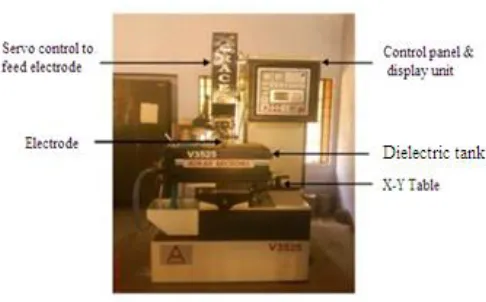
Experiments were carried out on Askar microns V3525 die sinking Electric discharge machine with servo head constant gap voltage, positive polarity, in which the Z-axis is servo controlled and X and Y axis are manually controlled. All three axes have accuracy of 5μm. Experiments were carried out by pulse arc discharges generated between tool (copper) and work piece (Titanium alloy). The downward movement of electrode towards work piece is controlled by servo control mechanism, which maintains uniform gap between work piece and electrode in EDM. Commercial graded standard (EDM30 grade) oil is used as dielectric medium for flushing purpose. Side flushing has been used during all experimental runs. The machine tool used for experimentation is shown in figure 1 and its detailed technical specifications are given as below;
Specifications of machine tool
Work tank internal dimensions (W x D x H) : 600 x390 x 275 mm
Work table dimensions : 350 x 250 mm
Transverse(X,Y,Z) : 225, 175, 175 mm
Maximum table loading :200Kg
Feed motor / servo system for Z axis : DC Servo
Position measuring system (X, Y, Z) : Incremental linear scale
Dielectric system : Integral with m/c tool
Dielectric capacity : 200 Litres
[image:2.596.312.555.181.332.2] Power supply : 3 phase, AC 230 V, 50 Hz
Fig. 1 Electric Discharge Machine
2.2
Details of work piece
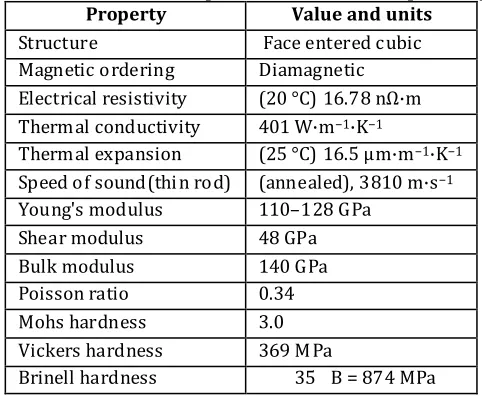
Titanium super alloy has been used as work material for experimentation. Titanium based super alloy which has excellent creep-rupture strength at temperatures up to 700°C (1300 °F). Owing to its excellent mechanical and metallurgical properties this alloy finds extensive use in gas turbines, rocket motors, spacecraft, nuclear reactors, pumps and cutting tools. Titanium is one of the most difficult to machine as super alloys in order to satisfy production and quality requirement. This difficulty in machining is attributed to its ability to maintain hardness at elevated temperature which is very useful for hot working environment. This alloy has attracted many researchers because of its increasing applicability in high temperature conditions. Still, the available research data in the form of papers and books pertaining to EDM of titanium alloy is limited. The chemical compositions and mechanical properties of Titanium super alloys are shown in Table 1 and 2 respectively. Details of work piece and its location are given below.
Work piece size : 50×30 mm2
Work piece shape : Rectangular
Work piece thickness : 6 mm
Angle of cut : Vertical
Location of work piece : Centre (on work table)
Stability : Servo control
Tool electrode material: Electrolytic Copper (99.9%)
© 2015, IRJET ISO 9001:2008 Certified Journal
Page 510
Table 1. Chemical compositions of Titanium alloyElement % by weight
Element % by weight Aluminium (Al) 5.5-6.8 Silicon (Si ) <0.15 Carbon (C) < 0.13 Iron (Fe) < 0.3 Molybdenum
(Mo)
0.5 – 2.0 Phosphorus (P)
0.8-2.5
Vanadium (V ) 0.3 Titanium Ti balance Zirconium( Zr) 1.5-2.5
[image:3.596.41.282.247.445.2]Table 2. Techanical Properties of Titanium super alloy
Property Value and units
Structure Face entered cubic Magnetic ordering Diamagnetic Electrical resistivity (20 °C) 16.78 nΩ·m Thermal conductivity 401 W·m−1·K−1
Thermal expansion (25 °C) 16.5 µm·m−1·K−1 Speed of sound(thin rod) (annealed), 3810 m·s−1 Young's modulus 110–128 GPa
Shear modulus 48 GPa
Bulk modulus 140 GPa
Poisson ratio 0.34
Mohs hardness 3.0
Vickers hardness 369 MPa
Brinell hardness 35 B = 874 MPa
2.3 Tool Electrode Material
Electrolytic copper electrode (99.9%) has been used as tool material. The circular cross sectional area of tool electrodes has been taken to carry out the experiments. The area of circular shaped electrode was taken 113.04 mm2 in machining.
2.4 Chosen levels for various factors
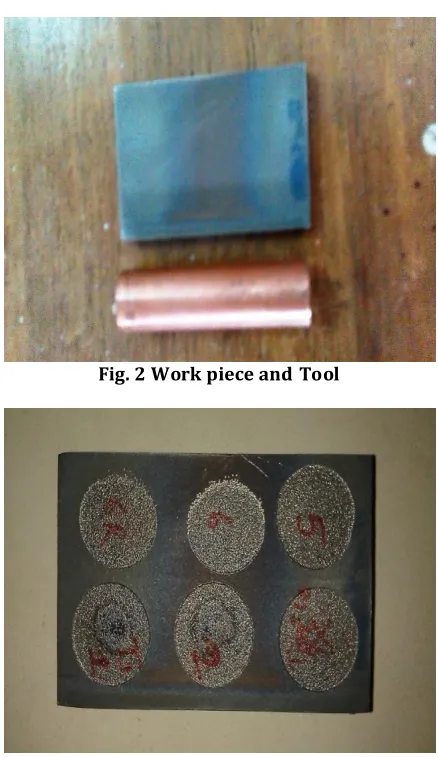
For the pilot experimentation the input parameter levels for current, pulse on time, pulse off time and electrode lift time are chosen as shown below table 3 The work piece, tool and the machined work piece are shown in figures 2 and 3.
3.
RESPONSE CHARACTERISTICS
Table 3. Input parameters and their levels
The detailed discussions related to the measurement of EDM experimental parameters Metal Removal Rate (MRR), Tool Wear Rate (TWR) and Surface Roughness (SR) are presented in the following.
3.1 Metal Removal rate
Metal removal rate is the amount of material removed from the work piece during the machining process of EDM due to the material erosion process. It is a desirable characteristic and it should be as high as possible to give least machine cycle time leading to increased productivity. In the present study MRR is a measured using Digital weighing balance machine and is given quantitatively in mg /min.
3.2 Tool Wear Rate
It is the amount of tool material removed during the machining process of EDM , Tool wear rate is undesirable characteristic and it should be as low as possible to give least machine cycle time leading to increased productivity. In the present study TWR is a measured using Digital weighing balance machine and is given quantitatively in mg /min.
3.3 Surface Roughness
Roughness is often a good predictor of the performance of a mechanical component, since irregularities in the surface may be formed due to erosion. Roughness is a measure of the texture of a surface. It is quantified by the vertical deviations of a real surface from its ideal form. If these deviations are large, the surface is rough; if small, the surface is smooth. Roughness is typically considered to be the high frequency, short wavelength component of a measured surface.
The parameter mostly used for general surface roughness is Ra. It measures average roughness by comparing all the peaks and valleys to the mean line, and then averaging them all over the entire cut-off length. Cut-off length is the length that the stylus is dragged across the surface; In this work the surface roughness was measured by Handy surf, which traces the surface of various machined parts and calculates the surface roughness based on roughness standards, and displays the results in μm. The work piece is attached to the detector unit of the Handysurf, which traces the minute irregularities of machined surface on the work piece surface. The vertical stylus displacement during the trace is processed and digitally displayed on the liquid crystal display of the Handysurf. The surface tester has a resolution varying from 0.01 μm to 0.4 μm depending on the measurement range.
3.4 Measurement of Response characteristics
Material removal rate, Tool wear rate and Surface roughness have been used to evaluate machining performance. The MRR and TWR are calculated by measuring the weight difference of work piece and electrode, before and after machining using a digital
PARAMETER
` LEVELS
1 2 3 4 5 6 7
CURRENT (A) 3 6 9 12 15 18 21
PULSE ON
TIME(msec) 5 10 20 50 100 200 500
PULSE OFF
TIME(m) 5 10 20 50 100 200 500
TOOL LIFT TIME
© 2015, IRJET ISO 9001:2008 Certified Journal
Page 511
weighing balance of type AY220 with precision 0.001mgand was calculated by using following equations.
Where MRR is Metal removal rate, wp1 and wp2 are the weights of the work piece before and after machining, T is the machining time.
[image:4.596.52.271.308.687.2]Where TWR is Tool wear rate, wt1 and wt2 are the weights of the work piece before and after machining, T is the machining time. The co mposition of the work piece is given in table.1. Surface roughness was measured by contact type stylus based surface tester handy surf. The centre line average (CLA) surface roughness parameter Ra was used to quantify the surface roughness.
Fig. 2 Work piece and Tool
Fig. 3 Machined Work Piece
4.
EXPERIMENTAL RESULTS DISCUSSION
Experiments were conducted on the Titanium super alloy by varying four input parameters on EDM machine from minimum to maximum value and varying one parameter
at a time. The output responses like metal removal rate, tool wear rate and surface roughness are obtained from the experiments. The levels of the factors are selected based on the machining condition. The effect of each parameter response characteristics are discussed in following sections.
4.1 Effect of Peak Current
[image:4.596.310.561.308.499.2]In conducting experiments the peak current is varied from 3 ampere to 21 ampere in steps of 3 ampere and the other parameters remains constant (Ton = 10 µSec, Toff = 50 µSec, Gap voltage = 32 volt, Tool lift time = 20 µSec, down tine =20 µSec). From the results shown in figure 4, MRR increases with increase in peak current. TWR decreases with increase in current up to 9A then increases continuously. SR gradually increases up to 12A, after that the rate of decrease or increase is almost zero.
Fig. 4 Effect of current on MRR, TWR and SR
4.2 Effect of Pulse on Time
© 2015, IRJET ISO 9001:2008 Certified Journal
Page 512
Fig. 5 Effect of pulse on time on MRR, TWR and SR4.2 Effect of Pulse off Time
[image:5.596.33.304.65.286.2]The pulse off time (Toff) is varied from 5µsec to 1000 µsec. The values of the other parameters are kept constant (Ton = 20 µSec; Ip = 15 ampere; Gap voltage = 32 volt; Tool lift time = 20 µSec; down tine =20 µSec). The observations from the results shown in figure 6, are i) MRR and TWR increases continuously with increase in pulse off time up to 50 µSec then decreases continuously and MRR is higher at 28.57% of duty factor. ii) The average value of SR is little higher for low pulse off time but increase in pulse off time causes to decrease surface roughness because of decrease in duty factor.
Fig. 6 Effect of pulse off time MRR, TWR and SR
4.3 Effect of Tool lift time
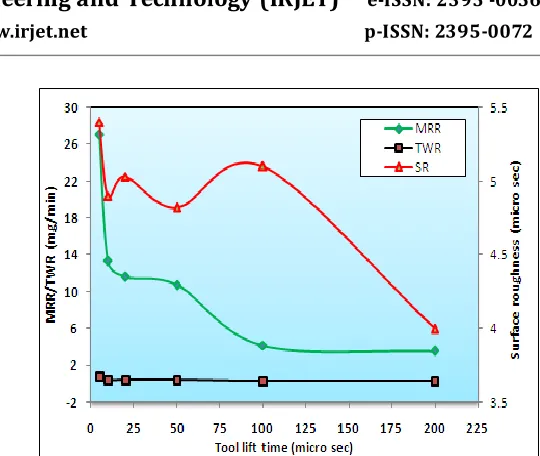
The Tool lift time is varied from 5µsec to 1000 µsec. The values of the other parameters are kept constant (Ton = 20 µSec; Toff = 50 µSec ; Ip = 15 ampere; Gap voltage = 32 volt; Tool down time =20 µSec; duty factor = 28.57%.). The results are shown in figure 7. It is observed that MRR, TWR and SR are decreases continuously with increase in tool lift time.
Fig. 7 Effect of tool lift time on MRR, TWR and SR
5.
CONCLUSIONS
Metal removal rate increases continuously with the increase in pulse on time up to 20 micro seconds thereafter decreases and also increase with pulse off time up to 50 micro seconds thereafter decreases continuously. Further, increases with the increase in current but at 18 amperes of current the centre of tool surface starts melting.
Electrode wear rate is decreased initially up to 9 amperes of current thereafter increases with increase in the Current. With increase in pulse on time increase initially up 50 micro seconds and later decreases due to carbide formation. Further increase of pulse-off time increased up to 50 micro seconds, later decreased continuously
Surface roughness increased with increase in current and the effect of current is more as compared to the effect of pulse ON time and pulse OFF time.
REFERENCES
1. M. M. Rahman, Md. Ashikur Rahman Khan, K. Kadirgama, M. M. Noor and Rosli A. Bakar, “Modeling of Material Removal on Machining of Ti-6Al-4V through EDM using Copper Tungsten Electrode and Positive Polarity” World Academy of Science, Engineering and Technology, 20104; 7, 576-581.
2. Sushant Dhar, Rajesh Purohit, Nishant Saini, Akhil Sharma and G. Hemath Kumar, “Mathematical modeling of electric discharge machining of cast Al–4Cu–6Si alloy–10 wt.% SiCP composites”, Journal of Materials Processing Technology, 2007; 194, 24–29.
[image:5.596.39.281.462.649.2]© 2015, IRJET ISO 9001:2008 Certified Journal
Page 513
Journal of Advanced Manufacturing Technology,2006; 28, 1118-1121.
4. Swarup Mahapatra, Amar Patnaik, “Parametric Optimization of Wire Electrical Discharge Machining Process using Taguchi Method”,
Journal of Braz. Society of Mech. Sci. & Eng. 2006; 28(4), 422-429.
5. Prasad D V S S V and Gopala Krishna A., “Empirical Modeling and Optimization of Wire Electrical Discharge Machining”, International journal of
Advanced Manufacturing Technology, 2008; 43,
914-925.
6. Ko-Ta Chiang, “Modeling and analysis of the effects of machining parameters on the performance characteristics in the EDM process of Al2O3+TiC mixed ceramic”, International Journal
of Advanced Manufacturing Technology, 2008; 37,
523–533.
7. Shabgard M. R. and Shotorbani R. M. “Mathematical Modeling of Machining Parameters of Electro discharge Machining of FW4 Welded steel”, World academy of Science, Engineering and Technology, 2009; 3(4), 52-55.
8. Bhattacharyya B. Gangopadhyay S. and Sarkar B.R.,”Modeling and analysis of EDM job surface integrity”, Journal of Materials Processing Technology, 2007; 189, 169-177.
9. Taweel, Travel. “Multi response optimization of EDM with Al-Cu-Si-TiC P/M composite electrode”,
International Journal of Advanced Manufacturing
Technology, 2009; 44, 100–113.
BIOGRAPHIES
Sri J Laxman is Asst. professor working in KITS, Warangal, Telangana. He has obtained M Tech. degree in the field of Production Engineering from NIT, Warangal. He is presently working for Doctoral degree in the field of EDM process under the guidance of Dr. K Guru Raj. He has more than 10 years of teaching experience and published 4 papers in International Journals.
Dr. K Guru Raj is professor working in KITS, Warangal, Telangana. He has obtained M Tech. degree in the field of Powder Metallurgy from IIT, Bombay and Doctoral degree from JNTU Hyderabad. He has more than 30 years of teaching experience, published 25 papers in International Journals, conferences and presently supervising 5 scholars.