STUDIES
IN STEATORRHEA
Effect of the Level of Dietary Fat upon the Absorption of Fat and Other
Foodstuffs in Idiopathic
Celiac Disease and Cystic Fibrosis
of the Pancreas
By ARTHUR W. CHUNG,* M.D., SOLEDAD MORALES,t M.D., SELMA E. SNYDERMAN4 M.D., J. M. LEwIs, M.D., AND L. EMMETT H0LT, JR., M.D.
(With
the
assli
lance
ofEileen
Hasselmeyer
and
A@igelina
iVlesi,ia)
New York
I N THE dietary management of states of intestinal intolerance, it has been customary to restrict the type of food to which the intestine was intolerant. Thus, in infantile diarrhea, in which assimilation of all foodstuffs is impaired, it has been the general prac tice to restrict food as a whole, in pure chronic steatorrheas to restrict fat, and in the celiac syndrome where the assimilation of both fat and carbohydrate are affected fo restrict both of these foodstuffs. The basis of this therapy has been : ( 1) the belief that food intolerance was occasioned by some toxic property of the food, (2 ) the view that rest to an organ or a function would facilitate recovery and, finally, ( 3 ) the fear that abnormal loss of some poorly tolerated food would ‘‘washout' ‘other essential nutrients, thereby impairing rather
than aiding nutrition.
In the case of infantile diarrhea the present investigators were led to challenge these traditional concepts. Efforts to implicate toxic components of the food had been singularly unsuccessful. It was show& that recovery from intestinal intolerance was not hastened by the policy of therapeutic starvation. Metabolic studies at different levels of feeding2 showed no evidence of ‘‘washing out' ‘of other nutrients, and even in the severest cases increased intake resulted in increased assimilation of every nutrient studied. These findings confirmed the clinical impressions of the value of a generous oral intake as a supplement' to needed parenteral therapy.
These observations in acute diarrhea suggested that the conventional food restrictions
in chronic steatorrheas might not necessarily be well founded. Therefore, it was under
taken to study the effect of varying the fat intake in various steatorrheas in order to as
certain the effect of fat administration on fat tolerance and on the assimilation of other
foodstuffs. If fat administration were without noxious effects, it was conceivable that excessive losses of fat could be compensated for by increasing the fat intake. Studies which the present authors have carried out on the steatorrhea of the premature infant have been reported previously.4 Briefly, it was found that the premature infant could tolerate intakes of fat well in excess of those ordinarily given, no untoward effects on fat tolerance being observed. The percentage absorption was not significantly affected by the intake and an increased intake thus served to increase the absolute assimilation.
From the Department of Pediatrics, New York University College of Medicine and the Children's Medical Service, Bellevue Hospital, New York.
Supported in part by a grant from the John and Mary R. Markle Foundation.
(Received for publication July 20, 1950.)
* Present address: Provincial Hospital, Tsinan, Shantung, China.
t Mead Johnson fellow in pediatrics.
@ Dazian fellow in pediatrics.
492 CHUNG, MORALES, SNYDERMAN, LEWIS AND HOLT, JR.
The present report deals with the effect of varying the fat intake in two other condi tions associated with steatorrhea, namely, ‘‘idiopathic' ‘celiac disease and cystic fibrosis of the pancreas. Since these two conditions are essentially different—the former being de pendent on a defective assimilatory mechanism in the intestinal wall and the latter upon a deficiency of digestive enzymes—they will be discussed separately.
I. ‘
‘IDIOPATHIC'
‘
CELIACDISEASE
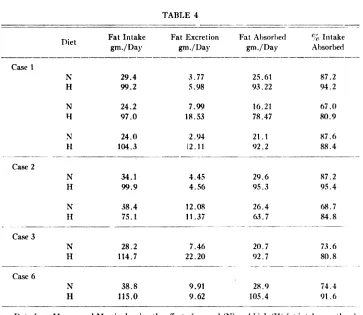
Some pertinent observations were already in the literature. Macrae and Morris2 had studied the effect of varying the fat intake in four celiac patients. Increasing the intake
from a normal level (24 to 38 gm/day)
to a high level (75 to 115 gm./day)
produced
striking increases in fat absorption, the percentage absorption showing no consistent change ; untoward clinical effects were not observed. Similar observations were made by Black, Fourman and Trinder and by Bassett et al.7 in adult sprue, a condition generally regarded as the adult counterpart of celiac disease. Extensive clinical observations were made by Haas,8 who maintained celiac patients on a generous fat intake for prolonged periods and concluded that definite clinical improvement could be attributed to this regime. Against these observations are various clinical reports in which relapse is believed
to have been initiated by the introduction
or increase of fat in the diet. In interpreting
such reports it is necessary to bear in mind that genuine relapses with loss of tolerance are common in celiac patients without any change in regimen and that a mere increase in steatorrhea following the administration of fat does not necessarily indicate a relapse ; it may mean merely that a defective absorption mechanism is being demonstrated by a load.
The present studies were carried out on three celiac patients admitted to the Children's Medical Service at Bellevue Hospital whose protocols were as follows:
Case 1. W. G. (B.H. 44003-47), an 8 mo. old white boy, was admitted to the hospital because of chronic diarrhea of 6 wk.' duration. At the time of admission he was having 5 to 10 loose, bulky, pale, foul-smelling stools a day. He was a pale, irritable boy showing evidence of marked weight loss.
The extremities were wasted and the abdomen was somewhat protuberant. An assay of the duodenal
juice showed an adequate concentration of trypsin. The glucose tolerance test gave a flat curve. Stool cultures were repeatedly negative for enteric pathogens. The course in the hospital was stormy.
After adequate parenteral therapy he was first placed on the skimmed milk-casec formula he had
been receiving at home. One week after admission he developed bronchopneumonia and was slowly recovering when the diarrhea, which had improved somewhat, flared up again. A vigorous course
of parenteral fluids followed when all appetite was lost and vomiting ensued. When he failed to gain weight, in spite of recovery of appetite 2 wk. later, he was transferred to the metabolism ward for study. He was placed on a basal diet of evaporated milk, sugar and water, providing I 10 cal/kg. and 33.5 gm. fat/day. In subsequent periods this was supplemented by the addition of 30 and later 90 gm. butter/day. Although the stools increased in size and were obviously more fatty, there was no clinical exacerbation in the boy's condition and the weight gradually rose. A supplement of homogenized meat* was added to the high fat diet in a fourth period which induced a further
gain in weight. In the succeeding 2 mo. during which he remained on this diet he gained 4.5 kg.
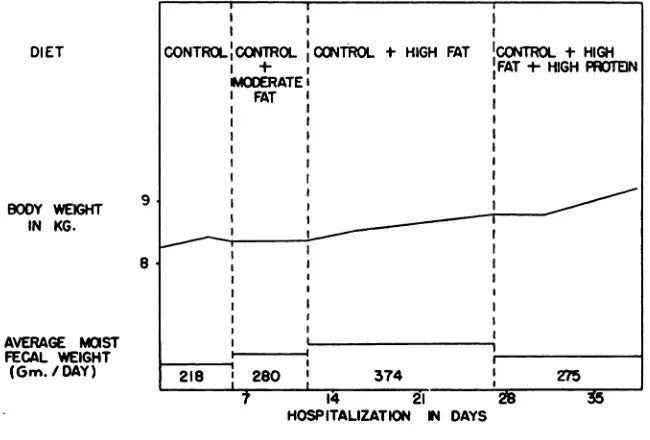
He was subsequently allowed to choose his own diet. A follow-up report indicates that his progress has been excellent, his weight being 19.1 kg. at the age of 2½yr. Except for some protuberance of the abdomen, there is no evidence of the celiac picture. Two relapses occurred after discharge from the hospital, both occurring on the prescribed diet and both definitely related to parenteral in fection with fever. The metabolic data is presented in table 1 and the weight curve in chart 1.
Examination of the data reveals that the addition of fat even at the extremely high level caused virtually no drop in the percentage absorption and caused a striking absolute increase in the assimila
tion of fat. The final period, far from showing any loss of tolerance to fat from the continuation
STUDIES IN STEATORRHEA 493
TABLE I
CASE 1*
>. @, @.. @. -@.
-:-@ -@ • C, S ‘Z'@
@‘ , -@
@ -@ ‘@
@ ,i ,,
‘..@ :@
@ @.
@
@ ‘@
@c; -@E
@ •“
@ .‘ ,@- -‘E 11―
::@@
@ z!
@ ;:! @.! @!
@ z!'
@
(‘ontrolI)iet Intake 1080 6.70 21.9 33.4 52.5 23.() 24.M 33.50 4.62 8.0
Urine 293 I.'@2 5.7 24.4 0.3
@ 7Q 23.4 2.45
Feces 110 4(5) 0.8 4.2 46.5 17,() 1.2 14.20 0.74
Absorbed $91 2.7() 21.1 29.2 6.() 6.1) 23.6 19.30 3.88
U Intake Alsorbed 82 40 ‘H 88 1 I 26 95 58 84
(‘ontrolDiet Intake 1260 7.32 31.8 34.1 54.0 23.1 34.Q 59.60 4.62 8.0
+30gm. Urine 425 3.06 19.5 29.8 0.3 8.2 31.4 1.85
Ilutter/I)ay FeceS 236 4.07 2.3 4.6 51.0 14.1 2.8 28.50 0.67 Absorbed 1024 3.25 29.5 29.5 3.0 9.0 32. I 31.10 3.95
C; IntakeAbsorbed 81 44 93 87 6 39 92 52 86
(‘ontrolI)iet Intake 1050 8.59 51.6 34.3 57.0 23.3 54.8 111 70 4.62 8.1
+90gm. Urine 446 2.96 26.2 30.0 0.6 6.8 41.5 1.30
Butter/Day Feces 293 4.65 5.2 5.8 74.9 21.8 2.1 60.50 0.72
Al)sorbe(I 757' 3.94 46.4 28.5 —17.9 1.5 52.7 51.20 3.90
c@;IntakeAbsorbed 72 46 90 86 —31 6 97 46 85
(‘ontrolI)iet Inlake 1280 10,62 66.8 49.5 57.3 25.5 60.7 111.70 8.88 8.8
+90gm. Urine 430 3.80 28.2 36.8 0.2 14.3 44.8 2.42
Iiutter+170 Feces 224 5.90 15.7 12.8 51.0 10.8 2.6 34.()0 1.46
gm.meat/day Absorbed 1056 4.72 51.1 36.7 6.3 14.7 58.1 77.70 7.42
e; IntakeAbsorbed 83 45 77 74 II 58 96 67 84
•The metabolism periods in this and other patients here reported were 4 days in duration, stools being marked with, carmine ‘I'l;cpatients were with 1 exception (Case 2) placed on metabolism frames to Permit separate collections of urine and fecc@ The analytic methods employed were as described in a previous publicatjon.2 The basal diets were prepared from evaporated milk and sugar, providing approximately 100 cal. /kg. of which approximately I5@T of the calories were from protein, 50'T from carbohydrate and 35'@ from fat. The supplementary fat was supplied as melted butter, fed by spoon.
DIET CONTROLCONTROL.CONTROL.+ HIGHFAT 1CONTR@1- HIGH
÷
I
FAT-$-HIGHPAOTEIN
iOOERATEI I
I FAT I
I I
I I I
I I
@ :
AVERAGE MCIST _______
FECAL WEIGHT _______
(Gm./DAY) 218 280
14 @I
HOSPITALIZATION 14 DAYS
494 CHUNG, MORALES, SNYDERMAN, LEWIS AND HOLT, JR.
of this diet, showed the reverse. Little change was noted in the absorption of nitrogen or minerals
from the increase in dietary fat, the only exception being a temporary loss of calcium immediately
following the institution of the highest fat intake; this was not, however, sustained.
Case 2. R. M. (B.H. 41757-49), a 7½yr. old white boy, was admitted to the Bellevue Metabolism Ward for study because of large bulky stools and failure to gain properly in weight and height since 6 mo. of age. The history from another hospital indicated that at the age of 4 mo. he began to have' intermittent diarrhea, the stools being reported as large, foul and bulky at 10 mo. when he
was hospitalized. The birth weight was not quite doubled at that time although the mother claimed the child's appetite was excellent. Stool cultures were negative for enteric pathogens. The glucose
tolerance curve was flat. The course after discharge from the hospital was uneventful except that the
weight gain was slow as was the gain in height. The parents were of normal height and weight.
‘FABLE2
-CASE 2
@. @.. >. S. ...
.--;@ .E .@ .E a .E
@
@. ‘a @- - a a
a @ @ @ @ . . .@ @ @ @ @. @‘ @ @ @
@‘::@
@
@
@
a
@
@
,@
@
@ .@@ ‘4! ‘@! @.! :@! :...@ Z@
Intake 1920 14.84 50.0 79.0 168.0 52.6 46,0 76.80 8.06 20,6
Urine 525 .5.40 .13.3 48.4 0.6 12.5 25.8 2.98
(‘ontrolDiet Feces 186 5.35 4.7 7,0 81.5 19.1 0.9 41.50 1.53 Absorbed 1734 9.49 45.3 72.0 86.5 33.3 45.1 35.25 6.5.3
:@
IntakeAbsorbed
90
64
91
91
52
64
98
46
81
Controhl)iet Intake 1920 16.64 78.2 79.8 172.3 52.9 74.8 153.60 8.06 20.6 +83.4gm. Urine 679 7.26 48.6 45.3 0.7 12.8 40.5 3.38
Butter/Day Feces 272 6.50 8.2 9.2 84.5 21.0 2.1 89.40 1.54
Absorbed 1648 10.14 70.0 70.6 87.8 31.9 72.7 64.20 6.52
¶‘,@IntakeAbsorbed 86 61 90 89 51 60 97 42 81
The abnormal stools persisted but became less frequent with time. When seen in this clinic at 7½ yr. of age, he was 111 cm. in height and weighed 20.0 kg. He was a well proportioned, small, somewhat thin boy who resembled a 6 yr. old in stature. The mental development was consistent
with the actual age. The stools were large, foul and fatty, numbering not more than 3/day. Follow ing the method of Shwachman, dilutions of stool samples showed normal tryptic digestion. It was
felt that the clinical and laboratory picture was consistent with the diagnosis of the celiac syndrome.
The fullest cooperation was secured not only in taking his diet but in the careful collection of his
excreta as well. Data on 2 levels of fat are shown in table 2. On discharge from the hespital it was suggested that supplements of fat and protein be given so that the amounts of these foodstuffs con
sumed would be approximately doubled. It is too early to record the results on this regime.
As is apparent from the table the addition of a supplement of butter fat which doubled the fat intake virtually doubled the fat absorption as well, the percentage absorption being 42% as opposed to 46% of the intake.
Case 3. D. C. (B.H. 46280-49), an 18 mo. old Puerto Rican infant, was brought to the hospital
because of fever and a sore mouth. He had been in poor health since the age of 1 yr. when he had
the onset of intermittent diarrhea, progressive weight loss and gradual increase in the size of his abdomen. He appeared pale, chronically ill with extreme emaciation and he had a large protuberant abdomen. Large, pale, fatty stools were noted from the onset of his hospitalization. Five stool
examinations for ova and parasites were negative and the duodenal contents were repeatedly negative for giardia lamblia. Assay of the duodenal juice for trypsin showed normal activity. A vitamin A tolerance test revealed a flat curve. The causes for admission (fever and sore mouth) were found
to be due to infectious mononucleosis, the diagnosis being made on the basis of a positive blood
Period IPeriod IIPeriod IIIPeriod IVFat
Intake(gm/day)36.036.045.092.7Fat
in
Feces(gm./day)5.38.56.710.0
STUDIES IN STEATORRHEA 495
purified diet consisting of protein 45 gm., carbohydrate 137 gm. and fat 45 gm. for the control
period. The data for this period as well as a period of high fat intake are given in table 3. He had an excellent gain in weight during his stay on the Metabolism Ward amounting to 1.5 kg. in less than 2 mo.
The data presented in the table indicate that this patient, like the preceding 2, was benefited by the fat supplementation. On a high fat diet, he assimilated more fat with apparent clinical benefit. These observations thus confirm those of Macrae and Morris, of Black, Fourman and Trinder and of Bassett et al. as to the effect of increasing fat intake on fat absorption. Pertinent data from the 2 former reports are presented in tables 4 and 5. This experience likewise confirms that of Haas, that generous fat intakes are well tolerated. Such relapses as the present authors have observed have been definitely related to parenteral infection rather than to changes in the diet.
TABLE 3*
Patient I).C. Age 20 mo. Celiac
EFFECT OF INCREASING FAT INTAKE ON FAT ABSORPTION
Fat Absorbed
(gm/day) 30.7 27.5 38.3 82.7
Per cent Intake
Absorbed 85.1% 76.5% 85.0% 89.1%
* Periods 10 days each.
II. CYSTIC FIBROSISOF THE PANCREAS
Pancreatic steatorrhea differs from that of “idiopathic―celiac disease in that the defect involves the preparation of food for absorption rather than the process of absorption itself. Both protein and fat digestion are interfered with, carbohydrate being as a rule only minimally affected. The restriction of fat intake has been enthusiastically advocated by Andersen'°'@ in these cases and she has supported this view by chemical observations from which the conclusion was drawn that fat not only increases the steatorrhea, but also exercises a deleterious influence on the nitrogen and mineral balance. An examination of the metabolic evidence presented by Andersen finds it open to criticism, as will be dis cussed below. Some of it is, moreover, quite at variance with observations of Coffey et al.'@ and of Handelsman et al.'5 on dogs deprived of their pancreatic secretion and with ob servations on one patient by May and Lowe.* For these reasons it seemed desirable to make further studies of patients with this condition at different levels of fat intake.
* A personal communication from C. D. May describes an unpublished experiment carried out by himself and C. U. Lowe in which a child with cystic fibrosis of the pancreas was fed at 2 levels
of fat, e.g., 35 gm. and 85 gm/day. The percentage retention was not affected. On the former diet
.
DletFat Intake
gm./DayFat
Excretion
gm./DayFat
Absorbed
gm./Day%
Intake
AbsorbedCase
1N
H29.4 99.23.77 5.9825.6! 93.2287.2
94.2N
H24.280.9N 97.07.99 18.5316.21 78.4767.0
H24.0 104.32.94 12.1121.1 92.287.6
88.4Case
2N
H34.1 99.94.45 4.5629.6 95.387.2
95.4N
II38.4 75.112.08 11.3726.4 63.768.7
84.8Case
3N
H28.2 114.77.46 22.2020.7 92.7
.
28.9
105.473.6
80.8
74.4
91.6Case6N H38.8 115.09.91 9.62
PatientOn
69 gm.Fat/DayOn 96
gm.Fat/DayFat
Absorbed% AbsorbedFat Absorbed%
Absorbedgm.gm.156.68279.983255.08071.074357.38384.588438.68583.587335.25142.244
496 CHUNG, MORALES, SNYDERMAN, LEWIS AND HOLT, JR.
TABLE 4
Data from Macrae and Morris showing the effect of normal (N) and high (H) fat intakes on the a1 sorption of fat in celiac syndrome. Cases 4 and 5 were placed on a single level of fat only.
TABLE 5
ABsoRvrIoN OF FAT IN TROPICAL SPRUE ON 2 LEVELS OF INTAKE
(Data of Black, Fourman and Trinder)
Studies on three patients with this condition have been carried out and are presented herewith.
Case 4. T. B. (B.H, 5226-48), an 81/2 mo. old white boy, was transferred to the Bellevue Metabolism Ward from the Beth Israel Hospital where he had previously been studied. He had
a history of a nonproductive cough and of loose, bulky, foul stools which were noted shortly after
Control
I)ietIntake188311.1592.058.0126.041.234.461.905.5014.7Urine11534.8456.542.81.57.621.03.22Feces784.265.76.362.013.30.324.801.07Absorbed18056.8986.351.764.027.934.137.104.43%IntakeAbsorbed966294895168996080Control
DietIntake181512.9898.060.5130.041.637.2163.155.5014.7+112.5gm.Urine9005.9468.348.71.46.745.73.15Butterj'dayFeces
Absorbed
‘;‘cIntake Absorbed248 1567 863.28 9.70 755.9 92.1 944.0 56.5 9359.2 70.8 5413.0 28.6 701.4 35.8 9637.10 126.05 771.23 4.27 78
STUDIES IN STEATORRHEA 497
TABLE 6
CASE4
55 >. a@ a@
,@ .@ .@ .@ .@ .@ :@
@
a
@ a:@ ‘@‘. . . . . .@ @0
@ C. C. C@ C.
@
@ .e@
@ H H H H ..,@
@ @ @ l@ @ @ @! @
Control 1)iet Intake 900 5.84 20.8 30.8 47.6 25.9 25.4 27.20 4.26 7.5
Urine 175 2.83 7.6 21.5 1.0 9.9 9.2 1.74
Feces 87 2.63 0.1 2.0 40.1 9.2 0.4 16.25 0.69
Absorbed 813 3.21 20.7 28.8 7.5 16.7 25.0 10.95 3.57 ‘/cIntake Absorbed 90 55 99 94 16 65 99 40 84
ControlDiet Intake 1020 7.10 40.6 31.6 50.6 26.1 45.8 79.40 4.26 7.5 +60gm. Urine 160 3.42 17.3 29.0 1.1 10.2 21.9 2.04 Butter/day Feces 100 2.37 0.2 1.9 45.2 10.4 0.3 33.20 0.73
Absorbed
@ 920 4.73 40.4 29.7 5.4 15.7 45.5 46.20 3.53 %IntakeAbsorbed 90 • 67 99 94 11 60 99 58 83
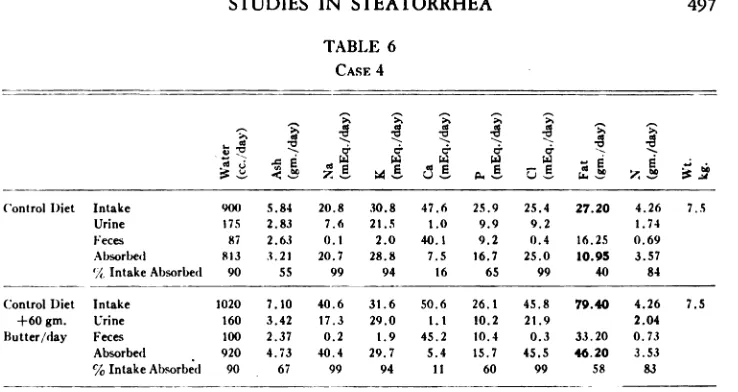
duodenal juice. The glucose tolerance and vitamip A tolerance curves were flat. He was a fairly well developed, but poorly nourished boy, showing persistent inspiratory rales over both bases pos teriorly. Metabolism periods consisted of a control diet and a test diet in which the fat intake was tripled. The diets were tolerated well and no exacerbation of the diarrhea was induced. The metabolic
data are given in table 6.
It will be noted that the added fat, which was the only variable in the diet, produced a striking increase in absolute fat absorption, though a negligible change in the percentage absorption. In con@
trast to the contention of Andersen, no untoward influence on the absorption of nitrogen or minerals
is discernible.
Case 5@#J, H. ( 145602 ) was a 3% yr. old white boy who was readmitted to Vanderbilt Hos
pital for the fifth time for metabolic studies. He was first observed at the age of 1 1 mo. with a history of chronic upper respiratory infections and passage of large, fatty, foul stools since 5 mo. of age. Duodenal drainage showed absence of tryptic digestion. The vitamin A tolerance curve was flat. He continued to have upper respiratory infections but gained weight satisfactorily on a high protein, high carbohydrate, low fat diet with panteric granules. At the time of the metabolism study, his nutrition was good.
TABLE 7
CASE 5
a, :@,
@ >@
@ca * @a a ‘a @ a. @ @ .@ .@ .@ @ a @ . ‘ . . . @ @
@ C. C@
@ C.
@
@ .@ a@ H @1 H H
@ @
@
@ .@,g 14.@
@ @ @
@ z'@
@
* For the opportunity to study the Cases 5 and 6, the authors are indebted to Dr. Amos Christie
j:-'
@ ,@ a
@ a
@
.@
@ .w :@
@ ‘@ .@ a' @‘
,,@a .@ , .@ .
@
@ .@ .@
@
@ C.
@ C. C. C@ -@
@ .a@ *a@ a2 a@ H a3
@ @
@
@ z.@
@ c@!
@ D!
@ z.10@,(‘ontrol
Diet Intake 1468 8.15 67.0 43.5 92.0 29.0 25.0 45.15 4.02
Urine 445 2.26 21.0 21.8 0.6 5.4 2.6 1.20
Feces 148 4.05 1.7 9.3 56.2 11.0 0.7 20.80 1.65
Absorbed 1320 4.10 65.3 34.2 35.8 18.0 24.3 24.35 2.37
% Intake Absorbed 90 50 98 79 39 62 97 54
5910.0ControlDiet
Intake 1752 9.37 71.0 45.4 94.7 29.2 25.9 112.65 4.02 +75gm. Urine 810 3.65 36.9 29.2 1.3 9.7 7.2 1.38 Butter/day Feces 121 3.66 0.9 5.8 55.0 13.3 1.1 63.00 1.95 Absorbed 1631 5.71 70.1 39.6 39.7 15.9 24.8 49.65 2.07
%IntakeAbsorbed 93 61 529.5TABLE99 87 42 54 96 44
9FAT
ABSORPTION lN DOGSSECRETION(DataDEPRIVED OF EXTERNAL PANCREATIC
of Coffey, Mann and Bollmann)gm.JdayFat
intake 17.0 36.0 36.0 106.0
Fatinstool 13.4 23.4 18.4 49.8
Fat absorbed 3.6 56.2TABLE12.6 17.6
10ABSORPTION
OFDUCT(DataN AND FAT IN Docs WiTH LIGATED PANCREATIC
of Handlesman, Golden andPratt)N
Fatintake
absorbed intake absorbed
(gm.) (gm.) (gin.)
(gm.)Standarddiet
10.4 5.7(56%) 19.4 11.7(60%)
High fat diet 10.0 6.3 (63%) 49.1 46.0(94%)
498 CHUNG, MORALES, SNYDERMAN, LEWIS AND HOLT, JR.
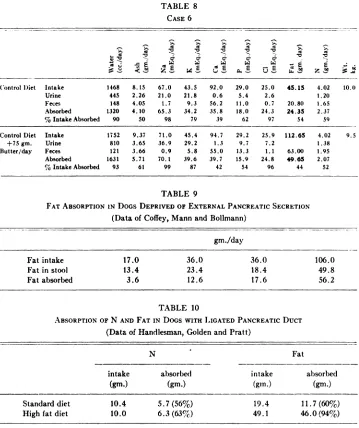
Table 7 shows the effect of a 2½fold increase in the fat intake, which increased strikingly the total fat absorption. No untoward manifestations of a clinical or chemical nature were noted.
Case 6.* D. S. (168046), a 22 mo. old white boy, was admitted to the Vanderbilt Hospital for the second time. His first admission was at the age of 18 mo. when he presented a history of
TABLE 8
CASE 6
chronic recurrent respiratory infection, poor weight gain and large, foul, bulky stools from birth.
Duodenal enzymes were reported absent. The vitamin A tolerance curve was flat. He was discharged from the hospital on a high protein, high carbohydrate, low fat diet with panteric granules. Penicillin aerosol was given daily. I-fe did fairly well on this regime until 2 days before admission when he developed an upper respiratory infection and was asked to come to the hospital for treatment and study. He was a poorly developed, poorly nourished irritable boy who had numerous rales and
* For the opportunity to study the Cases 5 and 6, the authors are indebted to Dr. Amos Christie of
STUDIES IN STEATORRHEA 499
rhonchi throughout the chest. He was studied on 2 levels of fat intake, one, 2½ times the other. The
study was uneventful clinically. The data presented in table 8 again indicate increased absorption oi
fat at the higher intake and no significant loss in percentage absorption.
It is thus apparent that these studies of cystic fibrosis of the pancreas are in agreement with that of May and Lowe and with those of Coffey, Mann and Boliman as well as those of Handelsman et al. in dogs deprived of their pancreatic secretion, significant data from whose experiments is presented in tables 9 and 10. Not only is fat absorption improved
FAT INTAKE
Gm. /DAY
40
35
30
25
20
15
lO
5
0
Grn./DAY
CHART 2. Relation between fat intake and fat absorption. (Data of Andersen.)
by the administration of fat, but no deleterious effect of fat on nitrogen absorption is found.
In examining the data of Andersenhl it is of interest to note that although fat excretion
in the stools was increased in her studies by raising the fat intake, the absorption of fat, not tabulated by her, was also increased. The linear relation between fat intake and ab sorption is quite as apparent in her studies (chart 2) as in the present report (chart 3).
It has not been possible to find in the data of Andersen evidence for her statement that
high fat intakes lead to protein loss by the “cathartic―action of the undigested fat. It is unfortunate that when studying the action of fat, Andersen failed to keep the protein intake constant, and it would seem likely that some of the changes in nitrogen excretion
‘K
I0
x x
15 20
25
30
0 35 60 85
FAT ABSORPTION
500 CHUNG, MORALES, SNYDERMAN, LEWIS AND HOLT, JR.
which she observed were occasioned by changes in nitrogen intake. The variations in mineral excretion which she observed were most irregular and showed no impressive correlation to the fat intake. The present data indicate the constancy of the mineral metab
olism in the face of alterations
in fat intake, with the one exception of calcium, the
absorption of which was adversely, though only temporarily, affected in Case 1. An ex planation of the anomalous behavior of calcium in this instance has not been found. Conceivably the patient was deficient in vitamin D, for a D supplement was not given
CHART 3. Relation between fat intake and fat absorption. (Authors' data.)
during the period of the study. It is of interest, however, that one of the cases studied by Macrae and Morris (Case I) showed a similar phenomenon.
COMMENT
It is not the purpose of this report to recommend a specific diet for the treatment of the celiac syndrome or of cystic fibrosis of the pancreas. The purpose of the study was to examine the fundamental nature of the metabolic disturbance in these conditions, on which sound dietotherapy must be based.
The authors have examined the evidence supporting the view that dietary fat leads to intolerance to fat and other foodstuffs and have found it wanting. Patients have been subjected to fat intakes far above the normal usage and it was found that these were well
tolerated.
The authors do not deny that it is usually possible to meet the nutritional requirements of these subjects by diets poor in fat if sufficient care in the construction of the diet is taken, hut one should not lose sight of the fact that fat, even when only 507 of the
x
x
150
25
00
75
50
25
‘ix
FAT INTAKE Gm. / DAY
110
STUDIES IN STEATORRHEA 501
intake is absorbed, is still the most efficient source of calories we possess. Interesting
knowledge is gradually coming to light on a number of noncaloric functions of fat, a subject recently reviewed by Deuel.'° Quite apart from the need of some fat to supply essential fatty acids, fats appear to be anti-allergic in nature and there is some evidence that they play a role in immunity. Swift, Forbes and others17' 18 have shown that they make for more efficient utilization of protein. According to a recent report,1° a generous
fat intake stimulates epiphyseal maturation, particularly in the male, abolishing the lead
which the preadolescent female has in this respect. For these reasons it would seem wise to hesitate before avoiding a valuable asset in the management of nutritional problems.
SUMMARY
Metabolic observations were carried out in three patients with ‘‘idiopathic―celiac disease and three patients with cystic fibrosis of the pancreas at different levels of fat intake. It was found that fat absorption remained proportional to fat intake even at high levels. Increasing the intake thus led to improved absorption.
Deleterious clinical or metabolic effects were not encountered with one possible minor exception.
The implications of these observa@ionsare discussed.
REFERENCES
1. Chung, A. W., and Viscorova, B., Effect of early oral feeding versus early oral starvation on
course of infantile diarrhea, J. Pediat. 33: 14, 1948.
2. Chung, A. W., Effect of oral feeding at different levels on absorption of foodstuffs in infantile di@'rrhea, J. Pediat. 33:1, 1948.
:@, Chung, A. W.. and Holt, L. F., Jr., Place of oral feeding in infantile diarrhea, PFIMA'FRICS
5:42!, 1950.
1. Morales, Soledad, Chung. A. \X'.. Lewis, J. M.. Messina. Angelina, and Holt, L. E., Jr., Ahsorp tit)n of fat and vitamin A in premature infants. I. Effect of different levels of fat intake on
retention of fat and vitamin A, PEDIATRICS6:86, 1950.
5. Macrae, 0., and Morris, N., Metabolism studies in coeliac disease, Arch. Dis. Childhood
6:75, 1931.
6. Black, D. A. K., Fourman, L. P. R., and Trinder, P., Fat absorption in tropical sprue, Lancet
1:574,1946.
7. Bassett, S. H., and others, Metabolism in adult steatorrhea, J. Clin. Investigation 18: 101, 1939. 8. Haas, S. V., Celiac disease, J. Pediat. 13:390, 1938.
9, Shwachman, H., Patterson, P. R., and Laguna, J., Studies in pancreatic fibrosis: Simple diagnostic
gelatin film test for stool trypsin, PEDIATRICs4:222, 1949.
10. Andersen, Dorothy H., Cystic fibrosis of pancreas and its relation to celiac disease, Am. J. Dis.
Child, 56:344, 1938.
I I . Andersen, Dorothy H., Cclia syndrome. 11. Fecal excretion in congenital pancreatic deficiency
at various ages and with various diets, with discussion of optimal diet, Am, J. Dis. Child.
69:221, 1945.
12. Andersen, Dorothy H., Celia syndrome. Ill. Dietary therapy for congenital pancreatic deficiency, Am. J. Dis. Child. 70:100, 1945.
13. Andersen, Dorothy H., Celiac syndrome: Relationship of celiac disease, starch intolerance and
steatorrhea,J.Pediat.30:564,1947.
14, Coffey, R. J., Mann, F. C., and Bollman, J. L., Influence of pancreas on utilization of foodstuffs,
Am. J. Digest. Dis. 7:144, 1940.
15. Handelsman, M. B., Golden, L. A., and Pratt, J. H., Effect of variations in diet on absorption of food in absence of pancreatic digestion, J. Nutrition 8:479, 1934.
502 CHUNG, MORALES, SNYDERMAN, LEWIS AND HOLT, JR.
17. Forbes, E. B., and others, Relation of fat to economy in food utilization, J. Nutrition 31:203 and
213, 1946.
18. Forbes, E. B., and others, Further experiments on relation of fat to food utilization, J. Nutrition
32:387 and 397, 1946.
19. Silverberg, M., and Silverberg, R., Sex differences in skeletal development of mice fed high fat diet, Fed. Proc. 9:343, 1950.
SPANISH ABSTRACT
Estudios
en Esteatorrea : Los Efectos
del Nivel
de Grasa
de la Dieta
sobre
la
Absorción de Esta y Otros
Productos
Alimenticios
en Pacientes
con Enfermedad
Cellaca Idiop@tica y Fibrosis Cistica del Pancreas
Observaciones metabolicas fueron realizadas en tres pacientes con enfermedad cellaca idiopática
y en otros tres con fibrosis cistica del pancreas.
Se encontró que Ia absorción de grasa se mantuvo proporcional a Ia cantidad ingerida en Ia dieta.
Un aumento en Ia ingestion de grasa fuéseguido por una absorción mayor. En general, no se encon@
traron efectos clinicos o metaholicos nocivos a excepción de una posible alteración insignificante. Los autores discuten los resultados e implicaciones de estas observaciones.