R E S E A R C H
Open Access
Eigenvalue bounds of the shift-splitting
preconditioned singular nonsymmetric
saddle-point matrices
Quan Shi
1, Qin-Qin Shen
1,2*and Lin-Quan Yao
2*Correspondence:
1School of Transportation, Nantong
University, Nantong, 226019, P.R. China
2School of Urban Rail
Transportation, Soochow University, Suzhou, 215006, P.R. China
Abstract
For singular nonsymmetric saddle-point problems, a shift-splitting preconditioner was studied in (Appl. Math. Comput. 269:947-955, 2015). To further show the efficiency of the shift-splitting preconditioner, we provide eigenvalue bounds for the nonzero eigenvalues of the shift-splitting preconditioned singular nonsymmetric saddle-point matrices. For real parts of the eigenvalues, the bound is provided by valid inequalities. For eigenvalues having nonzero imaginary parts, the bound is a combination of two inequalities proving their clustering in a confined region of the complex plane. Finally, two numerical examples are presented to verify the theoretical results.
MSC: 65F10
Keywords: singular nonsymmetric saddle-point matrix; shift-splitting preconditioner; eigenvalue
1 Introduction
Consider the large and sparse nonsymmetric saddle point problems
Au≡
A BT
–B
x y
=
f g
≡b, (.)
whereA=AT∈Rn×nis positive definite,B∈Rm×nis a rectangular matrix withm≤n, and
u= [xT,yT]Tandb= [fT,gT]T withx,f ∈Rnandy,g∈Rm are the unknown and given
right-hand side vectors, respectively. The system of linear equations (.) arises from many scientific computing and engineering applications, for example, the mixed finite element discretization of the Stokes equation [], the Lagrange-type methods for constrained opti-mization problems [], the meshfree discretization of elastic mechanics equation [], and so on. For more background information on the applications of saddle-point problems, see [, ] and references therein. According to the algebraic properties of the saddle-point ma-trixA[, ], we know that the linear system (.) is nonsingular if the matrixBis of full row rank (i.e.,rank(B) =m) and is singular if the matrixBis rank deficient (i.e.,rank(B) <m). In this paper, we consider the singular case and always assume thatrank(B) =r<mand that the singular nonsymmetric saddle-point problem (.) is consistent, that is,b∈range(A).
Due to its property of large sparsity, the nonsymmetric saddle-point problem (.) is suit-able for solving by iterative methods. To get fast convergence rate of the iterative methods, preconditioning techniques are often used []. The termpreconditioningis simply a means of transforming the original linear system into one that has the same solution, but which is likely to be easier to solve with an iterative solver. A lot of efficient preconditioning techniques have been studied in the past few decades; see [] for a good survey of effi-cient preconditioners for saddle-point problems. In this paper, we focus on the following shift-splitting (SS) preconditioner [, ]:
ˆ PSS=
αIn+A BT
–B βIm
, (.)
whereαandβare two positive parameters, andInandImare then×nandm×m
iden-tity matrices, respectively. In fact, the shift-splitting preconditioner can be induced by the following shift-splitting iteration method:
αIn+A BT
–B βIm
xk+ yk+
=
αIn–A –BT
B βIm
xk
yk
+
f g
. (.)
Theoretical results in [] and [] show that the shift-splitting iteration method (.) is convergent and semiconvergent unconditionally for solving nonsingular and singular non-symmetric saddle-point problems, respectively. In the particular caseα= , the eigenvalue distribution of the shift-splitting preconditioned nonsingular saddle-point matrixPˆ–
SSA
was studied in []. Note that, as a preconditioner, the prefactor in the matrixPˆSShas
no effect on the preconditioned system. Thus, generally, we can use
PSS= PˆSS=
αIn+A BT
–B βIm
(.)
instead of the original shift-splitting preconditionerPˆSS(.). AlthoughPSSis not induced
by the iteration scheme (.), the computational complexities of the preconditionersPSS
andPˆSSare almost the same. Numerical results in [, ] show that the shift-splitting
pre-conditioner (.) or (.) is very efficient. For an overview of the shift-splitting precondi-tioner (.) and the corresponding shift-splitting iteration method (.), see recent papers [, ] and references [–].
a particular case. These theoretical results are presented in Section . In Section , we present two numerical examples to verify our theoretical results. Finally, in Section , we end this paper with a few concluding remarks.
2 Eigenvalue bounds of the shift-splitting preconditioned matrixPSS–1A
In this section, we study eigenvalue bounds of the shift-splitting preconditioned saddle-point matrixP–
SSA. For convenience, we first present some notation. For square matrices
MandN,M()≺Nmeans thatN–Mis symmetric positive (semi)definite; (·)∗denotes the conjugate transpose of either a vector or a matrix; θ¯ stands for the conjugate of a complex numberθ;Re(θ) andIm(θ) stand for the real and imaginary parts of a complex numberθ;ρ(M) andnull(M) denote the spectral radius and the null space of the matrix M, respectively. Let the eigenvalues of the symmetric positive definite matrixAbe
η≥η≥ · · · ≥ηn> , (.)
and the singular values of the matrixBbe
σ≥σ≥ · · · ≥σr>σr+=· · ·=σm= . (.)
We first present the eigenvalue distribution of the shift-splitting preconditioned matrix
P–
SSAand give a bound for its nonzero eigenvalues. To this end, we first give a useful
lemma.
Lemma .([]) Assume that A∈Rn×nis positive definite and B∈Rm×n(m≤n)has full
row rank.Let the iteration matrixof the shift-splitting iteration(.)be
=
αIn+A BT
–B βIm
–
αIn–A –BT
B βIm
. (.)
Then
ρ() < , ∀α,β> .
Theorem . Assume that A∈Rn×nis symmetric positive definite and B∈Rm×n(m≤n)
is rank deficient withrank(B) =r<m.Let the shift-splitting preconditionerPSSbe defined
as in(.),andα,β> .Then the shift-splitting preconditioned matrixP–
SSAhas m–r
zero eigenvalue values and n+r nonzero eigenvalues.Letλbe a nonzero eigenvalue of the shift-splitting preconditioned matrixP–
SSA.Then it satisfies
λ–
<
,
that is,all nonzero eigenvalues are located inside the circle centered at(, )with radius.
Proof From (.) we assume that the singular value decomposition of the matrixBis
B=U
˜ B
whereU∈Rm×mandV∈Rn×nare orthogonal matrices, andB˜= [
r]∈Rr×nis of full
row rank withr=diag(σ,σ, . . . ,σr)∈Rr×r.
By the definition of the shift-splitting preconditioner we have
P–
SSA=
Pˆ
–
SSA
=
(In+m–) =
In+m–
αIn+A BT
–B βIm
–
αIn–A –BT
B βIm
= In+m–
V
U
⎡ ⎢ ⎣
αIn+VTAV B˜T
–B˜ βIr
βIm–r
⎤ ⎥ ⎦ –
× ⎡ ⎢ ⎣
αIn–VTAV –B˜T
˜
B βIr
βIm–r
⎤ ⎥ ⎦
VT
UT
,
which is similar to
In+r–
˜
, (.)
where
˜ =
αIn+VTAV B˜T
–B˜ βIr
–
αIn–VTAV –B˜T
˜
B βIr
.
SinceVis an orthogonal matrix andAis symmetric positive definite,VTAVis symmetric positive definite, too. From (.) we know thatB˜ is of full row rank. Thus, by Lemma . we haveρ(˜) < . Therefore, from (.) we obtain that the shift-splitting preconditioned matrixP–
SSAhasm–rzero eigenvalue values andn+rnonzero eigenvalues.
Now, we study a bound for the nonzero eigenvalues of the preconditioned matrixP–
SSA.
Letλandθbe nonzero eigenvalues of the shift-splitting preconditioned matrixP–
SSAand
˜
, respectively. Then we have
λ= –
θ and |θ|< .
By direct computation we obtain
λ–
<
,
that is, all nonzero eigenvalues of the shift-splitting preconditioned matrixP–
SSAare
lo-cated inside the circle centered at (, ) with radius.
(.) and the techniques used in Theorem ., we can see that the shift-splitting precon-ditioned matrixP–
SSAcan be rewritten as
P–
SSA=
αIn+A BT
–B βIm
– A BT
–B
=
V
U
αIn+A˜ B˜T
–B˜ βIr
–A˜ B˜T
–B˜
VT
UT
, (.)
whereA˜=VTAV, andB˜ is defined as in (.). Let
˜ P–
SSA˜=
αIn+A˜ B˜T
–B˜ βIr
– ˜ A B˜T
–B˜
. (.)
Equality (.) indicates that the nonzero eigenvalues of the shift-splitting preconditioned matrixPSS–Aare the eigenvalues ofP˜SS–A˜.
To further derive a bound for the nonreal eigenvalues of the shift-splitting precondi-tioned matrixPSS–A, we use the following lemma. Note that the conclusion of the lemma is a particular case of [], Theorem .
Lemma .([]) Assume that A∈Rn×nis positive definite and B∈Rm×n(m≤n)has
full row rank.Let
A+=
A BT
B
,
and let
PBT=
ˆ A BT
–Cˆ
be a block triangular preconditioner toA+,whereAˆ ∈Rn×nandCˆ ∈Rm×mare symmetric
positive definite matrices. Letθ be an eigenvalue of the block triangular preconditioned matrixP–
BTA+,andτnbe the smallest eigenvalue of the symmetric positive definite matrix
ˆ
A–AAˆ–.If –τ
n≥,then
|θ– | ≤ –τn.
If –τn< ,then all eigenvalues of the block triangular preconditioned matrixPBT–A+are
real.
Theorem . Assume that A∈Rn×nis symmetric positive definite and B∈Rm×n(m≤n) is rank deficient withrank(B) =r<m.Let the shift-splitting preconditionerPSSbe defined
as in(.),andα,β> .Letλbe a nonzero eigenvalue having nonzero imaginary part of the shift-splitting preconditioned matrixPSS–A.Then it satisfies
|λ– | ≤
α α+ηn
,
Proof By the preceding discussions, only the eigenvalues of the matrixP˜–
SSA˜(.) need to
be studied. Consider the additional auxiliary block diagonal symmetric positive definite matrix
˜ F=
αIn+A˜ T
βIr
.
Then the matrixP˜SS–A˜is similar to
˜ F–P˜
SSF˜–
–F˜–A˜F˜– =
In B¯T
–B¯ Ir
– ¯ A B¯T
–B¯
=
In B¯T
¯ B –Ir
– ¯ A B¯T
¯
B
, (.)
whereA¯= (αIn+A˜)–
A˜(αIn+A˜)– andB¯=√
βB˜(αIn+A˜)
–. Since
In B¯T
¯ B –Ir
=
In+B¯TB¯ B¯T
–Ir
In
–B¯ Ir
,
we can rewrite the right-hand side of (.) as
In
–B¯ Ir
–
In+B¯TB¯ B¯T
–Ir
– ¯ A B¯T
¯
B
,
which is similar to
In+B¯TB¯ B¯T
–Ir
– ¯ A B¯T
¯
B
In
–B¯ Ir
–
=
In+B¯TB¯ B¯T
–Ir
– ¯
A+B¯TB¯ B¯T
¯
B
P¯–
SSA¯.
Therefore, the preconditioned matrixP˜–
SSA˜is similar to the matrixP¯SS–A¯, and we only
need to provide the eigenvalue bounds forP¯SS–A¯.
By Lemma . we need to study the smallest eigenvalue of the matrix (In+B¯TB¯)–
(A¯+
¯ BTB¯)(I
n+B¯TB¯)–
, which is similar to (αIn+A˜+ βB˜TB˜)
–(A˜+
βB˜TB˜). Letτ˜be an eigenvalue of the matrix (αIn+A˜+βB˜
TB˜)–(A˜+
βB˜
TB˜), andv˜be the corresponding eigenvector. Then
we have
˜ A+
βB˜
TB˜
˜ v=τ˜
αIn+A˜ +
βB˜
TB˜
˜ v,
from which we obtain
< ηn
α+ηn≤
˜ v∗A˜v˜
αv˜∗v˜+v˜∗A˜v˜ ≤ ˜τ= ˜
v∗A˜v˜+βv˜∗B˜TB˜v˜
αv˜∗v˜+v˜∗A˜˜v+β˜v∗B˜TB˜v˜ ≤
βη+σ αβ+βη+σ
Letλbe a nonzero eigenvalue of the shift-splitting preconditioned matrixP–
SSA. Then by
Lemma . we have
|λ– | ≤
– ηn
α+ηn
=
α α+ηn
,
which shows that all eigenvalues having nonzero imaginary parts of the preconditioned matrixPSS–Aare located in the circle centered at (, ) with radiusα+αηn strictly less than
one.
Theorem . shows that the bound for the eigenvalues having nonzero imaginary parts of the shift-splitting preconditioned matrixP–
SSAonly depends on the parameterαand
the smallest eigenvalue of the matrixA. Combining Theorem . with Theorem ., we can obtain some refined bounds for the nonreal eigenvalues of the shift-splitting precon-ditioned matrixPSS–Ain the following theorem.
Theorem . Assume that A∈Rn×nis symmetric positive definite and B∈Rm×n(m≤n)
is rank deficient withrank(B) =r<m.Let the shift-splitting preconditionerPSSbe defined
as in(.),andα,β> .Then all eigenvaluesλhaving nonzero imaginary parts of the shift-splitting preconditioned matrixPSS–Aare located in the domain
λλ–
<
∩ |λ– | ≤
α α+ηn
,λ∈C
,
whereηnis the smallest eigenvalue of the matrix A.
Theorem . Assume that A∈Rn×nis symmetric positive definite and B∈Rm×n(m≤n)
is rank deficient withrank(B) =r<m.Let the shift-splitting preconditionerPSSbe defined as
in(.),andα,β> .The nonzero eigenvaluesλof the shift-splitting preconditioned matrix P–
SSAsatisfy
min
ηn
α+ηn
, σ
r
αβ+βη+σr
≤Re(λ)≤ βη+σ
αβ+βη+σ
,
whereηandηnare the largest and the smallest eigenvalues of the matrix A,andσandσr
are the largest and smallest nonzero singular values of the matrix B,respectively.
Proof According to the proof of Theorem ., we only need to provide bounds for the real eigenvalues of the matrixP¯–
SSA¯, which is similar toA¯P¯SS–. Consider additionally the block
diagonal symmetric positive definite matrix
ˇ F=
In+B¯TB¯
Ir
.
Then the matrixA¯P¯–
SS is similar to
ˇ
F–A¯Fˇ–Fˇ–P¯
SSFˇ–
–=
ˇ A BˇT
ˇ
B
In BˇT
–Ir
–
=
ˇ
A (Aˇ–In)BˇT
ˇ
B BˇBˇT
, (.)
whereAˇ= (In+B¯TB¯)–
LetAˇ =XXT be the eigenvalue decomposition ofAˇ withXbeing orthogonal and
being diagonal. By the proof of Theorem . we know that ≺<In. Thus, the right-hand
side matrix of (.) is orthogonal similar to
X
Ir
Tˇ
A (Aˇ–In)BˇT
ˇ
B BˇBˇT
X
Ir
=
(–In)XTBˇT
ˇ
BX BˇBˇT
=
(In–) (–In)XTBˇT
ˇ
BX(In–) BˇBˇT
In–
Ir
–
,
which is further similar to
In–
Ir
–
(In–) (–In)XTBˇT
ˇ
BX(In–) BˇBˇT
In–
Ir
–
=
–QT
Q S
,
whereQ=BXˇ (In–)
andS=BˇBˇT.
Letλbe a nonzero eigenvalue of the shift-splitting matrixP–
SSA. Then by similarity we
know thatλis also an eigenvalue of the matrix–QT Q S
. From [], Proposition ., we have
minλmin(),λmin(S)
≤Re(λ)≤maxλmax(),λmax(S)
. (.)
Inequalities (.) indicate that
ηn
α+ηn
In
βη+σ αβ+βη+σ
In. (.)
Now, we study the extreme eigenvalues of the symmetric positive definite matrix
S=BˇBˇT=B¯In+B¯TB¯
–¯ BT.
Let the singular value decomposition of the matrixB¯ be
¯ B=U¯
¯ r
¯ VT,
whereU¯ ∈Rr×randV¯ ∈Rn×nare orthogonal matrices, and¯
r=diag(σ¯,σ¯, . . . ,σ¯r)∈Rr×r
is a diagonal matrix withσ¯≥ ¯σ≥ · · · ≥ ¯σr> being the singular values ofB¯. Then
S=U¯
¯ r
Ir+¯r
In–r
– ¯ r ¯
UT=U¯diag
¯
σ
+σ¯
, . . . , σ¯
r
+σ¯
r ¯ UT and ¯ σr
+σ¯
r
IrS ¯
σ
whereσ¯
andσ¯r are the largest and smallest eigenvalues of the matrixB¯B¯T=βB˜(αIn+
˜
A)–B˜T, respectively. By [], Theorem ., we have
σ
r
β(α+η)≤ ¯
σr≤ ¯σ≤ σ β(α+ηn)
.
Then from (.) we obtain the inequalities
σ
r
αβ+βη+σr
IrS
σ αβ+βηn+σ
Ir. (.)
From inequalities (.), (.) and (.), the nonzero eigenvalues of the shift-splitting preconditioned matrixP–
SSAsatisfy
min
ηn
α+ηn
, σ
r
αβ+βη+σr
≤Re(λ)≤max
βη+σ αβ+βη+σ
, σ
αβ+βηn+σ
.
(.)
Since
βη+σ αβ+βη+σ
> σ
αβ+βηn+σ
,
equalities (.) can be further simplified:
min
ηn
α+ηn
, σ
r
αβ+βη+σr
≤Re(λ)≤ βη+σ
αβ+βη+σ
.
Thus, we complete the proof.
Remark . We give some remarks on the obtained theoretical results.
() Theorem . also presents a bound for the real eigenvalues of the shift-splitting preconditioned matrixP–
SSA. Besides, the bound given in Theorem . is much
tighter than that in Theorem ..
() Obviously, ifr=m, then the nonsymmetric saddle-point matrixAis nonsingular. Then, the theoretical results presented in Theorems .-. can be extended to the nonsingular case.
3 Numerical experiments
In this section, we use two numerical examples to verify the estimated eigenvalue bounds of the shift-splitting preconditioned matricesP–
SSAshown in Section .
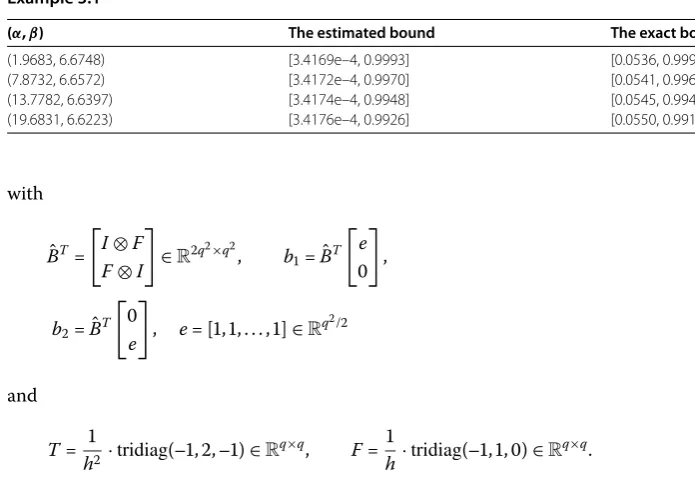
Example .([]) The first test singular nonsymmetric saddle-point problem has the fol-lowing coefficient submatrices:
A=
I⊗T+T⊗I
I⊗T+T⊗I
∈Rq×q
,
BT=
ˆ BT b
b
Table 1 Bounds of nonzero real eigenvalues of the preconditioned matrixPSS–1Afor Example 3.1
(α,β) The estimated bound The exact bound
(1.9683, 6.6748) [3.4169e–4, 0.9993] [0.0536, 0.9991]
(7.8732, 6.6572) [3.4172e–4, 0.9970] [0.0541, 0.9966]
(13.7782, 6.6397) [3.4174e–4, 0.9948] [0.0545, 0.9940]
(19.6831, 6.6223) [3.4176e–4, 0.9926] [0.0550, 0.9915]
with
ˆ BT=
I⊗F F⊗I
∈Rq×q, b
=BˆT
e
,
b=BˆT
e
, e= [, , . . . , ]∈Rq/
and
T=
h ·tridiag(–, , –)∈R
q×q, F=
h·tridiag(–, , )∈R
q×q.
Here,⊗denotes the Kronecker product symbol,νis a parameter, andh=q+ is the dis-cretization meshsize.
For this example, we haven= p,m=p+ , and the total number of variables ism+ n= p+ . The matrixBis an augmentation of the full rank matrixBˆ with two linearly
independent vectorsbandb. Sincebandbare linear combinations of the columns of
the matrixBˆ,Bis a rank-deficient matrix. Thus, the corresponding nonsymmetric saddle-point matrixAis singular. In order to verify the theoretical results, we only choose the case q= and vary the parametersαandβ. We choose four cases for the parameterα, that is,α= .ηn, .ηn, .ηn,ηn. The parameterβis obtained by the formulaβ=B/αIn+
A, which is often used in the shift-splitting preconditioners [, ].
The parametersαandβ, the estimated bounds, and the exact bounds of nonzero real eigenvalues of the shift-splitting preconditioned matricesP–
SSAare listed in Table . In
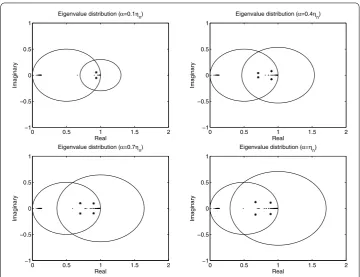
Figure , we plot all eigenvalues of the shift-splitting preconditioned matrixP–
SSAfor
Ex-ample .. In particular, the nonreal eigenvalues are plotted by ‘∗’, and the real eigenvalues are plotted by ‘·’.
By actual computation we know that two eigenvalues of the shift-splitting precondi-tioned matrixP–
SSAare zero, which confirms Theorem .. From Table and Figure we
can see that the estimated bounds sharply contain the exact bounds of real eigenvalues ofP–
GSSAand all eigenvalues having nonzero imaginary parts are located in an
intersec-tion of two circles. These results are in good agreement with our theoretical results in Theorem . and Theorem ..
Example . ([, ]) The second test singular nonsymmetric saddle-point problem arises from the following Stokes equation with suitable boundary conditions:
⎧ ⎨ ⎩
–νu+p=f,
·u= , in
[image:10.595.116.480.111.168.2]Figure 1 Eigenvalue distribution the shift-splitting preconditioned matrixPSS–1Afor Example 3.1.
Table 2 Bounds of nonzero real eigenvalues of the preconditioned matrixPSS–1Afor Example 3.2
(α,β) The estimated bound The exact bound
(0.0077, 0.0072) [1.1108e–3, 0.9995] [0.1356, 0.9990]
(0.0307, 0.0071) [1.1108e–3, 0.9981] [0.1361, 0.9960]
(0.0538, 0.0071) [1.1108e–3, 0.9966] [0.1365, 0.9930]
(0.0768, 0.0071) [1.1108e–3, 0.9952] [0.1370, 0.9900]
whereis a bounded domain,ν> is the viscosity, the vector fieldustands for the ve-locity, andprepresents the pressure.
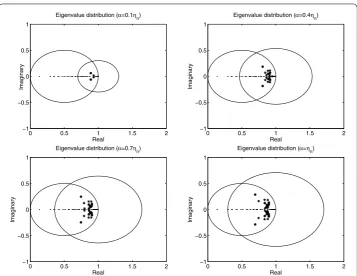
The IFISS software package developed by Elmanet al.[] is used to discretize the two-dimensional Stokes equation (.) on the unit square domain. In actual computation, the Q-Q mixed finite element method on uniform grid is used to generate discretizations. For simplicity, we set the viscosity valuesν= and take × grids to obtain the test matrix. Note that the rank of the matrixBin the test nonsymmetric saddle-point matrix ism– , which means that the discretized nonsymmetric saddle-point matrixAis singular. For the second example, the parametersα andβ are chosen by the same method as in Example .. That is, we considerα = .ηn, .ηn, .ηn,ηn, and the parameters β
are obtained by the formulaβ =B
/αIn+A. By computation we obtain that only
one eigenvalue of the shift-splitting preconditioned matrixPSS–Ais zero, which further confirms Theorem .. In Table , we list the parametersαandβ for the shift-splitting preconditionerPSS, the estimated bounds, and the exact bounds of real eigenvalues of the
[image:11.595.117.480.428.486.2]eigenval-Figure 2 Eigenvalue distribution the shift-splitting preconditioned matrixPSS–1Afor Example 3.2.
ues of the shift-splitting preconditioned matrixPSS–Atogether with the estimated circle. The numerical results presented in Table and Figure also coincide with our theoretical results in Theorem . and Theorem ..
4 Conclusion
To further show the efficiency of the shift-splitting preconditioner for singular nonsym-metric saddle-point problems (.), the eigenvalue bounds of the shift-splitting precondi-tioned saddle-point matrix are studied in detail in this paper. Theoretical analysis shows that all eigenvalues having nonzero imaginary parts are located in an intersection of two circles and all nonzero real eigenvalues are located in a positive interval. Two numerical examples are presented to confirm the theoretical results. The numerical results show that the eigenvalue bounds are very sharp.
Competing interests
The authors declare that they have no competing interests.
Authors’ contributions
The authors contributed equally to this work. All authors have read and approved the manuscript.
Acknowledgements
This work is supported by the National Natural Science Foundation of China (No. 11572210), the Natural Science Foundation of Jiangsu Province (No. BK20151272), the ‘333’ Program Talents of Jiangsu Province (No. BRA2015356), and the Six Top Talents of Jiangsu Province (No. 2014-WLW-029).
Received: 18 July 2016 Accepted: 4 October 2016
References
[image:12.595.119.477.79.355.2]2. Elman, HC, Silvester, DJ, Wathen, AJ: Finite Elements and Fast Iterative Solvers: With Applications in Incompressible Fluid Dynamics, 2nd edn. Oxford University Press, Oxford (2014)
3. Greif, C, Moulding, E, Orban, D: Bounds on eigenvalues of matrices arising from interior-point methods. SIAM J. Optim.24, 49-83 (2014)
4. Cao, Y, Yao, L-Q, Jiang, M-Q, Niu, Q: A relaxed HSS preconditioner for saddle point problems from meshfree discretization. J. Comput. Math.31, 398-421 (2013)
5. Benzi, M, Golub, GH, Liesen, J: Numerical solution of saddle point problems. Acta Numer.14, 1-137 (2005) 6. Bai, Z-Z: Structured preconditioners for nonsingular matrices of block two-by-two structures. Math. Comput.75,
791-815 (2006)
7. Bai, Z-Z: Eigenvalue estimates for saddle point matrices of Hermitian and indefinite leading blocks. J. Comput. Appl. Math.237, 295-306 (2013)
8. Saad, Y: Iterative Methods for Sparse Linear Systems, 2nd edn. SIAM, Philadelphia (2003)
9. Pestana, J, Wathen, AJ: Natural preconditioning and iterative methods for saddle point problems. SIAM Rev.57, 71-91 (2015)
10. Cao, Y, Du, J, Niu, Q: Shift-splitting preconditioners for saddle point problems. J. Comput. Appl. Math.272, 239-250 (2014)
11. Cao, Y, Miao, S-X: On semi-convergence of the generalized shift-splitting iteration method for singular nonsymmetric saddle point problems. Comput. Math. Appl.71, 1503-1511 (2016)
12. Shen, Q-Q, Shi, Q: Generalized shift-splitting preconditioners for nonsingular and singular generalized saddle point problems. Comput. Math. Appl.72, 632-641 (2016)
13. Bai, Z-Z, Yin, J-F, Su, Y-F: A shift-splitting preconditioner for non-Hermitian positive definite matrices. J. Comput. Math.
24, 539-552 (2006)
14. Cao, Y, Tao, H-R, Jiang, M-Q: Generalized shift splitting preconditioners for saddle point problems. Math. Numer. Sin.
36, 16-26 (2014) (in Chinese)
15. Cao, Y, Li, S, Yao, L-Q: A class of generalized shift-splitting preconditioners for nonsymmetric saddle point problems. Appl. Math. Lett.49, 20-27 (2015)
16. Olshanskii, MA, Simoncini, V: Acquired clustering properties and solution of certain saddle point systems. SIAM J. Matrix Anal. Appl.31, 2754-2768 (2010)
17. Shen, S-Q, Huang, T-Z, Yu, J: Eigenvalue estimates for preconditioned nonsymmetric saddle point matrices. SIAM J. Matrix Anal. Appl.31, 2453-2476 (2010)
18. Notay, Y: A new analysis of block preconditioners for saddle point problems. SIAM J. Matrix Anal. Appl.35, 143-173 (2014)
19. Cao, Y, Jiang, M-Q, Zheng, Y-L: A note on the positive stable block triangular preconditioner for generalized saddle point problems. Appl. Math. Comput.218, 11075-11082 (2012)
20. Simoncini, V: Block triangular preconditioners for symmetric saddle-point problems. Appl. Numer. Math.49, 63-80 (2004)
21. Axelsson, O: Unified analysis of preconditioning methods for saddle point matrices. Numer. Linear Algebra Appl.22, 233-253 (2015)