2018 International Conference on Communication, Network and Artificial Intelligence (CNAI 2018) ISBN: 978-1-60595-065-5
Antlion Optimization Algorithm Based on Quadratic Interpolation
Wen-yan GUO
*, Ke-xin LIU, Xuan ZHANG and Jiao-jiao ZHANG
School of Science, Xi’an University of Technology, Xi’an Shaanxi 710054, China *Corresponding author
Keywords: Quadratic interpolation, Antlion optimization algorithm, Computational intelligence,
Swarm intelligence.
Abstract. Because of slow convergence speed and low calculation precision of antlion optimization
(ALO) algorithm, an improved algorithm named quadratic interpolation antlion optimization (QIALO) is put forward in this paper puts. The new algorithm uses the quadratic interpolation (QI) to obtain the secondary renewal position of ants, which enhances the local search ability of the antlion optimization algorithm and accelerates the global optimization speed of the population. Simulation results on thirteen test functions indicate that the performance of the new algorithm is better than that of the contrast algorithms in the statistical sense, and the performance of QIALO algorithm for multimodal optimization is improved effectively.
Introduction
Swarm intelligence optimization algorithm is an effective method for solving optimization problems developed in the past two decades. By simulating and revealing natural phenomena or laws, and using the mechanism of sharing and cooperation among groups, the method of using the intelligence of the group to find the global optimal solution of the optimization problem has become an important method for solving optimization problems. At the same time it has become the focus of more and more researchers at home and abroad.
Antlion optimization (ALO) algorithm [1] is a new swarm intelligence algorithm proposed in 2015. This algorithm simulates the survival mechanism of antlion hunting ants. It searches for the global optimal solution through the evolution of antlion population and ant population. And the ALO algorithm has the advantages of less calculation parameters, simple calculation and easy execution, it has been effectively used to solve the model parameters, the distribution of renewable energy [2], the power dispatch and other problems. And the slow convergence speed and low calculation accuracy of ALO algorithm have attracted many scholars' attention to improve it.
Quadratic interpolation (QI) [3,4,5] uses parabola of three points to obtain local approximation of the objective function and uses the stationary point property of the vertex of the parabola to approximate the optimal value of the objective function, which can accelerate the convergence speed and improve the local search ability of the algorithm. Using QI to update the position of ants will improve the adaptability of ants and then improve the fitness of antlions. So it can effectively balance the exploitation and exploration ability of the algorithm. Therefore, this paper integrates QI into ALO algorithm, and the antlion optimization algorithm based on quadratic interpolation (QIALO) is proposed to improve the convergence speed and optimization performance of the algorithm. The simulation results of 13 test functions show that QIALO algorithm is better than the contrast algorithms in statistical sense.
Antlion Optimization Algorithm
an antlion, it is consumed. For the minimizing problems, the main steps of ALO algorithm are as follows.
Step1:Randomlyinitializing the positions of antlions and ants
The initial populations of ants and antlions are MAnt [A1,A2,AN] and ]
, ,
[ 1 2 N
Antlion AL AL AL
M , the ant i and the antlion i are expressed asAi [Ai1,Ai2,,AiD] and
] , , ,
[ i1 i2 iD
i AL AL AL
AL ,i1,2,,N , where N is the size of populations,Dis the dimension of
search space.
Step2:Determining the initial elite
The initial elite ALe(t) (here t =1) can be determined by calculating and sorting the fitness of
initial antlions f(ALi). In this paper, define the fitness function ( fit(x)) as fit(x) f(x). So the initial elite is defined as:
N i
i
e f AL
AL 1 ) ( min
arg . (1)
where f is the objective function.
Step3:Updating the position of every ant
Step3.1: Ants fall into the pits and slide towards the antlions
For an ant i at iteration t, to select an antlion using roulette wheel ALw(t)
i .
max '
'() ( 1), () ( 1), 10
t t I I t ub t ub I t lb t
lbj j j j . (2)
) ( ) ( ) ( ), ( ) ( ) ( ' ' t ub t AL t ub t lb t AL t
lbj j j j j j . (3)
where ALj(t) represents the ALe(t) or the ALwi(t) of the dimension j at current iterations t, is a
constant defined based on the current iteration, lbj(t) and ubj(t)represent the lower and the upper
bound of search space of the dimension j at iteration t respectively.
Step3.2: Ants randomly walk around ALe(t) and ALwi(t)
An ant i randomly walk around ALe(t) and ALwi(t) can be described as:
) ( ) ( ) ( )) ( ) ( ))( ( ) ( ( ) ( )) ( ) ( )( 1 ) ( 2 ( ) ( ) ( t lb t a t b t lb t ub t a t A t A t A t AL t r cumsum t A t A j ij ij j j ij e ij e ij ij e j ij e ij
. (4)
) ( ) ( ) ( )) ( ) ( ))( ( ) ( ( ) ( )) ( ) ( )( 1 ) ( 2 ( ) ( ) ( t lb t a t b t lb t ub t a t A t A t A t AL t r cumsum t A t A j ij ij j j ij w ij w ij ij w ij ij w ij
. (5)
where Aije(t) and Aijw(t) represent the positions of ant i randomly walk around ALe(t) and ALwi(t)
in the dimension j at iteration t respectively, Aije(t) and Aijw(t) are the normalization of Aije(t) and )
(t
Aijw , cumsum is a cumulative function, r(t)is a stochastic function defined as r(t)1 when
5 . 0
rand , r(t)0 when rand 0.5, rand[0,1], aij(t) and bij(t)represent the minimum and the
maximum random walk in the dimension j of ant i at iteration t respectively.
Step3.3: The update formula for ants
2 ) ( ) ( ) 1
(t A t A t
A w ij e ij ij
. (6)
Step4:Updating the position of antlions
The antlion i updates its position to the latest position of the hunted ant i using Eq.7.
)) ( ( )) ( ( ) ( )) ( ( )) ( ( ) 1 ( ) 1 ( t AL f t A f t AL t AL f t A f t A t AL i i i i i i
i . (7)
Step5:If t=T, output the elite and the fitness of elite, else return to step3 and t=t+1.
Antlion Optimization Algorithm Based on Quadratic Interpolation
In ALO algorithm, the optimization process of ants is realized by random walking around the elite antlion and the antlion selected by roulette. But if the individual fitness of current elite antlion and current antlion selected by roulette are poor, maybe the algorithm will easy to fall into local optimum and slow down the convergence speed. The quadratic interpolation is an algorithm with strong local search ability, and it has the advantage of less computation. So use the QI to obtain the secondary renewal position of ants.
The Secondary Renewal Position of Ants
Take three antsAij(t), Ai1j(t) and Ai2j(t) successively by calculating and sorting the fitness of ants, and the fitness of these three ants satisfy f(Ai(t)) f(Ai1(t)) f(Ai2(t)). According to the theory of QI, through these three points (Aij(t),f(Ai(t))), (Ai1j(t),f(Ai1(t))), (Ai2j(t),f(Ai2(t))) can
make a QI polynomial curve p(x), and the arrest point of p(x) is the new position ANEW(t)
ij . Fig.1
[image:3.612.212.402.419.537.2]shows the schematic of this process.
Figure 1. Schematic diagram of quadratic interpolation.
According to the theory of QI can obtain the secondary renewal formula for the ant i of j dimension
at iterations t (Eq.8 is fitting in each dimension).
( () () ) ( () ) ( () () ) ( () ) ( () ()) ( ())
2 ) ) ( ) ( )( ) ( ( ) ) ( ) ( )( ) ( ( ) ) ( ) ( ))( ( ( ) ( 2 2 2 2 1 2 1 2 2 2 2 2 1 2 2 2 2 1 2 2 2 2 1 2 1 2 2 t A f t A t A t A f t A t A t A f t A t A t A t A t A f t A t A t A f t A t A t A f t A i ij j i i j i ij i j i j i ij j i i j i ij i i j i i NEW ij . (8)
Let AiNEW(t)(AiNEW1 (t),AiNEW2 (t),,AiDNEW(t)), then if f(AiNEW(t)) f(Ai(t)), replace Ai(t) by
) (t ANEW
i .
Description of QIALO Algorithm
________________________________________________________________________________
Input: number of population N , objective function f , the maximum number of iterations tmax Output: elite and the fitness of elite
1. Initialize the population of antlions and ants
2. Calculate and sort the fitness of antlions, determine ALe(t) (here t is 1) 3. while(ttmax)
for every ant
Select an antlion ALw(t)
i using roulette wheel
Ants randomly walk around ALe(t) and ALwi(t) using Eq.4 and Eq.5 Update the position of ants using Eq.6
end for for every ant
Calculate and sort the fitness of ants, and take three ants in turn
Calculate a new position using Eq.8 (the secondary renewal position of the ants) if ( f(AiNEW(t)) f(Ai(t)))
Replace Ai(t) by AiNEW(t) end if
end for
4. Update the position of the antlion using Eq.7
5. Update ALe(t) if an antlion becomes fitter than the ALe(t) end
1
t
t
end while
Return eliteALe(t),f(elite) f(ALe(t))
________________________________________________________________________________
Results and Discussions
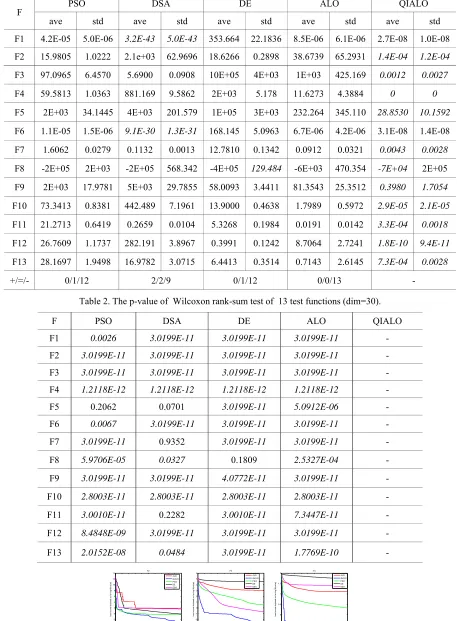
In order to verify the optimization performance of the new algorithm, the 13 functions (used in Reference [1], F1-F7 are unimodal test functions, F8-F13 are multimodal test functions) are tested separately, and QIALO is compared with ALO [2,6], the particle swarm optimization (PSO) algorithm [7,8], the dolphin swarm algorithm (DSA) [9] and the differential evolution (DE) algorithm [10] about the mean (ave) and standard deviation (std) of each selected function. According to the result of Wilcoxon rank-sum test, each algorithm and QIALO in the same population are compared to analyse their differences. In this paper, the significant level is 0.05. And the symbol “+/=/-” means that the QIALO algorithm is worse than, similar to, or better than the contrast algorithms respectively.
Setting of experimental parameters: the size of ant population is 30, the size of antlion population is
30, the maximum iteration number is 1000, the dimension of search space is 30. This experiment runs 30 times for each test function.
Table 1. Results of 13 unimodal test functions and multimodal test functions (dim=30).
F3 97.0965 6.4570 5.6900 0.0908 10E+05 4E+03 1E+03 425.169 0.0012 0.0027
F4 59.5813 1.0363 881.169 9.5862 2E+03 5.178 11.6273 4.3884 0 0
F5 2E+03 34.1445 4E+03 201.579 1E+05 3E+03 232.264 345.110 28.8530 10.1592
F6 1.1E-05 1.5E-06 9.1E-30 1.3E-31 168.145 5.0963 6.7E-06 4.2E-06 3.1E-08 1.4E-08 F7 1.6062 0.0279 0.1132 0.0013 12.7810 0.1342 0.0912 0.0321 0.0043 0.0028
F8 -2E+05 2E+03 -2E+05 568.342 -4E+05 129.484 -6E+03 470.354 -7E+04 2E+05
F9 2E+03 17.9781 5E+03 29.7855 58.0093 3.4411 81.3543 25.3512 0.3980 1.7054
F10 73.3413 0.8381 442.489 7.1961 13.9000 0.4638 1.7989 0.5972 2.9E-05 2.1E-05
F11 21.2713 0.6419 0.2659 0.0104 5.3268 0.1984 0.0191 0.0142 3.3E-04 0.0018
F12 26.7609 1.1737 282.191 3.8967 0.3991 0.1242 8.7064 2.7241 1.8E-10 9.4E-11
F13 28.1697 1.9498 16.9782 3.0715 6.4413 0.3514 0.7143 2.6145 7.3E-04 0.0028
[image:5.612.76.533.98.719.2]+/=/- 0/1/12 2/2/9 0/1/12 0/0/13 -
Table 2. The p-value of Wilcoxon rank-sum test of 13 test functions (dim=30).
F PSO DSA DE ALO QIALO
F1 0.0026 3.0199E-11 3.0199E-11 3.0199E-11 -
F2 3.0199E-11 3.0199E-11 3.0199E-11 3.0199E-11 -
F3 3.0199E-11 3.0199E-11 3.0199E-11 3.0199E-11 -
F4 1.2118E-12 1.2118E-12 1.2118E-12 1.2118E-12 -
F5 0.2062 0.0701 3.0199E-11 5.0912E-06 -
F6 0.0067 3.0199E-11 3.0199E-11 3.0199E-11 -
F7 3.0199E-11 0.9352 3.0199E-11 3.0199E-11 -
F8 5.9706E-05 0.0327 0.1809 2.5327E-04 -
F9 3.0199E-11 3.0199E-11 4.0772E-11 3.0199E-11 -
F10 2.8003E-11 2.8003E-11 2.8003E-11 2.8003E-11 -
F11 3.0010E-11 0.2282 3.0010E-11 7.3447E-11 -
F12 8.4848E-09 3.0199E-11 3.0199E-11 3.0199E-11 -
F13 2.0152E-08 0.0484 3.0199E-11 1.7769E-10 -
0 1002003004005006007008009001000 -4
-2 0 2 4 6 8 10 12 14
iteration
bes
t s
cor
e obt
ai
ned
s
o f
ar
log
10(
value)
F2 ALO QIALO PSO DE DSA
0 1002003004005006007008009001000 -3
-2 -1 0 1 2 3 4 5 6
iteration
bes
t s
cor
e obt
ai
ned
s
o f
ar
log
10(
value)
F3 ALO QIALO PSO DE DSA
0 100200300400 5006007008009001000 -0.5
0 0.5 1 1.5 2
iteration
bes
t s
cor
e obt
ai
ned
s
o f
ar
log
10(
value)
F4 ALO QIALO PSO DE DSA
Figure 2. Convergence curve of algorithms on three of the unimodal test functions F2, F3, F4 (dim=30).
F PSO DSA DE ALO QIALO
ave std ave std ave std ave std ave std
F1 4.2E-05 5.0E-06 3.2E-43 5.0E-43 353.664 22.1836 8.5E-06 6.1E-06 2.7E-08 1.0E-08
0 1002003004005006007008009001000 -0.5
0 0.5 1 1.5 2 2.5 3
iteration
bes
t s
co
re
obt
ai
ned s
o f
ar
lo
g10(
va
lue
)
F9 ALO QIALO PSO DE DSA
0 1002003004005006007008009001000 -10
-8 -6 -4 -2 0 2 4 6 8 10
iteration
bes
t s
co
re
obt
ai
ned s
o f
ar
lo
g10(
va
lue
)
F12 ALO QIALO PSO DE DSA
0 1002003004005006007008009001000 -4
-2 0 2 4 6 8 10
iteration
bes
t s
co
re
obt
ai
ned s
o f
ar
lo
g10(
va
lue
)
[image:6.612.181.426.67.132.2]F13 ALO QIALO PSO DE DSA
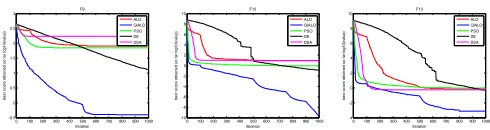
Figure 3. Convergence curve of algorithms on three of the multimodal test functions F9, F12, F13 (dim=30).
For the 30-dimensional search space, by comparing the experimental results (Table 1) of QIALO algorithm with other intelligent algorithms, we can see that QIALO is better than ALO for all test functions, QIALO is better than PSO for 12 test functions, QIALO is superior than DE for 12 test functions, QIALO is excellent than DSA for 9 test functions. And the DSA algorithm provides only two functions that are better than QIALO. There are only one function that make QIALO equal to PSO and DE. Table 2 shows that the p-value is less than the significant level 0.05 in most cases, so it's a credible hypothesis that there is a significant difference in the results tested by the algorithms. The convergence curves of the algorithms on some of the 13 test functions are shown in Figure 2 and Figure 3. These pictures reflect that the QIALO algorithm shows the fastest convergence speed compared with the contrast algorithms on the test functions and has the ability to jump out of the local optimum in the later stage of the algorithm.
Summary
Aiming at the defects of ALO algorithm which is easy to fall into local optimum and slow convergence speed, a new antlion optimization algorithm based on QI is proposed in this paper. The experimental results show that the QIALO algorithm has better local search ability and faster convergence speed. At the same time, it verifies the new algorithm is better than the contrast algorithms in statistical sense, and the performance of QIALO algorithm for multimodal test functions is improved in particularly.
Acknowledgement
This work was supported by National Nature Science Foundation of China (No.61772416,11601419) and Xi’an University of Technology Program (No.252051654).
References
[1]Seyedali Mirjalil. The Ant Lion Optimizer. Advances in Engineering Software, 2015, 83: 80-98. [2]He Zhonghua. Beijing Electricity Demand Forecast Based on Ant Lion Optimizer GM(1,1) Model. Modern Industrial Economy and Informationization, 2017, 22(7):5 8-63.
[3]Gao Guohui, Li Sikun. Improving DSSS signal PN code phase measurement precision by 3-points quadratic interpolation. Journal on Communication, 2007, 28(2): 131-133.
[4]Wu Jiana,Cui Zhihua,Liu Jing.Social emotional optimization algorithm based on quadratic interpolation method[. Journal of Computer Application, 2011, 31(9): 2522-2525.
[5]Zhang Lei, Zhang Guo, Qiu Yaqin. Research and error analysis of an new Lagrange interpolation algorithm. Power System Protection and Control, 2014, 42(16): 67-70.
[6]Zawbaa H.M., Emary E., Grosan Crina. Feature Selection via chaotic Antlion Optimization. Plos One, 2016, 11(3): 1-21.
[8]Liu Zhi-xiong, Liang Hua. Parameter setting and experimental analysis of the random number in particle swarm optimization algorithm. Control Theory & Applications, 2010, 27(11): 1490-1496. [9]Tian-qi Wu, Min Yao, Jian-hua Yang. Dolphin swarm algorithm. Frontiers of Information Techology & Electronic Engineering, 2016, 17(8): 717-729.