Comparative Study
of Segmentation and Recognition
Methods for Handwritten Devnagari Script
Swati Kinhekar
Department of Computer Engineering, Mumbai University
PIIT, New Panvel, India
Sharvari S. Govilkar
Department of Computer Engineering, Mumbai University
PIIT, New Panvel, India
ABSTRACT
Script recognition systems for various languages have gain importance in recent decades and are the area of deep interest for many researchers. English Character Recognition (CR) has been extensively studied in the last half century and progressed to a level, sufficient to produce technology driven applications. But same is not the case for Indian languages which are complicated in terms of structure and computations. Indian scripts present great challenges to an OCR designer due to the large number of letters in the alphabet, the sophisticated ways in which they combine, and the complicated graphemes they result in. Devnagari(Hindi) being the national language of India, spoken by more than 500 million people, should be given special attention so that document retrieval and analysis of rich ancient and modern Indian literature can be effectively done. This article is intended to serve as a guide and update for the readers, working in the Handwritten Devanagari Script Recognition (HDSR) area. An overview of HDSR systems is presented and the available HDSR techniques are reviewed. The current status of HDSR is discussed and directions for future researches are suggested.
Keywords
Handwritten Devnagari Character Recognition, Preprocessing, Segmentation, Feature Extraction, Recognition, Classification.
1.
INTRODUCTION
Handwritten character recognition is the ability of a computer to receive and interpret intelligible handwritten input from sources such as paper documents, photographs, touch-screens and other devices. Handwritten Devnagari Characters are more complex for recognition than corresponding English characters due to many possible variations in order, number, direction and shape of the constituent strokes.
In recent years, a lot of research has been done in this area.
Handwritten text recognition can be classified based upon two major criteria: the data acquisition process (on-line or off-line) and the text type (machine-printed or hand-written). For recognition of handwritten Hindi Characters there are four major stages, 1. Preprocessing 2.Segmentation 3.Feature Extraction 4.Recognition. The following sections present a study of literature survey done so far on the off-line Handwritten Devanagari Character Recognition.
2.
FEATURES OF DEVNAGARI SCRIPT
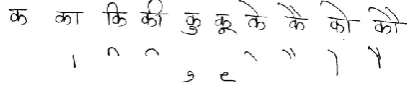
[image:1.595.316.540.224.321.2]Devnagari script is being used in various languages, in south Asian subcontinent, such as Sanskrit, Rajasthani, Marathi, Konkani and Nepali and it is also the script of Hindi, the official language of India and the mother tongue of majority of Indians. Devnagari has 13 vowels and 36 consonants along with modifiers as shown in fig 1
Fig. 1: Vowels & Consonants of Devnagari
They are called basic characters. Vowels can be written as independent letters, or by using a variety of diacritical marks which are written above, below, before or after the consonant they belong to. When vowels are written in this way they are known as modifiers and the characters so formed are called conjuncts shown in fig. 2
Fig. 2: Modifiers and conjuncts of Devnagari
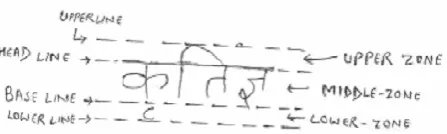
All the characters have a horizontal line in the upper part, known as shirorekha or headline. No English character has such a characteristic and so it can be taken as a distinguishable feature to extract English from these scripts. In continuous handwriting, from left to right direction, the shirorekha of one character joins with the shirorekha of the previous or next character of the same word. In this fashion, multiple characters and modified shapes in a word appear as a single connected component joined through the common shirorekha. All the characters and modified shapes in a word appear to hang from the hypothetical shirorekha of the word. Also in Devnagari there are vowels, consonants, vowel modifiers and compound characters, numerals. Moreover, there are many similar shaped characters. These characteristics of Devnagari make the script complicated for its segmentation.
[image:1.595.329.533.416.468.2]A typical zoning is shown in Fig.3
Fig 3: Three strips of a Devnagari word.
Handwritten Script Recognition involves Preprocessing of the scanned document for removal of noise, binarization, normalisation etc. Then the preprocessed data is passed through Segmentation phase, where the document is segmented into lines, word , composite character, modifiers and conjuncts. This isolated data input is passed to Feature Extraction phase, where various features of each character is extracted and stored for later use in recognition phase. The Recognition phase is based on classifying the character image based on its matched features.
3.
LITERATURE SURVEY
This section presents detail study of various segmentation & recognition techniques. It also provides with the details of all the methods or algorithms used by various researchers in other phases of handwritten Devnagari script recognition.
Despande, Malik & Arora[1] have used the concept of regular expression to classify the input image in recognition phase which is priorly converted into 0’s and 1’s in segmentation phase . This code of 0’s and 1’s is recognised by minimum edit distance algorithm in[2][6], where good amount of accuracy is observed. The authors in[3] takes single character image as input and code is generated based on extracted physical features, the recognition of which is being done by tree classifiers. An integrated approach for segmentation and recognition is described in[4], where Ostu’s method is used for binarization, Robert filters were used for feature extraction. The character image is recognised by quadratic classifiers. The approach is based on single character as input. In 2008, Bikash Shaw[5] suggest a system that converts input image into pseudo characters and applies HMM classifiers on the basis of the stokes of the pseudo character.
The author in[7] came up with a pure recognition system based on neural network with one hidden layer in which the view based features and shadow based features were extracted .Satish Kumar[8] has presented a comparative results of various features extracted from the sample input over which SVM and MLP classifiers are used for recognition. A comparative study of 12 different classifiers used to recognize handwritten character with 2-set of features extracted is done in[9]. The author has also presented the result of comparison. Hanmandlu & Pooja Agrawal[10] proposed a segmentation model where horizontal projection was used for header line detection and contour tracing algorithm was used to segment the modifiers. In the year 2010, Naresh Kumar with Lakwinder & M.K. Jindal had come up with a segmentation system that segment line, word, character and modifiers. They used vertical & horizontal profiles for segmentation. The system has put restriction on the amount of skew present in the text by limiting it to the height of the character consonant.
The system in[12] introduced by Kailash S. Sharma, A.R. Karwankar & Dr. Bhalchandra uses Self Organizing Maps(SOM) neural network for recognising the image which is preprocessed by binarization and cropping. The work done by
Sandhya Arora & colleagues[13] shows the comparison of the performance of SVM classifiers and ANN. They have tested the two recognition methods on various feature extracted from the input image. Vandana L. & Latesh M.[14] proposed a segmentation model which uses morphological operators and Moore tracing algorithm. The preprocessing in this is done by binarization, deskewing .Comparative study of recognition of handwritten and printed character and numerals by Nearest-neighbour classifiers was presented in[15].The important step in the area of recognition of compounded character was made by Sushma Shelke & Shaila Apte[16].The system used a 2 layered neural network for recognition on two different set of features. In the same year, 2 layer feed forward neural network was used for character recognition in which features were extracted after zoning the character image[17].
Author in[18] presented a pure segmentation system based on morphological operators. The result shows that due to presence of modifiers & fused character the rate of accuracy goes down. Brijmohan[19] present recognition results with KNN and SVM classifiers in which curvelet transform technique is used for feature extraction. The research achieves good results as Ostu’s method & Winner filter are respectively used for binarization & smoothening. Another segmentation model[20] by Ashwin Ramteke & Milind E Rane shows good results for word and character segmentation where the input image is smoothen using Median filter and projection schemes are applied for segmenting the text images. With same segmentation methods & without preprocessing the result of another segmentation model[21] shows comparative less accurate results.
Shubra S. & Gupta[22] applied their proposed recognition model using Feed Forward Back Propagation Neural Network on 20 samples collected for 4 Devnagari words. Aggrawal,Rani & Dhir[23] in 2012 came up with a system that extracts gradient features which are classified using SVM classifiers. First time the bounding box method was used for segmentation in[24], the system also supports skew detection & correction along with binarization & normalization of input image. The recognition is done by Feed Forward Neural network.
4.
SEGMENTATION AND
RECOGNITION METHODS
Segmentation & Recognition are two most important part of all recognition system. A result of recognition highly depends on the accuracy of segmentation done earlier. Thus, it is very important to choose a good segmentation and a good recognition method. In this section, we present the existing segmentation techniques and the various recognition methods that can be used by the researchers.
4.1 Segmentation Methods
Segmentation in any recognition system consist of dividing the Handwritten Devanagari script into first lines, the lines are further divided into words and the words further divided into characters from which the different modifiers & conjuncts are separated.
4.1.1 Projection Profile Techniques[33]
This method is based on the projection made by the various characters and lines in a given image. Based on certain parameters the input image can be divided into lines , words & characters. Further, the method can be divided into following type:
Vertical Projection: For a binary image of size H * W where H is the height of the image and W is the width of the image, the vertical projection has been defined as
V P(k); k = 1; 2; : : : ;W
This operation counts the total number of black pixels in each vertical column.
Horizontal Projection: For a binary image of size H * W where H is the height of the image and W is the width of the image, the horizontal projection is defined as
HP(j); j = 1; 2; : : : ;H
This operation counts the total number of black pixels in each horizontal row.
4.1.2 Contour Tracing Algorithm and Moore
Neighbourhood Tracing Algorithm.[10][14][18]
The method is used for detecting the point of intersection of image of modifiers with the character image.
The algorithm needs the coordinates of an image pixel that lies on the contour and returns the positions (row , column) of all the connected points by checking the continuity of the input pixel around its 3x3 neighbourhood.
• The region of interest is searched for a first transition between background and object, i.e. a transition from (logical) white to black if dark objects are to be segmented, black to white for light objects.
• As soon as the transition has been found, the algorithm searches for the next neighbour of the same (logical) colour with respect to the connectedness definition used. In this case, only border pixels are accepted as neighbours, i.e., pixels adjacent to at least one pixel of the other (logical) colour • Contour tracing ends when the algorithm reaches its starting point, i.e., the pixel where the first transition has been found.
4.1.3 Using Morphological Operators [18]
Erosion and Dilation are the two operators whose combination or series of combination can be applied with different structuring element depending upon the size of the image. In erosion, the input image is eroded with the structuring element to obtain the processed image. The processed image obtained is sharper. The reverse happens in dilation. These operators are usually applied for detecting and removing header line from the word.
4.2 Recognition Methods [34]
Recognition phase is applied after the various features of an input image is extracted and finally the input image has to be classified/recognised by comparing its features with those in the system’s database. This can be majorly done by using different image classifiers to classify the input image into various classes based on their matched features or by using neural networks which train the system first and then it is tested over the input image. Also, many systems are based on recognition using Genetic algorithm.
4.2.1 Statistical Methods
These methods are based on implementing a rule based system for classification.
Prior to application of the methods, some rules will be made based on the features which the system is going to extract for the input character image. On the basis of the rule which is matched, the output of recognition is given.
Techniques based on this approach-Quadratic discriminant function (QDF), Linear discriminant function (LDF), and Euclidean distance from class mean, K-NN, Modified QDF (MQDF) etc.
4.2.2 Artificial Neural Networks (ANNs)
A neural network is a set of connected input/output units in which each connection has a weight associated with it. During the learning phase, the network by adjusting the weights so as to be able to predict the correct class label of the input values. Feedforward neural networks, including multilayer perceptron (MLP), radial basis function (RBF) network, Back Propagation neural network (BPN) etc.
4.2.3 Kernel Methods
These methods require only a user-specified kernel, i.e., a similarity function over pairs of data. In this process, the raw data is transformed into feature vector representations. This image in form of vector will be compared with the input image vector and based on matched feature the output is returned. Support Vector Machine (SVM), kernel principal component analysis (KPCA), kernel Fisher discriminant analysis (KFDA) are some classifiers based on this method.
4.2.4 Genetic Algorithm:
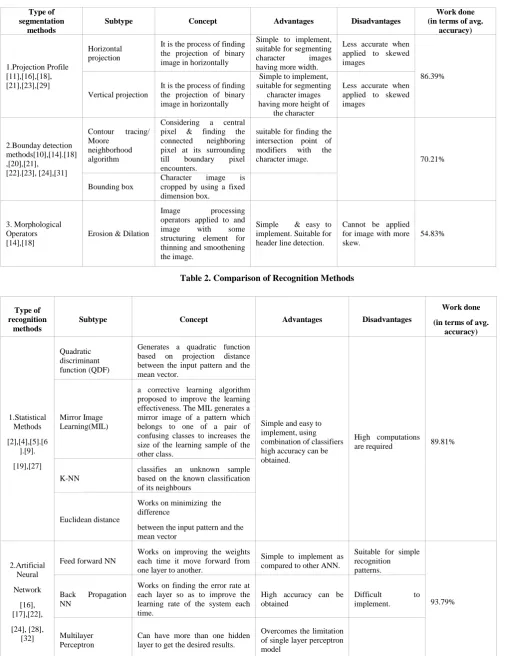
Table 1. Comparison of Segmentation Methods
Table 2. Comparison of Recognition Methods
Type of segmentation
methods
Subtype Concept Advantages Disadvantages
Work done (in terms of avg.
accuracy)
1.Projection Profile [11],[16],[18], [21],[23],[29]
Horizontal projection
It is the process of finding the projection of binary image in horizontally
Simple to implement, suitable for segmenting character images having more width.
Less accurate when applied to skewed images
86.39%
Vertical projection
It is the process of finding the projection of binary image in horizontally
Simple to implement, suitable for segmenting
character images having more height of
the character
Less accurate when applied to skewed images
2.Bounday detection methods[10],[14].[18] ,[20],[21],
[22].[23], [24],[31]
Contour tracing/ Moore
neighborhood algorithm
Considering a central pixel & finding the connected neighboring pixel at its surrounding till boundary pixel encounters.
suitable for finding the intersection point of modifiers with the
character image. 70.21%
Bounding box
Character image is cropped by using a fixed dimension box.
3. Morphological Operators [14],[18]
Erosion & Dilation
Image processing operators applied to and image with some structuring element for thinning and smoothening the image.
Simple & easy to implement. Suitable for header line detection.
Cannot be applied for image with more skew.
54.83%
Type of recognition
methods
Subtype Concept Advantages Disadvantages
Work done
(in terms of avg. accuracy)
1.Statistical Methods
[2],[4],[5].[6 ].[9].
[19],[27]
Quadratic discriminant function (QDF)
Generates a quadratic function based on projection distance between the input pattern and the mean vector.
Simple and easy to implement, using combination of classifiers high accuracy can be obtained.
High computations
are required 89.81% Mirror Image
Learning(MIL)
a corrective learning algorithm proposed to improve the learning effectiveness. The MIL generates a mirror image of a pattern which belongs to one of a pair of confusing classes to increases the size of the learning sample of the other class.
K-NN
classifies an unknown sample based on the known classification of its neighbours
Euclidean distance
Works on minimizing the difference
between the input pattern and the mean vector
2.Artificial Neural
Network
[16], [17],[22],
[24], [28], [32]
Feed forward NN
Works on improving the weights each time it move forward from one layer to another.
Simple to implement as compared to other ANN.
Suitable for simple recognition patterns.
93.79% Back Propagation
NN
Works on finding the error rate at each layer so as to improve the learning rate of the system each time.
High accuracy can be obtained
Difficult to implement.
Multilayer Perceptron
Can have more than one hidden layer to get the desired results.
5.
CONCLUSION
As Handwritten Devnagari Script Recognition has a huge scope in many areas, the researchers should used the most efficient techniques to get the desired results. This paper presents the following analysis after study of the detailed literature survey in the area. The survey analysis and the results shown in the previous sections suggest that a segmentation complexity increases from line to word, character to modifiers & conjuncts. Also, the complexity increases many folds when it comes to Handwritten Devanagari script. The same analysis can be seen in case of recognition. As compared to character recognition, word recognition in Devnagari script is very difficult. The literature survey shows that for word recognition the accuracy is reduced to 85% from an average accuracy of 95%.
The future scope in this area suggests that for Handwritten Devanagari script, better results can be obtained with MIL classifier [9] which provides accuracy around 95.17%. The MIL classifiers can be combined with horizontal & vertical projection methods for segmentation. Also, the script can be well preprocessed by Ostu’s method for binarization . The features of which can be extracted by modifying wavelet[16].Thus, this study suggest that the script recognition will give good results when projection methods are combine with modified wavelet technique and classified using MIL classifier.
6.
REFERENCES
[1] Dr. P. S. Deshpande, Mrs. Latesh Malik & Mrs. Sandhya Arora, “ Characterizing Hand Written Devanagari Characters using Evolved Regular Expressions ”,2006 IEEE
[2] Dr. P. S. Deshpande, Mrs. Latesh Malik & Mrs. Sandhya Arora, “Handwritten Devanagari Character Recognition Using Connected Segments And Minimum Edit Distance”, 2007 IEEE
[3] Dr. P. S. Deshpande, Latesh Malik &Mrs. Sandhya
Arora, “Recognition of Hand Written
DevnagariCharacters with Percentage Component Regular Expression Matching and Classification Tree”, 2007 IEEE [4] U. Pal, N. Sharma, T. Wakabayashi X& F. Kimura,
“Off-Line Handwritten Character Recognition of Devnagari Script”, 2007IEEE Ninth International Conference on Document Analysis and Recognition
[5] Bikash Shaw, Swapan Kumar Parui & Malayappan Shridhar, “ A Segmentation Based Approach to Offline Handwritten Devanagari Word Recognition”, 2008 IEEE International Conference on Information Technology. [6] Dr. P. S. Deshpande, Latesh Malik & Sandhya Arora,
“Fine Classification & Recognition of HandWritten Devnagari Characters with Regular Expressions & Minimum Edit Distance Method”, 2008- JOURNAL OF COMPUTERS, VOL. 3, NO. 5
[7] S. Arora, D. Bhattacharjee, M. Nasipuri2 , D.K. Basu , M.Kundu & L.Malik, “Study of Different Features on Handwritten Devnagari Character”,2009 Second International Conference on Emerging Trends in Engineering and Technology, ICETET
[8] Satish Kumar, “Performance Comparison of Features on Devanagari Hand-printed Dataset”,May-2009International Journal of Recent Trends in Engineering, Vol. 1, No. 2 [9] U. Pal, T. Wakabayashi & F. Kimura, “Comparative
Study of Devnagari Handwritten Character Recognition using Different Feature and Classifiers”, 2009 10th International Conference on Document Analysis and Recognition.
[10]M. Hanmandlu and Pooja Agrawal, “Structural Approach for Segmentation of Handwritten Hindi Text, 2009 Proceedings of the International Conference on Cognition and Recognition.
[11] Naresh Kumar Garg,Lakhwinder Kaur & M. K. Jindal, “Segmentation of Handwritten Hindi Text,2010 International Journal of Computer Applications (0975 – 8887) Volume 1 – No. 4.
[12]Kailash S. Sharma, A. R. Karwankar & Dr. A.S.Bhalchandra, “Devnagari Character Recognition Using Self Organizing Maps”,2010 IEEE
[13]Sandhya Arora, Debotosh Bhattacharjee, Mita Nasipuri, L. Malik , M. Kundu and D. K. Basu, “Performance Comparison of SVM and ANN for Handwritten Devanagari Character Recognition”,2010 IJCSI International Journal of Computer Science Issues, Vol. 7, Issue 3, No 6
[14]Vandana M. Ladwani & Mrs. Latesh Malik,“Novel Approach to Segmentation of Handwritten Devnagari Word” 2010 IEEE, Third International Conference on Emerging Trends in Engineering and Technology
3.Kernal methods
[19],[23]
Support Vector Machine(SVM)
SVM is a binary classifier with discriminant function being the weighted combination of kernel functions over all training samples.
Gives good results
Less efficient when applied to similar looking characters.
93.60%
4. Genetic Algorithm
[26],[30]
Based on finding the optimal solution by evaluating a fitness function of each generated sample.
Highly desirable when good evaluation function is used.
High computations are required.
[15] Anilkumar N. Holambe & Dr. Ravinder.C. Thool, “Comparative Study of Devanagari Handwritten and printed Character & Numerals Recognition using Nearest-Neighbor Classifiers”, 2010 International Journal of Engineering Science and Technology Vol. 2 (7), 2010, 2681-2689
[16]Sushama Shelke & Shaila Apte, “A Multistage Handwritten Marathi Compound Character Recognition Scheme using Neural Networks and Wavelet Features”,2011 International Journal of Signal Processing, Image Processing and Pattern Recognition.Vol. 4, No. 1 [17]P.B. Kanale & S.D. Chitnis, “Handwritten Devanagari
Character Recognition Using Artificial Neural Network”, 2011 Journal of Artificial Intelligence.
[18]Sandip N.Kamble and Prof. Megha
Kamble,“Morphological Approach for Segmentation of Scanned Handwritten Devnagari Text”, 2011 Dept. of CSE, SIRT Bhopal, MP, India IJCST Vol. 2, Iss ue 4, Oct . - Dec.
[19]Brijmohan Singh, Ankush Mittal, M.A. Ansari and Debashis Ghosh,“Handwritten Devanagari Word Recognition: A Curvelet Transform Based Approach”,2011 International Journal on Computer Science and Engineering (IJCSE).
[20]Ashwin S Ramteke, Milind E Rane, “Offline Handwritten Devanagari Script segmentation”, 2012 International Journal Of Scientific & Technology Research Volume 1, Issue 4
[21]Saiprakash Palakollu , Renu Dhir & Rajneesh Rani, “Handwritten Hindi Text Segmentation techniques for Lines and Characters”, 2012 Proceedings of the World Congress on Engineering and Computer Science,Vol I [22]Shubhra Saxena & P. C. Gupta, “ A Novel Approach of
Handwritten Devanagari Character Recognition through Feed Forward Back Propagation Neural Network”,2012 International Journal of Computer Applications (0975 – 8887) Volume 51– No.20
[23]Ashutosh Aggarwal,Rajneesh Rani & RenuDhir, “ Handwritten Devanagari Character Recognition Using Gradient Features”,2012 International Journal of Advanced Research in Computer Science and Software Engineering, Volume 2, Issue 5
[24]Mitrakshi B. Patil & Vaibhav Narawade, “ Recognition of Handwritten Devnagari Characters through Segmentation and Artificial neural networks,2012 International Journal of Engineering Research & Technology (IJERT) Vol. 1 Issue 6.
[25]Prof. M.S.Kumbhar1, Y.Y.Chandrachud, “Handwritten Marathi Character Recognition Using Neural Network”,2012 International Journal of Emerging Technology and Advanced Engineering.
[26]Ved Prakash Agnihotri, “ Offline Handwritten Devanagari Script Recognition”,2012 I.J. Information Technology and Computer Science.
[27]Mrs.Vinaya. S. Tapkir & Mrs.Sushma.D.Shelke, “ OCR For Handwritten Marathi Script”,2012 International Journal of Scientific & Engineering Research Volume 3, Issue 8
[28]S. Arora, D. Bhattacharjee, M. Nasipuri, D.K. Basu & M.Kundu, “Application of Statistical Features in Handwritten Devnagari Character Recognition”,2013 [29]Vneeta Rani and Dr.Vijay laxmi, “ Segmentation of
Handwritten Text Document Written in Devanagri Script for Simple character, skewed character and broken character”,2013 International Journal Of Computers & Technology, Vol 8, No 1.
[30]Vedgupt Saraf, D.S. Rao,“Devnagari Script Character Recognition Using Genetic Algorithm for Get Better Efficiency”2013 International Journal of Soft Computing and Engineering (IJSCE) ISSN: 2231-2307, Volume-2, Issue-4.
[31]Shuchi Kapoor and Vivek Verma, “FRAGMENTATION OF HANDWRITTEN TOUCHING CHARACTERS IN DEVANAGARI SCRIPT”,2014 International Journal of Information Technology, Modeling and Computing (IJITMC) Vol. 2, No. 1.
[32]Sohan Lal Sahu, “Devanagari Handwriting Recognition and Editing Using Neural Network”,2014 IJCSN International Journal of Computer Science and Network [33]Veena Bansal and R. M. K. Sinha “Segmentation Of
Touching And Fused Devanagari Characters.”2009 [34]Cheng-Lin Liu & Hiromichi Fujisawa, “Classification and