The Experience of Teaching in Art, Design and
Communication
Linda Drew,
B.A. (Hons)., M.A., Cert. Ed.
September 2003
This thesis is submitted in partial fulfilm ent of the
requirements for the degree of Doctor of Philosophy.
Department of Educational Research
ProQuest N um ber: 11003792
All rights reserved
INFORMATION TO ALL USERS
The q u a lity of this re p ro d u c tio n is d e p e n d e n t u p o n the q u a lity of the c o p y s u b m itte d .
In the unlikely e v e n t that the a u th o r did not send a c o m p le te m a n u s c rip t and there are missing p a g e s , these will be n o te d . Also, if m a te ria l had to be re m o v e d ,
a n o te will in d ic a te the d e le tio n .
uest
P roQ uest 11003792
Published by ProQuest LLC(2018). C o p y rig h t of the Dissertation is held by the A u tho r.
All rights reserved.
This work is p ro te c te d a g a in s t u n a u th o riz e d c o p y in g under Title 17, United States C o d e M icro fo rm Edition © ProQuest LLC.
ProQuest LLC.
789 East Eisenhower Parkway P.O. Box 1346
This thesis was completed as part of the Doctoral Programme in
Educational Research. The following article-length assignments
were submitted as part of the requirements of that programme:
Education, Training and Work:
The course team as the focus for contextualised professional learning.
Learning, Teaching and Assessment:
Art and Design lecturers’ conceptions of teaching: a study of conceptions and
individual accounts of influences in their formation
Policy, Change and Organisational Development:
Would you credit it? Adopting a credit framework in a specialist Art, Design and
Communication Institution.
Declaration
This thesis results entirely from my own work and has not been offered previously for
any other degree or diploma.
Linda Drew,
B.A. (Hons)., M.A., Cert. Ed.
“The Experience of Teaching in Art, Design and
Communication”
Submitted September 2003
Abstract
The aim of this thesis is to explore conceptions of and approaches to teaching
situated within the context of practice-based teachers of art, design and
communication. This thesis explores conceptions of teaching held by academics in
departments of art, design and communication and explores links between those
conceptions and the communities of practice associated with the subject context. It
also aims to further investigate how approaches to teaching relate to the concept of
communities of practice.
The qualitatively different ways that teachers of creative practices experience their
teaching is explored. The study focuses on teachers of practice-based subjects in
art, design or communication. The data is from an interview study of 44 teachers
from eight UK Universities and is explored with a phenomenographic approach. The
analysis was grouped into three discrete sub-disciplines, media practice (15), fine art
(11) and design (18), through which variation in the practice dimensions could also
be discerned. The research adopts a second-order perspective on the experience of
teaching a practice-based subject in art, design and communication departments.
The important feature of this analysis is the community of practice dimension, in
particular how teaching is perceived as contributing to engaging with the social
Following the interviews with art, design and communication teachers, a slightly
revised Approaches to Teaching Inventory (ATI), with the inclusion of skills and
communities of practice items, was distributed to teachers in the UK. 73 returned
questionnaires were analysed. The results show (a) that the ATI has validity in
practice-based areas, and (b) that all teachers aim to develop students’ skills, but
those with a student-focused approach are more likely to also focus on the practice
and the real world problems of the profession. The positive correlation between an
emphasis on development for the professions and a student-focused approach to
teaching, offers insight for those involved in the further development of teaching
List of Contents
Page
Number
Abstract
Preface of illustrations
ix
Southport School of Art ix
Three-dimensional studio class x
Miss Peake demonstrating modelling a dress xi on the stand
Art students at work xii
Acknowledgements
xiii
Chapter 1:
1.1 Background to the study 1
1.2 Aims of the enquiry 4
Chapter 2:
6
2.1 Conceptions of learning 6
2.2 Research on primary and secondary school 7 teacher beliefs
2.3 Research on tertiary teacher belief 8
orientations
2.4 Conceptions of teaching 11
2.5 Conceptions of teaching in creative practices 13
2.6 Approaches to teaching 17
2.7 Research which examines relations between 18 teachers’ conceptions and teachers’ practices 2.8 Research which discusses implications for 20
teacher development
2.9 Overview 22
Chapter 3:
23
3.1 Learning to practice and participation 23 3.2 The role of departmental and course level 32
cultures
3.3 Professional learning in the teaching context 36
Chapter 4:
Chapter 5:
Chapter 6:
Chapter 7:
Chapter 8:
The discipline context: epistemological
characteristics, societal, cultural and
organisational factors affecting the
context
38
4.1 Disciplinary differences 38
4.2 Disciplinary differences in teaching and 39 teaching scholarship
4.3 The particular context of Art & Design and 42 Communication & Media in higher education
4.4 QAA Subject overview reports 47
4.5 Subject benchmark statements 51
4.6 Overview 53
54
5.1 Introduction 54
5.2 Methodology 54
5.3 Methods 57
5.4 Reflections on the phenomenographic method 74
6.1 Conceptions of teaching media practice 82
6.2 Conceptions of teaching fine art 97
6.3 Conceptions of teaching design 104
7.1 Inventory item descriptives 121
7.2 Correlation matrix of additional items 125
7.3 Factor analysis 127
7.4 Analysis of the scales and the scale scores 129
7.5 Scale reliabilities 130
7.6 Correlation analyses 131
8.1 Introduction 135
8.2 The practice-based context of the interviews 138 8.3 Discussion in relation to the first and second 140
research questions: variation in the experience of teaching
8.4 A discussion of the community of practice 147 dimension
8.5 Discussion in relation to the third research 149 question: relations between approaches to
Chapter 9:
References
Appendices
List of
Tables
8.6 Consideration for development of teachers in 152 art, design and communication
8.7 The activity system as a focus for teacher 153 development
Conclusions and recommendations
1569.1 Summary of the findings 156
9.2 Reflections on the research process 157
9.3 Future research as an outcome of this study 161
163
Appendix 1: Interview schedule 177
Appendix 2: Approaches to teaching inventory 180 (ATI-ADC)
Appendix 3: Pilot staff development activity 182
Table 2.1 Conceptions of learning 6
(Saljo, 1979)
Table 2.2 Conceptions of teaching 12
(Prosser, Trigwell & Taylor, 1994)
Table 2.3 Approaches to teaching 17
(Trigwell, Prosser & Taylor, 1994)
Table 6.1 Conceptions of teaching media 96
practice: outcome space
Table 6.2 Conceptions of teaching fine art: 104
outcome space
Table 6.3 Conceptions of teaching design: 117
outcome space
Table 7.1 Item descriptives 123
Table 7.2 Correlation matrix of all 9 additional 126 inventory items
Table 7.3 Factor analysis results of all 9 127
additional inventory items
Table 7.4 Factor analysis for all four scales 129
Table 7.5 Scale descriptives 130
List of
Figures
Figure 3.i An activity system for learning and 25 teaching
Figure 7.i CCSF and Practice 132
Figure 7.ii ITTF and Practice 132
Figure 7.iii ITTF and Skills 133
Figure 7.iv CCSF and Skills 134
Figure 7.v Practice and Skills 134
Southport School of Art
Halliwell, A.E. (1920) Halliwell Collection
Miss Peake demonstrating modelling a dress on the stand (c. early 1950s)
Miss Peake, is a dressmaking teacher. Modelling on-the-stand involved interpreting a fashion sketch into a three-dimensional design which was achieved by pinning, draping and cutting a soft cotton fabric, usually Leno or Mull, on the dress stand until the desired effect was obtained. The fabric was then marked and ready to be used as a pattern. This was a technique in which many of the dressmaking trade teachers excelled.
Art students at work
National Arts Education Archive (1966) © NAEA Non-commercial
Acknowledgements
I would like to thank the following for their help and assistance with this thesis.
Peter Goodyear and Chris Jones, my supervisors, for a very concentrated period of
excellent tutorial and virtual support over the last year.
The University of Brighton, The London Institute and the UK’s Learning and Teaching
Support Network for funding, research support and research context. I have valued
the scholarly attitude of each of these organisations and many of my colleagues in
each who have participated in this study, worked with me and given me
encouragement.
My daughter, Nicola Drew, and my mother, Pat Drew for supporting me so tangibly,
and consistently during the Doctoral Programme since 1998 and particularly during
the production of this thesis.
Keith Trigwell, for being a constant source of support, for the personal and for the
phenomenographic. I am indebted to his help in my progress toward understanding
statistics and for reading and commenting on the draft chapters.
The Doctoral Programme cohort 4, particularly Norrie Brown and Pat Young for their
unwavering support and enthusiasm. Norrie Brown has been a great help with
reading drafts, making suggestions and regular phone conversations.
Tina Williams, research officer at ADC-LTSN, for contributions to the research
learnt a lot about phenomenography and about becoming researchers by working
Chapter One
Introduction
1.1 Background to the study
This study was first inspired by the learning experiences of art, design and
communication teachers on an accredited in service learning and teaching
programme. When I started the Doctoral Programme in 199 8,1 was course leader for
the SEDA (Staff and Educational Development Association) accredited programme
at the London Institute, a specialist art, design and communication collegiate higher
education institution. I was prepared for my students to change as they learnt about
learning and reflected on their own professional contexts as I had considerable
teaching experience with design students. I was not as prepared for the different
ways in which these learners would engage with the issues and begin to make
conceptual changes which in turn changed their conceptions and approaches to
learning and teaching. I had experienced conceptual change with design students,
but began to develop an awareness, in working with other teachers, that not all
teachers of practice-based creative arts subjects conceived of learning and teaching
in the same way that I did. I began to wonder about what those differences were, and
why some teachers held such different views even when they taught the same
subject and had similar backgrounds or learning experiences. I was also aware that
the educational research literature was rich in exploring the aspects of experiences of
learning (e.g. Marton and Saljo, 1976) and the experiences of teaching (e.g. Prosser
and Trigwell, 1999). However, there had been little in the literature that examined
learning and teaching in creative practice-based subjects. One article by Cal Swann,
originally published in Designer in 1986 (2002) had a big influence in the world of learning and teaching in art and design in particular. Swann argued that there was a
practice-based teachers was to reduce the amount of one-to-one contact in student-
teacher tutorials, which rely heavily on teacher guidance and instruction, the ‘Nellie’
approach.
The so-called ‘traditional’ teaching method in art and design, as far as studio work is concerned, has relied very heavily on a one-to-one tutorial that
generally takes place between the tutor and the student as a discussion about the particular project on which the student is working. It is usually an
examination of the work ‘on the drawing board’ and often results in the tutor demonstrating his/her own expertise to improve some aspects of the
students’ work - more or less a ‘sitting-by-Nellie’ approach. Most o f the teachers in art and design would call it a traditional ‘atelier’ method derived from the master artist/craftsman showing an apprentice how to do it, which is a kinder description but it comes to the same thing. (Swann, p. 50)
He proposed that art and design teachers should make more opportunities for peer
directed problem solving, group work and developing critical abilities. Crits, or
critiques, are intended to develop students critical sensibilities as a tutor/peer
assessment methodology, if the tutor leads the process in a teacher-focused way,
this intention is not realised and the students often come away demoralised and
demotivated. If a student-focus were enhanced, he asserts, it would ensure that
seminars and crits would develop higher level learning outcomes for art and design
students.
The overall theme of the experience of teaching is one that I have explored in the
context of art and design. Firstly for the LTA (Learning, Teaching and Assessment)
assignment (Drew, 2000a) where the study explored presage factors involved in
explored in a conference paper (Drew, 2000b) where the focus of analysis was the
qualitatively different ways in which design teachers experience their teaching. This
was presented as the ways in which these teachers conceive of or understand their
particular teaching and learning situations and was analysed using a
phenomenographic approach. This paper further discussed the characteristics of the
discipline building on existing research evidence foregrounding the notion of a
discipline specific context to teaching. The examination of the concept of learning to
practice as a teacher was illustrated with reference to the design teachers’
experience.
I also pursued the notion of learning to practice as a teacher of art and design in the
ETW (Education, Training and Work) assignment which led to a paper first presented
at the SRHE (Society for Research into Higher Education) Conference: Innovation
and Creativity in Teaching and Learning and later published in the journal,
Innovations in Education and Teaching International (Drew and Vaughan, 2002). This
article examined a course team, who have a joint responsibility in the design of the
student learning experience, as they reflect on their professional learning. This
course team, Design Technology for the Fashion Industries, also completed the
SEDA programme which had been the focus for my interest in the LTA assignment.
The focus of this study was therefore on the value added to professional
development as a course team when so often staff development is aimed at the
individual teacher. What was highlighted was a strategy for linking development
activities to course teams to create an integrated approach, informed by current
research. Examples were given of how the development focus had shifted from the
individual to a whole course team in an attempt to have more impact on the student
learning experience and innovative models of course design. The study examined
teaching and still produced an outcome which was likely to benefit student learning.
The results accord with studies which suggest developments aimed at improving
student learning need to be focused at the individual staff level and at the course and
department levels, and to have internal consistency.
1.2 Aims of the enquiry
The aim of this research is to explore:
Conceptions of and approaches to teaching situated within the context of
practice-based teachers of art, design and communication.
This study contributes to new knowledge in this research context through an
application of existing research methodologies further developed to map hierarchies
of experience in a new context. This would significantly benefit the discipline group
by clarifying the relationships between conceptions of teaching, approaches to
teaching and the context of communities of practice in art, design and
communication. This study also contributes to ways of improving practice by bringing
this discipline group to awareness in a contextualised study. Studies do exist of
teaching in say, physics and the sciences generally, humanities and other text based
disciplines. Relational studies of this nature, for example Trigwell et al. (1994) and
Trigwell and Prosser (1996b) found a relationship between teachers’ intentions and
their teaching strategies. This study extends the relational dimension to include
communities of practice. This study clearly illustrates how the practice relates to, and
therefore influences, the approaches to teaching. It will make a significant
contribution to educational and professional development programmes in the
discipline area as findings from previous studies suggest that such programmes can
1999). The discipline group of art, design and communication has been a recent
entrant to university teaching (relative to other disciplines) and as such has not
developed a collective awareness of research into learning and teaching. Teaching of
art, design and communication has its roots either in the academy tradition, learning
from the master, or in the guild tradition, learning by apprenticeship. The examination
of literature that reappraises situated learning will make a logical connection to the
two areas of practice examined, the practice-based arts and the practice of teaching.
From the prior inquiries discussed earlier in this introduction I developed an interest
to pursue a study of variation in teachers’ experience using a phenomenographic
approach. The focus for this study is teachers of practice-based subjects in art,
design and communication, e.g. fine art painting, graphic design, photography. The
reason for this focus is that the knowledge base and context of the teaching is in the
practice. The relational framework of conceptions and approaches identified by
Trigwell and Prosser (1996a and b) in university science teachers will not be
replicated in this study due to these fundamental differences. A further
contextualisation is called for by examining learning to practice as a teacher in these
subject areas. As the research is discipline specific the previous study (Drew, 2000b)
Chapter 2
Learning and Teaching: a review of studies relating to
conceptions and approaches to teaching
This chapter outlines the research into teachers’ experience of teaching in both
school and university level teaching. The literature on teacher thinking broadly
divides into studies of teacher beliefs and knowledge and phenomenographic studies
of teacher conceptions. The chapter commences with an overview of studies of
conceptions of learning which complement the studies of conceptions of teaching.
Studies of teacher beliefs, conceptions and approaches are examined before going
on to identify studies which look at relations between these areas. Finally, studies
which have implications for the development of teaching in universities will be
discussed.
2.1 Conceptions of Learning
Learners have been shown to hold qualitatively different conceptions of learning. In
his study of adult learners, Saljo (1979) reported five different conceptions:
1. Learning as a quantitative increase in knowledge
2. Learning as memorising
3. Learning as the acquisition of facts, methods etc. which can be retained and used
when necessary
4. Learning as the abstraction of meaning
5. Learning as an interpretive process aimed at understanding reality
Table 2.1
Marton & Saljo (1984) reported further relations between learners’ conceptions of
learning and their approaches to learning. There have also been many qualitative
to learning and learning outcomes (e.g. Biggs, 1993). In a further study reporting
conceptions of learning, Marton, Dall’Alba & Beaty (1993) found the five conceptions
of learning identified by Saljo (1979) and they also identified a sixth conception:
learning as changing as a person.
Studies of conceptions of learning have also been undertaken with university
teachers. In their study of teachers of first year university science subjects, Prosser,
Trigwell & Taylor (1994) reported qualitatively different conceptions of learning and
their relation to conceptions of teaching which are discussed later in this chapter.
2.2 Research on Primary and Secondary School Teacher Beliefs
Much research on school teaching has focused on teacher cognition (Calderhead,
1996; Clark & Peterson, 1986). As such, this research includes studies of teacher
knowledge, beliefs and thinking. Kagan (1990) describes teacher cognition as;
somewhat ambiguous, because researchers invoke the term to refer to different products, including teachers’ interactive thoughts during instruction; thoughts during lesson planning; implicit beliefs about students, classrooms and learning; reflections about their own teaching performance; automatized routines and activities that form their instructional repertoire; and self-awareness o f procedures they use to solve classroom problems, (p. 420) Studies of teachers’ conceptions in schools (e.g. Pajares, 1992) illustrate the central
role that teachers’ beliefs play in shaping teaching practices. In his review of teacher
beliefs Pajares (1992) identified the wide range of terms used to discuss this aspect
They travel in disguise and often under alias - attitudes, values judgements, axioms, opinions, ideology, perceptions, conceptions, conceptual systems, preconceptions, dispositions, implicit theories, explicit theories, personal theories, internal mental processes, action strategies, rules o f practice, practical principles, perspectives, repertories of understanding, and social strategy, to name but a few that can be found in the literature, (p. 309)
Findings from these research studies do however reach consensus on a number of
key issues. Beliefs are shaped by teachers’ prior experience of learning as school
students and foreground or filter new knowledge which is seen to be incompatible
with current beliefs (Pajares, 1992). This literature is rarely drawn on in studies of
teaching in tertiary settings, with some notable exceptions (Entwistle & Walker,
2000).
2.3 Research on Tertiary Teacher Belief Orientations
Kember (1997) produced a comparative review of research into beliefs and
conceptions of teaching in higher education which describes the work of others in
creating models for categorising beliefs and conceptions. Those studies which
characterise teachers’ belief orientations are mainly derived from a grounded
approach with the aim of making interpretations of qualitative data which can be
coded into categories and theoretical propositions (Glaser & Strauss, 1967). Fox
(1983) and Dunkin (1990) interviewed newly appointed staff and both identified
different dimensions of theories of teaching. Fox (1983) proposes a dimension which
contrasts teacher-initiated learning with student-initiated learning and a dimension
which contrasts an emphasis on subject content and a focus on students’
conceptions. Fox describes the theories of transfer, travelling, shaping and growing
dimensions of teaching beliefs: structuring learning; motivating learning; encouraging
activity and independence in learning; and establishing interpersonal relations
conducive to learning.
Further studies of belief orientations enhance and extend the findings of these early
studies as a “continuum of categories of conceptions” (Samuelowicz & Bain, 1992).
Samuelowicz & Bain (1992) proposed five orientations to teaching and learning
which were subsequently analysed to reveal constituent beliefs. Some studies focus
on specific aspects of teaching. For example Dunkin & Precians’ (1992) study of
award winning university teachers, helps us to understand that although these
teachers’ beliefs are not remarkably different from those in other studies, these
teachers do carefully consider certain aspects of the teaching context when they go
about their teaching. This study explored four dimensions of teaching: teaching as
structuring learning; teaching as motivating learning; teaching as encouraging activity
and independence in learning; and teaching as establishing interpersonal relations
conducive to learning. In a similar vein, Ballantyne, Bain & Packer (1999) studied
teachers who were nominated for “exemplary or noteworthy teaching practice” and
noted that these teachers’ accounts support the claim that there is a strong link
between teacher beliefs and practices. Some studies went on to develop quantitative
instruments (Gow & Kember, 1993) that could be used with larger samples, to
support generalisable claims about teacher beliefs which are framed as learning facilitation and knowledge transmission. Gow & Kember (1993) state that “this study suggests that the methods of teaching adopted, the learning tasks set, the
assessment demands made and the workload specified are strongly influenced by
the orientation to teaching” (p. 31) which is a similar to claims made in other studies
In Kember’s review of this research field, he proposed an overarching model for
these studies of belief orientations (the model also mapped studies of conceptions
which will be discussed later).
The model posits two broad higher level orientations labelled teacher-centred/content-oriented and student-centred/leaming oriented. Subordinate to each orientation are two conceptions. The boundary between each pair o f conceptions is shown as diffuse, implying a relatively easy development across each pair. Transitions between the two orientations are envisaged as requiring a more significant change. A fifth intermediate conception, in which teacher-student interaction is first recognised as necessary, is included as a transitionary bridge between the two orientations and their subordinate conceptions. (Kember, 1997 p. 266)
More recent studies of belief orientations revisit findings from earlier studies (Kember
& Kwan, 2000; Samuelowicz & Bain, 2001) and extend and refine those findings.
Samuelowicz & Bain (2001) provided illustrative stories to contextualize their findings
which they asserted “illustrate how closely coupled an academic’s beliefs and
practices tend to be, although that is not the focus of this article” (p. 312). Their 2001
findings were similar to the 1992 study in identifying the belief orientations of
2.4 Conceptions of Teaching
Studies outlined in this section adopt a phenomenographic approach, in which a
limited number of categories of conceptions are identified, describing the subjects’
perception of a phenomenon (e.g. Trigwell et al., 1994). The categories as defined in
many of these studies have many similarities in the use, and in the choice of
terminology, as in the studies of belief orientations. Conceptions are defined by Pratt.
Conceptions are specific meanings attached to phenomena which then . mediate our response to situations involving those phenomena. We form
conceptions of virtually every aspect o f our perceived world, and in so doing, use those abstract representations to delimit something from, and relate it to, other aspects of our world. In effect, we view the world through the lenses of our conceptions, interpreting and acting in accordance with our understanding of the world. (Pratt, 1992, p. 204)
Many of these studies present findings of teachers’ conceptions or ways of
understanding teaching which range from knowledge or information transmission to
facilitation of learning or conceptual change (e.g. Dall’Alba, 1991; Martin & Balia,
1991; Pratt, 1992; Martin & Ramsden, 1992). Dall’Alba (1991) described seven
qualitatively different conceptions of teaching and she further explored these
conceptions in a study of the ways teachers experienced their teaching roles and the
content of a course of study (Dall’Alba, 1993). The categorisations identified in these
studies form an ordered set of qualitatively differing conceptions and a nested
hierarchy of conceptions.
Prosser, Trigwell & Taylor (1994) report a phenomenographic study of conceptions of
teaching environments): first year university science teaching. This study further
underpins research into teachers’ approaches to teaching which is discussed later in
this chapter. This study adopts a second-order, phenomenographic perspective
which clarifies that conceptions are not characteristics of individuals but are relations
between individuals and a phenomenon. The phenomenon in this case consists of a
particular teaching role and context. Because conceptions are context dependent
they are not stable characteristics of individuals but are relations between individuals
and a particular task and context. Teachers can change their conceptions according
to the teaching environment and other aspects of the context, for example teachers
of first year undergraduate courses may think of their teaching in qualitatively
different ways when they teach on postgraduate courses. This study proposes six
conceptions of teaching (Table 2.2) and five conceptions of learning (discussed
earlier in this chapter).
Conceptions of Teaching (Prosser, Trigwell & Taylor, 1994)
Conception 1: Teaching as transmitting concepts of the syllabus
Conception 2: Teaching as transmitting the teacher’s knowledge
Conception 3: Teaching as helping students acquire concepts of the syllabus
Conception 4: Teaching as helping students acquire teacher’s knowledge
Conception 5: Teaching as helping students develop conceptions
Conception 6: Teaching as helping students change conceptions
2.5 Conceptions of Teaching in Creative Practices
Teaching context or discipline frameworks are another area that the literature
suggests can influence teachers’ conceptions of teaching. One such study did begin
to categorise conceptions from two broadly different discipline areas, the sciences
and social sciences (Samuelowicz & Bain, 1992). However, no conclusions could be
drawn from the findings of this study that bear a direct relevance to either teaching
context or discipline frameworks for teaching and learning. This may be due to the
limited sample size in this study (13 teachers) or because there was a limited
discipline mix (science and social science). This study has been revisited by these
authors with a larger sample (39 teachers) and a range of disciplines, they
characterise the differences in belief dimensions with illustrative cases from
Chemistry and Architecture (Samuelowicz & Bain, 2001). These cases characterise
the Chemistry teacher as having an orientation which is labelled ‘Providing and
facilitating understanding’; the Architecture teacher as having an orientation labelled
‘Helping students develop expertise’. The main conclusions drawn from this study
further substantiate the claims of the 1992 study which are presented as two different
stories about belief orientations. Samuelowicz and Bain (2001) are careful to point
out that further work needs to be done to look at the link between belief and practice
as well as how much these findings are due to variations in disciplines and their
underpinning epistemologies. The work of Prosser & Trigwell (summarised in their
1999 book), concentrates on empirical studies of science teachers (physics and
chemistry), and as such they are clear in conveying that although some findings will
have generalisable applications, in the main the findings may only be pertinent to the
context of science teaching.
Most studies of conceptions of teaching have chosen to focus on traditional university
conceptions of teaching in creative practice-based disciplines including music (Reid,
1997; 2000) and design (Drew, 2000a; 2000b).
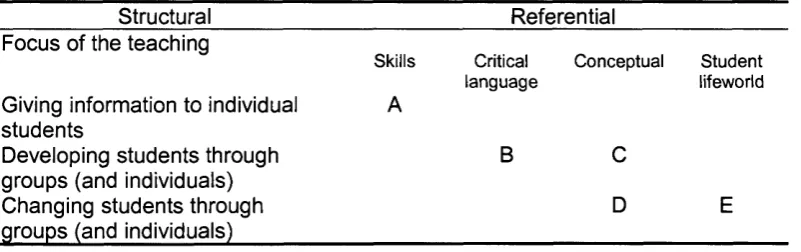
In an earlier study of design teachers (Drew, 2000b) five qualitatively different
conceptions of design teaching are described. These range from the teacher offering
a range of practical and technical skills to students, through to the teaching as
helping to change students’ conceptions. These categories of description illustrate a
dimension of the qualitative variation in design teaching. Conception A in this study
illustrates that even one-to-one teaching contexts can still been conceptualised in
transmission terms. The other four conceptions identified incorporate a degree of
student-centred ness which increases from B to E. Categories D and E also
demonstrate a community of practice dimension as a focus for the context of
teaching.
Variation in Conceptions of Design Teaching (Drew, 2000b)
Conception A: Teaching is offering students a range of practical and technical
skills
The teacher aims to reinforce technical ability by giving demonstrations and
showing individual students ways of making or doing. The teacher believes
that the students need to follow technical topics based on what the teacher
feels they need to learn. The emphasis of the learning is on a product or
artefact. The intention is to demonstrate or give examples of technical skills.
Conception B: Teaching is developing students’ practical and technical skills
The teacher emphasises developing and practising skills, sometimes in
differing contexts, with the aim of perfecting techniques. The emphasis of the
learning is on a product or artefact. The teacher works with individual
students with the intention of giving a guided learning experience.
Conception C: Teaching is developing students’ critical, practical and
technical skills through student interaction
The teacher aims to enable students to develop a critical language by working
together in groups or teams to present their own work and to see the work of
others. The emphasis of the learning is on peer learning and process. The
teacher works with individuals, groups or teams with the intention to enable
students to form opinions and ideas.
Conception D: Teaching is developing students’ skills and conceptions in the
context of professional practice
The teacher encourages students to manage projects involving complex
problem solving skills which are set in the context of professional practice.
The emphasis of the learning is on peer learning and process. The teacher
works with students to develop conceptions with the intention to increase self-
awareness, individual and team autonomy and for professional preparation.
The teacher emphasises original research and conceptual thinking skills. The
emphasis of the learning is on peer learning and process. The teacher works
with students with the intention to improve self-directed research, conceptual
skills and change conceptions.
7 introduced the programme by explaining the brief in full to the entire class, showing
exam ples o f the variety o f work that they could consider and stressing the importance
o f original research and innovation. I then sent them aw ay to research concepts for
four o f their collections which they were to present visually and verbally the following
week. F o r this Concept Sem inar I called on the other tutor (X) to join m e in discussing
with the students the themes they had developed, as a fresh but informed eye. In
subsequent weeks I worked with the students to develop sketchbooks, developm ent
sheets and presentation drawings building on those themes. I would start the session
by reminding them o f the stage we had reached in the work schedule, agreeing an
order in which to see each student and cover any points o f general concern or
uncertainty. I would then work with those students scheduled to be seen that day, and
(in the last h alf hour o f the session) those students from the other group who had
asked to be seen because they were having problems. The agreem ent was that the
group timetabled to be working independently must sign in at the start o f the session
but could then work in the library etc. if necessary, but the majority chose to stay in
the studio too. I program m ed another Concept S em inar with (X) n e a r the end o f the
schedule, thinking that the students would n eed a change o f pace and som e creative
input to freshen their ideas, and we held a m ajor critique on the last day in which the
students presented their completed portfolios to the staff and the other students. ’
Adapted from Drew, L. (2000b)
The practice-based context of studio teaching can be seen as a student centred
conceptions of teaching as instructional and teacher centred rather than co-operative
and collaborative learning. The quality of this learning environment relates to the
context and the conceptions of learning and teaching held by both teacher and
student (Reid and Davies, 2000).
2.6 Approaches to Teaching
Trigwell, Prosser & Taylor (1994) reported five approaches to teaching (Table 2.3)
using transcripts from the interviews with 24 university physics and chemistry
teachers from an earlier study to conduct their analysis (Prosser, Trigwell & Taylor,
1994). The analysis of categories of approaches to teaching was conducted in terms
of the strategies teachers adopted and the intentions which informed those
strategies.
Approach A A teacher-focused strategy with the intention of transmitting information
to students
Approach B A teacher-focused strategy with the intention that students acquire the
concepts of the discipline
Approach C A teacher/student interaction strategy with the intention that students
acquire the concepts of the discipline
Approach D A student-focused strategy aimed at students developing their
conceptions
Approach E A student-focused strategy aimed at students changing their
conceptions
Table 2.3
Prosser & Trigwell used the outcomes of these qualitative studies to devise the
questionnaire confirmed the relationship between intention and strategy which was
found previously in qualitative studies. The Approaches to Teaching Inventory or ATI
was developed to measure the variation in the ways teachers approach their
teaching in a particular situation as it is a relational instrument.
It has 16 items.
• 8 on a sub-scale describing an approach which is intended to change student’s
conceptions or ways of seeing things through a focus on the student. This sub
scale is labelled conceptual change/student-focused or CCSF
• 8 on a sub-scale describing an approach concerned with information
transmission and a teacher-focus, labelled ITTF.
The full 16 item inventory and its use as a relational instrument is discussed by
Prosser & Trigwell (1999). They present the research into teachers’ approaches
together with discussion of earlier research into student learning and teachers’
conceptions. The declared aim of this research is to seek relations between these
areas, that is, student learning and teaching, in order to derive conclusions for the
development of teachers. Research into teacher approaches therefore acknowledges
teachers’ conceptions and consequently aims to help to improve student learning
outcomes by coming to a better understanding of what it is that teachers think and do
when they go about their teaching.
2.7 Research which examines relations between teachers’
conceptions and teachers’ practices
Some other studies have made the logical progression from describing the variation
in conceptions and approaches by seeking to identify connections between these
areas. This is mainly because, as has been asserted earlier, beliefs and conceptions
Measures to enhance the quality of teaching should take account of teaching conceptions if they are to be effective, as teaching approaches are strongly influenced by the underlying beliefs o f the teacher. (Kember, 1997)
Willcoxson (1998) interviewed both teachers and their students in order to examine
what relationships existed between those teachers’ experience of teaching, their
perceptions of teaching and the experience of students being taught (in lectures) by
the same teacher. The experience of the students in this study is the key factor. What
they perceive is considered to be an indicator of teacher efficacy. Martin & Ramsden
(1992) conducted a modified phenomenographic study of five teachers engaged in a
university level course in learning and teaching. The aim of this study was to
investigate “how academic staff understand teaching and how that understanding is
embodied in their practice” (p. 148). Martin & Ramsden reported case studies based
on both interviews and observational studies of the participants over a period of time
during the teachers’ professional development. Martin, Prosser, Trigwell, Ramsden &
Benjamin (2000) examined relationships between teaching intention and strategy in a
study of 26 university teachers in four discipline areas. This study was conducted
using both interviews and observational studies to examine those relationships. The
results of this study confirmed that there were no inconsistencies between the way
that teachers reported their intentions and their actual practices which supports the
claim that the way teachers think about their teaching informs the way in which they
go about it. Hativa, Barak & Simhi (2001) conducted a similar study, with exemplary
university teachers. This study used a wide range of sources including course
documents, a teaching effectiveness questionnaire, interviews and video
observations. The authors came to very similar conclusions “that there is a good, but
far from perfect, fit between these teachers’ beliefs and knowledge concerning
Some studies do make well supported claims for the relationship between
conceptions and approaches to teaching. These studies use qualitative and
quantitative methods to derive their findings (Trigwell & Prosser, 1996a; Kember &
Kwan, 2000). The five approaches to teaching (Trigwell, Prosser & Taylor, 1994)
discussed earlier are further explored in relation to the teachers’ conceptions of
learning and teaching (Trigwell & Prosser, 1996a) to present a fuller relational picture
of teachers’ awareness, strategies and intentions. The findings in this study
demonstrate a statistically significant relationship between conceptions of teaching
and approaches to teaching (p<0.001), conceptions of teaching and conceptions of
learning (p<0.001) and conceptions of learning and approaches to teaching (p<0.05).
Kember & Kwan (2000) also sought to examine this relationship and found “a high
level of correspondence” of 89.5% using cross tabulation which confirms the earlier
findings, in other words, teachers’ conceptions were found to very closely mirror the
way in which those same teachers approach their teaching. Teaching conceptions
have therefore been shown to be related to approaches to teaching, which, in turn,
affect students’ approaches to learning and the quality of student learning outcomes
(Trigwell, Prosser & Waterhouse, 1999). If educational development activities are
focused on the formation of a student-focused/learning oriented conception of
teaching, then the role of those activities is central to the enhancement of the quality
of student learning outcomes.
2.8 Research which discusses implications for teacher development
As a teacher develops they can become more aware of their conceptions of teaching.
In fact it is an essential part of changing approaches to teaching to increase this
awareness. Teachers’ conceptions and experiences are stressed by Prosser and
argue that one of the primary roles of academic development is to expand teachers’
awareness of their learning and teaching situations. Those principles are as follows:
1. Teachers need to become aware of the way they conceive of learning and
teaching within the subjects they are teaching.
2. Teachers need to examine carefully the context in which they are teaching and to
become aware of how that context relates to or affects the way they teach.
3. Teachers need to be aware of and seek to understand the way their students
perceive the learning and teaching situation.
4. Teachers need to be continually revising, adjusting and developing their teaching
in the light of this developing awareness.
Entwistle, Skinner, Entwistle & Orr (2000) studied the views of students on a
postgraduate teacher training course about what they perceived ‘good teaching’ to
be. The conceptions of student teachers provide a useful insight from the perspective
of the learner. This study has some implications for development of teachers in other
contexts, they concluded that an expanded awareness of the relationship between
teaching and learning can be achieved if the teacher can see things from the
perspective of the learner. In engaging with an educational development activity, the
teacher becomes a learner also and uniquely sees what it is their own students are
experiencing with a new focus. Marton & Booth (1997) have described this
awareness:
Entwistle & Walker (2000) encourage the use of staff development activities which
are designed to help teachers to develop more sophisticated conceptions of learning
and teaching, i.e. those conceptions which are student-focused, learning oriented
and concerned with conceptual development or change. Martin, Prosser, Trigwell,
Ramsden & Benjamin (2000) also make this recommendation and qualify this in the
respect that development activities should also take account of the ‘object of study’.
Ho, Watkins & Kelly (2001) studied teachers on a development programme which
used a conceptual change approach. Their study took account of teachers’
conceptions and approaches before and after the programme as well as the learning
approaches of their students. The results of this study have very positive implications
for teacher development activities. All of the teachers showed positive changes in
their conceptions and teaching practices which then led to some changes in their
students’ approaches to learning.
2.9 Overview
Much of this literature is reviewed or summarised in three main sources. Prosser &
Trigwell (1999) is an authoritative source in this area from the phenomenographic
perspective. Hativa & Goodyear (2002) brings together a broader selection of studies
from both the phenomenographic and belief orientation traditions and with a wide
variety of tertiary teaching contexts and settings. Kane, Sandretto & Heath (2002)
have produced a critical review of studies of teaching beliefs and practices. This
review, while comprehensive, does not fully appreciate the findings from the
phenomenographic (non-dualist) perspective particularly. The authors of the latter
review adopt a dualist perspective on research in this area and advocate that studies
of conceptions should be triangulated with observations of teaching to seek
Chapter 3
Comm unities of practice and learning to practice
This chapter outlines the research into communities of practice and learning to
practice. Most of this literature comes from a social constructivist perspective, the
epistemological characteristic of which is that knowledge is seen to be constructed in
a social context. The chapter commences with an overview of studies relating to
learning to practice and participation in practice and also reports of studies which use
narrative to explore learning to practice. Studies of expertise and competence and
activity theoretical perspectives are also reviewed as they further complement the
studies of learning to practice. The chapter goes on to discuss studies of team and
course cultures which are mainly derived from an organisational theoretical
perspective. The chapter concludes with an overview of studies of professional
learning, particularly as related to the learning of teachers.
3.1 Learning to practice and participation
The roots of social theory go back to Plato’s arguments about the nature of a
republic. However, more recently these ideas and their contemporary antecedents
are well described by Giddens (1984). He argues that social structures demonstrate
the characteristics of rules and resources. Rules have normative elements and codes
of signification. Resources comprise both authoritative and allocative aspects which
are transmitted by socialisation (Giddens, 1984, p xxxi and p 17). Social structures
have properties which give coherence and relative permanence to social practices in
different times and locales (Giddens, 1984). In much of Giddens’ work a common
conceptual framework is used to examine notions of practice, see for example ‘New
Rules of Sociological Method’ (1976), ‘Central Problems in Social Theory’ (1979) and
has become routinised, in other words something which happens as part of a daily
pattern of life. So a ‘practice’ according to Giddens, is a way of doing something, the
nature of which is reproduced in social contexts and conforms to certain rules. These
ideas about social context, temporality and historicity are further developed in some
of the studies reviewed here.
There is a significant literature which embraces the sociocultural perspective on
practice, particularly emphasising learning to practice in various settings. Learning to
practice, whether in workplace or simulated settings is seen as a move towards full
participation in a community of practice (Lave and Wenger 1991; Lave 1993). That
move to full participation takes place by engaging in ‘legitimate peripheral
participation’ which is taking part in the authentic activities of the practice albeit with
guidance and at the edges of the practice community. These views emphasise social
practice as a premise for learning and that ‘knowing in practice’ arises from
participation in that social practice (Billett 1998). The community of practice has been
further conceived as constituting smaller units, or activity systems (Engestrom 1987)
which engage in practice through expansive learning, learning by extension and
diversification of activity. The principle of expansive learning concerns the activity
system (e.g. a course team) as the unit of analysis, in this regard individual teachers’
and group actions are important. An activity system is a community of multiple points
of view, different traditions and interests. Activity systems get shaped and change
over time so they are both a source of trouble and of innovation. The history of
aspects of the activity system helps us to understand their inherent problems and
potentials. Contradictions, or the process of questioning and evaluating, play a
central role in the cycle of expansive learning, as a system develops the learning
expands by individuals questioning the different aspects of the situation. So
contradictions are not the same as problems or conflicts. New elements (e.g. a
secondary contradictions which then generate disturbances and conflict, further
questioning, evaluation and expansive learning. Activity systems move through long
cycles of qualitative change, thus leading to collaborative envisioning and collective
change efforts.
Activity theory focuses on the structure of activities as historically constituted entities.
The learning focus of activity theory is to describe the historical nature of an activity
(e.g. teaching on a particular course) and compare that to the developmental stage of
a person in respect of that activity (e.g. a learner on that course). The aim is to
further define a ‘zone of proximal development’ so that learners can be helped to
perform the activities of the practice with help and guidance which they would not be
able to perform alone (Vygotsky, 1934; Wertsch, 1985; Engestrom 1987).
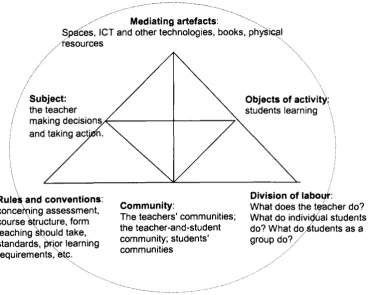
Teachers and their learners, engaged in collective work and learning demonstrate all
of the principles of the activity system (Engestrom, 2001) (Fig 3.i)
Fig 3.i An activity system for learning and teaching
Mediating artefacts:
Spaces, IC T and other technologies, books, physical resources
Subject: the teacher making decisions/
and taking actjdn.
Objects of activity; students learning
Rule* and conventions: concerning assessment, course Structure, form
Community:
Division of labour: W hat does the teacher do?
teaching Should take, standards, prior learning requirements, etc.
The teachers’ communities; W hat do individual students the teacher-and-student do? W h at dO/Students as a community; students’ group do?
[image:40.467.34.403.429.724.2]The diagram shows teaching as an activity system (adapted from Knight, 2002)
Figure 3.1 shows teaching as an activity system, noting that:
1. Teaching is not sufficient to produce the planned learning outcomes.
2. Linking subject, object and community in the inner triangle: clarifies that the
action is not individual (teacher) but individual and social (teacher and their
communities)
3. Linking opportunities and possibilities in the outer triangle: mediating artefacts,
which teachers shape to their activities; rules, codes, expectations and the like;
and the division of labour.
4. The outer triangle provides parameters for teachers to work within: rules for
course design and structure, rules for quality assurance, rules for assessment
etc; how the division of labour works in a course team; what resources and use of
learning environments. These factors can also limit what can happen in changing
course design for example.
Learning which is the result of participation in social practices means that the
participants appropriate ways of seeing the world inherent in those practices. These
situational and social factors are a key part of learning to practice (Billett, 2001).
Billett argues that a non-dualist view of learning is becoming more accepted, based
on the concept that there is an inseparable relationship between an individual’s
knowing and their social lifeworld (Rogoff, 1990). Many would argue that preparing
learners for life as a creative practitioner, be that as an artist or a photographer, is
practices and norms shape even the most apparently solitary activities. This is further
confirmed by Billett (2001).
An artist working in the isolation o f his studio reported shaping his practice to account for situational factors determining the kinds and purposes o f his work that included physical environments and consideration o f the market (p. 444) These kinds of social situation and activity related analyses are also clearly
demonstrated in the work of Suchman (1987) in her accounts of an airport operations
room. She describes the activities of the individuals and the work related artefacts
constituting a locally ordered work setting that is subject to constant change.
Jean Lave describes the social participatory perspective on learning as individuals
developing and changing their identities, “ ... people are becoming kinds of persons”
(Lave 1996, p 157). Lave’s study of the apprenticeship of tailors in Liberia during the
seventies identifies how the tailors were primarily making ready-to-wear trousers, but
the apprentices also learned other important contextual factors about being a tailor:
... they were learning relations among the major social identities and divisions in Liberian society which they were in the business of dressing. They were learning to make a life, to make a living, to make clothes, to grow old enough, and mature enough to become master tailors, and to see the truth of the respect due to a master of their trade.
(Lave, 1996, p 159)
indirect guidance from participation in the tailoring practices, working with other
tailors and other tailors’ apprentices. These apprentices were effectively immersed in
tailoring practice and this environment helped them to fully participate in tailoring and
learn the trade. The community of practice dimension is most certainly about
“becoming kinds of persons”, and about developing ways of seeing the world through
practice.
The cornerstone of these issues for professional learning can be summarised as
learning to practice or becoming inducted into a community of practice (Wenger,
1998). Wenger further defines the role of participation in a practice in its relationship with the reification of artefacts or processes particular to the practice. Wenger regards participation as ‘the social experience of living in the world’ (1998, p. 55)
which involves acting, thinking and feeling as a whole personal experience. It is from
participation Wenger argues, that an identity o f participation is constituted through the relations formed in participation itself. Wenger’s idea of reification is central to practice, artefacts, processes and concepts can be reified (made into a concrete
object).
Any community of practice produces abstractions, tools, symbols, stories, terms, and concepts that reify something o f that practice in a congealed form.
(p. 59)
The indicators of a community of practice, according to Wenger are:
1. Collective reflection on practice - sustained mutual relationships leading to awareness
2. Talking about practice - shared ways of engaging in doing things together 3. Sharing problems and issues relating to practice - knowing what others know,
4. Context of practice - absence of introductory preambles, interactions are the continuation of ongoing discussions
5. Cultural aspects of practice - a shared discourse reflecting a certain perspective on the world
Narrative and story telling are regarded as processes central to learning to practice.
A learning experience is framed in stories and anecdotes which give a different
dimension to the learning, the non-canonical practice (Orr, 1996; Brown & Duguid,
1996). Canonical practice is described by Orr (1996) as being derived from a map of
‘directive’ documentation which is aimed at single issues. This documentation is often
a work practice manual and is much less like a map and more like a single
predetermined route with no alternatives. For example, the manual which
accompanies a video recorder could fit Orr’s account of canonical practice, yet many
people would tell very different stories of how they have actually used a video
recorder or diagnosed even simple problems. Experience tells us that the
practicalities of using something as commonplace as a video recorder vary
immensely and are often at odds with the simple instructions in the user manual. The
account of actual practice, the non-canonical, is very different and is anything but the
following of simple instructions. The accounts of actual practices, shared between
learners, teachers and other practitioners enrich the informal learning process. Orr
(1996) analysed the work of service technicians in training and work with a rich,
descriptive ethnographic account. His analysis contrasts the official documentation of
the practice e.g. work manuals, the canonical practice, with the diagnostic process
afforded by story telling and cooperative knowledge building, the non-canonical
practice.
accomplished through a verbal consideration o f those facts with a primary criterion of coherence. The process is situated, in Such m an’s terms, in that both the damaged machine and the social context o f the user site are
essential resources for both the definition o f the problem and its resolution.... They are faced with a failing machine displaying diagnostic information which has previously proved worthless and in which no one has any particular confidence this time. They do not know where they are going to find the information they need to understand and solve the problem. In their search for inspiration, they tell stories. (Orr, 1996, pp. 178-179)
Studies of experience, expertise and competence further demonstrate that learning
to practice is not just about participation, but also about an experience of meaning
which is constructed over time in engaging at the community level in order to build a
repertoire of practice. Earlier studies of competence define a linear hierarchy of
competence acquisition from novice to expert (Dreyfus & Dreyfus, 1986; Benner,
1984) which do not take account of social factors but do define aspects of
competence as context dependent. Schon (1983) criticised the technical rational
epistemology by elaborating on what he called an ‘epistemology of practice’. His
study closely examined the professional work and learning of architects, engineers,
psychotherapists, planners and managers. From this study he further determined two
different types of human competence, knowing-in-action and reflection-in-action.
Knowing-in-action illustrates the context-dependent nature of competence. The
professional workers’ reflection-in-action further demonstrates and clarifies the
context-dependent nature of competence.
Wenger (1998, p137-139) explains that learning in practice is possible if an
experience of meaning interacts with a regime of competence. He also distinguishes
may be out of alignment in the practice learning experience. Developing competence
in the skills of a practice does not in itself build experience as the practice has many
socially situated elements the meaning of which have to be negotiated within the
community of practice. Billett (2001) has produced an authoritative study of knowing
in practice and vocational expertise which uses accounts of Australian hairdresser’s
learning to practice. He acknowledges both the social and the situational in the
process of coming to know and in developing expertise.
Expertise needs to be considered situationally, being related to the circumstances o f the enactment of the vocational practice. This does not mean that the individual’s capacity to perform is welded to one setting. Rather; it recognises that expertise can only be understood within particular domains of knowledge and action (social practice), thus embedding it in particular social circumstances. (Billett, 2001, p. 441)
Sandberg (1994) developed an interpretive approach to human competence at work
in his phenomenographic study of engine optimisers. His findings indicate that
knowledge, skills and other attributes are not externally related to work as assumed
within the rationalistic approach, but internally related to it through the workers’
conceptions of that work. He further elaborates on the collaborative sense making of
work practices as described by other interpretive studies (e.g. Weick, 1983, 1995).
The phenomenographic approach in this study focuses on ‘the workers’ own
experience or sense making of their work’ (Sandberg, 1994, pp. 45-46). Sandberg’s
interpretation yields three qualitatively different conceptions of competence in engine
optimisation;