Munich Personal RePEc Archive
Open Source Licensing in Mixed
Markets, or Why Open Source Software
Does Not Succeed
Gaudeul, Alexia
Department of Economics, University of East Anglia, ESRC Centre
for Competition Policy
29 July 2008
Online at
https://mpra.ub.uni-muenchen.de/19596/
ISSN 1745-9648
Open Source Licensing in Mixed
Markets, or Why Open Source Software
Does Not Succeed
by
Alexia Gaudeul
Dept. of Economics and ESRC Centre for Competition Policy
University of East Anglia
CCP Working Paper 08-2
Open Source Licensing in Mixed Markets, or Why
Open Source Software Does Not Succeed
Alexia Gaudeul
yJuly 29, 2008
Abstract
The rivalry between developers of open source and proprietary software encourages open source developers to court users and respond to their needs. If the open source developer wants to promote her own open source standard and solutions, she may choose liberal license terms such as those of the Berkeley Software Distribution as proprietary developers will then nd it easier to adopt her standard in their products. If she wants to promote the use of open source softwareper se, she may use more restrictive license terms such as the General Public License to discourage proprietary appropriation of her effort. I show that open source software that comes late into a market will be less likely than more innovative open source software to be compatible with proprietary software, but is also more likely to be made more accessible to inexperienced users.
Keywords: Open Source; Software; Standards; Compatibility; Network Effects; Duopoly; Mixed Markets; Intellectual Property; Copyright; Licensing.
JEL Classi cations:D23, H41, L13, L22, L31, L86, O34, O38
Early drafts of this article were written while I was an EC-funded Marie Curie Research Fellow at the University of Southampton. Jacques Crémer at the University of Toulouse, Robin Mason at the University of Southampton and Bruce Lyons at the University of East Anglia provided helpful advice. Thang To at the ESRC CCP provided very able assistance with data collection. This paper was inspired by a case study of the (LA)TEX project (Gaudeul 2007).
The second part of the title is inspired by Bonaccorsi and Rossi's `Why Open Source Software Can Succeed' (2003). The paper was presented at the OSSEMP workshop in conjunction with the Third International Conference on Open Source Systems in Limerick in June 2007, at the EEA conference in Amsterdam in August 2005, at the Toulouse Workshop on Open Source Software and Intellectual Property in the Software Industry in January 2005, at the Open Source Software conference `Autour du Libre' at ENST Bretagne in Brest in May 2004, and in seminars at the University of Strathclyde in Glasgow and at the INRA GAEL in Grenoble. Support from the ESRC and from the European Commission is gratefully acknowledged.
ySchool of Economics and ESRC Centre for Competition Policy, University of East Anglia, Norwich. email:
[email protected], website: http://agaudeul.free.fr
1 INTRODUCTION
1
Introduction
Why is open source software (`OSS') widely used in some markets and development areas and
not others? Why is it so dif cult in some cases to use OSS alongside proprietary software (`PS')
because of incompatibility problems, while in some other cases both type of software are used on
the same types of platforms and use the same standards and may even be integrated seamlessly
into each other? Why do some open source developers (`OSD') decide to adopt liberal license
terms that allow integration of the open source (`OS') standard and its associated implementation
into proprietary software (`PS') while others seek to exclude proprietary use by adopting more re-strictive license terms? Why do some proprietary software developers (`PSD') choose to develop
add-ons and interfaces to OS products while other PSDs develop software independently? This
paper considers those questions by analyzing competition between a proprietary developer who
wishes to maximize pro ts from selling his product on the market, and an open source developer
with different motivations:
Motivations: One set of motivations for the OSD is own use or enjoyment; she wants to
de-velop software she needs or enjoys dede-veloping (von Hippel, 2005). Another set of motivations combine to make her want others to use her software. This may be because she bene ts from
network effects, direct (the more people use software, the higher is its utility, for example
com-munication software), or indirect (users may convert into developers who will then improve the
software, contribute their expertise and knowledge and provide peer review (von Krogh, Spaeth,
and Lakhani, 2003)). It may also be that she derives prestige and reputation from the software's
success (Lerner and Tirole, 2002).
Goals: In addition to those two sets of motivations, I will want to make the difference between whether the OSD focuses on pragmatic goals, typical of rms (Bonaccorsi and Rossi, 2006), such
as getting her software's solutions and standards adopted, or on ideological goals, typical of
indi-viduals engaged in OS development, such as protecting and promoting open-source development
methods and the open-source community (again, Bonaccorsi and Rossi, 2006).
Ideological goalsare those of a developer who cares about open source values such as code reciprocation and software freedom. She cares about providing software that is free (as in
`free beer'), freely modi able and with speci cations that are open. In this case she will not
1 INTRODUCTION
She may then choose restrictive license terms such as the GPL, that make it dif cult for
proprietary developers to make use of her code or adopt her standard.
Pragmatic goalsare those of a developer who is interested in the technological, problem solving aspect of OSS. She may then choose liberal license terms, such as the BSD, that
facilitate the integration of her solutions and standard into proprietary software and thus
facilitate compatibility between her software and proprietary software.
I will examine in this paper how such different and potentially con icting goals translate into
market outcomes: market share, type of users served, license used, compatibility with the existing
standard and development of an user interface.
Licensing: The open source developer will have the choice between the General Public License
(`GPL')1 and a license of the type of the Berkeley Software Distribution (`BSD').23 The two licenses authorize anybody to use, distribute or modify the project's code for free, subject to
acknowledging previous contributions and, in the case of the GPL, subject to distributing the
modi cations under the same GPL license. The BSD does not impose this later restriction: it
allows developers to distribute modi cations and improvements under other licenses, including
under proprietary licenses. Because of its license, open source software is essentially free to use.
Unlike open source licenses, proprietary licenses prohibit the unauthorized use, replication and
modi cation of the product by others. The owner of the project can then sell the right to use his
product.
The choice of license between the GPL and the BSD is the source of great controversy in the
OS community. The open source software model, promoted by Bruce Perens, tries to encourage
the involvement of commercial developers by encouraging the use of the BSD. The free software
model, promoted by Richard Stallman, is more averse to involvement by commercial developers
and promotes the GPL. That reluctance is informed by the bad experience of the hijacking of the
development of Unix by AT&T, which was at the origin of the GNU project (`Gnu isNotUnix').
1http://www.gnu.org/copyleft/gpl.html
2http://www.opensource.org/licenses/bsd-license.php
3This does not imply of course that other types of open source licenses are not covered, only that they either
1 INTRODUCTION
Literature: This paper is part of the literature on the coexistence of open-source and
propri-etary software projects in a competitive setting. OSS provides fringe competition that may
dis-cipline big monopolistic players such as Microsoft. It also provides an opportunity for software rms to collaborate in the development of OS industry-wide standards with no fear of seeing their
efforts hijacked by others. OSS has made signi cant inroads in many areas of software
devel-opment, from servers (Apache) and mail management systems (Sendmail) to operating systems
(Linux), browsers (Mozilla) and typesetting engines (TEX). This leads to hopes (and fears) that OSS will come to replace proprietary software: `for equal quality, consumers will prefer a free
product to a paying one' (Schmidt and Schnitzer, 2003), `OSS can achieve better quality and
faster adaptation to technological change' (Kuan, 2002), `the OS development method is more
ef cient than closed source development methods' (Johnson, 2002 and Johnson, 2006), `OSS is
open to innovation from many quarters' (von Hippel, 1994 and von Hippel, 1998), `OSS is more
exible and offers better control of its internal working', etc...
Evidence shows that OSS breeds a new and more ef cient `private-collective' innovation model
where OS and proprietary development methods support each other (von Krogh and von Hippel,
2003). Koenig, 2004 offers examples of such collaborative innovation in a list of for-pro t OS
strategies, followed by such companies as Oracle, IBM, HP or Red Hat. Mustonen, 2005 argues
that PSDs will encourage and support OSS in order to promote their own standards as common standards, as done by Adobe for example. They may also do so to gain some control over the
OS standard and in uence its development, as done with Linux by IBM and with Java by Sun
Microsystems. Case studies of the markets for operating systems, servers and web browsers
do actually show that competition by OSS tends to accelerate the pace of innovation across the
whole industry (Bitzer and Schröder, 2006).
Some differences persist however, and they relate to the ability of rms to provide better user
interfaces, and also to attract users through subsidization of early users and advertising:
Interfaces:Bessen, 2006 argues that pre-packaged PS addresses common uses with limited
fea-ture sets while OSS targets users with more specialized and complex needs. Nichols and Twidale, 2003 point out how OSD usually have preferences in terms of user interface that differ from those
of the common end-user. They tend to prefer command line based interfaces with many
short-cuts, as those allow direct access to the basic functions of the software. They tend to dislike
the more intuitive What You See Is What You Get (“WYSIWYG”) interfaces that automate
fre-quently used tasks but are less exible. Against all this, Franke and von Hippel, 2003 argue from
a survey of Apache users that developers and end-users do not actually differ much in terms of
1 INTRODUCTION
Proprietary development will have an organizational advantage over OS development. Raymond,
2002 mentions the advantage for a `big player with a lot of money' in doing `systematic user
in-terface end user testing' as well as `setting up large-scale focus group testing with end users'. OSDs on the other hand will face problems in coordination, such as when TEX developers faced the prospect of leading radical mid-life changes to their software (Gaudeul, 2007). Open source
development appears to be too unruly and undirected to provide the stability and support users
need. PSDs would thus bene t from their ability to reliably direct the work of others in a
central-ized way according to a well de ned and enforceable strategy de ned from the point of view of
the customer.
Strategy: Proprietary development will also have a strategic advantage over OS development. Casadesus-Masanell and Ghemawat, 2006 show that PSD can subsidize purchases by the rst
users in order to build a user base, and then exploit the latecomers. This, as well as advertising,
is not affordable for OSDs as OSS generates only limited income streams. The case of Microsoft
provides a range of other strategies to counter the emergence of OSS. FUD tactics (spreading
Fear, Uncertainty, and Doubt) underline how OSS is supposedly `unsupported'.4 Prices may be
lowered for vulnerable consumers such as public administrations who get preferential deals and
consumers in less developed countries who get offered Windows XP Starter Edition, a lower cost
lesser quality version of Windows XP. Faced with this array of strategies, OSS may receive the
support of governments through public subsidies, mandated adoption or information campaigns
(Comino and Manenti, 2005).
This paper completes the above literature by clarifying the impact of the differences between the
OS and proprietary development models on the structure of the software markets. I show that
the market outcome in the competition between OS and proprietary software is affected by: (i)
whether the open source developer is a precursor or a follower, and whether open source
de-velopers want to promote adoption of their standard or of their software; (ii) whether network
effects are important and whether the majority of consumers are professionals or non-specialists;
and (iii) how costly user-interface development is and whether open source software's intrinsic
quality is higher than that of proprietary software. An open source developer who is a
late-comer to the market will be less likely than an early entrant to make her product compatible with that of the proprietary developer, but she is also more likely to orient her software towards the
non-specialist (inexperienced) user. Depending on the factors outlined above, a manager may
seek compatibility with open source software, borrow open source code, offer interfaces to open
4Microsoft's proposed response to the emergence of open source software as a competitor can be found at
2 A MODEL
source development, or in other cases, be better off developing well away of open source
devel-opers and users. The OSD may choose the BSD license if she is a precursor and has pragmatic
goals, which are typical of rms involved in OS development. She may also do so even if her goals are ideological, but in a more limited number of cases, i.e. if this increases the number
of users of OSS compared to a situation where compatibility would not be achievable, that is,
if allowing use of her standard in proprietary products softens competition. I provide empirical
support for the assertions and ndings of the paper by considering the market conditions in a
variety of software development areas.
2
A model
Consider two developers. They are identical in every respect, except that one chooses to develop
software under an open source license and the other chooses to develop software under a
propri-etary license. For clarity of exposition, I will refer to the open source developer as `she' and to
the proprietary developer as `he'.5
Quality: Consumers can choose between an open source and a proprietary software of quality
qo and qp respectively. The `o' subscript denotes the open source product and the `p' subscript
denotes the proprietary product. Ifqp > qo (respectivelyqo > qp) then proprietary (respectively
open source) software is of higher quality than open source (respectively proprietary) software.
Quality can be interpreted as the number of software functionality if as in the empirical section
they can be ranked from basic to more sophisticated features. It may also represent code quality.
Consumers all agree on the quality of each software.
Interfaces: There is a mass1of consumers who differ in their software expertise. Mass M < 1 of consumers (`inexperienced' consumers) need a WYSIWYG interface or a Windows port of the application or an extensive documentation for the program (`interfaces'). They cannot
use software without those elements. The rest of the consumers do not need those elements.
Signi cantly, I assume the OSD does not need those elements either, and faces costcin providing
them. I also assume the PD always develops interfaces, and considers this development as a sunk
cost necessary to the marketing of his software. There are several ways to justify this assumption.
The rst is ease of exposition; adding the decision to develop interfaces or not for the PD makes
5This choice of convention does not necessarily suggest the likely gender of an open source developer. Only
2 A MODEL
the solving of the model more involved. The second is practical; since a consumer cannot have
access to the source code of proprietary software, it would be very dif cult for them to port it to
their own preferred platform, or to understand its functioning. It is therefore necessary for the PD to write documentation for the program and compile it for a variety of platforms to make it
marketable. OSS on the other hand may still be used by experienced users even if no interfaces
or documentation are provided. Indeed, the expert user will be able to make sense of the code or
communicate with the developer directly.
Network effects: The consumers derive utility from the number of other users of the software
they use. k will denote the strength of network effects. Usual sources of network effects –
do consumers bene t from the use others make of the product? Do they exchange data using that product? Is that data exchange standardized? – are complemented by the impact that the
continued use and development of the product will have on its quality over time.
Licensing:An open source developer can choose between the (liberal) BSD license that facilitates
integration of her code and/or standard into a proprietary product, in which case compatibility
can be achieved, and the (restrictive) GPL license that makes it more dif cult and negates most
bene ts from doing so – the PSD cannot appropriate any improvement to the GPL standard.
Con-versely, the speci cations of the PS may be made public so the OSD may achieve compatibility
with PS.
Consumers:Suppose the two competing products, open source(o)and proprietary(p), of quality
qo andqp respectively, are used by massno andnp of consumers respectively. The open source
product is free, while the proprietary product is priced atp.
If the two products are incompatible, then a consumer who chooses the open source software derives bene t
qo+kno (1)
if the OSS has interfaces or if the OS product does not have interfaces and the consumer is
experienced. She derives no value from the software if the OSS does not have interfaces and she
is inexperienced.
A consumers who chooses the proprietary software derives bene t
qp+knp p (2)
from the proprietary product, whether she is experienced or not.
2 A MODEL
Developers: The open source developer derives utility from using her own software (Raymond,
2001) and may also develop interfaces to make her software usable by all if that brings about
positive network externalities, such as prestige, increased usage, high network value, etc.
Her utility is
Uo =qo+kn c (3)
if she develops interfaces and
Uo =qo+kn (4)
if she does not develop interfaces.
cre ects the costs of developing interfaces. The OSD incurs those costs fully as she does
not derive any direct bene t from developing interfaces since she is an experienced user.
nis 1) the number of users of her software if her goals are ideological, or 2) the number of
consumers who use software based on her standard if her goals are pragmatic (see p.2).
The proprietary developer aims to maximize pro t. Denotepthe price of his software andnpthe
number of its users. His pro t is =pnp.
Timing:I will assume development is sequential; either the OSD or the PSD develops rst. I will
call the rst mover a precursor and the second mover a follower. The second mover observes the
licensing choice and development choice of the rst mover and then decides whether to develop
and what to develop. This dynamic element in the model re ects a pattern of OS and proprietary
development. Rather than occurring at the same time along different lines, they alternate
leader-ship, catching up and borrowing from each other. The (LA)TEX case study provides an example
of such dynamics in the development of software in the typesetting industry (see Figure 1 in
Gaudeul, 2007 and section 5 in this paper). This dynamic element in the model also re ects dif-ferences between software that is pathbreaking and introduces new ideasvs. that which imitates
and borrows from other software. As discussed in section 5, there is some indication that OSS is
very often an imitation of existing software.
Once both developers have developed their product, the proprietary developer chooses the price
pof his product and consumers choose which product to use. The open-source product is free.
I will use the concept of ful lled expectation equilibrium (Katz and Shapiro, 1985) to determine
the equilibrium product adoption and pro ts or utility of the developers. A ful lled expectation
4 MIXED MARKET DUOPOLY
to be. I will assume a proprietary developer can always tip the market in his favor. This may be
through a combination of advertising and/or low introductory pricing, all strategies that are not
available to the same extent to an OS developer (see Casadesus-Masanell and Ghemawat, 2006 for an analysis of such forward looking pricing strategies).
3
Monopoly market
In this part, I consider a single developer with software under either the OS or the proprietary
license.
Open source software: In a monopoly situation, the OSD may choose not to develop interfaces
and be used only by portion 1 M of users, so her utility is Uo = qo +k(1 M); or she can
develop interfaces and be used by all users, so her utility isUo =qo+k c:She will choose the
later s.t. k > Mc. Intuitively, high M (many inexperienced users) encourages the OSD to serve all by developing interfaces. High k (high network effects) sustains this tendency as gaining additional consumers become more valuable.
Proprietary software: The monopoly PSD will sell to all consumers at pricep = qp +k and
make pro t =qp+k.
4
Mixed market duopoly
This part examines the development, compatibility and licensing decisions of the OS and
propri-etary developers when they compete with each other in a two stage game.
In a rst part I will analyze the situation where the OSD develops rst. In a second part I will look into the case where the PSD is the rst mover. A rst mover will have to decide on whether
to allow compatibility as well as on the licensing of its code and on whether to develop interfaces.
The OSD leader's choice between the BSD and the GPL license terms is important. Indeed,
the BSD allows integration of her standard into a proprietary product, so the PSD may then
choose to use the OS standard and build on it. The OSD may derive bene ts from this as this
means her standard will be used by more people. However, that also means users may prefer the
implementation of her standard in its proprietary form to its OS implementation, for example if PS has more users, or if PS is of higher quality, or if PS is the only one offering interfaces. The
4.1 The OSD is a precursor 4 MIXED MARKET DUOPOLY
If the PSD moves rst, the later coming OS standard will not be integrated into his software
so the OS follower will be indifferent between the GPL or the BSD license. The PSD may
make the speci cations of the proprietary software available so as to encourage the production of compatible or add-on products. Rather than adopt the proprietary standard, the OSD may decide
to develop her own standard because incompatibility between OS and PS allows her to gain a
higher share of the market than compatibility.
4.1
The OSD is a precursor
If the OSD is a precursor, then the timing of decisions is as follows:
Stage 1: The OSD chooses her software license, either BSD or GPL and chooses whether
to develop interfaces or not.
Stage 2: The PSD chooses whether to adopt the OS standard and be compatible with OSS,
or not adopting the OS standard and not be compatible. Adopting the OS standard is
possible only if OSS is under the BSD.
Stage 3: The PSD chooses the pricepof his software and consumers simultaneously choose
which software to adopt. Those who choose PS must pay for its use, those who choose OSS
do not pay anything.
At any one speci c stage, all agents observe all decisions made by all other agents in the
preced-ing stages. The game will be solved by backward induction. The different situation in stage 3 are outlined in appendix A.
4.1.1 Stage 2: the compatibility decision of the PD
There are three cases: either the OSD developed interfaces, in which case both software are in
direct competition so incompatibility is preferred by the PSD. Or the OSD did not develop
inter-faces, in which case the outcome depends on the OSD's licensing choice. If the OSD chose the
GPL, then compatibility is not achievable and this will encourage the PD to serve all consumers.
If the OSD chose the BSD, then the PD may accommodate OSS and serve only inexperienced
4.1 The OSD is a precursor 4 MIXED MARKET DUOPOLY
Proposition 1 A) If the OSD developed interfaces and if k > qo qp; then the PD prefers
incompatibility and gains the whole market. Ifk qo qpthen the PS does not enter the market,
on which the OSD will have a monopoly.
B) If the OSD did not develop interfaces and chose the GPL, then compatibility is not achievable
and the proprietary developer chooses to serve all consumers s.t. k qo (1 M)qp
1 M2 , and otherwise
serves only inexperienced consumers.
C) If the OSD did not develop interfaces and chose the BSD, then the PSD chooses incompatibility
and serves all consumers s.t.k qo (1 M)qp
1 M ;and otherwise prefers compatibility and serves only
inexperienced consumers.
[image:13.612.119.462.363.611.2]Proof.The proofs of the above are given in the appendix B of this paper.
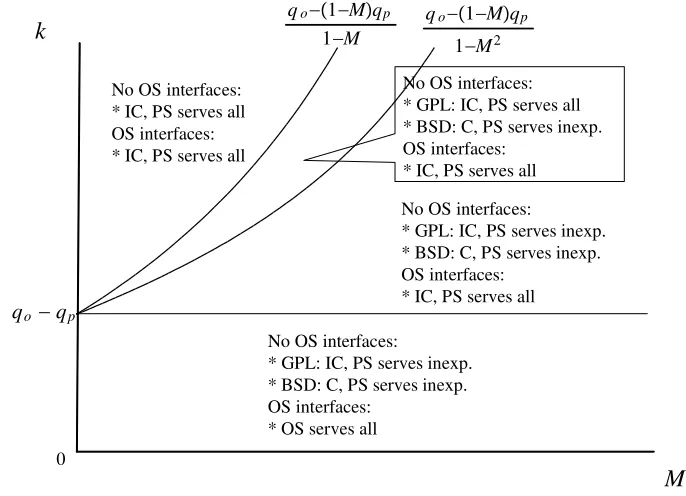
Figure 1 below illustrates the above statements. IC denotes incompatibility, C denotes compati-bility, Inexp. denotes inexperienced consumers.
No OS interfaces: * IC, PS serves all OS interfaces: * IC, PS serves all
No OS interfaces:
* GPL: IC, PS serves inexp. * BSD: C, PS serves inexp. OS interfaces:
* IC, PS serves all
No OS interfaces:
* GPL: IC, PS serves inexp. * BSD: C, PS serves inexp. OS interfaces:
* OS serves all
0
k
qo ?qp
M
qo?Ý1?MÞqp
1?M2 qo?Ý1?MÞqp
1?M
No OS interfaces: * GPL: IC, PS serves all * BSD: C, PS serves inexp. OS interfaces:
* IC, PS serves all
Figure 1: Market share and compatibility in a mixed market duopoly, as a function of OS interface and licensing choices.
When the OSD develops interfaces, the PD is in direct competition with OSS and prefers
4.1 The OSD is a precursor 4 MIXED MARKET DUOPOLY
if its quality is higher than PS and network effects are low (k qo qp). Otherwise, the PD gains
the whole market. This means that OSDs will be keen to develop interfaces only when network
effects in their development area are low and the quality of their product is higher than that of competing proprietary software.
When the OSD does not develop interfaces and chooses the GPL, then the PD may decide
not to serve the whole market and instead serve only inexperienced users (this happens if
k qo (1 M)qp
1 M2 ): Since the GPL prevents compatibility, this is with an incompatible product.
When the OSD does not develop interfaces and chooses the BSD, the PD is more likely to serve
only inexperienced users (this happens if k qo (1 M)qp
1 M ) and when he does so, this is with a
product that is compatible with OSS. This means that the OSD may prefer the BSD to the GPL not only in order to get her standard adopted but also in order to share the market when otherwise
the PS would have monopolized it. Choosing the BSD expands the range where OSS or an OS
standard is used by at least a portion of consumers compared to choosing the GPL. The BSD
en-courages compatibility which has two main advantages: for the developer with pragmatic goals,
this gets her standard adopted by more users since it is integrated in a proprietary version. It also
saves her the cost of developing interfaces. For the developer with ideological goals, offering
compatibility may avoid head on competition whereby the PS would gain the whole market.
From this part, I can also point out that higher quality OSS does not necessarily dominate its market. The analysis in the article admits the possibility that OSS would be intrinsically better
than PS (qp < qo) and yet PS stays on the market by developing interfaces for inexperienced
users. This can happen as long asqp > qo k. Note also that conversely, one may haveqp qo
and yet open source software maintains a share of the market. This happens if the PSD chooses
to concentrate on inexperienced users. The case whereqo > qp and yet PS serves inexperienced
users would validate the paradoxical perception by experienced OSS users that OSS is of higher
quality than PS while at the same time inexperienced, PS users cannot fathom using OSS because
it lacks the interfaces that are essential to them. The case where qo < qp and yet OSS serves
experienced users would validate the perception that users of OSS use OSS because PS is priced
for other types of users that differ from users of OSS in their need for some speci c, `user-friendly' interfaces.
4.1.2 Stage 1: Interface development and licensing
Consider in this part whether the OSD will develop an interface for the end-user and if not, which
4.1 The OSD is a precursor 4 MIXED MARKET DUOPOLY
or pragmatic. As seen previously, the OSD with pragmatic goals who chose the BSD may see
a proprietary implementation of her standard developed by the PSD. There is therefore no point
in her developing an interface if that is likely to happen. The OSD with ideological goals may develop an interface to her software if that allow her to gain market shares compared to not doing
so. She will do so provided her software is of suf ciently better quality than that of the PSD
and the gain in the number of users of her standard more than compensates for the cost c of
developing the interface.
Proposition 2 The OS precursor with pragmatic goals will never develop interfaces.
She will strictly prefer the BSD to the GPL for anyk qo (1 M)qp
1 M , and is indifferent between the
two licenses otherwise.
The OS precursor with ideological goals will develop interfaces only ifqo > qp andk qo qp;
and if that is so, will do so s.t. k > Mc:
She will strictly prefer the BSD only if k 2 [qo (1 M)qp 1 M2 ;
qo (1 M)qp
1 M ];and is indifferent between
the two licenses otherwise.
Proof. The proofs are given in the appendix C of this paper.
From this proposition, there is only a limited number of cases where OSS will develop interfaces.
An OS developer with pragmatic goals derives no bene ts from developing interfaces since the
PSD will provide a proprietary implementation of her standard for use by inexperienced users.
For interfaces to be developed, the OSD must have ideological goals, OS quality must be higher
than that of equivalent proprietary software, and network effects must be neither too high (oth-erwise the PD would monopolize the market) not too low (oth(oth-erwise, gaining experienced users
would not be very valuable in terms of network effects). Non availability of an OS interface for
OSS should therefore correlate with OSS being of lower quality than PS, or with the OSD having
pragmatic goals. Availability of an OS interface for OSS should correlate with OSS being of
higher quality than PS and should result with OSS gaining the whole market.
From this proposition, I can also conclude that the pragmatic OSD will almost always prefer the
BSD (except whenk qo (1 M)qp
1 M when she is indifferent), while the ideological OSD will prefer
the BSD only in a very limited range of case. This is because an OS developer with ideological
goals does not care about those users who use the OS standard in its proprietary implementation.
Since the OSD with pragmatic goals is more likely to choose the BSD and does not develop
4.2 The OSD is a follower 4 MIXED MARKET DUOPOLY
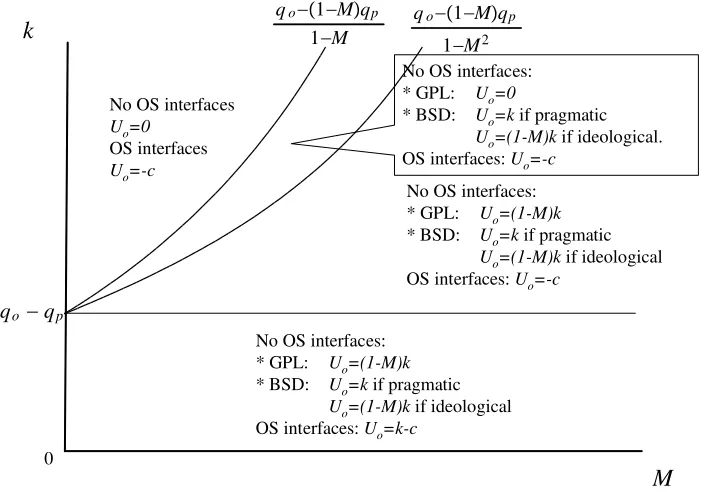
Figure 2 below shows the utility of the OSD depending on her goals and on her interface and licensing decision. When the distinction between licensing choices or goals is not shown, this indicates that the utility is the same irrespective of licensing choices or goals.
No OS interfaces Uo=0
OS interfaces Uo=-c
No OS interfaces: * GPL: Uo=(1-M)k * BSD: Uo=kif pragmatic
Uo=(1-M)kif ideological OS interfaces:Uo=-c
No OS interfaces: * GPL: Uo=(1-M)k * BSD: Uo=kif pragmatic
Uo=(1-M)kif ideological OS interfaces:Uo=k-c
0
k
qo ?qp
M
qo?Ý1?MÞqp
1?M2 qo?Ý1?MÞqp
1?M
No OS interfaces: * GPL: Uo=0
* BSD: Uo=kif pragmatic Uo=(1-M)kif ideological. OS interfaces:Uo=-c
Figure 2: Utility for the OSD as a function of her goals and of her interface and licensing choices.
Consider now brie y the case where the OSD is a follower:
4.2
The OSD is a follower
If the OSD is a follower, then the timing of decisions is as follows:
Stage 1: The PSD choose whether to make the speci cations of his standard available or
not.
Stage 2: The OSD chooses her software license, either BSD or GPL and chooses whether
to develop interfaces or not.
Stage 3: The OSD chooses whether to adopt the proprietary standard and be compatible
with PS, or not adopting the proprietary standard and not be compatible with PS. Adopting
4.2 The OSD is a follower 4 MIXED MARKET DUOPOLY
Stage 4: The PSD chooses the price of his software and consumers simultaneously choose
which software to use. Those who choose PS must pay for its use, those who choose OSS
do not pay anything.
At any one speci c stage, all agents observe all decisions made by all other agents in the preced-ing stages. The game will be solved by backward induction. It will be necessary to distpreced-inguish
between OSD with pragmatic and ideological goals in stage 3.
If the OS developer is the second mover (`OS follower'), then her standard will not be integrated
in the proprietary software. That means that the incentive for the OS follower to develop
inter-faces will be the same as those of the precursor with ideological motivations, and this even if the
OS follower has pragmatic goals. She is interested only in maximizing the number of users of her
software, and this whether she has pragmatic or ideological goals. The OS follower is therefore indifferent between the GPL and the BSD. The PSD will prefer to open his standard only if that
leads the OSD to adopt it, and she will do so only if that increases open source market share.
The above is summarized in the proposition below, that can be understood in comparison with
proposition 2:
Proposition 3 The OS follower with pragmatic goals will behave in the same way as the OS
follower with ideological goals. She will develop interfaces whenever an OS leader with
ideo-logical goals would have done so. There will be compatibility with PS only whenk2[qo (1 M)qp 1 M2 ;
qo (1 M)qp 1 M ]:
Proof. Consider stage 4. This stage can be analyzed in exactly the same way as when the
OSD is a leader (see appendix A). Consider now stage 3. If the PSD chose not to open his standard in stage 1, then no compatibility may occur, and the analysis is the same as when the
OSD is a leader and chose the GPL. If the PSD chose to open his standard in stage 1, then the
OSD will choose to adopt it only if that leads the PD to choose to serve only inexperienced
users while not adopting the proprietary standard would lead the PD to monopolize the market.
This happens only for k 2 [qo (1 M)qp 1 M2 ;
qo (1 M)qp
1 M ]: Consider now stage 2. The OSD will be
indifferent between choosing the GPL or the BSD since her standard will not be adopted by the
PD as she is a latecomer to the market. As before, she will develop interfaces only ifqo> qpand
5 EMPIRICAL SUPPORT
her goals are ideological or pragmatic, she will develop the interface only s.t. k c > (1 M)k;
that is, ifk Mc :
At this point, it is possible to compare OS precursors and followers and BSD and GPL software.
The main question is whether precursors or followers will gain the highest market shares for OSS
and for OS standards, and which license will be associated with the most successful OS software
and/or standards.
BSD standards will generally be more successful than GPL standards because they will be adopted in proprietary software when GPL standard would not. However, software developed
under the GPL software is more likely to offer interfaces and thus be easily available to all than
BSD software. BSD software, when it coexists with PS that uses the OS standard, will serve
professional or expert (experienced) users. Finally, the BSD license is more likely to be chosen
by a precursor than by a follower, and by an OS developer with pragmatic goals than by an OS
developer with ideological goals.
The standard will be OS in markets with lower network effects if OSS quality is higher than that of PS and the OSD develops an interface so all consumers use the OSS. The standard may also
be OS when OSS is a precursor in its market as long as it is licensed under the BSD. In that
case the OS standard is adopted by the PSD, the OS implementation of the OS standard serves
the professional/specialist users and the rest use the proprietary implementation with its easy to
use interfaces. This nding would explain the difference between professionals' markets, where
interfaces for OSS are developed by proprietary rms, and non professionals' end-users' markets
where the interface will be a key development area for the OS projects (as Gnome is for Linux
for example).
5
Empirical support
I assumed in this paper that OS developers think strategically when choosing whether to devote
efforts to developing interfaces for their product, or when choosing the license terms for their
software. This assumption is supported by my case study of the history of (LA)TEX (Gaudeul,
2007). (LA)TEX powers various widely used typesetting systems. A long series of interviews with OS and PS developers who participated in the development of (LA)TEX revealed a series
of interactions between OS and proprietary development. PSDs initially developed software to
5 EMPIRICAL SUPPORT
They were mindful of the need to identify such users, respond to their needs and differentiate
from the OS offering. This is how for example proprietary implementations of (LA)TEX such
as Scienti c Workplace were able to gain large market shares. As the market for typesetting software expanded, some PSDs chose to develop typesetting systems independently of (LA)TEX
(Quark, Framemaker...). Over time, they differentiated enough or provided output of suf ciently
high quality to attract many of those users who previously used (LA)TEX. In later stages, interfaces
were developed from within the OS community, with TEXLive and MiKTEX offering an easy to install (LA)TEX distributions and LYX offering a WYSIWYG interface for LATEX typesetting.
This history thus evidences a variety of different patterns of cohabitation between OS and PS in
one development area as the relative quality of competing software and degree of experience of
consumers varied over time.
Comparison between BSD and GPL software also support this paper's theoretical predictions. I
showed that OS precursors are more likely than followers to choose the BSD license and for their
standards to be integrated in proprietary software. In practice, one indeed observes that BSD software such as (LA)TEX, Apache, Sendmail or Unix were all precursors and were all integrated
into proprietary offering which gave them mass-market appeal. On the contrary, one observes that
GPL software such as Linux, Gnome or Firefox (Mozilla) were all inspired by existing software
(Unix, Windows and Netscape respectively) and were initially relegated to niche markets. Only
with gradual improvements in their quality, notably in their interface, did they begin to make
inroads into mass markets. One also notes that BSD software is essentially software for expert,
professional users (Apache for example) while GPL software (such as Linux) is more likely to
be developed as a hobby, to learn, to establish reputation or for ideological reason. This con rms
the theoretical ndings from the paper if one accepts that rms and professionals are more likely
to have pragmatic goals, which motivate the choice of the BSD.
Empirical data on the software industry surveying open and proprietary applications over several
product categories and operating systems is reported in appendix D, and underlines that OSS is
generally of lower quality or with less functionality than PS and dif cult to access for the majority
of users as it is not available on Windows. This makes it signi cantly less popular than PS in
most development areas.
1. OSS offered lower quality and less features than proprietary software. 50% of standard
features were available in OSS on average, vs. 70% in proprietary software. However, in
5 EMPIRICAL SUPPORT
the most features. This means that only few OSS have a chance to overtake PS. I assert
in the paper that OSS that is available on Windows (has an interface) is likely to be of
higher quality than corresponding proprietary software. I found indeed that OSS that is available on Windows is of signi cantly higher quality than OSS that is not available on
Windows, and this in all categories and across all OS license terms. However, even OSS
that is available on Windows is generally not of higher quality than proprietary software
that is available on Windows, except for database software. This means there is only partial
support for the assertion in the paper.
2. For software to be available in practice to the 95% of computer users who use the Windows
operating system, it must be available under that platform. Being available on the Windows
platform was used as an indicator for whether interfaces are available or not, since in the
model, providing interfaces means making the software accessible to a wider audience, in
the same way as making software available under Windows makes it available to most. Only 75% of open source software were found to be available on Windows, vs. 95% for
proprietary software. However OSS was more likely than PS to be available on Mac, Unix,
Linux. This con rms that OS developers often prefer not to devote efforts to developing
interfaces. The analysis of the data also shows there is strong evidence that OSS that is
available on Windows gets higher market shares than OSS that is not available on Windows,
all of which supports the model's conclusions.
3. OSS rarely got more than 20% of the market according to my measures. In the instant
mes-sengers category, OSS could not compete against free proprietary software, each having its
own proprietary protocol (AOL, Yahoo! and Microsoft). OSS was not very successful ei-ther in `professionals' markets: In graphic design, incompatible products with proprietary
standards dominate (QuarkXPress, Adobe InDesign, Microsoft Publisher, Framemaker,
Apple Pages). The only signi cant graphic design package, Scribus, cannot read or write
the native le formats of commercial programs. In database software, where the common
standard is sql, proprietary rms dominate too (Microsoft Access, FileMaker Pro) and dual
licensed OSS (MySQL) uses the common standard. The only area where OSS achieves
success is the web browser category where network effects are relatively low, standards
are open (html) and OSS offers good interfaces (Mozilla Firefox is an example). Those
ndings con rm the dif culty for OS software to gain a signi cant share of the market.
Either it is relegated to a minority of specialist users and its standard is adopted in
6 CONCLUSION
proprietary software with its own standard when specialist users represent a majority of the
market.
4. Whether the GPL or the BSD was chosen depended on the development area. This
con-rms that the choice of license is at least partly dependent on the conditions in the market, as posited in the paper. An assertion from the paper is that BSD software is less likely than
GPL software to offer interfaces, because BSD standards are likely to be taken up by
pro-prietary developers, who will take care of the interface. Data shows however that all BSD
software is available on Windows, while only 65% of GPL software is. This would seem
to contradict the above. However, higher quality of BSD software may be what encourages
the development of OS interfaces for BSD software (BSD software stands a higher chance
to win in frontal competition with PS). It is dif cult to compare the quality of GPL and
BSD software, as it is only in the web browser category that both BSD and GPL are used.
However, I nd that BSD software is of signi cantly higher average quality than GPL
soft-ware, and of equal average quality than proprietary software in that category. I also nd that for database software, where all OSS is under the BSD, OSS is of higher average
qual-ity than proprietary software. There is therefore some evidence that BSD software is of
higher quality than GPL software, which might explain its wider availability on Windows.
5. Data relating age and innovativeness of OS vs. proprietary software were not conclusive
(see appendix D). Other sources of data must therefore be used: In a study by Klincewicz,
2005 of the 500 most popular open source projects on Sourceforge, the main OSS
reposi-tory, about 87% of the projects were deemed non-innovative and about 10% were
consid-ered as existing technology that was adapted for use on a new development platform. One
per cent only were considered as radical breakthrough and only 13% of the projects were
not direct imitations of existing products. Whether that level of innovativeness is higher or
lower than that of proprietary software is not discussed, but the perception of open source
software as essentially `me too' products seems to be widespread (The Economist, 2006). This would explain why the BSD license is rarely used in OS project (as seen in the paper,
the BSD license is primarily used by OS precursors).
6
Conclusion
I offered in this model a typology of the licensing, development and orientation of competing
6 CONCLUSION
a precursor or a follower and by whether the OS developer wants to promote adoption of her
standard or of her software (pragmatic vs. ideological goals). The outcome is also affected by
whether network effects are important and whether consumers are in their majority professionals (experienced) or non-specialists (inexperienced). The outcome nally depends on how costly
user-interface development is and on whether OSS's intrinsic quality is higher than that of
pro-prietary software. I draw several observations from the model. Those can be used as guidelines
for the analysis of the development history and present competitive situation of OSS projects.
I consider the availability of user-oriented developments such as an interface that is easy to learn
to use, a distribution that is easy to install, support for users, documentation and so on. I show
that OS precursors will be less likely than OS followers to engage in such activities and such
de-velopments, especially if their goals are pragmatic. They will prefer to let PSDs take on such user
support and enhancements. An OS precursor will engage in such activities only if her product is
of higher quality than PS and development of interfaces gains it a monopoly on the market. Early
and innovative OSS will be used mainly by developers or professionals, which does not however
mean OSS will have a minority share of the market, as professionals and/or developers may form
the majority share of some markets.
Innovative OS development, that is, development that is groundbreaking, anticipates the needs of
the common user and predates proprietary development, may bene t from being under the BSD
license. On the other hand, OS development that follows in the footsteps of proprietary
develop-ment is not affected by its choice of license. Innovative OSS is more likely to be compatible with
proprietary software than an OS follower is, as a proprietary follower is more motivated than an
OS follower to make his software compatible with the leading software. This is all the more true when the OSD's development objective is to foster adoption of her standard and solutions
(prag-matic goals) rather than to foster adoption of open source software per se (ideological goals).
In so far as compatibility is socially desirable, as it increases the joint value of proprietary and
OS software, and in so far as letting the proprietary follower adopt OS standard is also socially
desirable, since a single standard is desirable, then an OS precursor who chooses the BSD will
generate higher welfare than an OS follower or than an OS precursor who chooses the GPL.
Further work in this area should focus on empirical investigations of the link between 1) the
market positioning of OS and the compatibility and licensing decisions of OSDs on the one
hand, and 2) the chronology of innovation in software design and the strength and origin of
network effects in OS development on the other hand. There is also work to do in comparing the
development dynamics of OSS that is under the BSD license with that of OSS that is under the
REFERENCES REFERENCES
References
ADAM, A. E. (2004): “Hacking into Hacking: Gender and the Hacker Phenomenon,” ACM
SIGCAS Computers and Society, 32(7).
BESSEN, J. (2006): “The Economics of Open Source Software Development,” inOpen Source
Software: Free Provision Of Complex Public Goods, ed. by J. Bitzer,andP. J. H. Schröder, pp. 57–81. Elsevier: Amsterdam, http://ssrn.com/abstract=588763.
BITZER, J., AND P. J. H. SCHRÖDER (2006): “The impact of entry and competition by open source software on innovation activity,” inThe Economics of Open Source Software Develop-ment, ed. by J. Bitzer,andP. J. H. Schröder, pp. 219–246. Elsevier: Amsterdam.
BONACCORSI, A., AND C. ROSSI (2003): “Why open source sofware can succeed,” Research
Policy, 32, 1243–1258.
(2006): “Comparing Motivations of Individual Programmers and Firms to Take Part
in the Open Source Movement: From Community to Business,”Knowledge, Technology, and
Policy, 18(4), 40–64.
CASADESUS-MASANELL, R.,ANDP. GHEMAWAT(2006): “Dynamic mixed duopoly: A model motivated by Linux vs. Windows,”Management Science, 52(7), 1072–1085.
COMINO, S., AND F. M. MANENTI (2005): “Government Policies Supporting Open Source
Software for the Mass Market,”Review of Industrial Organization, 26, 217–240.
FRANKE, N., ANDE. VONHIPPEL(2003): “Satisfying heterogeneous user needs via innovation
toolkits: the case of Apache security software,”Research Policy, Special Issue on Open Source
Software, 32(7), 1199–1215.
GAUDEUL, A. (2007): “Do Open Source Developers Respond to Competition?: The (LA)TEX
case study.,”Review of Network Economics, 6(2), 239–263.
GHOSH, R. A., R. GLOTT, B. KRIEGER,ANDG. ROBLES(2002): “Free/Libre and Open Source Software: Survey and Study,” Part IV: Survey of Developers.
HERTEL, G., S. NIEDNER, ANDS. HERRMANN (2003): “Motivation of software developers in
Open Source projects: an Internet-based survey of contributors to the Linux Kernel,”Research
REFERENCES REFERENCES
JOHNSON, J. P. (2002): “Open Source Software: Private Provision of a Public Good,”Journal
of Economics & Management Strategy, 11(4), 637–662.
JOHNSON, J. P. (2006): “Collaboration, Peer Review and Open Source Software,”Information
Economics and Policy, 18(4), 477–497.
KATZ, M., AND C. SHAPIRO (1985): “Network Externalities, Competition and Compatibility,”
American Economic Review, 75, 424–440.
KLINCEWICZ, K. (2005): “Innovativeness of open source software projects,” Discussion paper, Tokyo Institute of Technology and Warsaw University.
KOENIG, J. (2004): “Seven open source business strategies for competitive advantage,” IT
Man-ager's Journal, http://www.itmanagersjournal.com/feature/314.
KUAN, J. (2002): “Open Source Software as Lead User's Make or Buy Decision: A study of
Open and Closed Source Quality,” Stanford Institute for Economic Policy Research, Stanford
University.
LERNER, J., AND J. TIROLE (2002): “Some Simple Economics of Open Source,” Journal of
Industrial Economics, 50(2), 197–234.
LIN, Y. (2006): “Women in Free/Libre Open Source Software Development,” inThe
Encyclope-dia of Gender and Information Technology, ed. by E. M. Trauth, vol. 2, pp. 1286–1291. Idea
Group Publishing: Hershey, PA.
LYMAN, J. (2005): “Getting in touch with the feminine side of open source,” NewsForge,
http://www.newsforge.com/articles/05/08/08/1449259.shtml.
MUSTONEN, M. (2005): “When Does a Firm Support Substitute Open Source Programming?,”
Journal of Economics & Management Strategy, 14(1), 121–139.
NICHOLS, D.,ANDM. TWIDALE(2003): “The usability of open source software,”First Monday, 8(1).
RATLIFF, C. (2005): “Gender and Open Source,” http://culturecat.net/node/889.
RAYMOND, E. (2001): The Cathedral and the Bazaar: Musings on Linux and Open Source by
an Accidental Revolutionary.O'Reilly Media, Inc.
A STAGE 3: THE PRICING AND CONSUMPTION DECISIONS
SCHMIDT, K., AND M. SCHNITZER (2003): “Public Subsidies for Open-Source? Some Eco-nomic Policy Issues of the Software Market,” Harvard Journal of Law and Technology, 26,
473–505.
THE ECONOMIST(2006): “Open-source business,” March 16th 2006.
VONHIPPEL, E. (1994): ““Sticky Information” and the Locus of Problem Solving: Implications
for Innovation,”Management Science, 40(4), 429–439.
(1998): “Economics of Product Development by Users: The Impact of “Sticky” Local
Information,”Management Science, 44(5), 629–644.
(2005):Democratizing Innovation. The MIT Press: Cambridge, MA.
VONKROGH, G., S. SPAETH, ANDK. R. LAKHANI(2003): “Community, joining, and
special-ization in open source software innovation: a case study,”Research Policy, 32, 1217–1241.
VONKROGH, G.,AND E.VON HIPPEL(2003): “Special Issue on Open Source Software Devel-opment,”Research Policy, 32, 1149–1157.
A
Stage 3: the pricing and consumption decisions
Denotene p; n
e
othe consumers' expected share of each software.
1. Suppose the OSDdevelopedinterfaces in stage 2.
– 1.a. Suppose both software are incompatible. Consumers, whether inexperienced or not, will choose PS only if qo +kneo < qp +knep p: The PSD may price at
p =qp qo+k(nep n e
o)and if so is chosen by all and gains the whole market. In
a ful lled expectation equilibrium, one then hasne = 1:The PSD then makes pro t
=qp qo+k:This strategy is pro table only ifk > qo qp:
– 1.b. Suppose both software arecompatible. All consumers use software, sone = 1:
Consumers, whether inexperienced or not, will choose PS only ifqo+k < qp+k p:
The PSD may price atp= qp qoand gain the whole market. The PSD then makes
pro t = qp qo:This strategy is pro table only if qp > qo:If this is not the case
B STAGE 2: THE COMPATIBILITY DECISION
2. Suppose now that the OSDdid not developinterfaces in stage 2.
– 2.a. Suppose both software are incompatible. Inexperienced consumers only have
access to PS and buy it s.t.
qp+knep p 0 (5)
Experienced consumers buy the PS only s.t.
qp+knep p qo+kneo (6)
There are thus two cases,
the PSD setsp =qp qo +k(nep n e
o)and serves all consumers. In a Ful lled
Expectation Equilibrium, np = 1 and no = 0; so that p = qp qo +k and
proprietary pro t is =qp qo+k:This strategy is pro table only ifk > qo qp:
or the PSD sets p = qp +knep and serves only inexperienced consumers. In a
FEE,np = M and no = 1 M and the PSD makes pro t = M(qp +kM):
This is always pro table.
The proprietary developer will thus choose to serve all consumers s.t.
qp qo+k M(qp+kM) (7)
which can be rewritten
k qo (1 M)qp
1 M2 (8)
– 2.b. Suppose both software arecompatible. Then either the PSD sells to
inexperi-enced consumers only with pricep=qp+kand makes pro t =M(qp+k)or the
PSD sells to all at pricep=qp qo and makes pro t =qp qo:He will choose to
serve all consumers s.t.
qp qo M(qp+k)
which can be rewritten
k qp(1 M) qo M
B
Stage 2: The compatibility decision
C STAGE 1: OS INTERFACES AND LICENSING
Consider rst the case where the OSD chose the BSD and the PD may thus choose to make
his software compatible with OSS.
– When the OSD develops interfaces, then the PSD will always prefer incompatibility
to compatibility, as this allows it to keep consumer captive and make them pay for his
proprietary network of users.
– When the OSD does not develop interfaces, there are then two cases:
Ifqo (1 M)qp >0 :Then, if there is compatibility, the PD prefers to serve
in-experienced consumers and makes pro t of =M(qp+k):He will always
pre-fer this to incompatibility and serving inexperienced consumers. He will prepre-fer
this to incompatibility and serving all consumers only ifM(qp+k)> qp qo+k;
that is, ifk < qo qp(1 M)
1 M :
Ifqo (1 M)qp < 0 (A) Then if there is incompatibility, the PD prefers to
serve all consumers and make pro tqp qo+k. He prefers this to compatibility
and serving all consumers, and prefers this to compatibility and serving
inexpe-rienced consumers only ifqp qo+k > M(qp+k);that is, ifk >
qo qp(1 M)
1 M ;
that is, always sinceqo (1 M)qp <0from (A).
This can be summarized by saying that if the OSD does not develop
inter-faces, the PD prefers incompatibility and serves all consumers for any k
qo qp(1 M)
1 M ; and prefers compatibility and serves inexperienced consumers for
anyk qo qp(1 M)
1 M :
Consider now the case where the OSD chose the GPL. Then the PD may not make his
software compatible with OSS. This does not change the situation when the OSD develops
interfaces, since in that case the PD did prefer no compatibility. If the OSD does not
develop interfaces, then the PD will serve all consumers for anyk qo (1 M)qp
1 M2 ;and will
serve only inexperienced consumers fork qo (1 M)qp 1 M2 :
C
Stage 1: OS interfaces and licensing
Consider rst the case where the OSD developed interfaces. Ifk qo qp she gets no
share of the market and PS is incompatible with OSS, so her utility isUo = c:Therefore,
the OSD never develops interfaces for any k qo qp: If k qo qp she gains the
D EMPIRICAL STUDY
k qo qp:Then, if she chose the GPL, there will be incompatibility and she will gain
only experienced users, so her utility isUo = (1 M)k:If she chose the BSD, then there
will be compatibility, so the OSD with pragmatic goals gets her standard adopted by all and gains utility Uo = k; while the OSD with ideological goals does not care about adoption
of her standard by the PD and gets utilityUo = (1 M)k:Therefore, fork qo qp;the
OSD with pragmatic goals will choose the BSD and gain utilityUo = k; while the OSD
with ideological goals will be indifferent between the BSD and the GPL and will develop
interfaces s.t. k c (1 M)k;that is, ifk Mc :
Suppose nowk qo qp:As we saw previously, this means the OSD will not develop
inter-faces. Ifk qo (1 M)qp
1 M ;the PD will never choose compatibility with OSS and will gain the
whole market, so Uo = 0whatever the choice of license. Ifk 2 [
qo (1 M)qp 1 M2 ;
qo (1 M)qp 1 M ];
then the PD will gain the whole market if compatibility is not possible, so the OSD will not
choose the GPL in that domain and will prefer the BSD. Her utility will then beUo =kif
her goals are pragmatic (her standard is adopted by all), and Uo = (1 M)k if her goals
are ideological (her software is used only by experienced users). If k qo (1 M)qp 1 M2 ;then
the PD will serve only experienced users whether compatibility is possible or not, so the
OSD with ideological goals is indifferent between the BSD and the GPL. The OSD with
pragmatic goals however will prefer the BSD as the PD will then adopt her standard and
her utility will beUo=krather thanUo = (1 M)kif she had chosen the GPL.
D
Empirical study
In order to motivate and illustrate the model, data was collected in May 2006 on the prices,
supported platforms, number of key features, age, and popularity of software, licensed either
under Proprietary, GPL, BSD or Dual licenses, across six categories (Word processors, back-up
software, database software, graphical applications, instant messengers and web browser). 84
software were surveyed in total, about half of them proprietary, half of them open source, with 13 to 15 software in each category. The sample was drawn from four main sources: Amazon (mainly
proprietary software), Download.com (mainly freeware and shareware), Sourceforge (mainly
open source software) and Google Directory (any type of software). Those sources spanned the
four main software marketing/distribution/development categories (shareware, freeware, open
source and shelfware). The sample included software for non-specialists (word processors,
(data-D.1 Popularity D EMPIRICAL STUDY
base, graphic design).6 The sample also includes software with higher network effects (instant
messengers, word processors) and those with lower network effects (back up, graphic design).
The sample nally included highly standardized categories and others with many different stan-dards: there was little compatibility between systems for instant messaging, between graphic
design packages or between back-up systems. There was more compatibility, with at least some
basic standard everyone can use, in word processors (rtf), database (sql) and web browsers (html).
D.1
Popularity
The sampling was designed to identify the main OS and proprietary software in each development
category. This resulted in an about equal number of OS and proprietary software being studied
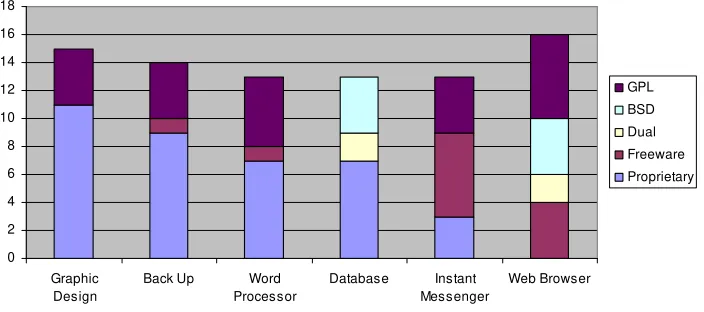
in each development category (Figure D1). Quite striking is that the BSD and dual licenses were
never used in word processors, backup software, graphic design and instant messaging, while
the GPL was never used in database development. The only area where BSD, dual and GPL
licensed software cohabited was web browser development. There thus seems to be preferences
for different OS licenses depending on the development area. Among proprietary software, which
were divided between freeware and commercial software, freeware was very present in Internet
communication software such as web browsers and instant messengers.
0 2 4 6 8 10 12 14 16 18
Graphic Design
Back Up Word
Processor
Database Instant Messenger
[image:29.612.133.485.444.600.2]Web Browser GPL BSD Dual Freeware Proprietary
Figure D1: Number of software in the sample, by license and by category.
Popularity was measured according to three Web metrics: the number of links to the publisher's
website (backlinks), Google's page rank for the website (from 0 to 10, higher is better), and
6In each category, some less sophisticated software did serve the non-specialist and others served more
D.2 Quality D EMPIRICAL STUDY
the number of mentions of the software's name on the web. Those numbers, all collected from
Google, the main search engine, indicate how easy it is to nd the software on the Internet
(Google Rank), but also how widely diffused the software is (number of mentions) and how often it is endorsed by others (backlinks). Those measures were strongly correlated with each
other. Software popularity within its category was computed by averaging the proportion of the
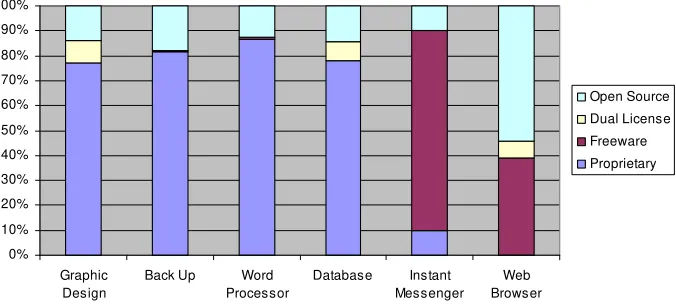
exponential of page rank, backlinks and mentions of that software within its category. Figure D2
below shows popularity of open source, dual license, proprietary software and freeware in their
respective market categories.
0% 10% 20% 30% 40% 50% 60% 70% 80% 90% 100%
Graphic Design
Back Up Word
Processor
Database Instant Messenger
Web Browser
[image:30.612.144.482.263.416.2]Open Source Dual License Freeware Proprietary
Figure D2: Popularity of software in the sample, by type and by category.
D.2
Quality
A list of the main features that could be available for software in a given category was established
and was used to assess the quality of the software. Software with the most features was found
to also include the features of software with less features. The number of features thus appeared to be an ordinal measure of quality. At the least, it could be considered as a measure of the
capabilities of the software, without judging of the number of bugs, of the quality of output, or
D.3 End-user orientation D EMPIRICAL STUDY
Graphic Design Back Up Word Processor
Max Mean N Max Mean M Max Mean N Proprietary 100% 71% 11 80% 67% 9 100% 86% 7
Freeware . . 0 40% 40% 1 50% 50% 1
Open Source 100% 43% 4 80% 60% 4 100% 38% 5
Database Instant Messenger Web Browser
Max Mean N Max Mean M Max Mean N Proprietary 100% 63% 7 71% 47% 3 . . 0
Freeware . . 0 100% 67% 6 90% 70% 4
[image:31.612.112.499.93.242.2]Open Source 100% 79% 4 43% 22% 4 100% 52% 10
Table D1: Percentage of key features provided, mean and maximum by license and by category (dual licenses not shown).
On this quality scale, OSS proved to be of signi cantly lower quality than proprietary software in
word processors, instant messenger and graphic design. It was of lower quality in web browsers,
of equal quality in backup software and of better quality in database software. On average,
OSS included 50% of the maximum number of features, while proprietary software and freeware included 70%. In most categories however, at least one OSS and one PS had all the features on
our list of main features.
There was little correlation between price and number of features, either on the whole or category
by category, and popularity did not exhibit a link with price or our measure of quality. I cannot
therefore go much further than comparing the popularity and quality of commercial software,
freeware and OSS as was done above. This is especially so one could argue that less featured
OSS may be faster and more reliable than proprietary software (an argument often made by OS proponents).
D.3
End-user orientation
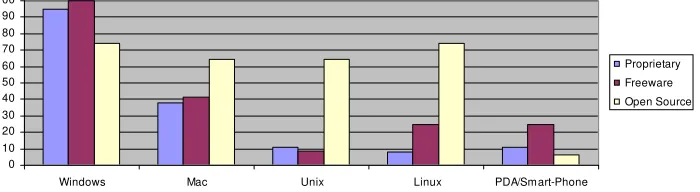
Open source software was less likely than freeware and proprietary software to be available on Windows and PDA/Smartphones, but far more likely to be available on Mac, Unix and Linux.
Indeed, only 75% of OSS was available on Windows, compared to about 95% of proprietary
software while proprietary software was signi cantly less likely to be available on Unix and
Linux (about 10% vs. about 65% for OSS) and also less likely to be available on Mac (about
40%vs. 60% for OSS). Overall therefore, OSS was less likely to be easily available to the mass