A Weighted Fair Queue based SBPN (WFQ-SBPN)
Algorithm to Improve Qos for Multimedia Application in
Mobile Ad Hoc Networks
Gagandeep Kaur
Student, Dept. of CSE
Amritsar College of Engineering and Technology PTU, Jalandhar, Punjab
Tanu Preet Singh,
Ph.D. Professor and HOD, Dept. of ECE Amritsar College of Engineering and Technology,PTU, Jalandhar, Punjab
ABSTRACT
Inthis paper we investigate a new technique based on SBPN for congestion avoidance. In this technique we proposed a new algorithm based on WFQ for improving the Qos for multimedia traffic in MANET. In traditional algorithm used SBPN-FIFO in which data transmitted in which order its received .In SBPN-FIFO all packets are treated equally by placed into single queue that’s why short packets have to wait long time. In proposed algorithm SBPN-WFQ where data handle with priority and every flow have opportunity to send data in specific time. This method reorders or discard packet according to expiry time. The main advantage of SBPN-WFQ it only drops packets only of aggressive flow. The study has carried on some issues like throughput, packet delivery ratio (PDF), packet drop. Simulation has been performed using NS-2.34. The simulation results show that our proposed algorithm will present better network performance in throughput, packet delivery fraction and number of dropped packets.
General Terms
MANET, SBPN, FIFO, WFQ.1.
INTRODUCTION
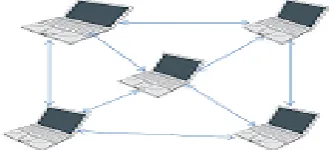
A Mobile Ad Hoc network is collection of various mobile nodes that can send data from one node to another node by using different intermediate nodes sometimes that nodes acts as routers that helps various nodes to send data with each other. Mobile Ad hoc network is self -configure network .A nodes of Ad hoc network can freely move in any direction so, rapidly and unpredictable changes in topology. There are no limits or direction for movement of nodes in Ad hoc network .There is no permanent infrastructure in mobile ad hoc network.
Drop tail queue is passive queue management method which defines the maximum length of queue and it start dropping when queue become full .it and it continue drops the packet whenever queue have not enough space for hold packets
There are several drawbacks of drop tail queue method:
1. Drop tail is simple queue management technique used FIFO in which all packets are treated equally and no special treatment given to packets that are of higher priority
2. There is various smaller numbers of packets in flow which are ready to forward but it strictly follows the FIFO
CASE A: A new packets arrives to enter in queue a queue has a enough space it can easily be fit
FIFO
PACKET
CASE B: A new packets arrives but queue is already full queue not enough space for fit packet so starts packet dropping it is called tail dropping
FIFO
TAIL DROP
[image:1.595.325.516.401.491.2] [image:1.595.83.251.590.665.2]2.
SEND BEST PACKET NEXT (SBPN)
SBPN is send best packet method in which determine which packet sent and in which order. where important data transmitted first .Mostly application layer send data to transport layer and it divides data into various segments and assign different priority to different parts of data SBPN also a congestion control mechanism for multimedia application .it is totally sender based method it only change the transmission criteria of data .it is not treated all packets equally. SBPN uses two parts of data packet expiry time and priority level. if data will not reach at receiver end before expiry time than it will be discarded3.
CONVENTIONAL SBPN-FIFO
ALGORITHM
In the conventional algorithm which was used to managed the queue in MANET was send best packet next (SBPN) based on FIFO. In SBPN-FIFO technique actually work on the principle of FIFO queue in which packets are coming from one side and leave the queue at another side. In SBPN-FIFO all packets are treated equally no special treatment to give packets which are of higher priority. If there are number of packets belong to different flows are ready to forward .but they are strictly handled in FIFO order. If there are number of smaller packets are queued behind a long packet then FIFO queuing result in more delay for small packets.
1. When the queue is full packets are dropped from the output side this process is called tail Dropping.
2. Whenever packets enter into full queue have to long time to be transmitted
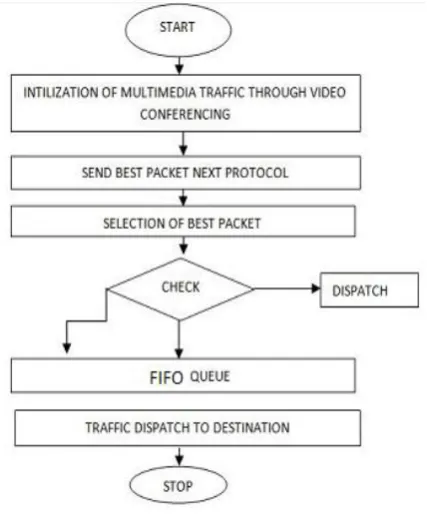
Following is the basic algorithm used in SBPN-FIFO
Step 1: Initialize the number of flows of multimedia network traffic through video conferencing
Step 2: Now used SBPN protocol on multimedia network for choose the best packet from flow
Step 3: If packet is best than directly dispatch at destination
Step 4: FIFO queuing technique is used to send packet to destination it chooses packet according to arrival of packet at source end
Step 5: Now dispatch packet at destination which is passed through FIFO queue
[image:2.595.325.539.71.334.2]Step 6: Exit
Fig 3: Traditional Flowchart
In the SBPN-FIFO Technique all packets are treated equally but in some application need priority to some packets and different treatment for different packets like in multimedia application some are video packets and audio packets so those packets would be important for user we have send first that packets. In video conferencing audio is more important than video that’s why we introduced new technique called SBPN-WFQ that overcomes the problem of SBPN-FIFO.
4.
PROPOSED ALGORITHM
(SBPN-WFQ)
In this proposed section we present a new active queue management technique is send best packet next (SBPN) based on weighted fair queue (WFQ).
Fig 4: weighted fair queue
Each flow is I is given as weight w
Service rate received by flow i is
R i = R * w i / (w1 + w2 + ... + w n)
Where R is channel rate in bps
In the proposed algorithm it only drops the packet of aggressive flow
It also used the scheduler for assign bandwidth equally to all flows is called TDM (time division multiplexing).
Following is the basic algorithm used in SBPN-WFQ
Step 1: Initialize the various flows of multimedia network traffic through video conferencing
Step 2: Now used SBPN protocol on multimedia network for choose the best packet from flow
Step 3: If packet is best than directly dispatch at destination
Step 4: Now used weighted fair queuing technique to send packet in which we can assign some weight to each and every
Flow of network
Enqueue (packet, i)
(a) If not active (i)
(b) Activate (i)
(c) Active += r (i)
(d) If queue (i) is empty
(e) F(i)=SF (i)max(F(i),V(t)/weight
(f) Else
(g) SF (i) += L / weight
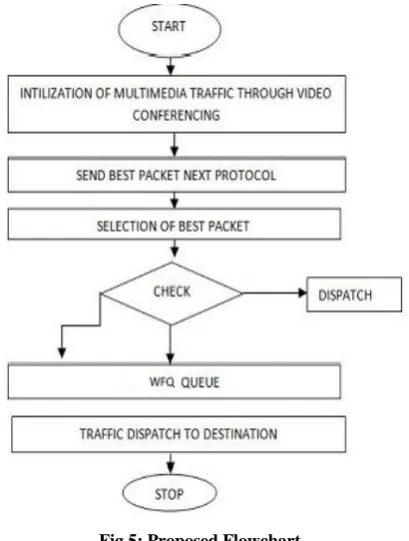
Fig 5: Proposed Flowchart.
In the proposed flowchart as shown in figure 2 instead of using the
FIFO queue for arrange packets in particular order we are using the weighted fair queuing method .WFQ each queuing method which is used to deal each flow differently with assign different bandwidth to each flow in which small packets also take advantage
The following figure shows comparison of FIFO and WFQ:
CASE A: FLOW 1
1 1 1 1 1 1 1 1
FLOW 2
2
FLOW 11
11
[image:3.595.61.279.83.321.2]FLOW 2
2
FLOW 11
11
FIFO
1 2 3 4 5 6 7 8 9 10 11 1 1 1 1 1 1
WFQ
[image:4.595.33.300.73.283.2]1 2 1 3 1 4 1 5 1 6 1 7 1 8 1 9 10 11
Fig 6: comparison of WFQ and FIFO
The proposed algorithm as shown in figure 2 instead of using the FIFO queue for handles flows of multimedia network we are using WFQ (weighted fair queuing) in which each flow received guaranteed flow rate but in the FIFO all others flows have to wait whenever one flow send the packets so it causes the problem of starvation and delay
WFQ gives appropriate and guaranteed amount of service to each flow
In short, we have included a new queuing method weighted fair queuing gives better results as comparison to FIFO .The simulation results shows that the proposed algorithm gives increased throughput, increased packet delivery fraction and decreased number.
5.
SIMULATION SCENARIO
The simulation has performed using NS-2.33. In our simulation we have taken the AODV protocol as foundation. Initially we have calculated the throughput, PDF and End to End delay for SBPN-FIFO algorithm then the same procedure is do for the weighted fair queuing based SBPN i.e. our proposed algorithm. The simulation results shows that our proposed algorithm give the better network management in requisites of throughput, PDF and delay. In our simulation we will compare the existing algorithm with the proposed algorithm. The simulation parameters taken are:
Table 1
Parameter Value
Routing Protocol AODV
Number of Nodes 50
Pause Time 6s
Area 800 *800 m2
Speed 1000 m/s
Packet Size 1000b
Simulation Time 60s
Traffic Pattern CBR
Mobility Model Random Way Point Model
The following parameters of SBPN-WFQ algorithm need to be set in TCL scripts while executing the conventional and proposed RED algorithm
Simulation has been performed by taking the above stated simulation
Parameters .The trace files have been generated by simulating the scenario and with the help of XGRAPH and AWK files results are formulated.
6.
RESULTS AND DISCUSSION
The results has been obtained by using the NS-2.34 simulator and results shows that our proposed algorithm performed better than traditional SBPN-FIFO algorithm in term of throughput, packet delivery ratio and packet drop rate.
6.1
Throughput
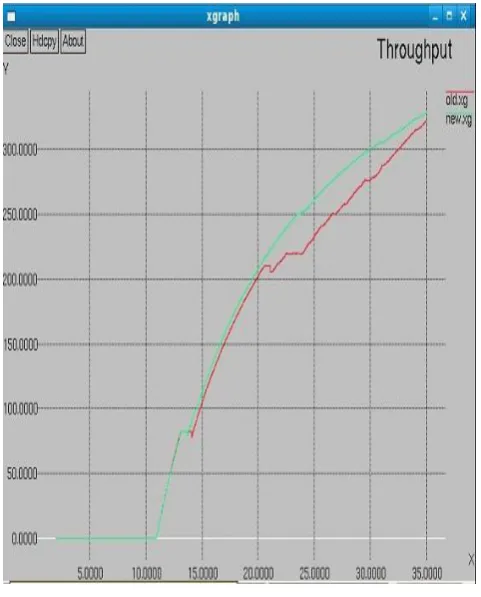
It may be defined as the total amount of data received by destination from the source node divided by time taken to receive the last packet. Figure 6 shows the Simulation Time (X-Axis) versus Throughput (Y-Axis) Of FIFO and WFQ. It has been clear from the figure that the proposed algorithm gives the higher throughput than the Traditional FIFO. The simulation is carried out for 60sec and it has been observed from the results that the proposed algorithm SBPN-WFQ gives a throughput 394 and SBPN- FIFO gives the throughput of 382.
Fig 7: Throughput versus simulation time.
6.2
Packet Delivery Ratio
[image:4.595.319.560.356.655.2]Fig 8: Packet Delivery Fraction versus simulation time.
6.3
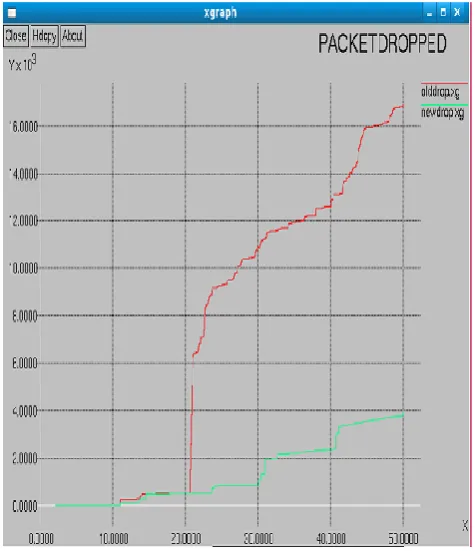
Packet Dropped
It may be defined as the total number of sent and forwarded packets minus the received packets. Figure 9 shows the simulation time (X-Axis) versus packet dropped (Y-Axis) of SBPN-FIFO and SBPN-WFQ algorithm. The figure shows that the proposed algorithm drops less number of packets than the SBPN-FIFO algorithm. For the same simulation time i.e. 60sec the number of packets dropped is also less in our proposed algorithm which is 3947 in SBPN-WFQ and 16933 and in SBPN-FIFO.
7.
CONCLUSION AND FUTURE
WORK
In this paper we have proposed a new active queue management technique named as weighted fair queue based send best packet next(WFQ-SBPN) .The traditional SBPN-FIFO . In this algorithm various flows suffer with large delay and tail dropping problem. In the proposed work we have generated a new queuing method WFQ based On SBPN which treat all flows equally to provide equal bandwidth to each flow. Simulations have been carried out and results shows that the proposed technique gives higher throughput, packet delivery fraction and lower number of dropped packets. In future we have to implement the proposed work for changing new routing protocol.
8.
REFERENCES
[1] Bhabani Sankar Gouda, A. K. ,”A Comprehensive Performance Analysis of Energy Efficient Routing Protocols in different traffic based Mobile Ad-hoc Networks”, IEEE.
[2] C.Ram Murthy, B. S. Manoj Ad Hoc Wireless Networks. Pearson Education
[3] David D. Clark, Wenjia Fang, “Explicit Allocation of Best-Effort Packet Delivery Service”, IEEE 2012
[4] Geethu Mohandas, D. S. (2013). Survey on Routing Protocols on Mobile Adhoc. IEEE (pp. 514-517). IEEE.
[5] Guillermo Diaz Delgdo,Victor Carrascal Frías, Mónica Aguilar Igartua “Video-streaming Transmission with QOS over Cross-Layered Ad hoc Networks”, 2012.
[6] HUAIZHI LI, M. S. (2007).” ABRP: Anchor-based Routing Protocol for Mobile Ad Hoc Networks. Wireless Personal Communications” (Springer) ©2006 , 277-300
[7] I.A.McDonald, R. Nelson “Application-level QOS: improving video conferencing quality through sending the best packet next", vol.4, No.1, IPT 2011
[8] Iftikhar Ahmad1, Humaira Jabeen ,Faisal Riaz “Improved quality of service protocol for real time traffic in MANETS”, IJCN , Vol.5,No.4, 2013..
[9] Kavita tandel, Rachana shelat, “Video streaming issues and techniques over MANETS", Vol.3, Issue 1, Feb 2013
[10] LI LA Yuan, LI ChunLin "QOS multicast routing protocol in hierarchical wireless MANETs”, SPRINGER 2011.
[image:5.595.54.292.450.726.2]