R E S E A R C H A R T I C L E
Open Access
Assessment of personality-related levels of
functioning: a pilot study of clinical
assessment of the DSM-5 level of
personality functioning based on a
semi-structured interview
Birgitte Thylstrup
1*, Sebastian Simonsen
2, Caroline Nemery
3, Erik Simonsen
4, Jane Fjernestad Noll
4,
Mikkel Wanting Myatt
2and Morten Hesse
1Abstract
Background:The personality disorder categories in the Diagnostic and Statistical Manual of Mental Disorders IV have been extensively criticized, and there is a growing consensus that personality pathology should be
represented dimensionally rather than categorically. The aim of this pilot study was to test the Clinical Assessment of the Level of Personality Functioning Scale, a semi-structured clinical interview, designed to assess the Level of Personality Functioning Scale of the DSM-5 (Section III) by applying strategies similar to what characterizes assessments in clinical practice.
Methods:The inter-rater reliability of the assessment of the four domains and the total impairment in the Level of Personality Functioning Scale were measured in a patient sample that varied in terms of severity and type of pathology. Ratings were done independently by the interviewer and two experts who watched a videotaped Clinical Assessment of the Level of Personality Functioning Scale interview.
Results:Inter-rater reliability coefficients varied between domains and were not sufficient for clinical practice, but may support the use of the interview to assess the dimensions of personality functioning for research purposes.
Conclusions:While designed to measure the Level of Personality Functioning Scale with a high degree of similarity to clinical practice, the Clinical Assessment of the Level of Personality Functioning Scale had weak reliabilities and a rating based on a single interview should not be considered a stand-alone assessment of areas of functioning for a given patient.
Keywords:Personality, Levels of functioning, Assessment, Interview, Clinical practice
Background
Perhaps nothing is more central to treating mental health problems than the patient’s personality [1]. Since the introduction of Axis II into the diagnostic nomencla-ture in the DSM-III, it has been possible for clinicians and researchers to consider personality in practice and research. However, the personality disorder (PD)
categories in the Diagnostic and Statistical Manual of Mental Disorders IV [2] have been extensively criticized on a number of grounds. For instance, it has been noted that there is considerable overlap between categories in both general population [3] and clinical samples [4], that most of the PD diagnoses do not represent categorical phenomena at the latent variable level [5], and that the way in which clinicians diagnose PD does not corres-pond to the way that researchers have found to be the most reliable and valid [6].
* Correspondence:[email protected]
1Center for Alcohol and Drug Research, Aarhus University, Bartholins Allé 10,
8000 Aarhus C, Denmark
Full list of author information is available at the end of the article
There is now a growing consensus that personality path-ology should be represented dimensionally rather than categorically [5, 7, 8]. While the DSM-IV categorical model was retained in the DSM-5 Section II as the official diagnostic system, a novel approach to the assessment of personality pathology was included in Section III to stimu-late further research and possible inclusion in future DSM iterations [9]. The new system is a hybrid of dimensional and categorical ratings that include personality traits as well as diagnoses [10]. An innovative component is the Level of Personality Functioning Scale (LPFS), which de-fines personality pathology in terms of impairments in self-functioning (Identity and Self-direction) and interper-sonal functioning (Empathy and Intimacy), and can be used to assess both the presence and severity of personal-ity pathology [9]. The four domains are rated individually, and for diagnostic purposes the clinician selects the level of functioning that most closely captures the patient’s overall level of impairment [11]. The LPFS constitutes the first step toward the diagnosis of a personality disorder under Section III [10]. Following the LPFS assessment, the clinician must assess pathological personality traits ac-cording to five trait domains: negative affectivity, detach-ment, antagonism, disinhibition, and psychoticism.
The diagnostic assessment of the level of personality functioning scale
During the development of the LPFS, Morey and col-leagues first published data in support of the validity of a global dimension of personality pathology related to both self and interpersonal functioning [11], and in a subsequent study, Morey and colleagues found support for the concurrent and clinical validity of the LPFS [12]. Similarly, other measures such as the Inventory of Per-sonality Organization and the Objects Relations Inven-tory have been used as indicators of levels of personality functioning [13]. A study by Hopwood and colleagues [14] of PD patients participating in the Collaborative Longitudinal Personality Disorders Study [15] demon-strated that generalized severity is the most important single predictor of concurrent and prospective dysfunc-tion in the assessment of personality pathology, and may be one of the most important features to assess when working with personality pathology [11, 16].
The alternative model has received substantial criti-cism after its publication, especially for being too com-plicated for general clinical use and research [10]. While this criticism may in part reflect the difficulty of adjust-ing to new ideas when conductadjust-ing any assessment or intervention, it underlines the importance of finding the right balance between the time and resources used when obtaining qualified assessment tools for clinical use as well as research. However, there is at present no offi-cially approved clinical instrument to assess the LPFS,
and since a substantial amount of evidence from clinical research points to the difficulties in obtaining valid and reliable diagnostic information about personality path-ology, there is a need for a diagnostic instrument that can be used to assess each particular aspect of the LPFS in a standardized, reliable, meaningful and clinically ac-ceptable way. Several research groups are currently working on developing a standardized instrument, but to the best of our knowledge, only two studies have pub-lished data on the inter-rater reliability of the LPFS ratings.
To challenge the claim that the constructs in the LPFS are too complex for most clinicians to rate e.g. [1, 17–19], Zimmerman and colleagues [20] studied whether 22 psychology undergraduate students were able to apply the LPFS with sufficient reliability. The ratings were based on an operationalized psychodynamic interview of 10 female patients conducted by an experienced clinician, of which five patients were diagnosed with a PD according to the SCID-II and five were not. The study indicated that the concerns about the complexity of the LPFS constructs were premature with an acceptable Intra Class Correlation (ICC) for the total dimension (ICC) = .51, 95 % confidence intervals [CI] (.31, .78). However, the ICC was more mixed for the four domains, ranging from .25 for Empathy to .63 for Intimacy. Although a social relations model analysis found evidence of significant perceiver variance for Em-pathy, the students’ ratings converged with expert-rated proxy measures of the severity of personality pathology, that is the presence and number of patients with DSM-IVPD diagnoses and OPD level of structural integration. The second reliability study was conducted by Few and colleagues [21] with 109 community adults receiving out-patient mental health treatment. In this study, the LPFS was rated by trained graduate students based on a video-taped SCID-II interview conducted by graduate students, and the reliability was based on both interviewer and video-ratings. In this study, the inter-rater reliabilities for Identity, Self-Direction, Empathy, and Intimacy were .49, .47, .49 and .47, respectively.
are hardly representative of a standard clinical interview. In the Few study, both the interviews and ratings were carried out by specifically trained graduate students, and also in this context it seems unlikely that a general clin-ician would conduct and rate the LPFS in a similar way.
Finally, Hutsebaut and colleagues developed a semi-structured interview to assess the LPFS [22], the Alter-native Model for Personality Disorders (AMPD). Each section of the AMPD opens with a general question, but specific questions are asked that probe directly for facets of the LPFS. The inter-rater reliability of the AMPD is substantially higher than the inter-rater reliability that has been reported in the two previous studies, with intraclass correlations ranging from .58 to .82 in the clinical sample, and from .81 to .92 when combining the patient sample with additional non-clinical cases.
The Clinical Assessment of the Level of Personality Functioning Scale (CALF)
The aim of the present study was to assess inter-rater re-liability of a semi-structured interview developed for the assessment of the four domains in the LPFS, the Clinical Assessment of the Levels of Personality Functioning Scale (CALF). The CALF was designed to be relatively brief, lasting less than an hour, and to be suitable early on in the assessment process. In order to assess duration of interview and identify questions that were problem-atic, or areas that required further questions before the current study, a previous version of the CALF was tested with patients undergoing treatment for substance use disorders and prison inmates in a high-security prison for offenders who were deemed to need treatment for severe psychiatric disorders, and a small community sample.
Further we wanted to increase the diversity of person-ality pathology studied with the LPFS by sampling a range of patients who varied in terms of both severity and type of pathology within different treatment settings. If the inter-rater reliability was also acceptable under such conditions, this would increase the acceptability of using the CALF to assess patients based on the LPFS in clinical practice, making a strong case against the need for the costly retraining of expert clinicians to carry out the clinical interviews and rate the LPFS.
Methods
Procedure
To have access to a range of patients who varied in se-verity and type of pathology in this study, we sampled patients from three different sources: an outpatient psy-chotherapy clinic that specifically served patients with PDs, a general outpatient psychiatric clinic, and sub-stance dependent patients in ongoing day or residential treatment with no drug or alcohol use in the past
30 days, including some from a high security prison. All participants were informed about the aim and content of the study and gave informed consent to participate.
The CALF interviews were conducted by six trained experts and lasted for between 44 and 69 min (M = 57.3, SD = 9.6); all interviews were videotaped. Following this, the videotaped interviews were distributed between six experts with each interview co-rated by two experts, who had not carried out the interview that was being rated.
Interviewers and raters
The interviews and ratings were conducted by four psy-chologists and two MDs with extensive experience with clinical assessment and assessment research, three men and three women with a mean age of 38.9 years (range 31 to 46 years). Additionally, two of the interviews were conducted by a female psychology student, age 31 years, under supervision by one of the MDs.
Participants
Participants were recruited from a patient (n= 36) and a community sample (n= 7). The patient sample consisted of 36 patients, 19 men and 17 women, with a mean age of 36 years (range: 18 to 56 years): Substance dependent patients (n= 19); Personality disordered patients (n= 12); Patients with anxiety or depression (n= 5). The commu-nity sample consisted of seven women with a mean age of 34 years (range: 24 to 45 years).
Measures
The Level of Personality Functioning Scale (LPFS) rates the four domains Identity and Self-direction (self-tioning) and Empathy and Intimacy (interpersonal func-tioning) on a scale from 0 (no impairment) to 4 (highest level of impairment). Within each domain, a compre-hensive description is given for each criterion. For the purpose of this study, the total score was summarized as the mean of the four domain scores.
No formal training was provided for the raters, and the instructions for determining the ratings were re-stricted to handing out written copies of the LPFS.
The CALF interview
on the totality of the interview rather than on patient re-sponses to the questions in the corresponding section. For each section, the interviewer has to rate the level of dysfunction by giving a score from 0 to 4, with 0 indicat-ing no impairment and 4 indicatindicat-ing extremely severe impairment.
The CALF opens with questions about general demo-graphics, followed by questions about current problems with mental health and current treatments. The main body of the interview consists of four sections, each of which concerns one of the dimensions in the LPFS, but where some of the questions within each section also provide information on the level of functioning within other domains. Specifically, the CALF prompts patients to talk about the four domains based on their general life situation within the last three to five years.
All sections open with a global question concerning the specific domain, followed by prompts for specific ex-amples and qualifications of the response. All sections conclude with questions about contentment and con-cerns for the given domain, and whether recent changes, events or periods of higher or lower distress have af-fected specific areas of functioning within this domain.
Section 1 assesses Self-direction. According to the LPFS, Self-direction concerns the ability to set and pur-sue realistic and meaningful goals in life. Questions in this section concern the patient’s goals in life, and prompt questions concerning the respondent’s ability to set reasonable goals based on a realistic assessment of personal capacities. Since the pilot testing showed that current life goals may be difficult to evaluate in terms of how realistic they are and how consistently the patient pursues these goals, we included past life goals and how these had been pursued. Following this, the patient is asked about the value and meaning of current and past goals, what has been done to obtain the goals and whether they have been obtained, possible future obsta-cles, and what the patient can do to overcome these ob-stacles. Finally, the patient is asked if he or she considers herself to be in control of her life in general, and whether she is satisfied with the goals that he or she is presently pursuing.
Section 2 assesses Intimacy. In the LPFS, Intimacy in-cludes both close relationships and relationships in the community, and is more concerned with the reciprocity and the depth of the relationships than with the size of network of perceived support. In order to identify the degree of reciprocity, this section opens with questions about who the patient sees in daily life and the fre-quency of contact. Next, the patient is asked to identify a single person who is particularly important and to de-scribe what he or she likes about that person, and then to describe what the other person likes about her. Fi-nally, this section asks about conflicts that have resulted
in the discontinuation of social contacts, an area which is also considered in the assessment of the capacity for Empathy.
Section 3 concerns Empathy, which is referred to in the LPFS as the capability to understand and respond adequately to the experiences and motivations of others, and the awareness of how one’s own actions affect others. The section opens with questions about disagree-ments and who the patient disagrees with. Next, the patient is asked to identify a disagreement with a person, and is asked about the motivations and intentions be-hind the disagreement (of both those of the patient and the other person), and whether and how the disagree-ment was resolved. The purpose of these questions is primarily to assess the patient’s capacity for understand-ing and considerunderstand-ing the perspectives and needs of others in a conflict, the ability to understand their reactions, and the ability to learn from disagreements.
Section 4 adds further information concerning the Identity dimension. Usually, responses to the previous sections in the CALF interview are highly salient for the issues covered in the Identity section, because they pro-vide rich information about self-image, self-worth, and the capacity for independent functioning. However, an important aspect of Identity that is not necessarily cov-ered by the previous sections is the patient’s access to and ability to regulate a wide range of emotions. To as-sess this aspect of Identity, the patient is asked about feelings of sadness, anxiety, anger and pleasure, what triggers these feelings, the intensity and duration of the feeling, and how the patient reacts to the feeling. Finally, the section contains questions about differences between private and public identities.
Statistical analysis
The number of patients included was determined pri-marily on pragmatic grounds. Hence, a post hoc power analysis was conducted to assess the power to assess correlations which indicated that with a sample size of 34, the power to detect a correlation of 0.50 was 86 % withα= 0.05.
For the dependent variable, the LPFS score, we summed the scores on each of the four domains to yield a number that could range from 0 (no dysfunction) to 12 (maximal dysfunction).
Further, to assess agreement between different video ratings of the same video, we calculated agreement using intraclass correlations from mixed effects regression models. For these correlations, we report the confidence intervals, and thep-values based on the assumption that the distribution of the likelihood-ratio test statistic is a 50:50 mixture of χ2 distributions with k and k + 1° of freedom. All analyses were carried out on Stata 13 for Windows [26].
The analyses were repeated, so that all analyses were first conducted using only the patient sample, and in a second round, the community individuals were included in the analyses.
Results
In the patient sample, the mean score on the LPFS was 8.18 for the interviewer ratings (range: 1 to 13, standard deviation [SD] = 2.98), and 7.59 for the video ratings (range: 1 to 12, SD = 3.22). In the community sample, the mean score for interviewer rating was 0.86 (range: 0 to 4, SD = 1.46), and the mean video rating was 2.00 (range: 0 to 8, SD = 2.89).
Agreement between video ratings and interviewer ratings
For five patients, the interviewer did not rate the LPFS, leaving 31 patients for this analysis (17 psychiatric pa-tients and 14 papa-tients with substance use disorders). The power to detect a correlation of 0.5 was 83 % with a sample size of 31, which is still within the acceptable range.
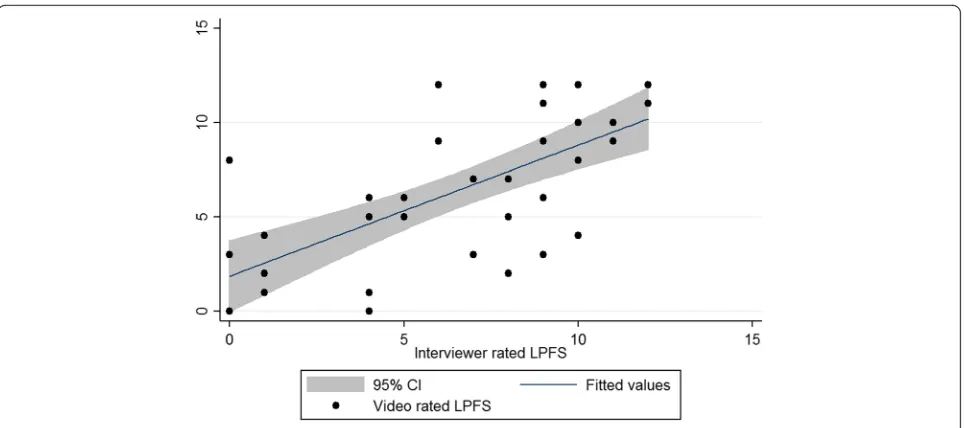
For the full LPFS, the Pearson correlation between video rating and interviewer was 0.59 (p< .001). The do-main correlations between the interviewer and video-based ratings are shown in Table 1. Correlations ranged from 0.16 (Identity, ns) to 0.66 (Self-direction, p< .001). The correlation between the sum of the LPFS as rated by interviewer and by video rater is illustrated in Fig. 1. When community controls were included, all coeffi-cients increased, and all became significant.
Agreement between different video raters
For six patients, only one video had been rated by a video rater, leaving 30 patients for the inter-rater analysis
of the video-based ratings. The intraclass correlations between two independent video raters are summarized in Table 2. The intraclass correlations range from 0.31 to 0.60. Again, the highest inter-rater agreement was found for Self-direction, and the weakest for Identity. When community controls were included, all coefficients in-creased, and all became significant.
Discussion
In this study, we tried a semi-structured interview, the CALF, developed to measure the LPFS. The CALF was designed to be conducted in a clinical setting, applying strategies similar to what characterizes assessments in clinical practice, which often involves the inference of the underlying processes in the patient’s narrative. How-ever, the findings were only minimally encouraging for the use of the CALF as a diagnostic instrument for the LPFS. Most inter-rater correlations were statistically sig-nificant, but none were in the range where two different assessments were so similar, that one could substitute the other (i.e., more than 50 % shared variance). This is in spite of the fact that we had a very diverse sample of patients in which a wide range of variation could be ex-pected in the LPFS.
[image:5.595.56.541.633.715.2]In terms of specific domains, the strongest inter-rater reliability was found for Self-direction, both in terms of different video raters and when comparing video ratings to interviewer ratings. Self-direction is characterized by the ability to set and consistently pursue realistic and meaningful goals, and it appears that especially by asking the patient to describe his or her past goals and clarify which of them have been obtained and what has been done to reach them, the interviewer will get a reliable es-timate of the patient’s level of functioning in this area. The two interpersonal areas, Empathy and Intimacy, gave more modest inter-rater reliability estimates, and although the correlations were statistically significant and may contribute to the overall clinical picture, such ratings should not be considered stand-alone assess-ments of these areas of functioning in a research con-text, let alone in a clinical context. Finally, the inter-rater reliability of the Identity scale was low, indicating that in order to obtain acceptable reliability, a different
Table 1Pearson correlations between interviewer-rated LPFS and randomly selected video-rated LPFS
Clinical sample (n= 31) P-value Total sample (n= 38) P-value Identity .202 (−.164 to .519) .276 .588 (.331 to .764) .000 Self-direction .672 (.417 to .829) .000 .716 (.514 to .843) .000 Intimacy .495 (.171 to .723) .005 .650 (.417 to .803) .000 Empathy .360 (.007 to .634) .046 .419 (.114 to .651) .000 Total .582 (.287 to .776) .001 .689 (.474 to .827) .000
approach is probably needed than the one found in the current version of CALF. We have no good explanation for the lower reliability on the Identity scale. It may be that Identity is a complicated construct with no univer-sally agreed upon definition e.g. [27], or that the rating of the Identity domain draws more heavily on answers obtained in the other sections of the CALF.
The concerns about the inter-rater reliability in this study are similar to those raised in previous research. Although the present study is a small study that only yields prelimin-ary evidence on the inter-rater reliability of the LPFS, the correlations were strong enough to suggest further research on the rating of the LPFS. A central question is here how a clinical interview format best supports a reliable standard-ized assessment of the LPFS, and whether using assessment strategies that mirror how psychiatrists and psychologists work in clinical practice may find a place within such for-mat [6]. A major challenge to the dimensional approach in the LPFS is that, unlike specific types of psychopathology, overall personality functioning and the four domains in the LPFS do not manifest in clear, well-defined symptoms, but address complex and diverse phenomena. The question is how this can be reflected in the assessment approach in a
[image:6.595.58.540.86.300.2]way that supports assessment reliability and validity. One extreme would be a fully structured interview in which pa-tients’answers would be transformed into relevant scores with only slight perceiver inference. The other extreme would be a minimally structured and phenomenologically oriented interview, in which the clinician would infer the LPFS scores based on information which is influenced by several factors besides the patient’s answers [28]. However, although sufficient reliability is easier to obtain when per-ceiver inference is kept to a minimum, this could come at the price of reduced validity concerning the rating of the complex constructs in the LPFS. Other related studies that have assessed concepts similar to the concepts in the LPFS have used interviews based on a structured format, which also facilitates the patients in talking freely about personal and affect-laden aspects like the CALF, in order to observe metacognitive capacities, narrative coherence, and the rep-resentational style of the interviewee, all of which are core elements which influence the assessment of personality functioning. In the Metacognition Assessment Interview (MAI) [23], the patient is asked to describe an autobio-graphical episode about the worst psychological situation within the last six months, and following this, the clinician Fig. 1Scatterplot of video-rated LPFS as a function of interviewer-rated LPFS
Table 2Intraclass correlations between video-rated LPFS
Clinical sample (n= 30) P-value Total sample (n= 37) P-value Identity .31 (.09 to .67) .039 .59 (.38 to .77) .000 Self-direction .58 (.35 to .79) .000 .62 (.41 to .79) .000 Intimacy .46 (.22 to .73) .004 .62 (.42 to .79) .000 Empathy .57 (.33 to .78) .000 .59 (.38 to .78) .000 Total .54 (.30 to .77) .000 .65 (.46 to .81) .000
Notes:ICCIntraclass correlation
[image:6.595.57.538.623.707.2]adheres to a structured list of questions to assess four func-tional domains (monitoring, integrating, differentiating and decentering). In the Adult Attachment Interview (AAI), the patient is asked about the demographics of his or her child-hood followed with questions about the nature of the rela-tionships with parents, and an elaboration on specific episodes when positive adjectives are used when de-scribing these relationships [29]. Thus, like the CALF, both the MAI and the AAI contain specific questions as well as more open questions about highly personal and affect-laden topics, in which patient statements are used to make inferences about an underlying quality see also [30].
The CALF was designed to assess level of personality functioning in a way that closely mimics what clinicians do in general practice, by requiring the interviewer to prompt for examples and clarifications within broad life functioning areas, rather than by probing for specific be-haviors or emotions that match the criteria in the LPFS levels. While it is both a weakness and strength that the CALF also assesses what is left unsaid, this study shows that videotaped assessment interviews can be used to as-sess the processing of various non-verbal types of data, such as speed of speech, body language and voice inton-ation [31–33], which would be of particular interest when a patient is being interviewed about salient areas of functioning in life. Given that the present study, like the previous studies that we know of which have assessed the LPFS [20–22], assessed inter-rater agree-ment based on the rating of same data give a lower bound on the reliability of the assessment. Had different interviews of the same patient been assessed, instead of assessing the same interview, the results would almost certainly have pointed to lower reliability. In turn, this means that correlations with other variables are bound to be considerably lower.
Directions for further research
The inclusion of underlying processes in patient narratives in the assessment of the LPFS may be highly useful for clinical practice, in which self-reporting may be biased due to impairment in realistic self-appraisal and the ability to reflect upon and understand aspects of functioning, in-cluding mental processes and their impact on others. The CALF interview was an attempt to do this in a way that corresponds to how clinicians do in real world settings. However, before assessment of narratives can be meaning-fully included in the assessment of personality functioning, improvements in inter-rater reliability are required.
Limitations
There are a number of important limitations to this study. First, the raters were not a random sample of psy-chologists and psychiatrists, but rather an expert group
with a special interest in PDs. Further, the number of patients and controls was small, and larger samples are needed in future studies. Finally, the interviewers were not blind to the patients’clinical status.
Conclusion
The present study showed that only weak inter-rater re-liability was obtained, when the Clinical Assessment of the Level of Personality Functioning Scale interview was used to assess the Levels of Personality Function-ing Scale. The interview was designed to rely on a rela-tively high level of inference, and the weak reliability is likely to be an effect of this fact. Based on the present findings, rating based on the Clinical Assessment of the Level of Personality Functioning Scale interview should not be considered a stand-alone assessment of areas of functioning for a given patient.
Funding
The project was funded entirely by intra-murral sources.
Availability of data and materials
A copy of the data can be obtained from researchers by contacting the corresponding author. A beta translation of the full interview is available from the corresponding author.
Authors’contributions
All authors took part in the study. MH, BT, SS, and CN drafted the
manuscript, and the other authors commented and gave their final approval of the final version. All authors read and approved the final manuscript.
Competing interests
The authors declare that they have no competing interests.
Consent for publication Not applicable.
Ethics approval and consent to participate
The Committee on Health Research Ethics in the Capital Region of Denmark reviewed the project description and concluded that it did not require ethical evaluation (journal # H-3-2012-FSP56). All patients gave written and verbal consent to participate in the study.
Author details 1
Center for Alcohol and Drug Research, Aarhus University, Bartholins Allé 10, 8000 Aarhus C, Denmark.2Regional Services for Mental Health, Capital
Region, Stolpegårdsvej 20, 2820 Gentofte, Denmark.3BOMI, Renter for Neurorehabilitation, Maglegårdsvej 15, Roskilde, Denmark.4Regional Services
for Mental Health, Nørregade 54, 4100 Ringsted, Denmark.
Received: 22 March 2016 Accepted: 18 August 2016
References
1. Clarkin JF, Huprich SK. Do Dsm-5 personality disorder proposals meet criteria for clinical utility? J Pers Disord. 2011;25(2):192–205. 2. American Psychiatric Association. Diagnostic and statistical manual of
mental disorders (4th ed., text rev.). Washington, DC: Author; 2000. 3. Grant BF, Stinson FS, Dawson DA, Chou SP, Ruan WJ. Co-occurrence of
DSM-IV personality disorders in the United States: results from the national epidemiologic survey on alcohol and related conditions. Compr Psychiat. 2005;46(1):1–5.
5. Haslam N, Holland E, Kuppens P. Categories versus dimensions in personality and psychopathology: a quantitative review of taxometric research. Psychol Med. 2012;42:903–20.
6. Westen D. Divergences between clinical and research methods for assessing personality disorders: Implications for research and the evolution of axis II. Am J Psychiat. 1997;154(7):895–903.
7. Krueger RF, Hopwood CJ, Wright AG, Markon KE. Challenges and strategies in helping the DSM become more dimensional and empirically based. Current psychiatry reports. 2014;16(12).
8. Widiger TA, Livesley WJ, Clark LA. An integrative dimensional classification of personality disorder. Psychol Assess. 2009;21(3):243–55.
9. American Psychiatric Association. Diagnostic and statistical manual of mental disorders (5th ed.). Arlington, VA: American Psychiatric Publishing; 2013.
10. Skodol AE, Morey LC, Bender DS, Oldham JM. The alternative DSM-5 model for personality disorders: a clinical application. Am J Psychiat. 2015;172(7):606–13.
11. Morey LC, Berghuis H, Bender DS, Verheul R, Krueger RF, Skodol AE. Toward a model for assessing level of personality functioning in DSM-5, part II: empirical articulation of a core dimension of personality pathology. J Pers Assess. 2011;93(4):347–53.
12. Morey LC, Bender DS, Skodol AE. Validating the proposed diagnostic and statistical manual of mental disorders, 5th edition, severity indicator for personality disorder. J Nerv Ment Dis. 2013;201(9):729–35.
13. Lowyck B, Luyten P, Verhaest Y, Vandeneede B, Vermote R. Levels of personality functioning and their association with clinical features and interpersonal functioning in patients with personality disorders. J Pers Disord. 2013;27(3):320–36.
14. Hopwood CJ, Malone JC, Ansell EB, Sanislow CA, Gill CM, McGlashan TH, et al. Personality assessment in Dsm-5: empirical support for rating severity, style, and traits. J Pers Disord. 2011;25(3):305–20.
15. Gunderson JG, Shea MT, Skodol AE, McGlashan TH, Morey LC, Stout RL, et al. The collaborative longitudinal personality disorders study: development, aims, design, and sample characteristics. J Pers Disord. 2000;14(4):300–15. 16. Skodol AE, Clark LA, Bender DS, Krueger RF, Morey LC, Verheul R, et al.
Proposed changes in personality and personality disorder assessment and diagnosis for DSM-5 part I: description and rationale. Personal Disord. 2011;2(1):4–22.
17. Pilkonis PA, Hallquist MN, Morse JQ, Stepp SD. Striking the (Im)proper balance between scientific advances and clinical utility: commentary on the DSM-5 proposal for personality disorders. Personal Disord. 2011;2(1):68–82. 18. Tyrer P. Diagnostic and statistical manual of mental disorders: a classification
of personality disorders that has had its day. Clin Psychol Psychot. 2012;19(5):372–4.
19. Tyrer P, Crawford M, Mulder R, Blashfield R, Farnam A, Fossati A, et al. The rationale for the reclassification of personality disorder in the 11th revision of the International Classification of Diseases (ICD-11). Personal Ment Health. 2011;5(4):246–59.
20. Zimmermann J, Benecke C, Bender DS, Skodol AE, Schauenburg H, Cierpka M, et al. Assessing DSM-5 level of personality functioning from videotaped clinical interviews: a pilot study with untrained and clinically inexperienced students. J Pers Assess. 2014;96(4):397–409.
21. Few LR, Miller JD, Rothbaum AO, Meller S, Maples J, Terry DP, et al. Examination of the Section III DSM-5 diagnostic system for personality disorders in an outpatient clinical sample. J Abnorm Psychol. 2013;122(4):1057–69. 22. Hutsebaut J, Feenstra DJ, Kamphuis JH. Development and preliminary
psychometric evaluation of a brief self-report questionnaire for the assessment of the DSM-5 level of personality functioning scale: the LPFS brief form (LPFS-BF). Personal Disord. 2016;7(2):192–7.
23. Semerari A, Cucchi M, Dimaggio G, Cavadini D, Carcione A, Battelli V, et al. The development of the metacognition assessment interview: instrument description, factor structure and reliability in a non-clinical sample. Psychiatry Res. 2012;200(2–3):890–5.
24. Hare RD, Neumann CS. Psychopathy as a clinical and empirical construct. Annu Rev Clin Psychol. 2008;4:217–46.
25. Westen D, Muderrisoglu S. Assessing personality disorders using a systematic clinical interview: evaluation of an alternative to structured interviews. J Pers Disord. 2003;17(4):351–69.
26. Stata Statistical Software. 13 ed. Texas: StataCorp LP.; 2013.
27. Jørgensen CR. Disturbed sense of identity in borderline personality disorder. J Pers Disord. 2006;20(6):618–44.
28. Nordgaard J, Revsbech R, Saebye D, Parnas J. Assessing the diagnostic validity of a structured psychiatric interview in a first-admission hospital sample. World Psychiatry. 2012;11(3):181–5.
29. George C, Kaplan N, Main M. The adult attachment interview. Berkeley: University of California; 1985.
30. Hopwood CJ, Zimmermann J, Pincus AL, Krueger RF. Connecting personality structure and dynamics: towards a more evidence-based and clinically useful diagnostic scheme. J Pers Disord. 2015;29(4):431–48. 31. Blair KS, Richell RA, Mitchell DG, Leonard A, Morton J, Blair RJ. They know
the words, but not the music: affective and semantic priming in individuals with psychopathy. Biol Psychol. 2006;73(2):114–23.
32. Klaver JR, Lee Z, Hart SD. Psychopathy and nonverbal indicators of deception in offenders. Law Human Behav. 2007;31(4):337–51. 33. Aziz-Zadeh L, Sheng T, Gheytanchi A. Common premotor regions for the
perception and production of prosody and correlations with empathy and prosodic ability. PLoS One. 2010;5(1):e8759.
• We accept pre-submission inquiries
• Our selector tool helps you to find the most relevant journal • We provide round the clock customer support
• Convenient online submission • Thorough peer review
• Inclusion in PubMed and all major indexing services • Maximum visibility for your research
Submit your manuscript at www.biomedcentral.com/submit