2016 International Conference on Electronic Information Technology and Intellectualization (ICEITI 2016) ISBN: 978-1-60595-364-9
Research and Implementation of Message
Queue on Key Event Processing
Zhijian Yin and Linhan Dai
ABSTRACT
As electronic technology products continue to expand the control panel buttons, there are hundreds of buttons, and different types of buttons. In this paper, the advantages and functions of message queue in the processing of key events are analyzed in detail. Proposed bond between the control board and the control board to pass key information through SPI communication method, and implemented in Free ROTS(embedded operating systems) use a variety of different message queue management of key events, and in response to key events. The conclusion is that the main control board chip can use software to classify the key events by message queue.
INTRODUCTION
Electronic technology products increased peripheral button number, type diversification, lead to a traditional software consists of a main control chip control scan button event will greatly increase the task burden of MCU and software execution efficiency. In addition to the aid of hardware other specialized keyboard management chip scanning key events, and with main control MCU establish corresponding communication protocol, software also need to use more optimized way to manage key events. The way in which the use of message queues can not only greatly reduce the burden of MCU real-scan key event, but also to manage a variety of different types and key messages for different events.
_______________________________
MESSAGE QUEUING IN THE ROLE OF KEY EVENTS
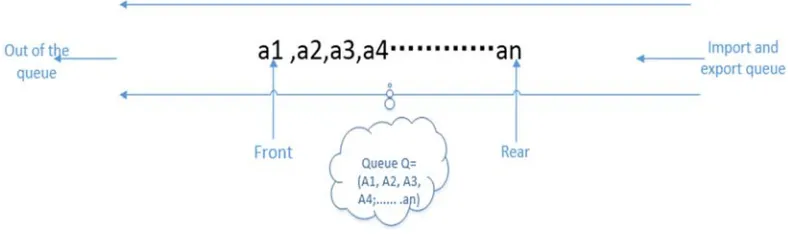
Figure 1. Key into the queue.
Message queue is a linear chain structure. When the message queue is empty, only the first team and the team tail these two pointers, they are front and rear. When the MCU receives key ID from slave machine through communication. For example, by mean of SPI communication, the task is scanned to the corresponding button ID changes, the message queue will be in a specific format and a particular priority to add new messages received at this time. As shown in Figure 1:
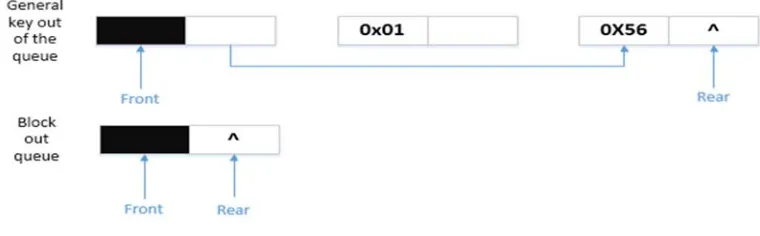
Message queues are created based on the message structure defined by the user, including the type of key, key state ID, keys, key values and other information, create a new node. By linear chain structure to add in a new node. Since the head of the queue (front) is only allowed to remove one end, while the tail (rear) is to allow only one end of the FIFO queue to delete determines the characteristics (FIFO), as shown in Figure 2:
[image:2.612.116.510.498.615.2]Figure 3. key out of the queue.
When the button is released, the button event will be released from the queue in accordance with the first out of the way, the release of the button marked the queue node in the queue to delete. Node in the key structure of the message will also be followed by the team as shown in Figure 3:
Therefore, the message queue is used to deal with the key events, and only need to open a high priority task to monitor the key events in the embedded operating system. As long as the detected event is triggered, the new message queue will be added, when the button is released in response to a custom mode according to the corresponding treatment. So, It can reflect the advantages as follows: 1. Key management become more high speed and high efficiency, as long as the key data structure established, the same type of button can be given the same attributes, without keys on the each one defined its structure properties; 2. To save the memory, expansion and convenient buttons; 3. Facilitate the management, when a certain key types or attributes to change, only need to change the corresponding data structure can be. 4 According to the needs of users to deal with complex button events such as: combination of buttons, long press, even press, etc..
MESSAGE QUEUE KEY COMMUNICATION MESSAGES
THE KEY MESSAGE QUEUE AND DATA STRUCTURE CREATED
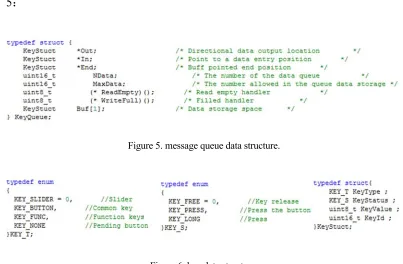
You should first establish the key message queue data structure shown in Figure
5:
[image:4.612.93.496.131.395.2]Figure 5. message queue data structure.
Figure 6. key data structure.
By writing Q_Key Msg Create uint8_t (*Buf void, Buf Size uint32_t) function, where “Buf” is the data, Buf Size is the size of the data set up an empty queue. Then define the data structures of various keys for different types of buttons, as shown in Figure 6:
MESSAGE QUEUE KEY EVENT RESPONSE
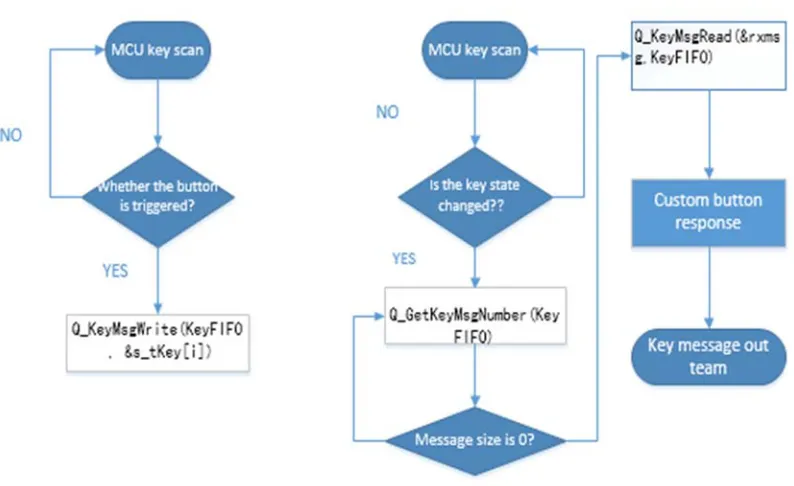
values of key ID. Key type slider, ordinary keys, function keys, pending button. The state of key includes the long press, press and release. At the same time, each key has by pressing the corresponding value and ID. The flow chart is shown in Figure 7:
Figure 7. message queue processing button flow chart.
SYSTEM TEST
When the encoder rotates, the message queue receives the pulse message of the encoder, and the program can increase or decrease the corresponding value according to the logic judgment. As shown in Figure 8:
When the slider is sliding, the message queue receives the current value of the slider in real time, and the program also increases or decreases the corresponding value. As shown in Figure 9:
Figure 8. the encoder control value addition and subtraction.
Figure 9. sliding block control numerical addition and subtraction.
Figure 10. message queue processing combination keys.
CONCLUSION
Message Queuing in dealing with issues of key events enable efficient management of all types and combinations of keys. Through analysis of the key events to the message queue processing, according to the characteristics of the message queue extended is used to solve other problems. For example: the pulse signal processing and utilization the message queue communication platform for three-tier structure, MMORPG server software architecture is implemented.
REFERENCE
1. Xiao Guangbing. 2013.04. ARM embedded development example. Electronics Industry Press, 112-121.
2. Yan Yumin, Wu Weimin. 2012.05.1. Data structure. Beijing: Tsinghua University Press, 431-439.
3. Lewin A.R.W. Edwards. 2011.3.4. embedded engineers will certainly know. People's Posts and Telecommunications Press, 178-192.
4. Mu Yu. 2010. Design of embedded applications. Beijing: People's Posts and Telecommunications Press, 152-165.
[image:6.612.181.430.315.365.2]