Open Access
Research article
A draft genome sequence and functional screen reveals the
repertoire of type III secreted proteins of Pseudomonas syringae
pathovar tabaci 11528
David J Studholme*
1, Selena Gimenez Ibanez
1, Daniel MacLean
1,
Jeffery L Dangl
2, Jeff H Chang
3,4and John P Rathjen
1Address: 1The Sainsbury Laboratory, Norwich, NR4 7UH, UK, 2Department of Biology, CB# 3280, Coker Hall, The University of North Carolina at Chapel Hill, Chapel Hill, North Carolina 27599-3280, USA, 3Department of Botany and Plant Pathology, Oregon State University, 2082 Cordley Hall, Corvallis, OR 97331, USA and 4Center for Genome Research and Biocomputing, Oregon State University, 2082 Cordley Hall, Corvallis, OR 97331, USA
Email: David J Studholme* - [email protected]; Selena Gimenez Ibanez - [email protected];
Daniel MacLean - [email protected]; Jeffery L Dangl - [email protected]; Jeff H Chang - [email protected]; John P Rathjen - [email protected]
* Corresponding author
Abstract
Background: Pseudomonas syringae is a widespread bacterial pathogen that causes disease on a broad range of economically important plant species. Pathogenicity of P. syringae strains is dependent on the type III secretion system, which secretes a suite of up to about thirty virulence 'effector' proteins into the host cytoplasm where they subvert the eukaryotic cell physiology and disrupt host defences. P. syringae pathovar tabaci naturally causes disease on wild tobacco, the model member of the Solanaceae, a family that includes many crop species as well as on soybean.
Results: We used the 'next-generation' Illumina sequencing platform and the Velvet short-read assembly program to generate a 145X deep 6,077,921 nucleotide draft genome sequence for P. syringae pathovar tabaci strain 11528. From our draft assembly, we predicted 5,300 potential genes encoding proteins of at least 100 amino acids long, of which 303 (5.72%) had no significant sequence similarity to those encoded by the three previously fully sequenced P. syringae genomes. Of the core set of Hrp Outer Proteins that are conserved in three previously fully sequenced P. syringae strains, most were also conserved in strain 11528, including AvrE1, HopAH2, HopAJ2, HopAK1, HopAN1, HopI, HopJ1, HopX1, HrpK1 and HrpW1. However, the hrpZ1 gene is partially deleted and hopAF1 is completely absent in 11528. The draft genome of strain 11528 also encodes close homologues of HopO1, HopT1, HopAH1, HopR1, HopV1, HopAG1, HopAS1, HopAE1, HopAR1, HopF1, and HopW1 and a degenerate HopM1'. Using a functional screen, we confirmed that hopO1, hopT1, hopAH1, hopM1', hopAE1, hopAR1, and hopAI1' are part of the virulence-associated HrpL regulon, though the hopAI1' and hopM1' sequences were degenerate with premature stop codons. We also discovered two additional HrpL-regulated effector candidates and an HrpL-regulated distant homologue of avrPto1.
Conclusion: The draft genome sequence facilitates the continued development of P. syringae pathovar tabaci on wild tobacco as an attractive model system for studying bacterial disease on plants. The catalogue of effectors sheds further light on the evolution of pathogenicity and host-specificity as well as providing a set of molecular tools for the study of plant defence mechanisms. We also discovered several large genomic regions in Pta 11528 that do not share detectable nucleotide sequence similarity with previously sequenced Pseudomonas genomes. These regions may include horizontally acquired islands that possibly contribute to pathogenicity or epiphytic fitness of Pta 11528.
Published: 24 August 2009
BMC Genomics 2009, 10:395 doi:10.1186/1471-2164-10-395
Received: 4 March 2009 Accepted: 24 August 2009 This article is available from: http://www.biomedcentral.com/1471-2164/10/395
© 2009 Studholme et al; licensee BioMed Central Ltd.
This is an Open Access article distributed under the terms of the Creative Commons Attribution License (http://creativecommons.org/licenses/by/2.0), which permits unrestricted use, distribution, and reproduction in any medium, provided the original work is properly cited.
Background
Pseudomonas syringae is a widespread bacterial pathogen
that causes disease on a broad range of economically important plant species. The species P. syringae is sub-divided into about 50 pathovars, each exhibiting charac-teristic disease symptoms and distinct host-specificities. P.
syringae pathovar tabaci (Pta) causes wild-fire disease in
soybean and tobacco plants [1,2], characterised by chlo-rotic halos surrounding necchlo-rotic spots on the leaves of infected plants. Formation of halos is dependent on the beta-lactam tabtoxin, which causes ammonia accumula-tion in the host cell by inhibiaccumula-tion of glutamine synthetase [3]. However, whether tabtoxin is an essential component of the disease process is unclear [4,5].
Pathogenicity of P. syringae strains is dependent on the type III secretion system (T3SS). The T3SS secretes a suite of virulence 'effector' proteins into the host cytoplasm where they subvert the eukaryotic cell physiology and dis-rupt host defences [6-14]. Mutants lacking the T3SS do not secrete effectors, and as a consequence do not infect plants or induce disease symptoms. Thus, understanding effector action is central to understanding bacterial patho-genesis. A single P. syringae strain typically encodes about 30 different effectors [14]. However, different P. syringae strains have different complements of effector genes. The emerging view is that of a core of common effectors encoded by most strains, augmented by a variable set. Individual effectors appear to act redundantly with each other and are individually dispensable with a small or no loss to pathogen virulence [10]. Effectors are also thought to play an important role in determining host range. This is most clearly true when infections are restricted by host defences. Some plants have evolved specific mechanisms to recognise certain effectors; such recognition induces strong host defences which curtail infection. For example, expression of the T3SS effector HopQ1-1 from P. syringae pathovar tomato (Pto) DC3000 was sufficient to render Pta 11528 avirulent on Nicotiana benthamiana [15]. The oppo-site situation, in which acquisition of a novel effector gene confers the ability to infect new host plants, has not been demonstrated and remains speculative. However, heterol-ogous expression of the effector gene avrPtoB conferred a plasmid-cured strain of P. syringae pathovar phaseolicola (Pph) with increased virulence [16]. We hope that further identification and characterisation of effector repertoires of particular strains will shine new light on their roles in determining host range. Finally, bacterial virulence is also likely to be influenced by other non-T3SS-dependent vir-ulence factors such as toxins which are often co-regulated with the T3SS [17].
Complete genome sequences are available for strains rep-resenting three P. syringae pathovars: Pto, pathovar
pha-seolicola (Pph) and pathovar syringae (Psy) [18-20].
Comparisons of these have led to the identification of core effector gene sets and to explain some of the differ-ences in host-specificity between pathovars. However, these three sequenced strains are representatives of three distinct phylogroups within the species P. syringae, and as such are phylogenetically quite distant [21,22]. According to DNA-DNA hybridisation studies and ribotyping [21],
P. syringae can be divided into 9 discrete genomospecies.
Representative strains of Psy, Pph and Pto fell into genom-ospecies one, two and three respectively [21]. Recently, a strain of pathovar oryzae (genomospecies four) was sequenced [23]. A draft genome sequence was also pub-lished for Pto T1 [24], a strain closely related to Pto DC3000 but restricted to tomato hosts, whereas Pto DC3000 is able to cause disease on Arabidopsis. In the cur-rent study, we explore genetic differences at an intermedi-ate phylogenetic resolution; that is, we compared the genome sequences of Pta 11528 to that of P. phaseolicola (Pph) 1448A, which resides within the same phylogroup but possesses a distinct host range and causes different disease symptoms.
Pto DC3000 was the first plant-pathogenic pseudomonad
to have its genome sequenced, helping to establish the
Arabidopsis-Pto system as the primary model for
plant-microbe interactions. However, Arabidopsis is not a natural host of Pto, and it is important to develop alternative sys-tems given the genetic variability of P. syringae strains, par-ticularly in regard to effectors. We work on the interaction between Pta and the wild tobacco plant N. benthamiana, which offers certain advantages over Arabidopsis. Firstly, N.
benthamiana is an important model for the Solanaceae,
which includes many important crop species. The Pta-N.
benthamiana interaction is a natural pathosystem. Lastly, N. benthamiana is an important model plant that is more
amenable to biochemistry-based approaches and facile manipulation of gene expression such as virus-induced gene silencing (VIGS). Thus N. benthamiana provides experimental options for understanding plant-bacterial interactions. Strains of Pta can cause disease on N.
bentha-miana, but relatively few genetic sequence data are
availa-ble for this pathovar.
In this study we generated a draft complete genome sequence of Pta 11528 and used a functional screen for HrpL-dependent genes to infer its repertoire of T3SS effec-tors and associated Hrp Outer Proteins (Hops), which dif-fers significantly from that of its closest relative whose complete genome has previously been published (Pph 1448A). Pta 11528 does not encode functional homo-logues of HopAF1 or HrpZ1. This was surprising since HopAF1 was conserved in the three previously sequenced pathovars [18-20]. HrpZ1 is conserved in most strains of
P. syringae that have been investigated, albeit with
6605 and several other isolates from Japan, were previ-ously shown to carry a major deletion leading to truncated HrpZ protein product [26]. Pta 11528 encodes several novel potential T3SS effectors for which no close ortho-logues have been reported. We also discovered several large genomic regions in Pta 11528 that do not share detectable nucleotide sequence similarity with previously sequenced Pseudomonas genomes. These regions may be horizontally acquired islands that possibly contribute to pathogenicity or epiphytic fitness of Pta 11528.
Results and discussion
Sequencing and assembly of the Pta 11528 genome The Illumina sequencing platform provides a cost-effec-tive and rapid means to generate nucleotide sequence data [27-29]. Although this method generates very short sequence reads, several recent studies have demonstrated that it is possible to assemble these short reads into good quality draft genome sequences [30-41].
We generated 12,096,631 pairs of 36-nucleotide reads for a total of 870,957,432 nucleotides. This represents approximately 145X depth of coverage assuming a genome size of six megabases. We used Velvet 0.7.18 [41] to assemble the reads de novo. Our resulting assembly had 71 supercontigs of mean length 85,604 nucleotides, an
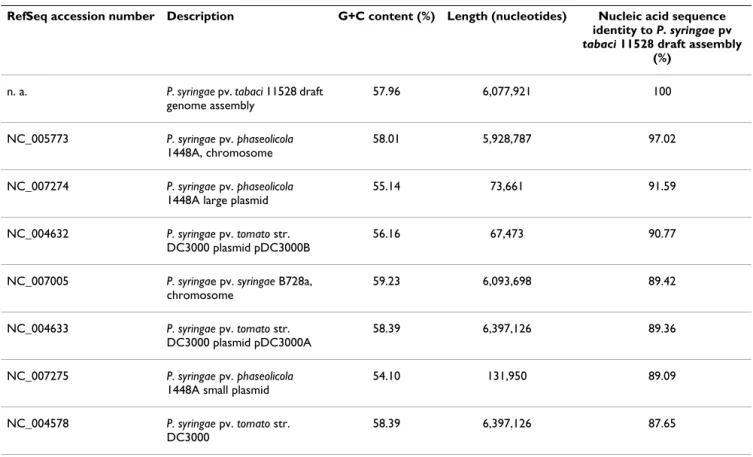
N50 number of eight, and N50 length of 317,167 nucle-otides; that is, the eight longest supercontigs were all at least 317,167 nucleotides long and together covered more than 50% of the predicted genome size of six megabases. The largest supercontig was 606,547 nucleotides long. The total length of the 71 assembled supercontigs was 6,077,921 nucleotides. The G+C content of the assembly was 57.96%, similar to that of the previously sequenced P.
syringae genomes (Table 1). The sequence data from this
project have been deposited at DDBJ/EMBL/GenBank under the accession ACHU00000000. The version described in this paper is the first version, ACHU01000000. The data can also be accessed from the authors' website http://tinyurl.com/Pta11528-data and as Additional files submitted with this manuscript. In addi-tion, an interactive genome browser is available from the authors' website http://tinyurl.com/Pta11528-browser. We aligned the 71 Pta supercontigs against published complete Pseudomonas genome sequences using MUM-MER [42]. The Pta 11528 genome was most similar to that of Pph 1448A, with 97.02% nucleotide sequence identity over the alignable portions. The next most similar genome was that of Pto DC3000, with less than 90% identity (Table 1). This pattern of sequence similarity is consistent with phylogenetic studies that placed strains of Pta in the
Table 1: Comparison of Pta 11528 genome properties with those of previously sequenced P. syringae genomes [18-20,83-85], [86-93].
RefSeq accession number Description G+C content (%) Length (nucleotides) Nucleic acid sequence identity to P. syringae pv
tabaci 11528 draft assembly
(%)
n. a. P. syringae pv. tabaci 11528 draft
genome assembly 57.96 6,077,921 100 NC_005773 P. syringae pv. phaseolicola 1448A, chromosome 58.01 5,928,787 97.02 NC_007274 P. syringae pv. phaseolicola
1448A large plasmid
55.14 73,661 91.59
NC_004632 P. syringae pv. tomato str.
DC3000 plasmid pDC3000B
56.16 67,473 90.77
NC_007005 P. syringae pv. syringae B728a,
chromosome 59.23 6,093,698 89.42 NC_004633 P. syringae pv. tomato str. DC3000 plasmid pDC3000A 58.39 6,397,126 89.36 NC_007275 P. syringae pv. phaseolicola
1448A small plasmid
54.10 131,950 89.09
NC_004578 P. syringae pv. tomato str.
DC3000
58.39 6,397,126 87.65
same phylogroup as Pph and revealed a relatively distant relationship to Pto [21,22].
Comparison of the protein complement of Pta 11528 versus Pph 1448A and other pseudomonads
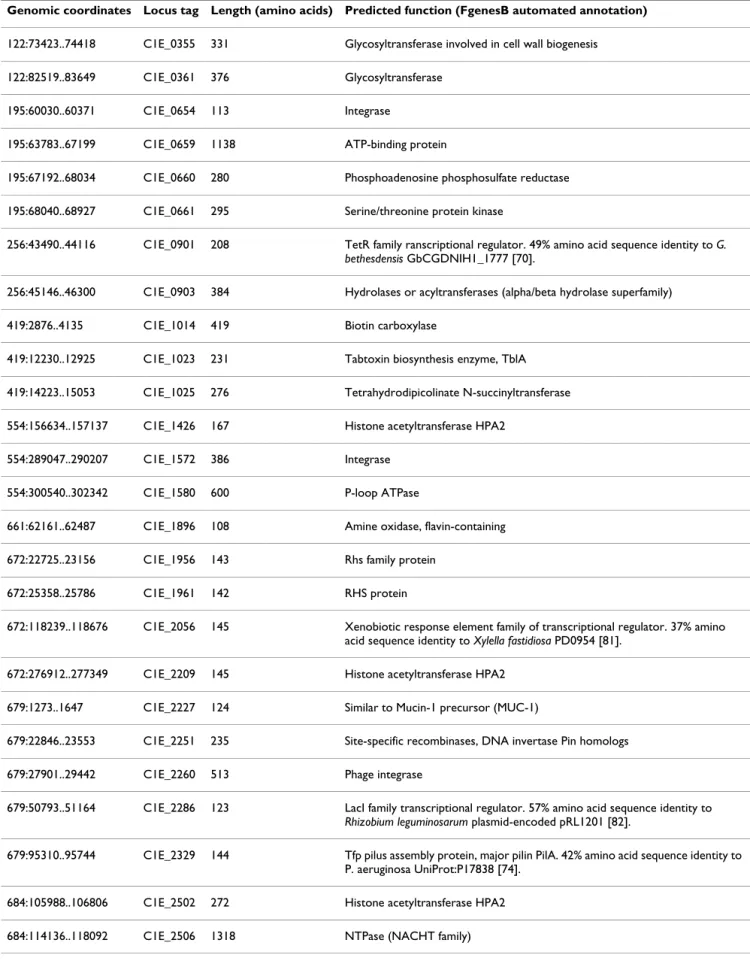
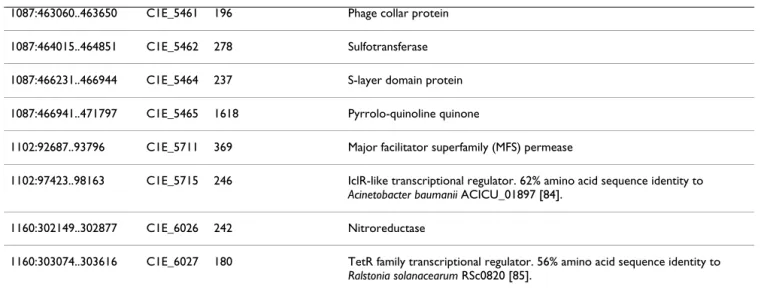
Using the FgenesB annotation pipeline http://www.soft berry.com, we identified 6,057 potential protein-coding genes, of which 5,300 were predicted to encode proteins of at least 100 amino acids long. Of 5,300 predicted Pta 11528 proteins, 575 (10.8%) had no detectable homol-ogy with Pph 1448A proteins (based on our criterion of an E-value less than 1e-10 using BLASTP). Of these 575 sequences, 303 had no detectable homologues in Psy B728a nor Pto DC3000. These 303 Pta-specific sequences had a median length of 198 amino acids whereas the median length of the 5,300 sequences was 216 amino acids. Automated gene prediction is not infallible and inevitably a subset of the predictions will be incorrect. The reliability of gene predictions is poorer for short sequences than for longer ones. This slight enrichment for very short sequences among the Pta-specific gene predic-tions might be explained by the inclusion of some open reading frames that are not functional genes among those 303. However, many of the predicted proteins showed sig-nificant similarity to other proteins in the NCBI NR data-bases (See Additional file 1: Table S1), confirming that these are likely to be genuine conserved genes.
Conservation of the T3SS apparatus and T3SS-dependent effectors
The Hop Database (HopDB, http://www.pseudomonas-syringae.org) provides a catalogue of confirmed and pre-dicted hop genes [43]. Figure 1 lists the hop genes in HopDB for the three previously fully sequenced P. syringae genomes. A 'core' set of hop genes are conserved in all three previously sequenced pathovars: avrE1, hopAF1,
hopAH2, hopAJ2, hopAK1, hopAN1, hopI1, hopJ1, hopX1, hrpK1, hrpW1 and hrpZ1. In addition to this core set, each
genome contains additional hop genes that are found in only a subset of the sequenced strains. The Pta 11528 homologues of hop genes are listed in Table 2. Figure 1 also indicates those hop genes for which a close homo-logue was found to be encoded in Pta 11528.
In sequenced strains of P. syringae, the gene cluster encod-ing the T3SS apparatus is flanked by collections of effector genes termed the exchangeable effector locus (EEL) and the conserved effector locus (CEL). Together, these three genetic components comprise the Hrp pathogenicity island [44]. A core set of hop genes is located in the Hrp pathogenicity island [44], which is highly conserved between Pta 11528 and Pph 1448A (Figure 2), except that in Pta 11528 there is a deletion in hrpZ1 and an insertion in the hrpV-hrcU intergenic region. The core hop genes
avrE1, hopAH2, hopAJ2, hopAK1, hopAN1, hopI1, hopJ1,
hopX1 and hrpK1 are conserved in Pta 11528 and encode
intact length proteins. Pta 11528 encodes a full-length HrpW1 protein, albeit with insertions of 69 and 12 nucleotides relative to the Pph 1448A sequence. However, there is a large deletion in hrpZ1 that likely renders it non-functional and hopAF1 is completely absent.
Besides the core conserved hop genes, the Pta 11528 genome assembly contains full-length orthologues of
hopR1, hopAS1, hopAE1 and hopV1, which are also found
in Pph 1448A but are absent from Psy B728a and/or Pto DC3000.
The hrpZ1 gene encodes a harpin, which is not classified as a type III effector because it is not injected directly into host cells. Harpins are characteristically acidic, heat-stable and enriched for glycine, lack cysteine residues [8] and can induce defences in both host and non-host plants [45,46]. HrpZ1 forms pores in the host membrane [47] suggesting a role in translocation of effectors across the host mem-brane. It also shows sequence-specific protein binding activity [48]. HrpZ1 can induce defences in both host and non-host plants and tobacco has been extensively used as the non-host plant species [45,46]. The inactivation of
hrpZ1 in Pta 11528 and other strains of Pta [26] may be an
adaptive strategy and have been an important process in the stepwise progression towards compatibility, allowing
Pta 11528 to avoid detection by the tobacco host plant.
This is reminiscent of the "black holes" and other proc-esses that inactivate genes whose expressed products are detrimental to a pathogenic lifestyle [49,50]. One excel-lent example is the inactivation of cadA in genomes of
Shigella species as compared to the genome of their closely
related but non-pathogenic Escherichia coli strain [51,52].
Pta 11528 contains highly conserved homologues of hopAB2, hopW, hopO1-1, hopT1-1, hopAG1, hopAH1, hopF1
and hopAR1, which are absent in Pph 1448A. Although absent from the Pph 1448A genome, hopAR1 and hopF1 have been identified in other strains of Pph [53-57]. In Pph 1302A, hopAR1 is located on the pathogenicity island
PPHGI-1, though its genomic location varies between
strains [56,57]. PPHGI-1 is absent from the Pph 1448A genome [57]. The Pta 11528 genome (supercontig 1087) possesses a region of similarity to PTPHGI-1, but which contains a substantial number of insertions and deletions (Additional file 2: Figure S1). The Pta 11528 hopAR1 homologue (C1E_2036) is not located in the PPHGI-1 region; it falls on supercontig 672 about two kilobases upstream of a gene encoding a protein (C1E_2039) shar-ing 43% amino acid identity with Pto DC3000 avrPto1. In contrast to AvrPto1 from Pto DC3000, the AvrPto1 homo-logue (C1E_2039) from Pta 11528 is not recognised by the plant Pto/Prf system (S. Gimenez Ibanez and J. Rathjen, manuscript in preparation).
Table 2: Homologues of known hop genes in Pta 11528. Homologues were detected by searching the Pta 11528 FgenesB-predicted protein sequences against HopDB http://www.pseudomonas-syringae.org using BLASTP
Effector gene Gene in Pta 11528 genome (location) Hrp-box HMM score (bioinformatic evidence) HrpL-dependent (functional screen) Homologue in Pph 1448A avrE1 C1E_5333 (1087:342585..346532) 18.24 Yes PSPPH_1268 (chromosome) avrPto1-like C1E_2039 (672:104030..104509) 26.02 Yes None hopAB2 C1E_3975 (955:85214..86053)
None Yes None
hopAE1 C1E_0512 (174:82348..85077) 17.91 Yes PSPPH_4326 (chromosome) hopAG1 C1E_2305 (679:71608..73584) 19.67 No None hopAH1 C1E_2306 (679:74209..74976) None No None hopAH2 C1E_3507 (891:229657..230907) None No PSPPH_3036 (chromosome)
hopAI1' (degenerate) C1E_2307 (679:75143..75466) 24.85 Yes None hopAJ2 C1E_0586 (174:157540..158877) None No PSPPH_4398 (chromosome) hopAK1 C1E_4764 (1053:316850..318520) 21.71 No PSPPH_1424 (chromosome) hopAN1 C1E_1908 (661:72932..74221) None No PSPPH_0456 (chromosome) hopAR1 C1E_2036 (672:101352..102155) 15.68 Yes None hopAS1 C1E_1389 (554:110458..114543) 18.77 No PSPPH_4736 (chromosome) hopI1 C1E_0551 (174:125987..126916) 21.66 Yes PSPPH_4366 (chromosome) hopM1' C1E_5336 (1087:348226..350460) 13.65 Yes PSPPH1266 hopO1-1 C1E_5022 (1087:78582..79433) 18.48 Yes None hopR1 C1E_3889 (955:5054..6763) 24.65 No PSPPH_0171 hopT1-1 C1E_5021 (1087:77437..78576) 18.48 Yes None hopV1 C1E_2810 (733:27251..28225) 14.09 No PSPPH_2351 (chromosome)
The homologues of hopAG1, hopAH1 and the degenerate
hopAI1' are found within a region of the Pta 11528
genome that shares synteny with the chromosome of Psy B728a. This region is also conserved in Pto DC3000A, albeit with several deletions and insertions, suggesting that these effector genes are ancestral to the divergence of the pathovars and have been lost in Pph 1448A rather than having been laterally transferred laterally between Pta 11528 and Psy B728a. In Pto DC3000, hopAG1 (PSPTO_0901) has been disrupted by an insertion sequence (IS) element. This is consistent with a model of lineage-specific loss of certain ancestral effectors.
In Pto DC3000, hopO1-1 and hopT1-1 are located on the large plasmid pDC3000A; homologues of these effector-encoding genes are not found in Pph 1448A. The Pta 11528 genome contains a three kilobase region of homol-ogy to pDC3000 comprising homologues of these two effector genes and a homologue of the ShcO1 chaperone-encoding gene. These three genes are situated in a large (at least 50 kilobase) region of the Pta 11528 genome that has only limited sequence similarity with Pph 1448A. Two tRNA genes (tRNA-Pro and tRNA-Lys) are located at the boundary of this region (Figure 3), which would be con-sistent with this comprising a mobile island.
In plasmid pMA4326B from P. syringae pathovar
maculi-cola (Pma), the hopW1 effector gene is immediately
adja-cent to a three-gene cassette comprising a resolvase, an integrase and exeA. This cassette is also found in plasmids and chromosomes of several human-pathogenic Gram-negative bacteria [58]. We found a homologue of this cas-sette along with a hopW1 homologue on supercontig 955 of the Pta 11528 genome assembly. Stavrinides and
Gutt-man [58] proposed that the boundaries of the cassette lay upstream of the resolvase and upstream of hopW1. The presence of this four-gene unit in a completely different location in Pta 11528 is indeed consistent with the hypothesis that it represents a discrete mobile unit. Several hop genes are located on the large plasmid of Pph 1448A. We found no homologues of these genes in Pta 11528, suggesting that the plasmid is not present in Pta 11528. Consistent with this, only a small proportion of the plasmid was alignable to our 36-nucleotide Illumina sequence reads (Figure 4). This reveals that a large compo-nent of the pathogen's effector arsenal is determined by its complement of plasmids. However, simple loss or gain of a plasmid does not explain all of the differences in effector complement since Pta 11528 lacks homologues of several
Pph 1448A chromosomally-located effector-encoding hop
genes hopG1, hopAF1, avrB4, hopF3 and hopAT1 as well as the non-effector hopAJ1. It also lacks homologues of the
Pph 1448A degenerate effector gene hopAB3'.
The regions of the Pph 1448A large plasmid that are appar-ently conserved in Pta 11528 include genes encoding the conjugal transfer system, suggesting the presence of one or more plasmids in this strain. We found an open reading frame (C1E_3950, located on supercontig 955 coordi-nates 59126-60394) encoding a protein with about 97% sequence identity to the RepA proteins characteristically encoded on pT23A-family plasmids (e.g. AAW01447; reviewed in [59]), suggesting that this 236 kilobase super-contig might represent a plasmid.
hopW1 C1E_3964 (955:74860..77184) 10.73 No None (PSPPH is a truncated HopW1 homologue) hopX1 C1E_5300 (1087:315085..316227) 27.96 No PSPPH_1296 (chromosome) hrpK1 C1E_5301 (1087:316323..318641) 27.96 No PSPPH_1295 (chromosome) hrpW1 C1E_5341 (1087:351970..352491) 20.57 No PSPPH_1264 (chromosome) hrpZ1 C1E_5325 (1087:337056..337478) 19.74 No PSPPH_1273 (chromosome) C1E_5324 (1087:336767..337045)
The locations of Pph 1448A homologous genes is indicated, including an indication of whether they are located on the chromosome or on the large plasmid. Also indicated is whether each gene appeared in the functional screen for Hrp-dependent transcription.
Table 2: Homologues of known hop genes in Pta 11528. Homologues were detected by searching the Pta 11528 FgenesB-predicted protein sequences against HopDB http://www.pseudomonas-syringae.org using BLASTP (Continued)
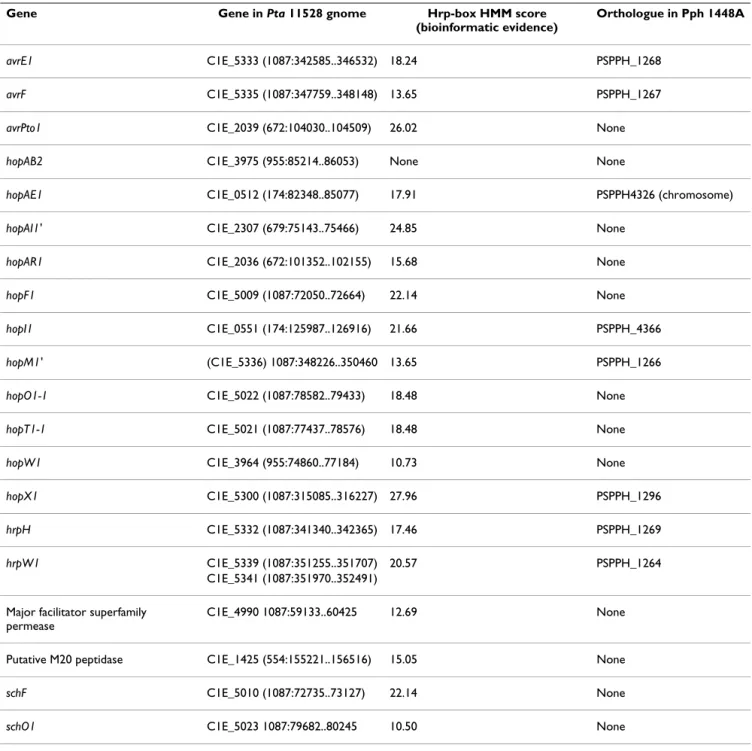
A functional screen for HrpL-regulated genes
We used a previously described functional screen [60] to complement our bioinformatics-based searches for type III effectors of Pta 11528. Our functional screen was based on two steps. The first step was employed to identify genes whose expression was regulated by the T3SS alternative
sigma factor, HrpL. The second step was used to identify the subset of HrpL-regulated genes that encoded effectors. For Pta 11528, we employed only the first step to identify candidate effector genes based on induced expression by HrpL. A library was constructed from Pta 11528 into a broad-host range vector carrying a promoter-less GFP and Comparison of the hop gene complements of the three previously fully sequenced P. syringae genomes
Figure 1
Comparison of the hop gene complements of the three previously fully sequenced P. syringae genomes. Those
hop genes that are conserved in Pta 11528 are shown in boldface and underlined. Pta 11528 also contains three hop genes that
do not have orthologues in the sequenced genomes: hopAR1, hopF1 and hopW1. * No close homologue of avrPto1 was found in
Pta 11528; however, there is a gene encoding a protein that shares 43% amino acid identity with Avr Pto1 from Pto DC3000. **
mobilized into Pto lacking its endogenous hrpL but condi-tionally complemented with an arabinose-inducible hrpL. We used a fluorescence activated cell sorter (FACS) to select clones that carried HrpL-inducible promoters based on expression of GFP after growth in arabinose. Clones were sequenced and sequences were assembled. Clones representative of assembled supercontigs were verified again for HrpL regulation using FACS. Among the genes
whose expression was confirmed to be HrpL-dependent were those encoding effectors hopAE1, hopI1, hopAR1, the
avrPto1-like gene, hopF1, hopT1-1, hopO1-1, avrE1, hopX1,
and the degenerate hopM1' and hopAI1' as well as known T3SS-associated genes hrpH (ORF1 of the CEL; [61]) and
hrpW1. Interestingly, the screen also confirmed
HrpL-dependent regulation of genes encoding a major facilita-Conservation of the Hrp pathogenicity island between Pph 1448A and Pta 11528
Figure 2
Conservation of the Hrp pathogenicity island between Pph 1448A and Pta 11528. Panel A shows an alignment of the
Pph 1448A Hrp pathogenicity island (lower track) against the homologous region in Pta 11528 (upper track), prepared using
GenomeMatcher, which indicates similarity values by colour with dark blue, green, yellow and red representing increasing degrees of similarity [78]. Panel B shows the MAQ [79] alignment of the Pta 11528 Illumina reads (in black) and the BLASTN [80] alignment of the Pta 11528 de novo assembly (in green) against the Hrp region of the Pph 1448A genome.
tor superfamily (MFS) permease and a putative peptidase (Table 3).
Other differences in predicted proteomes of P. syringae strains
Host range and pathogenicity are likely to be further influ-enced by genes other than those associated with type III secretion. Virulence determinants in P. syringae include toxins as well as epiphytic fitness; that is, the ability to acquire nutrients and survive on the leaf surface [14]. Epi-phytic fitness depends on quorum-sensing [62], chemo-taxis [63], osmo-protection, extracellular polysaccharides, glycosylation of extracellular structures [64] iron uptake [65] and the ability to form biofilms. Cell-wall-degrading hydrolytic enzymes play a role in virulence in at least some plant-pathogenic pseudomonads [66]). Secretion systems (including type I, type II, type IV, type V, type VI and twin arginine transporter) may also contribute to both virulence and epiphytic fitness [67], whilst multid-rug efflux pumps may confer resistance to plant-derived antimicrobials [68]. To identify differences between Pta 11528 and the previ-ously sequenced Pph 1448A, Psy B728a and Pto DC3000 with respect to their repertoires of virulence factors, we performed BLASTP searches between the predicted pro-teomes. We found no significant differences in the reper-toires of secretion systems between the proteomes. However, we found that Pta 11528 lacks homologues of several Pph 1448A polysaccharide modifying enzymes (glycosyl transferase PSPPH_0951, polysaccharide lyase PSPPH_1510, glycosyl transferase PSPPH_3642). Con-versely, Pta 11528 encodes two glycosyl transferases (C1E_0355 and C1E_0361) and a thermostable glycosy-lase (C1E_4802) that do not have homologues in any of the three fully sequenced P. syringae genomes. This may
imply differences in the extracellular polysaccharide pro-files. In contrast to Pph 1448A, Pta 11528 lacks homo-logues of RhsA insecticidal toxins (PSPPH_4042 and PSPPH_4043). However, a tabtoxin biosynthesis gene cluster is found in the Pta 11528 genome and shows a high degree of conservation with the previously sequenced Pta BR2 tabtoxin biosynthesis cluster [69].
Pta 11528 encodes several enzymes that do not have
homologues in any of the three fully sequenced P. syringae genomes (Table 4), including a predicted gluconolacto-nase (C1E_2553), a predicted dienelactone hydrolase (C1E_2589), a predicted nitroreductase (C1E_6026), and a sulphotransferase (C1E_6026). C1E_0903 shares 71.4% amino acid sequence identity with a predicted epoxide hydrolase (YP_745600.1) from Granulibacter bethesdensis CGDNIH1 [70] and has a significant match to the epoxide hydrolase N-terminal domain in the Pfam database (PF06441) [71,72]. Epoxide hydrolases are found in P.
aeruginosa and P. fluorescens PfO-1, but not in any other
pseudomonads. It is possible that this gene product has a function in detoxification of host-derived secondary metabolites.
Pta protein C1E_6026 has a significant match to the
sul-photransferase domain (Pfam:PF00685). Examples of this protein domain have not been found in other pseu-domonads except for P. fluorescens PfO-1. Sulphotrans-ferase proteins include flavonyl 3-sulphotransSulphotrans-ferase, aryl sulphotransferase, alcohol sulphotransferase, estrogen sulphotransferase and phenol-sulphating phenol sulpho-transferase. These enzymes are responsible for the transfer of sulphate groups to specific compounds. The sulpho-transferase gene (C1E_6026, 82% amino acid identity to
P. fluorescens Pfl01_0157) overlaps a two kilobase Pta
11528-specific genomic island that also encodes a phage A 90-kilobase region of the Pta 11528 genome containing homologues of hopT1-1 and hopO1-1
Figure 3
A 90-kilobase region of the Pta 11528 genome containing homologues of hopT1-1 and hopO1-1. The G+C con-tent is indicated by the plot near the top of the figure.
Limited conservation between the Pta 11528 genome sequence and the sequence of the Pph 1448A large plasmid Figure 4
Limited conservation between the Pta 11528 genome sequence and the sequence of the Pph 1448A large plas-mid. The MAQ [79] alignment of the Pta 11528 Illumina reads is shown in black. The thickness of the black track is propor-tional to the depth of coverage by Illumina reads. The BLASTN [80] alignment of the Pta 11528 de novo assembly against the plasmid sequence is shown in a green track, with the thickness of this single green track being proportional to sequence iden-tity.
tail collar-protein encoding gene (C1E_5461, 61% amino acid identity to P. fluorescens Pfl01_0155) and an acetyl-transferase (C1E_5459, 76% amino acid identity to P.
flu-orescens Pfl01_0148). We speculate that this region has
been horizontally acquired in the Pta 11528 lineage via a bacteriophage.
An 80 kilobase region of Pta 11528 supercontig 684 con-tains two open reading frames (ORFs) (C1E_2584 and C1E_2585) whose respective predicted protein products
show 48 and 55% amino acid identity to the C- and N-ter-mini of a P. putida methyl-accepting chemotaxis protein (MCP) (PP_2643) and little similarity to any P. syringae protein. Since the N- and C-termini are divided into sepa-rate reading frames, this probably represents a degenesepa-rate pseudogene. Immediately downstream of these ORFs is a gene (C1E_2583) that specifies a MCP showing greatest sequence identity (70%) to PP_2643 from P. putida, whilst sharing only 65% identity to its closest homologue in P. syringae (PSPPH_4743). This region also encodes
Table 3: Pta 11528 genes confirmed by the functional screen to be under the transcriptional control of HrpL
Gene Gene in Pta 11528 gnome Hrp-box HMM score (bioinformatic evidence)
Orthologue in Pph 1448A
avrE1 C1E_5333 (1087:342585..346532) 18.24 PSPPH_1268
avrF C1E_5335 (1087:347759..348148) 13.65 PSPPH_1267
avrPto1 C1E_2039 (672:104030..104509) 26.02 None
hopAB2 C1E_3975 (955:85214..86053) None None
hopAE1 C1E_0512 (174:82348..85077) 17.91 PSPPH4326 (chromosome)
hopAI1' C1E_2307 (679:75143..75466) 24.85 None
hopAR1 C1E_2036 (672:101352..102155) 15.68 None
hopF1 C1E_5009 (1087:72050..72664) 22.14 None
hopI1 C1E_0551 (174:125987..126916) 21.66 PSPPH_4366
hopM1' (C1E_5336) 1087:348226..350460 13.65 PSPPH_1266
hopO1-1 C1E_5022 (1087:78582..79433) 18.48 None
hopT1-1 C1E_5021 (1087:77437..78576) 18.48 None
hopW1 C1E_3964 (955:74860..77184) 10.73 None
hopX1 C1E_5300 (1087:315085..316227) 27.96 PSPPH_1296
hrpH C1E_5332 (1087:341340..342365) 17.46 PSPPH_1269
hrpW1 C1E_5339 (1087:351255..351707) 20.57 PSPPH_1264
C1E_5341 (1087:351970..352491) Major facilitator superfamily
permease
C1E_4990 1087:59133..60425 12.69 None
Putative M20 peptidase C1E_1425 (554:155221..156516) 15.05 None
schF C1E_5010 (1087:72735..73127) 22.14 None
Table 4: Proteins encoded by the draft Pta 11528 genome that have no detectable homologues on three previously fully sequenced P. syringae genomes.
Genomic coordinates Locus tag Length (amino acids) Predicted function (FgenesB automated annotation)
122:73423..74418 C1E_0355 331 Glycosyltransferase involved in cell wall biogenesis 122:82519..83649 C1E_0361 376 Glycosyltransferase
195:60030..60371 C1E_0654 113 Integrase
195:63783..67199 C1E_0659 1138 ATP-binding protein
195:67192..68034 C1E_0660 280 Phosphoadenosine phosphosulfate reductase 195:68040..68927 C1E_0661 295 Serine/threonine protein kinase
256:43490..44116 C1E_0901 208 TetR family ranscriptional regulator. 49% amino acid sequence identity to G.
bethesdensis GbCGDNIH1_1777 [70].
256:45146..46300 C1E_0903 384 Hydrolases or acyltransferases (alpha/beta hydrolase superfamily) 419:2876..4135 C1E_1014 419 Biotin carboxylase
419:12230..12925 C1E_1023 231 Tabtoxin biosynthesis enzyme, TblA 419:14223..15053 C1E_1025 276 Tetrahydrodipicolinate N-succinyltransferase 554:156634..157137 C1E_1426 167 Histone acetyltransferase HPA2
554:289047..290207 C1E_1572 386 Integrase 554:300540..302342 C1E_1580 600 P-loop ATPase
661:62161..62487 C1E_1896 108 Amine oxidase, flavin-containing 672:22725..23156 C1E_1956 143 Rhs family protein
672:25358..25786 C1E_1961 142 RHS protein
672:118239..118676 C1E_2056 145 Xenobiotic response element family of transcriptional regulator. 37% amino acid sequence identity to Xylella fastidiosa PD0954 [81].
672:276912..277349 C1E_2209 145 Histone acetyltransferase HPA2 679:1273..1647 C1E_2227 124 Similar to Mucin-1 precursor (MUC-1)
679:22846..23553 C1E_2251 235 Site-specific recombinases, DNA invertase Pin homologs 679:27901..29442 C1E_2260 513 Phage integrase
679:50793..51164 C1E_2286 123 LacI family transcriptional regulator. 57% amino acid sequence identity to
Rhizobium leguminosarum plasmid-encoded pRL1201 [82].
679:95310..95744 C1E_2329 144 Tfp pilus assembly protein, major pilin PilA. 42% amino acid sequence identity to P. aeruginosa UniProt:P17838 [74].
684:105988..106806 C1E_2502 272 Histone acetyltransferase HPA2 684:114136..118092 C1E_2506 1318 NTPase (NACHT family)
684:137829..138611 C1E_2527 260 Permeases of the major facilitator superfamily 684:150262..150585 C1E_2541 107 Short-chain dehydrogenase/reductase SDR 684:151896..152792 C1E_2545 298 Nucleoside-diphosphate-sugar
684:160330..161241 C1E_2553 303 Gluconolactonase
684:166181..167533 C1E_2556 450 ASPIC/UnbV domain-containing protein
684:174586..174987 C1E_2563 133 Xenobiotic response element family of transcriptional regulator. 38% amino acid sequence identity to P. aeruginosa PACL_0260 [83].
684:178452..178925 C1E_2570 157 Cro/CI family transcriptional regulator. 36% amino acid sequence identity to Pto DC3000 PSPTO_2855 [18].
684:192825..193367 C1E_2584 180 Methyl-accepting chemotaxis sensory transducer (C terminus) 684:193364..193720 C1E_2585 118 Methyl-accepting chemotaxis sensory transducer (N terminus) 684:197314..198498 C1E_2589 394 Dienelactone hydrolase
891:113887..115026 C1E_3396 379 Pectate lyase
891:121799..122809 C1E_3401 336 Type II secretory pathway, component PulK 955:27327..28100 C1E_3914 257 DNA-binding HTH domain-containing 955:37638..38900 C1E_3925 420 Outer membrane efflux protein 955:67953..68687 C1E_3957 244 Plasmid stability protein 1053:122043..123497 C1E_4568 484 Phage integrase family protein 1053:127685..128557 C1E_4572 290 Superfamily I DNA or RNA helicase
1053:130636..131022 C1E_4576 128 ATP-dependent DNA helicase, UvrD/Rep family 1053:363558..364328 C1E_4802 256 Thermostable 8-oxoguanine DNA glycosylase 1053:364986..365591 C1E_4804 201 PP-loop superfamily ATPase
1053:365588..366790 C1E_4805 400 Sugar kinase, ribokinase 1053:371237..371890 C1E_4809 217 Restriction endonuclease 1053:384339..385847 C1E_4823 502 ATPase
1053:387166..387564 C1E_4827 132 ATP-dependent DNA helicase, UvrD/Rep family 1053:403085..403480 C1E_4845 131 ATP-dependent DNA helicase, UvrD/Rep family 1053:405835..406488 C1E_4849 217 Restriction endonuclease
1087:462184..462693 C1E_5459 169 Histone acetyltransferase HPA2
Table 4: Proteins encoded by the draft Pta 11528 genome that have no detectable homologues on three previously fully sequenced P. syringae genomes. (Continued)
1087:463060..463650 C1E_5461 196 Phage collar protein 1087:464015..464851 C1E_5462 278 Sulfotransferase 1087:466231..466944 C1E_5464 237 S-layer domain protein 1087:466941..471797 C1E_5465 1618 Pyrrolo-quinoline quinone
1102:92687..93796 C1E_5711 369 Major facilitator superfamily (MFS) permease
1102:97423..98163 C1E_5715 246 IclR-like transcriptional regulator. 62% amino acid sequence identity to
Acinetobacter baumanii ACICU_01897 [84].
1160:302149..302877 C1E_6026 242 Nitroreductase
1160:303074..303616 C1E_6027 180 TetR family transcriptional regulator. 56% amino acid sequence identity to
Ralstonia solanacearum RSc0820 [85].
Protein-coding genes were predicted and automatically annotated using the FgenesB pipeline http://www.softberry.com. Only those proteins are shown for which a predicted function could be proposed.
Table 4: Proteins encoded by the draft Pta 11528 genome that have no detectable homologues on three previously fully sequenced P. syringae genomes. (Continued)
another MCP (C1E_2587) that shares only 50% amino acid identity with any previously sequenced P. syringae homologue. It remains to be tested whether these MCPs play a role in pathogenesis and/or epiphytic fitness. Transcriptional regulators are not normally considered to be virulence factors. However, expression of virulence fac-tors may be coordinated by and dependent on regulafac-tors. Moreover, heterologous expression of the RscS regulator was recently shown to be sufficient to transform a fish symbiont into a squid symbiont [73]. Pta 11528 encodes several predicted transcriptional regulators that are not found in Pto DC3000, Psy B728a and Pph 1448A. These include two predicted TetR-like proteins (C1E_0901 and C1E_6027), two predicted xenobiotic response element proteins (C1E_2056 and C1E_2563), a LacI-like protein (C1E_2286), a Cro/CI family protein (C1E_2570) and an IclR family protein (C1E_5715).
Pta 11528 encodes a novel pilin (C1E_2329) not found in
previously sequenced P. syringae strains but sharing signif-icant sequence similarity with a type IV pilin from P.
aer-uginosa [74]. Pilin is the major protein component of the
type IV pili, which have functions in forming micro-colo-nies and biofilms, host-cell adhesion, signalling, phage-attachment, DNA uptake and surface motility, and have been implicated as virulence factors in animal-pathogenic bacteria [75]. The precise function of the C1E_2329 pilin is unknown but it may be involved in epiphytic fitness or plant-pathogenesis or could even be involved in an inter-action with an insect vector.
Pta-specific genomic islands
We identified 102 genomic regions of at least one kilobase in length which gave no BLASTN matches against previ-ously sequenced Pseudomonas genomes (Additional file 3: Table S2). Ten of the Pta 11528-specific regions are longer than 10 kilobases, the longest being 37.7, 21.8, 18.7, 17.9 and 16.6 kilobases. The 16.6 kilobase region corresponds to the tabtoxin biosynthesis gene cluster [69]. These regions will be good candidates for further study of the genetic basis for association of Pta with the tobacco host. For example, several of the islands encode MFS transport-ers and other efflux proteins that might be involved in protection from plant-derived antimicrobials (Additional file 3: Table S2).
Conclusion
We have generated a draft complete genome sequence for the Pta 11528 a pathogen that naturally causes disease in wild tobacco, an important model system for studying plant disease and immunity. From this sequence, com-bined with a functional screen, we were able to deduce the pathogen's repertoire of T3SS-associated Hop proteins. This has revealed some important differences between Pta and other pathovars with respect to the arsenal of T3SS effectors at their disposal for use against the host plant. We also revealed more than a hundred Pta-specific genomic regions that are not conserved in any other sequenced P. syringae, providing many potential leads for the further study of the Pta-tobacco disease system.
Methods
Sequence data
The previously published sequences of P. syringae patho-var phaseolicola 1448A [20], P. syringae pathopatho-var syringae B728a [19], P. syringae pathovar tomato DC3000 [18] were downloaded from the NCBI FTP site ftp:// ftp.ncbi.nih.gov/genomes/Bacteria/
Pseudomonas_syringae_pv_B728a. The NCBI non-redun-dant (NR) Proteins database was downloaded from the NCBI FTP site ftp://ftp.ncbi.nih.gov/blast/db/ on 10th December 2008.
De novo sequence assembly and annotation
Solexa sequence data were assembled using Velvet 0.7.18 [41]. We used Softberry's FgenesB pipeline http:// www.softberry.com to predict genes encoding rRNAs, tDNAs and proteins. Annotation of protein-coding genes by FgenesB was based on the NCBI NR Proteins database. Prediction of HrpL-binding sites (Hrp boxes)
We built a profile hidden Markov model (HMM) based on a multiple sequence alignment of 26 known Hrp boxes from Pto DC3000 using hmmb from the HMMER 1.8.5 package http://hmmer.janelia.org. DNA sequence was scanned against this profile-HMM using hmmls from HMMER 1.8.5 with a bit-score cut-off of 12.0.
Functional screen for candidate type III effectors
Library preparation and the Flow cytometric-based screen for HrpL-induced genes of Pta 11528 were done according to [60].
Visualisation of data
We generated graphical views of genome alignments using CGView [76]. To visualise the annotation draft genome assembly of Pta11528, we used the 'gbrowse' Generic Genome Browser [77].
Library preparation for Illumina sequencing
DNA was prepared from bacteria grown in L-medium using the Puregene Genomic DNA Purification Kit (Gen-tra Systems, Inc., Minneapolis, USA) according to manu-facturer's instructions. A library for Illumina Paired-End sequencing was prepared from 5 mg DNA using a Paired-End DNA Sample Prep Kit (Pe-102-1001, Illumina, Inc., Cambridge, UK). DNA was fragmented by nebulisation for 6 min at a pressure of 32 psi. For end-repair and phos-phorylation, sheared DNA was purified using QIAquick Nucleotide Removal Kit (Quiagen, Crawley, UK). The end repaired DNA was A-tailed and ada Ptors were ligated according to manufacturer's instructions.
Size fractionation and purification of ligation products was performed using a 5% polyacrylamide gel run in TBE at 180V for 120 min. Gel slices were cut containing DNA
in the 500 to 10 bp range. DNA was than extracted using 0.3 M sodium acetate and 2 mM EDTA [pH 8.0] followed by ethanol precipitation. Using 18 PCR cycles with primer PE1.0 and PE2.0 supplied by Illumina, 5' ada Ptor exten-sion and enrichment of the library was performed. The library was finally purified using a QIAquick PCR Purifica-tion Kit and adjusted to a concentraPurifica-tion of 10 nM in 0.1% Tween. The stock was kept at -20°C until used.
Sequencing
The flow cell was prepared according to manufacturer's instructions using a Paired-End Cluster Generation Kit (Pe-103-1001) and a Cluster Station. Sequencing reac-tions were performed on a 1G Genome Analyzer equipped with a Paired-End Module (Illumina, Inc., Cam-bridge, UK). 5 pM of the library were used to achieve ~20,000 to 25,000 clusters per tile. Capillary sequencing of avrE, HrpW1 and other individual genes was done on an ABI 3730. PCR products were directly sequenced after treatment with ExoI and SAP. Primer sequences are avail-able upon request from JHC.
Verification of Illumina sequence data
Three of the core hop genes in Pta 11528 appeared to be degenerate, based on the de novo assembly of short Illu-mina sequence reads. The avrE1 gene appeared to have a 20-nucleotide deletion, hrpZ1 a 325-nucleotide deletion, whilst hrpW1 appeared to have three insertions of 22, 6 and 12 nucleotides. Currently, the reliability of de novo sequence assembly from short Illumina reads has not been fully characterised. In particular, repetitive and low-complexity sequence might generate artefacts in assem-bled supercontigs. Therefore, we checked these putative insertions and deletions by aligning the Illumina sequence reads against the relevant regions of both the
Pph 1448A reference genome sequence and our Pta 11528
assembly. As an additional control, we also performed Velvet assembies on previously published Illumina short-read data from Psy B728a [35]. We found that the B728a
avreE1, hrpZ1, hrpW1 and hopAF1 were assembled intact
[Additional file 4: Figure S2], indicating that there is noth-ing inherently 'un-assemble-able' about these gene sequences. Sequence alignment is much more robust than
de novo assembly and is not subject to assembly artefacts.
The alignments supported the presence of a large deletion in hrpZ1. However, the alignments were not consistent with the assembly for avrE1 and hrpW1. Therefore, we amplified the Pta 11528 avrE1 and hrpW1 genes by PCR and verified their sequences by capillary sequencing [Additional file 5: Table S3]. This confirmed that the apparent deletion in avrE1 was an artefact of the de novo assembly and that the avrE1 sequence encodes a full-length protein product. Furthermore, transient expression of avrE1 in N. benthamiana induces cell death (S. Gimenez Ibanez and J. Rathjen, unpublished). Capillary
sequenc-ing also confirmed that the de novo assembly of hrpW1 was incorrect and that Pta 11528 encodes a full-length HrpW1 protein, albeit with repetitive sequence insertions of 69 and 12 nucleotides relative to the Pph 1448A sequence. The absence of hopAF1 from Pta 11528 is supported not only by the de novo assembly, but also by the absence of aligned (unassembled) reads. As an additional control for the degeneracy of hopAF1 and hrpZ1, we performed the same bioinformatics and sequencing protocols to Psy B728a [35] and recovered hopAF1 and hrpZ1 intact in the
de novo assembly assembly (Additional file 4: Figure S1).
Sequence data
In addition to the data available from Genbank accession ACHU00000000, the Velvet assembly and predicted pro-tein sequences are provided in FastA format in Additional files 6 and Additional file 7.
Bioinformatics tools
We used GenomeMatcher [78] for generating and visual-ising whole-genome alignments. For aligning short Illu-mina sequence reads against a reference genome, we used MAQ [79] and for other sequence alignments and searches we used BLAST [80]. We used previously pub-lished complete genomes as reference sequences for com-parative analyses [81-85].
List of abbreviations
CEL: conserved effector locus; EEL: exchangeable effector locus; HMM: hidden Markov model; HopDB: Hop data-base; MCP: methyl-accepting chemotaxis protein; PCR: polymerase chain reaction; Pma: Pseudomonas syringae pathovar maculicola; Pph: Pseudomonas syringae pathovar
phaseolicola; PPHGI-1: Pph genomic island 1; Pta: Pseu-domonas syringae pathovar tabaci; Psy: PseuPseu-domonas syringae
pathovar syringae; Pto: Pseudomonas syringae pathovar
tomato; VIGS: virus-induced gene silencing; IS: insertion
sequence.
Authors' contributions
DJS and DM performed the sequence assembly and all subsequent bioinformatics analyses. SGI prepared the DNA libraries and performed phenotypic characterisation of Pta 11528. JHC performed the functional screen for HrpL-dependent genes and analysed the resulting data. JR, DJS and JHC conceived of the study, participated in its design. DJS, JR and JHC wrote the manuscript. All authors read, approved and made contributions to the manu-script.
Additional material
Additional file 1
Table S1. Proteins encoded in the Pta 11528 draft with no detectable homologue in previously sequenced P. syringae genomes (Pto DC3000, Psy B728a and Pph 1448A). Proteins implicated in mobile
genetic elements are shaded in cyan. Other proteins for which a function could be predicted by homology are shaded in yellow.
Click here for file
[http://www.biomedcentral.com/content/supplementary/1471-2164-10-395-S1.html]
Additional file 2
Figure S1. Alignment of the Pph 1302A PPHGI-1 pathogenicity island against the Pta 11528 genome assembly. The Pta 11528 genome
sequence is in the upper track, aligned against the Pph 1302A PPHGI-1 pathogenicity island sequence. (Genbank: AJ870974).
Click here for file
[http://www.biomedcentral.com/content/supplementary/1471-2164-10-395-S2.pdf]
Additional file 3
Table S2. Regions of the Pta 11528 genome with no nucleotide sequence similarity to the genomes of Pto DC3000, Pss B728a and Pph 1448A.
Click here for file
[http://www.biomedcentral.com/content/supplementary/1471-2164-10-395-S3.html]
Additional file 4
Figure S2. The avrE1, hrpZ1, hrpW1 and hopAF1 genes are recov-ered intact in a de novo sequence assembly of Illumina short sequence reads from Psy B728a. We assembled a 40 × deep dataset (reference 35)
of paired 36-nucleotide reads from Psy B728a genomic DNA using Velvet 0.7.18, using the same protocol as for the Pta 11528 data. Panel A shows the MAQ alignment of the B728a Illumina reads (in black) and the
blastn alignment of the B728a de novo assembly (in green) against the avrE1 gene in the B728a genome. Panel B shows the alignments against hrpZ1. Panel C shows the alignments against hrpW1. Panel D shows the
alignments against hopAF1.
Click here for file
[http://www.biomedcentral.com/content/supplementary/1471-2164-10-395-S4.pdf]
Additional file 5
Table S3. Verification of predicted genes by capillary sequencing. We
verified a selection of genes predicted from the Illumina-based Pta11528 genome sequence assembly by capillary sequencing of cloned PCR prod-ucts. Sequence reads were trimmed to remove poor quality nucleotide calls and the trimmed sequences were aligned against predicted proteins using TBLASTN.
Click here for file
[http://www.biomedcentral.com/content/supplementary/1471-2164-10-395-S5.html]
Additional file 6
The Pta 11528 draft genome assembly, in FastA format, generated using Velvet
Click here for file
[http://www.biomedcentral.com/content/supplementary/1471-2164-10-395-S6.fna]
Acknowledgements
We would like to thank Dr. Larry Arnold and Theresa Law for their assist-ance in the functional screen for candidate type III effector genes of Pta 11528, Jodie Pike for performing the Illumina sequencing, Eric Kemen for advice and help with Illumina sequencing and Kee Hoon Sohn for handling and maintaining the bacterial strains. We thank Ashley Chu and Caitlin Thireault for assistance with capillary sequencing and Dr. Jonathan Urbach for guidance on searching for hrp-boxes. We thank Robert Jackson, Gail Preston and two anonymous reviewers for very helpful comments on the manuscript. Financial support by the Gatsby Charitable Foundation is grate-fully acknowledged.
References
1. Gasson MJ: Indicator Technique for Antimetabolic Toxin Pro-duction by Phytopathogenic Species of Pseudomonas. Appl
Environ Microbiol 1980, 39:25-29.
2. Ribeiro R de LD, Hagedorn DJ, Durbin RD, Uchytil TF: Characteri-zation of the Bacterium Inciting Bean Wildfire in Brazil.
Phy-topathology 1979, 69:208-212.
3. Thomas MD, Langston-Unkefer PJ, Uchytil TF, Durbin RD: Inhibi-tion of Glutamine Synthetase from Pea by Tabtoxinine-beta-lactam. Plant Physiol 1983, 71:912-915.
4. Durbin RD: Bacterial phytotoxins: Mechanisms of action. Cell
Mol Life Sci 1991, 47:776-783.
5. Turner JG, Taha RR: Contribution of tabtoxin to the patho-genicity of Pseudomonas syringae pv. tabaci. Physiol plant pathol 1984, 25:55-69.
6. Chang JH, Goel AK, Grant SR, Dangl JL: Wake of the flood: ascrib-ing functions to the wave of type III effector proteins of phy-topathogenic bacteria. Curr Opin Microbiol 2004, 7:11-18. 7. Collmer A, Lindeberg M, Petnicki-Ocwieja T, Schneider DJ, Alfano JR:
Genomic mining type III secretion system effectors in Pseu-domonas syringae yields new picks for all TTSS prospectors.
Trends Microbiol 2002, 10:462-469.
8. Cornelis GR, Van Gijsegem F: Assembly and function of type III secretory systems. Annu Rev Microbiol 2000, 54:735-774. 9. Cunnac S, Lindeberg M, Collmer A: Pseudomonas syringae type III
secretion system effectors: repertoires in search of func-tions. Curr Opin Microbiol 2009, 12:53-60.
10. Grant SR, Fisher EJ, Chang JH, Mole BM, Dangl JL: Subterfuge and manipulation: type III effector proteins of phytopathogenic bacteria. Annu Rev Microbiol 2006, 60:425-449.
11. Greenberg JT, Vinatzer BA: Identifying type III effectors of plant pathogens and analyzing their interaction with plant cells.
Curr Opin Microbiol 2003, 6:20-28.
12. Jin Q, Thilmony R, Zwiesler-Vollick J, He SY: Type III protein secretion in Pseudomonas syringae. Microbes Infect 2003, 5:301-310.
13. Lindeberg M, Cartinhour S, Myers CR, Schechter LM, Schneider DJ, Collmer A: Closing the circle on the discovery of genes encod-ing Hrp regulon members and type III secretion system effectors in the genomes of three model Pseudomonas syrin-gae strains. Mol Plant Microbe Interact 2006, 19:1151-1158. 14. Lindeberg M, Myers CR, Collmer A, Schneider DJ: Roadmap to
new virulence determinants in Pseudomonas syringae: insights from comparative genomics and genome organiza-tion. Mol Plant Microbe Interact 2008, 21:685-700.
15. Wei CF, Kvitko BH, Shimizu R, Crabill E, Alfano JR, Lin NC, Martin GB, Huang HC, Collmer A: A Pseudomonas syringae pv. tomato DC3000 mutant lacking the type III effector HopQ1-1 is able
to cause disease in the model plant Nicotiana benthamiana.
Plant J 2007, 51:32-46.
16. de Torres M, Mansfield JW, Grabov N, Brown IR, Ammouneh H, Tsiamis G, Forsyth A, Robatzek S, Grant M, Boch J: Pseudomonas syringae effector AvrPtoB suppresses basal defence in Arabi-dopsis. Plant J 2006, 47:368-382.
17. Peñaloza-Vázquez A, Preston GM, Collmer A, Bender CL: Regula-tory interactions between the Hrp type III protein secretion system and coronatine biosynthesis in Pseudomonas syringae pv. tomato DC3000. Microbiology 2000, 146:2447-2456. 18. Buell CR, Joardar V, Lindeberg M, Selengut J, Paulsen IT, Gwinn ML,
Dodson RJ, Deboy RT, Durkin AS, Kolonay JF, Madupu R, Daugherty S, Brinkac L, Beanan MJ, Haft DH, Nelson WC, Davidsen T, Zafar N, Zhou L, Liu J, Yuan Q, Khouri H, Fedorova N, Tran B, Russell D, Berry K, Utterback T, Van Aken SE, Feldblyum TV, D'Ascenzo M, Deng WL, Ramos AR, Alfano JR, Cartinhour S, Chatterjee AK, Dela-ney TP, Lazarowitz SG, Martin GB, Schneider DJ, Tang X, Bender CL, White O, Fraser CM, Collmer A: The complete genome sequence of the Arabidopsis and tomato pathogen Pseu-domonas syringae pv. tomato DC3000. Proc Natl Acad Sci USA 2003, 100:10181-10186.
19. Feil H, Feil WS, Chain P, Larimer F, DiBartolo G, Copeland A, Lykidis A, Trong S, Nolan M, Goltsman E, Thiel J, Malfatti S, Loper JE, Lapidus A, Detter JC, Land M, Richardson PM, Kyrpides NC, Ivanova N, Lin-dow SE: Comparison of the complete genome sequences of Pseudomonas syringae pv. syringae B728a and pv. tomato DC3000. Proc Natl Acad Sci USA 2005, 102:11064-11069. 20. Joardar V, Lindeberg M, Jackson RW, Selengut J, Dodson R, Brinkac
LM, Daugherty SC, Deboy R, Durkin AS, Giglio MG, Madupu R, Nel-son WC, Rosovitz MJ, Sullivan S, Crabtree J, Creasy T, Davidsen T, Haft DH, Zafar N, Zhou L, Halpin R, Holley T, Khouri H, Feldblyum T, White O, Fraser CM, Chatterjee AK, Cartinhour S, Schneider DJ, Mansfield J, Collmer A, Buell CR: Whole-genome sequence anal-ysis of Pseudomonas syringae pv. phaseolicola 1448A reveals divergence among pathovars in genes involved in virulence and transposition. J Bacteriol 2005, 187:6488-6498.
21. Gardan L, Shafik H, Belouin S, Broch R, Grimont F, Grimont PA: DNA relatedness among the pathovars of Pseudomonas syrin-gae and description of Pseudomonas tremae sp. nov. and Pseu-domonas cannabina sp. nov. (ex Sutic and Dowson 1959). Int J
Syst Bacteriol 1999, 49:469-478.
22. Sarkar SF, Guttman DS: Evolution of the core genome of Pseu-domonas syringae, a highly clonal, endemic plant pathogen.
Appl Environ Microbiol 2004, 70:1999-2012.
23. Reinhardt JA, Baltrus DA, Nishimura MT, Jeck WR, Jones CD, Dangl JL: De novo assembly using low-coverage short read sequence data from the rice pathogen Pseudomonas syringae pv. oryzae.
Genome Res 2009, 19:294-305.
24. Almeida NF, Yan S, Lindeberg M, Studholme DJ, Schneider DJ, Con-don B, Liu H, Viana CJ, Warren A, Evans C, Kemen E, Maclean D, Angot A, Martin GB, Jones JD, Collmer A, Setubal JC, Vinatzer BA: A draft genome sequence of Pseudomonas syringae pv. tomato T1 reveals a type III effector repertoire significantly diver-gent from that of Pseudomonas syringae pv. tomato DC3000.
Mol Plant Microbe Interact 2009, 22:52-62.
25. Inoue Y, Takikawa Y: The hrpZ and hrpA genes are variable, and useful for grouping Pseudomonas syringae bacteria. J Gen Plant
Pathol 2006, 72:26-33.
26. Taguchi F, Tanaka R, Kinoshita S, Ichinose Y, Imura Y, Andi S, Toyoda K, Tomonori Shiraishi T, Yamada T: Harpinpsta from Pseudomonas syringae pv. tabaci Is Defective and Deficient in Its Expression and HR-inducing Activity. Pseudomonas syringae 2001, 67:116-123.
27. Holt RA, Jones SJ: The new paradigm of flow cell sequencing.
Genome Res 2008, 18:839-846.
28. Mardis ER: Next-generation DNA sequencing methods. Annu
Rev Genomics 2008, 9:387-402.
29. MacLean D, Jones JDG, Studholme DJ: Application of 'next-gener-ation' sequencing technologies to microbial genetics. Nature
Rev Microbiol 2009, 7:287-296.
30. Aury JM, Cruaud C, Barbe V, Rogier O, Mangenot S, Samson G, Pou-lain J, Anthouard V, Scarpelli C, Artiguenave F, Wincker P: High quality draft sequences for prokaryotic genomes using a mix of new sequencing technologies. BMC Genomics 2008, 9:603. 31. Butler J, MacCallum I, Kleber M, Shlyakhter IA, Belmonte MK, Lander
ES, Nusbaum C, Jaffe DB: ALLPATHS: de novo assembly of
Additional file 7
Protein sequences, in FastA format, predicted in the Pta 11528 draft genome assembly using FgenesB
Click here for file
[http://www.biomedcentral.com/content/supplementary/1471-2164-10-395-S7.faa]