Analysis of Cloud Virtualization & Emergence of
Green Computing Measure
Abstract –Virtual cloud computing presents organizations with the opportunity to improve the utilization of information technology assets reduce overall energy consumption for a transition towards the cloud computing, higher utilization rates which means greater return from less information reduce energy consumption of server or storage devices. Man of them gain in the cloud model come from resource multiplexing through virtualization technique to allocate data center resources dynamically based on application demands and support green computing by servers. This analysis presents the concept of virtualization with skewness measure the unevenness in the multi-dimensional resource utilization of server and compare with existing work our technique combine types of workloads improve the overall utilization of server resources and heuristics effectively for saving energy.
Keywords – Green Computing, Virtualization, Energy, Cloud Introduction I
Cloud computing is an internet as schematic clouds, what happens when applications and services are moved into the internet cloud. Cloud uses a virtualized software model enabling the sharing of physical services storage and networking capabilities, allows for the provision of services based on current demand requirements done automatically using software automation, enabling the expansion and contraction of service capability as needed and scaling needs to be done while maintaining high levels of reliability. Cloud access across the internet from a broad range of devices such as laptops and mobile devices using standard based APIs and uses metering for managing and optimizing the service and to provide reporting and billing information. Most of companies can reduce their capital expenditures and use operational expenditures for increasing their computing capabilities. Cloud computing is a category of computing solutions in which a technology access computing resources on demand as needed regardless of whether the resources are virtual dedicated or shared
when needed for as long as needed. Cloud can be used in IT services instead of buying servers for internal or external services the company can buy them as a service. Cloud service provides multiplexing virtual resources is expected to order the load variation and also reduces the hardware cost electric power mapping of virtual machine to the physical machines mechanism provided by the virtual machine monitors are hidden from the cloud users. Virtual machine migration method makes the maps with virtual and physical machine when it requires execution, virtual machine is a host
program that allows a computer to support multiple and identical execution direct on the hardware controls the operating system.
Virtualization is a scalable cloud isolates the underlying hardware as virtual machines in their own runtime environment for computing storage and networking in a single hosting, virtual resources are critical for managing data moving it into out of the cloud and running applications with high
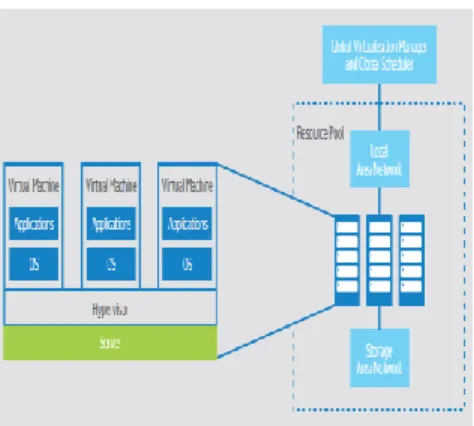
availability.Virtualization is managed by a host server running a hypervisor software firmware or hardware that creates and run virtual machine operating platform that executes the operating system for an application, virtualization also provides several key capabilities for cloud computing including resources sharing, isolation load balancing.
Figure 1 Cloud Computing Virtualization Virtualization has moved from reducing costs by consolidating data centers to increasing flexibility and agility through pervasive use of virtualization for faster service deployment and dynamic placement of workloads. Pervasive virtualization is a strategic approach that provides a method for judiciously bringing legacy applications into cloud to meet budget benefits lower energy consumption.
Section II
2. Related Work: System of Physical
machine supports a privileged domain 0 and each virtual machine performs applications as web server remote desktop and mail functions. Multiplexing of virtual machine is managed using the logic system implemented as a set of plug in node which collects the usage statistics of resources for each virtual machine on the node. CPU and
network usage can be monitoring the scheduling and memory usage within a virtual machine however is not visible to the hypervisor. Memory shortage of a virtual machine by observing its swap activities unfortunately the guest operating system is required is required to install a separate partition to adjust the memory allocation by the time swapping occurs. Physical machine forwarded to the virtual machine scheduler runs and is invoked periodically and receives from the resource demand history of virtual machine the capacity and the load history of physical machine and the current layout of virtual machine on physical machine. Predictor future resource demands of virtual machine and load of physical machine based on past statistics compute the load of a physical machine by aggregating the resource usage of its virtual machine. The spot solver in our virtual machine scheduler detects if the resource utilization of any physical machine the hot threshold some virtual machine running on them will be migrated away to reduce their load. Cloud spot solver checks if the average utilization of actively used physical machine is a green computing threshold physical machine potentially be turned off to save energy identifies the set of physical machine whose utilization is cloud threshold which attempt to migrate virtual machine.
Virtual machine is used for dynamic resource allocation in virtualized combines multi-dimensional load information into a single, virtual machine and data migration to mitigate hot sports not just on the servers but also on network devices and the storage nodes as well. Extended vector product as an indicator of imbalance in resource utilization load balancing is a variant of the method for multi-dimensional knapsack problem system does not support green computing and load prediction dynamic placement of virtual servers to minimize bin packing problem
and use the well-known first fit approximation to calculate the virtual machine to physical machine periodically. Section III
3. Problem Definition: Virtualization is
probably the beneficial factor of the cloud enterprise level resource allocation and consumption can be performed within reduced time and cost virtualization has some operational risks which may lead to detrimental consequences for the huge data centers and information infrastructures. The environment of virtualization may face vulnerabilities of system and application based threats because of the multi-level centralized architecture beyond pragmatic enterprise information technology and uses the pooled resources on-demand without acquiring any resource. Hypervisor based cloud communication is prone to security breaches because of the limitations of the physical infrastructure consists of transit based architecture in whole cloud channel may be compromised security vulnerability in the information servers and physical layered architecture. Possible solutions this problem is encryption of hypervisor log files all the data transfer must be examined using the monitor control procedure calls we propose a green computing.
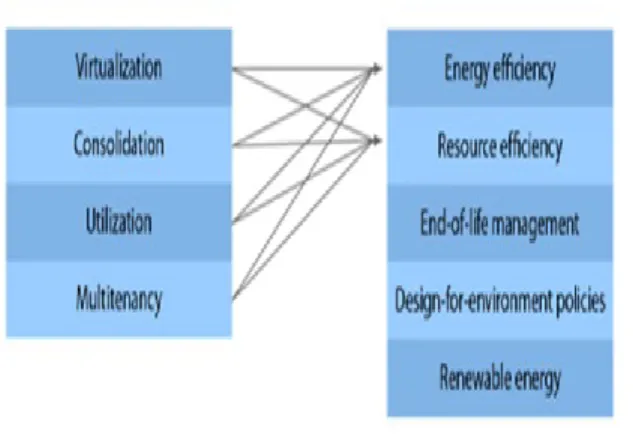
Virtualization is a technology for deploying cloud based infrastructure that allows single physical server to run multiple operating system images from a resource efficiency perspective less equipment is needed to run workloads proactively reduces data center space and the eventual foot print. Presence of virtualization alone doesn’t maximize energy and resource efficiencies rapidly provision move scale workloads cloud based infrastructure relies on automation software. Pay-as-you nature of cloud based infrastructure encourages users to only consume what they need and nothing
more combined with self-service lifecycle management will improve users can consume infrastructure resources when they need it.Multitenancy allows many different organizations or business units within the same organization to benefit from a common cloud based infrastructure combining demand patterns across many organizations and business unit’s peaks troughs of compute requirements flatten out.
Figure 2 Shows the Benefits of Virtualization Green Computing
Cloud providers are going to position services as green must invest in renewable energy sources really the most energy efficient data center can have a significant footprint because they get 70 percent of electricity from green.
The concept of Skewness to quantify the unevenness in the utilization of multiple resources on a server n is the number of resources and rithe utilization of the i-th resource the resource skewness of a server p as
Here r is the average utilization of all resources for server p not all types of resources are performance critical consider bottleneck resource in calculation. Skewness workloads and improve the overall utilization of server resources. Or green computing is invoked when the average utilization of all resources on active servers are below the green computing threshold cold spots in the system based on the ascending order of their memory size.
Section IV
4.1.Cloud Computing:Cloud computing refers to applications and services offered over the Internet. These services are offered from data centers all over the world, which collectively are referred to as the "cloud." Cloud computing is a movement away from applications needing to be installed on an individual's computer towards the applications being hosted online. Cloud resources are usually not only shared by multiple users but as well as dynamically re-allocated as per demand. This can work for allocating resources to users in different time zones.
4.2. Resource Management:Dynamic resource management has become an active area of research in the Cloud Computing paradigm. Cost of resources varies significantly depending on configuration for using them. Hence efficient management of resources is of prime interest to both Cloud Providers and Cloud Users. The success of any cloud management software critically de-pends on the flexibility; scale and efficiency with which it can utilize the underlying hardware resources while pro-viding necessary performance isolation. Successful resource management solution for cloud environments needs to provide a rich set of resource controls for better isolation, while doing initial placement and
load balancing for efficient utilization of underlying resources.
4.3. Virtualization: Virtualization, in computing, is the creation of a virtual Version of something, such as a hardware platform, operating system, and a storage device or network resources.VM live migration is a widely used technique for dynamic resource allocation in a virtualized environment. The process of running two or more logical computer system so on one set of physical hardware.
4.4. Green Computing: Many efforts have been made to curtail energy consumption. Hardware based approaches include novel thermal design for lower cooling power, or adopting power-proportional and low-power hardware. Dynamic Voltage and Frequency Scaling to adjust CPU power according to its load in data centers. Our work belongs to the category of pure-software low-cost Solutions. It requires that the desktop is virtualized with shared storage. Green computing ensures end user satisfaction, regulatory compliance, telecommuting, virtualization of server resources.
Section V
5. Comparative Study: Virtual machine monitors such as Xen provide a mechanism for mapping virtual machines (VMs) to physical resources. This mapping is largely hidden from the cloud users. Users with the Amazon EC2 service, for example, do not know where their VM instances run. It is up to the cloud provider to make sure the underlying physical machines (PMs) have sufficient resources to meet their needs. VM live migration technology makes it possible to change the mapping between VMs and PMs while applications are running. Compare to previous workthe automated
resource management system that overload avoidance is the capacity of a physical machine should be sufficient to satisfy the resource needs of all virtual machine running on it. Otherwise, the physical machine is overloaded and can lead to degraded performance of its virtual machine. Green computing is the number of PMs used should be minimized as long as they can still satisfy the needs of all VMs. Idle PMs can be turned off to save energy. Advantage of that system maintains resource allocation system that can avoid overload in the system effectively while minimizing the number of servers used. The concept of “skewness” to measure the uneven utilization of a server by minimizing skewness, we can improve the overall utilization of servers in the face of multi-dimensional resource constraints. The analysis a group of 30 PowerEdge blade servers with intel E5620 CPU and 24GB of RAM servers run Xen 3.3 and Linux 2.6.18 periodically read load statistics using the library different shades of each virtual machine are configured with 128 MB of RAM an apache server runs on each virtual machine to invoke CPU intensive PHP scripts on the Apache server allows us to subject the virtual machine to different degree of CPU load by adjusting the client request rates.
CONCLUSION VI
Environment of cloud computing explored the concept of green cloud computing and general deployment of virtualization, our work analysis shows the virtual machine authenticate and trust the policy enforcement into the system mechanism for multiple pool system. Multiplex virtual to physical resources adaptively based on change demand and skewness combines the different virtual machine so the capacity of servers are
utilized to avoid overload green computing for multiple resources.
Reference
[1]The NIST Definition of Cloud Computing. U.S. Department of Commerce, National Institute of Standards and Technology Special Publication 800-145 (September 2011).
[2] G. Chen, H. Wenbo, J. Liu, S. Nath, L. Rigas, L. Xiao, andF. Zhao, “Energy-aware server provisioning and load dispatchingfor connection-intensive internet services,” in Proc. of the USENIXSymposium on Networked Systems Design and Implementation(NSDI’08), Apr. 2008. [3] P. Padala, K.-Y.Hou, K. G. Shin, X. Zhu, M. Uysal, Z. Wang,S. Singhal, and A. Merchant, “Automated control of multiple virtualizedresources,” in Proc. of the ACM European conference on Computersystems (EuroSys’09), 2009.
[4] N. Bobroff, A. Kochut, and K. Beaty, “Dynamic placement of virtualmachines for managing sla violations,” in Proc. of the IFIP/IEEEInternational Symposium on Integrated Network Management (IM’07),2007.
K. Roja
Rani M.Tech, CSE Dept., Institute of Aeronautical Engineering,HYD-500043,TS,India.
Dr. N. Chandra Sekhar Reddy Professor, CSE Dept., Institute of Aeronautical Engineering, HYD-500043,TS, India.