Abstract— As global warming and climate change issues are
defying modern society sustainable development; biofuels, biodiesel included, are among promising solutions. Biodiesel is generally produced from renewable vegetable oils and animal fats via acid or base catalyzed transesterification. Depending on regional availability, biodiesel production feedstocks vary from vegetable oils such as rapeseed oil, soya oil, palm oil, and jatropha oil, to used cooking oil and animal fats, with each type of feedstock presenting its own process challenges rooting from its chemical composition. The blends of palm bio diesel used in the test were B0(pure diesel), B15, B25. The engine performance was calculated through torque, power, and specific fuel consumption, while the emission were calculated through carbon monoxide (CO), hydrocarbon (HC), carbon dioxide (CO2), and oxides of nitrogen (NOx) pollutants. The result shows that higher content of palm biodiesel can reduce the emission of CO, HC, PM, and CO2. The optimal reaction conditions during esterification are: 2.3% weight of catalyst, reaction time of 120 min and a reaction temperature of 60 ̊C. Under these conditions, a 85% yield of biodiesel was obtained.
Index Terms—Palm oil biodiesel, Transesterification, carbon monoxide (CO), hydrocarbon (HC) and oxides of nitrogen (NOx)
I. INTRODUCTION
Biodiesel is a biofuel obtained from the transesterification of vegetable oil or animal fat with a low molecular weight alcohol under the presence of a catalyst. The most used ones are sodium or potassium hydroxide due to their low cost and high efficiency [1]. Biodiesel may be used in pure form or mixed with diesel, as a total or partial substitute of diesel oil in internal combustion engines [2]. This offers various advantages over petro- diesel, i.e. it is biodegradable, it is obtained from renewable materials, it has a cleaner combustion due to its low contaminant emissions, it is non-toxic, and it provides a good lubrication of engine parts, among others. From the social point of view, biodiesel may produce socioeconomic benefits, i.e. added value to raw material, generation of rural jobs and employments for the manufacturing and distribution of biodiesel. Palm oil (Elaeis guineensis) has recently become a main feedstock for biodiesel production. There is a need to assist and compare the technical, environmental and economic efficiency of biodiesel feedstock production. The model of biodiesel
production is divided into 3 stages: palm oil farming, palm oil production and transesterification into biodiesel. However the cost of biodiesel could certainly be lowered by improving the production process.
II. MATERIALSANDMETHOD
A. Materials
Ethyl alcohol, sodium hydroxide was purchased from Biochemical laboratory, Chennai. Fresh fruit palm crude oil was purchased.
B. Transesterification of crude palm oil
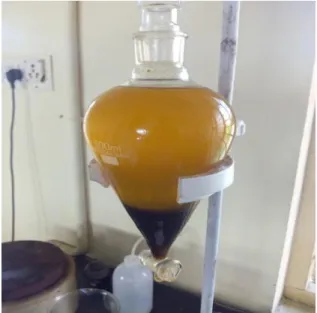
Palm oil is well-known vegetable oil feedstock to produce biodiesel through the transesterification process. Transesterification is a process by which triglycerides (vegetable oil) react with an alcohol (ethanol) to form fatty acid ethyl esters and glycerol . The esters derived from vegetable oils are very similar to petro-diesel in terms of cetane number, viscosity, and energy content , thus aptly named as „biodiesel‟. Amongst different types of vegetable oils, palm oil holds significant potentials in meeting energy demands owing to its high yield[6]. In transesterification the base catalyst sodium hydroxide pellet of 5 grams are weigh and kept in atmospheric temperature for 24 hours, then the liquid NaOH mixed with 100ml of ethyl alcohol which is added with the boiling crude palm oil between 50-60 °C.
Figure (1) Crude palm oil boiling
Allen Jeffrey.J1,Joseph Kingston2,Dejoe Denny.V3,Ajith Jose.A4,Ajith Kumar.V5 1
Assistant Professor Department of Mechanical Engineering Loyola Institute of Technology 2,3,4,5
UG student Department of Mechanical Engineering Loyola Institute of Technology
Effectiveness of Palm Oil Biodiesel on
Performance and Emission Characteristics in a
Compression Ignition Engine
547
All Rights Reserved © 2017 IJSETR
Figure (2) Glycerol separation
Figure (3) Palm biodiesel
Figure (4) Separated glycerol
Table 1:Comparison of physical properties of Palm Oil Vs Conventional Diesel
III. EXPERIMENTALSETUP
The survey carried out on the performance of a diesel engine using palm biodiesel in a single cylinder four stroke air cooled engine. The specifications of the engine used for the test are given below.
Table 2 Engine specification
Engine Kriloskar TAF 1
Type Four stroke air cooled engine
No. of cylinder Single cylinder
Rated power 4.4 KW
Injection pressure 200 bar
Rated speed 1500 rpm
Compression ratio 17:5:1
Injection timing 23btdca
Bore diameter 87.5mm
Stroke 110mm
a-Before top dead center
Palm oil biodiesel produced from the crude palm oil by transesterification we get palm oil biodiesel with conversion of 88% of palm bio oil and rest of glycerol
Parameters Palm oil fuel Diesel Unit Flash point 92 52 ▫C Fire point 102 96 ▫C Calculated cetane index 31 Gross calorific value 8718 44800 Kcal/kg
Cloud point Below minus 10 Below minus 40 ▫C Density at 15▫C 0.9125 0.851 gm/ml Kinematic viscosity at 40▫C 17.07 - cst Carbon content 1.67 - %
The biodiesel testing was done in a Kriloskar TAF engine with rated power of 4.4kw and an injection pressure of 200 bar, compression ratio of 17.5:1 and a standard injection timing of 23 ⁰ C
A PEFORMANCE CHARACTERSTICS
Break thermal efficiency
Figure (5) Variation of BTE with Break power
Break thermal efficiency is defined as the power developed by combustion of fuel in the engine cylinder. Therefore, the difference between ip and bp indicates the power loss in the mechanical components of engine (due to friction). So the mechanical efficiency is defined as ratio of brake power to the indicated power .The variation in brake thermal efficiency with respect to output power at different loads for conventional diesel and palm oil biodiesel blends is shown in the figure(5).
Specific fuel consumption
The figure (6) shows the specific fuel consumption for conventional diesel and palm oil biodiesel blends at different loading condition, where there is lowest specific fuel consumption in conventional diesel when compared with palm oil biodiesel blends. Brake specific fuel consumption (BSFC) is a measure of the fuel efficiency of any prime mover that burns fuel and produces rotational, or shaft, power. It is typically used for comparing the efficiency of internal combustion engines with a shaft output. It is the rate of fuel consumption divided by the power produced. The main reason for rise in specific fuel consumption is that the heating value reduces when blend increases.
Figure (6) Variation of SFC with Break power
B EMISSION CHARACTERSTICS
CO Emission
Figure (7) Variation of Carbon monoxide emission with load
Carbon monoxide (CO) is a colorless, odorless, tasteless,
and toxic air pollutant is produced in the incomplete combustion of carbon-containing fuels, such as gasoline, natural gas, oil, coal, and wood. The variation in Carbon monoxide emission for diesel and palm oil biodiesel at different loads are shown in figure (7). Thus the graph says that as the load increases the CO emission in parts per million will be reduced and it prove that as the biodiesel blends exhaust produce less CO emission than conventional diesel. 0 5 10 15 20 25 30 35 0 2 4 6 B TE ℅ BREAK POWER (KW) Diesel P-15 P-25 0 0.5 1 1.5 2 2.5 3 3.5 4 4.5 0 2 4 6 B SF C Kg/KWh r BREAK POWER (KW) Diesel P-15 P-25 0 0.02 0.04 0.06 0.08 0.1 0.12 0 50 100 150 C A R B O N M O N O X ID E(P P M ) LOAD ℅ Diesel P-15 P-25
549
All Rights Reserved © 2017 IJSETR
HC Emissions
Figure (8) Variation of Hydro carbon emission with load
Hydrocarbon is an organic compound consisting entirely of hydrogen and carbon. Hydrocarbon (HC) emissions are almost always a sign of poor fuel ignition as like carbon monoxide emission. It also occurs while rich fuel mixture and improper combustion. The figure (8) shows the Hydro carbon emissions for conventional diesel and palm oil biodiesel. The Hydro carbon emission is lesser in biodiesel due to more amount of oxygen content.
NOx Emissions
Nitrogen oxides are a group of gases that are composed of nitrogen and oxygen. Nitrogen oxides are released into the air from motor vehicle exhaust or the burning of coal, oil, diesel fuel, and natural gas. Nitrogen Oxides are a family of poisonous, highly reactive gases. These gases form when fuel is burned at high temperatures. It cause due to the combustion temperature inside the engine increases a limit, nitrogen combines with oxygen to form nitrogen oxide NOx. Figure (9) shows that, there is an increase in NOx emission when using palm oil biodiesel compared to conventional diesel. The NOx emission from an engine depends on the maximum combustion temperature and the availability of oxygen.
Figure (9) Variation of Nitrogen oxide emission with load Oxygen content
Oxygen is a chemical element It is a member of the chalcogen group on the periodic table and is a highly reactive nonmetal and oxidizing agent that readily forms oxides with most elements as well as other compounds .The oxygen content in palm oil biodiesel is higher when compared with conventional diesel. Figure (9) shows the variation of oxygen content when using different biodiesel blends at different loads.
Figure (7) Variation of oxygen content with load. V. CONCLUSION
Palm oil was transesterified using NaOH as catalyst and ethanol to form biodiesel. The fuel properties like viscosity, density, flash point, fire point and calorific value of the the transesterified product (biodiesel) compared well with 0 5 10 15 20 25 30 35 0 50 100 150 H Y D R O C A R B O N (P P M ) LOAD ℅ Diesel P-15 P-25 0 200 400 600 800 1000 1200 1400 0 50 100 150 N IT R O G EN O X ID E (P P M ) LOAD ℅ Diesel P-15 P-25 0 2 4 6 8 10 12 14 16 18 20 0 50 100 150 O X Y G EN C O N TE N T % LOAD℅ Diesel P-15 P-25
standards[4]. The basic properties of palm oil biodiesel–diesel fuel blends were measured according to the corresponding Indian standards. High flash point and hence safe to transport and store , Oxygenated fuel and hence clean burning. Low viscosity and hence improved injection and atomization, Cetane number of esters is greater, Reduced emissions , Provides domestic, renewable energy.
ACKNOWLEDGMENT
The author would like to thank the Correspondent Rev Sister Arockia Mary, Principal Dr Sujatha Jamuna Anand Vice Principal Dr R.D Samuel and Head Of the Department Mechanical engineering Mr Nimal Swarna Ross of Loyola institute of technology Chennai and ETA LAB for their kind support and encouragement to carry out this project work
.
REFERENCES
[1] Eman N. Alia, Cadence Isis Taya Characterization of Biodiesel Produced from Palm Oil via Base Catalyzed Transesterification,
Procedia Engineering 53 ( 2013 ) 7 – 12
[2] yun hin taufiq-yap, nurul fitriyah ,abdullah & mahiran basri Biodiesel Production via Transesterification of Palm Oil, Using NaOH/Al2O3 Catalysts Sains Malaysiana 40(6)(2011): 587–594
[3] [3] Shuli Yan, Steven O. Salley, K.Y. Simon Ng thor's personal copy,
Simultaneous transesterification and esterification of unrefined or waste oils over ZnO-La2O3 catalysts Applied Catalysis A: General
353 (2009) 203–212
[4] Soni, Sisbudi, harsono, biodiesel department of agricultural engineering, faculty of agriculture. technology, university of
jember production from palm oil technology Research Journal of Agricultural Science, 43 (4), 2011
[5] Venkata Ramesh Mamilla1, M.V. Mallikarjun2 , Dr. G. Lakshmi
Narayana Rao3 biodiesel production from palm oil by transesterification method International Journal of Current Research Vol. 4, Issue 08, pp. 083-088. August, 2012
[6] [6] Jundika C. Kurnia , Sachin V. Jangam, Saad Akhtar , Agus P. Sasmito , Arun S. Mujumdar Advances in biofuel production from oil palm and palm oil processing wastes: A review Biofuel Research
Journal 9 (2016) 332-346
[7] [Onochie Uche Paul Itoje Harrison John Itabor Ndubuisi Akhator Peter Ojariafe Godspower Calorific Value of Palm Oil Residues for Energy Utilisation International Journal of Engineering Innovation &
ResearchVolume 4, Issue 4, ISSN: 2277 – 5668
J.Allen Jeffrey Assistant Professor Department of Mechanical Engineering Loyola institute of technology Chennai
J.Joseph Kingston Final year student Department
of Mechanical
Engineering Loyola
institute of technology Chennai.
.
Dejoe denny Final year
student Department of Mechanical Engineering
Loyola institute of
technology Chennai.
A.Ajith jose Final year student Department of Mechanical Engineering
Loyola institute of
technology Chennai.
Ajith kumar.V Final year student Department of Mechanical Engineering
Loyola institute of