Recognising and Interpreting Named Temporal Expressions
Matteo Brucato University of Bologna
Leon Derczynski University of Sheffield
Hector Llorens Nuance Communications
Kalina Bontcheva University of Sheffield
Christian S. Jensen Aarhus University
Abstract
This paper introduces a new class of tem-poral expression – named temtem-poral ex-pressions – and methods for recognis-ing and interpretrecognis-ing its members. The commonest temporal expressions typically contain date and time words, likeAprilor hours. Research into recognising and in-terpreting these typical expressions is ma-ture in many languages. However, there is a class of expressions that are less typical, very varied, and difficult to automatically interpret. These indicate dates and times, but are harder to detect because they of-ten do not contain time words and are not used frequently enough to appear in con-ventional temporally-annotated corpora – for example Michaelmas or Vasant Pan-chami.
Using Wikipedia and linked data, we auto-matically construct a resource of English named temporal expressions, and use it to extract training examples from a large corpus. These examples are then used to train and evaluate a named temporal ex-pression recogniser. We also introduce and evaluate rules for automatically interpret-ing these expressions, and we observe that use of the rules improves temporal annota-tion performance over existing corpora.
1 Introduction
The ability to express time in language is critical. We require this ability in order to communicate plans, to tell stories, and to describe change in the world around us.
Phrases that explicitly describe certain periods of time, ortemporal expressions, are particularly useful. They may be calendar dates, mentions of months, relative expressions like“tomorrow”, and so on. In-depth accounts of temporal expres-sions –timexes– are given by Ferro et al. (2005) and Llorens et al. (2012a).
In this paper, we discuss a new class of timexes that signify a date or range of dates, but that do not explicitly include information about which dates these are (e.g., October 31 vs. Halloween). Fol-lowing the description of expressions that clearly identify one entity from a set of others by use of a proper noun as named entities, we call these named temporal expressions(orNTEs).
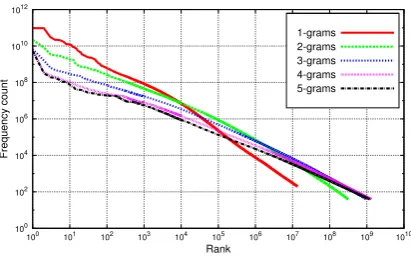
As with many linguistic phenomena, the phrases used as timexes have a power law-like fre-quency distribution in text. A few forms of ex-pression make up for the bulk of occurrences of temporal expressions. However, existing research has been typically evaluated on only a small cor-pus of hand-annotated temporal expressions. With such resources, it is difficult to build or evalu-ate tools for recognising or interpreting the less-frequent temporal expressions, and this is reflected in the performance plateau of recent TempEval ex-ercises (Verhagen et al., 2010; UzZaman et al., 2013).
Existing temporal expression recognition tools are typically rule-based (Str¨otgen and Gertz, 2010). These perform reasonably well on exist-ing datasets, achievexist-ing F-scores of around 0.90, and improving them is an active area of research. However, as temporal annotation is expensive, existing datasets are not particularly large, and therefore do not contain as challenging a variety of forms of expression as general, unannotated text. Therefore, evaluations using these resources
Figure 3: Holidays from a country (Bangladesh), as shown on a Wikipedia page
one might expect to see from a very small corpus. Namely, some of the more common expressions are found, in relatively high frequency (the initial shallow curve). The remaining expressions found in the small sample that this corpus represents are much rarer, as shown by the sharp drop at the low-frequency end of the curve.
This suggests that existing TimeML corpora are so small that they do not include a sufficiently di-verse selection of these terms. Indeed, TimeBank has only around 65K tokens. To build and evaluate approaches for recognising NTEs, a new source of data is required.
4 Automatic Named Timex Recognition
Having described named timexes, we build a named timex resource taking a re-usable, low-supervision approach, and then construct a tool for automatic named timex discovery.
4.1 Mining Existing Named Timexes
Current TIMEX3-annotated resources do not ac-count for a representatively broad set of temporal expressions (Figure 2). To supplement these re-sources, we automatically mined named temporal expressions from Wikipedia.
We started by identifying collections of these terms, for example on pages listing public holi-days. The selection criterion was that the page be in English and have a reasonable number of NTE descriptions, marked up in a wiki table (e.g., Fig-ure 3). The pages used are listed in FigFig-ure 4. We
en.wikipedia.org/wiki/...
Federal_holidays_in_the_United_States Public_and_Bank_holidays_in_Scotland Public_holidays_in_Australia
Public_holidays_in_Canada Public_holidays_in_Denmark Public_holidays_in_France Public_holidays_in_Germany Public_holidays_in_Hong_Kong Public_holidays_in_India Public_holidays_in_Italy Public_holidays_in_Malaysia Public_holidays_in_South_Africa Public_holidays_in_the_European_Union Public_holidays_in_the_United_Kingdom Public_holidays_in_the_United_States
Figure 4: URLs from which source NTE descriptions were extracted
Official name Date
Columbus Day Second Monday in October Veterans Day November 11
Thanksgiving Day Fourth Thursday in November Christmas December 25
Table 1: Sample Wikipedia events and interpretations
then automatically extracted the terms and their textual descriptions from these collections. An ex-ample extract is given in Table 1.
This data was supplemented using the holiday terms given in JollyDay, a Java date-handling li-brary.1 In total, we found 247 unique terms from 15 manually-selected Wikipedia pages, and 239 from JollyDay (containing an overlap of 54), for a total of 432 named timexes.
The resulting list of candidate named tempo-ral expressions contained two types of anomaly. It contained some conventional temporal expres-sions (e.g., August) which should be removed; these were filtered out using HeidelTime, a rule-engineered timex system. It also contained poly-semous named timexes, that were not only used in a temporal sense. For example,Carnivalis both a specific festival, a tour operator, and a polysemous common noun indicating a period of revelry or an exciting mixture of something.
4.2 Disambiguating NTEs with Linked Data
Following Shaw et al. (2009), we used linked open data to handle ambiguous temporal entities. We discriminated monosemous timexes (e.g., Refor-mation Day) from polysemous ones (e.g., Easter,
1
which may be both a holiday and part of a com-pound noun referring to e.g. a chocolate egg) via DBpedia (Bizer et al., 2009), looking for entities with matching names.
After discarding URIs of media that were in film and song titles, NTEs that still had more than one remaining corresponding entity URI were identified as polysemous. The final set comprised 424 expressions, of which 342 were monosemous and 82 were polysemous.
4.3 Recognising Named Timexes in Text
Having built a collection of named temporal ex-pressions, we moved on to the task of NTE discov-ery. Our approach was to first develop a statistical tagger adapted to NTE recognition, and then ap-ply it to new data, to observe what expressions it annotates beyond those in the collection extracted from Wikipedia.
The collection was used to construct a cor-pus and then a statistical named temporal expres-sion recogniser. The corpus was constructed as follows. Using our list of monosemous named timexes, we searched the Gigaword corpus to re-trieve paragraphs containing the timexes. These paragraphs were split into sentences (Kiss and Strunk, 2006), and the sentences matching any NTE were extracted; the sentences were then bro-ken down into lists of tobro-kens. We marked all monosemous named timexes in the sentences as target entities.
Some NTEs are polysemous, having both tem-poral and non-temtem-poral sense. Observation of a small part of the corpus suggested that these pol-ysemous NTEs generally occurred in a temporal sense when in the same sentence as other tempo-ral phrases. Rather than excluding any sentence containing a polysemous NTE from the corpus on grounds of ambiguity, based on this observation, we adopted a simple heuristic: polysemous NTEs are included if they are collocated with a monose-mous NTE. This reduced the considered set of pol-ysemous NTEs by 22 to 60, for a total of 402 unique expressions.
Tokens in each sentence were then labelled ac-cording to a simple in-entity/out-of-entity binary format. The sentences were then split into training and evaluation sets, with no named temporal ex-pressions found in both groups, i.e., every NTE is exclusively in either one or the other set.
In total, 3 861 sentences (117 060 tokens) were
System Recall Precision F1
strict
Gazetteer baseline 5.6% 15.2% 8.2%
TIPSem 56.5% 71.7% 63.2%
TIPSem-B 56.6% 75.5% 64.7%
Stanford NER 56.7% 74.2% 64.3% lenient
Gazetteer baseline 6.8% 19.4% 10.1%
TIPSem 75.8% 97.3% 85.9%
TIPSem-B 71.4% 95.0% 81.5%
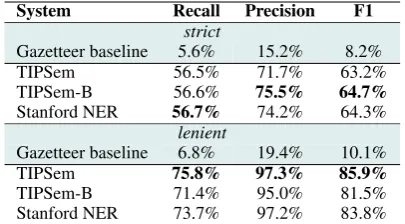
Stanford NER 73.7% 97.2% 83.8% Table 2: Sample Wikipedia events and interpretations. Le-nient matches includes annotations that at least overlap with the reference.
extracted from English Gigaword v5 (Graff et al., 2003), containing 4 180 named timex annotations. The training split contained 1 053 of these sen-tences. The entire corpus construction method re-quires no human intervention aside from supply-ing source Wikipedia pages.
Regarding the NTE recognisers, we adapted three entity recognition approaches to the task by discarding their default models and rebuild-ing new models based solely on this NTE corpus. The recognition tools were CRF-based: a multi-purpose system incorporating non-local informa-tion, Stanford NER (Finkel et al., 2005); one for temporal entity recognition that uses semantic role information, TIPSem (Llorens et al., 2012b); and TIPSem-B, a baseline temporal entity recognition variant of TIPSem.
Recognisers were learned from the training split and evaluated on the test split. As we are attempt-ing to recognise named timexes only, we do not do comparison against tools designed for standard timex recognition, as these are designed for a dif-ferent task.
A na¨ıve gazetteer-matching baseline was used, based on timex strings found in existing resources (TimeBank and the AQUAINT TimeML annota-tions). This behaved exactly as a direct case-insensitive word look-up, matching any whole phrases found within the corpus. Its recall should tell us how broad the range of temporal expres-sions found in prior TimeML resources is. Evalu-ation was performed using GATE (Cunningham et al., 2013); results are reported in Table 2.
Recogniser % of query texts % of queries
HeidelTime 2.90 1.97
NTE gazetteer 0.06 0.14
Table 3: Temporal intent indicator prevalence in a web search query log
approaches do not identify too many non-timexes as being timexes, further work is called for at im-proving the range of named timexes they recog-nise. In particular, the temporal expressions used in the TimeBank and AQUAINT corpora have a very small overlap with the named temporal ex-pressions we identified.
4.4 Finding New NTEs
With a system that is capable of recognising named temporal expressions in our test data, which contains previously-unseen NTEs, it may be possible to discover new NTEs. Unlabelled text can be labelled using statistical NTE recognisers. One may have concerns over using a system with strict recognition precision in the 70s for this pur-pose; however, lenient recognition precision is in the mid- to high-90s, which indicates that the neg-ative impact of spurious annotations will be low.
We attempted to find new NTEs by applying the TIPSem model to another portion of the Gigaword text. Sample results include phrases such as:
• European Cup
• Hamlet Cup
• bank holiday
• Dayton peace agreement
Although these are difficult to evaluate directly, they can readily applied in semi-supervised ap-proaches to temporal annotation, e.g., in part of a bootstrapping approach to NTE recognition and general timex recognition.
5 Temporal Intent Queries
This section contains a brief investigation of named temporal expressions (and general tempo-ral expression recognition) in information retrieval query interpretation.
In classical information retrieval with a textual query over a document collection, the query repre-sents the lexicalisation of a searcher’s information need. To identify a temporal information need, one must recognise signals in the query that reflect
this (Jones and Diaz, 2007; Metzler et al., 2009). Detecting temporal intent in queries may benefit from linguistic approaches to query understanding and decomposition (Campos et al., 2012).
Beyond common formulations of timexes, this is a challenging problem in two regards. As we have already explained, certain forms of tempo-ral expression are not recognised by existing tools. Also, event-related queries (e.g.,“stock market re-action to michael jackson’s death”) signify tempo-ral intent but may not contain any tempotempo-ral expres-sions at all. While the second class is not covered here, we do address the first.
We are interested in the proportion of tempo-ral intent search queries that can be captured with awareness of named temporal expressions. Our method is to examine existing records of text ques-tions and search engine queries, similar to the ap-proach of Nunes et al. (2008). We used 1 200 000 randomly sampled query strings from the AOL search log (Pass et al., 2006) as a corpus. This cor-pus comprises 167 794 unique terse query strings. We ran HeidelTime (Str¨otgen and Gertz, 2010) over this corpus. We also computed the intersec-tion of query texts with our mined named timexes. Results are given in Table 3.
While temporal expressions in general are no-tably frequent in the data, it can be seen that only a relatively small proportion of queries con-tain named temporal expressions (0.14%). Named temporal expressions are not dominant in queries from this corpus. Indeed, while the data suggests that general temporal expressions are in the long tail (as the proportion of timexes recognised in unique queries is greater than that in all queries), the inverse is true for named temporal expressions. Examining the data, only a few variants of NTE occur in the query log.
6 Temporal Expression Interpretation
Once one has recognised that a particular expres-sion is used in a temporal sense, the next step is to interpret the expression. This may entail anchor-ing it to a calendar or other formal representation. We consider the task of interpreting timexes to the TimeML/TIMEX3 standard (Ferro et al., 2005). This produces normalised values from timexes, as shown below.
(1) January 2nd, 1980→1980-01-02 Summer 2012→2012-SU
id expression interpretation -- ---
---92 Autumn_Holiday DATE_WEEK_WEEKNUM(DCT, -1, Monday ,TO_MONTH("September")) 178 Liberation_Day DATE_MONTH_DAY(DCT, TO_MONTH("April"), TO_DAY("25")) 179 Republic_Day DATE_MONTH_DAY(DCT, TO_MONTH("June"), TO_DAY("2")) 180 Ferragosto DATE_MONTH_DAY(DCT, TO_MONTH("August"), TO_DAY("15"))
Figure 5: Example named timex rules in TIMEN
Discovering such interpretations is a difficult task. For example, based on text, it is difficult to automatically learn or infer the link between “New Year’s Day”and 1st January, or the associ-ations between north/south hemisphere and which months fall in summer, especially given the cost of temporal annotation and resulting scarcity of an-notated resources. This often leaves the task of developing such interpretations to human compu-tation (Sabou et al., 2012). The closest computa-tional method for solving this problem uses a more flexible compositional approach to timex interpre-tation (Angeli et al., 2012), though it is prone to floundering and failing on completely new expres-sions, such as named timexes.
As the named timexes mined from Wikipedia were generally accompanied by a textual descrip-tion of the time (e.g., as in Figure 3), we used these descriptions to work out how to interpret the ex-pression. We created a custom parser that worked well with the majority of uncurated, natural lan-guage descriptions of named timex dates. Having gathered information from Wikipedia, we then en-coded it as rules in a popular timex interpretation system, TIMEN (Llorens et al., 2012a).
TIMEN operates using expression capture rules over a language-specific knowledge base that con-tains information on temporal primitives such as weekday and month names. Rules chosen for nor-malisation are those that match the timex’s pattern, in order of priority, highest first. If a rule has con-ditions, it can only be applied if the timex satis-fies them. Matched rules operate on a priority and constraint-satisfaction basis.
The rules in TIMEN allow the linking of contextual temporal information not explicit in the expression (such as document creation year) with time information in the expression. This expression-based information is often qualitative (i.e., text), and so TIMEN also includes rules for rendering it quantitative. For example, there are built-in functions that convert language-specific terms such as Monday, lunes or the second into quantitative offsets that operate over an internal knowledge base provided for that language. The
Corpus TIMEN Augmented ER
TempEval-3 69.6% 69.8% 0.7% TimenEval 68.0% 69.4% 4.3%
Table 4: Timex interpretation accuracy with and without rules mined from Wikipedia. ER is Error Reduction
result is a numeric representation of the tempo-ral expression. This representation can be under-specified. For example, in the scope of NTEs, of-ten the year is not mentioned, as it is document-dependent. As a result, the TIMEN rules for han-dling NTEs often do not declare any information about years, leaving this to TIMEN’s management of reference time (Reichenbach, 1947).
Example rules for NTEs are shown in Figure 5. In total, we successfully extracted interpretation rules for 298 of the previously-identified named timexes (70.3% of the NTEs in our inventory).
To evaluate this approach, we did timex in-terpretation only, using reference annotations of timex bounds. We ran the standard and aug-mented TIMEN over recent existing corpora (the TempEval-3 corpus and the TIMEN test data);results are in Table 4. The additional rules improved TIMEN’s ability to interpret named timexes. The error reduction figures demonstrate that improvements can be achieved by accounting for these timexes.
Note the small improvement over the small TempEval-3 corpus (0.7%); upon examination, we found that this newswire corpus’ content not only contained few named timexes, but in fact seemed to take pains to avoid mentioning festivals, possi-bly as part of areligious journalist guidelines.
7 Discussion
While recognising and interpreting named timexes is useful in many scenarios, and while it is possible to perform this task automatically, we encountered some interesting problems during our work.
Spatial Variations: Many expressions are in-terpreted differently depending on the locale. For example, Labor Day is May 1 in much of the world, but is the first Monday in May in parts of Australia (Queensland and the Northern Ter-ritories) and the first Monday in September in the USA. While TIMEN can process variations in named timex interpretation over time (e.g., Wash-ington Dayis February 22 until 1971, after which it falls on the third Monday in February), this locale-based information is not always available and is not considered for the interpretation task. This may be possible as a future extension: sepa-rate modules can assess the origin or subject locale of the input text (based on, e.g., newswire lead-in, spelling variation, or location mentions, the last of which also requires spatial grounding or entity dis-ambiguation) and pass this region information to rules for normalising, e.g.,Summer.
Easter: Easter is difficult to interpret.2 Its time is based on locale, year, which equinox is to be used (astronomical vs. religious), and many other factors. Also, many other named timexes depend on Easter, such as Pentecost, Lent, and Pancake Day. Being able to use Easter as an offset in date calculus will improve the coverage of named timex interpretation. The liturgical origins of the named timexes associated with the date provide some indication of the frequency of texts associ-ated with named temporal expressions.
Multiple Calendars: Not all named timexes can be calculated with one calendar. When build-ing interpretation rules, demand for, e.g., lu-nar, astronomical, and Hebrew calendars emerges quickly. Even conventional dates require different calendars when one goes far back enough. A com-prehensive timex interpretation tool must account for multiple calendars (Urgun et al., 2007).
Forms of Expression: Finally, diversity of ex-pression may impair named timex recognition. The NTE Martin Luther King day, for example, may also be expressed as MLK day. In a suffi-ciently long text, one may use co-reference res-olution to link and resolve the two. A statistical
2
See https://en.wikipedia.org/wiki/Computus
approach like our named timex recogniser (Sec-tion 4.3) may help here.
8 Conclusion
In this paper, we have introduced a new class of entities: named temporal expressions. These are hard to deal with because they do not resemble conventional temporal expressions, they can be expressed in a wide range of ways, they occur in-frequently, and they cannot readily be interpreted to calendar dates.
8.1 Summary
We developed an approach for automatically ex-tracting these named temporal expressions from Wikipedia, and we developed a named temporal expression corpus using linked data. This then helped train classifiers for automatically recognis-ing (and thus discoverrecognis-ing) named temporal expres-sions, with reasonable success (64.7% F1 mea-sure). We also extracted interpretation rules for these expressions, allowing them to be converted to calendar dates, and used these to extend an existing state-of-the-art system. This augmented system had improved performance on existing temporally-annotated corpora.
8.2 Resources
The mined expressions and the annotated sen-tences extracted from Gigaword are made avail-able via an author’s website.3Further, the TIMEN rules for normalising named timexes are also re-leased, to be included in TIMEN.
8.3 Future Work
Building basic approaches to timex normalisation is no longer an interesting or useful task. Multi-ple actively-maintained, state-of-the art tools ad-dress this problem, achieving good performance. However, as with many natural language process-ing problems, diminishprocess-ing returns are beprocess-ing seen in the field. Therefore, next efforts must address the temporal expressions that we cannot yet al-ready detect and interpret.
It is of interest to consider the automatic extrac-tion of named timex resoluextrac-tion rules, perhaps us-ing the most important timexes (Str¨otgen et al., 2012) from articles describing the correspond-ing occasion. It is also relevant to merge our named timex corpus with existing timex corpora
3
S. Nunes, C. Ribeiro, and G. David. 2008. Use of
temporal expressions in web search. InAdvances in
Information Retrieval, pages 580–584. Springer.
G. Pass, A. Chowdhury, and C. Torgeson. 2006. A picture of search. InProceedings of the 1st Interna-tional Conference on Scalable Information Systems.
J. Pustejovsky, J. Castano, R. Ingria, R. Sauri, R. Gaizauskas, A. Setzer, G. Katz, and D. Radev. 2003. TimeML: Robust specification of event and
temporal expressions in text. New directions in
question answering, 3:28–34.
H. Reichenbach. 1947. The tenses of verbs. In
Ele-ments of Symbolic Logic. Dover Publications.
M. Sabou, K. Bontcheva, and A. Scharl. 2012. Crowd-sourcing research opportunities: lessons from natu-ral language processing. InProceedings of the 12th International Conference on Knowledge Manage-ment and Knowledge Technologies, page 17. ACM.
R. Shaw, R. Troncy, and L. Hardman. 2009. LODE:
Linking Open Descriptions of Events. In
Proceed-ings of the Asian Semantic Web Conference, volume LNCS 5926, pages 153–167. Springer.
M. Steedman. 2011. Romantics and revolutionaries.
Linguistic Issues in Language Technology, 6(11).
J. Str¨otgen and M. Gertz. 2010. HeidelTime: High quality rule-based extraction and normalization of
temporal expressions. In Proceedings of the 5th
International Workshop on Semantic Evaluation, pages 321–324. Association for Computational Lin-guistics.
J. Str¨otgen, O. Alonso, and M. Gertz. 2012. Identifi-cation of top relevant temporal expressions in
doc-uments. In Proceedings of the 2nd Temporal Web
Analytics Workshop, pages 33–40. ACM.
B. Urgun, C. E. Dyreson, R. T. Snodgrass, J. K. Miller, N. Kline, M. D. Soo, and C. S. Jensen. 2007.
In-tegrating multiple calendars usingτZAMAN.
Soft-ware: Practice and Experience, 37(3):267–308.
N. UzZaman, H. Llorens, L. Derczynski, M. Verhagen, J. F. Allen, and J. Pustejovsky. 2013. SemEval-2013 Task 1: TempEval-3: Evaluating Time Expressions,
Events, and Temporal Relations. InProceedings of
the 7th International Workshop on Semantic Evalu-ations.
M. Verhagen, R. Saur´ı, T. Caselli, and J. Pustejovsky.
2010. SemEval-2010 task 13: TempEval-2. In