GHULAM DASTGIR ALAM QASMI
Thesis presented for the Degree of Doctor of Philosophy
in the Faculty of Science of the University of London.
Experimental Atomic Physics.
University College London.
The differential electron capturp. probabilities were measured 0++ N 0+ + Ne+ and 0++ + He
---for the processes + e --. --- 0+ + He+
at impact energies of 1200 and 2600 eVe The mass analysed 0 ++ beam was injected into a single collision reaction region and scattered
+ d 0++· . t . t . d f t · f I
o
an lon ln enSl les measure as a unc lon 0 ang e. This angular data was reduced in terms of the differential electron capture probabilities as a function of impact parameter.The results are qualitatively compared with ~he theoretical
predictions of the semi-classical impact parameter treatment and those based on the pseudo-crossing of potential energy curves. The form of the oscillations in the 1200 eV data for the (O++,Ne) reaction is similar to those encountered in singly charged ion-atom collisions in the absence of curve crossing. However the oscillations in the 2600 eV
( ++ ++
impact energy data for 0 ,Ne) and the 1200 eV data for (0 ,He) indicate that curve crossing takes place.
CON TEN T S
Page
Abstract ii
Contents iii
CHAPTER I INTRODUCTION OF THE PRESENT WORK 1 CHAPTER II
Section 2.1
2.2
2.3
2.4
THEORY OF CHARGE TRANSFER
Introduction
General Mathematical formalism of the impact parameter treatment
Symmetric Resonance Process
Asymmetric charge transfer process
2.4.2 Behaviour of asymmetric charge transfer with
6
6
7
10
18
impact energy. The "Adiabatic Maximum Rule".
19
2.4.3
Approximate computations of the asymmetriccharge transfer cross-sections 21
2.4.4 Discussion of the results 26
2.5.1 Potential energy curves and their intersection 27
2.5.2 Landau-Zener formula 31
2.5.3
Charge transfer cross-sections fromLandau-Zener formula
34
2.5.4 Limitations of the Landau-Zener formula and recent calculations based on the impact parameter treatment
CHAPI'ER III EXPERIMENTAL STUDY OF CHARGE TRANSFER
Introduction
Thick and thin targets
3.3 The total charge collection method
45
46
3.4
Secondary Analysis Method51
3.5
Primary Beam Analysis Method52
3.5.1
Studies using thick target technique52
3.5.2
Primary beam .studies using thin targettechnique
56
3.5.3
Measurements of the Angular Distributions58
CHAPTER IV CONSTRUCTION AND OPERATION OF THE APPARATUS4.1
Introduction4.2.1
The Ion Source65
4.2.2
Principle and construction of the oscillatingelectron source
66
4.2.3
Power supply for the ion source68
4.2.4
Operating conditions for the ion source70
4.3.1
Magnetic Analysis72
4.3.2
Analysis Chamber74
4.3.3
Resolution of the instrument75
4.4.1
The Einzel Lens79
4.5.1
The Scattering Apparatus4.5.2
Angular Resolution4.6.1
The Particle counting system92
4.6.2
The continuous channel electron multiplier92
4.6.3
The counting system99
CHAPTER V
EXPEEIMENTAL MEASUREMENTS AND DISCUSSION OF THE RESULTS
5.1 Method of taking measurements
5.2
Relation betweenp
ande
5.3
Results and DiscussionACKNOWLEDGMENTS
REFERENCES
C HAP T E R I
INTRODUCTION TO
THE PRESENT WORK
The study of the charge transfer or electron capture process was stimul~ted because of the important role they play in geophysics, physics of the upper atmosphere, controlled fusioll reactions and the design of tandem accelerators. The reactions in which hydrogen atoms lose an electron are involved in the trapping of protons in the earths magnetic field and the lifetime of the trapped proton is determined by their cross-sections for electron capture. In controlled fusion research where the primary object is to create a hot plasma, the electron capture with the background gas acts as a heat sink and makes the
attainment of high temperatures extremely difficult. Similarly in tandem accelerators where the primary ion beam has a long path length to cover, the electron capture not only results in a considerable loss of the beam intensity but also mixes neutrals in the beam as an impurity. This process is therefore the subject of many experimental and theoretical investigations in many laboratories of the world. The experimental
studies are further motivated from an academic point of view by a need for data to which theoretical predictions could be compared.
+ 1 .1
callpd the symmetric reso~ance and
+ B+ +
AE
(energy defect) 1.2 called the asymmetric process. The energy dependence of the cross-sections for 1.1 is different from 1.2. In the former case, the cross-section for atomic ions increaE;es monotonically with the decrease of the impact energy whereas for the latter, the cros[;-section is in general very small at low impact energies, rises to a maximum and then decreases rapidly at higher energies. The maximum of the cross-section occurs atthe velocity v given in terms of MasseY's1a."Adiabatic Criterion" as m
v ,.." a
AE
m ,.."h
where a represents the range of interaction,
AE
the energy defect of the process and h the Plank's constant. Thus within the adiabatic region where v<
aA
Eh
the cross-sections are small for the asymmetric process. However there are a few exceptions to this rule, particularly the partial charge transfer process of the type
1.4
The Landau-Zener2,3iLformula has been aPI-,lied to a number of charge transfer processes of the type 1.2 in which pseudo-crossing of the potential energy curves eX1S S • . t
4a.
However, the formula was derived on very strong assumptioLs, some of which are rather unlikely to be fulfilled for real systems, In particular it was assumed that the interactions can only take place at the crossing point. Bates5a..
has shown that in fact the width of the zone around which transitions are likely is given bywhere
h (R)
nm H
¢
m dris the interaction matrix element between the initial state
¢
and n the final state¢ ,
H being the Hamiltonian.m If the interactions are
strong this width may be considerable and in some cases of the order of interaction range. Also recent calculations by Ellison and Borowitz
6a
based on equal exponential model and Bates, Stewart and Johnston' s7a.
calculEltions based on the numerical integration of the coupled equations of the two-state ap:proximation, show that for the systems for which pseudo-crossing of the potential energy curves exist, transitions can take place not only at the crossing point but also in the vicinity of the crossing point and contrary to the Landau-Zener theory the transition probability is an oscillating function of the impact parameter ofIt was, therefore, decided to study this transition probability as a functioL of the impact parameter experimentally. For such a study
8a.
an experiment based on the primary analysis method of Everhart was found to be most suitable, since the angular distribution of ions suffering electron capture lends information on the dependence of the electron capture probability on the impact parameter. At a fixed
scattering angle the impact parameter is a function of the impact energy and at fixed energy it is a function of the scattering angle.
The partial charge transfer reaction of the type
B - - A(n-1)+ +
for the multiply charged ions provides an interacting system in which there exists a pseudo-crossing of the potential energy curves at a calculable nuclear separation. The fast primary ions An+ and the
(n-1)+
electron capture product A have the same energy since in such a collision practically no energy is transferred. It is therefore, comparatively simple to separate the two charge states An + and
(n -1 ) + . tl 1 t t · 1
A Wl I an e ec ros atlc ana yser rather than to use the magnetic
analysis as used by Fedorenko et
a19~
If Nn + (e) and N(n-1)+ (8) are respectively the number of An + and A(n-1)+ scattered in the direction 9, then the electron capture
p (e)
=
N(e)(n-1)+
N(e)n+ + N(e)(n-1)+
Due to the fact that the theoretical calculations and the Landau-Zener formula apply mainly to S - S transitions, the choice of reactions under study were limited to
0++ + Ne
+and
1.6
The second chapter is mainly concerned with the theoretical
wory applicable to electron capture processes with special reference to the pseudo-crossing of the potential energy curves. The third chapter deals witt the experimental techniques for the study of electron capture processes. In the fourth chapter, the apparatus which was designed for the measurement of angular distributions of ions suffering electron capture is discussed in detail. The fifth chapter deals with the
experimental data and how it is expressed in terms of the transition probability and the impact paramEter, to render it suitable for
C HAP T E R II
THEORY OF CHARGE TRANSFER PROCESSES
2.1
INTRODUCTIOn
The electron capture or charge transfer process involves the transfer of an electron from the target to the projectile and can be classified into the following classes
A+ + A ~ A + A+ (symmetric resonance) A+ + B ~ A + B+ +
IE
(asymmetric)A2+ + B --+ A + B2+ +
IE
(double elp.ctron capture) An+ + B---..
/n-1 )+ + B + +IE
(partial charge transfer)where
IE
is the energy defect of the process. From the theoretical point of view, being many body problems these are as yet incapable of2.1 2.2
2.3
2.4
exact quantum mechanical solution except in the case of simpler systems such as p + H ---.. H + p.
In all other cases one has to resort to approximate methods which are then naturally valid only for a limited velocity range, different
approximations being applicabl p to different velocity ranges. For this reason the velocity region has been arbitrarily divided into three ranges to be callpd 'high', 'intermediate' and '101.-1'. According to Rapp and
Francis 1 the dividing line between low, intermediate and high velocity is taken as 10
5
cm/sec and 108 cm/sec. For velocities~108
cm/sec,where 2
e
<
1-the Born approximation has been successfully applied to a number of charge transfer processes e.g., McCarro12, Schiff
3 ,
Bransden4.
In the 10\11 and intermediate velocity range two methods have been employed, namely, the wave treatment in which both the electronic and molecular motions are described by the wave-functions, the scattered wave approximation being an example, and the impact parameter treatment where the nuclear motion is described by the classical orbits and the electronic motion by the quantum mechanical wave-functions. The impact parameter treatment is thus valid only when the de Broglie wavelength of the incident particle is sufftciently small so that the classical
trajectory of the particle is a good description of the wave packet motion. Because of its relative simplicity, this treatment has been extensively applied to the charge transfer processes. I t has been shO\VI1 by
Gurnee and Magee
5
that in the intermediate velocity range the impact parameter treatment is identical to the more rigorous wave treatment.The following section will therefore be concerned with the theory of the charge transfer in the intermediate velocity range studied in terms of the impact parameter treatment.
2.2 General Mathema-Lieal formalism of the impact parameter treatment. Consider the general charge transfer process
A+ + (B+ + e)
---.
(A+ + e) + B + +,E
205asymptotic states. The single valence electron can be either attached
to A+ or B+ and it is assumed that the total wave function
\V
whichrepresents the system (A+ + B+ + e) can be expanded as a linear combination
+ +
of the orbital wave-functions of the electron around A and B , thus
\V=
CACt) ¢ACrA) exp C- i EAt) + CBCt) ¢BCrB) exp (-i EBt) 2.6h
~where the CIS are the time dependent coefficients of the expansion,
¢A and ¢B are the atomic orbitals for the electron on nuclei A+ and B+;
r
A and rB the distances of the electron from A+ and B+. EA and EB
are the eigen energies. ¢A and ¢B satisfy the Schrgdinger equation
[<-
~m)
V
2 + vB(rbl-EB] ¢B " 02.7
If H is the total Hamiltonian of the system CA+ + B+ + e), then
lV
satisfies the SchrHdinger time dependent equation
where
H
= [ (-
2~
)V
2+ VA C r a) + VB C r b) ]
e
substituting 2.6 in 2.8 and making use of 2.7, we get
= i
11
-
dCB¢
B
exp C - iEBt)Alternatively multiplying by ¢A* and ¢B* and integrating over all space
two coupled differential equations in C
A and CB are obtained, which
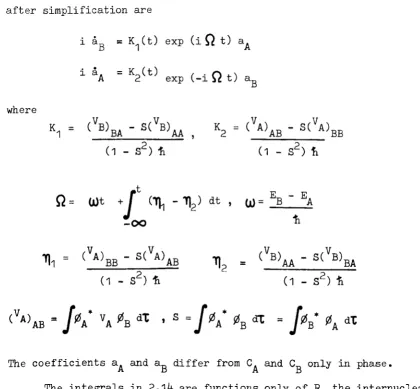
after simplification are
2.11
=
K2(t) exp
(-i
r"\ H t) a Bwhere
v
V
K2 = ( A)AB - S( A)BB
(1 - S2)
t
t
Wt +
J
(~-
11
2 ) dt ,-00
E - E
W=
B A11
2.13
"1
1 =V
V
( A)BB - S( A)AB
(1 - S2)
11
112
=
2.14
The coefficients a
A and aB differ from CA and CB only in phase.
The integrals in
2.14
are functions only of R, the internucle&r separation, and from the classical collisionA~
______
x~=~v~t____
~o____________ -.
p
8
trajectory x
=
vt of Fi5~re 2.1,are therefore, functions of time andthe impact parameter.
t
aA\2 and laB' 2 are respectively the probabilities+ +
of locating the electron on A and B at any particular time and since initially C t
=
-00 ), the electron is located on B+, we have the initial conditions ,(i) a
A( -(0)
=
0(ii) aBC -(0) .. 1
2.15
+
The probability of locating the electron on the nucleus A after the collision is
I
aA C +00 )I
2 ,whi ch can be determined from the coupled equations 2011 and 2.12 subject to the boundary conditions laid down in 2.15. The charge transfer probability P=
I
aAC+OO) \2 is thus afunction of the impact parameter. The cross-section can then be calcula-ted by integrating this probability over all values of the impact parameter,
i. e. ,
o
If it is assumed that the expansion of the wave-function for the quasi-molecule formed by (A+ + B+ + e) in terms of the atomic orbitals of A and B is correct, then the treatment so far is general and correct and is applicable to both symmetric and asymmetric charge transfer processes.
2.3 Symmetric Resonance Process.
In the symmetric resonance +
are involved and there is no coupling between other states, then in equation 2.11 and 2.12,
E -B
= K
= 0
=
11-t -
'\12which simplify the equations 2.11 and 2.12 to
=
dt and=
dt 2.17 2.18These equations can be solved exactly to give the probability for the symmetric case
P
(p,
v)sy
/
+00
=
sin2~
-00 2hv
dx 2.19
in which we put dx vdt. At finite internuclear separation there are two stationary state wave-functions for the molecule A
2+, namely (A+A) and (AA+) , one being a symmetric combination of the atomic wave-functions and the other anti-symmetric. At a given internuclear separa-tion R, the two states have the
E
<
E ,
the example being thes a
molecule. Pauling and Wilson 6 matrix element K is given by
K = (E - E ) a s
energies
E
s two states have shownand
21:
uthat
E respectively, with
a
and 2
Lg
of the H2 + the combination of thethus
p (P,v)
=
sin2J+OOE
a - Es sy-00 2 h v
dx
The energy difference (E - E ) has been evaluated accurately a s
simplest of the collision problems, H+ + H ~ H + H+ and less accurately9 for
He+ + He ~ He + He+
2.21
8
for the
for which the atomic wave-functions are known, but for all other complex systems approximate wave-functions must be used. Gurnee and Magee
5 ,
for10 example, use one electron nodeless slater wave-function
n-1 -ar
~(r)
=
r e 2.22where n and a are adjustable parameters for different atoms. Rapp and Francis 1 use semi-empirical orbitals of the type
2.23
where a is the radius of the first Bohr orbit, and I the ionization
o
potential in eV. They obtain
(E - E )
a s
=
2I(...B....)
ao
exp [
-which on substitution in 2.21 gives
!+~
.1.2 2
. 2 I (x2
p (p,v)
=
Sln + P )sy a h v
-00 0
exp [- - -I 13.6
R2 2 2 used.
in which the relation
=
x +P
has been2.24
1 1
2
p2
f
"2 x +
dx
a 0
1.0
0.5
-0.25
11
The integral in 2.25 has been evallJat.ed by Dalgarno in terms of
the Bessel functioIlL, and the result for (_I_)
Y2..»
1 ,
simplifies to13.6
ao
p (p,v)
I
Y
=
13.6
exp
C
~p
)1
o
This probability, shown in Figure 2.2 is seen to oscillatl' between 2.26
o
and 1 at small p and finally decays exponentially to zero at large p.Rapp and Francis approximate the probability to
0.5
up to an impact parameter P1 as indicated in the figure, P1 being the point whereP
(p,v) falls to0.25,
thussy
o
sy =2nJ
P
sy(p,v) p .dp
=
P1 is given by the equality
i.e j
exp
CW1 )
Equation 2.27 can be simplified to give
~
0sy2
=
K1 - K2
log va
o
6
2.27
2.28
12
n :1
/
/
10 +
/
He
+He
1 KeV
/
8 2 /
/
3/
o<t
6/
c
~
.::
N
I.
2
limit
1 2
~ct
parameter
~
in
A
3
where K1 and K2 are constants depellding only on the ionization potential I.
12
This equetion has been used for extrapolntjng charge transfer data over veJocity ranges but it is improbabl~ that such a simple law holds over more than a Ijmited range of energies.
13
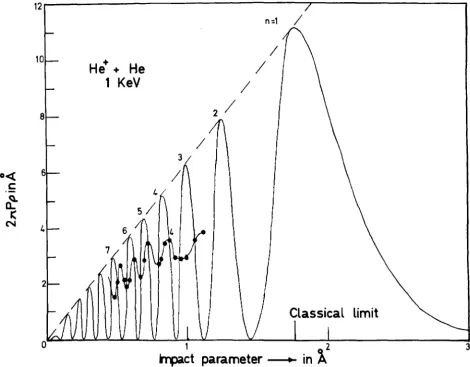
The di.fferential measuremerJts by Everhart et al of the charge transfer probability P in
He+ + He ~ He +
at 1 keV are plotted vs impact parameter in Figure 2.3 and compared with the predictions of the impact parameter treatmEnt method. Al though the experimentally observed oscilJatim,s do not range from zero to unity, the location of peakE is in good agreement and points to the success of the impact parameter treatm'r,t of the problem. Such oscillations have
b J t a114 for also been observed y ones e
at 240 eV; although these have not been compared with the theory.
A comparison of Rap!-) and Francis' calcul11t:i ons for the processes
p +
H
~H
+ pand Kr+ + Kr --. Kr + Kr+
is compared with the experimental data in Figure
2.4.
The experimental data for the process 2.31 is due to Fite et a115 while for the process16
.
17
18
E
u G1C>
o
.-x
..,
-'b
E
u
12
P+ H - H + p
FIG.2.4
01~---~---~7'---~Q8--~
105 106 10 10
Vern/sec
+ +
Kr + K r - Kr + Kr
6
2.4 Asymmetric .ch~~·ge tran,sfer process
The impact pararnE,ter treatment when applied to the asymmetric
+
A + B+
process A + B --- +
6.E
is fae ed with two problems not encountered in tbe symr.:etrical resonance case.Firstly, the difficulty in assigning moleeu18r orbitals to the
collision complex
(AB)+
which in thif; case goes to two different asymptotic+ +
forms as R ----'00 , namely (A + B) and (A + B ), separated by an energy
AE,
whereas in the symmetric case there is only one asymptotic state +(A + A ). Rapp and Francis use the semi-empirical orl)itals of 1.23 where I is the mean of the ionization potEntialE; of A and B.
Secondly the principle of detailed bal;:mce, whicr. states that the probability of a transitioy for a process and its reversal are equal, is not satisfied. In a charge transfer process there is a transition from one electronic state to another and in the intermediat.e velocity range where the impact parameters are large, it is assumed that spin and angular momentum are conserved. In other words transi tin!, S leetdj !Ig to charge
transfer only occur to identical symmetry statpE' of the
AB+
complex. Now the collisio!" complex may dissoeiab~ into a number of states alJ of wtic:h do not leod to charge transfer. The statistical weight factor f, is the ratio of the statef; which lead to the charge transfer and the total+
number of states to which the collision complex
(AB)
can dissociate. Similarly f 2 is the correspondin g sta Usb cal weight fac tor for the process in the reverse direction. The principle of detailed balance requires thata forward
a backward
This requirement is not satj Hfic~d for the asymmetrical process by the equaticL 2.11 and 2.12 since K1 ~ K
2• To satif;fy the principle of detailed balance an arithmetic mc[lYi of K1 and K2 is used, equations 2.11
and 2.12 can then be written as
ivda
B a
A K
- - -
=
dx
and
ivda
A a
B K - - - =
dx
with 1,
ex)
(x)
exp ( i w x) v
C
i w xexp
v
= 0, and
P
= f 12.33
2
2.4.2 Behaviour of a~J:!I1met!,~9_ charge transfer wi_tE_ .?-!TIp?ct energy. "The Adiabatic Maximum Rule".
i(x) in the above equations is a bell shaped function of x with a
maximum at x ::: 0 and decreasing to zero at ~OO. At high velocities when ~« 1, the exponential term in (2.33), and (2.34) may be set
v
equal to 1, giving
=
dx
and ivda
A
=
dxresonance case, shows that the behaviour of the asymmetrical cross-section at hi~h veloci iir!s is similar to that of the symmEtric resonance cross-sections. In this velocity range the cross-section increaE;es with de-creasing velocity because an increase in the time of collision results in an increase of the corresponding electron transition probability. This situation does not extend to low velocities since the exponential terms in 2.33 and 2.34 begin to oscillate wildly and reduce a B(+oo)2 despite the
1 factor
v acting weakly in the opposite direction. Thus at lower velocities where aB(+OO) 2 falls off rapidly with decreasir,g velocities.
v
This region of the impact energy is termed the "Adiabatic Region" proposed
19
by Massey • The projectile velocities in this region arp comparable to the electronic orbital veloci tip,; and the collision time is long enough for the electron to adjust its motion to the outside perturbations. This makes the transition an unlikely event at very low velocities. The collision in this region is an adiElbatic process and the electron capture cross-sectior,s are very low. At some nucleur separation a, where
--
wa-1
v
the charge transfer cross-section will be a maximum, and w a =
AE
a = 1v 'tv
a
AE
= [2eE1
2.35h 300M
where V is the energy in eV at which the cross-section attains its max
maximum val1JC'l M is the mass number of the impactine; species, a is given in ~, and
AE
in eVe The va11J e 0 f 7 o A for 'a' 11:'> . constant' 20 21 over a wide ranGE of atomic system and is a useful tool to predict the energy of the cross-section function maximum. H as,e an'l t d ~ L 22. ee lnc u e ln 1 d . th e energy defectAE,
the contributions for Coulomb and polarij',ationinteractions which reduce the pro"bable error for the adiabatic parameter a ~7 ~ from
65%
to20%
for the charge transfer.2.4.3
Appro~ima.te comp~.!:~.:tio~Js of the asymmej:ric charge transfer cross-sections.Using semi-empirical wave-function
2.23,
withI
as the mean of the ionization potentialf; of A and B, Rapp and Francis 1 obtain the transition pror)ability P Cp,v) for the asymmetrical case asasy
P (p,v)
asy
]~
and the cross-sections for the three regio~s of energy have been computed as follows:
Figure
2.5
2 [ w
and sech -;;
shows
P
Cp,v) syplotted
against p for different energy ranges.
When
~«
1,
for high velocities, the sech2 function is represented,,,,-
,,,,,-\""-
""-\ \
""
\
\
\
\
\
c
~
FIG.2.5
A
-
---
B-
---
----
--
by the curve A and remains unity over the important range of p. The behaviour of the asymmetric charge transfer cro,ss-section is therefore the same as for the symmetric reSOl1Cmce case given by equation 2.30.
ii. For intermediate velocities where w :::::: 1, the sech2 function is
v
given by curve B in which case P (p,v) can be replaced by 0.5 with an sy
upper limit of p in this case taken at a point such that
sech2
[~
a o TIp 1 )=
4 P (P1'v)2Y
sy 2.37and
f
jP1
a
=
.1. 2 sech2 [ w aoTIP] 2npdp0 v
2Y
iii. For very low velocities when
~~1,
the sech2 function is givenv
by the curve IC;, The sech2 function in this case decays to zero witbin I
the important range of
P,
the upper limit in 2.38 can therefore be replaced by infinity, giving,a(v) = 2TI
f'7sech2
ul
u3 dua.
0
=
9
(1.202) 2n 2.39'8
a. ...1
with a.
=
TIa 2 (-.£ ) (~)2Y
vInstead of dividirlg the velocity range into three regions,
4
in He
3
2
1
o~~~~~--~----~\--~~~--~--~
3 4
6
/810
7
2
4
6 8
10
8
2
4
Vern/sec
1
=
"4
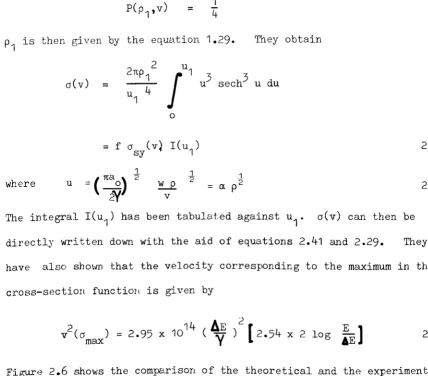
P1 is then given by the equation 1.29.
a(v)
where u
=
u 4 1
=
f 0 ( v ~ I (u1 )
sy
~
v
1
"2
They obtain
2.40
2.41 The integral ICu
1) has been tabulat.ed against u1. a(v) can then be
directly written down with the aid of equations 2.41 and 2.29. They have also ShO\vTI that the velocity corresponding to the maximum in the
cross-section function is given by
2 14
AE
2 [ E1
v (a )
=
2.95 x 10 ( y ) 2.54 x 2 log--max 6E
2.42
Figure
2.6
shows the comparison of the theoretical and the experimental results for the processHe+ + Ne --. He +
AE
(3 eV)together with the theoretical calculations for the resonant process
+ He - - He +
The theoretical calcl).lations are due to Rapp and Francis and the experi-mental data due to 1. Hasted and Stedeford , 24 2. Jones et a125 ,
in the correct velocity region, the theoretical calculations give lower values to the o(v) than the experimentally determined values. Thif; behaviour may be due largely to the approximah' methods used in the
calcllJr:1tion whereby an average ionization potential is used for both A and B.
2.4.4 DiscussioD of the results.
In these calcn] c::tiO!,s, however, no account is tak'c'n of the
possibility that the separation of thp. potential energy curves representing
( + +
respectively the quasi-molecule A + B) and (A + B ) may be smaller than the energy defect
AE
and in the absence of any interaction may be zero at a particular value of the internucle[j}' separatioll R.A
low value ofAE
for thisR,
Greatly increases the probability of the charge transfer at this point. This happens to be the case for the process1.4,
the partial charge transfer, of which+ 2.43
is a particular case. The measurements of Hasted and Smith27 for the
partial charge transfer of N2+, A2+, C2+ in He, Ne, A and Flaks and Solov'ev's
2+ 2+
measurements of Ne ,Xe in He, Ne, A,
Kr,
Xe show that the cross-sections have indeed large magntiudes well within the adinbatic region and areslowly varying functio:,s of the energy. The maximum of the cross-section is obtained at a different velocity than i6 predicted by the adiabatic maximum rule or for hat matter by this simple form of the impact parameter
+ Kr ---+ A + Kr+
+ Kr --+
c
+where the observed cross-section is fair] ~I energy independent in the low energy limit and is many times larger than to be expected in a similar case
H+· H
such as ln e. In this connection it was pointed out by them that this effect is due to the pseudo-crossing of the potential energy curves.
Since the potential energy curves play an important part in the above processes, the next sections will, therefore, be devoted to the detailed discussion of the intersection of the potential energy curves, derivation of the Landau-Zener formula and its application to the above processes in which there exists pseudo-crossing at a finite internuclf'ar separation.
28
More recent calculc)t~oDs of Bates and Johnston along these lines which are relevant to the present experimental wort: will also be discussed.
2.5.1 Potential energy curves and their intersection The electron capture process
2.44
where ~E is the energy defect, involves the transfer of an electron from the nucleus B to the nucl~uE A. The systems on the right and left of the abovf-; equation can be considered as a quasi-molecule wi tli the electron in different states. Unlike the atomic case where the energy levels are certain numbers, the el~ctron terms in molecules are not numbers but
call(~d thE potEntial energy curves can be represented gra:r:;hically by plotting the energy as a functioII of R, the inter-nuclEar sepClration.
Let
U
1
(R)
andU/R)
be the different potential energy curves and if they intersect at some point, then the functions U1 and U2 will have neighbouring valuEs near the point. If
R
is such a sepClration where U1 and
U
2 have very close vlues E1 and E2, then it is possible by a smaJl displacement R to make U
1 and U2 equal. The energies E1 and E2 are the eigen values of the Hamiltonian H of the electron in the f:i e1 d of the nuclei which are fixed at a dif;tance R from each other. For a small displacement
OR,
the Hamiltonian isH + V H + 2.45
If
4'1
and 4'2 be the eigen functions of the operator H wi tb the eigen energies E1 and E2, then the total wave-function is a linear combination of the two i.e:2.46 The SchrHdinger equation for the perturbed system is
(H + V) ~ = E~ 2.47
substituting 2.46 in 2.47 we get
2.48 Multiplying 2.48 on the left by
4'1*
and~*
in turn and integrating,C1(E
1 + h11 - E) + C2h12
=
o
2.49Equatjons 2.49 and 2.50 give after simplification
The curves will intersect each other (Figure 2.7a) if the expression under the radical in equatioYJ 2051 vanishes Le;
The above two equatj or:s cam lot generally be satisfied simultaneously. It mB.y happen, however, that the matrix element h12 vanishes identically. This haprens in all cases where the two terms are of different symmetry. Thus in this case, there remains only one equation which can be satisfied by suitable choice of
R
and then the potential energy curves willcross, but in general the intersection of the terms of like symmetry " 'bl 29
1.S l.mposs1. e • In such cases, the potential energy curves are found to move apart as shown in Figure 2.7b.
~
'"'
c
0~
l!
~tU
.
Co
N
Q)
en
.
...,.
...
(!)
~
cu
Q)
-13
LL
~
charged, as is the case for the partial charge transfer
A+n + B
~
A+(n-1) + B+ +AE
and the mutual neutralization process
In such cases, one state has a strOllg CO'llomb interaction and the other a weak polari:~ation interaction. Neglecting the latter, it is possible in such systems to find the curve croEsing point R from the relation30
x
R
:=X
2702 (n-1)
AE
a.u.where
AE
is the energy defect in volts and n is the charge in atomic units on the projectile A before the collision.2.502 Landau Zener formula
The exact electronic eigenfunction ~ m (r/R) and .1. 'l'n (r/R) of the
2.53
quasi-molecule for fixed nuclnj are functions of the electronic coordinate r and depend on R, the internuclear separation as a parameter while
E
(R)m and E (R) belonging to them depend only on R as a parameter.
n If the
eigenfunctions interchange their characters as R changes from R ~ Rx to R
<
Rx1 there is a pseudo-cro<:;sine of the potential energies, in which case the exact eigenfunctions can be expressed as a linear orthogonal combination of the functions¢
(r/R) and¢
(r/R).n m In the case of the
electron transfer from the state n of the atomic system A to the state m of the atomic system B
(A + e) + B ~ A + (B + e)
¢
(r/R) represent!:' the left ha.YJ.d side for all Rand¢
(r/R) represent:::; then m
right hand side for all R. If the relative nuclear velocity is constant, Z
=
E'Y
=
vt, then the perturbation calculation gives the equation for the amplitudese
(z) ande
(z) associated with the states¢
(r/R) andm n m
¢
(r/R). n. 31
The result is two coupled equRtlons Z
i1lV
Oe
(Z)= h (R)
e
(Z) exp {-k,;
J
h1m
(R) - h nn ( R) ) dZ}n
- -
nm m 2.55bz
and
Z i11v
e
(Z)h (R)
e
(Z) exp { iJ
[(hmm(R)-m
Kv mn n
Z where
The crossing distance is defined by h
(R)
=
h(R)
mm c nn c
Eliminating
e
(Z) in 2.55 and 2.56 gives mi
+
-11'11'
]
be
(z)(h - h ) n +
mm nn
0
Zh (R) )] dZ
nn
h 2
(nm)
e
(Z) = 0rv-
n2.56
In the
La.ndau(~2~ener(33)
theory i t is assumed that the transitions can only occur in a very narro',,' zone around the crossirlg point, so thath (Z)
nn h mn (Z) ex.(Z - Z ). c '
ex.
=
constant h (Z) = h (Z) = ~ = constantThese assumptions lead to an exact solution of
2.55
and2.56
and are jmitified if most of the transi iions take place near the crossing point so that the Vall;f'S of the matrix elements are unimportant elsewhere. The boundary conditions arec
C -00) = 1 and C (-00) = 0n m
The transi tio~l pro babili ty
P ,Cm(+OO)
12
is then the solution of2.57
subject to the cor::ditions of2.58
and2.59.
The Landau-Zener formula is then given byP
=
exp-(
2 hvwhere AU(R ) is the energy difference between the two potential energy x curves at R
=
R andx
v
¢. dl
VCR)
being the appropriate interaction energy.If the atoms A and B in states A1 and B1 respectively are aLlowed to come together infinitely slowly, the interaction between them will follow curve lIb and no transfer will tClk' place. However if the atoms approach with a finite relative velocity v, there is a finite probability that a transition will occur in which the system will jump from lIb to lb. This is the probability P given by
2.60.
The prolability that thedistance of closest approach, their relative motion will reverse and there is again a chance P, that a transition will occur. Thus if the atoms are brought together and then allowed to separate again, the total probability of transition is
fJ
=
2PC1 -
p) 2.612.5.3 Charge Transfer cross-section from Landau-Zener formula. The probability
P
depollds upon the relative angular momentumVLC.t
+ 1) h, of the colliding system and the charge transfer cross-section iso 2.62
where
K
=
E being the initial kinetic energy of relative motion and 1l the reduced mass. Replacing the summation sign by integration in 2.62 and making use of 2.60, Bates and Moiseiwitsch34 obtain2.63 with
2.64 where
2.65
A
=
U.(OO) - U.(R )
1 1 X 2.66
1l
=(Re~
(AE)21 (n2 ClA- (n_1)2ClA+a.,i")
2.67where f is the probability that the p8rticles approach along the particular potential energy curves and the a's the corresponding polarizabilities. Integral 1(7]) has a maximum value of 0.11335 when
~
=
0.424, which implies that the cr08s-section function should behave likewise. Using experiment-ally determined maxima, it is thus possible to calculate the cross-sections at other energies. Bates and Moi;:'81.vJitsch also calculate the energyseparation
when
s
=J¢(rpjn
A) ¢(rB+/nB+) dt
P =
J¢
(rB+/nB+)2 rA -1
dt
2.68
2.69
2.71
2.72
in which
¢
represents the initial and final wave functions of the active electron, r the position vectors and m the principal quantumd L H · 36 .
number. Haste, ee and ussaln USlJl~ an asumptotic wave function of the type
¢
__ N r (rl-1) exp nin which m* is the effective quantum number, N the normalising factor, n
E. the ioni7.ation energy in a. u. have computed AUeR ) for the partial
10---______ •
~
-6
or
10
::::>
<l
•
14
.
.2~•
•
FrG.2.B
•
28 • 27
oL---L---~--~~--~~----~--~
0.'
0.2
0.3
0.4
0.5
0.6
(R-')
A. U . - - -...
charge transfer process for a number of projectile and target atoms. They have plotted all the available data on ~U(R
)
as log ( ~UR)
againstx x
R
-1 and have shown that~U(R)
is dependent onR .
x x x The valu.::s of
AUeR )
estima";ed from the measurements of Hasted and Hussain37
" x '
Hasted and Smith, Hasted and Chong38 and the theoretical calculcttions of Dalgarno
39 ,
Bates and Moiseiwitsch40, Boyd and Moiseiwitsch41 provide a means of determining empirical] y the dependence ofAU(R )
onR ,
thex x
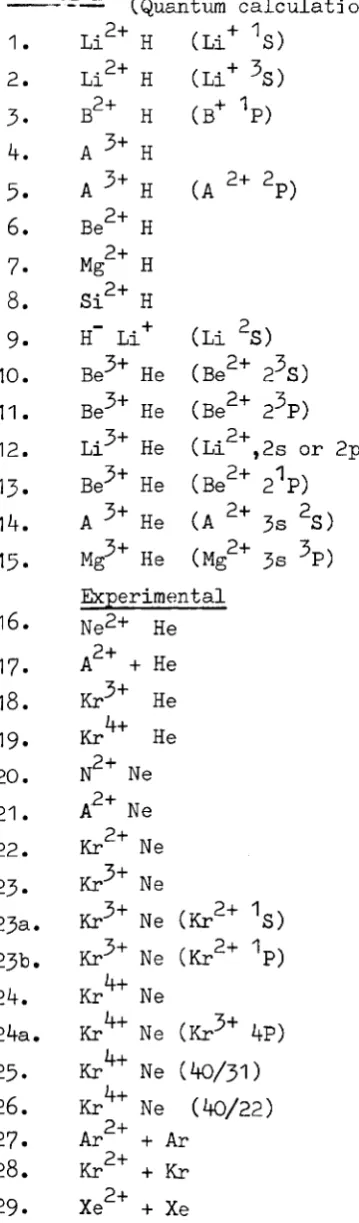
internuclec:..r separation at the crossing point. Figure 2.8 shows such a curve in which the key to numbers is shown in Table 1.
This curve enables the Landau-Zener formula to predict the cross-sections of the processes proceeding by way of transitions at the
pseudo-crossing of the potential energy curves. For a given process,
AE
the energy defect may be calc1Jl;:d.ed from the ionization potentials i Rx
may be calculated from equation
2.53
andAU(R )
correspondjr'g toR
x x
may then be deduced from Figure 2.8. With
AueR )
thus determined, xequation
2.63
may be used to predict the energy of the maximumcross-section to within 60% and the maximum cross-cross-section may also be calculated.
2.5.4
Limitations of the Landau-Zener formula and recent calculationsbased on the impact parameter treatment.
Although the Landau-Zener formula discussed in the preceding sections, is valuable in providing a qualitative explanation of the occasional
44
1 • Li 2+ H (Li + 1 S)
2. Li2+ H (Li+ 3S)
3.
B2+ H (B+ 1p)4.
A 3+ H5.
A 3+ H (A 2+ 2p)6.
7.
8.
9.
10. 11. 12. 13.14.
15.
16.
17.
18.
19.
20. 21. 22. 23· 23a. 23b.24.
24a.
25.
26.
27.
28.
Be2+
H
Mg2+ H
Si2+ H
H-
Li+ Be3
+ He Be3
+ He Li3
+ He Be3
+ HeA
3+ He Mg3
+ He(Li 2S )
(Be2+ 2
3
S)(Be2+ 2
3
p) (Li2+,2s or 2p)(Be2+ 21p)
(A 2+ 3s 2S ) CMg2+ 3s
3
p )Experimental
Ne2+ He
A2+ + He
Kr3+ He
Kr 4+ He
N2+ Ne
A2+ Ne
Kr2+ Ne
Kr3+ Ne
Kr3+ Ne (Kr2+ 1S ) Kr3+ Ne CKr2+ 1p)
Kr4+ Ne
Kr4+ Ne (Kr3+ 4p)
Kr 4+ Ne (40/31)
Kr4+ Ne (40/22) Ar2+ + Ar
Kr2+ + Kr
29. Xe2+ + Xe
Dalgarno.
Bates and Moiseiwitsch.
Bates and Boyd.
Boyd and Moiseiwitsch.
Hasted and Smith.
"
"
"
Hasted and Chong.Hasted and Smith.
or near the crossing point, severely limits its range of validity. In fact the limits within which it is valid are seldom found in actual practice. Contrary to the Landau-Zener assumptiOl~s, the refi!lements proposed by Bates show that the range of inter-nuclear separation over which transitions are likely is given by
4n:vh
(R-R )
AR
=
x2.73
h - h
nn mm
==
0.51
AU(Rx)
I
Rx 2where R is the crossing point. If the interaction is strong this x
width may be so large that the failure to take account of the variation of the interaction energies with nuclear separation leads to serious error in the calculation of the transition probabilith:s. Therefore for an exact solution of the coupled equations
2.55
and2.56
it is necessary to integrate over the entire range of Z=
vt. The probability is then given byp = 2 iiv i
l
o
the solution of which in some cases results in a second maximum in the
2.75
cross-section function, not predicted by the over simplified Landau-Zener theory. The second maximum in the cross-section function has not so far been observed experimentally. In the event of the faiJure of the equation
2.75,
it becomes imperative to solve the coupled equations28
Treating the nuclei A and B as classical particles with constant relative velocity ~, they obtain the coupled equations similar to the equations
2.33
and2.34
for the asymmetric charge transfer process2.2
(relating the coefficients C and C ). p These equations areq
and
where
ivdC (Z)
{i I(Z) } p C (Z) K (R) exp _ _
dt q v
ivdC (Z)
{ i I(Z)} q
C (Z) K (R)
= exp -
-dZ q V
K1 (R)+ K2 (R)
K (R)
=
g(R) h pq h pp 2
h S h
pq - qq 1 - S2
=
=f
Z
I (R) {, o
g(R) dZ
h S h
qp - pp
1 - S2
h h S(h h )
=
E - E + pp - qq + pq - qpp q
1 - S2
=
J¢
yA
¢d't
h=J
¢ VB ¢d't
p q qp q P
=
J
¢p VB ¢p d"t , h qq=
J¢q
yA
¢qd't
S
=
J¢
¢d't
p qE andE being the eigen values of the eigen-functions ¢ , ¢
p q p q
respectively, and
0
and VB the corresponding potentials. The boundary conditions areC (-00) = 1, C (-00) = 0
p q
and the probability that the collision results in a transition of the electron from state p around
B
to state q aroundA
isp
=
IC
q(+
OOl
I2
They express
P
in terms of the solutions at the origin and the coefficients in polar form,where r (Z) and ~(Z) are the solutions of the purely real equations
p
~
vdr (Z) { 2 } 2
P = 1 - rp (Z)
and
dZ
vd11 (Z)
dZ
= -
g(R) +which are obtained from 2.76 and 2.77. these equations are
K (R) sin11(Z) 2.79
~
)iZ(R)
cos 11( Z)} 2.80
The boundary conditions for
r (-00)
=
1 ,P 11(-00) = 0
The transition probability
P
as a function of the impact parameter obtained from equaiion 2.78 by the numerical solution of the equations 2.79, 2.80 for the processBe2
++ H --. Be+ + H+ + 4.61, R
=5.81 a
I"~~r-~--'-~--'--r--r-~
£=10450 tv
0·5
--(0'5
.
-~ I·-~--.L..L--IL.-::-"---:nr-''-r .8 o
ct 0.5 _________ _
0·
7·0
F1G.2.9
...
NO
I j
\: 25
-
oII>
'i
.5 ...
4
IOCJ £ (£ in tV)
is shown in Figure
2.9.
It is seen that P is a rapidly oscillating function ofp,
the impact parameter. The derived cross-section is shown in Figure 2.10 where it is observed that the maximum of the cross-section a obtained from the solution of the coupled equations is almost twiceSc
that of the maximum of the cross-section aiz obtained from the Landau-Zener approximation. Two other features are also apparent, namely, the cross-section maxima do not coincide and at lower energies asc~~aiZ'
The advantage of the numerical solution is that it enables one to
compare the experimentally and theoretically derived transition probabilities as a function of the impact parameter. The laboratory measurements
do ~ °b ° f A++ and A+ h ++
of the angular lSl,rl utlOD 0 , w en A traverses the target atoms in the collision chamber under single collision conditions, may be converted into the transition probabilities as a function of the impact parameter, provided the angular deflection may be related to the impact parameter. The difficulty arises in the choice of an interacting system for whjch the theoretical calculations are readily available and for which the measurements in the laboratory may be carried out with relative ease. For example, the theoretical calculations are only available for the reaction
Be++ + H Be+ + H+ +
4 6
• 1 eValso be bourne in mind that these calculations are only applicable to
s - s transitions. This of course limits the choice of systems for experimen-tal study. Two such systems for which the angular measurements can be
carried out in the laboratory are
R = 2.00 a
x
0R
=
2.583 ax 0
Experimental investigations of the angular distributions of 0++ and 0+ for the above reactions were carried out at two energies 1200 eV
2.82
2.83
and 2600 eVe The experimental set up will be discussed in the third
chapter while the fourth chapter will be concerned with the data and
C HAP T E RIll
EXPERIMENTAL STUDY OF CHARGE TRANSFER
3D1
INTRODUCTIONAn ideal charge transfer experiment has the following requirements i) an ion source producing cha.rged particles in a known state and narrow energy distribution. ii) a magnetic analyzer to obtain a monoenergetic beam of particular ions in a known charge state. iii) the analyzed ions must be accelerated or decelerated to the required impact energy and then permitted to pass through a gas target at known pressure. There are then three signals available for study after the collision, namely
a, Fast atom signal b, Fast ion signal c, Slow ion signal
and to obtain complete information of the collision process each of the above signals must be subjected to mass, energy and charge state analysis. Moreover study of the angulc'f' distributiol of the fast and slow sibnals furnishes informEtion on the dependence of the transition probability on the impact parameter of the collidinG system. Further, for the
post collision primary beam or measured and analyzed the slow collision products when the projectile beam traverses the collision chamber. These primary or secondary analysis techniques however provide enough data for the determin&tion of the cross-sections for the inelastic heavy particle collisions. Various experimental methods have been reviewed by
Massey and Burhop43, Allison44, Allison and Garcia Munoz45 and Hasted46 The following sections wlIJ be concerned with a discussion of the various experimental techniques together with a descdptioll of different experimental arrangements.
Experimental determination of the colliHion cross-sections can be divided into two classes, namely, "thick" and "thin" target techniques. The former Clc=ISS of experiments consist of either determining the
equilibrium charge state composition of a beam of projectiles when passed through a gas target thick enough to ensure an equilibrium between the
production and loss reactions of each of the possible charge state components, or determining the attenuation of a beam of projectiles in a gas filled
collision chamcer across which is applied a transverse electric or magnetic field. These fields sweep aside the slow ions, produced by the charge changing collisions with the target gas as soon as they are formed.
comparable to the dimensions of the collision chamber so that chances of multiple collisions are negli~ible.
3.3
The Total Charge Collection Method.The passage of the fast ion beam through the gas in the collision chamber produces slow ions due to electron caIJture and ionization processes. The two processes can be separated because of the fact that the ionization produces an electron-ion pair. The collection of all these slow ions and electrons without any discrimination of the charge state of the slow ions is the basis of the total charge collection method of the cross-section measurements. If single collit;ion technique is employed and if I c is the
slow ion current detected, 0T' the total collision cross-section producing the slow charged particles, p the pressure and
t
the collision path length, thenwhere I is the fast projectile ion beam current passing through the
o
collision chamber. The s:ingle collision condj tions can be verif:i ed by studying the collected current Ic as function of the target pressure. As shOwn by equation
3.1
the variation of I with p shoul~ be linear.c
Addition of the electron and the slow ion current ensures that the current I has no component due to the ionization process.
c Separation of the
primary ion bearr.s but should be strong enough to me.kc the path of the slo'" imls transverse to the primary beam, and to achieve "saturation conditions". The transverse path of the slow ions towards the collector and the saturation conditions ensure that i) all the slow ions are being collected, ii) the path length of the collision region is accurately known.
Experiments utilising a uniform el(,ctric field applied across the collision chamber have been performed by, amongst others Keene
47 ,
Gilbody and Hasted48 ,
Donahoe and Hushfar49
with uniform electric and magnetic fieJds parallel and transverse to the ion beam by Wolf50 and Hasted51 , Analternative method to usine; "static" gas in the collision chamber is to let the ion beam pass through a neutral beam referred to as "the crossed beam technique". A module.ted atomic beam from a furnace is crossed with a fast ion beam and slO\v ions produced are collected by a total ion
collpctor or analysed by the mass spectrometric detector. The modulation is interposed in order to distinguish between charge transfer with beam particles as opposed to charge transfer with the backgro1..md gas in the vacuum chamber. The A. C. beam signals so produc ed can be sepal'a ted electronically from the
D.C.
background gas signals. This technique has been applied by Fite et a152 in an experimental arrangement shown in Figure3.1.
The ions produced in an elf'ctron bombardm"mi. source are~~~==:C:=~~-Ne'utral-~am
Vacuum ChamlM!trs ..
dl::~::z:z:Zlr. iC.:z::z:z::z:z:z::z:z~
Shield\
Lenses
I
,~Lenses
~r-TI
- - - 1 _ _ '--11..=
Shield ~ Electron gun
Oscilloscope
FI G. 3.1
Integrator
source
Faraday cup
Current amplifier
lenses are pro'Jided to keep the iOlL beam focussed. The ions then pass through a narrow collimating slit which intercepts unwanted ions of adjacent masses. After passin!:; through another set of cylindrical lens and collimating slit systems, the ion beam enters the interaction region. The ion and the neutral beams are made to intersect at the
centre of a cylindrical collector whose axis coincides with the axis of the primary ion be[ill], the potential of which is maintained negative with
respect to the surrounding electrode and slow charge transfer ions are then collected on the surface of this cylinder. The primary ions pass through a further defining slit and are collected in a Faraday cup. The apertures in the collision region are such that all those ions which pass through this slit necessarily pass through the neutral beam. The neutral beam is produced in a tungsten furnace and is modulated at 100 cps by a mechanically driven, toothed chopper whee~, any ions present in the beam are removed by the deflector plates. The beam is then passed
through two apertures positioned diametrically opposite in the cylindrical collector. These apertures are covered with a
90%
optically transparent grid to prevent field penetration. A mass spectrometer is used with an electron gun to determine the degree of dissociation of the neutral beam by observing the reduction in the signal of the molecular ions as the furnace is heated. The dissociatiorl fraction D is given by531
Q
i S iD
=
/(1 +j2
1 2)
3.2Q
i S i 2 1where S i and S i ar~~ atomic and molecular peul<: strengths on the mass
spectrometer and Q1i/Q i
2
is the ratio of the cross-sections for ionization of the atomic and molecular species. Q1i/Q i
2
was determined in a
similar set-up with the exception that the ion beam was substituted by an electron beam. If S1 is the charge transfer signal due to the atoms in the neutral beam,
Q
2Q
1
the ratio of the molecular to the atomic
signals and S the total signal due to the slow ions formed irk the collision, then Fite et al find that
S
=
S1 [ 1 +Thus the measurements in this experiment yield both the atomic and molecular charge transfer cross-sections.
3.4
Secopd~ry Analysis MethodThe total charge collection method does not yield any inforIT.ation about the state of the target atom or molecule and an obvious extension of the investigation is to subject the secondary ions to mass analysis. Relatively slow secondary ions can be extracted by an electric field perpendicular to the main bean: of sufficiently small intensity as not to distort the paths of the main beam unduly. The extracted slow ion beam can be accelerated and mass analysed into a spectrum of ions of
different mass numbers. Provided the single collision conditions prevail, it is possiblp to meaSlJre the cross-section for the formation of ions
of a given charge to mass ratio. In this analysis, however, the
The exit slit must therp.fore be made suffjciently wide and the extraction potential sufficiently large to effect complete extraction. In whi.ch ca.se the extraction field sets a lower limit to the primary ion energy at about 30 eV, below whi eh excessive diE'tortion of the prim&.ry beam would occur. Two conditions must then be satisfied, i) The extracted beam strength must be independent of the transverse collision chamber field. ii) The analysi.s peaKE; must be fOlmd to be "flat top", that is, indepew'Jent of mc.g;netic field over a certain range not only when the exit slit is widened abnornally but also with a narrow slit. Only then will the ion current be proportional to the number of iOllS entering the mass spectrometer.
Calibration of the instrument against total charge collection measuremer. t is necessary in order to determine absolute cross-sections.
The secondary analysis method has been employed by Fedorendo and
Afrosimo~5,56
in the primary ion energy range3 - 180
keV, by Lindholm57
for the studyof secondary ion formation in dissociaiio!, of molf:cular gases, by Hasted and Hussain
58
for the study of electron car:ture by multiply charged ions and by Morgan and Everhart59
,
for the study of angular and energy distribu-tions of recoiliLg target particles.Measurements of the cross-section have been carried out by studying the charge composition of the primary beam after it has passed through the gas in the collision chamber by using thick or thin target techniques.