
Validating (d,p
γ
) as a Surrogate for Neutron Capture
A. Ratkiewicz1,a, J.A. Cizewski1, S.D. Pain2, A.S. Adekola1, J.T. Burke3, R.J. Casperson3, N. Fotiades4, M. McCleskey5, S. Burcher1, C.M. Shand1,6, R.A.E. Austin7, T. Baugher1, M.P. Carpenter8, M. Devlin4, J.E. Escher3, S. Hardy1,6, R. Hatarik3, M.E. Howard1, R.O. Hughes9, K.L. Jones10, R.L. Kozub11, C.J. Lister12, B. Manning1, J.M. O‘Donnell4, W.A. Peters13, T.J. Ross9, N.D. Scielzo3, D. Seweryniak8, and S. Zhu8
1Department of Physics and Astronomy, Rutgers University, New Brunswick, NJ 08903, USA 2Physics Division, Oak Ridge National Laboratory, Oak Ridge, TN 37831, USA
3Lawrence Livermore National Laboratory, Livermore, CA 94550, USA 4Los Alamos National Laboratory, Los Alamos, NM 87545, USA
5Cyclotron Institute, Texas A&M University, College Station, TX 77843, USA 6Department of Physics, University of Surrey, Guildford, Surrey, GU2 7XH, UK
7Astronomy and Physics Department, Saint Mary’s University, Halifax, NS BH3 3C3, Canada 8Physics Division, Argonne National Laboratory, Argonne, IL 60439, USA
9Department of Physics, University of Richmond, VA 23173, USA
10Department of Physics and Astronomy, University of Tennessee, Knoxville, TN 37996, USA 11Physics Department, Tennessee Technological University, Cookeville, TN 38505, USA
12Department of Physics and Applied Physics, University of Massachusetts Lowell, Lowell, MA 01854, USA 13Oak Ridge Associated Universities, Oak Ridge, Tennessee 37831, USA
Abstract. Ther-process is responsible for creating roughly half of the elements heavier than iron. It has recently become understood that the rates at which neutron capture reactions proceed at late times in ther -process may dramatically affect the final abundance pattern. However, direct measurements of neutron capture reaction rates on exotic nuclei are exceptionally difficult, necessitating the development of indirect approaches such as the surrogate technique. The (d,pγ) reaction at low energies was identified as a promising surrogate for the (n,γ) reaction, as both reactions share many characteristics. We report on a program to validate (d,pγ) as a surrogate for (n,γ) using95Mo as a target. The experimental campaign includes direct measurements of the
γ-ray intensities from the decay of excited states populated in the95Mo(n,γ) and95Mo(d,pγ) reactions.
1 Introduction
Neutron capture reactions on unstable nuclei are of broad interest due to their importance to interpretations of r -process abundance patterns [1] and applications to nuclear security and nuclear energy. However, direct measure-ments of such reactions in the neutron-rich areas of inter-est are very difficult or impossible to carry out due to the unstable nature of both neutrons and the targets. There-fore, techniques to indirectly extract these cross sections must be developed. When the nuclear reaction in question (a+A→ B →c+C) forms a compound nucleus (B), a system sufficiently long-lived for its excitation energy to be evenly distributed over all of the nucleons compris-ing it, the entrance channel is “forgotten” and the decay of the compound nucleus (c+C) is independent of the en-trance channel. The cross section for this reaction can be expressed in the Hauser-Feshbach formalism as [2]:
σαχ(En)=
J,π
σCN
α (Eex,J, π)GCNχ (Eex,J, π). (1)
ae-mail: [email protected]
Here, αdenotes the entrance channel, σCN
α (Eex,J, π) the
formation cross section for the compound nucleus, and
GCN
χ (Eex,J, π) represents the decay of the compound
nu-cleus through the exit channelχ. In practice, the formation cross sections can be reliably calculated with optical po-tentials, but the branching ratios are difficult to determine with sufficient accuracy to constrain neutron capture cross sections. It is thus necessary to constrainGCNχ through
ex-periment.
The same compound nucleus may be formed through a “surrogate reaction”, (d+D → B+b), in which the projectile-target system are more amenable to experimen-tal study and the decay of the compound nucleus (B) is observed in coincidence with a particle represented by
b. Then the probability for forming the compound nu-cleus created through the entrance channelδand decaying through the exit channelχcan be expressed as [2]:
Pδχ(Eex)=
J,π
FCNδ (Eex,J, π)GCNχ (Eex,J, π), (2)
where FCN
δ (Eex,J, π) represents the probability of
form-ing the compound nucleus B with an excitation energy C
Owned by the authors, published by EDP Sciences, 2015
of Eex. The Weisskopf-Ewing (WE) approximation [3] is often employed in order to make the calculation of the branching ratio tractable. This approximation makes the assumption that the branching ratios depend only on the energy, not the spin or parity, of the excited state and the branching ratio simplifies:GCN
χ (Eex,J, π)→ GCNχ (Eex). If
the surrogate and desired reactions form the “same” com-pound nucleus, the probability of forming the comcom-pound nucleus is: J,πFCNδ (Eex,J, π)= 1. Therefore Eq. 2
be-comes:
Pδχ(Eex)=GCNχ (Eex). (3)
The branching ratio can then be determined experimen-tally by measuring the number of surrogate events (Nδ) and the number of coincidences between the observable tagging the relevant exit channel of the reaction and the compound nucleus (Nδχ), corrected by the efficiency of the detector system for the detection of that observable ( χ)
[2]:
Pδχ(Eex)= Nδχ
Nδ χ. (4)
The cross section for the desired reaction can be deter-mined from Eq. 1:
σCN
αχ (Eex)=σCNα (Eex)Pδχ(Eex). (5)
Theoretical models suggest that it may be appropriate to employ the Weisskopf-Ewing approximation for neutron energies above about 3 MeV [4]. However, the (n,γ) cross section is enhanced at lower energies, and several studies [4–7] have shown that the WE approximation cannot be used to extract neutron capture cross sections in the energy range appropriate for (n, γ) reactions with large cross sec-tions whenEn <1 MeV. However, Escheret al. [6] have suggested that a “serendipitous” approach may be valid when the spin-parity of the surrogate reaction is similar to that of neutron capture. Indeed, Hatarik et al. [5] have shown that by focusing on the side-feeding of low-lying transitions in the (d,pγ) surrogate reaction the ratios of the (n, γ) cross sections can be reproduced.
2 Surrogate Measurements in Normal
Kinematics
2.1 Experimental Setup
The work of Forssénet al. [4] emphasizes the need for a benchmarking of the surrogate reaction method, in which known (n,γ) cross sections are compared to cross sections extracted from a surrogate experiment. The (d,pγ) reaction is a natural candidate for an (n,γ) surrogate – like (n,γ) re-actions, low-energy (d,pγ) reactions primarily involve the transfer of a nucleon with low angular momentum. The choice of the target was informed by benchmarking re-quirements – first that the neutron capture cross section should be known up to at least 200 keV. Second, the anal-ysis is simplified if the daughter nucleus is an even-even one in which a strong 2+1 → 0+g.s.transition collects much
of the decay strength from the decay of the compound cleus. As the formation and decay of the compound nu-cleus must be modeled and these models are sensitive to
Threshold Energy (A.U.)
Counts (x 1000)
P
D
2
0 4 6 8 10 12
0 1 2 3 4 5 6 7 8 9 10
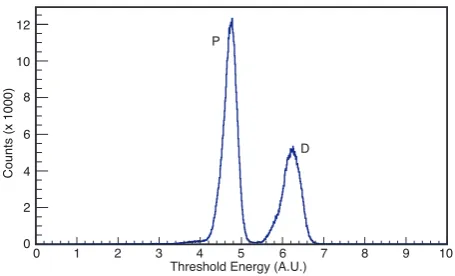
Figure 1. Particle identification histogram constructed through the linearization of energies (Eq. 6) deposited in forward-angle ΔE and E detectors by particles from the reaction of a 12.5 MeV deuteron beam on a 95Mo target. The linearization technique
allows clear discrimination between the peaks due to protons (lower energy, labeled “P”) and deuterons (higher energy, labeled “D”). Approximately one hour of data are shown. Elastically scattered deuterons are suppressed by applying a cut on larger angles.
the structure of the nucleus, so the structure of the nucleus chosen for the benchmarking experiments should be well known. 95
42Mo meets all of these requirements, with the (n,γ) cross section having been directly measured by Mus-groveet al.[8].
The 95Mo(d,pγ) reaction was measured with the Silicon Telescope Array for Reactions with Livermore andTexas A&M Univeristy andRichmond (STARLiTeR) detector system currently located at the Texas A&M Cy-clotron Institute [9, 10]. Light ejectiles were detected in two silicon telescopes 1.6 cm upstream and 2.1 cm down-stream of the target respectively. Each telescope was com-posed of a detector for measuring energy loss (ΔE, 140μm thick) and total energy (E, 1000 μm thick). Each detec-tor was segmented into 48 rings on the front side, bussed together in pairs, and 16 sectors on the back side, also bussed together in pairs. A 16μm thick aluminum shield was used to protect the forward angle detector fromδ elec-trons. Four high-purity germanium clover detectors inside of BGO Compton-suppressing shields were located at 90, 220, 270, and 320 degrees with respect to the beam axis in the laboratory frame.
A 12.5-MeV beam of deuterons was provided by the K150 cyclotron at the Cyclotron Institute at Texas A&M University, and impinged on a 0.96 mg/cm2thick molyb-denum target foil enriched to 96.8% in 95Mo. The pri-mary contaminant was96Mo with an abundance of 1.54% [11]. The data acquisition trigger condition required that an above-threshold signal (about 400 keV) be detected in both detectors in either the forward or backward telescope. When this condition was satisfied, any γ rays detected in coincidence with the triggering event in the telescopes were recorded.
follow-Figure 2. (color online) Matrix showing coincidences between the reconstructed center of mass96Mo excitation energies of
pro-tons (MeV) detected in the forward telescope andγrays (keV) detected in the four HPGe clovers. The neutron separation en-ergy (Sn=9.152 MeV) is indicated by the dashed line. Approxi-mately one hour of data are shown.
ing equation:
R=(E1+ ΔE1)α−E1α (6)
whereα=1.68 is a constant related to the stopping power of silicon. The particle identification histogram is shown in Fig. 1.
The silicon detectors were calibrated using a226Raα source. Following the calibration, the nuclear excitation energy (Eex) was calculated fromEex=Ebeam−Eproton− Erecoil, whereEbeam =12.5 MeV is the beam energy, and
Eproton (the proton energy) and Erecoil(the energy of the
recoiling 95Mo target nucleus) were reconstructed on an event-by-event basis. A matrix showing the proton-gated coincidences between events in the reconstructed excita-tion energy spectrum and γ rays detected in the clover detectors is shown in Fig. 2. The 95Mo(d,pγ) reaction can populate states below the neutron separation energy of
96Mo (S
n=9.152 MeV [13]), as well as aboveSn, which
corresponds to the (n, γ) surrogate, characterized byγ-ray de-excitations to the ground state of96Mo. States popu-lated significantly above the neutron separation energy in 96Mo can also decay to the ground state in95Mo, acting
as the (n,nγ) surrogate. The transition between the (n, γ) and (n,nγ) decay channels can be clearly seen in Fig. 2.
2.2 Preliminary Results
The probability that the final nucleus with excitation en-ergyEexin the95Mo(d,pγ) reaction de-excites throughγ -ray emission (Ppγ) was determined following the method used by Scielzoet al.in [7, 14]:
Ppγ(Eex)= (1−αIC) γf(Eex)
Npγ(Eex)
Np(Eex), (7) where αIC is the internal conversion coefficient for the
transition, f(Eex) is the fraction of the γ-ray cascades which de-excites through the transition in question, γ is
theγ-ray detection efficiency,Npγ is the number of coin-cidences between a proton and a γ-ray characteristic of
bin center (MeV) EX
E
-ray Emission Probability
γ -3 10 -2 10 -1 10 g.s. + 0 → 1 + 2 + + 1 + 2 → 1 + 4 4 → 6 2 → 2 2 → 2 g.s. + 5/2 → + 3/2 g.s. + 5/2 → + 7/2 1 + 1 + 1 + 2 + 1 3 0 10
2 4 6 8 10 12 14
Figure 3. (color online) Emission probabilities calculated from the intensities of transitions in 96Mo (the (n, γ) surrogate) and 95Mo (the (
n,n) surrogate) are displayed. The dashed line cor-responds to the neutron separation energy in96Mo,S
n=9.152 MeV [13]. The probability of emission of γ rays fromyrast
transitions in96Mo are indicated by the black (2+
1 →0+g.s.), pink
(4+1 →2+1), and blue (6+1 →4+1) lines. Emission probabilities for
non-yrasttransitions in96Mo are shown in red (2+
2 → 2+1) and
green (2+3 →2+1). Emission probabilities for transitions created through the decay of states above the (n,n) surrogate threshold are shown in yellow (3/2+→5/2+
g.s.) and purple (7/2+→5/2+g.s.).
the transition of interest, and Np is the number of pro-ton singles detected. For the case of96Mo, in which very few transitions are strongly internally converted, Eq. 7 be-comes:
Ppγ(Eex)≈ 1
γ
Npγ(Eex)
Np(Eex). (8) The particle-γexcitation matrix shown in Fig. 2 was projected onto the ordinate in 100-keV increments. The re-sulting spectra of low-lyingγrays emitted in the decay of excited states as a function of excitation energy in95,96Mo were fit using the ROOFIT package [15]. The resulting intensities are shown in Fig. 3.
The96Moyrasttransitions are the strongest observed, with the 2+1 → 0+g.s.transition (at 778 keV) the strongest,
the 6+1 →4+1 transition (at 812 keV) being the weakest of these, and no evidence of a 8+1 →6+1 transition (at 538 keV [13]). As Fig. 3 shows, the emission probability for the 2+1 → 0+g.s.transition belowSnis nearly 1, supporting the
conclusion that this transition collects almost all of theγ -ray intensity. Current analysis is focused on expanding the analysis to the full spectrum ofγrays produced in the de-excitation of96Mo, including those that directly populate the ground state, to extract the full emission probability (Eq. 8).
Future work will include exploiting the 2+1 →0+g.s.as a collecting transition and the side-feeding of low-lying lev-els to calculate (n, γ) surrogate cross sections that would be compared to direct measurements of the (n, γ) cross section by Musgroveet al.in [8].
2.3 Comparison to(n, γ)Measurements
transi-tions as a function of excitation energy or effective neu-tron energy. The95Mo(n, γ) reaction was measured at the Los Alamos Neutron Science Center (LANSCE) to pro-vide analogous information on the intensity ofγ-ray tran-sitions as a function of neutron energy. Two measure-ments were made. The first exploited a small array of HPGe detectors on flight-path 12 at the Lujan Center, en-abling measurements from 20 eV< En <200 keV. The same96Mo transitions were observed in these data as those summarized in Fig. 3, including the 6+ → 4+812-keV transition at the higher neutron energies, and no evidence for the 8+ → 6+ transition. The second measurement at
En >200 keV was made at WNR with the GEANIE array of Compton-suppressed HPGe detectors [16]. Prelimi-nary results show the (n,n) channel dominating above the 204-keV threshold for populating the first excited state in 95Mo. The goal is to use the intensities of the transitions as
a function of neutron energy measured in actual (n, γ) re-actions to extract a neutron capture cross section using the same techniques as are deployed in a surrogate measure-ment and compared to the results from direct95Mo(n, γ) cross section measurements [8].
3 Surrogate Reactions in Inverse
Kinematics
The STARLiTeR detector is optimized to measure transfer reactions in normal kinematics, which limits possible tar-gets to those isotopes which are stable or very long-lived. Measuring surrogate reactions in neutron-rich regions of the nuclear chart of interest to astrophysical, nuclear se-curity, and nuclear energy applications requires a detector suited for inverse kinematics measurements with radioac-tive ion beams and capable of measuring light particles andγrays in coincidence. Such a particle-γspectrometer must have highγ-ray detection efficiency (as the rates of available beams are likely to be low) and high energy res-olution forγ-ray and particle detection, as some exotic nu-clei have dense excited state structure. Only HPGe detec-tors which cover a large fraction of the solid angle around the target are currently able to satisfy the simultaneous requirements of high γ-ray energy resolution and detec-tion efficiency. The Gammasphere array of 110 Compton-suppressed HPGe detectors [17] combines high geomet-ric efficiency with target area large enough to support the mounting of the light charged-particle detector ORRUBA [18]. ORRUBA (theOakRidgeRUtgersBarrelArray) is a modestly-segmented silicon detector array which com-bines high angular resolution (Δθ=1 degree) with high energy resolution (∼28 keV FWHM for a 5.8 MeV α -particle). The ORRUBA barrel is composed of rectangular position sensitive 1 mm-thick detectors to measure total energy (E) which are segmented into four resistive strips on the front and four blocks on the back. A telescope can be made by combining theEdetectors with 65μm-thick non-resistiveΔE detectors which are segmented into eight strips on the front. ORRUBA can be augmented with an-nular endcap detectors, each covering∼90◦ of the polar angle, which are segmented into 32 variably-pitched strips
Laboratory Angle (Degrees)
0 20 40 60 80 100 120 140 160 180
Cross Section (mb/sr)
-2 10
-1 10
1 10
IVK l = 0 IVK l = 1 IVK l = 2 NK l = 0 NK l = 1 NK l = 2
STARS Blind
Figure 4. (color online) DWBA calculation of the differential cross section for different-transfers to a 1-MeV excited state in96Mo from the95Mo(d,p) reaction at an energy of 10 MeV-A
for normal (dashed lines, “NK") and inverse (solid lines, “IVK") kinematics. The areas shaded in grey are the angles to which GODDESS is blind. The angles to which STARS is blind are indicated by the blue boxes at the top of the figure.
on the front side and four sectors on the back side. Up to three layers of these endcap detectors can be configured into a telescope, with theΔE layer 100-μm thick and the
Elayer 1-mm thick. The entire array covers 75% of the polar angle between 15 and 165 degrees in the laboratory frame. Figure 4 shows the relative angular coverage for ORRUBA and STARLiTeR. Together, the Gammasphere and ORRUBA systems form Gammasphere-ORRUBA: DualDetectors forExperimentalStructureStudies (GOD-DESS) [19, 20]. When it is necessary to detect the heavy recoiling particles, GODDESS can be supplemented by the Fragment Mass Analyzer (FMA) [21] or (when the beam is too rigid to be bent by the FMA) a re-entrant high-rate ionization chamber of a design similar to the one de-scribed by Chaeet al.in [22].
The high geometric efficiency provided by GOD-DESS will allow surrogate reactions to be measured in in-verse kinematics with radioactive beams, opening exotic, neutron-rich areas of the nuclear chart for exploration with this technique. Additionally, by covering a large fraction of the solid angle, GODDESS enables the simultaneous measurement of pickup and stripping reactions – the (n,γ) surrogate can be measured “for free” in any measurement of a stripping reaction. The GODDESS detector system is nearly complete, with first beam expected late 2014 or early 2015. One of the first planned experiments with GODDESS is a measurement of the95Mo(d,pγ) reaction in inverse kinematics. This measurement will extend to in-verse kinematics the validation of the (d,pγ) reaction as a surrogate for the (n, γ) reaction.
4 Summary
stability important for understandingr-process nucleosyn-thesis and applications for nuclear security and energy. Preliminary results from the normal kinematics measure-ment of the95Mo(d,pγ) surrogate for (n, γ) are presented here. They show that a limited amount of angular mo-mentum, populating at maximum the 6+1 state in96Mo, is brought into the entry state above the neutron separation energy in the (d,p) reaction. This is similar to what is seen in the preliminary results from the95Mo(n, γ) mea-surement at LANSCE, where the 6+1 state (and no state of higher angular momentum) is populated. The next step is to use the empiricalγ-ray emission probabilities from both the normal kinematics (d,pγ) and (n, γ) measurements and calculations of the formation of the compound nucleus as input for calculating (n, γ) cross sections. To realize (n, γ) surrogate reactions of unstable nuclei requires a valid sur-rogate in inverse kinematics with radioactive ion beams interacting with a deuteron (e.g., CD2) target. The GOD-DESS particle-γ spectrometer is poised to complete the surrogate validation efforts with95Mo beams and particle-gamma coincidences enabled by the ORRUBA and Gam-masphere arrays, respectively.
Acknowledgements
The authors thank the operations staffat the Texas A&M Cyclotron institute for their exceptional support of the nor-mal kinematics measurement of the95Mo(d,pγ) reaction. A.R. thanks Giordano Cerizza for useful discussions.
This work is supported in part by the U.S. Depart-ment of Energy (DOE) National Nuclear Security Ad-ministration (NNSA) Stewardship Science Academic Al-liance Programs through Cooperative Agreements No. DE- FG52- 08NA28552 and DE-NA0002132 (Rutgers), No. FG52-09NA29467 (TAMU); DOE Contracts DE-AC02-06CH11357 (ANL), No. DE-AC52-07NA27344 (LLNL), No. AC52-06NA25396 (LANL), No. DE-FG52-06 NA26206 (Richmond), DOE Office of Sci-ence No. DE-AC05-00OR22725 (ORNL), DE-FG02-96ER40983 (UTK), No. SC0001174 (UTK), DE-FG02-96ER40955 (TTU), No. DE-FG02-05 ER41379 and ), and No. DE-FG02-93ER40773 (TAMU); the Na-tional Science Foundation No. 1067906 (Rutgers); and the Department of Energy’s NNSA Office of Defense Nuclear Nonproliferation Research & Development (LLNL).
References
[1] R. Surman, J. Beun, G.C. McLaughlin, W.R. Hix, Phys. Rev. C79, 045809 (2009)
[2] J.E. Escher, J.T. Burke, F.S. Dietrich, N.D. Scielzo, I.J. Thompson, W. Younes, Rev. Mod. Phys.84, 353, (2012)
[3] V.F. Weisskopf and D.H. Ewing, Phys. Rev.57, 472 (1940)
[4] C. Forssén, F.S. Dietrich, J.E. Escher, R.D. Hoffman, K. Kelley, Phys. Rev. C75, 055807 (2007)
[5] R. Hatarik, L.A. Bernstein, J.A. Cizewski, D.L. Bleuel, J.T. Burke, J.E. Escher, J. Gibelin, B.L. Gold-blum, A.M. Hatarik, S.R. Lesheret al., Phys. Rev. C 81, 011602 (2010)
[6] J.E. Escher and F.S. Dietrich, Phys. Rev. C81, 024612 (2010)
[7] N.D. Scielzo, J.E. Escher, J.M. Allmond, M.S. Basu-nia, C.W. Beausang, L.A. Bernstein, D.L. Bleuel, J.T. Burke, R.M. Clark, F.S. Dietrichet al., Phys. Rev. C 81, 034608 (2010)
[8] A.R. De L. Musgrove, B.J. Allen, J.W. Boldeman, R.L. Macklin, Nucl. Phys. A270, 108 (1976)
[9] S.R. Lesher, L. Phair, L.A. Bernstein, D.L. Bleuel, J.T. Burke, J.A. Church, P. Fallon, J. Gibelin, N.D. Sci-elzo, M. Wiedeking, Nucl. Inst. and Meth. in Phys. Sect. A621, 286 (2010)
[10] R.J. Casperson, J.T. Burke, N.D. Scielzo, J.E. Escher, E. McCleskey, M. McCleskey, A. Saastamoinen, A. Spiridon, A. Ratkiewicz, A. Blancet al., Phys. Rev. C 90034601 (2014)
[11] NIDC Staff, private communication (2012)
[12] F.S. Goulding, D.A. Landis, J. Cerny, R.H. Pehl, Nucl. Inst. and Meth.31, 1 (1964)
[13] NNDC, http://www.nndc.bnl.gov/
[14] N.D. Scielzo, J.E. Escher, J.M. Allmond, M.S. Basu-nia, C.W. Beausang, L.A. Bernstein, D.L. Bleuel, J.T. Burke, R.M. Clark, F.S. Dietrichet al., Phys. Rev. C 85, 054619 (2012)
[15] W. Verkerke and D. Kirkby http://roofit.sourceforge. net/
[16] J.A. Becker and R.O. Nelson, Nuclear Physics News 7, 11 (1997)
[17] I.Y. Lee, Nucl. Phys. A520, c641 (1990)
[18] S.D. Pain , J.A. Cizewski, R. Hatarik, K.L. Jones, J.S. Thomas, D.W. Bardayan, J.C. Blackmon, C. D. Nesaraja, M.S. Smith, R.L. Kozub, M.S. Johnson, Nucl. Inst. and Meth. in Phys. Sect. B 261, 1122 (2007)
[19] A. Ratkiewicz, S.D. Pain, J.A. Cizewski, D.W. Bar-dayan, J.C. Blackmon, K.A. Chipps, S. Hardy, K.L. Jones, R.L. Kozub, C.J. Listeret al., AIP Conference Proceedings1525, 487 (2013)
[20] , A. Ratkiewicz, J.A. Cizewski, S. Hardy, M.E. Howard, B. Manning, C.M. Shand, S.D. Pain, D.W. Bardayan, M. Matos, J.C. Blackmon et al., Fission and Properties of Neutron-Rich Nuclei pp. 326-331 (2012)
[21] C.N. Davids and J.D. Larson, Lecture Notes in Physics317, 313 (1988)
![Figure 3. (color online) Emission probabilities calculated fromMeV [13]. The probability of emission oftransitions inthe intensities of transitions in 96Mo (the (n, γ) surrogate) and95Mo (the (n, n′) surrogate) are displayed](https://thumb-us.123doks.com/thumbv2/123dok_us/8178168.1365847/3.595.310.540.64.201/probabilities-calculated-probability-oftransitions-intensities-transitions-surrogate-surrogate.webp)

