c
Owned by the authors, published by EDP Sciences, 2015
Evaluation of the performance of three elastomers for non-lethal
projectile applications
N. Thota1,2,a, J. Epaarachchi2, and K.T. Lau2
1CAD-CAE Consultants, 45 Horley Tce, Kilburn, South Australia, 5084, Australia
2Centre of Excellence in Engineered Fibre Composites, University of Southern Queensland, Toowoomba, 4350, Queensland, Australia
Abstract. Less lethal kinetic ammunitions with soft noses such as eXact iMpact 1006, National Sports Spartan and B&T have been commonly used by military and law enforcement officers in the situations where lethal force is not warranted. In order to explore new materials to be used as nose in such ammunitions, a scholastic study using finite element simulations has been carried out to evaluate the effectiveness of two rubber like elastomers and a polyolefinic foam (low density, highly compressible, stiff and closed cell type of thermos plastic elastomer). State-of-the art thorax surrogate MTHOTA has been employed for the evaluation of blunt thoracic trauma. Force-rigid wall method was employed for the evaluation of head damage curves for each material. XM 1006 has been used as the benchmark projectile for the purpose of comparison. Both blunt thoracic trauma and head damage criterion point of view, both rubbers (R1 and R2) have yielded high values of VCmaxand peak impact force. Polyolefinic
foam (F1) considered in the study has yielded very promising VCmaxvalues and very less peak impact force when compared with
those of bench mark projectile XM 1006.
1. Introduction
In the past few decades, law enforcement agencies, military and defense forces have started using less-lethal weapons which were designed to temporarily incapacitate the subject in the situations where lethal force is not warranted. The very basic requirement of non-lethal weapons are that the projectile impact should give short duration pain, be sufficient to deter the subject and should not cause any serious injuries, which require hospitalization and medical treatment [1–3].
Non-lethal munitions, though made up of foam and PVC, are very expensive (cost of each round of XM 1006 is approximately 30 – 55 USD depending upon the order quantity [4,5], and the cost of TASER-XREP round is more than 99 USD [6]). Therefore, a scholastic study was carried out to produce cheaper alternatives to XM 1006 which can be fired using the same M79 grenade launcher.
The projectile of interest XM 1006 (benchmark projectile in the present study), in the laboratory tests using 3-RCS, has produced a VCmax of 0.21 at an impact velocity of 91.5 m/s. Though the design (dimensions) of the projectile is available in the technical documents published by Defense Tech, as there is no mention of the foam nose material data, the development of an XM 1006 equivalent foam nosed projectile becomes an arduous task and entails extensive physical tryouts with grenade launchers and thorax surrogates (Cadavers, surrogates, anesthetized animals) and experimental setup with costly equipment. Therefore, in the present study, authors have used a state of the art thorax surrogate MTHOTA aCorresponding author:[email protected]
[7,8] and experimentally obtained and validated material data of few elastomers (from the own database [9] and published articles by other researchers [10]) and validated 3 materials (Rubbers R1, R2 and Polyolefin F1) in a virtual testing environment whether or not they suitable as nose material in manufacturing less lethal ammunition.
Though XM 1006 is widely used and aerodynamically stable (spin stabilized), impacts on the head (due to dispersion effects) can be lethal as the peak impact force on the head at the speed of 60 m/s is >20 kN, which indicates very high probability for skull fracture and coma [11]. Therefore, in the present study, authors have employed force wall method and evaluated head damage characteristics of the projectile with R1, R2 and F1 noses. In this paper, authors have presented blunt thoracic trauma and head damage characteristics of the projectile with R1, R2 and F1 noses and compared with those of the benchmark projectile.
2. Methodology
Non-linear finite element analyses were carried out for two purposes. Firstly, to evaluate the blunt thoracic trauma in terms of the peak viscous criterion and secondly, to evaluate head damage criterion in terms of peak impact force caused by the impacts of the projectiles with R1, R2 and F1 noses so that they can be compared with those of the benchmark projectiles XM 1006.
2.1. Evaluation of the blunt thoracic trauma
Figure 1. Details of MTHOTA thorax surrogate.
(compressible nose) in manufacture of non-lethal impact munitions, Mechanical THOrax for Trauma Assessment (MTHOTA), a state-of-the art surrogate of the thorax was subjected to the following cases impacts with projectiles whose design is similar to that of XM1006, in a virtual testing environment. Design details of the XM1006 were obtained from the published research papers and technical reports [12,13].
1. An FEA non-linear simulation run with the projectile (nose made up of Rubber-1 material) impacting MTHOTA at 99 m/s speed.
2. Repeat the above simulation run with Rubber-2 and Poly-olefin Foam as nose materials.
3. For better comparison, all of the above three cases were repeated with equivalent impact velocities. Equivalent velocities were evaluated such a way that initial kinetic energy of the projectiles were equal.
Construction details of the MTHOTA surrogate are illustrated in the Fig.1.
MTHOTA surrogate is validated with human biome-chanical response corridors developed by researchers at Wayne State University [14,15] such a way that the peak viscous response (VCmax) is given by the Eq. (1).
V Cmax=S(Ymax/D)(Ymax/T ). (1) Where,
VCmax=Peak viscous injury in m/s S=Scaling factor=0.366 for MTHOTA
Ymax=maximum deflection of the impact plate in mm
D=Dummy constant=110 mm for MTHOTA T=time at which deflection is maximum in ms. Complete details of MTHOTA, its development, validation and its applications can be found in the research articles published by the present authors [7,8,16–18].
Table 1. Human head tolerance limits when subjected to blunt
ballistic impacts [11].
Type of head damage Peak impact force (kN)
Insignificant ≤2.5
Unconsciousness 2.5≤peak impact force≤5.0 Meningeal 5.0≤peak impact force≤7.5 Bone fracture and coma ≥7.5
2.2. Evaluation of head damage criterion by force wall method
Due to dispersion effects, though most of the projectiles’ designs are aerodynamically stable, there is a possibility of “subjects of interest” getting hit on the head. Such incidents can be fatal, if intracranial pressure caused by the impact is ≥150 kPa which corresponds to ≥7.5 kN peak impact force on the head. Table1delieneates relation between Peak impact force and the type of head damage, which was experimentally obtained by researchers of Direction Generale de l’Aremement (DGA) of the French Ministry of Defense.
The researchers at DGA have developed head damage curves for non-lethal ammunitions using both head and animal head biological models. The data was very well correlated with that obtained from the force wall method (impacting a perfectly rigid wall with the projectile). Oukura et al. [11] expressed the relation between peak impact force and impact velocity as given in the Eq. (1). (F )H ead =K∗(V/10)N. (2) Where,
K=experimetnally obtained coefficient N=experimentallyobtained coefficient (F )H ead =Peak impact force on the head in kN V =impact velocity of the projectile in m/s.
The following non-linear transient dynamic simulations were carried out for the evaluation of head damage criterion by force wall method.
1. Projectile with R1 nose impacting a rigid fixed plate at 20–100 m/s, with an increment of 10 m/s. 2. The above analyses were repeated with the
projectile with R2 and F1 as nose materilas.
2.3. Material data and material models used in the scholastic study
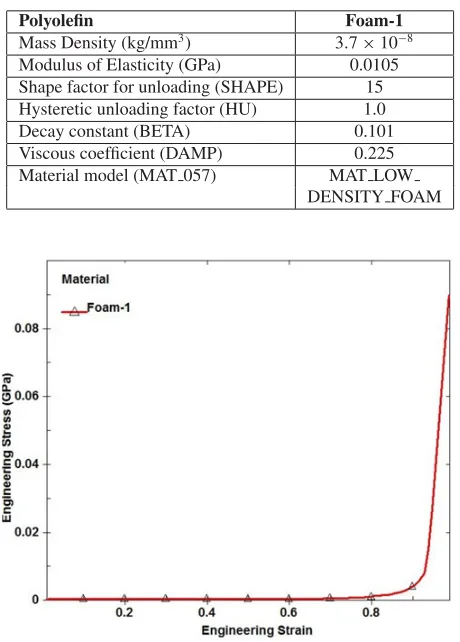
Material properties and material models used for the FEA modelling of Rubbers (R1 and R2) and Polyolefin (F1) are given in the Table2and Table3respectively.
Table 2. Material properties and material data of Rubber-1 and Rubber-2.
Material parameter
Details
Material model MAT MOONEY RIVLIN RUBBER (MAT 027 of LS-DYNA 9.71 software)
Strain energy density function
W=A(I−3)+B(II−3)+ C(III−2−1)+D(III−1)2
I, II and III are invariants of right Cauchy-Green Tensor
C=0.5 A+B
D=[A(5µ−2)+B(11µ−5)]/ (2−4µ)
Shear modulus of linear elasticity
2 (A+B)
µ(Poisson’s ratio)
0.495
Rubber-1 Rubber-2
ρ(mass density)
1.07× 10⁻⁶kg/mm3
0.97×10⁻⁶
A 0.0001243 0.000334
B 6.14×10⁻⁴ 0.00167
Table 3. Material data and material model of the polyolefin
(Foam-1) used in the study.
Polyolefin Foam-1
Mass Density (kg/mm3) 3.7×10⁻⁸
Modulus of Elasticity (GPa) 0.0105 Shape factor for unloading (SHAPE) 15 Hysteretic unloading factor (HU) 1.0
Decay constant (BETA) 0.101
Viscous coefficient (DAMP) 0.225
Material model (MAT 057) MAT LOW
DENSITY FOAM
Figure 2. Stress-Strain curve for the Polyolefin Foam-1 material
(obtained from the quasi-static compression test at 500 mm/min strain rate.
Figure 3. Dynamic deflection response of the MTHOTA when
impacted at 99 m/s impact speed.
Figure 4. Dynamic deflection response of the MTHOTA when
impacted with projectile with 147.03 J of initial Kinetic Energy.
3. Results and discussion
3.1. Evaluation of the blunt thoracic trauma
Blunt thoracic trauma in terms of VCmax was evaluated for all impact cases (3 cases of projectile nose material and 2 cases of impact velocity) using the displacement time histories of the impact plate of the MTHOTA surrogate. Deflection-time responses of impact cases for are illustrated in the Fig.3and Fig.4Stages of MTHOTA and the projectile with polyolefin foam nose during the impact are shown in the Fig.5.
Figure 5. Stages of the MTHOTA when impacted with projectile
with Polyolefinic nose at 99 m/s impact speed.
Table 4. VCmaxvalues evaluated for 99 m/s impact speed.
Nose Maximum Time VCmax
material deflection (mm) (ms) (m/s)
Rubber-1 45.6 3.94 3.81
Rubber-2 44.8 3.29 4.41
Polyolefinic foam 17.6 4.64 0.51
Table 5. VCmaxvalues evaluated for equivalent impact speed.
Nose Maximum Time VCmax
material deflection (mm) (ms) (m/s)
Rubber-1 39.5 4.38 2.57
Rubber-2 40.1 3.19 3.64
Polyolefinic foam 19.1 4.74 0.71
VCmax=1.0 m/s indicate that blunt thoracic trauma point of view the 25% probability for AIS3+ injuries. Both elastomeric rubbers have yielded very high VCmax values and therefore, they are not suiable for making noses of the projectiles. Polyolefinic foam considered for the scholastic study has shown promising results as VCmax values are very much less than the 1.0 m/s. It is important to note that at 99 m/s, benchmark projectile’s VCmax was evaluted as 0.21 m/s using 3-RCS thorax surrogate. In order to evaluate at what impact speed, projectile with the polyolefinic foam nose would provide the similar viscous response, further simulations were carried out using the projectile with the polyolefinic foam nose with impact speeds of 70 and 75 m/s. VCmaxvalues evaluated for these two impact cases were 0.25 and 0.31 m/s respectively.
3.2. Head damage criterion
In the present study, non-linear finite element simulations were carried out by impacting a rigid fixed plate with the projectile with the softnose made up of Rubber-1. Impact speeds considered for this analysis were 20–100 m/s (with an increments of 10 m/s). From the deceleration time histories of the projectile, peak impact forces were evaluated and illustrated in the Fig.6.
Figure 6. Force-time response of MTHOTA when impacted with
the projectile with nose of Rubber-1.
Figure 7. Force-time response of MTHOTA when impacted with
the projectile with nose of Rubber-2.
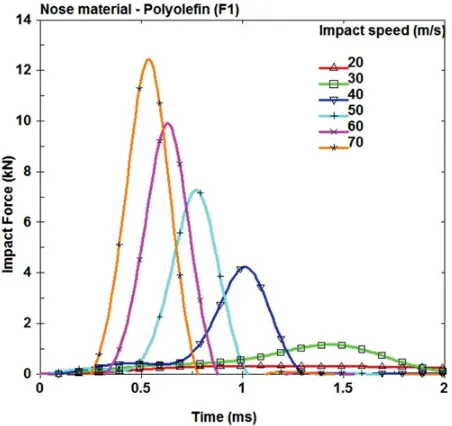
Similar analyses were carried out for nose with materials Rubber-2 and Poly-olefinic foam. Force-time plots obtained from the analyses for these projectile cases are shown in the Fig.7and Fig.8respectively.
Head damage curves (peak impact force versus impact velocity) for all three cases of projectile (R1, R2 and F1 as nose materials), along with the bench projectile (XM 1006 as evaluated by Oukura et al. [11]) are illustrated in the Fig.9.
Figure 8. Force-time response of MTHOTA when impacted with
the projectile with nose of Polyolefin foam (Foam-1).
Figure 9. Head damage curves produced using force-wall
method.
lesser peak impact forces than that of the benchmark projectile.
4. Conclusions
From the synthesis of the outcome of the FEA simulations, the following conclusions were drawn.
1. Projectiles with R1 and R2 noses have produced lesser peak impact forces on the head when compared to that produced by benchmark projectile. But, as far as the blunt thoracic trauama is concerned these projectiles have produced comparatively very high VCmax values, which disqualifies them as nose materials.
2. Projectile with polyolefin (F1) foam nose, as far as the head damage point of view, exibited better characteristics. Though the VCmax values produced by this projectile at 99 m/s is 0.51 m/s which is more than that of the benchmark projectile, the results are very promising.
3. Projectile with polyolefin foam (F1) has produced VCmax value of 0.25 m/s and peak impact force 12.2 kN. Blunt thoracic trauma point of view, at this impact speed, the projectile with F1 nose produced almost an equal effect and head trauma point view, the peak impact force was reduced by 75% when compared with those of the benchmark projectile.
The principal author gratefully acknowledges Mr Velizar Sedev and Mr Jason Tamas, Directors of CAECON of Adelaide of South Australia for complete sponsorship to attend the DYMAT-2015 conference. He also thanks Mr Srinivasa Rao Koya, Chairman of Amerigo Structural Engineers Private Limited, Bangalore, India’ for providing the necessary funds and resources for the successful completion of the research project.
References
[1] J. Widder, C. Perhala, and J. Rascoe, “Caseless, Variable Velocity Systems for Precision Non-Lethal Fires to beyond 100 Meters. Part-II: Terminal effects Study, Selection of Projectile Parameters,” AMMTIAC-WSTIAC Journal vol. 1, pp. 13–16 (2003).
[2] J.M. Widder, D.J. Butz, and J.M. Milosh, “Assessing the Blunt Trauma Potential of Free Flying Projectiles for Development and Safety Certification of Non-Lethal Impactors,” Battelle Columbus Operations, Columbus, OH 43201, USA (1997).
[3] B. Koene, F. Id-Boufker, and A. Papy, “Kinetic non-lethal weapons,” Netherlands annual review of military studies, pp. 9–24 (2008).
[4] (2011, 15/02/2015). X1006 Sponge Round (Point), http://www.globalsecurity.org/military/ systems/munitions/40-nl.htm
[5] (2015, 15/02/2015). Defnse Technology eXact iMpact Sponge Round, 40 mm [Electronic]. Available: http://www.chiefsupply.com/defense- technology-exact-impact-sponge-round-40mm.html
[6] S. Johnson. (2010, February 1, 2015). Taser XREP Up Close (and pricing!). TFB – The Firearms Blog. Available: http://www.thefirearmblog. com/blog/2010/02/10/taser-xrep-up-close-and-pricing/
[7] N.M. Thota, J.A. Eepaarachchi, and K.T. Lau, “Develop and validate a biomechanical surrogate of the human thorax using corrugated sheets: a feasi-bility study,” in Proceedings of the 7th Australasian Congress on Applied Mechanics (ACAM 7), (2012). [8] N. Thota, J. Epaarachchi, and K.T. Lau,
“Devel-opment and validation of a thorax surrogate FE model for assessment of trauma due to high speed blunt impacts,” Journal of Biomechanical Science and Engineering, vol. 9, pp. JBSE0008-JBSE0008 (2014).
Fibre Composites, University of Southern Queens-land, Australia (To be published).
[10] G. Slik, G. Vogel, V. Chawda, and D. Automotive, “Material model validation of a high efficient energy absorbing foam,” in Proceedings of the 5th LS-DYNA Forum (2006).
[11] A. Oukura, C. Robbe, N. Nsiampa, and A. Papy, “Comparison of the lethality of different kinetic energy non-lethal projectiles using a new French assessment approach for head impacts,” presented at the 27th International symposium on ballistics Freiburg, Germany (2013).
[12] D.H. Lyon, “Development of a 40mm nonlethal catridge,” Defense Technology Federal Laboratories Research Journal, pp. 64–78 (1997).
[13] D.H. Lyon, C.A. Bir, and B.J. Patton, “Injury Evaluation Techniques for Non-Lethal Kinetic Energy Munitions,” DTIC Document (1999). [14] C. Bir, D. Viano, and A. King, “Development of
biomechanical response corridors of the thorax to blunt ballistic impacts,” J Biomech, vol. 37, pp. 73–9 Jan. (2004).
[15] C.A. Bir, “The evaluation of blunt ballistic impacts of the thorax,” Doctor of Philosophy, Biomedical Engi-neering, Wayne State University, Detroit, Michigan, USA (2000).
[16] N.M. Thota, J.A. Eepaarachchi, and K.T. Lau, “Effect of energy absorbing mechanisms on the blunt thoracic trauma caused by ballistic impacts,” in Proceedings of the 8th Australasian Congress on Applied Mechanics (ACAM 8), Melbourne Convention Centre, Melbourne, Victoria, Australia (2014).
[17] N.M. Thota, J.A. Eepaarachchi, and K.T. Lau, “Evaluation of the blunt thoracic trauma due to baseball impacts - Review of the blunt criterion,” in Proceedings of the 8th Australasian Congress on Applied Mechanics (ACAM 8), Melbourne Convention Centre, Melbourne, Victoria, Australia (2014).
[18] N.M. Thota, J.A. Eepaarachchi, and K.T. Lau, “Viscous criterion and its relation with the projectile-thorax energy interactions,” in Proceedings of the 8th Australasian Congress on Applied Mechan-ics (ACAM 8), Melbourne Convention Centre, Melbourne, Victoria, Australia (2014).
![Table 1. Human head tolerance limits when subjected to bluntballistic impacts [11].](https://thumb-us.123doks.com/thumbv2/123dok_us/8176466.1365562/2.595.63.273.72.265/table-human-head-tolerance-limits-subjected-bluntballistic-impacts.webp)