IJEDR1503074
International Journal of Engineering Development and Research (www.ijedr.org)1
A Hybrid PSO-GA Approach to Solve Vehicle
Routing Problem
1
Parvinder Kaur,
2Prabhjot Kaur,
1Student, 2Assist. Prof. 1ECE Department, 1BBSBEC, Fatehgarh Sahib, India
________________________________________________________________________________________________________ Abstract - The Vehicle Routing Problem can be expressed as the problem of designing optimal collection or delivery routes from one or multiple depots to a number of terrestrially scattered customers or cities, subject to side constraints such as time, capacity, mileage etc. The VRP plays a key role in the fields of logistics and transportation. There exist a number of variants of VRPs. Mostly VRPs with fixed demands are considered as compared to uncertainty in demands. In this paper meta-heuristic approaches for VRP, namely: Particle Swarm Optimization (PSO) and Genetic Algorithms (GA) are described. These algorithms have some limitations, like pre convergence and local optimization. Thus a new hybrid PSO-GA algorithm is proposed in this paper where properties of PSO and PSO-GA are integrated to deal with VRP. In the proposed algorithm selection procedure is based on PSO and population is updated using crossover and mutation operators of GA. The result obtained from both the standard PSO and the proposed algorithm has been compared. It is analyzed that the hybrid PSO-GA seems to better as compared to PSO to find the optimal route for given vehicle routing problem.
Index Terms - Optimization, Vehicle Routing Problem, PSO, GA, Hybrid PSO-GA Methodology.
________________________________________________________________________________________________________
I.INTRODUCTION
Routing means following a certain path to deliver something. In case of communication systems routing is termed as transmission of data through different nodes. Similarly in the field of transportation routing is defined as transportation of goods from the depot to customers through different physical routes. Later one is called as vehicle routing problem. The VRP can be expressed as the problem of designing optimal routes from a depot to a number of geographically dispersed customers, subject to side constraints. Christofides [1] proposed the name vehicle routing problem for the first time and later on this name became famous as VRP. Number of variants of basic VRP containing different constraints has been put forward.The main goal of the VRP is to find route with minimum cost. This cost may be termed as total distance traveled by the vehicle or the fuel cost. In real world customers or cities to be served are present in geographically dispersed position. There may be so many routes available having unique cost to connect these customers or cities. Among all these available routes it is required to pick those routes which have minimum cost. The VRP deals with such kind of problems. The procedure of finding the minimum cost routes using different approaches is known as VRP optimization. After the introduction of VRP in late 1950’s [2], researchers showed keen interest in this problem and addressed so many methods or algorithms to solve different classes of VRP. Numerous methods have been used to find solution for this problem which includes exact algorithms [3], heuristics and meta-heuristics approaches [4]. These approaches can be integrated to develop hybrid algorithms for better results. In this paper meta-heuristic based solution algorithms, namely: PSO, GA and proposed hybrid PSO-GA are presented.
The PSO is a population based optimization algorithm introduced by Eberhart and Kennedy [5], inspired from the group behavior of bird flocking. PSO has its roots in artificial neural networks, social psychology, computer science and engineering design management. In PSO the process is initialized by generating population of random solutions, known as swarm, and then searches for optimal solution by updating generations.
Genetic Algorithm is a population based stochastic search strategy used to optimize non-linear systems, which emulates the evolution of living beings, introduced by Charles Darwin. Also it is a class of Evolutionary Algorithms (EA). Holland [6] developed the basic concepts of this algorithm. Although the practical use of GA to solve complex problems is described in [7]. Genetic Algorithm involves four discrete phases to create new generation of chromosomes, which includes initialization of population, selection, crossover and mutation. A major difference between natural and artificial GA is that encoding, crossovers, mutations and selection methods can be designed as per the requirement.
The remaining part of paper is ordered as follows: section II describes the fitness function for vehicle routing problem. In section III PSO methodology is discussed. In Section IV proposed hybrid PSO-GA approach is given. Simulation results using MATLAB are given in section V. In last section the research work is concluded along with future work directions.
II.PROBLEMFORMULATION
Assume VRP consists of m customers and a depot. M is the set of total customers and a depot. M= {c0, c1, c3... cm}.
Here c0 represents the depot and the rest is customers. Each vehicle starts its journey from depot c0 and returns to the same depot
after accomplishing the demands of customers. N= {v1, v2, v3...vn} represents a set of vehicles used. The fitness function
IJEDR1503074
International Journal of Engineering Development and Research (www.ijedr.org)2
Distances between the customers and the depot and between the customers have been known. The demand (c) of each customer should be less than the total capacity of vehicle. Demands of customers must be satisfied within the specified time (t).
Variables used in given problem are xijsand yis. Where xijs is 1 if vehicle “s” departs from customer “i” to “j”, otherwise it is 0.
Similarly value of yis is 1 when customer “i” is served by vehicle “s”, otherwise it is 0. Also tij is the time interval between the
customers; cis be the load for the customers.
𝑓𝑖𝑡𝑛𝑒𝑠𝑠 = min {𝛼 ∑
𝑚
𝑖=0
∑
𝑚
𝑗=0
∑ 𝑑𝑖𝑗
𝑛
𝑠=1,𝑗≠1
𝑥𝑖𝑗𝑠+ 𝛽 ∑ 𝑚
𝑖=0
∑ 𝑡𝑖𝑗 𝑚
𝑗=0
+ 𝛾 ∑
𝑚
𝑖=0
∑ 𝑐𝑖𝑗 𝑚
𝑗=0
} (1)
where
m= total number of customers n= total number of vehicles
s= vehicle number from the set of n vehicles
dij = distance from customer i to j. s.t.
∑ 𝑥𝑖𝑗𝑠
𝑚
𝑖=0
= 𝑦𝑖𝑠 𝑗 = 1,2, … . . 𝑚; 𝑠 = 1,2 … . . 𝑛 (2)
∑ 𝑥𝑖𝑗𝑠
𝑚
𝑗=0
= 𝑦𝑖𝑠 𝑖 = 1,2 … . . 𝑚; 𝑠 = 1,2 … . . 𝑛 (3)
∑ 𝑦𝑖𝑠 𝑛
𝑠=1
= 1 𝑠 = 1,2,3 … … … 𝑛 (4)
Equations2 and 3 ensure that route is coherent; Eq. 4 shows that every customer is visited once by single vehicle. To minimize the fitness function all parts of the equation should be minimizes. Also as per the requirement of the user, using weighing parameters α, β and y the priority of each part of fitness function is decided. Also
𝛼 + 𝛽 + 𝛾 = 1
III.PARTICLE SWARM OPTIMIZATION FOR RESOLVING VRP
Applicability of particle swarm optimization (PSO) has been growing rapidly. The algorithm of PSO imitates from behavior of animals societies that don’t follow any leader in their group, as in bird flocking or fish schooling. Typically, a flock of birds will find food randomly by following one of the members of the group having the nearest position with a food source. The flocks achieve their best condition simultaneously by communicating throughout the search. Members who already have a better situation will inform about it to its flocks then others will move simultaneously to that particular place. This process repeats until a food source discovered [8]. In terms of VRP this food source is analogous to optimum route for fleet of vehicles. In PSO, the term “particles” belongs to population members who are subject to velocities and accelerations towards a better mode of behavior. Also the word “swarm” derived from the irregular motion of the particles in the problem hyperspace. In PSO, the initial solutions are called as particles; these particles with given velocities fly through the problem space by following the present optimum particles. At each iteration step, the velocities of the individual particles, as described in Eq.5, are adjusted according to the previous particle’s best position known as local best (pbest) and global best position (gbest). Both the local best and the global best are derived
according to given fitness function [9]. Also Eq. 6 describes the position update corresponding to change in the velocity.
𝑣𝑖𝑘+1= 𝜔𝑣𝑖𝑘+ 𝑐1𝑟1(𝑝𝑖𝑘− 𝑥𝑖𝑘) + 𝑐2𝑟2 (𝑝𝑔𝑘− 𝑥𝑖𝑘) (5)
𝑥𝑖𝑘+1= 𝑥𝑖𝑘+ 𝑣𝑖𝑘+1 (6)
i= 1, 2, 3……….n
where k indicates the iteration number; is weight factor, responsible for controlling the momentum of the particle by weighing the involvement of previous velocity; r1 and r2 are random numbers having value between 0 and 1; c1 and c2 are acceleration coefficients responsible for moving each particle towards global best and local best [10]. Using Eq.7 value of is selected.
𝜔 = 𝜔𝑚𝑎𝑥−
𝜔𝑚𝑎𝑥−𝜔𝑚𝑖𝑛
𝑖𝑡𝑒𝑟𝑚𝑎𝑥 ∗ 𝑖𝑡𝑒𝑟 (7)
where itermax is number of maximum iterations and iter shows current iteration.
IJEDR1503074
International Journal of Engineering Development and Research (www.ijedr.org)3
Figure1. Flow chart describing implementation process of PSO algorithmIV.PROPOSED HYBRID PSO-GA ALGORITHM FOR RESOLVING VRP
From literature it is summarized that the basic PSO have some limitations like pre-convergence and local optimization. Hence a better technique should be required to find optimum results. In this work the PSO is mixed with genetic algorithm which leads to hybrid PSO-GA methodology for VRP optimization. The proposed hybrid PSO-GA algorithm consists of integral of properties of PSO and GA. In this thesis integer encoding is used for population generation because the number of customers and their corresponding location can be defined appropriately in integer form. An Optimization process for resolving VRP using hybrid PSO-GA algorithm is as follows:
Step 1: Set Initial parameters like; scale of search space; number of customers and their respective locations, initial population size and number of maximum iterations for the algorithm. Locations of customers can be selected randomly or manually.
Step 2: Generate initial population (set of initial solutions) randomly and compute the fitness function i.e. minimum total distance travelled using Eq.1 for the given VRP.
Step 3: Discover local best (pbest) and global best (gbest), these values will be further used in computation of best fitness
by implementing PSO selection procedure.
Step 4: Generate a new set of population for next iteration rounds using updating operators of genetic algorithm; crossover and mutation.
Crossover operator: To perform crossover, crossover rate should be defined first. In this work random generation of crossover rate between 0 and 1 is utilized. Now two parents (individuals) are selected from the set of initial population then according to crossover rate inter-change specific particles of selected parents and generate new offspring.
Mutation operator: To perform mutation, mutation rate is defined first as in case of crossover. Choose two offspring from the population then as per mutation rate (between 0 and 1) select two points from the pair of offspring and swap them. The population generated as a result of crossover and mutation is used in next iteration.
Step 5: Again evaluate the fitness function using Eq.1 for the new set of population. Find the global best and local best again. Update the values of global best and local best if and only if they are better than the previous ones. Save new results.
Step 6: Repeat steps 4 and 5 up to maximum number of iterations as given in step 1. And then save the optimized results.
IJEDR1503074
International Journal of Engineering Development and Research (www.ijedr.org)4
V.COMPUTATIONAL RESULTS
In this section the computational performances of standard PSO and hybrid PSO-GA optimization methodologies for VRP are investigated. The performance of proposed algorithm can be checked by comparing the best minimum costs obtained through implementation of both the algorithms using MATLAB (R2010a). All the simulations are realized using dimensions 100*100 for search space. The location of customers is generated randomly within given dimensions. Initial population size (initial set of solutions) is taken 40 for all cases. The value for time interval is considered between [0-10] units and demand for each customer is taken < 1000 units. The Number of customer considered for the given VRP is 20 and 30. Also α=0.7, β=0.2 and y=0.1 is used. Two different cases are presented below to test the performance of proposed algorithm. The control parameters used for both the cases are represented in Table 1.
Table 1 Control Parameters Used
Control Parameters CASE 1 CASE 2
No. of customers 20 30
Initial Population 40 40
Iterations 200 150
For both the cases, the best minimum cost values obtained by implementing PSO and Hybrid PSO-GA are compared. In Figures 2 and 3 the comparisons of these values is shown.
Figure2. Performance comparison of PSO & hybrid PSO-GA for case 1
Figure3. Performance comparison of PSO & hybrid PSO-GA for case 2
0 50 100 150 200 250
1480 1500 1520 1540 1560 1580 1600 1620 1640 1660
Iterations
B
es
t
M
in
im
um
c
os
t
PSO
PSO-GA
0 20 40 60 80 100 120 140 160
2200 2220 2240 2260 2280 2300 2320 2340 2360 2380 2400
Iterations
B
es
t M
in
im
um
c
os
t
IJEDR1503074
International Journal of Engineering Development and Research (www.ijedr.org)5
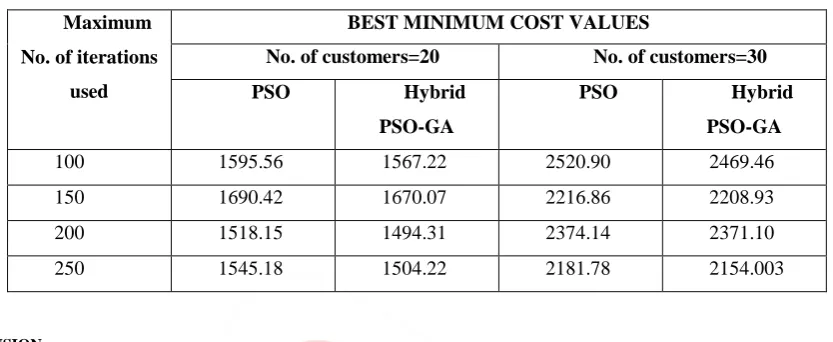
From the above performance comparison graphs it is analyzed that for hybrid PSO-GA, the best minimum cost is less and obtained earlier in comparison to standard PSO for both the cases. This proves that proposed hybrid PSO-GA approach is better. Hence by using proposed algorithm better optimum routes for fleet of vehicles can be generated.Except from cases discussed above, some other cases are also tested to prove the effectiveness of hybrid PSO-GA methodology. Parameters used and the results obtained in these cases are tabulated in Table 2. Dimensions of search space and initial population are same as mentioned in above cases.
Table 2 Summarization of Results Obtained Maximum
No. of iterations
used
BEST MINIMUM COST VALUES
No. of customers=20 No. of customers=30
PSO Hybrid
PSO-GA
PSO Hybrid
PSO-GA
100 1595.56 1567.22 2520.90 2469.46
150 1690.42 1670.07 2216.86 2208.93
200 1518.15 1494.31 2374.14 2371.10
250 1545.18 1504.22 2181.78 2154.003
VI.CONCLUSION
The proposed algorithm has been tested for set of 20 and 30 customers against the standard PSO at different iteration rounds. The empirical results show that the hybrid PSO-GA methodology is competitive in terms of total travel distance. For randomly distributed customers, the hybrid algorithm proves to be more efficient than the basic PSO. The results provide the guidelines for selection of control parameters. The proposed algorithm can also be adopted for Multi depot VRP.
Further study will be conducted to make this algorithm more effective and flexible. In the future, optimized crossover operator can be implemented to further improve the performance of proposed algorithm.
REFERENCES
[1] Christofides, N., “The vehicle routing problem.” RAIRO (Recherche Op´erationnelle), Vol. 10, No. 1, pp. 55–70, 1976. [2] Dantzig, G.B., and John H. Ramser, “The truck dispatching problem”, Management Science, Vol. 10, No. 6, pp. 80-91, 1959. [3] Laporte, G., and Y. Nobert, “Exact algorithms for the vehicle routing problem”, Surveys in Combinatorial Optimization,
North-Holland, Amsterdam, Vol. 31, pp. 147-184, 1987.
[4] Sandhya and Vijay Kumar, “Issues in Solving Vehicle Routing Problem with Time Window and its Variants using Meta heuristics - A Survey”, International Journal of Engineering and Technology, Vol. 3, No. 6, 2013.
[5] Kennedy, J., and R. Eberhart, “Particle Swarm Optimization,” in Proc. IEEE International Conference on Neural Networks, Perth, WA, Vol. 4, pp. 1942–1948, 1995.
[6] Holland, John H., “Adaptation in Natural and Artificial Systems”, MIT Press, Ann Arbor, 1975.
[7] Goldberg, D. E, “Genetic Algorithms in Search, Optimization, and Machine Learning”, Addison-Wesley Publishing Company Inc, New York, 1989.
[8] Rini, D.P., S.M. Shamsuddin and S.S. Yuhaniz, “Particle Swarm Optimization: Technique, System and Challenges”, International Journal of Computer Applications, Vol. 14, No.1, pp. 19-27, 2011.
[9] del Valle, Y., Venayagamoorthy, G.K., Mohagheghi, S., Hernandez, J-C and Harley, R.G., “Particle Swarm Optimization: Basic Concepts, Variants and Applications in Power Systems”, Transactions on Evolutionary Computation, Vol. 12, No. 2, pp. 171-195, IEEE 2008.