International Journal of COPD 2016:11 2369–2376
International Journal of COPD
Dove
press
submit your manuscript | www.dovepress.com 2369
O r I g I n a l r e s e a r C h
open access to scientific and medical research
Open access Full Text article
elevated circulating PaI-1 levels are related to
lung function decline, systemic inflammation, and
small airway obstruction in chronic obstructive
pulmonary disease
hao Wang1,2,*
Ting Yang1,2,*
Diandian li1,2
Yanqiu Wu1,2
Xue Zhang1,2
Caishuang Pang1,2
Junlong Zhang3
Binwu Ying3
Tao Wang1,2
Fuqiang Wen1,2
1Department of respiratory and Critical Care Medicine, West China hospital of sichuan University, Chengdu, sichuan, People’s republic of China; 2Division of Pulmonary Diseases, state Key laboratory of Biotherapy of China, West China hospital of sichuan University, Chengdu, sichuan, People’s republic of China; 3Department of laboratory Medicine, West China hospital of sichuan University, Chengdu, sichuan, People’s republic of China
*These authors contributed equally to this work
Background: Plasminogen activator inhibitor-1 (PAI-1) and soluble urokinase-type plasminogen activator receptor (suPAR) participate in inflammation and tissue remolding in various diseases, but their roles in chronic obstructive pulmonary disease (COPD) are not yet clear. This study aimed to investigate if PAI-1 and suPAR were involved in systemic inflam-mation and small airway obstruction (SAO) in COPD.
Methods: Demographic and clinical characteristics, spirometry examination, and blood samples were obtained from 84 COPD patients and 51 healthy volunteers. Serum concentrations of PAI-1, suPAR, tissue inhibitor of metalloproteinase-1 (TIMP-1), Matrix metalloproteinase-9 (MMP-9), and C-reactive protein (CRP) were detected with Magnetic Luminex Screening Assay. Differences between groups were statistically analyzed using one-way analysis of variance or chi-square test. Pearson’s partial correlation test (adjusted for age, sex, body mass index, cigarette status, and passive smoke exposure) and multivariable linear analysis were used to explore the relationships between circulating PAI-1 and indicators of COPD.
Results: First, we found that serum PAI-1 levels but not suPAR levels were significantly increased in COPD patients compared with healthy volunteers (125.56±51.74 ng/mL versus 102.98±36.62 ng/mL, P=0.007). Then, the correlation analysis showed that circulating PAI-1 was inversely correlated with pulmonary function parameters including the ratio of forced expi-ratory volume in 1 second to forced vital capacity (FEV1/FVC), FEV1/Pre (justified r=-0.308,
P,0.001; justified r=-0.295, P=0.001, respectively) and SAO indicators such as FEV3/FVC, MMEF25–75/Pre (justified r=-0.289, P=0.001; justified r=-0.273, P=0.002, respectively), but positively related to the inflammatory marker CRP (justified r=0.351, P,0.001), the small air-way remolding biomarker TIMP-1, and MMP-9 (justified r=0.498, P,0.001; justified r=0.267,
P=0.002, respectively). Besides, multivariable linear analysis showed that FEV1/FVC, CRP, and TIMP-1 were independent parameters associated with PAI-1.
Conclusion: Our findings first illustrate that elevated serum PAI-1 levels are related to the lung function decline, systemic inflammation, and SAO in COPD, suggesting that PAI-1 may play critical roles in the pathogenesis of COPD.
Keywords: plasminogen activator inhibitor-1 (PAI-1), chronic obstructive pulmonary disease (COPD), systemic inflammation, small airway obstruction (SAO)
Introduction
Chronic obstructive pulmonary disease (COPD) is a worldwide health care problem characterized by progressive airflow limitation, which is rarely reversible.1 The World Correspondence: Fuqiang Wen
Department of respiratory and Critical Care Medicine, West China hospital of sichuan University, guoxuexiang 37, Chengdu, sichuan 610041, People’s republic of China
Tel +86 28 8542 2350 Fax +86 28 8558 2944
email [email protected]
Journal name: International Journal of COPD Article Designation: Original Research Year: 2016
Volume: 11
Running head verso: Wang et al
Running head recto: Elevated circulating PAI-1 in COPD DOI: http://dx.doi.org/10.2147/COPD.S107409
International Journal of Chronic Obstructive Pulmonary Disease downloaded from https://www.dovepress.com/ by 118.70.13.36 on 22-Aug-2020
For personal use only.
Number of times this article has been viewed
This article was published in the following Dove Press journal: International Journal of COPD
Dovepress Wang et al
Health Organization predicted that COPD would become the third leading cause of death and might move up to the fifth leading cause of disability-adjusted life years by 2030.2,3
Aside from airway inflammation and oxidative stress, recent studies suggested that small airway obstruction (SAO) caused by small airway remolding (SAR) along with aber-rant extracellular matrix (ECM) deposition also contributed to the pathogenesis of COPD.4 On the other hand, more and
more evidences showed that airway inflammation might also “spread” into the circulatory system and cause systemic inflammatory injuries and organ damage.5 However,
argu-ments about how they work in COPD and what factors are involved have never stopped.
As we know, plasminogen activator inhibitor-1 (PAI-1) was first identified as an important PAI expressed by cultured bovine endothelial cells6 and many other different types of cells
in various tissues.7 During the past decades, numerous clinical
and laboratory studies have evaluated the various functions of this unique serpin, including regulating fibrinolysis in the pro-cess of thrombus formation, promoting ECM, contributing to atherosclerosis,8 bone remolding,9 renal fibrosis,8 myocardial
infarction, and diabetic vascular damage.10 Mostly, PAI-1 is
found to act in the aforementioned roles by interacting with the urokinase-type activator (uPA) system, which is known for its contribution to the fibrinolysis in blood.11 Meanwhile,
recent studies have found that uPA system, including uPA and urokinase-type activator receptor (uPAR), is involved in inflammation and tissue remolding.12 Interestingly, sputum
levels of PAI-1 and soluble uPAR (suPAR) were found to be increased in COPD patients.13,14 These findings raised the
problem of whether PAI-1 and uPA system is involved in the inflammatory response and tissue remolding in COPD? Unfortunately, there is no definite answer until now.
Therefore, we measured the serum levels of PAI-1 and suPAR in COPD patients and healthy subjects and analyzed if these two circulatory biomarkers were related to lung function decline, systemic inflammation, and SAO so as to explore the potential roles of PAI-1 and suPAR in COPD.
Methods
study protocol
The study protocol conformed to the principles of the Declara-tion of Helsinki and was approved by the Ethic Committee of West China Hospital, Sichuan University, People’s Republic of China. All subjects gave written informed consents before the study. Between October 2013 and March 2014, naïve COPD patients and healthy controls without active pulmonary disorders were recruited from the Outpatient Department of West China Hospital. Every subject received a standard lung
function test according to the American Thoracic Society and European Respiratory Society guidelines;15 briefly, all the
subjects underwent three-time eligible prebronchodilation spirometry tests and postbronchodilation spirometry tests. Then, COPD was diagnosed prospectively for this study on the basis of the Global Initiative for Chronic Obstructive Lung Disease (GOLD) criteria.1 To be included in the study,
patients had to show a ratio of forced expiratory volume in the first second to forced vital capacity (FEV1/FVC) below 70% after bronchodilation and an increase in FEV1 below 12% after inhalation of β2-agonist (200 mg salbutamol). Meanwhile, during the final 3 months, they had to be clini-cally stable. All the enrolled patients and controls had never received standard COPD-related therapies such as inhaled corticosteroids, bronchodilator, etc. Chest X-ray and elec-trocardiogram were performed to exclude the comorbidities such as pneumonia, pulmonary tuberculosis, lung cancer, cardiomegaly, myocardial ischemia, arrhythmia, and other cardiopulmonary disorders. Patients were also excluded if they had conditions known to affect serum levels of PAI-1, suPAR, or C-reactive protein (CRP), including hemorrhagic and clotting disorders, diabetes, stroke, acute infectious disorders, and so on.
Collection of the basic information
The basic information of enrolled subjects, including age, sex, height, weight, cigarette status, passive cigarette exposure, main complaints, and medical history, was collected by two individual investigators. Body mass index (BMI) was calcu-lated using the formula weight/square of height. To avoid the contrived bias, the third investigator assessed this information and had it confirmed by the subjects, and all the investigators were blind to the spirometry reports of the subjects.
Measurement of PaI-1, suPar, CrP,
TIMP-1, and MMP-9
The COPD patients and healthy controls were requested to fast overnight from 22:00 the night before; the next morning venous blood samples were collected from the median cubital vein, and 1 hour later, serum was separated by centrifugation at 3,000 revolutions per minute for 10 minutes and stored at -80°C until analysis. Serum levels of PAI-1, suPAR, CRP, tissue inhibitor of metalloproteinase-1 (TIMP-1), and Matrix metalloproteinase-9 (MMP-9) were detected using a Magnetic Luminex Screening Assay (R&D Systems, Minneapolis, MN, USA) on the Bio-Plex 200 (Bio-Rad, CA, USA) at the Department of Laboratory Medicine of West China Hospital. The detection sensitivities were 0.67 pg/mL for PAI-1, 43.2 pg/mL for suPAR, 116 pg/mL for CRP,
International Journal of Chronic Obstructive Pulmonary Disease downloaded from https://www.dovepress.com/ by 118.70.13.36 on 22-Aug-2020
Dovepress elevated circulating PaI-1 in COPD
3.42 pg/mL for TIMP-1, and 13.6 pg/mL for MMP-9. All the measurements were carried out strictly according to the manufacturer’s instructions, and technicians who performed tests were blinded to the clinical details of the subjects.
statistical analysis
All the data are presented as mean ± standard deviation (SD). Differences between groups were statistically ana-lyzed using one-way analysis of variance or chi-square test when appropriate. Then, correlations between different serum biomarkers and lung functions were tested using Pearson’s partial correlation test adjusting for age, sex, BMI, pack-years, and passive cigarette exposure status. Finally, multivariable linear analysis was conducted to confirm the aforementioned relationships. The threshold of significance was set at two-side 5%. Data were analyzed, and figures were created with GraphPad Prism 6.01 for Windows (GraphPad Software Inc, La Jolla, CA, USA).
Results
Clinical characteristics of subjects
We enrolled 43 COPD smokers, 41 COPD nonsmokers, 18 healthy smokers, and 33 healthy nonsmokers. According to the GOLD standard, among these 84 COPD patients, there were 44 GOLD 1, 35 GOLD 2, 4 GOLD 3, and 1 GOLD 4
patients. Table 1 lists the demographic and clinical charac-teristics including age, sex, BMI, smoking status, pack-years, passive smoke exposure, lung function data, and serum levels of PAI-1, suPAR, and CRP. No significant difference in age, BMI, and passive smoke exposure was observed among these four groups. However, irrespective of COPD group or the healthy group, almost all the smokers were males. Lung function data illustrated that COPD patients were suffering from more serious SAO as their maximum midexpiratory flow (MMEF)/Pre and FEV3/FVC were largely decreased when compared with healthy controls.
Circulatory PaI-1 but not suPar was
upregulated in COPD patients
First, we compared PAI-1 and suPAR levels between COPD patients and healthy subjects. As listed in Table 1, serum PAI-1 levels in COPD patients was significantly increased in comparison with healthy subjects (125.56±51.74 ng/mL versus 102.98±36.62 ng/mL, P=0.007); more specifically, COPD smokers had higher levels of PAI-1 compared with healthy nonsmokers, healthy smokers, and COPD nonsmokers (136.16±52.61 ng/mL versus 99.29±37.14 ng/mL, 109.74±35.69 ng/mL, and 114.43±49.00 ng/mL, P,0.05, respectively, Figure 1A). Similarly, serum levels of CRP in COPD smokers were the highest among these four groups
Table 1 Characteristics of healthy volunteers and COPD patients
Characteristics Healthy controls (N=51) COPD (N=84) P-value
Nonsmokers (HN, 33)
Smokers (HS, 18)
Nonsmokers (CN, 41)
Smokers (CS, 43)
age, years 59.21±10.64 56.94±12.52 60.27±9.32 63.74±9.63 0.076
sex, male/femalea 10/23 17/1 12/29 43/0 ,0.001b
BMI, kg/m2 23.04±5.40 20.11±7.75 23.50±2.79 22.50±2.75 0.057
Current smokers (%) na 14 (77.78) na 29 (67.44) 0.544a
Former smokers (%) na 4 (22.22) na 14 (32.56)
Pack-years for ever-smokers na 23.01±13.91 na 28.15±20.48 0.356
Passive smoke exposure (%)a 11 (33.33) 5 (27.78) 10 (24.39) 10 (23.26) 0.771a
FeV1, l 2.28±0.84 3.11±0.56 1.68±0.50 2.05±0.71 ,0.001b
FVC, l 2.99±0.95 4.04±0.62 2.87±0.62 3.72±0.81 ,0.001b
FeV1/FVC, % 81.38±5.68 77.39±5.51 58.03±10.88 57.67±9.69 ,0.001b
FeV1/Pre, % 110.00±19.05 111.44±15.05 79.37±21.31 81.70±19.24 ,0.001b
FeV3/FVC, % 95.00±3.68 92.17±3.91 79.49±9.92 77.89±9.39 ,0.001b
MMeF25–75, l/s 2.17±0.95 2.70±1.04 0.73±0.35 0.84±0.52 ,0.001b
MMeF25–75/Pre, % 70.57±23.84 77.69±22.74 24.66±11.59 26.14±14.02 ,0.001b
PaI-1, ng/ml 99.29±37.14 109.74±35.69 114.43±49.00 136.16±52.61c–e 0.006b
suPar, pg/ml 697.26±366.34 698.12±339.84 797.06±412.79 746.52±507.10 0.829
CrP (μg/ml) 1.08±1.12 1.06±1.19 1.91±2.50 2.84±3.08c,d 0.005b
Notes: Data are presented as mean ± standard deviation; aχ2 test was used to test the significance of the difference between two groups; bthese characteristics are significantly
different between groups; crepresents significance for CS versus HN; dfor Cs versus hs; efor Cs versus Cn. P,0.05 was considered to be statistically significant. Abbreviations: COPD, chronic obstructive pulmonary disease; BMI, body mass index; kg/m2, kilogram per square meter; FeV
1, forced expiratory volume in the first second;
FVC, forced vital capacity; MMEF, maximum midexpiratory flow; PAI-1, plasminogen activator inhibitor-1; suPAR, soluble urokinase-type activator receptor; CRP, C-reactive protein; na, not applicable.
International Journal of Chronic Obstructive Pulmonary Disease downloaded from https://www.dovepress.com/ by 118.70.13.36 on 22-Aug-2020
Dovepress Wang et al
(2.84±3.08 μg/mL, P=0.005). Moreover, PAI-1 levels increased in patients with GOLD 2–4 COPD compared with healthy subjects and GOLD 1 COPD patients (138.85±55.59 ng/mL versus 102.98±36.62 ng/mL and 113.47±45.28 ng/mL, P,0.05, respectively, Figure 1B). However, serum suPAR levels showed no difference among these different patients and healthy subjects (P=0.829).
PaI-1 levels were correlated with lung
function and systemic inflammation
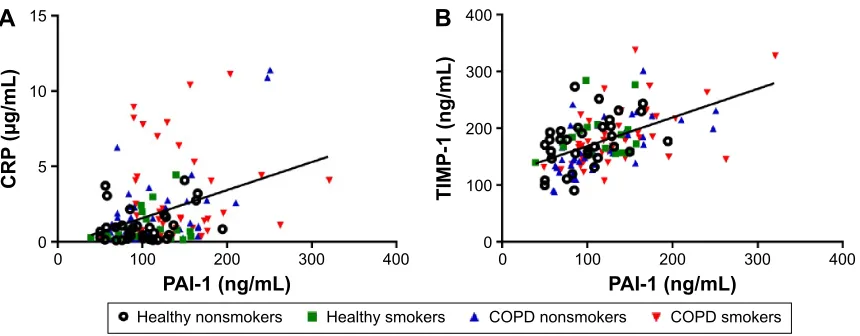
Next, we studied the relationship between PAI-1 and COPD-related parameters (Table 2). As can be seen from Table 2, serum PAI-1 levels were inversely related to FEV1/FVC (justified r=-0.308, P,0.001, Figure 2A) and FEV1/Pre (justified r=-0.295, P=0.001, Figure 2B) after adjusting for age, sex, BMI, pack-years, and passive cigarette exposure status. Meanwhile, PAI-1 levels showed a positive relationship with CRP levels (justified r=-0.351, P,0.001, Figure 3A).
Serum PAI-1 levels reflected SAO
and sar
Also, from the data given in Table 2, we observe inverse correlations between PAI-1 levels and spirometry index of SAO, including the ratio of FEV3/FVC (justified r=-0.289,
P=0.001) and the ratio of MMEF25–75/Pre (justified
r=-0.273, P=0.002). Furthermore, PAI-1 levels were posi-tively related to TIMP-1 levels (justified r=0.498, P,0.001, Figure 3B) and MMP-9 levels (justified r=0.267, P=0.002). Besides, a positive relationship was observed between PAI-1 levels and suPAR levels (justified r=0.210, P=0.016).
+HDOWK\
QRQVPRNHUV VPRNHUV+HDOWK\ QRQVPRNHUV&23' VPRNHUV&23'
3
3
3
*URXSV
3$,QJP/
$
3
3
+HDOWK\
VXEMHFWV *2/' &23'
*URXSV
3$,QJP/
*2/'±
%
Figure 1 serum PaI-1 levels in subjects.
Notes: Serum PAI-1 levels significantly increased in COPD smokers compared with other groups (A); meanwhile, it was higher in gOlD 2–4 COPD patients compared with healthy subjects and gOlD 1 COPD patients (B).
Abbreviations: PaI-1, plasminogen activator inhibitor-1; COPD, chronic obstructive pulmonary disease; gOlD, global Initiative for Chronic Obstructive lung Disease.
Table 2 Correlations between serum PaI-1 levels, suPar levels, and COPD-related characteristics in all subjects
Parameter PAI-1 (justified) suPAR (justified)
FeV1/FVC
r -0.308 0.014
P ,0.001 0.873
FeV1/Pre
r -0.295 -0.133
P 0.001 0.132
FeV3/FVC
r -0.289 0.021
P 0.001 0.817
MMeF25–75/Pre
r -0.273 -0.046
P 0.002 0.602
CrP
r 0.351 0.188
P ,0.001 0.032
TIMP-1
r 0.498 0.456
P ,0.001 ,0.001
MMP-9
r 0.267 0.133
P 0.002 0.132
suPar
r 0.210 –
P 0.016 –
Notes: The value of r represents the Pearson’s partial correlation coefficient adjusted for age, sex, BMI, cigarette status, and passive smoke exposure (in the
column titled PAI-1 (justified)). P,0.05 was considered to be statistically significant.
Data in bold indicates statistical significance.
Abbreviations: PaI-1, plasminogen activator inhibitor-1; suPar, soluble urokinase-type activator receptor; COPD, chronic obstructive pulmonary disease; FeV1, forced
expiratory volume in the first second; FVC, forced vital capacity; FEV1/FVC, ratio of
FeV1 to FVC; FeV1/Pre, FeV1 percent predicted; FeV3/FVC, ratio of forced expiratory
volume in 3 seconds to FVC; MMEF25–75, maximum midexpiratory flow; MMEF25–75/ Pre, MMeF25–75 percent predicted; CrP, C-reactive protein; TIMP-1, tissue inhibitor of metalloproteinase-1; MMP-9, Matrix metalloproteinase-9; BMI, body mass index.
International Journal of Chronic Obstructive Pulmonary Disease downloaded from https://www.dovepress.com/ by 118.70.13.36 on 22-Aug-2020
Dovepress elevated circulating PaI-1 in COPD
serum suPar were related to CrP
and TIMP-1
On the other hand, serum suPAR levels showed positive correlations with CRP levels (adjusted r=0.188, P=0.032) and TIMP-1 levels (adjusted r=0.456, P,0.001). However, it showed no relationship with lung function parameters and MMP-9 levels.
Multivariable linear analysis
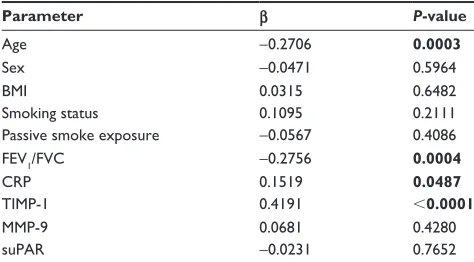
Finally, we performed a multivariable linear analysis for circulating PAI-1 levels and found that age, FEV1/FVC, CRP, and TIMP-1 were the independent parameters associated with PAI-1, as listed in Table 3.
Discussion
Our main goal was to explore the role of PAI-1 and suPAR in COPD. First, we measured and compared the serum PAI-1 and suPAR levels in healthy nonsmokers, healthy smokers, COPD nonsmokers, and COPD smokers. Then, we analyzed the correlations between serum PAI-1, suPAR levels, and indicators of lung function decline, systemic inflammation, and SAO. Finally, we found that serum PAI-1 levels were significantly increased in COPD patients, especially COPD smokers, and serum PAI-1 levels were related to lung func-tion parameters such as FEV1/Pre and FEV1/FVC, systemic inflammation indicators represented by serum CRP, and SAO parameters including FEV3/FVC, MMEF25–75/Pre, serum
+HDOWK\QRQVPRNHUV +HDOWK\VPRNHUV &23'QRQVPRNHUV &23'VPRNHUV
3$,QJP/
)(9
)9&
$
)(9
3UH
3$,QJP/
%
Figure 2 Circulating PaI-1 levels were related to lung function.
Notes: PaI-1 levels were reversely correlated with FeV1/FVC (adjusted r=-0.308, P,0.001, (A) and FeV1/predicted (adjusted r=-0.295, P=0.001, (B). The solid line denotes
the line of best fit, and Pearson’s partial correlation coefficient is presented as an adjusted r-value.
Abbreviations: PaI-1, plasminogen activator inhibitor-1; FeV1, forced expiratory volume in the first second; FVC, forced vital capacity.
+HDOWK\QRQVPRNHUV +HDOWK\VPRNHUV &23'QRQVPRNHUV &23'VPRNHUV
3$,QJP/
&53
JP/
$
3$,QJP/
7,03QJP/
%
Figure 3 Correlations between serum PaI-1 levels and established COPD-related biomarkers.
Notes: PaI-1 levels were positively correlated with CrP (adjusted r=0.351, P,0.001, A) and TIMP-1 (adjusted r=0.498, P,0.001, B). The solid line denotes the line of best
fit, and Pearson’s partial correlation coefficient is presented as an adjusted r-value.
Abbreviations: PaI-1, plasminogen activator inhibitor-1; COPD, chronic obstructive pulmonary disease; CrP, C-reactive protein.
International Journal of Chronic Obstructive Pulmonary Disease downloaded from https://www.dovepress.com/ by 118.70.13.36 on 22-Aug-2020
Dovepress Wang et al
TIMP, and serum MMP-9. On the other hand, however, serum suPAR levels only showed association with CRP and TIMP-1 levels. These findings implied that PAI-1 might be involved in the inflammation responses and airway remolding process in COPD.
First, we found that serum PAI-1 level, but not suPAR, was increased significantly in COPD patients, especially COPD smokers compared with other subjects, and negatively related to FEV1/Pre and FEV1/FVC. As a serpin with multiple func-tions, PAI-1 was first identified as an inhibitor of plasminogen activation system.16 By interacting with uPAR, PAI-1 showed
profibrogenic properties and acted as a meaningful serum biomarker in various pulmonary diseases such as pulmonary fibrosis17 and asthma.18 Previous studies illustrated that
ciga-rette smoke exposure could apparently increase the expression of PAI-1 in mice,19 and sputum PAI-1 levels are significantly
increased in COPD patients.13 Thus, our finding confirmed that
PAI-1 might be related to cigarette smoke exposure in COPD. Besides, we found that serum PAI-1 was positively related to suPAR, which was consistent with the result of the previous study, which indicated that plasminogen activation system (especially uPA system) was invoked in COPD.11
Then, our data showed a positive relationship between serum PAI-1 and serum CRP. Recently, it has been widely accepted that COPD-related inflammation was not only lim-ited to the local airway, but could also “spread” to the whole body, which was termed systemic inflammation.20 As the most
widely investigated biomarker of systemic inflammation, CRP was found to relate to airflow obstruction21 and disease
severity of COPD.22 This was confirmed in our study by
dem-onstrating that serum CRP was increased in COPD patients. Meanwhile, basic research indicated that PAI-1 regulated lipopolysaccharide-induced inflammation via targeting on the
TLR4/NF-κB signaling pathway in alveolar macrophages,23
and elevated PAI-1 expression promoted alveolar epithelial cell apoptosis and exacerbated lung inflammation induced by influenza A virus.19 On the other hand, Chen et al24 found
that CRP could increase the expression of PAI-1 via medi-ating oxidative stress and MAPK signal pathway in human coronary endothelial cells. Therefore, our findings suggested for the first time that PAI-1 may be associated with systemic inflammatory responses in COPD.
In addition, we observed that serum PAI-1 was related to SAO parameters, including MMEF25–75/Pre and FEV3/ FVC, and SAR indicators such as TIMP-1 and MMP-9. As we know, SAR affecting bronchioles, especially respiratory bron-chioles that were the transition zones between the airway and alveolar spaces, was the leading cause of SAO, which induces the persistent airflow limitation in COPD.25 More specifically,
as the main mechanism of SAR, epithelial–mesenchymal transition (EMT) mainly involving MMP and TIMP families played vital roles in the pathogenesis of COPD.26 Previous
studies have identified MMPs as a family of enzymes that were capable of degrading all components of the ECM involved in the EMT process27 and found that members of the MMP
family were selectively inhibited by specific individuals of TIMPs. Particularly, TIMP-1 has been shown to bind to both the active and latent forms of MMP-9 and inhibit its enzymatic activity. Overall, TIMP-1 and MMP-9 regulated the balance between degradation and deposition of ECM, which were involved in airway remolding.28 On the other hand, clinical
investigations showed that serum TIMP-1 and MMP-9 levels were markedly increased and significantly negatively related to FEV1/FVC or FEV1% predicted in COPD patients.29,30
These studies identified TIMP-1 and MMP-9 as serum bio-markers of SAR and SAO in COPD. Therefore, the positive relationship between serum TIMP-1, MMP-9 and PAI-1 found in our study indicated that serum PAI-1 might be involved in the EMT and SAR process in COPD.
Besides, serum suPAR only showed positive correlations with serum TIMP-1 and CRP in our study, which is consistent with previous findings that increased uPAR expression in the small airway epithelium is involved in the EMT process in COPD patients.31 These findings implied that suPAR might
act synergistically with PAI-1 in SAR and systemic inflam-mation in COPD.
Finally, we performed multivariable linear analysis for PAI-1 and found that FEV1/FVC, CRP, and TIMP-1 were the independent parameters associated with PAI-1, which confirmed the relationship between PAI-1 and lung function decline, systemic inflammation, and SAO in COPD.
Table 3 Multivariable linear analysis for circulating PaI-1 levels
Parameter β P-value
age -0.2706 0.0003
sex -0.0471 0.5964
BMI 0.0315 0.6482
smoking status 0.1095 0.2111
Passive smoke exposure -0.0567 0.4086
FeV1/FVC -0.2756 0.0004
CrP 0.1519 0.0487
TIMP-1 0.4191 ,0.0001
MMP-9 0.0681 0.4280
suPar -0.0231 0.7652
Notes: The value of β represents standard regression coefficient. Bold denotes a value of P,0.05.
Abbreviations: BMI, body mass index; FeV1/FVC, ratio of FeV1 to FVC; CrP,
C-reactive protein; TIMP-1, tissue inhibitor of metalloproteinase-1; MMP-9, Matrix metalloproteinase-9; suPar, soluble urokinase-type activator receptor.
International Journal of Chronic Obstructive Pulmonary Disease downloaded from https://www.dovepress.com/ by 118.70.13.36 on 22-Aug-2020
Dovepress elevated circulating PaI-1 in COPD
In this study, we only enrolled 135 subjects because of the rigorous inclusion and exclusion criteria; this would limit the
P-value in the correlation analysis. Meanwhile, we evaluated
the relationship between PAI-1 levels and SAR only based on the correlation analysis with four indirect indicators TIMP-1, MMP-9, FEV3/FVC, and MMEF25–75/Pre. To avoid these limi-tations, future studies should enroll more COPD and healthy sub-jects and collect more evidences of SAR, such as high-resolution computed tomography, biopsy, or other direct indicators.
Conclusion
In conclusion, our findings first revealed the hypothesis that PAI-1 might be associated with lung function decline, systemic inflammation, and SAO in COPD. A previous study showed that airway inflammation and chronic airway remolding induced by ovalbumin were attenuated in PAI-1 gene knockout mice and wide-type mice receiving intra-tracheal administrations of small interfering RNA against PAI-1.32 In combination with this study, we suggested that
PAI-1 might be introduced into clinical practice as a thera-peutic target of COPD in the future. However, larger, in-depth clinical and laboratory studies are needed to confirm our find-ings and explore how elevated PAI-1 play roles in COPD.
Acknowledgments
This work was supported by grants from the National Natural Science Foundation of China (NSFC, Grants 81470236, 81230001, and 31171103) and National key Technology Research and Development Program of the Ministry of Science and Technology of China during of the “12th Five-Year Plan” (Grants 2012BAI05B02 and 2014BAI08B04) to Prof Fuqiang Wen, NSFC Grant 81300011 to Dr Ting Yang, and NSFC Grant 81200031 to Dr Lei Chen.
Author contributions
Hao Wang and Fuqiang Wen designed this research, and all authors contributed toward subjects recruit, data collection, statistical analysis, drafting, and critically revising the paper, gave final approval of the version to be published, and agree to be accountable for all aspects of the work.
Disclosure
The authors declare no conflicts of interests in this work.
References
1. GOLD. Global Strategy for the Diagnosis, Management, and Prevention of COPD (Updated 2015). Global Initiative for Chronic Obstructive Lung Disease; 2015. Available from: http://goldcopd.org/. Accessed September 14, 2016.
2. WHO. The Global Burden of Disease (2004 Update). Geneva: World Health Organization; 2008.
3. WHO. Global Health Estimates Summary Tables: Deaths by Cause, Age and Sex by Various Regional Grouping. Geneva: World Health Organization; 2013.
4. Kranenburg AR, Willems-Widyastuti A, Moori WJ, et al. Enhanced bronchial expression of extracellular matrix proteins in chronic obstruc-tive pulmonary disease. Am J Clin Pathol. 2006;126(5):725–735. 5. Agusti A, Edwards LD, Rennard SI, et al. Persistent systemic
inflam-mation is associated with poor clinical outcomes in COPD: a novel phenotype. PloS One. 2012;7(5):e37483.
6. Loskutoff DJ, van Mourik JA, Erickson LA, Lawrence D. Detection of an unusually stable fibrinolytic inhibitor produced by bovine endothelial cells. Proc Natl Acad Sci U S A. 1983;80(10):2956–2960.
7. Simpson AJ, Booth NA, Moore NR, Bennett B. Distribution of plasmi-nogen activator inhibitor (PAI-1) in tissues. J Clin Pathol. 1991;44(2): 139–143.
8. Ha H, Oh EY, Lee HB. The role of plasminogen activator inhibitor 1 in renal and cardiovascular diseases. Nat Rev Nephrol. 2009;5(4): 203–211.
9. Daci E, Verstuyf A, Moermans K, Bouillon R, Carmeliet G. Mice lack-ing the plasminogen activator inhibitor 1 are protected from trabecular bone loss induced by estrogen deficiency. J Bone Miner Res. 2000;15(8): 1510–1516.
10. Lyon CJ, Hsueh WA. Effect of plasminogen activator inhibitor-1 in diabetes mellitus and cardiovascular disease. Am J Med. 2003;115 (Suppl 8A):62s–68s.
11. Schuliga M, Westall G, Xia Y, Stewart AG. The plasminogen activation system: new targets in lung inflammation and remodeling. Curr Opin Pharmacol. 2013;13(3):386–393.
12. Del Rosso M, Margheri F, Serrati S, Chilla A, Laurenzana A, Fibbi G. The urokinase receptor system, a key regulator at the intersection between inflammation, immunity, and coagulation. Curr Pharm Des. 2011;17(19): 1924–1943.
13. To M, Takagi D, Akashi K, et al. Sputum plasminogen activator inhibitor-1 elevation by oxidative stress-dependent nuclear factor-kappaB activation in COPD. Chest. 2013;144(2):515–521.
14. Xiao W, Hsu YP, Ishizaka A, Kirikae T, Moss RB. Sputum cathelicidin, urokinase plasminogen activation system components, and cytokines dis-criminate cystic fibrosis, COPD, and asthma inflammation. Chest. 2005; 128(4):2316–2326.
15. Miller MR, Hankinson J, Brusasco V, et al. Standardisation of spirom-etry. Eur Respir J. 2005;26(2):319–338.
16. Declerck PJ, Gils A. Three decades of research on plasminogen activator inhibitor-1: a multifaceted serpin. Semin Thromb Hemost. 2013;39(4): 356–364.
17. Kotani I, Sato A, Hayakawa H, Urano T, Takada Y, Takada A. Increased procoagulant and antifibrinolytic activities in the lungs with idiopathic pulmonary fibrosis. Thromb Res. 1995;77(6):493–504.
18. Cho S, Kang J, Lyttle C, et al. Association of elevated plasminogen activator inhibitor 1 levels with diminished lung function in patients with asthma. Ann Allergy Asthma Immunol. 2011;106(5):371–377. 19. Bhandary YP, Shetty SK, Marudamuthu AS, et al. Plasminogen
acti-vator inhibitor-1 in cigarette smoke exposure and influenza A virus infection-induced lung injury. PloS One. 2015;10(5):e0123187. 20. Agusti AG, Noguera A, Sauleda J, Sala E, Pons J, Busquets X.
Sys-temic effects of chronic obstructive pulmonary disease. Eur Respir J. 2003;21(2):347–360.
21. Eickhoff P, Valipour A, Kiss D, et al. Determinants of systemic vascular function in patients with stable chronic obstructive pulmonary disease. Am J Respir Crit Care Med. 2008;178(12):1211–1218.
22. de Torres JP, Cordoba-Lanus E, Lopez-Aguilar C, et al. C-reactive protein levels and clinically important predictive outcomes in stable COPD patients. Eur Respir J. 2006;27(5):902–907.
23. Ren W, Wang Z, Hua F, Zhu L. Plasminogen activator inhibitor-1 regulates LPS-induced TLR4/MD-2 pathway activation and inflam-mation in alveolar macrophages. Inflaminflam-mation. 2015;38(1):384–393.
International Journal of Chronic Obstructive Pulmonary Disease downloaded from https://www.dovepress.com/ by 118.70.13.36 on 22-Aug-2020
International Journal of COPD
Publish your work in this journal
Submit your manuscript here: http://www.dovepress.com/international-journal-of-chronic-obstructive-pulmonary-disease-journal
The International Journal of COPD is an international, peer-reviewed journal of therapeutics and pharmacology focusing on concise rapid reporting of clinical studies and reviews in COPD. Special focus is given to the pathophysiological processes underlying the disease, intervention programs, patient focused education, and self management protocols.
This journal is indexed on PubMed Central, MedLine and CAS. The manuscript management system is completely online and includes a very quick and fair peer-review system, which is all easy to use. Visit http://www.dovepress.com/testimonials.php to read real quotes from published authors.
Dovepress
Dove
press
Wang et al
24. Chen C, Nan B, Lin P, Yao Q. C-reactive protein increases plasminogen activator inhibitor-1 expression in human endothelial cells. Thromb Res. 2008;122(1):125–133.
25. Hogg JC, Chu F, Utokaparch S, et al. The nature of small-airway obstruction in chronic obstructive pulmonary disease. N Engl J Med. 2004;350(26):2645–2653.
26. Pain M, Bermudez O, Lacoste P, et al. Tissue remodelling in chronic bronchial diseases: from the epithelial to mesenchymal phenotype. Eur Respir Rev. 2014;23(131):118–130.
27. Woessner JF Jr. Matrix metalloproteinases and their inhibitors in con-nective tissue remodeling. FASEB J. 1991;5(8):2145–2154.
28. Baratelli FE, Heuze-Vourc’h N, Krysan K, et al. Prostaglandin E2-dependent enhancement of tissue inhibitors of metalloproteinases-1 production limits dendritic cell migration through extracellular matrix. J Immunol. 2004;173(9):5458–5466.
29. Higashimoto Y, Yamagata Y, Iwata T, et al. Increased serum concentra-tions of tissue inhibitor of metalloproteinase-1 in COPD patients. Eur Respir J. 2005;25(5):885–890.
30. Linder R, Ronmark E, Pourazar J, Behndig A, Blomberg A, Lindberg A. Serum metalloproteinase-9 is related to COPD severity and symptoms – cross-sectional data from a population based cohort-study. Respir Res. 2015;16(1):28.
31. Wang Q, Wang Y, Zhang Y, Zhang Y, Xiao W. The role of uPAR in epithelial-mesenchymal transition in small airway epithelium of patients with chronic obstructive pulmonary disease. Respir Res. 2013;14:67. 32. Miyamoto S, Hattori N, Senoo T, et al. Intra-airway administration of
small interfering RNA targeting plasminogen activator inhibitor-1 atten-uates allergic asthma in mice. Am J Physiol Lung Cell Mol Physiol. 2011; 301(6):L908–L916.
International Journal of Chronic Obstructive Pulmonary Disease downloaded from https://www.dovepress.com/ by 118.70.13.36 on 22-Aug-2020