Light mesons at BESIII
Xiaobin Ji1,a(for the BESIII Collaboration)
1Institute of High Energy Physics, Chinese Academy of Sciences
Abstract.BESIII had accumulated 1.3×10⁹
J/ψdata samples. Selected results of the light mesons study based
on part or fullJ/ψsamples are presented, including several observed structures around 1.85 GeV/c2, partial
wave analysis ofJ/ψ→γηη, measurements ofηandηanomalous decays, anda0(980) inJ/ψ→ppa0¯ (980).
1 Introduction
Hadron spectroscopy would help us understand the substructure of observed hadrons and verify the theory. Quantum Chromodynamics (QCD) describes the strong interactions of colored quarks and gluons, it predicts the existence of new types of hadrons except the ordinary me-son and baryon in the quark model, such as glueballs, hy-birds and multiquark states. Experimental search of new hadrons and measure the new decay modes of known hadron would provide valuable information for the further understanding the strong interactions.
The BESIII detector [1] at BEPC II (the upgraded Beijing Electron and Positron Collider), has collected the world’s largest data samples at τ-charm energy region since 2009, including 1.3 billion J/ψevents, 0.5 billion
ψ(3686) events, 2.9 fb−1at the peak of theψ(3770) reso-nance, and lots of data samples above 4.0 GeV/c2, which offers us a unique opportunity to study the hadron spec-troscopy and search for the new hadrons.
The article reviews several structures around 1.85 GeV/c2 found or confirmed by BESIII, the particle wave analysis results of J/ψ → γηη, the study of η and η anomalous decays, and the analysis ofJ/ψ→ ppa¯ 0(980).
2 Structures around 1.85 GeV/
c
2in
J
/ψ
decay
Results in this section are based on 225.3 millionJ/ψ collected in 2009 at BESIII.
2.1 X(1860) and X(1835)
An anomalous enhancement near the pp¯mass thresh-old in the processJ/ψ→ γpp¯ was first observed by BE-SII experiment [2]. It was confirmed by BEBE-SIII [3] and CLEO-c experiment [4].
In order to determine the parameters of the pp¯ mass threshold structure, a partial wave analysis (PWA) of
a. e-mail: [email protected]
J/ψ→ γpp¯withMpp¯ <2.2 GeV/c2 was performed [5]. In the fit, the signal amplitudes is described by the rela-tivistic covariant tensor amplitude method [6] and the fi-nal states interaction (FSI) is included using Julich for-mulation [7]. The spin-parity of the pp¯ mass threshold structure was determined to be 0−+, and the mass, width and product BR for the X(pp¯) were measured to be:
M =1832+−195 (stat.)−+1817(syst.)±19 (model) MeV/c2,Γ = 13±39 (stat.)+−1013(syst.)±4 (model) MeV (a total width of Γ<76 MeV/c2at the 90% C.L) andB(J/ψ→γX)B(X→
pp¯)=(9.0+0.4
−1.1(stat.)+ 1.5
−5.0(syst.)±2.3 (model))×10−5, re-spectively.
A PWA on ψ → γpp¯ was also performed by fix-ing the mass, width and spin-parity of X(pp¯) to results from J/ψ. The measured BRs isB(ψ → γX)× B(X → pp¯)=(4.57±0.36 (stat.)+−14..2307(syst.)±1.28 (model))×10−6 and the production ratio of the X(pp¯) between J/ψand
ψradiative decays isR = (5.08+0.71 −0.45 (stat.)+
0.67
−3.58 (syst.)± 0.12 (model))%.
Nopp¯threshold enhancement was found in theJ/ψ→
ωpp¯[8], which means pure FSI is disfavored.
TheX(1835) was observed from the invariant mass of
π+π−ηinJ/ψ→γπ+π−ηdecay with a statistical signifi-cance of 7.7σby the BESII experiment [9]. The same pro-cess was studied at BESIII. X(1835) was confirmed with the statistical significance larger than 20σ [10]. The an-gular distribution analysis shows that it is consistent with expectation for pseudoscalar state. Furthermore, two new structure namedX(2120) andX(2370) were observed with the statistical significance larger than 7.2σ and 6.4σ re-spectively.
2.2 X(1870)inJ/ψ→ωηππ
To further understand the nature of pp¯ mass thresh-old structure (X(1860)) and/or X(1835), the decay of
J/ψ→ ωπ+π−ηwas studied [11]. The process ofJ/ψ→
ωX(1870),X(1870)→a±0(980)π∓was first observed with the signal significance estimated to be 7.2σ. The f1(1285) andη(1450) were also clearly observed in theηπ+π−mass
DOI: 10.1051/
C
Owned by the authors, published by EDP Sciences, 2015
/201
epjconf 5960103
This is an Open Access article distributed under the terms of the Creative Commons Attribution License 4.0, which permits unrestricted use, distribution, and reproduction in any medium, provided the original work is properly cited.
spectrum. Figure 1 shows results of fit to theηπ+π−mass spectrum.
1.2 1.4 1.6 1.8 2.0 2.2 0
100 200 300 400 500 600 700 800 900
M
ηπ+π−(GeV
/
c
2)
Ev
ents
/
20
MeV
/
c
2
Figure 1.Results of fits to theM(ηπ+π−) mass distribution for
events with either theηπ+orηπ− in thea0(980) mass window
in J/ψ → ωηππ. The dotted curve shows the contribution of
non-ωand/or non-a0(980) background, the dashed line also
in-cludes the contribution from J/ψ → b1(1235)a0(980), and the
dot-dashed curve indicates the total background with the
non-resonantJ/ψ→ωa±0(980)π∓included.χ
2/d.o.f is 1.27 for this
fit.
2.3 X(1840)inJ/ψ→γ3(π+π−)
Since theX(1835) was confirmed to be a pseudoscalar particle [10] and it may have properties in common with theηc. Six charged pions is a known decay mode of the
ηc. Therefore, J/ψradiative decays to 3(π+π−) may be a favorable channel to search for theXstates in the 1.8 - 1.9 GeV/c2 region. Fig. 2 shows the 3(π+π−) invariant mass spectrum inJ/ψ→ γ3(π+π−). A structure at 1.84 GeV/c2 was observed with a statistical significance of 7.6σ. The mass and width were measured to beM=1842.2±4.2+7.1 −2.6 MeV/c2 andΓ =83±14±11 MeV. The product branch-ing fraction was determined to beB(J/ψ→γX(1840))×
B(X(1840)→3(π+π−))=(2.44±0.36+0.60
−0.74)×10−5.
2.4 PWA ofJ/ψ→γωφ
A study of the double OZI suppressed decays of
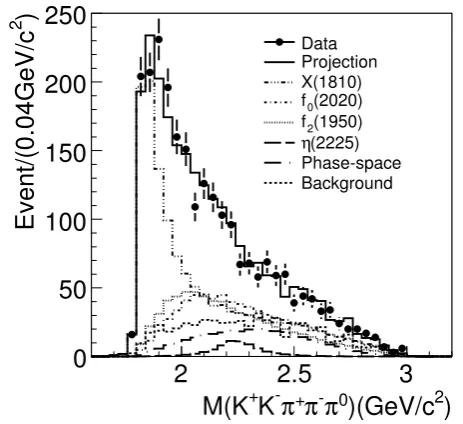
J/ψ → γωφ [12] was performed. A strong deviation (>30σ) from three-body phase space forJ/ψ→γωφnear theωφinvariant-mass threshold was observed (see Fig. 3). Assuming the enhancement is due to the influence of a res-onance, theX(1810), a partial wave analysis with a tensor covariant amplitude determined that the spin-parity of the
X(1810) is 0++. The mass and width of theX(1810) were determined to be M = 1795±7(stat)+13
−5 (syst)±19(mod) MeV/c2 andΓ =95±10(stat)+21
−34(syst)±75(mod) MeV/c2 and the product branching fraction was measured to be
B(J/ψ → γX(1810))× B(X(1810) → ωφ) = (2.00± 0.08(stat)+0.45
−1.00(syst)±1.30(mod))×10−4, where the first er-ror indicates the statistical erer-ror and the second is the sys-tematical error. These results are consistent within errors with those from the BESII experiment [13].
)
2
)) (GeV/c
-π
+
π
M(3(
1.6 1.7 1.8 1.9 2 2.1
)
2
EVENTS/(10 MeV/c
0 50 100 150 200 250 300
)
2
)) (GeV/c
-π
+
π
M(3(
1.6 1.7 1.8 1.9 2 2.1
)
2
EVENTS/(10 MeV/c
0 50 100 150 200 250 300
Figure 2. The fit of mass spectrum of 3(π+π−) in J/ψ →
γ3(π+π−). The dots with error bars are data; the solid line is the fit
result. The dashed line represents all the backgrounds, including
the background events fromJ/ψ→π03(π+π−) (dash-dotted line,
fixed in the fit) and a third-order polynomial representing other backgrounds.
)
2)(GeV/c
0π
-π
+
π
-K
+M(K
2
2.5
3
)
2
Event/(0.04GeV/c
0
50
100
150
200
250
Data Projection X(1810)
(2020)
0
f (1950)
2
f (2225)
η
Phase-space Background
Figure 3.Comparisons between data and PWA fit projections in
the invariant mass spectrum ofK+K−π+π−π0in
J/ψ→γωφ.
The comparison to the mentioned BESIII results of the masses and widths are shown in Fig. 4. The mass of
)
2
Mass (MeV/c
1800 1850 1900 1950
W
idt
h (
M
eV)
0 50 100 150 200 250
X(1840);JPunknown( [14])
X(1870);JPunknown(Ref. [11])
X(1835);JP=0−(Ref. [10])
X(pp¯);JP=0−(Ref. [5])
X(1810);JP=0+(Ref. [12])
Figure 4.Comparisons of observations at BESIII. The error bars include statistical, systematic, and, where applicable, model un-certainties.
3 PWA of
J
/ψ
→
γηη
Radiative J/ψdecay is a gluon-rich process and has long been regarded as one of the most promising hunting grounds for glueballs. In particular, for aJ/ψradiative de-cay to two pseudoscalar mesons, it offers a very clean lab-oratory to search for scalar and tensor glueballs because only intermediate states withJPC =even++are possible.
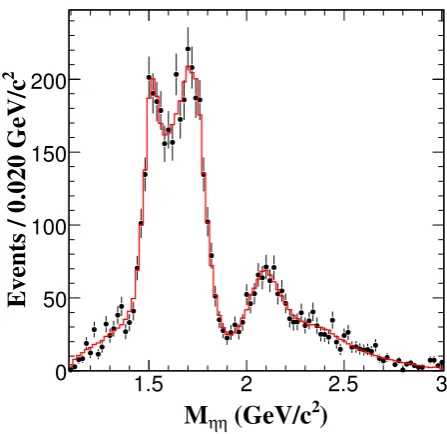
Using 225 million J/ψevents collected with the BE-SIII detector, a PWA ofJ/ψ→ γηηhas been performed. Fig. 5 shows the projection of PWA in the invariant mass spectrum ofηη. The scalar contributions are mainly from
f0(1500), f0(1710) and f0(2100), while no evident contri-butions fromf0(1370) andf0(1790) are seen. Recently, the production rate of the pure gauge scalar glueball inJ/ψ ra-diative decays predicted by the lattice QCD [15] was found to be compatible with the production rate ofJ/ψradiative decays tof0(1710); this suggests that f0(1710) has a larger overlap with the glueball compared to other glueball can-didates (eg. f0(1500)). In this analysis, the production rate of f0(1710) and f0(2100) are both about one order of mag-nitude larger than that of the f0(1500) and no clear evi-dence was found for f0(1370), which are both consistent with, at least not contrary to, lattice QCD predictions.
The tensor components, which are dominantly from
f2(1525), f2(1810) and f2(2340), also have a large con-tribution in J/ψ → γηηdecays. The significant contribu-tion from f2(1525) is shown as a clear peak in theηηmass spectrum; a tensor component exists in the mass region from 1.8 GeV/c2to 2 GeV/c2, although we cannot distin-guish f2(1810) from f2(1910) or f2(1950); and the PWA requires a strong contribution from f2(2340), although the possibility of f2(2300) cannot be ruled out.
4
η
and
η
physics
The η/η system provides a unique stage for un-derstanding the distinct symmetry-breaking mechanisms. Furthermore, theη/ηdecays play an important role to ex-plore the effective theory of QCD at low energy, especially
)
2
(GeV/c
η η
M
1.5
2
2.5
3
2
Events / 0.020 GeV/c
0
50
100
150
200
Figure 5.The invariant mass ofηη(dots with error bars) and the PWA fit projections (histogram).
for the Chiral Perturbation Theory (χPTh). Its main de-cay modes, including hadronic and radiative dede-cays, have been well measured, but the study of anomalous decays is still an open field. BESIII had collected 1.3 billion J/ψ events, one can obtain largeη/ηsamples (∼ 106) from processes J/ψ → γη/η or J/ψ → φη/η. It is a good place to study the anomalous decays ofη/η. BESIII had published results ofη/ηinvisible decays [16], weak decay ofη/η→ π−e+ν+c.c.[17]. Here we present other three studies briefly.
4.1 Measurement ofη→ π+π−l+l−
η → π+π−e+e− was first reported by CLEO re-cently [18]. Theoretically this decay is expected to proceed via a virtual photon intermediate state,η → π+π−γ∗ →
π+π−e+e−, and provides a more stringent test of the theo-ries since it involves off-shell photons.
Based on 225 M J/ψ events, the decays of η →
π+π−l+l− were studied via J/ψ → γη at BESIII [19]. A clearηsignal was observed in theπ+π−e+e−invariant mass spectrum, and the branching fraction was measured to be B(η → π+π−e+e−) =(2.11±0.12±0.15)×10−3, which is in good agreement with theoretical predictions and the previous measurement, but was determined with much higher precision. No η signal was found in the
π+π−μ+μ−mass spectrum, and the upper limit was deter-mined to beB(η →π+π−μ+μ−)<2.9×10⁻⁵at the 90% confidence level.
4.2 Observation ofη →π+π−π+π−(π+π−π0π0)
to be mediated by chiral anomalies, since an odd num-ber (five) of pseudoscalar particles are involved. In par-ticular, a contribution from a new type of anomaly, the pentagon anomaly, might show up. There should be also a significant contribution from the intermediate state with two ρ mesons. Based on a sample of 1.3 billion J/ψ events taken with the BESIII detector, we observe the de-cay modesη → π+π−π+π− andη → π+π−π0π0 with a statistical significance of 18σ and 5σ, respectively (See Fig.6. The branching fractions were determined to be
B(η → π+π−π+π−) = (8.53±0.69±0.64)×10−5 and B(η→π+π−π0π0)=(1.82±0.35±0.18)×10−4, which are consistent with the theoretical predictions based on a com-bination of chiral perturbation theory and vector-meson dominance [20], but not with the broken-SU6×O3 quark model [21].
)
2(GeV/c
-π + π -π + πM
0.7 0.8 0.9 1
2
Events/5 MeV/c
0 50 100)
2(GeV/c
-π + π -π + πM
0.7 0.8 0.9 1
2
Events/5 MeV/c
0 50 100)
2(GeV/c
-π + π -π + πM
0.7 0.8 0.9 1
2
Events/5 MeV/c
0 50
100 dataFull fit
-π + π -π + π → (1270) 2 (1270), f 2 f γ → ψ J/ -π + π -π + π γ → ψ J/ -π + π γ → η , η -π + π → ’ η ’, η γ → ψ J/ e + e -π + π → ’ η ’, η γ → ψ J/ (a)
)
2(GeV/c
0 π 0 π -π + πM
0.7 0.8 0.9 1
2
Events/5 MeV/c
0 20 40 60)
2(GeV/c
0 π 0 π -π + πM
0.7 0.8 0.9 1
2
Events/5 MeV/c
0 20 40 60)
2(GeV/c
0 π 0 π -π + πM
0.7 0.8 0.9 1
2
Events/5 MeV/c
0 20 40 60 data Full fit 0 π 0 π -π + π → (1270) 2 (1270), f 2 f γ → ψ J/ 0 π 0 π -π + π γ → ψ J/ -π + π γ → η , η 0 π 0 π → ’ η ’, η γ → ψ J/ 0 π -π + π → ω , ω γ → ’ η ’, η γ → ψ J/ 0 π 0 π 0 π → η , η -π + π → ’ η ’, η γ → ψ J/ (b)Figure 6.Results of the fits to (a)Mπ+π−π+π−and (b) Mπ+π−π0π0,
where the background contributions are displayed as the hatched histograms.
4.3 η/η →γγπ0(Preliminary)
The decay η → π0γγ, in the frame ofχPTh, both at
O(p2) and O(p4) is forbidden because there is no direct
coupling of photons to the neutralπ0andη. The first siz-able contribution comes atO(p6) [22]. This decay provides a unique opportunity to test directly the correctness of the calculations of third orderχPTh.
With a sample of 1.3 billion J/ψ events in the BE-SIII, the rare, doubly radiative decaysη/η → γγπ0have been studied.ηcan be seen clearly in the invariant mass spectrum ofγγπ0(Fig. 7), the peaking background events mainly come from η → γω(ρ) with ω(ρ) → γπ0. The branching fraction ofη→ γγπ0is measured for the first time to beB(η→γγπ0)=(6.91±0.51±0.58)×10−4. The measured value is much lower than that of the theoretical predictions [23, 24] but consistent with the upper limit in PDG. No evidence for the decay ofη→γγπ0is found.
Figure 7.The Mγγπ0 distribution with fit results superimposed
for theη→γγπ0decay.
5
J
/ψ
→
p
pa
¯
0(980))
As one of the low-lying scalars, the statea0(980) has turned out to be mysterious in the quark model scenario. Its production near threshold allows tests of various hy-potheses for its structure. The measurement of J/ψ →
ppa¯ 0(980) is an additional observable constraining any phenomenological models trying to understand the nature of thea0(980). A chiral unitary coupled channels approach of theχPTh is applied in investigation of the four-body de-caysJ/ψ→NN MM¯ process [25] where theNstands for a baryon and the M for a meson. The experiment input is needed for further progress in understanding of the dy-namics of the four-body decay processes taking the FSI of mesons into account.
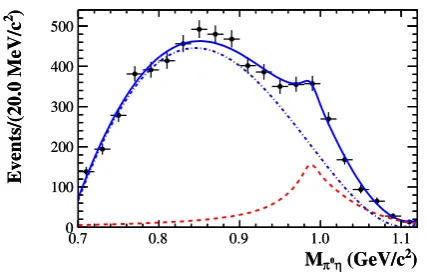
Based on 225 million J/ψ events at BESIII, J/ψ →
same final states with intermediateN∗states, the branch-ing fraction was measured to beB(J/ψ→ ppa¯ 0(980) →
ppπ¯ 0η) = (6.8 ±1.2±1.3)×10−5. Taking the branch-ing fraction ofJ/ψ→ ppπ¯ +π−from PDG, the coefficient
r4in the chiral unitary approach [25] shows preference to
r4=0.2 instead of−0.27.
)
2
(GeV/c
η 0 π
M
0.7 0.8 0.9 1.0 1.1
)
2
Events/(20.0 MeV/c
0 100 200 300 400 500
)
2
(GeV/c
η 0 π
M
0.7 0.8 0.9 1.0 1.1
)
2
Events/(20.0 MeV/c
0 100 200 300 400 500
Figure 8.The results of fitting the mass spectrum forπ0η. Dots
with error bars are data and the solid line is the fitted
spec-trum. The dash-dotted line shows the non-a0(980) background
described by a third-order Cheybechev polynomial. The dashed
line shows the signal described by an efficiency-weighted Flatté
formula convoluted with a resolution function.
6 Summary
BESIII had collected 1.3 billion J/ψ data samples. Based 225 million or fullJ/ψsamples, some progresses on the light meson study are reported.pp¯threshold enhance-ment inJ/ψ→γpp¯,X(1835) inJ/ψ→γηπ+π−,X(1810) in J/ψ → γωφ were confirmed. Two new structures,
X(1840) inJ/ψ→γ3(π+π−) andX(1870) inJ/ψ→ωηππ were observed. Furthermore, various studies on the light meson were shown, including PWA ofJ/ψ → γηη,η/η anomalous decays,a0(980) inJ/ψ → ppηπ¯ . It turns out that BESIII is an excellent place to study the hadron spec-troscopy. With the high statistics data accumulated at the BESIII, more interesting results are expected to be coming soon.
References
[1] M. Ablikim et al. (BESIII Collaboration), Nucl. In-strum. Meth.A614, 345 (2010),0911.4960
[2] J. Bai et al. (BES Collaboration), Phys. Rev. Lett.91, 022001 (2003),hep-ex/0303006
[3] M. Ablikim et al. (BESIII Collaboration), Chin. Phys.C34(2010),1001.5328
[4] J. Alexander et al. (CLEO Collaboration), Phys. Rev.
D82, 092002 (2010),1007.2886
[5] M. Ablikim et al. (BESIII Collaboration), Phys. Rev. Lett.108, 112003 (2012),1112.0942
[6] S. Dulat, B.S. Zou, Eur. Phys. J.A26, 125 (2005),
hep-ph/0508087
[7] A. Sibirtsev, J. Haidenbauer, S. Krewald, U.G. Meissner, A.W. Thomas, Phys. Rev. D71, 054010 (2005),hep-ph/0411386
[8] M. Ablikim et al. (BESIII Collaboration), Phys. Rev.
D87, 112004 (2013),1303.3108
[9] M. Ablikim et al. (BES Collaboration), Phys. Rev. Lett.95, 262001 (2005),hep-ex/0508025
[10] M. Ablikim et al. (BESIII Collaboration), Phys. Rev. Lett.106, 072002 (2011),1012.3510
[11] M. Ablikim et al. (BESIII Collaboration), Phys. Rev. Lett.107, 182001 (2011),1107.1806
[12] M. Ablikim et al. (BESIII Collaboration), Phys. Rev.
D87, 032008 (2013),1211.5668
[13] M. Ablikim et al. (BES Collaboration), Phys. Rev. Lett.96, 162002 (2006),hep-ex/0602031
[14] M. Ablikim et al. (BESIII Collaboration), Phys. Rev.
D88, 091502 (2013),1305.5333
[15] L.C. Gui, Y. Chen, G. Li, C. Liu, Y.B. Liu et al., Phys. Rev. Lett.110, 021601 (2013),1206.0125
[16] M. Ablikim et al. (BESIII Collaboration), Phys. Rev.
D87, 012009 (2013),1209.2469
[17] M. Ablikim et al. (BESIII Collaboration), Phys. Rev.
D87, 032006 (2013),1211.3600
[18] P. Naik et al. (CLEO Collaboration), Phys. Rev. Lett.
102, 061801 (2009),0809.2587
[19] M. Ablikim et al. (BESIII Collaboration), Phys. Rev.
D87, 092011 (2013),1303.7360
[20] F.K. Guo, B. Kubis, A. Wirzba, Phys. Rev. D85, 014014 (2012),1111.5949
[21] D. Parashar, Phys. Rev.D19, 268 (1979)
[22] L. Ametller, J. Bijnens, A. Bramon, F. Cornet, Phys. Lett.B276, 185 (1992)
[23] R. Escribano, PoSCD12, 035 (2013)
[24] R. Jora, Nucl. Phys. Proc. Suppl. 207-208, 224 (2010)
[25] C.b. Li, E. Oset, M. Vicente Vacas, Phys. Rev.C69, 015201 (2004),nucl-th/0305041
[26] M. Ablikim et al. (BESIII Collaboration), Phys. Rev.