The Meson Spectroscopy Program at the Jefferson Laboratory
A. Filippi1,afor the CLAS Collaboration2,b
1I.N.F.N. sez. di Torino, via P. Giuria, 1, 10125 Torino, Italy
2Thomas Jefferson National Accelerator Facility, 12000 Jefferson Avenue, Newport News VA 23606, U.S.A.
Abstract.The experimental techniques that will be applied by the next generation meson spectroscopy exper-iments at JLab are described. For the first time, these experexper-iments will be able to exploit the features of a photon beam of unprecedented intensity and momentum resolution, that will allow to perform precision studies of meson states with masses below 3 GeV/c2. Photon induced reactions will enhance the production of spin-1
mesons, that are of particular interest according to the most recent Lattice QCD calculations of the lightest exotic hybrid meson.
1 Introduction
One of the still open questions in hadron physics is the origin of masses and the structure of the meson spec-trum. Experimental observations have indeed pointed out that a constituent quark model (CQM) interpretation is not enough to account for all the hadron properties, but glu-onic degrees of freedom have necessarily to be taken into account [1]. As a consequence of the non-abelian nature of the Quantum Chromodynamics field theory (QCD), self interactions between the gluons may occur, which could allow for the formation of extra states not foreseen by CQM. They are known as glueballs (composed by glu-ons only,ggg),hybrids(composed by a mixture of quarks and gluons, ¯qqg), and multiquark states (featuring a more complex structure, like, for instance, molecular-like ¯qqqq).¯ Some of these states could bear exotic quantum numbers, not allowed for “conventional” hadrons. In the last 50 years many searches have been pursued, exploiting dif-ferent experimental techniques in production reactions in-duced by different probes, to extend the knowledge of the meson spectrum and prove the existence of such exotic states. Even though some of the features (like decay pat-terns) of some exotic states should help disentangling them from conventional mesons, their observation has not been conclusive so far, and none of the found candidates has actually been confirmed. This is also due to the fact that, especially in the light meson sector, many states overlap in the same mass region, and have similar and relatively large widths, on the order of 100 MeV. Therefore, their unam-biguous extraction and observation is a difficult task. The situation is possibly a little simpler in the case of mesons composed by heavy quarks, whose widths are narrower so the overlap among different states is limited. However, also in this case many new observations of unexpected
ae-mail: fi[email protected]
bCLAS Collaboration website: http://www.jlab.org/Hall-B
states call for alternative interpretations of the full hadron spectrum.
In order to provide a correct identification of the still unknown states, high statistics observations are necessary, possibly in different reactions and in different decay chan-nels. This started to be possible only in the Nineties. The experiments in that decade had been able to collect a good amount of data, however they didn’t always agree on the observed properties of similar objects, that some-times were even in open contradiction. New high statistics and high precision spectroscopy experiments are therefore still needed.
From the theoretical point of view, big advances have been made in the last years by QCD calculations on the lattice, which are now able to predict most of the conven-tional meson spectrum in good agreement with experimen-tal findings [2]. These confirmations of course strengthen the confidence in their predictive power for the searches of new states. According to these calculations, the light-est hybrids and glueballs are predicted in the 1.4–3 GeV/c2 mass range: namely, at 2 GeV/c2for the lightestJPC =0+− state, and at 1.6 GeV/c2for the 1−+one. This is actually the mass region which will be investigated by the new ex-periments foreseen to operate at the upgraded CEBAF ma-chine at JLab.
A few observations in this mass range for some struc-tures with exotic quantum numbers have already been re-ported by old experiments, but with relatively small statis-tics. Aπ1(1400) object, with JPC = 1−+, was claimed to have been observed at BNL by the E852 experiment [3], in theηπdecay channel in theπ−p→π−ηpandπ−p→π0ηn reactions at 18 GeV/cincident pion momentum. The VES experiment found a much weaker signal at 37 GeV/c in-cident momentum and did not confirm this result [4]. In
¯
p annihilations at rest on hydrogen and deuterium, the Crystal Barrel experiment at LEAR reported as well the observation of the π1(1400) decaying in ηπ, seen in the
DOI: 10.1051/
C
Owned by the authors, published by EDP Sciences, 2015 /201
epjconf 5960101
This is an Open Access article distributed under the terms of the Creative Commons Attribution License 4.0, which permits unrestricted use, distribution, and reproduction in any medium, provided the original work is properly cited.
¯
pp → π0π0η and ¯pn → π−π0ηreactions [5]: theππ de-cays ofσandρ, and the contribution of thea2(1320) were found not to be enough to reproduce correctly the observed Dalitz Plot.
A second 1−+ state at a larger mass (about 1600 MeV/c2), was observed by E852 in the ηπ and ρπ de-cay channels, in theπ−p → 2π−π+p andπ−p → ηπ−p peripheral productions at 18 GeV/c[6]. Recently, a sig-nature for a 1−+state in the same mass region was found by the COMPASS experiment at CERN-SPS [7], in the π−Pb → π+π−π−Pbreaction at 190 GeV/cincident mo-mentum. This is so far the highest statistic signature avail-able for such a structure.
2 Meson spectroscopy with photons at
JLab
As already mentioned, several reactions and beams have been used so far for meson spectroscopy searches: just to remind the most important, high-energy meson (mainly pion) and proton beams, exploiting the peripheral and central production mechanisms, antinucleon annihilation at rest and in flight, which convey the formation of a gluon-rich environment suitable for glueball production, ande+e−annihilation. The latter reaction has been stud-ied extensively since the LEP era, and is a suitable envi-ronment where alsoγγcollisions can be measured, which provide quite useful information as they are a natural anti-glueball filter. Starting in the Nineties thee+e− annihila-tion was fruitfully exploited for meson spectroscopy stud-ies at flavor factorstud-ies, with successful experiments like BaBar at PEPII and Belle at KEK, that operated at the
Υ(nS) masses, BES (and its present upgrade) at BEPC, operating in the charmonium mass region, and KLOE at DAΦNE, which operated at theφ energy. Thee+e− an-nihilation differs from hadronic reactions for the fact that only 1−− systems can be formed, so these reactions pro-vide naturally a powerful quantum number selection.
On the other hand, the use of electromagnetic probes, and in particular of photons, in fixed target reactions was not used very extensively for meson spectroscopy pur-poses, due to the lack of sources of suitable intensity and momentum resolution. Nevertheless, electromagnetic re-actions could deliver important complementary informa-tion. Let us remind that, first of all, electromagnetic pro-cesses can be exactly reproduced to a high level of pre-cision through QED diagrams thanks to the smallness of the electromagnetic coupling, fact is prevented in the case of strong interactions. Moreover, photons can excite with larger probability the production of spin-1 mesons as com-pared to pion or kaon induced reactions, since in the latter case a spin-flip is required. Therefore, the production of vector hybrid mesons could occur in photoproduction re-actions with a rate comparable to those of conventional vector mesons [8, 9]. This feature applies not only to hy-brids, but also to spin-1 ¯ssexcitations, whose production rate is suppressed, in general, as a consequence of OZI rule. The issues which prevented the use of electromag-netic probes in the past will be overcome by the new
ex-periments at the upgraded CEBAF machine at JLab, which is presently under commissioning and will be operating in the next years.
2.1 Experiments at CEBAF-12 GeV
The CEBAF electron machine has been recently upgraded to reach electron momenta up to 12 GeV/c, about dou-bling the energy available in the first phase of operation of the facility. Its commissioning in the new configura-tion started in Fall 2014. Four experimental halls will host several fixed target experiments: for Hall A, B, C the max-imum energy for the delivered electron beam will be 10.9 GeV, while the newly built Hall D will benefit of a max-imum energy beam of 12 GeV. Details on the machine’s expected performance may be found elsewhere [10]. As figures of merit, the beam power will reach 1 MW with a current of 90μA maximum intensity, corresponding to a luminosity on fixed targets of about 1035cm−2s−1.
Two main experiments will be dedicated to a me-son spectroscopy search program: GlueX in Hall D, and CLAS12 in Hall B. Their main features and their comple-mentarity will be briefly described in the following.
2.1.1 The GlueX Experiment
The GlueX Experiment is a 4πfull acceptance spectrom-eter which will be completely dedicated to meson spec-troscopy studies with a real photon beam. The photon beam will be produced by a dedicated facility based on electron bremsstrahlung on a diamond crystal, exploiting a technique well known and consolidated in experiments of the 6 GeV CEBAF era. The obtained photon beam will have an energy in the 6 −9 GeV range with a 10 MeV resolution, and will have a linear polarization (mea-sured collectively) from 15 to 50%. Information on the photon beam will be obtained through a proper tagging equipment. The use of polarized photons is important to reduce the number of degrees of freedom and simplify the data analysis through partial-wave decomposition, whose number of components can thus be reduced, as will be de-scribed in the following. The photon flux will have an intensity of 108−109γ/s, enough to succesfully perform high statistics spectroscopy studies.
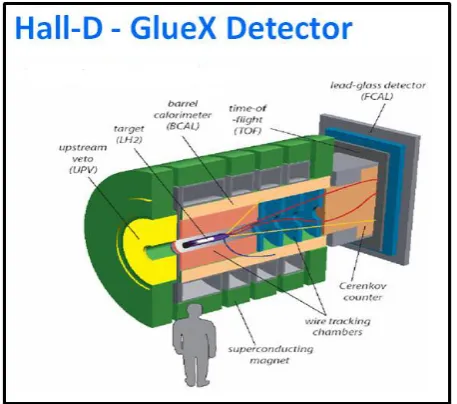
A detailed description of the experimental apparatus may be found in Ref. [11]. Here it is enough to men-tion that the apparatus has been devised to feature a good hermeticity and acceptance. It includes particle identi-fication detectors for the detection of kaons and strange hadrons, to study strangeness photoproduction, a topic still largely unknown, but features a limited momentum reso-lution, though enough for spectroscopy investigations. A sketch of the experimental apparatus is shown in Fig. 1.
2.1.2 The CLAS12 Experiment and the Forward Tagger equipment
Figure 1.Schematic view of the GlueX experiment.
and structure to meson spectroscopy investigations. It is an upgraded version of the CLAS Experiment which oper-ated until 2010 [12]. Due to the increased beam energy, as compared to the previous installation, the CLAS12 spec-trometer has a more compact structure, which limits its ge-ometric acceptance, although allowing an acceptable her-meticity. However, its detectors feature better momentum resolution and particle identification capabilities as com-pared to GlueX, therefore the two experimental setups of-fer complementary qualities.
A full description of CLAS12 is given elsewhere [13]. Two main sections constitute it, a forward part covering the 5◦ −35◦ angular region and a central one, covering polar angles up to 135◦. In the forward part the detectors are arranged around the beam pipe in a six-fold symmetry, and form six identical spectrometers; in the central part they are arranged in cylindrical symmetry. In the follow-ing a list of the elements composfollow-ing CLAS12 in its base configuration is given.
The Forward Detector is composed of:
• a torus magnet, composed of six kidney-shaped coils providing a toroidal magnetic field with a maximum in-tensity of 3.58 T;
• a forward Micromegas tracker, composed by three lay-ers, providing a spatial resolution of about 144μm inx andy;
• a high threshold gas Cherenkov counter (HTCC);
• a drift chamber system, that together with the Mi-cromegas tracker forms the Forward Tracking system. The Forward Tracker features a momentum resolution dependent on the polar angle and ranging from 0.3% at 5◦ to 1% at 30◦. The drift chambers consist of three super-layers (composed each of two drift planes stag-gered by ±6◦), one located in front of the torus coils outside the field region, the second between the coils where the field is maximum and the third outside them;
• a low threshold gas Cherenkov counter (LTCC);
• a Time-Of-Flight (TOF) system, composed by scintilla-tors, able to provide aπ/K separation up to 3 GeV/c, with a time resolution depending on the polar angle and varying from 60 to 150 ps. Each of the six sectors is made of three sets of overlapping counters, forming pan-els of two types, that cover two different angular regions;
• a preshower calorimeter (PCAL), formed by 15 layers of plastic scintillator and lead, staggered by 120◦ ev-ery layer pair; it is necessary to degrade the energy of the electromagnetic showers with momenta larger than 5 GeV/cand to reduce theπ0 energy, to allow the fol-lowing electromagnetic calorimeter to fully absorb the shower energy and to resolve theγ’s from theπ0decay with enough resolution;
• an electromagnetic calorimeter (EC), used to measure and identify electrons and photons with energy larger than 500 MeV and 200 MeV, respectively, and provide their separation. The full PCAL+EC assembly will fea-ture an energy resolutionσE/E∼0.1/
√
E;
The Central Detector is composed of:
• a superconducting solenoidal magnet, of cylindric ge-ometry, providing a field of 5 T. Besides from bending particles, it is also necessary to shield the Forward De-tector from Møller electrons;
• the target system, located at the center; according to the experimental program, it can also include a longitudi-nally polarized cryogenic target;
• a barrel tracker, composed of three layers of Mi-cromegas sandwiching two layers of double-sided sili-con microstrip detectors, providing a momentum reso-lution of 5% at 1 GeV/c;
• a central TOF system (CTOF), used for particle identi-fication through speed measurement, able to allow a 4σ separation of pions from kaons up to 640 MeV/c. The detector is composed by 50 plastic scintillator counters, arranged as staves of a∼ 25 cm radius barrel inserted inside the solenoid;
• a central neutron detector, whose structure is similar to CTOF and is made by four cylindrical layers composed by 30 thick scintillators each. Its momentum resolution is about 5% and the neutron detection efficiency∼10%.
Other additional detectors will be added to the base con-figuration according to the purpose of the running experi-ment. A sketch of CLAS12 is shown in Fig. 2.
Figure 2.Schematic view of the CLAS12 experiment (exploded; beam comes from the right.)
Forward Tagger, was devised to detect these forward scat-tered electrons. For momentum transfers in the interval 0.01 < Q2 < 0.3 (GeV/c)2, the electrons scattered be-tween 2.5◦and 4.5◦in polar angle in the lab have an energy in the 0.5–4.5 GeV range, being produced by the interac-tion of 6.5–10.5 GeV quasi-real photons on protons. Mea-suring the electron momentum, each virtual photon can be tagged. The use of the CLAS12 spectrometer to mea-sure in coincidence the particles produced in the photopro-duction reaction will allow to perform a complete event recontruction, necessary for meson spectroscopy studies. With this tagging technique one can measure also the vir-tual photon polarization, that is linear and can be deduced, event by event, from the energy and the angle of the scat-tered electron. The systematic uncertainty affecting the polarization depends only on the electron momentum res-olution. High electron currents may be used, therefore a good luminosity can be obtained even with thin tar-gets, that are not operable with real photon bremsstrahlung beams. For instance, using a 5 cm long LH2target, the re-sulting hadronic rate will be equivalent to that achievable by a real photon flux of about 5×10⁸γ/s.
The Forward Tagger equipment, described in detail in Ref. [14], is located between the HTCC and the torus sup-port, about 190 cm away from the target and fits within a 5◦cone around the beam axis. It is made up of:
• an electromagnetic calorimeter (FT-Cal): composed by 332 PbWO4crystals, 20 cm long and with square 15×15 mm2 cross-section. It is used to identify the scattered electron and measure its energy, from which the photon energy and its polarization can be deduced (the polariza-tion being given by−1∼1+ν2/(EE), whereν=E−E is the photon energy, and E andE the energies of the incident and of the scattered electron, respectively). It
is also used to provide a fast trigger signal. Its expected design resolution isσE/E∼(2%/
√
E(GeV)⊕1%);
• a scintillator hodoscope made of plastic scintillator tiles: located in front of the calorimeter, is used to veto pho-tons; its spatial and timing resolution is required to be comparable with FT-Cal’s;
• a tracker: located in front of the hodoscope and com-posed by Micromegas detectors, is used to measure the angle of the scattered electron and the photon polariza-tion plane.
A sketch of the Forward Tagger region is shown in Fig. 3.
Figure 3. Schematic view of the Forward Tagger equipment, to be hosted in CLAS12.
3 The MesonEX experiment at CLAS12
1−hybrids and exotics:
• γp→3πN
• γp→ηπ0p[16] • γp→ηπ+π−p
Hybrids with open strangeness and strangeonia:
• γp→φπ0p • γp→φηp
• γp→KKπp
Scalar mesons:
• γp→π+π−p
• γp→KK p
As mentioned above, the study of the 3πandηπ in-termediate states will bring additional information to the recent observation by COMPASS of an isovector state in the 1400 MeV/c2region [7].
Concerning the photoproduction of open and hidden strangeness, data on these reactions are missing as they were never studied thoroughly in the past due to the small production rates. In fact, the production of strange quarks in a non-strange environment involves disconnected quark diagrams whose occurrence is suppressed as a conse-quence of the OZI rule. Apart form a handful confirmed states, little is known for instance about the radial excita-tions of theφ(1020) meson, and even less about strangeo-nia with quantum numbers other than 1−−. Smoking guns for the existence of such states would by their observations in theφηor φπinvariant mass systems [8]; especially in the first case, due to the strange content of theη meson, the production of strangeness should be eased [9].
Kaonia and open strangeness states can be produced in photoproduction reactions in this mass region as well. These states were widely studied in the past to disentangle between their production and that ofηexcitations, which could possibly carry exotic quantum numbers. Many ob-servation ofη’s and f1 mesons have been reported since the Sixties, when the issue of the overlap of many axial and pseudoscalar states and the difficulty of their identification posed the so-called E/ιpuzzle [17]. While annihilation experiments, and in particular OBELIX, could provide a solution to this puzzle addressing the production of several pseudoscalar and axial states, high statistics photoproduc-tion reacphotoproduc-tions are expected to provide new complementary information which will be able to improve the knowledge in this sector.
In spite of the efforts by the experiments in the early Nineties, in particular those studying antinucleon annihi-lations, like Crystal Barrel and OBELIX, also in the scalar meson sector the situation is not completely clear yet. Ob-servations have been made of several mesons whose ex-istence was not foreseen by the CQM; one of them, the f0(1500), seemed to have the right features as lightest scalar glueball [18]. Among these, the most important is the fact that it was observed to decay in several channels, a clear hint to its flavor-blindness. However, more data are still desirable to confirm these properties and identify
the other structures tentatively identified as scalars. All the existing observations make the interpretation of the scalar sector difficult, since it is populated, more than ex-pected, by broad and overlapping states. In this mass re-gion one should also recall the existence of the σ state (also known as f0(500)), corresponding to a very broadππ non-resonant iso-scalarS-wave interaction, whose nature and properties are still unclear. Also scarcely known are the features of theκ, the analogous ofσobserved in the KKchannel [19].
The MesonEX experiment is expected to collect data for 80 days at the full CEBAF luminosity (∼ 1035 s−1cm−2), in parallel with other CLAS12 experiments studying electron interactions, but that will benefit of the presence of the Forward Tagger. The total expected trig-ger rate for photoproduction reactions is less than 10 kHz. In this data taking time, assuming an apparatus acceptance for four track events of the order of 15%, it will be pos-sible to collect as many as 3000 events per 10 MeV/c2 mass bin, for reactions with a cross section as small as 10 nb, expected for instance for strangeonia production. This statistics is considered to be enough to perform detailed partial-wave analysis studies, as will be described in the following section.
4 Data analysis: methods
The extraction of signatures of meson production in pho-ton induced reactions is performed through the widely known Partial Wave Analysis (PWA) method, by which the production cross sections are parameterized via the sum of partial amplitudes. Each amplitude enters in the sum with a weight, usually expressed as a complex num-ber (including this way a phase which accounts for a co-herent overlap), which is to be determined by fitting the total production amplitude to the data sample.
for instance a potential source of unitarity break-down. An alternative approach, mathematically preserving unitarity and causality, is based on dispersion relations and dual-ity [21]. In this case the implementation, however, is not always straightforward and so far proved to be successful only in some simple cases, namely few-body decay am-plitudes. However, quite recently some efforts have been spent in this direction, as this approach provides a more comprehensive and complete description of scattering and decay amplitudes [22].
Therefore, when trying to reproduce the data by means of these descriptions, one has to face a twofold problem: a) using a reliable and as accurate as possible model to reproduce the data in the best way and b) address the exis-tence of additional effects, not included in the amplitude, to account for the possible remaining discrepancies be-tween the data and the model. Signatures of exotic states are expected to show up as tiny effects, so the identifica-tion of such structures is a particularly delicate task. Care must also be taken, from the experimental side, to provide accurate acceptance corrections to the data, in order not to misidentify distortions caused by acceptance flaws or finite detector resolution as real physical effects.
Ideally, the most effective way to obtain a reliable de-scription of the production of a given state would be to use as many experimental data samples as possible, obtained in different reactions and in different experimental envi-ronments; each will allow to impose additional constraints to the number of degrees of freedom,i.e. of free parame-ters to be determined by the fit. For this reason it is also important to exploit as much as possible the experimental conditions in which the reactions occur, upon which quan-tum numbers may vary. For instance, one method is to select the polarization of the beam, which defines the he-licity of the initial state. A piece of information often ex-ploited in ¯pannihilation reactions is the density of the tar-get (liquid or gaseous at different pressures): this is an im-portant parameter to determine the partial wave in which the beam-target interaction occurs, as a consequence of the Stark effect.
The crossed information on the same objects obtained in different reactions is indeed one of the best handles to unambiguously identify new structures and pin down their properties.
5 Data analysis: feasibility tests on
CLAS12 data and performances
In order to perform a reliable partial-wave analysis a good number of selected events, on the order of at least a few thousand per mass or momentum transfer bins, are nec-essary. Studies with Monte Carlo data have been made to check the capability of CLAS12 to face the mentioned problems and provide a good enough data sample to ex-tract reliable information on new physical effects. To this purpose, some benchmark reactions have been inves-tigated, in which new signals in known conditions have been injected (i.e., with known spin and fixed production rates), to check the reproducibility of the simulated
spec-trum against acceptance distortions and an approximate amplitude description.
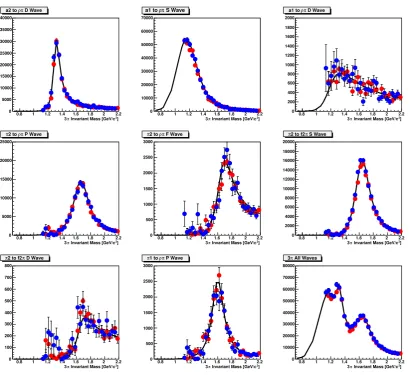
An example of a tested reaction isγp → π+π+π−n, in which a sum of eight isobar channels was considered, corresponding to the known resonant states inS-,P-,D-, F-waves decaying inρπor f2(1270)π, plus an exotic signal inP-wave (standing for theπ1(1600) 1−+state in itsρπ de-cay). The simulated data were folded with the CLAS12 ac-ceptance, processed through the full reconstruction chain, and then fitted via a proper partial-wave set in the frame-work of the isobar model and in selected bins of trans-ferred momentum t. The obtained results, in two t bins marked by points of different colors, are shown in Fig. 4. All known resonances –a2(1320) inD-wave,a1(1260) in D-wave,π2(1670) in the two decay channelsρπ (P- and F-wave) and f2π(S- andD-wave) – are correctly repro-duced at the right mass values, as well as the additional exotic signal. Its injected weight, at the level of 2% (cor-responding to a production cross section of about 200 nb), was reproduced correctly as well. Similar tests (see for in-stance Ref. [16] for the γp → ηπ0p channel) show that partial-wave analyses will be feasible with CLAS12 data without any particular problem related to the limited ap-paratus acceptance, with a sensitivity on signal production which can reach the level of a few percent.
6 Outlook and conclusions
Nowadays many communities are involved all over the world in hadron spectroscopy studies, both from experi-mental and from the theoretical point of view. Experimen-tal facilities are presently delivering, and will deliver in the near future, large amounts of good quality data that will al-low to extract for the first time new information on many still unsolved issues from different reactions and experi-mental environments.
The required effort to analyse and interpret the data, es-pecially in a comprehensive perspective, is huge, and the development of common tools and collective collaborative resources is mandatory to achieve this goal. This of course implies not only the development of a common analysis framework for data handling and interpretation through in-novative and general-purpose partial-wave decomposition formalisms, but also requires the deployment of new com-puting standards for a most efficient and fast data access, distribution and processing.
Common tools to perform partial-wave analyses with standardized procedures, such as AmpTools [23] or Com-PWA [24] have been developed in the latest years and are now freely available to the community. Concerning infor-mation technology infrastructures, Cloud computing looks as one the most suitable resources to effectively perform data distribution and mining among several experiments and laboratories. Concerning computational techniques, promising steps have recently been made in the study and test of GPU performances, for application to data process-ing and high level analyses.
]
2
Invariant Mass [GeV/c
π
3
0.8 1 1.2 1.4 1.6 1.8 2 2.2
0 5000 10000 15000 20000 25000 30000 35000 40000 D Wave π ρ a2 to ] 2
Invariant Mass [GeV/c
π
3
0.8 1 1.2 1.4 1.6 1.8 2 2.2
0 10000 20000 30000 40000 50000 60000 70000 S Wave π ρ a1 to ] 2
Invariant Mass [GeV/c
π
3
0.8 1 1.2 1.4 1.6 1.8 2 2.2
0 200 400 600 800 1000 1200 1400 1600 1800 2000 D Wave π ρ a1 to ] 2
Invariant Mass [GeV/c
π
3
0.8 1 1.2 1.4 1.6 1.8 2 2.2
0 5000 10000 15000 20000 25000 P Wave π ρ 2 to π ] 2
Invariant Mass [GeV/c
π
3
0.8 1 1.2 1.4 1.6 1.8 2 2.2
0 500 1000 1500 2000 2500 3000 F Wave π ρ 2 to π ] 2
Invariant Mass [GeV/c
π
3
0.8 1 1.2 1.4 1.6 1.8 2 2.2
0 2000 4000 6000 8000 10000 12000 14000 16000 18000 20000 S Wave π 2 to f2 π
]
2
Invariant Mass [GeV/c
π
3
0.8 1 1.2 1.4 1.6 1.8 2 2.2
0 100 200 300 400 500 600 700 800 D Wave π 2 to f2 π
]
2
Invariant Mass [GeV/c
π
3
0.8 1 1.2 1.4 1.6 1.8 2 2.2
0 500 1000 1500 2000 2500 3000 P Wave π ρ 1 to π ] 2
Invariant Mass [GeV/c
π
3
0.8 1 1.2 1.4 1.6 1.8 2 2.2
0 10000 20000 30000 40000 50000 60000 70000 80000 All Waves π 3
Figure 4.Intensities of eight isobar channels in theγp→π+π+π−nchannel. In the bottom row, the last pad on the right corresponds to the total 3πintensity, while the pad in the center correspond to the exotic signal injected in the pseudo-data sample. The black lines are the generated partial waves, while the points are the fit results for pseudo-data selected in the two bins centered att=0.2 (GeV/c)2
(0.25 (MeV/c)2wide, blue points) andt=0.5 (GeV/c)2(1 (MeV/c)2wide, red points).
useful to the whole spectroscopy community. One of them, dedicated to the study of the photoproduction data from CLAS12 (and previous CLAS as well, used as bench-marks to test feasibility and explore new investigation grounds), is the Hadron Spectroscopy Center (HaSpect), based in Genova, Italy [25]. Experimentalists as well as theoreticians belonging to this group work in synergy to provide tools and patterns applied directly to the photo-production case but extendable to other reactions as well.
Photoproduction experiments at JLab will play a big role in the coming future. At JLab, GlueX and CLAS12 will provide data samples of unprecedented quality and richness. Their contribution is expected to grow to size-able relevance and have a big impact in the present and future meson spectroscopy experimental scenario, com-plementing the information that will be provided bye+e− collisions (by BESIII and BelleII), by pion induced inter-actions (by COMPASS), by proton-proton interinter-actions (at fixed target by LHCb, and in high-energyppcollisions by ATLAS and CMS) and by antiproton-proton annihilations (by PANDA at FAIR).
References
[1] K.A. Oliveet al. (Particle Data Group), Chin. Phys. C38, 090001 (2014); see for instance the number of observed states in the listing of light unflavored mesons: many more states than predicted by the simple CQM are reported.
[2] J. Dudeket al.,,Phys. Rev.D82(2010), 034508; J. Dudeket al.,,Phys. Rev.D83(2011), 111502 [3] E852 Collaboration, G.S. Adams et al., Phys. Rev.
Lett.81(1998), 5760
[4] VES Collaboration, G.M. Beladidze,Phys. Lett. B213 (1993), 276
[5] Crystal Barrel Collaboration, A. Abele et al., Phys. Lett.B423(1998), 175;
Crystal Barrel Collaboration, A. Abele et al., Phys. Lett.B446(1998), 349
[6] E852 Collaboration, S.U. Chunget al. Phys. Rev.D65 (2002), 072001;
E852 Collaboration, M. Lu et al.,Phys. Rev. Lett. 94 (2005), 032002
[7] COMPASS Collaboration, A. Alekseev et al., Phys. Rev. Lett.104(2010), 241803;
COMPASS Collaboration, B. Grubeet al., arXiv:1002.1272 [hep-ex] (2010)
[8] F. Close and P. Page,Phys. Rev.D52(1995), 1706; A. Afanasev and P. Page,Phys. Rev.D57(1998), 6771; A. Szczepaniak and M. Swat,Phys. Lett.B516(2001), 72
[9] T. Barneset al.,Phys. Rev.D55(1997), 4157; T. Barnes, N. Black and P. Page,Phys. Rev.D68(2003), 054014
[10] C.W. Leemann et al., Ann. Rev. Nucl. Part. Sci.51 (2001), 413
[11] GlueX Collaboration, Mapping the Spectrum of Li-ght Mesons and Gluonic Excitations with Linearly Polarized Photons, Proposal to Jefferson Laboratory PAC30, 2006; url: http://argus.phys.uregina.ca/ cgi-bin/public/DocDB/ShowDocument?docid=1226 [12] B.A. Meckinget al.,Nucl. Instr. Meth.A503(2003),
513
[13] CLAS Collaboration,CLAS12 Technical Design Re-port, Tech. Rep. Jefferson Laboratory, 2008
[14] CLAS Collaboration, CLAS12 Forward Tagger (FT) Technical Design Report, Tech. Rep. Jefferson Lab, 2012; url: http://clasweb.jlab.org/wiki/index.php/ CLAS12_Technical_Design_Report
[15] CLAS Collaboration,Meson Spectroscopy with low Q2electron scattering in CLAS12, Proposal to Jefferson Laboratory PAC37, 2011
[16] A. Celentano, The Forward Tagger detectors for CLAS12 at Jefferson Laboratory and the MesonEx ex-periment, PhD Thesis, Università degli Studi di Genova (2014)
[17] A. Masoni, C. Cicalò and G.L. Usai, J. Phys.G32 (2006), R293
[18] Crystal Barrel Collaboration, C. Amsleret al.,Phys. Lett.B342(1995), 433;
Crystal Barrel Collaboration, C. Amsler et al., Phys. Lett.B353(1995), 571;
Crystal Barrel Collaboration, C. Amsler et al., Phys. Lett.B385(1996), 425;
OBELIX Collaboration, A. Bertin et al., Phys. Lett. B408(1997), 476;
OBELIX Collaboration, A. Bertinet al.,Phys. RevD57 (1998), 55;
OBELIX Collaboration, M. Bargiottiet al.,Phys. Lett. B561(2003), 233
[19] J.R. Pelaez,These Proceedings
[20] K.M. Watson,Phys. Rev88(1952), 1163 [21] G. Veneziano,Nuovo Cim.57(1968), 180;
R.C. Brower,Phys. Rep.14(1974); G. Altarelli,Phys. Rev.183(1969), 1469
[22] A. Szczepaniak and M. Pennington,Phys. Lett.B737 (2014), 283
[23] For AmpTools documentation, see for instance: http://amptools/sourgeforge.net/index.php/Main_Page [24] For ComPWA documentation, see for instance:
http://compwa.gitub.io/ComPWA