Thermodynamics of SU(2) quantum Yang-Mills theory and CMB
anomalies
Ralf Hofmann1,2,a
1Institut für Theoretische Physik
Universität Heidelberg Philosophenweg 16 69120 Heidelberg, Germany
2Institut für Photonenforschung und Synchrotronstrahlung
Karlsruher Institut für Technologie Hermann-von-Helmholtz Platz 1 Eggenstein-Leopoldshafen, Germany
Abstract.A brief review of effective SU(2) Yang-Mills thermodynamics in the decon-fining phase is given, including the construction of the thermal ground-state estimate in terms of an inert, adjoint scalar fieldφ, based on non-propagating (anti)selfdual field configurations of topological charge unity. We also discuss kinematic constraints on interacting propagating gauge fields implied by the according spatial coarse-graining, and we explain why the screening physics of an SU(2) photon is subject to an electric-magnetically dual interpretation. This argument relies on the fact that only (anti)calorons of scale parameter ρ ∼ |φ|−1 contribute to the coarse-graining required for
thermal-ground-state emergence at temperatureT. Thus, use of the effective gauge couplinge
in the (anti)caloron action is justified, yielding the value for the latter at almost all temperatures. As a consequence, the indeterministic transition of initial to final plane waves caused by an effective, pointlike vertex is fundamentally mediated in Euclidean time by a single (anti)caloron being part of the thermal ground state. Next, we elucidate how a low-frequency excess of line temperature in the Cosmic Microwave Background (CMB) determines the value of the critical temperature of the deconfining-preconfining phase transition of an SU(2) Yang-Mills theory postulated to describe photon propaga-tion, and we describe how, starting at a redshift of about unity, SU(2) photons collectively work 3D temperature depressions into the CMB. Upon projection along a line of sight, a given depression influences the present CMB sky in a cosmologically local way, possibly explaining the large-angle anomalies confirmed recently by the Planck collaboration. Fi-nally, six relativistic polarisations residing in the SU(2) vector modes roughly match the number of degrees of freedom in cosmic neutrinos (Planck) which would disqualify the latter as radiation. Indeed, if interpreted as single center-vortex loops in confining phases of SU(2) Yang-Mills theories neutrino massmνsolely arises by interactions with an en-vironment. Cosmologically, the CMB represents this environment, and thus one would expect thatmν =ξT whereξ=O(1). In this model cosmic neutrinos are a small dark-matter contribution, conserved only together with the CMB fluid, influencing Baryonic Acoustic Oscillations during CMB decoupling.
ae-mail: [email protected] C
1 Effective Yang-Mills thermodynamics and SU(2)
CMBTo understand non-Abelian quantum gauge theory requires unconventional thinking because, except for asymptotically large momentum transfer [1, 2], the fundamental Yang-Mills fieldAμselfinteracts strongly. In a high-temperature situation a pure SU(N) Yang-Mills theory was argued a long time ago to be inaccessible by perturbative techniques [3]: the so-called soft magnetic sector of the the-ory is screened too weakly for an infrared instability of the small-coupling expansion to be avoided. Namely, starting at order six in the perturbative series, kinetic and interaction terms are comparable, contradicting the perturbative paradigm that free particle propagation is modified by small corrections only. On the other hand, a numerical approach to Yang-Mills thermodynamics, which relies on a discretisation of Euclidean spactime on a 4D point lattice, suffers from available spatial lattice sizes being too small for capturing the long-range correlations of the soft magnetic sector exhaustively [4]. In contrast to the expectation based on a naive substitution of momentum transfer by temperatureT in the zero-temperature perturbative running of the gauge coupling high-temperature Yang-Mills ther-modynamics exhibits strong nonperturbative effects [5] which, paradoxically (see also [6]), drive the behaviour of propagating gauge-field fluctuations in a rapid, power-like way to the Stefan-Boltzmann limit which, however, is subject to a larger number of polarisations [7]. Note that the extraction of the nonperturbative latticeβfunction is problematic since the perfect lattice action at finite lattice spacing ais prohibitively expensive to construct and operate [8].
In [7, 9] the deconfining-phase thermodynamics of SU(2) and SU(3) Yang-Mills theories was ad-dressed nonperturbatively and analytically. The starting point is the construction of unique thermal ground-state estimates in terms of stable, (anti)selfdual, that is, nonpropagating gauge-field configu-rations of topological charge modulus unity: Harrington-Shepard (HS) (anti)calorons [10]. A spatial coarse graining over these energy- and pressure-free field configurations in a particular (singular) gauge, which is facilitated by the unique computation of the kernel of a linear differential operator in terms of an average over space and caloron scale parameterρof the covariant two-point function of the fundamental (anti)caloron field-strength tensorFμν, yields the equation of motion of an effective, inert, and adjoint scalar fieldφ. For later use, it is important to point out that theρintegral is strongly dominated by the upper cutoff[11]. The potential of fieldφ,V(φ) = trΛ6/φ2, which represents an additively unique entity, is parameterized by a mass scaleΛ. The latter emerges by integration of the condition that an Euler-Lagrange type, second-order equation and a BPS type, first-order equation simultaneously need to be satisfied by fieldφin the coarse-grained equivalent of singular gauge: the
winding gauge. As a consequence,φ’s modulus is determined as|φ| =
Λ3
2πT in supernatural units =c=kB=1.
Apart from potentialV(φ) the complete, Euclidean effective action density for the coarse-grained, propagating gauge fieldaμincludes a term tr12GμνGμν, whereGμν≡∂μaν−∂νaμ−ie[aμ,aν]≡Ga
μνta (etheeffectivegauge coupling) and a gauge-invariant kinetic term tr (Dμφ)2 for fieldφ. This form of the effective action is uniquely determined by the following constraints: (i) coarse-graining over interacting, topologically trivial fluctuations does not lead to a change of the form of the fundamental Yang-Mills action [12], (ii) the effective action needs to be gauge invariant, and (iii) fieldφis inert and thus cannot participate in any momentum transfer. While condition (i) forbids the occurrence of higher dimensional operators solely constructed from gauge fieldaμ, condition (iii) assures that, apart from the kinetic term, operators, which mix fields aμ and φ, are excluded. From tr (Dμφ)2 one reads offan adjoint-Higgs-mechanism induced quasiparticle mass termm2
associated with directiona of the Lie algebra. For SU(2) and in unitary gauge φ = 2|φ|t3, which is reached from winding gauge by an admissible albeit singular gauge transformation, one obtains: m2 ≡m2
1 =m 2 2 =4e
2 Λ3
2πT andm3=0.Instead of inferring the massiveness of two out of three gauge modes from the action density, one may envisage a Dyson series for the propagator ofaμsubject to an interaction monomialm2
a(aaμ)2 = −2e2tr [φ,ta][φ,ta](aaμ)2. An immediate consequence of fieldφ being inert then is that the massive modesa1,2μ always propagate withp2=m2(pbeing the respective four-momentum) because absorption or emission of a finite-momentum mode bya1,2μ , which would facilitate a shift away from this thermal-quasiparticle mass-shell, necessarily transfers momentum to fieldφ. This, however, is excluded byφ’s very definition.
Demanding that, on the level of noninteracting quasiparticles, the effective theory is thermody-namically consistent (Legendre transformations for thermodynamical quantities hold in the effective theory as they do in the fundamental theory) yields a first-order evolution equation foreas a function ofT. The respective solution exhibits attractor behaviour, characterised by a plateaue= √8πand a logarithmically thin pole at the critical temperatureλc≡2πTc
Λ =13.87 of the deconfining-preconfining phase transition where monopoles are screened to masslessness and thus start to condense [5]. Com-puting radiative corrections subject to thisT dependence ofeyields a tightly controlled loop expan-sion which is conjectured to terminate at a finite irreducible order [13]. The reason for increasing loop orders to imply hierarchically decreasing contributions to quantities such as pressure, energy density, and polarisation tensors is the explosion of the number of independent kinematic constraints with respect to the number of integration variables. Kinematic constraints, which are simple to for-mulate in physical, Coulomb-unitary gauge (total Cartan and off-Cartan gauge fixing, respectively), arise because the momentum transfer through an effective four-vertex is contrained to be|φ|2in each Mandelstam variables,t, anduand because the massless mode’s four momentum pneeds to satisfy
|p2| ≤ |φ|2. Note that scattering, mediated by a four-vertex in the effective theory, is computed as a coherent average over the contributions from each channel [14].
Let us now review the role of couplingein the effective theory [11]. Working in units where c=kB=1 butis re-instated as an action, the (dimensionless) exponent
−
β
0 dτd 3xL
eff[aμ]
, (1)
in the weight belonging to fluctuating fields in the effective partition function1can, in unitary gauge, be re-cast as
−tr β
0
dτd3x1
2(∂μa˜ν−∂νa˜μ−ie
√
[˜aμ,a˜ν])2−e2[˜a μ,φ]˜ 2
, (β≡ 1
T), (2)
if we define ˜aμ≡aμ/√and ˜φ≡φ/√and assume these fields not to depend on[15]. Because of terms∝0in (2) the unit of ˜aμis length−1which is also true of ˜φ. Thus couplingehas units of 1/√, and we have
e=
√
8π
√
(3)
almost everywhere in the deconfining phase. Only (anti)calorons of scale parameterρ ∼ |φ|−1 con-tribute to the emergence of fieldφand thus to the thermal ground state as a whole. In other words, only those (anti)calorons, which takes place just below the level of resolution in the effective theory,
1Sinceφis inert the factor, whose exponent is the potential-part of the effective action, can be pulled out of the partition
actually support the description of deconfining Yang-Mills thermodynamics in terms of fieldsφand aμ. Therefore, it is justified to use the effective couplingewhen computing the action of a single,
relevant(anti)caloron asS(A)C =
8π2
e2 . But Eq. (3) then implies thatS(A)C =which suggests that the
indeterminism of plane-wave scattering by isolated effective vertices occurs because in and out states are interpolated inimaginary timeby a fundamental, topologically nontrivial field configuration of a definite action.
In [7] it was assumed that the critical temperatureTcfor the deconfining-preconfining phase tran-sition of a particular SU(2) Yang-Mills theory associated with thermal photon propagation coincides with the present baseline temperatureT0 =2.725 K of the Cosmic Microwave Background (CMB). This speculation is supported by the balloon borne NASA mission Arcade 2 [16] and earlier terres-tial radio-frequency CMB radiance measurements, see references in [16]. Their results indicate a highly significant increase of CMB line temperature for decreasing frequencies below 3 GHz which was interpreted in [17] as a mild redistribution of the CMB Rayleigh-Jeans spectrum due to an onset of photon Meissner massiveness and an accompanying evanescence of low frequency modes. For the SU(2) photon to acquire a small Meissner mass (mγ ∼100 MHz), as suggested by the data, one requiresTcto be slightly belowT0. For all practical purposes, however, one can setTc=T0, and we have introduced the names SU(2)CMBfor the physical Yang-Mills theory of this scale andV±for the
vector modes of this model whose common mass vanishes withT−1/2with increasing temperatureT. This paper is organised as follows: The next section gives arguments on why the SU(2)CMBphoton
and the topological defects of SU(2)CMB(in the deconfining phase: unresolved, screened monopoles;
in the preconfining phase: condensed massless monopoles) enjoy an electric-magnetically dual in-terpretation. Also, results on the longitudinal and transverse parts of the polarisation tensor of the massless mode are reviewed. In Sec. 4 the afore mentioned low-frequency anomaly of CMB line temperature is described in more detail. Sec. 5 exposes the major CMB anomalies at large angles as recently confirmed by the results of the Planck collaboration. A scenario on how SU(2)CMBcan
possi-bly explain these anomalies is discussed in Sec. 6. Finally, Sec. 7 is devoted to the apparent problem of SU(2)CMByieding too many relativistic degrees of freedom appear at big-bang nucleosynthesis and
CMB decoupling: Already at moderate redshifts the SU(2)CMB vector modes V± nearly match the
number of massless neutrino degrees of freedom as extracted from the Planck data. This leads to the proposition that the latter should be replaced by the former. Cosmic neutrinos, in turn, are argued to behave like (luke-)warm dark matter: Interpreted as single center-vortex loops in the confining phases of additional SU(2) Yang-Mills theories, their mass emerges by interaction with the CMB.
2 Electric-magnetically dual interpretation in SU(2)
CMBIf photon progation is, indeed, due to an SU(2) rather than a U(1) gauge principle then the observation thate= √√8π
has implications. Namely, the question then arises how the unit of electric chargeQis
seen by the SU(2)CMBphoton as compared to a conventional U(1) photon. In units ofc=kB =1 and withre-instated as an action, this is addressed by recalling that the QED fine-structure constantα, a unitless quantity, is given as
α=4πQ2. (4)
Forαto be unitless (in any system of unitsαis dimensionless)Qshould be proportional to√which is the case ifQ ∝ 1/e. Since this is true ofmagneticcharge w.r.t. to the Cartan subgroup U(1) of SU(2) (the charge of a monopole inside an (anti)caloron of extentρ∼ |φ|−1is 4π
e
,
λ
c
,
ρ
f
,
κ
d
,
σ
p
p
−
k
k
p
μ
,
a
= 3
ν
,
b
= 3
c
,
ρ
d
,
σ
p
p
k
μ
,
a
= 3
ν
,
b
= 3
A
B
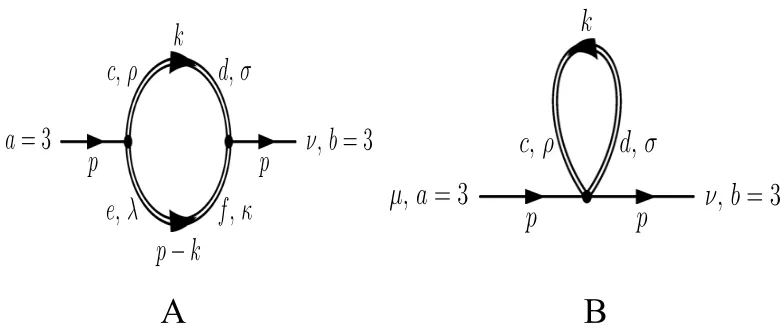
Figure 1. The two diagrams potentially contributing to the one-loop polarisation tensor ofγ. Double lines associate withV±propagation, a single line withγ.
is, an electric-magnetically dual interpretation of electromagnetism based on SU(2)CMB is in order2.
Thus SU(2)CMBpredicts the existence of electric rather than magnetic monopoles. These monopoles,
however, are never resolved in the effective theory: they collectively contribute to the alteration of conventional, thermal photon propagation.
3 Polarisation tensor of the thermal photon
Here we review briefly how (anti)screening effects due to interaction with the vector modesV± in-fluence the propagation properties of the photonγin SU(2)CMB. There are two invariantsG(p0, p,T) andF(p0, p,T) which modify the respective dispersion laws for tranverse and longitudinal3 photon propagation of four momentum (p0, p) in a thermal plasma containingγandV±. Collectively, inter-action ofγwithV±in the effective theory summarises screening and antiscreening effects the photon experiences due to the presence ofunresolvedelectric monopoles induced into the thermal ground-state estimate by effective radiative corrections [5]. On a fundamental level, induction of monopole constituents is a consequence of transient holonomy shifts in (anti)calorons [19–22] due to their in-teraction with the propagating sector. Depending on the acquired holonomy, induced monopole-antimonopole pairs either attract one another (small holonomy), leading to annihilation, or, rarely, their repulsion (large holonomy) causes the (anti)caloron to dissociate into these constituents which then are subject to screening by other (anti)monopoles. We have argued and shown in [13, 23, 24] that due to a large hierarchy in radiative corrections with increasing loop order it is sufficient for practical purposes to computeγ’s polarisation tensorΠμνon the one-loop level.
In unitary-Coulomb gauge kinematic constraints allow only diagram B in Fig. 1 to contribute to
Πμν. For screening functionGthe following gap equation arises [23, 25]:
2The Bianchi identities of the conventional theory are not violated since the vector modesV±of SU(2)CMB, which are of magnetic charge in the real world, practically do not couple to the photon at electric field strengths prevailing in atoms and molecules and also for macroscopic electric field strengths, see discussion in [18].
3On tree level, there is no longitudinal polarisation, but magnetic charge density waves are generated radiatively in the
0.00 0.05 0.10 0.15 0.20 0.25 0.30 0.35 0.000 0.002 0.004 0.006 0.008 0.010
0.00 0.05 0.10 0.15 0.20 0.25 0.30 0.000 0.002 0.004 0.006 0.008
I/T3
Y
T = 8.2 K
T = 10.9 K
(a) (b)
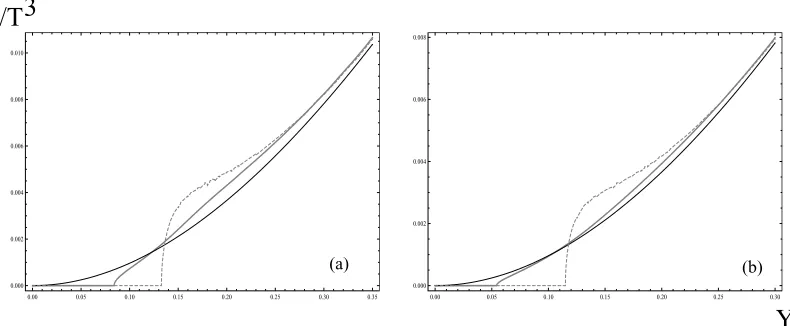
Figure 2. Plots of the results for the dimensionless spectral energy density I
T3obtained in the one-loop
selfcon-sistent calculation (solid grey curves) and with the approximationp2 =0 (dashed grey curves) for (a)T =3T c
and (b)T = 4Tc. Here Y ≡ p0T. Solid black curves depict the conventional Rayleigh-Jeans spectrum. Note
the much faster approach with rising temperature to the low-frequency Planck spectrum in the selfconsistent one-loop result in comparison with the approximate calculation.
G
T2 =
Π11 T2 =
Π22 T2 =
= e2
πλ3
d3y
⎛ ⎜⎜⎜⎜⎝−2+ y
2 1 4e2
⎞ ⎟⎟⎟⎟⎠ nB
2πλ−3/2y2+4e2
y2+4e2 , (5)
where the integration over dimensionless variables on the right-hand side is subject to the constraint G T2 λ3 (2π)2 +
λ3/2 π
⎛ ⎜⎜⎜⎜⎜ ⎝±
X2+ G
T2
ρ2+ξ2+4e2−Xξ
⎞ ⎟⎟⎟⎟⎟ ⎠+4e2
≤1. (6)
In (6) cylindrical coordinatesy1 ≡ρcosϕ,y2 ≡ρsinϕ, andy3 =ξwere introduced, and we define X ≡ |Tp|. Similar expressions hold forF’s gap equation [18]. The modification of transverse photon dispersion introduced byGleads to an anomaly in the blackbody spectrum of energy density which is indicated in Fig. 2 [23, 25]. Longitudinal propagation occurs in various low-momentum branches. In [26] we have argued that these incoherent magnetic-field modes can acquire large correlation lengths if temperatureT exhibits an (adiabatically slow) dependence on space. In Sec. 6 this will be shown to happen on cosmological distances associated with a reshift of order unity by induction through the blackbody anomaly in transverse modes. So the longitudinalγsector could provide for emergent cos-mic magnetic fields by virtue of CMB temperature inhomogeneities arising from anomalous thermal photon propagation.
4 CMB low-frequency anomaly and SU(2)
CMBTo make contact with CMB observation it is necessary to fix the Yang-Mills scale or, which is the same,Tcof SU(2)CMBby observation. To this end, we discuss low-frequency observations of the CMB
Arcade 2 is a balloon borne instrument to observe the CMB at very low frequencies (bands at ν = 3,8,10,30,and 90 GHz) by alternating observation of a calibrator black body emitter and the CMB sky. After subtraction of known and well modelled foreground radiance in the sky signal, an adjustment of the calibrator’s temperature such that the two signals null each other yields the temperature of the calibrator as a function of frequency (CMB line temperature). The interesting feature in this data was the detection of a clear excess (statistically significant at the level of five standard deviations) of the CMB line temperatureT(ν) at 3 and 8 GHz. This is expressed by a power-law model [16]
T(ν)=T0+TR
ν ν0
β
. (7)
subject to the following parameter values:T0 =2.725 K (within errors FIRAS’ CMB baseline tem-perature [27]) obtained by a fit to the CMB spectrum at frequencies from 60 GHz to 600 GHz), ν0 = 310 MHz, TR = 24.1±2.1 K, andβ = −2.599±0.036. The claim by the collaboration that this significant low-frequency deviation from a perfect black-body spectrum (T(ν) ≡ const) is not an artefact of galactic foreground subtraction, unlikely is related to an average effect of distant point sources, and that these results confirm the trend seen in earlier radio-frequency data [28–31] appears to rest on solid grounds. In [17] this observational situation was taken as motivation for an unconven-tional explanation of Eq. (7) which, at the same time, determines the value ofTcfor SU(2)CMB.
Roughly speaking, the rise in line temperature can be explained ifγmodes become evanescent at low frequencies due to the onset of the Meissner effect (electric monopoles start to condense into a new ground state atT0). This leads to a re-arrangement of spectral blackbody power at low frequencies: the power of evanescent modes is maximal atν=0 and matches that of propagating photons at a transition frequency which is comparable to the (effective and feeble4) photon mass of about 100 MHz. In SU(2)CMBthis scenario takes place ifTcis slightly belowT0, and, for all practical purposes, one may setTc=T0.
5 CMB large-angle anomalies: WMAP and Planck
Recently released data by the Planck collaboration confirm and strengthen the occurrence of large-angle anomalies in the CMB map of temperature fluctuations [32] which were first noticed based on WMAP data [33–36]. Here are some of them:
• Large-angle suppression ofT T(θ), defined as the product of temperature in two pixels, which are separated by angleθ, averaged over all possible pixel pairs. On angular scalesθ > 60◦ and most notably on the northern ecliptic hemisphere (equatorial plane=plane of the solar system),T T(θ) is significantly smaller than predicted by the Cosmological Standard Model (CSM).
• Low variance of temperature fluctuations in the northern compared to the southern ecliptic hemi-sphere. The variance in the latter essentially agrees with CSM simulations.
• Power asymmetry. There is a plane, again close to the ecliptic, for which the difference between the average amplitude of temperature fluctuations in the northern and southern hemispheres reaches a maximum.
• The CMB ‘cold spot’ — a region of anomalously low temperature. The cold spot is detected by an estimation of the kurtosis of the distribution of temperature values in its surroundings, indicating a local violation of Gaussianity.
• Significant alignment of the CMB quadrupole with the octupole.
4In [17] it was assumed that monopole condensation atT
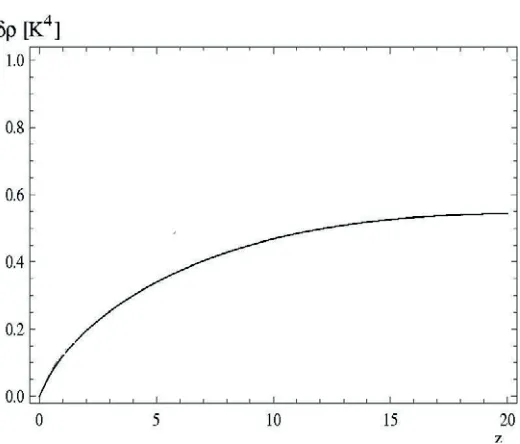
Figure 3. The differenceδρ in energy densities of theγ part in SU(2)CMBand of thermal photons in the
conventional U(1) theory for photon propagation as a function ofz≡T/T0−1.
• Hemispherical antisymmetry. Temperature fluctuations in pixels that are related by mirror-reflection about a plane, whose normal is misaligned with the cold-spot direction by about 42◦, tend to be the negative of one another.
A dipolar modulation model [37], which assumes a statistically isotropic CMB sky to be multiplica-tively influenced by a vectorp, mimicks the actual CMB sky realistically [32].
6 Dynamical breaking of the CMB’s statistical isotropy by SU(2)
CMBTo discuss how SU(2)CMBcould explain the CMB large-angle anomalies it is important to consider the
differenceδρin energy densities, given by the respective spectral integrals, of theγpart in SU(2)CMB
and of thermal photons in the conventional U(1) theory for photon propagation, see Fig.2, as a func-tion ofT. Fig. 3 depictsδρ(T). Note that functionδρexhibitspositiveslope which is maximal atTc. In propagating the CMB from decoupling at redshiftz ∼1100 to today (z =0) its thermal photons should stream freely according to conventional theory modulo effects induced by nonlinear growth of matter structure (gravitational lensing, integrated Sachs-Wolfe) and re-ionised interstellar hydro-gen/stellar plasmas (Sunyaev-Zeldovich). Disregarding these small effects, observed CMB tempera-ture fluctuationsδTshould be determined (i) by initial conditions, transferred from those of the matter sector through linear theory, and (ii) baryonic acoustic oscillations (BAO), influencing the CMB dur-ing decoupldur-ing. Note that angular fluctuationsδT are projections along lines of sights through 3D temperature distributionsΔT(z, x) for redshiftsz.
are:kB==c=1)
Pz(ΔT)= exp
−ρ( ¯T+ΔT)ΔV ¯ T
∞
T0 dT exp
−ρ(T)ΔV ¯ T
, (8)
where now redshiftzrelates to the average CMB temperature ¯T asz = TT¯
0 −1. Note that since the
Silk cutofffor BAO translates today into a spatial scale equal to a typical galaxy diameter and because the energy density of today’s CMB isρU(1) ∼ π
2
15T 4 0 = π
2
15(11.9 cm−
1)4the magnitude of the exponents
in Eq. (8) is very large such that two very small numbers appear in the numerator and denominator definingPz(ΔT). The factorFzto bias temperature fluctuationsΔT for SU(2) effects in cooling down the CMB by cosmological redshift should be the probability forΔT to occur in volume elementΔV in SU(2)CMBnormalized to the according U(1) probability5:
Fz(ΔT)= Pz,SU(2)(ΔT) Pz,U(1)(ΔT)
∝exp
−δρ( ¯T + Δ¯ T)ΔV
T
. (9)
Sinceδρhas positive slope, which vanishes, however, in a powerlike way for ¯T → ∞(see Fig. (3)),
negativefluctuationsΔT are for 0 ≤ z ≤ 1 significantly favoured over positive ones (Fz(−|ΔT|) > Fz(|ΔT|)) by prescribing
ΔT →Fz(ΔT)ΔT. (10)
If the propagation of the CMB toz=0 is performed in Fourier space then the multiplication of (10) turns into a convolution operation.
What are the implications? If by primordial chanceΔTxis negative within a given volume element
ΔVx (xdenoting a co-moving location at the center of ΔVx) at a redshift z ∼ 1 then the biasing of (10) strengthens this trend. That is, a local dip in temperature becomes deeper and, in going to lower redshift, broader due to the free-streaming part of the CMB photon spectrum cooling offthe region contained in the forward light cone ofx. This leads to the emergence of cold regions of extent z∼1, their centers representing the locations of exceptionally negative, primordial seed fluctuations
ΔTx. Observation of the CMB from a present position at the slope of one of these cold regions or temperature depressions faces a preferred direction: the local gradient p of such a temperature depression. Statistical isotropy thus is broken locally by SU(2)CMBthermodynamics. It is clear that
performing projections along and counter to the direction ofpyields maximally asymmetric results: In the former case more unbiased fluctuations contribute, because the distance to the edge of the depression is small, and a variance asymmetry is expected as a consequence. Also, a dynamical contribution to the CMB dipole arises from the difference of these extremal projections while a cold spot emerges from their average. Becausepemerges forz<1 it is clear that primordial fluctuations on large angular scales are most affected by the build-up of an observable temperature depression: this process suppresses the temperature-temperature correlation function for large angles, and it aligns low multipoles.
5In CMB simulations fluctuationΔTis determined nonthermally in terms of Gaussian initial conditions, butP z(ΔT)dT
states how likely an apparent temperature parameter in a region represented by volume elementΔVwould assume values in the range from ¯T+ ΔT−1
2dTto ¯T+ ΔT+ 1
2dTgiven an overall heat reservoir of physical, mean temperature ¯T. So long as there
is no such physical reservoir, which is true of CMB photons after their last scattering if described by conventional U(1) gauge theory but also for SU(2)CMBphotons if ¯TT0,Pz(ΔT) is an invalid concept. This is accomodated by the cancelation to unity
between SU(2)CMBand U(1) in the definition ofFz(ΔT) in Eq. (9). However, for ¯Tlarger but comparable toT0the thermal
ground state of SU(2)CMBand the thermal ensemble ofV±modes couple toγand thus commonly act as a heat reservoir. In the
ratioFz(ΔT) ofPz(ΔT) for SU(2)CMBand U(1) the U(1) part in SU(2)CMBstill cancels. This part is due to non-Rayleigh-Jeans
7 Cosmic neutrinos
Let us finally address an interesting match of the non-photonic number of relativistic degrees of free-dom extracted from the high-lpart of the angular power spectrum associated with the Planck data: [38] reports a numberNeffof neutrino flavours asNeff=3.30±0.27. Interestingly, this implies a num-ber of about six relativistic degrees of freedom at CMB decoupling which is a near match to those represented byV±of SU(2)CMB: three relativistic polarisations in each of the two vector species. Note
that already for ¯T not much larger thanT0=Tc, the ratioRof the (common) mass ofV±to ¯Tis given as
R=mV± ¯ T =2e
|φ|
¯
T =
√
108π2λ−c3/2
λ λc
−3/2
. (11)
Forλλ
c =2,10,1100 one hasR=0.702,0.063,5.4×10
−5, respectively, and thusV±describe relativistic degrees of freedom already at moderate redshifts and certainly so during CMB decoupling. But if dur-ing CMB decoupldur-ing the vector modesV±of SU(2)CMBactually play the role conventionally attributed
to neutrinos then how do the latter vanish from the spectrum of relativistic degrees of freedom? In [39, 40] we have proposed that neutrinos could be single, that is, non-selfintersecting center-vortex loops6 (zero selfintersection number,N = 0) in the confining phases of pure SU(2) gauge theories whose Yang-Mills scales match the masses of charged leptons. Due to the absence of an explicit mass scale in the sector withN=0 and void of interactions with an environment a single vortex loop would shrink to a round point [40] of zero mass and vanishing electric/magnetic multipoles. However, cos-mic neutrinos do interact with an environment, the CMB, over long time scales. Already at moderate temperatures, the only CMB mass scale is ¯T, and thus we expect that neutrino masses are given as mν=ξT¯whereξis a dimensionless factor of order unity macroscopically parametrising the effect of the CMB on the mass of a center-vortex loop.
Is this compatible with neutrino oscillations physics? The strongest bound of 8×10⁻³eV on neutrino mass scales comes from solar neutrino oscillations [41]. SinceT0=2.35×10⁻⁴eV this bound leads to the constraintξ≤30. But already for values ofξmoderately larger than unity neutrinos would behave like matter rather than radiation, see Fig. 4. Note that in this scenario CMB and neutrino fluids are no longer separately conserved. In CMB simulationsξshould be included as a new fit parameter, and we expect a small, (luke-)warm contribution to dark matter to be mimicked by the neutrino sector during decoupling which should have an influence on BAO. Since the here-discussed scenario assumes that a thermal neutrino mass emerges by feeble interactions with the CMB the comparatively very local freeze-out physics at the onset of big-bang nucleosynthesis, where relative neutron and proton number densities are fixed by the equality of their conversion rate and the rate of expansion of the Universe, is not influenced: thermal masses of cosmic neutrino are induced after the fact, that is, only after their decoupling from matter.
8 Summary and conclusion
In this talk we have briefly reviewed the nonperturbative physics leading to the emergence of a thermal ground state in the deconfining phase of an SU(2) Yang-Mills theory, and we have discussed why the gauge symmetry breaking SU(2)→ U(1), dynamically induced by this ground state – collectively representing calorons and anticalorons of topological charge modulus unity –, is commensurate with the postulate that photon propagation is fundamentally described by an SU(2) rather than a U(1)
6A closed chain of nearly massless monopoles and antimonopoles, which, due to an electric-magnetically dual
0 2 4 6 8 10 0
1 2 3 4
ω
κν
ξ
ν
| |
Figure 4. The modulus ofκν inρ(a) = ρ0aκν (solid line), whereρ, adenote energy density, scale factor,
respectively (a0 ≡1), andωνinp=ωνρ(dashed line), wherepdenotes pressure, as functions ofξfor cosmic
neutrinos if the latter are assumed to be single center-vortex loops of pure SU(2) gauge theories in their confining phases. In this model, neutrinos would exhibit a CMB induced massmν=ξT¯.
gauge principle, see also [42]. In this context, explanations of a low-frequency anomaly in CMB line temperature [16] and recently confirmed [32] large-angle anomalies in the temperature fluctuations of the CMB sky are proposed which entail a re-interpretation of the number of relativistic degrees of freedom during CMB decoupling.
Acknowledgments
We would like to acknowledge useful conversations with James Annis and Markus Schwarz.
References
[1] D. J. Gross and F. Wilczek,Phys. Rev. Lett.30, 1343 (1973). [2] H. D. Politzer,Phys. Rev. Lett.30, 1346 (1973).
[3] A. D. Linde,Phys. Lett. B96, 289 (1980).
[4] J. Engels, F. Karsch, and T. Scheideler,Nucl. Phys. B564, 302 (1999). [5] J. Ludescheret al,Annalen. d. Physik19, 102 (2010).
[6] H. M. Fried, Y. Gabellini, and T. Grandou,Annals Phys.338, 107 (2013).
[7] R. Hofmann,Int. J. Mod. Phys. A20, 4123 (2005);Erratum-ibid. A21, 6515 (2006). [8] P. Hasenfratz and F. Niedermayer,Nucl. Phys. B414, 785 (1994).
[9] U. Herbst and R. Hofmann,ISRN High Energy Physics2012, Article ID 373121 (2012). [10] B. J. Harrington and H. K. Shepard,Phys. Rev. D17, 2122 (1977).
[11] R. Hofmann,AIP Conf. Proc.1479, 549 (2012).
[13] R. Hofmann, Braz. J. Phys.42, 110 (2012).
[14] N. Krasowski and R. Hofmann, arXiv: 1301.4716 (2013). [15] S. J. Brodsky and P. Hoyer,Phys. Rev. D83, 045026 (2011). [16] D. J. Fixsenet al,Astrophys. J.734, 5 (2011).
[17] R. Hofmann,Ann. d. Phys.18, 634 (2009).
[18] C. Falquez, R. Hofmann, and T. Baumbach,Ann. d. Phys.522, 904 (2010).
[19] W. Nahm, inMonopoles in Quantum Field Teory, ed. N. Craigieet al. (World Scientific, Singa-pore), p. 87 (1982),
W. Nahm, inTrieste Group Theor. Method 1983, p. 189 (1983). W. Nahm, CERN preprint TH-3172, (1981).
[20] K. Lee and C. Lu,Phys. Rev. D58, 025011-1 (1998). [21] T. C. Kraan and P. Van Baal,Phys. Lett. B428, 268 (1998),
T. C. Kraan and P. Van Baal,Nucl. Phys. B533, 627 (1998). [22] D. Diakonovet al,Phys. Rev. D70, 036003 (2004).
[23] M. Schwarz, R. Hofmann, and F. Giacosa,Int. J. Mod. Phys. A22, 1213 (2007). [24] D. Kaviani and R. Hofmann,Mod. Phys. Lett. A22, 2343 (2007). on the one-loop level. [25] J. Ludescher and R. Hofmann,Annalen d. Physik18, 271 (2009).
[26] C. Falquez, R. Hofmann, and T. Baumbach,Quant. Matt.1, 153 (2012). [27] J. C. Matheret al,Astrophys. J.420, 439 (1994).
[28] R. S. Rogeret al,Astron.&Astrophys. Suppl. Ser.137, 7 (1999). [29] K. Maedaet al140, 145 (1999).
[30] C. G. T. Haslam,Astron.&Astrophys.100, 209 (1981).
[31] P. Reich and W. Reich,Astron.&Astrophys. Suppl. Ser.63, 205 (1986). [32] P. A. R. Adeet al, arXiv: 1305.5083.
[33] M. Tegmark, A. de Oliveira-Costa, and A. J. Hamilton,Phys. Rev. D68, 123523 (2003). [34] A. de Oliveira-Costaet al,Phys. Rev. D69, 063516 (2004).
[35] C. J. Copiet al,Mon. Not. R. Astron. Soc.367, 79 (2006). [36] P. Vielva,Adv. Astron.2010, Article ID 592094 (2010).
[37] C. Gordon, W. Huterer, and T. Crawford,Phys. Rev. D72, 103002 (2005). [38] P. A. R. Adeet al, arXiv: 1305.5076.
[39] F. Giacosa, and R. Hofmann,Eur. Phys. J. C50, 635 (2007).
[40] J. Moosmann and R. Hofmann,ISRN Mathematical Physics2012, Article ID 236783 (2012). [41] M. Maltoniet al,New J. Phys.6, 122 (2004).